More news trickles in via BBC and other sources in the aftermath of Roh's funeral and cremation. Currently, Roh's ashes are temporarily interred at his hometown, while the family decides on a worthy permanent resting place for him. Meanwhile, over 5 million people were known to have paid their respects to Roh at official altars, including many outside South Korea, including a few hundred people in major US cities. (Of course, as Roh was completely despised among Korean-Americans, I was surprised that anyone actually paid respects stateside.)
Analysis comes in in the form of what the South Korean people will make out of Roh's legacy, and it appears that a consensus is forming. Many believed that 2MB's prosecution of Roh's corruption charges was politically motivated, and now that Roh is dead, there will be serious backlash against 2MB. (In fact, when 2MB paid respects to Roh's coffin, he got many boos.) Many prominent people are giving opinions that Roh's ideals of bringing unity to the South Korean society, and opportunity to its working class, are to be revered - even if Roh did not exactly do a good job of carrying out those ideals himself - and that 2MB's policies have served to really fracture and divide the South Korean society.
Based on my observations in Seoul, and based on what other Americans on long-term assignments in South Korea have shared with me, I am very well convinced that the 2MB presidency is all about taking South Korea several decades back, into outright oppression and outdated McCarthyism. Even stateside, I have paid for this - in the form of all the false rumors about my own current President, and in the form of Proposition 8 in California. If Roh's death finally spurs the better South Koreans to take a firmer stand to defend their democracy, restore South Korea's rule of law (and sovereignty), and ensure that their taxes are spent on themselves rather than far-right special interest groups stateside, then South Korea will end up doing a huge favor to itself and all the freedom-loving people of the world, like it did before through its democratic struggle.
Thanks to regulations which require a current South Korean resident registration to apply for memberships at South Korean websites, I am not able to join pro-democracy groups, much less contribute to them. But I do want to help out with this new phase of democratic progress in any way or capacity I can.
Of course, the fresh round of very raw belligerence from Pyongyang complicates things further. But I've read the analyses on this as well, and nothing is unpredictable. North Korea must remember that any hardline actions on its part will only serve to legitimize the 2MB rule that it detests so much, and more importantly, they go completely against its rhetoric of serving the entire Korean race. 2MB must also remember that his policies have, in turn, have legitimized the North's belligerent actions. If the Confucian model of diplomacy, long held standard in the region, is to be put into action again, South Korea must be able to take the high road as the more mature, more affluent of the two regimes, and treat North Korea as any mature older brother would treat a younger, impoverished brother throwing temper tantrums. (Read: a good mix of sticks and carrots.) And most importantly, I do hope for good decisions stateside as well; while open hostilities will certainly result in more income for the US defense contractors, the US will more than pay for it with massive loss of goodwill, and must do everything it can to broker permanent peace. A new war in Korea is certainly bad news for China and Japan as well - and definitely extremely bad news for the world economy.
Many people in the US and around the world have pointed out to South Korea as a role model to look up to when it comes to people-powered democracy. It's time for that reputation to be upheld - and to hopefully spark other democratic movements around the world, including the US. (The Obama Presidency was only just setting the stage - the people now MUST speak up and tell Obama what to do.) This is a time of crisis, but if handled correctly, the results will be more than worth it. Even for me, I'll be happy once the circumstances change to the point where the Korean-American community will have to choose between changing and becoming irrelevant.
30 May 2009
28 May 2009
Adios, El Salvador del Norte
Maybe I need to leave California sooner than I thought. As in, weeks rather than years.
I came back from Canada to the knowledge that I do not have full civil rights in California anymore. That's one thing - and I actually expected Prop 8 to be upheld. However, now I am out of a livelihood as well, as I've been barred from entry to a military base where my company has several contracts. All of this happened on basis of false witness from the civilian uneducated theocratic thugs staffing the passes office for the base - that I was a "threat" to them. Never mind that bearing false witness is a direct violation of Article 9 of the California Constitution (I now consider the Biblical Ten Commandments as the only Constitution that applies to California, knowing how much of a theocracy that it is).
I still have my company and job, but I will need to be working in exile, and have my representatives actually supervise the job sites. At this point, I think I can do everything by email, and it makes no point to remain in the Third World theocratic hellhole known as California.
I'll now plot my move as to where I'm heading next. I've been thinking of a move "on paper," setting up a Nevada address at, say, some dirt-cheap shack in Las Vegas which I could use for my driver's license and car registration. I may actually have to act on it, though I don't consider Las Vegas, great as it is, to be a worthy hometown. For a permanent hometown, I'll need a cultured, well-educated place with a government that works well and is a good value for the taxes I'm expected to pay. Nevada is certainly good value (the state has enough gambling revenues that it doesn't need to tax me much, if at all), but it's certainly not the most educated, and there are Mormon theocrats galore outside the Vegas Strip. The Pacific Northwest, most of the Northeast, and the Chicago area come across my mind as acceptable destinations.
Of course, if I keep running my business long enough to build assets and move into some other opportunities, then my dependence on the US Department of Defense will not be so total. At that point, I'll seriously consider a Canadian entrepreneur or investor visa option. I do not wish to give up on the US, but I do want to add Canada as a second home country, and benefit from its higher standard of living and more enlightened mindsets. Comparing the constructive Canadian immigration system to the destructive US system, I know that Canada is more of "a nation of immigrants" than the US ever was, and if I have something nice to offer to my new hosts of the Canadian society, I will gladly do so. I'll start working more closely with my Canadian contacts to see how I can fit into their society.
In any case, between the anti-business far left and the anti-civil rights far right, both too busy sucking up to the nonwhite theocrats to get anything meaningful done, California is a lost cause. There is no reason for me to be in California anymore, when my means of making a living can easily be taken away at the whims of a theocratic thug. California is now doomed to decay into a pathetic state where nothing meaningful can ever be done and poverty become rampant, much like the Central American homelands of Guatemala, El Salvador, and Nicaragua where many Californians indeed hail from. I hope the saner states and nations take a clue from California, and prevent their own jurisdictions from meeting the same fate.
I came back from Canada to the knowledge that I do not have full civil rights in California anymore. That's one thing - and I actually expected Prop 8 to be upheld. However, now I am out of a livelihood as well, as I've been barred from entry to a military base where my company has several contracts. All of this happened on basis of false witness from the civilian uneducated theocratic thugs staffing the passes office for the base - that I was a "threat" to them. Never mind that bearing false witness is a direct violation of Article 9 of the California Constitution (I now consider the Biblical Ten Commandments as the only Constitution that applies to California, knowing how much of a theocracy that it is).
I still have my company and job, but I will need to be working in exile, and have my representatives actually supervise the job sites. At this point, I think I can do everything by email, and it makes no point to remain in the Third World theocratic hellhole known as California.
I'll now plot my move as to where I'm heading next. I've been thinking of a move "on paper," setting up a Nevada address at, say, some dirt-cheap shack in Las Vegas which I could use for my driver's license and car registration. I may actually have to act on it, though I don't consider Las Vegas, great as it is, to be a worthy hometown. For a permanent hometown, I'll need a cultured, well-educated place with a government that works well and is a good value for the taxes I'm expected to pay. Nevada is certainly good value (the state has enough gambling revenues that it doesn't need to tax me much, if at all), but it's certainly not the most educated, and there are Mormon theocrats galore outside the Vegas Strip. The Pacific Northwest, most of the Northeast, and the Chicago area come across my mind as acceptable destinations.
Of course, if I keep running my business long enough to build assets and move into some other opportunities, then my dependence on the US Department of Defense will not be so total. At that point, I'll seriously consider a Canadian entrepreneur or investor visa option. I do not wish to give up on the US, but I do want to add Canada as a second home country, and benefit from its higher standard of living and more enlightened mindsets. Comparing the constructive Canadian immigration system to the destructive US system, I know that Canada is more of "a nation of immigrants" than the US ever was, and if I have something nice to offer to my new hosts of the Canadian society, I will gladly do so. I'll start working more closely with my Canadian contacts to see how I can fit into their society.
In any case, between the anti-business far left and the anti-civil rights far right, both too busy sucking up to the nonwhite theocrats to get anything meaningful done, California is a lost cause. There is no reason for me to be in California anymore, when my means of making a living can easily be taken away at the whims of a theocratic thug. California is now doomed to decay into a pathetic state where nothing meaningful can ever be done and poverty become rampant, much like the Central American homelands of Guatemala, El Salvador, and Nicaragua where many Californians indeed hail from. I hope the saner states and nations take a clue from California, and prevent their own jurisdictions from meeting the same fate.

Funeral of ex-President
South Korea's Roh Moo-hyun that is. He committed suicide last week, and I got the news during my sightseeing in Toronto. Right now, the funeral live stream is being piped into my room, straight from the familiar grounds of Seoul's Gyeongbok Palace. (After all the months spent in Seoul and my frustration with the uneducated theocrats of Los Angeles, I now list Seoul as my hometown on Facebook, and sincerely do feel that way.) The funeral is being held as a "national funeral" appropriate for a former President, with invocations from all major South Korean religious traditions. (Roh was agnostic - something the Korean-Americans found unacceptable.)
During Roh's political career, there were too many scandals and verbal gaffes floating around - and Roh was an extremely unpopular figure. He wasn't too competent a leader either; his education never went beyond high school, and his bar license was obtained through self-study in the 1970s. The right hated him for his unchecked unconditional aids to North Korea, and the left hated him for backstabbing them through sending South Korean troops to Iraq and negotiating a free trade agreement with the US (the free trade agreement that's never mentioned in the US). Roh's unpopularity was a key contributing factor to the current presidency of far-right Lee Myung-bak (2MB). (I certainly do NOT like seeing him - especially as he entered the funeral grounds in his BMW.)
But now that Roh is gone, a more complex portrait of the man is emerging. During the 1987 democratic revolution that brought real democracy to South Korea, Roh was a key member of the pro-democracy movement in Busan. In 1988 he entered politics as a National Assemblyman, and took key part in prosecuting ex-Presidents Chun Doo-hwan and Roh Tae-woo (unrelated) for their 1979 military coup and 1980 civilian massacre. And when his ambitions turned presidential in 2002, he promised to take South Korean democracy into a new era and mentality. Of course, walking across the DMZ, then doing the most historic road trip ever in Korean history - a drive to Pyongyang - was noted by the entire world.
The legacy is complex. Roh was proof that power tends to corrupt even well-meaning individuals of modest backgrounds. (If power didn't corrupt, maybe those communist revolutions of the 20th Century may actually have succeeded, and Hugo Chavez of Venezuela wouldn't be such an a-hole either.) I am still well convinced that he did not offer much substance to the people he ruled. However, he did leave a legacy, and the South Korean democratic struggle cannot be discussed without Roh. In his death, that may be what Roh may leave the people of South Korea with - a continued call for democracy that keeps the power grab of the current government in check, and also ensures that 2MB will serve his subjects rather than US-based far-right special interests.
And bringing the focus back to the US, the fact that President Obama is not fulfilling his campaign promises - something angrily noted by many liberals including many of my friends - needs to be put into perspective. Obama must serve many different interests, including conservative nonwhite theocrats of California, the large defense contractors, and more. All those special interest demands will eventually corrupt even the best of his intentions, and unfortunately that is to be expected. I also don't want Obama to have sweeping powers to change things overnight either; a too-powerful President, even a "good" one, is always dangerous, as well demonstrated by W. I no longer consider myself an enthusiastic Obama supporter, and while he listens a bit more than W, I'll just put it at that, and keep pressuring for not only change from Obama himself, but from the American society at large. (Honestly, I find the ethnic theocracy of California to be hopeless... I need to leave. Next post will talk about that.)
I am more than happy to share my observations of South Korean society and politics with Americans and other good people of the world (I'm especially having great exchanges with other Americans with significant South Korean time under their belt - and we all agree that 2MB has been going too far), in hopes that all the nations involved will have better governments and societies in the long run.
During Roh's political career, there were too many scandals and verbal gaffes floating around - and Roh was an extremely unpopular figure. He wasn't too competent a leader either; his education never went beyond high school, and his bar license was obtained through self-study in the 1970s. The right hated him for his unchecked unconditional aids to North Korea, and the left hated him for backstabbing them through sending South Korean troops to Iraq and negotiating a free trade agreement with the US (the free trade agreement that's never mentioned in the US). Roh's unpopularity was a key contributing factor to the current presidency of far-right Lee Myung-bak (2MB). (I certainly do NOT like seeing him - especially as he entered the funeral grounds in his BMW.)
But now that Roh is gone, a more complex portrait of the man is emerging. During the 1987 democratic revolution that brought real democracy to South Korea, Roh was a key member of the pro-democracy movement in Busan. In 1988 he entered politics as a National Assemblyman, and took key part in prosecuting ex-Presidents Chun Doo-hwan and Roh Tae-woo (unrelated) for their 1979 military coup and 1980 civilian massacre. And when his ambitions turned presidential in 2002, he promised to take South Korean democracy into a new era and mentality. Of course, walking across the DMZ, then doing the most historic road trip ever in Korean history - a drive to Pyongyang - was noted by the entire world.
The legacy is complex. Roh was proof that power tends to corrupt even well-meaning individuals of modest backgrounds. (If power didn't corrupt, maybe those communist revolutions of the 20th Century may actually have succeeded, and Hugo Chavez of Venezuela wouldn't be such an a-hole either.) I am still well convinced that he did not offer much substance to the people he ruled. However, he did leave a legacy, and the South Korean democratic struggle cannot be discussed without Roh. In his death, that may be what Roh may leave the people of South Korea with - a continued call for democracy that keeps the power grab of the current government in check, and also ensures that 2MB will serve his subjects rather than US-based far-right special interests.
And bringing the focus back to the US, the fact that President Obama is not fulfilling his campaign promises - something angrily noted by many liberals including many of my friends - needs to be put into perspective. Obama must serve many different interests, including conservative nonwhite theocrats of California, the large defense contractors, and more. All those special interest demands will eventually corrupt even the best of his intentions, and unfortunately that is to be expected. I also don't want Obama to have sweeping powers to change things overnight either; a too-powerful President, even a "good" one, is always dangerous, as well demonstrated by W. I no longer consider myself an enthusiastic Obama supporter, and while he listens a bit more than W, I'll just put it at that, and keep pressuring for not only change from Obama himself, but from the American society at large. (Honestly, I find the ethnic theocracy of California to be hopeless... I need to leave. Next post will talk about that.)
I am more than happy to share my observations of South Korean society and politics with Americans and other good people of the world (I'm especially having great exchanges with other Americans with significant South Korean time under their belt - and we all agree that 2MB has been going too far), in hopes that all the nations involved will have better governments and societies in the long run.
26 May 2009
Toronto: Wrapping Up
A bit overdue - photos from my final Toronto day. I will certainly miss Canada's largest city - though if I were to move to Canada, I'd still pick Vancouver as my hometown.
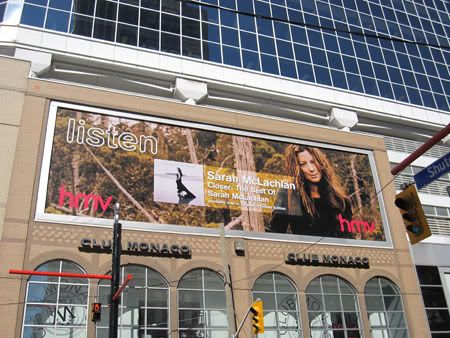 Starting out at Eaton Centre again. I took another photo of the billboards, this time concentrating on Sarah McLachlan. That is the best photo of her I've seen in a long time, if ever. Thanks to the likes of McLachlan, Canadian musicians - and women rockers around the world - have a level ground to compete on.
There is a somewhat pricey diner below this sign - selling eggs-oriented breakfast, lunch, and dinner. It appeared to be part of a national chain as well. I ended up having a late breakfast there.
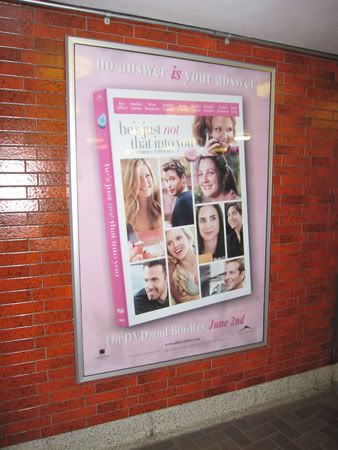 I am in the subway, in order to reach Casa Loma. And I see that on June 2nd, I will be able to buy a DVD of He's Just Not That Into You, with an all-star cast including my favorite Greek Goddess, Jennifer Aniston.
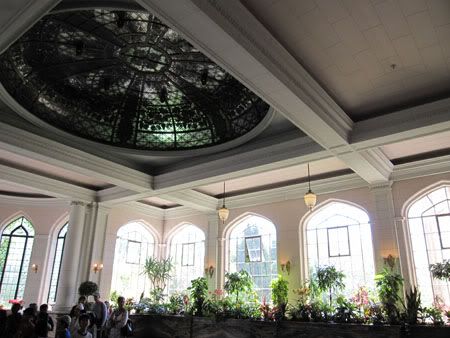 I have reached Casa Loma, the largest residence in Canada. It was the residence of Sir Henry Pallatt, who made a fortune developing hydroelectric power on the Niagara River, and was influential in the economic development of the Toronto area and early Canada as a whole. While such mansions are common in the US, where showing off one's wealth is considered the reward of one's hard work, Casa Loma is one of a kind in Canada. Casa Loma feels a lot like California's Hearst Castle in many ways.
Pallatt lived here until 1924, when business overexpansion drove him into debt, and the loss of his hydroelectric power monopoly forced him to liquidate everything he owned. The Kiwanis Club has maintained the mansion as a tourist attraction since 1937, slowly but steadily restoring many of the sections.
This photo shows the indoor conservatory. Pallatt and his wife were renowned horticulturists, I was told.
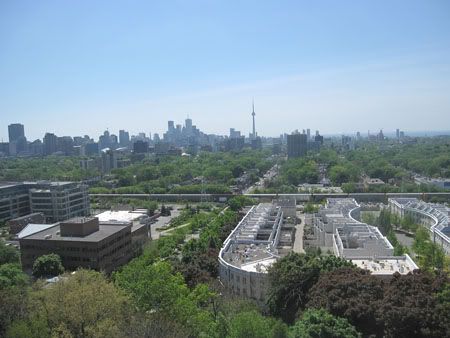 Climbing up the narrow spiral staircase, I have reached the highest level in the mansion tower, with this great look at the city skyline. A lot of bricks were covered with tourist graffiti - some in Asian scripts!
Those row houses in front, which I had passed to get here, felt very British in character. One of these days, I need to get back to England, and really expand my reach well beyond London. Maybe beyond England and into other parts of the UK.
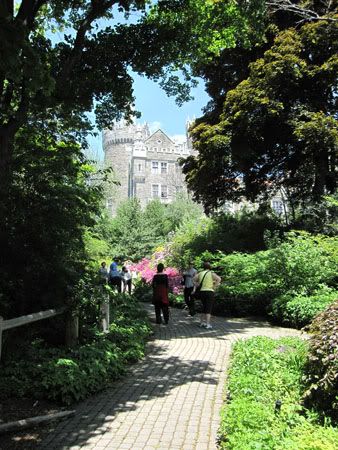 The outdoors garden, open from May to October, is also a gem.
It's starting to get a bit warm again, even though forecasts called for the day's high temperature to be just 19 degrees Celsius. I am again wearing my trusty tights and boots, topping them off with a dress-shaped floral tunic featuring poet's 3/4 sleeves (a very popular look during my teeny bopper years) and a black trench coat. My makeup is also a bit heavier than usual, especially with the eye pencil, and I am feeling a teeny bopper spirit inside my 33-year-old body.
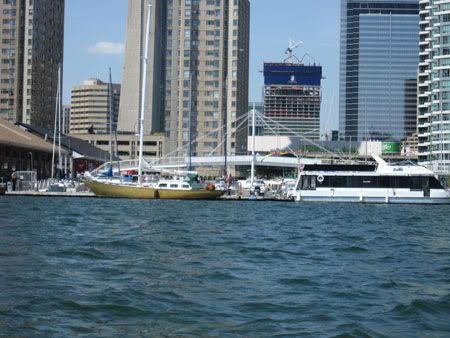 I proceeded to the harbour, where my real age started to catch up with me. My left foot was starting to hurt, as if I had fractured a bone! Walking became very challenging.
I decided to do a touristy harbour boat tour, shellling out $27. That got me an hour in a boat with a guide to explain the various sights, with an option to get off at Toronto Islands and explore.
Here is an interesting sight. This bridge came from an Amsterdam canal, as a gift of the Dutch Royal Family who had been based in Toronto during World War II. The last thing I need right now is a reminder of my past travel hellhole with way too many parallels to the California ethnic theocracy.
Other waterfront sights include former industrial warehouses turned into art galleries, as well as Rogers Centre, the home of Toronto Blue Jays and formerly known as the Skydome. Rogers is one of the three major players of Canada's cell phone industry (Bell Canada and Telus are the other two), and all AT&T phones - including my iPhone - use Rogers when roaming in Canada.
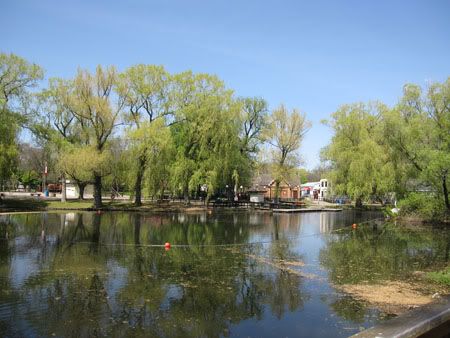 I landed at Centre Island, one of over a dozen islands that make up the Toronto Islands, separating the harbour from Lake Ontario.
The Islands have many features. Some natural sections doubled as the Florida Everglades in a movie - in fact, the CN Tower made a 3-second appearance in Florida in that movie, I was told. There are recreational facilities, including a small amusement park seen above, open daily June-August and weekends May and September. There is even a clothing optional beach on the west side - one of two in Canada - but due to jurisdictional differences, it's legal to be naked on land but illegal to be naked in the water (fine is $65). As the Islands are quite chilly compared to inland, I wouldn't dare get naked here...
The Islands even host an airport, Toronto Island Airport, which hosts Porter Airlines, offering frequent propeller aircraft service to Chicago, New York, and other major cities.
 Due to the foot pain, I decided to return to my hotel for a quick break. Then I added even more eyeliner, changed into that white Aritzia long shirt, topped off with a long suit jacket, and headed back out. Aside from my lack of pants, I could've passed for a Toronto commuter. (Though I was really feeling even more like a teeny bopper this day.)
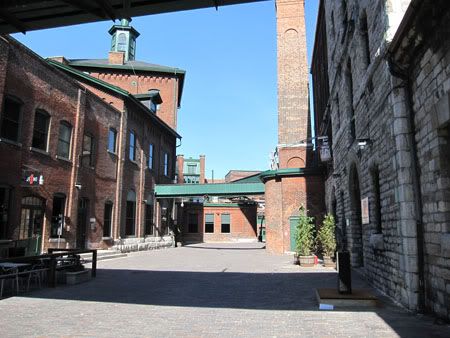
My first destination: the Distillery, a gentrification of a distillery and several other industrial buildings just east of downtown on the waterfront. The gentrification is still ongoing, so not many things to see/do right now. Love the "abandoned factory" ambience, however.
I then headed west on King West, taking a northbound bus (#63) on Shaw so that I could head back east on Queen West. West of Bathurst, Queen West maintains its original rough-and-tumble independent funky vibe, while between Bathurst and Yonge, it feels more corporate and trendy. Again, due to my foot pain, I didn't do much walking. I finished off with a Thai fast food dinner at Eaton Centre, as well as shopping; while I wanted to buy dressy boots as an alternative to my flat suede casual boots (that'd give my "pantsless suit" ensemble a bit more polish), I had no luck, and instead ended up with a Gap black mini, which I kind of needed to replace my worn-out black microminis. Due to Gap's generous sizing, I found that a Size 6 was a good fit.
My journey back to California started after only an hour or two of sleep. I declared only USD $120 worth of purchases to the US customs, who have presence at all major Canadian airports (including Toronto Pearson). The US immigration officer grilled me with a dozen detailed questions, but the questioning was smooth and I cleared US entry formalities without fuss.
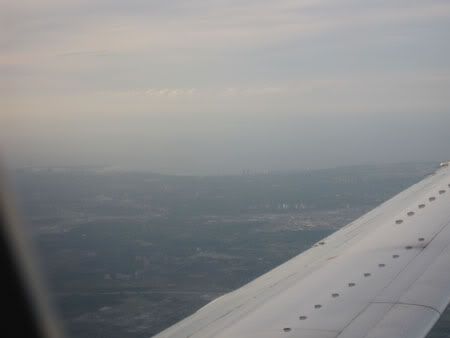 It's now about 7 in the morning. I am on a very old United plane as it leaves Toronto. The left of the shoreline shows the Toronto Harbour as well as faint outlines of the CN Tower and a few other skyscrapers.
This was a very miserable flight due to a very cut-rate purser who had a knack for insulting the passengers' intelligence. If this were my first flight on United Airlines, it would've certainly been my last as well. I usually have far better luck with United's flight crew, both pilots and flight attendants, however.
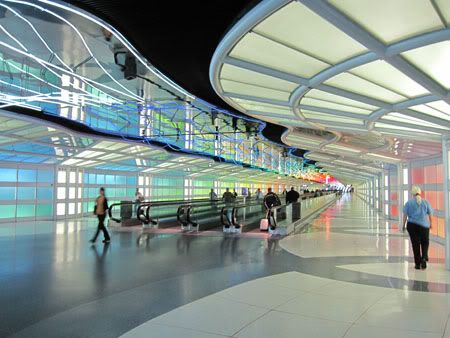 As I had cleared US immigration and customs in Toronto, I was a domestic passenger upon landing at O'Hare Airport in Chicago. This is the underground corridor that links the two main United terminals at O'Hare. Of course, O'Hare is United's home airport, and American also maintains a large presence.
Continuation to Los Angeles was on a newly renovated Boeing 767 aircraft, featuring United's new flat-bed business class and revamped first class. The economy section had seen next to no improvements, however, and I was very unhappy about that. While flying on an airplane in general, and on a United flight in particular, is normally a joyous occasion for me, and usually ends up taking me to a better place than where I leave from, today was certainly NOT one of those days, especially considering that California was reaffirming the ethnic theocrats' greatest contribution to the state politics, the constitutional ban on gay marriage (Proposition 8), as my half-renovated 767 was descending over San Bernardino.
I already miss Canada - especially its constructive approach to immigration (rather that the destructive US approach). I will make sure to visit more often.
Starting out at Eaton Centre again. I took another photo of the billboards, this time concentrating on Sarah McLachlan. That is the best photo of her I've seen in a long time, if ever. Thanks to the likes of McLachlan, Canadian musicians - and women rockers around the world - have a level ground to compete on.There is a somewhat pricey diner below this sign - selling eggs-oriented breakfast, lunch, and dinner. It appeared to be part of a national chain as well. I ended up having a late breakfast there.
I am in the subway, in order to reach Casa Loma. And I see that on June 2nd, I will be able to buy a DVD of He's Just Not That Into You, with an all-star cast including my favorite Greek Goddess, Jennifer Aniston.I have reached Casa Loma, the largest residence in Canada. It was the residence of Sir Henry Pallatt, who made a fortune developing hydroelectric power on the Niagara River, and was influential in the economic development of the Toronto area and early Canada as a whole. While such mansions are common in the US, where showing off one's wealth is considered the reward of one's hard work, Casa Loma is one of a kind in Canada. Casa Loma feels a lot like California's Hearst Castle in many ways.Pallatt lived here until 1924, when business overexpansion drove him into debt, and the loss of his hydroelectric power monopoly forced him to liquidate everything he owned. The Kiwanis Club has maintained the mansion as a tourist attraction since 1937, slowly but steadily restoring many of the sections.
This photo shows the indoor conservatory. Pallatt and his wife were renowned horticulturists, I was told.
Climbing up the narrow spiral staircase, I have reached the highest level in the mansion tower, with this great look at the city skyline. A lot of bricks were covered with tourist graffiti - some in Asian scripts!Those row houses in front, which I had passed to get here, felt very British in character. One of these days, I need to get back to England, and really expand my reach well beyond London. Maybe beyond England and into other parts of the UK.
The outdoors garden, open from May to October, is also a gem.It's starting to get a bit warm again, even though forecasts called for the day's high temperature to be just 19 degrees Celsius. I am again wearing my trusty tights and boots, topping them off with a dress-shaped floral tunic featuring poet's 3/4 sleeves (a very popular look during my teeny bopper years) and a black trench coat. My makeup is also a bit heavier than usual, especially with the eye pencil, and I am feeling a teeny bopper spirit inside my 33-year-old body.
I proceeded to the harbour, where my real age started to catch up with me. My left foot was starting to hurt, as if I had fractured a bone! Walking became very challenging.I decided to do a touristy harbour boat tour, shellling out $27. That got me an hour in a boat with a guide to explain the various sights, with an option to get off at Toronto Islands and explore.
Here is an interesting sight. This bridge came from an Amsterdam canal, as a gift of the Dutch Royal Family who had been based in Toronto during World War II. The last thing I need right now is a reminder of my past travel hellhole with way too many parallels to the California ethnic theocracy.
Other waterfront sights include former industrial warehouses turned into art galleries, as well as Rogers Centre, the home of Toronto Blue Jays and formerly known as the Skydome. Rogers is one of the three major players of Canada's cell phone industry (Bell Canada and Telus are the other two), and all AT&T phones - including my iPhone - use Rogers when roaming in Canada.
I landed at Centre Island, one of over a dozen islands that make up the Toronto Islands, separating the harbour from Lake Ontario.The Islands have many features. Some natural sections doubled as the Florida Everglades in a movie - in fact, the CN Tower made a 3-second appearance in Florida in that movie, I was told. There are recreational facilities, including a small amusement park seen above, open daily June-August and weekends May and September. There is even a clothing optional beach on the west side - one of two in Canada - but due to jurisdictional differences, it's legal to be naked on land but illegal to be naked in the water (fine is $65). As the Islands are quite chilly compared to inland, I wouldn't dare get naked here...
The Islands even host an airport, Toronto Island Airport, which hosts Porter Airlines, offering frequent propeller aircraft service to Chicago, New York, and other major cities.
Due to the foot pain, I decided to return to my hotel for a quick break. Then I added even more eyeliner, changed into that white Aritzia long shirt, topped off with a long suit jacket, and headed back out. Aside from my lack of pants, I could've passed for a Toronto commuter. (Though I was really feeling even more like a teeny bopper this day.)My first destination: the Distillery, a gentrification of a distillery and several other industrial buildings just east of downtown on the waterfront. The gentrification is still ongoing, so not many things to see/do right now. Love the "abandoned factory" ambience, however.
I then headed west on King West, taking a northbound bus (#63) on Shaw so that I could head back east on Queen West. West of Bathurst, Queen West maintains its original rough-and-tumble independent funky vibe, while between Bathurst and Yonge, it feels more corporate and trendy. Again, due to my foot pain, I didn't do much walking. I finished off with a Thai fast food dinner at Eaton Centre, as well as shopping; while I wanted to buy dressy boots as an alternative to my flat suede casual boots (that'd give my "pantsless suit" ensemble a bit more polish), I had no luck, and instead ended up with a Gap black mini, which I kind of needed to replace my worn-out black microminis. Due to Gap's generous sizing, I found that a Size 6 was a good fit.
My journey back to California started after only an hour or two of sleep. I declared only USD $120 worth of purchases to the US customs, who have presence at all major Canadian airports (including Toronto Pearson). The US immigration officer grilled me with a dozen detailed questions, but the questioning was smooth and I cleared US entry formalities without fuss.
It's now about 7 in the morning. I am on a very old United plane as it leaves Toronto. The left of the shoreline shows the Toronto Harbour as well as faint outlines of the CN Tower and a few other skyscrapers.This was a very miserable flight due to a very cut-rate purser who had a knack for insulting the passengers' intelligence. If this were my first flight on United Airlines, it would've certainly been my last as well. I usually have far better luck with United's flight crew, both pilots and flight attendants, however.
As I had cleared US immigration and customs in Toronto, I was a domestic passenger upon landing at O'Hare Airport in Chicago. This is the underground corridor that links the two main United terminals at O'Hare. Of course, O'Hare is United's home airport, and American also maintains a large presence.Continuation to Los Angeles was on a newly renovated Boeing 767 aircraft, featuring United's new flat-bed business class and revamped first class. The economy section had seen next to no improvements, however, and I was very unhappy about that. While flying on an airplane in general, and on a United flight in particular, is normally a joyous occasion for me, and usually ends up taking me to a better place than where I leave from, today was certainly NOT one of those days, especially considering that California was reaffirming the ethnic theocrats' greatest contribution to the state politics, the constitutional ban on gay marriage (Proposition 8), as my half-renovated 767 was descending over San Bernardino.
I already miss Canada - especially its constructive approach to immigration (rather that the destructive US approach). I will make sure to visit more often.
Quick Update
I am no longer in Toronto. My return to Los Angeles today was miserable - partly due to a cut-rate purser on the United flight from Toronto to Chicago, and partly because of the knowledge that instead of flying from a hellhole to a sane place (often the case with my past United flights, especially when flying out of Amsterdam or Indianapolis), I was going the other way. California upheld Proposition 8 just as my flight (a 767 that was only half-refurbished) was descending over San Bernardino; it's definitely a far cry from the Province of Ontario, the first North American jurisdiction to legalize gay marriages.
I wasn't able to do my final blogging in Toronto due to my hotel Internet connection ($12/day) being cut a few hours early. While Pantages was a great hotel with a lot of personality, I'll certainly be looking elsewhere on my next Toronto visit. Instead of taking a cab to downtown ($120 roundtrip after tips), it'll make more sense to rent a car, book a cheaper business hotel (Hilton Garden Inn or similar, with free Internet) close to the airport (possibly the neighboring city of Mississauga), and park the rental car at a park-and-ride lot before taking the subway into downtown Toronto. With a car, I'll also get to other great places in the area - Niagara Falls and the Wine Country, London/Hamilton, and even Ottawa (it'd be a major stretch). Plus, even within Toronto, driving seemed to make some sense in most areas outside the downtown core.
Another idea: I will try renting a bike next time, due to Toronto's flat terrain and a large cyclist population. Nice to see miniskirted fashionista cyclists (just like Europe, never in the US) for a change!
My final Toronto day consisted of a visit to Casa Loma, a cruise of the harbour (and a one-hour visit of the islands), a quick tour of the Distillery District (whose gentrification is still ongoing and it's not great yet), and a return to Queen West - the farther west points of Queen West that are still eclectic and independent (rather than the older Queen West, east of Bathurst and closer to Yonge, that is now more corporate). I ended up doing some shopping at Eaton Centre - while I went in looking for a pair of dressy boots, I ended up with a very nice black mini instead (as my existing ones are showing signs of wear).
Photos and details coming soon - I have yet to get home (I've been at work since returning).
I wasn't able to do my final blogging in Toronto due to my hotel Internet connection ($12/day) being cut a few hours early. While Pantages was a great hotel with a lot of personality, I'll certainly be looking elsewhere on my next Toronto visit. Instead of taking a cab to downtown ($120 roundtrip after tips), it'll make more sense to rent a car, book a cheaper business hotel (Hilton Garden Inn or similar, with free Internet) close to the airport (possibly the neighboring city of Mississauga), and park the rental car at a park-and-ride lot before taking the subway into downtown Toronto. With a car, I'll also get to other great places in the area - Niagara Falls and the Wine Country, London/Hamilton, and even Ottawa (it'd be a major stretch). Plus, even within Toronto, driving seemed to make some sense in most areas outside the downtown core.
Another idea: I will try renting a bike next time, due to Toronto's flat terrain and a large cyclist population. Nice to see miniskirted fashionista cyclists (just like Europe, never in the US) for a change!
My final Toronto day consisted of a visit to Casa Loma, a cruise of the harbour (and a one-hour visit of the islands), a quick tour of the Distillery District (whose gentrification is still ongoing and it's not great yet), and a return to Queen West - the farther west points of Queen West that are still eclectic and independent (rather than the older Queen West, east of Bathurst and closer to Yonge, that is now more corporate). I ended up doing some shopping at Eaton Centre - while I went in looking for a pair of dressy boots, I ended up with a very nice black mini instead (as my existing ones are showing signs of wear).
Photos and details coming soon - I have yet to get home (I've been at work since returning).
24 May 2009
Toronto: Continuing on...
I continued my tour of Toronto. Waking up late (primarily due to the subway not entering service until 9AM), I ended up spending most of my day at Ontario Science Centre, a fairly nice science museum.
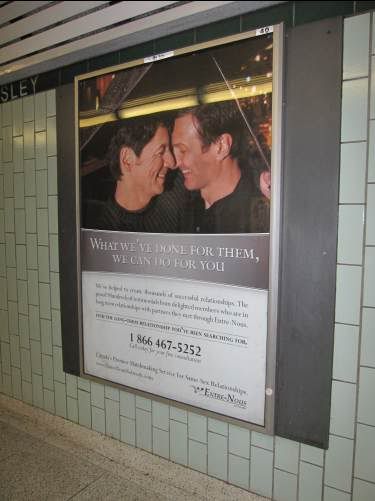 As Toronto is the first North American city to have legalized gay marriages, it's only fair that I start at Church-Wellesley, the heart of gay Toronto. I am at Wellesley Station on the Yonge subway line, where I am being greeted with this gay dating service poster. Entre-Nous features men on its subway ads; I want to see some women too.
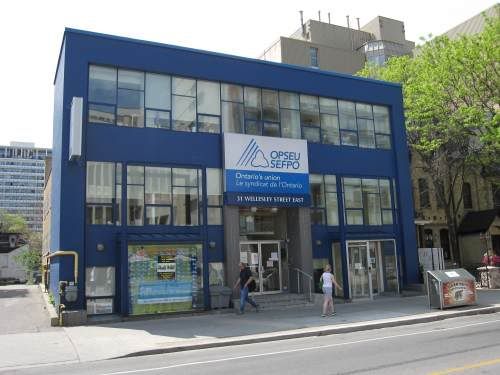 Heading east on Wellesley. Here is a union hall - belonging to Ontario Public Service Employees Union.
Canada's unionization rate is around 28%, which is lower than the European Union but still double the US rate. Unions are a well-accepted part of life in Canada, and union organizers are more concerned with community service and customer relations, and ensuring better working condition for the rank-and-file, than with outright politicking (typical of pro-union states in the US) or the very survival (typical of anti-union US states).
Back in the US, I understand that the Employee Free Choices Act is a major source of political contention - and a major agenda initiative of President Obama. I want to make clear that workers should be able to organize on their own initiative, and that sensible regulations need to be enacted to ensure that not only greedy employers, but also greedy union bosses, are kept in control.
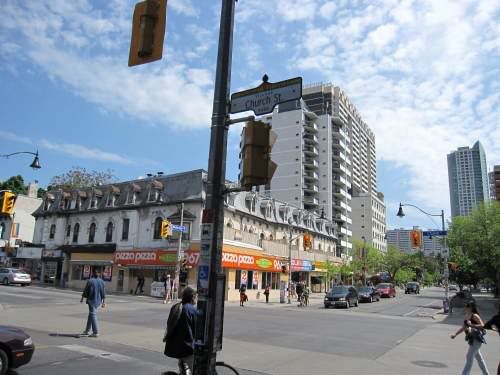 I am at the southwest corner of Church and Wellesley - Toronto's equivalent to, say, San Francisco's Market and Castro. Rainbow flags all around, and yes, the gayness is in the air.
As expected of gay neighborhoods, this area has upscale restaurants, bars, and other hangouts. Plenty of alternative newspapers being given out for free too, as well as posters. At one of the men's bars, there will be an underwear drag show tonight - I'm skipping it (I am finding drag to be too tedious anyway).
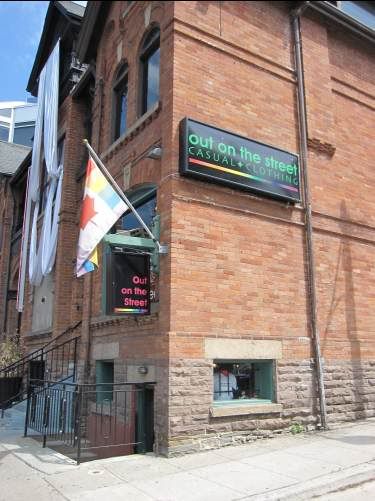 In the US, many gays fly their own version of the Stars and Stripes by keeping the canton but replacing the red-and-white stripes with the rainbow flag. And now I see that Canada also has its own gay version of the national flag as well - replacing the red bars on either side with the rainbow flag. I love it!
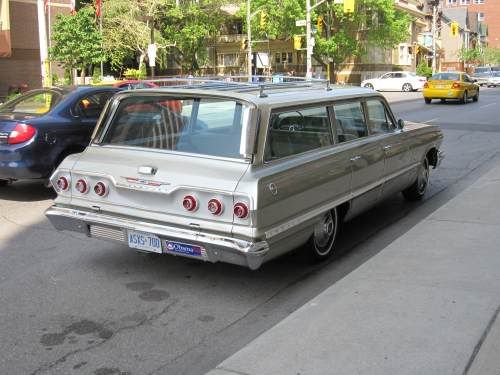 I wonder if this is an expat American, or a Canadian who really has a vested interest in US politics? Glad to see an Obama bumper sticker on this classic Chevy wagon with Ontario plates.
With a car this old, the speedometer will be in miles per hour regardless of whether the car was for US or Canadian duty (Canada didn't go metric until the 1970s). So that leaves me with one less way of figuring out whether this is a transplanted American or a Canadian.
Old cars in this mint of a condition are very rare in Toronto. Most cars rust away after so many brutal winters. It's hard to find cars over 15 years old. (So much for my dreams of finding an ancient Hyundai Pony to park next to my car and restore.)
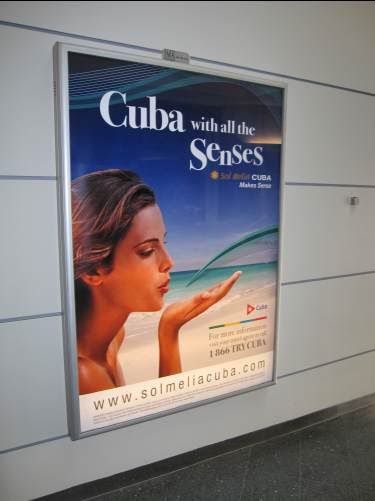 Time to continue. I am at the Yonge-Bloor subway station, looking at a resort ad. Nothing unusual about the Sol Melia name, well-known in Spanish-speaking nations - and outside; in fact, my final London visit had involved four nights at the White House, Sol Melia's premier London property. What is noteworthy is that there are several resorts to choose from, all in Cuba.
When I know I can buy Cuban vacation packages, I definitely know that I am NOT in the US, and therefore outside the sphere of influence of the McCarthyist mentality of Miami's Little Havana.
Again, the US must revisit its Cuban policy (I know that Obama is making minor steps toward this), to ensure the best results possible for the everyday people of Cuba, rather than fulfilling some gripes of the Cuban expats in Miami. Some tell me that the difference between Cubans and Cuban-Americans has strong parallels to the difference between South Koreans and Korean-Americans that I describe to them. Strategic engagement in Cuba will buy influence and improve lives of the ordinary Cubans.
I proceeded east to Greektown for a gyro lunch, which was wonderful - and ended up costing me only $10 after taxes. The restaurant was near Chester station, named Kalyvia, and the waiter, an older Greek native gentleman, was very friendly. He even called me "miss" - despite my age. In fact, people do call me "miss" a bit more often now than a few years ago, and I think maybe it could be the way I dress - less like Calista Flockhart and more like Lindsay Lohan. Yes, I was "pants free" today too - working a long T-shirt as a dress, and adding yesterday's American Apparel $9 belt for an empire waistline.
 I then proceeded to Ontario Science Centre, by taking the No. 25 bus from Pape Station. Many subway stations outside downtown, including Pape, have bus boarding platforms inside paid areas, making life a bit easier. I also loved the views of the various creeks and ravines, densely forested, that interrupt the Toronto cityscape here and there.
Here is one of the more interesting exhibits at the museum. This exhibit is capturing and showing the cosmic rays that fly through the Earth. Cosmic rays can be a number of different things - alpha particles (naked helium nuclei), protons, etc. It's one thing to study them in college, another to see them for real.
 The museum has five levels, three of which are exhibits. The exhibit levels are located an escalator ride or two down from the admissions kiosk.
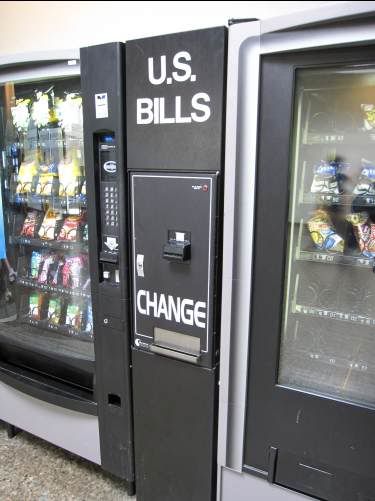
I am about to enter one of the exhibit areas, in front of a row of vending machines. While Canadian coins go up to $2 and the machines themselves can break up to $20, visiting Americans are not so lucky. To buy a $2.75 drink, they may need to pull out a few dollar bills. This machine, made in Indianapolis, exchanges US dollar bills into Canadian coins - though I presume the exchange rate is probably 1:1 or something almost as lousy.
I don't worry about this kind of stuff. I am carrying strictly Canadian currency only in my purse, and will not be touching US currency until it's time to fly home.
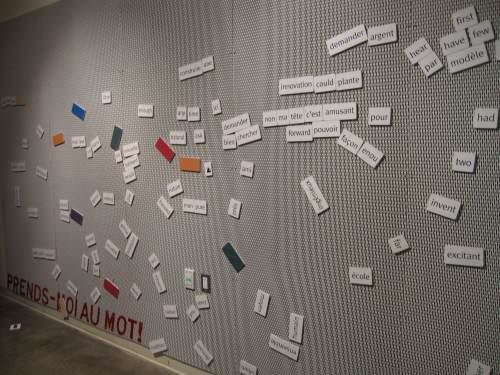 Here is an interactive area. This exhibit allows visitors to string together a series of words to make a sentence. But this being Canada, I need to choose whether I want to make an English sentence or a French one. And even though Toronto speaks English, most of the words available to me are French.
All exhibits are in both languages. It's actually pretty interesting to see how concepts like "black hole" are written in French.
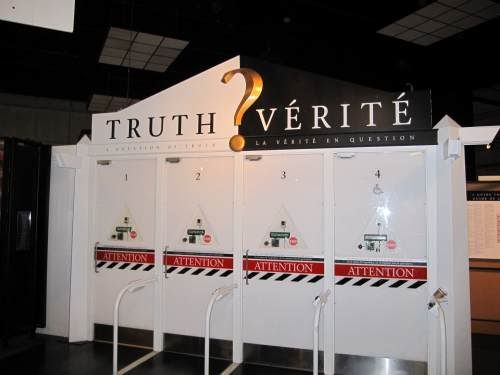 There are a number of special exhibitions. One highly touted one was about espionage, but I didn't find it too interesting. This one, titled Truth, is far more to my liking. It discusses how various cultures have been deemed "inferior" or "primitive," and how even science got a bias against the said cultures, because of the Eurocentric mindset that prevailed for several centuries. Sexism and racism are also well discussed.
After this exhibit, I had a chance to write my feelings to be shared with future visitors. I wrote the following note:
24 May 2009
Thank you for this food for thought.
It bears remembering that all humans are equally capable of good/intelligence/culture. However, different circumstances result in cultural differences that make people, well, different.
Wrong combinations of cultural elements, however, may end up being extremely toxic. While Christianity is taught as a religion of love/liberation, it often becomes tyranny when placed in communal nonwhite cultures (i.e. Latin America, Korea, Asian enclaves in USA). Europe leapfrogged ahead only due to its Renaissance/individualism which happened only due to prevailing circumstances.
I do appreciate Canada for recognizing the good that everyone can potentially offer. The USA, on the other hand, runs a partisan immigration policy that brings in only "desirable" demographics to pit against other demographics. California is paying a heavy price as a result.
The surest way to ensure enlightenment for all cultures is decent standard of living. Central America and former USSR suffer, while East Asia's formerly draconian societies are far more tolerant now, for this precise reason.
Thanks Ontario Science Centre - and thanks Canada!
Rachel K. So
Los Angeles, CA, USA / Seoul, Republic of Korea
Yes, I put down two hometowns, Seoul being the second (and the more enlightened) one. I even used the Republic of Korea moniker as a shout-out to the good people back in Seoul, even though I do not recognize the legitimacy of South Korea's current government. And indeed, great leaps forward in culture and mentalities do happen when a society is affluent enough that people can afford to think and discuss philosophy rather than having to scramble just to survive - a point well demonstrated by none other than South Korea.
I continued my tour of Ontario Science Centre, going even through sections on basic scientific laws and human physiology. I loved the frank talk in the human physiology section about reproduction and birth control options - something that's increasingly harder to get in the US. Not as forward-thinking as the British (who discuss even transgender issues in ways children can swallow), but very impressive nevertheless. Of course, I took in a side view of the male and female reproductive systems as well.
I returned to downtown, getting off at Yonge-Dundas Plaza and heading west on Dundas. Passing the Art Gallery of Ontario, I ended up at Chinatown.
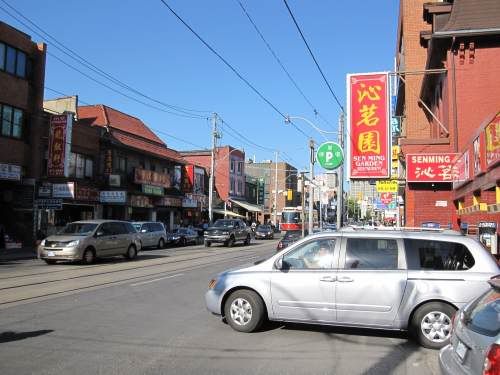 Toronto boasts 300,000 residents of Chinese ancestry, I am told. Needless to say, Chinatown is quite impressive, even though it's not as grand as the Chinatowns of San Francisco, New York, or Vancouver.
When even the municipal parking lot is labeled in Chinese, I know that I am in Chinatown.
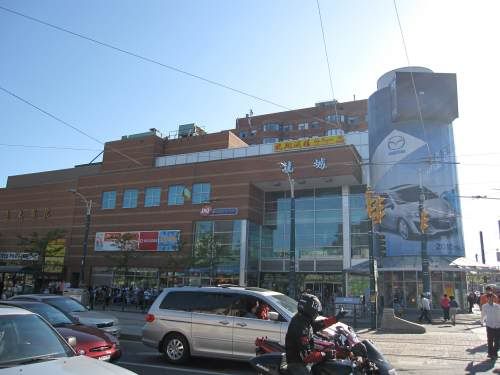 The anchor of Toronto's Chinatown is this shopping mall, named Dragon City. It stands on the southwest corner of Dundas and Spadina.
There was a karaoke room with a happy hour promotion ($10/hr per person until 8:45 PM) but I was too tired to go in. As for the rest of the mall, not as impressive as the grand Asian shopping centers I'm used to elsewhere.
I will NOT be mistaking this area for Hong Kong anytime soon. But again, this is an impressive enclave anyway.
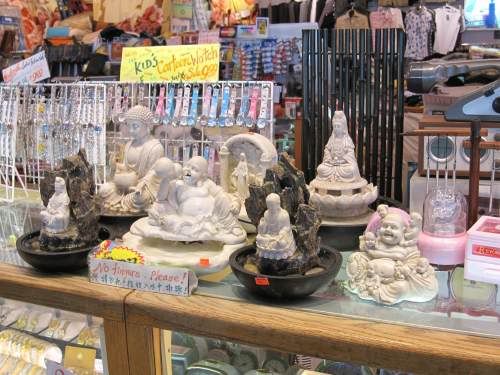 Seen at a store in Dragon City: some Buddhist statues for sale. Mostly Happy Buddhas but two examples of my transgender matron saint too. Can't go wrong with either.
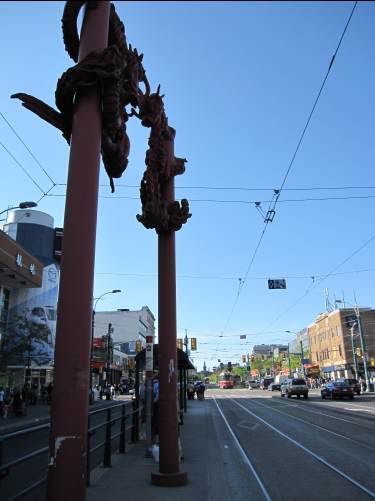 And what good is Chinatown without a gate? Toronto's Chinatown has two gates, both located on Spadina at the streetcar platform. One of them is here, the other is on the other track beyond the traffic signal.
I took the streetcar on Spadina down to Queen West, but as it was almost 6PM on Sunday, everything was closing up. I grabbed a quick pizza dinner for $5 at a Canadian pizza chain, then headed back to my hotel, feet hurting and all. The breeze was also causing my T-shirt to fly up quite a bit - I am pretty sure half of Toronto now knows what my lingerie preference is (it's pretty boring actually - utilitarian black panties, hiding under black tights).
Due to too much time spent at Ontario Science Centre, I didn't make it to Casa Loma. I am thinking that will be the first thing in the morning, as I kick off my final Toronto day. In addition, I need to also squeeze in a harbor cruise, a few extra museums, and maybe extra shopping. The thought of having to go back to California theocracy is NOT appetizing, but I must, and I need to take as much of the good spirits of Canada and the rest of the civilized world as I can.
As Toronto is the first North American city to have legalized gay marriages, it's only fair that I start at Church-Wellesley, the heart of gay Toronto. I am at Wellesley Station on the Yonge subway line, where I am being greeted with this gay dating service poster. Entre-Nous features men on its subway ads; I want to see some women too.Heading east on Wellesley. Here is a union hall - belonging to Ontario Public Service Employees Union.Canada's unionization rate is around 28%, which is lower than the European Union but still double the US rate. Unions are a well-accepted part of life in Canada, and union organizers are more concerned with community service and customer relations, and ensuring better working condition for the rank-and-file, than with outright politicking (typical of pro-union states in the US) or the very survival (typical of anti-union US states).
Back in the US, I understand that the Employee Free Choices Act is a major source of political contention - and a major agenda initiative of President Obama. I want to make clear that workers should be able to organize on their own initiative, and that sensible regulations need to be enacted to ensure that not only greedy employers, but also greedy union bosses, are kept in control.
I am at the southwest corner of Church and Wellesley - Toronto's equivalent to, say, San Francisco's Market and Castro. Rainbow flags all around, and yes, the gayness is in the air.As expected of gay neighborhoods, this area has upscale restaurants, bars, and other hangouts. Plenty of alternative newspapers being given out for free too, as well as posters. At one of the men's bars, there will be an underwear drag show tonight - I'm skipping it (I am finding drag to be too tedious anyway).
In the US, many gays fly their own version of the Stars and Stripes by keeping the canton but replacing the red-and-white stripes with the rainbow flag. And now I see that Canada also has its own gay version of the national flag as well - replacing the red bars on either side with the rainbow flag. I love it!I wonder if this is an expat American, or a Canadian who really has a vested interest in US politics? Glad to see an Obama bumper sticker on this classic Chevy wagon with Ontario plates.With a car this old, the speedometer will be in miles per hour regardless of whether the car was for US or Canadian duty (Canada didn't go metric until the 1970s). So that leaves me with one less way of figuring out whether this is a transplanted American or a Canadian.
Old cars in this mint of a condition are very rare in Toronto. Most cars rust away after so many brutal winters. It's hard to find cars over 15 years old. (So much for my dreams of finding an ancient Hyundai Pony to park next to my car and restore.)
Time to continue. I am at the Yonge-Bloor subway station, looking at a resort ad. Nothing unusual about the Sol Melia name, well-known in Spanish-speaking nations - and outside; in fact, my final London visit had involved four nights at the White House, Sol Melia's premier London property. What is noteworthy is that there are several resorts to choose from, all in Cuba.When I know I can buy Cuban vacation packages, I definitely know that I am NOT in the US, and therefore outside the sphere of influence of the McCarthyist mentality of Miami's Little Havana.
Again, the US must revisit its Cuban policy (I know that Obama is making minor steps toward this), to ensure the best results possible for the everyday people of Cuba, rather than fulfilling some gripes of the Cuban expats in Miami. Some tell me that the difference between Cubans and Cuban-Americans has strong parallels to the difference between South Koreans and Korean-Americans that I describe to them. Strategic engagement in Cuba will buy influence and improve lives of the ordinary Cubans.
I proceeded east to Greektown for a gyro lunch, which was wonderful - and ended up costing me only $10 after taxes. The restaurant was near Chester station, named Kalyvia, and the waiter, an older Greek native gentleman, was very friendly. He even called me "miss" - despite my age. In fact, people do call me "miss" a bit more often now than a few years ago, and I think maybe it could be the way I dress - less like Calista Flockhart and more like Lindsay Lohan. Yes, I was "pants free" today too - working a long T-shirt as a dress, and adding yesterday's American Apparel $9 belt for an empire waistline.
I then proceeded to Ontario Science Centre, by taking the No. 25 bus from Pape Station. Many subway stations outside downtown, including Pape, have bus boarding platforms inside paid areas, making life a bit easier. I also loved the views of the various creeks and ravines, densely forested, that interrupt the Toronto cityscape here and there.Here is one of the more interesting exhibits at the museum. This exhibit is capturing and showing the cosmic rays that fly through the Earth. Cosmic rays can be a number of different things - alpha particles (naked helium nuclei), protons, etc. It's one thing to study them in college, another to see them for real.
The museum has five levels, three of which are exhibits. The exhibit levels are located an escalator ride or two down from the admissions kiosk.I am about to enter one of the exhibit areas, in front of a row of vending machines. While Canadian coins go up to $2 and the machines themselves can break up to $20, visiting Americans are not so lucky. To buy a $2.75 drink, they may need to pull out a few dollar bills. This machine, made in Indianapolis, exchanges US dollar bills into Canadian coins - though I presume the exchange rate is probably 1:1 or something almost as lousy.
I don't worry about this kind of stuff. I am carrying strictly Canadian currency only in my purse, and will not be touching US currency until it's time to fly home.
Here is an interactive area. This exhibit allows visitors to string together a series of words to make a sentence. But this being Canada, I need to choose whether I want to make an English sentence or a French one. And even though Toronto speaks English, most of the words available to me are French.All exhibits are in both languages. It's actually pretty interesting to see how concepts like "black hole" are written in French.
There are a number of special exhibitions. One highly touted one was about espionage, but I didn't find it too interesting. This one, titled Truth, is far more to my liking. It discusses how various cultures have been deemed "inferior" or "primitive," and how even science got a bias against the said cultures, because of the Eurocentric mindset that prevailed for several centuries. Sexism and racism are also well discussed.After this exhibit, I had a chance to write my feelings to be shared with future visitors. I wrote the following note:
24 May 2009
Thank you for this food for thought.
It bears remembering that all humans are equally capable of good/intelligence/culture. However, different circumstances result in cultural differences that make people, well, different.
Wrong combinations of cultural elements, however, may end up being extremely toxic. While Christianity is taught as a religion of love/liberation, it often becomes tyranny when placed in communal nonwhite cultures (i.e. Latin America, Korea, Asian enclaves in USA). Europe leapfrogged ahead only due to its Renaissance/individualism which happened only due to prevailing circumstances.
I do appreciate Canada for recognizing the good that everyone can potentially offer. The USA, on the other hand, runs a partisan immigration policy that brings in only "desirable" demographics to pit against other demographics. California is paying a heavy price as a result.
The surest way to ensure enlightenment for all cultures is decent standard of living. Central America and former USSR suffer, while East Asia's formerly draconian societies are far more tolerant now, for this precise reason.
Thanks Ontario Science Centre - and thanks Canada!
Rachel K. So
Los Angeles, CA, USA / Seoul, Republic of Korea
Yes, I put down two hometowns, Seoul being the second (and the more enlightened) one. I even used the Republic of Korea moniker as a shout-out to the good people back in Seoul, even though I do not recognize the legitimacy of South Korea's current government. And indeed, great leaps forward in culture and mentalities do happen when a society is affluent enough that people can afford to think and discuss philosophy rather than having to scramble just to survive - a point well demonstrated by none other than South Korea.
I continued my tour of Ontario Science Centre, going even through sections on basic scientific laws and human physiology. I loved the frank talk in the human physiology section about reproduction and birth control options - something that's increasingly harder to get in the US. Not as forward-thinking as the British (who discuss even transgender issues in ways children can swallow), but very impressive nevertheless. Of course, I took in a side view of the male and female reproductive systems as well.
I returned to downtown, getting off at Yonge-Dundas Plaza and heading west on Dundas. Passing the Art Gallery of Ontario, I ended up at Chinatown.
Toronto boasts 300,000 residents of Chinese ancestry, I am told. Needless to say, Chinatown is quite impressive, even though it's not as grand as the Chinatowns of San Francisco, New York, or Vancouver.When even the municipal parking lot is labeled in Chinese, I know that I am in Chinatown.
The anchor of Toronto's Chinatown is this shopping mall, named Dragon City. It stands on the southwest corner of Dundas and Spadina.There was a karaoke room with a happy hour promotion ($10/hr per person until 8:45 PM) but I was too tired to go in. As for the rest of the mall, not as impressive as the grand Asian shopping centers I'm used to elsewhere.
I will NOT be mistaking this area for Hong Kong anytime soon. But again, this is an impressive enclave anyway.
Seen at a store in Dragon City: some Buddhist statues for sale. Mostly Happy Buddhas but two examples of my transgender matron saint too. Can't go wrong with either.And what good is Chinatown without a gate? Toronto's Chinatown has two gates, both located on Spadina at the streetcar platform. One of them is here, the other is on the other track beyond the traffic signal.I took the streetcar on Spadina down to Queen West, but as it was almost 6PM on Sunday, everything was closing up. I grabbed a quick pizza dinner for $5 at a Canadian pizza chain, then headed back to my hotel, feet hurting and all. The breeze was also causing my T-shirt to fly up quite a bit - I am pretty sure half of Toronto now knows what my lingerie preference is (it's pretty boring actually - utilitarian black panties, hiding under black tights).
Due to too much time spent at Ontario Science Centre, I didn't make it to Casa Loma. I am thinking that will be the first thing in the morning, as I kick off my final Toronto day. In addition, I need to also squeeze in a harbor cruise, a few extra museums, and maybe extra shopping. The thought of having to go back to California theocracy is NOT appetizing, but I must, and I need to take as much of the good spirits of Canada and the rest of the civilized world as I can.
23 May 2009
Toronto: Kickoff
I have yet to upload my DC photos, but now that I am in Toronto, I will go ahead and upload today's Toronto photos first.
I was supposed to fly United Airlines to Chicago yesterday, then change planes there to reach Toronto. But about four hours before departure, an automated call from United informed me that my Chicago flight was cancelled. United rebooked me automatically, but due to the long weekend, my next possible flight had to wait until this morning, reaching Toronto 16 1/2 hours behind schedule. I called the Premier dedicated hotline - and had myself rebooked on an Air Canada nonstop instead. It turned out be a great flight, and I arrived in Toronto 45 minutes earlier than I would have otherwise.
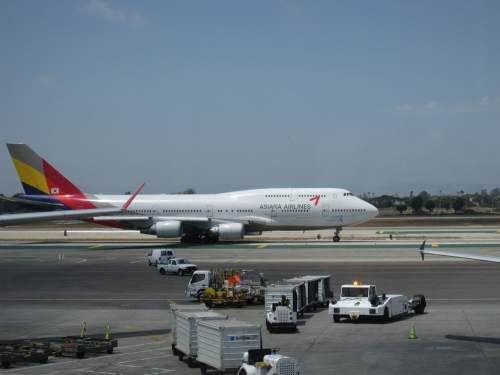 As I await my Air Canada flight, I am getting a look at another fine member of Star Alliance, the alliance that both United and Air Canada founded. That is an Asiana 747, with registration HL7428, operating as Asiana 201 and heading for the runway to start its 13-hour journey to Seoul. The last time I left the US, it was on that very aircraft, for the second installment of my 3-month Seoul stint (which eventually also took me to Hong Kong).
My flight on Air Canada (my first ever on Air Canada, and the third Star Alliance member I fly on) was on a standard Airbus A319, which nevertheless featured a video-on-demand system. Selections were not great, and air show was not available, but it did keep me busy almost all the way to Toronto. My re-booking was done as a full-fare economy ticket, so I did not even have to pay for the inflight snacks and sandwiches, but I did pay $6 Canadian for a can of Molson Canadian beer, just to set the mood right. (Not too impressed with Molson's taste, however, and I'll never drink any alcohol during a flight ever again.)
Pearson International is a lovely airport - reminds me a lot of Incheon, even down to crummy ground connections to the city. Due to the late-night arrival I shelled out $49 (Canadian, of course) plus tip for a cab ride downtown.
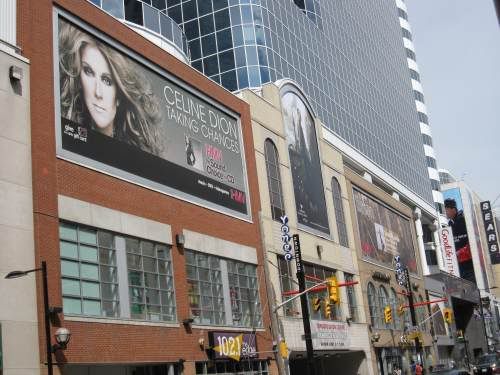 It's late morning, and I'm out for my first day in Toronto. I'm passing by Eaton Centre, located on Yonge Street, Toronto's main north-south street and also known as the longest street in Canada. My hotel, for that matter, is meditation-themed Pantages, only a block to the east.
Loving those billboards. There is an HMV record store, where I can buy the newest albums from two fine Canadian chanteuses - Celine Dion (representing Quebec and the French-speakers) and Sarah McLachlan (representing Nova Scotia & British Columbia, and the English-speakers).
During the previous day's Air Canada flight, I did find the Sarah McLachlan album - the Closer compilation - and make sure to listen to it. Did not find Celine Dion, but I substituted with an American, Mariah Carey.
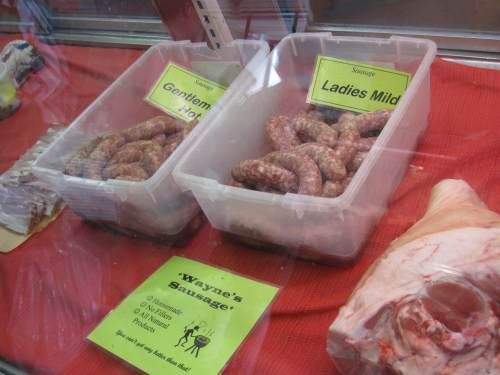 My first sight: St. Lawrence Market. There are lots of weird things available there, including sausages and other food items. Some are imported from Ukraine - or wherever else the various immigrant communities of Toronto hail from.
These sausages are Canadian domestic, but I took a photo to note its gender stereotyping.
Canada is very proactive about recruiting immigrants, and has a much better immigration policy than the US policy full of political calculations. Toronto overflows with a zillion nationalities - I see plenty of Muslim women with headscarves (and even a burka) around, and hear more languages than I can ever count. Even Spanish, which I associate more with the US than with Canada, is widely taught. And even though Ontario is an English-speaking province, I don't think a French speaker would have too much of a problem here (unlike Quebec, where speaking English is difficult, and British Columbia, where virtually nobody speaks French). And even with this flow of immigrants, Toronto managed to be the first North American locale to legalize gay marriages. Shame on you again, California!
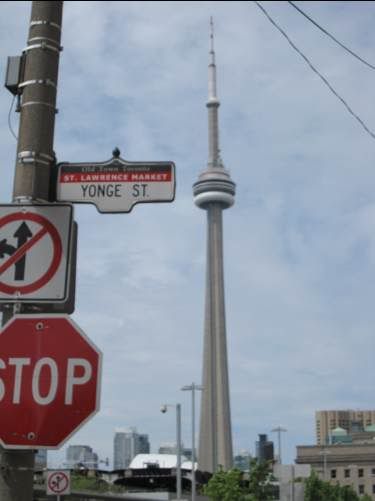 Leaving the market. I took this photo just to remind myself that I am in Toronto. Yes, I am back at Yonge Street (pronounced Young). And the CN Tower can be seen from just about anywhere in town.
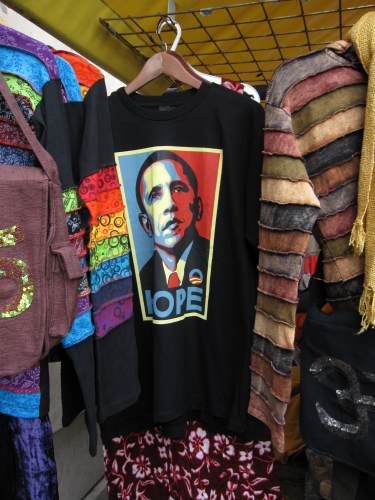 Another photo seen around the market. Sure, I may be north of the border, but President Obama is quite popular even here (maybe even more so than in many parts of the US). The Obama Presidency does signal that the US is walking away from 8 years of W cowboy diplomacy, and that Canada's own W puppet, Stephen Harper, is with fewer political options. I don't imagine that Toronto would have too many Harper supporters - most of them are out west in Calgary and Edmonton.
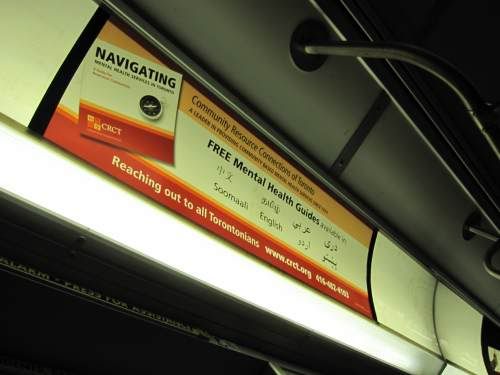 Back on the subway. I am using a $9 flash pass, good until 5:30 AM the next morning for unlimited travel on the Toronto Transit Commission (TTC) system.
Even though Canadian government services are more extensive than those in the US, community organizations still have key roles to play. Again, I am reminded of Toronto's polyglot makeup. Residents can get mental health services in the languages listed in this ad.
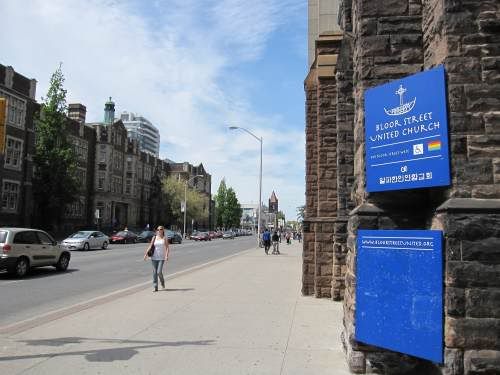 My intended destination was Royal Ontario Museum, which would require me to turn east from St. George station served by both of TTC's main subway lines. But as station vicinity maps always show north first (and I am used to them oriented the same way I'm facing, as was standard in Seoul), I got confused and walked west. Now I'm getting lost on the main east-west artery, Bloor Street, but getting lost is part of the fun.
Here is a liberal Christian congregation, which appears to welcome LGBTs. The congregation also has a Korean-language service. I don't think I'd see this mix back in the US - no Korean Christian church in the US would be caught dead sharing facilities with an LGBT-friendly congregation.
Speaking of the Korean community in Toronto, Koreatown sits on Bloor, further ahead to the west. In fact, I'll reach its eastern end at Bathurst before getting back on the subway to return to St. George and Royal Ontario Museum.
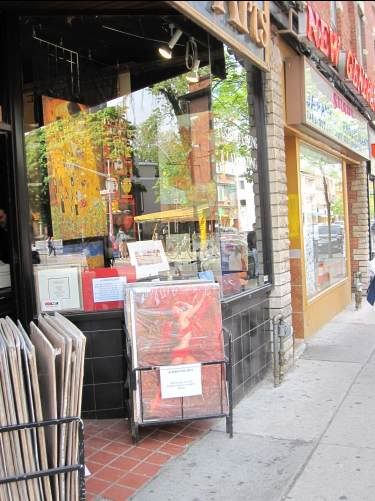 Still walking west on Bloor. Here is a sexy poster for sale at an alternative art gallery.
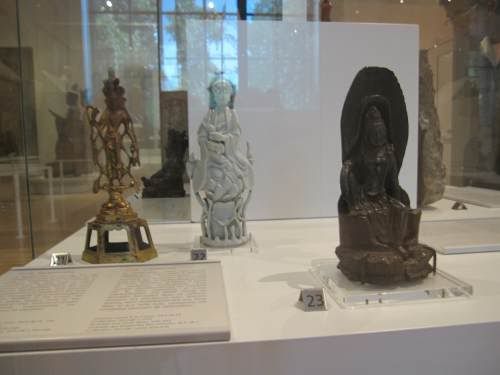 Now I am at Royal Ontario Museum, which combines a natural history museum with a world arts museum. And in either capacity, the collections are outstanding.
The Chinese collection is especially exhaustive. Thanks to the clout of the Chinese-Canadians (especially with all the Hong Kong wealth that migrated to Vancouver, and to a lesser extent, here to Toronto), Chinese culture gets healthy respect in Canada.
The above are three Chinese Kwan Yin statues, including an eleven-faced example and a fertility example. At Royal Ontario Museum, Kwan Yin is always referred to by male pronouns, but the captions do make it clear that from the 12th Century on, Kwan Yin was depicted in an increasingly female manner.
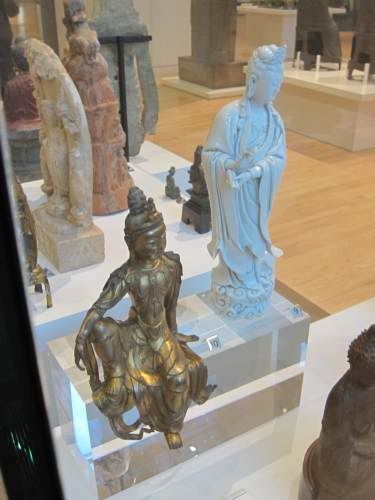 Two more Kwan Yins. There are over a dozen examples of all descriptions at Royal Ontario Museum. It was great to be reminded of my Hong Kong trip six months ago, where I got a near-overload of my transgender matron saint.
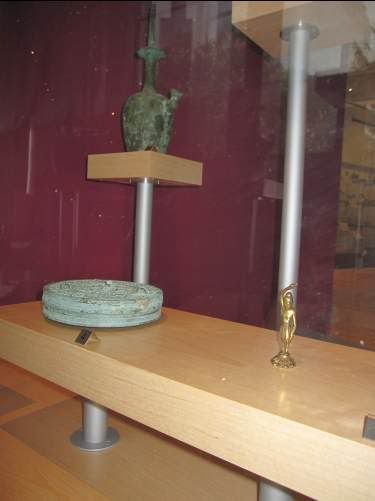 The Korean collection doesn't enjoy the support that the Chinese collection (from Chinese-Canadians) and the Japanese collection (from Japanese corporations) do, but it's still healthy.
No Kwan Yins, but I do see a newborn miniskirted Buddha, which is extremely rare even in Korea. The bronze water pitcher is also a familiar shape (though I'm more likely to see it in the form of the blue celadons). Speaking of blue celadons, there are a few dozen here, but none really stood out.
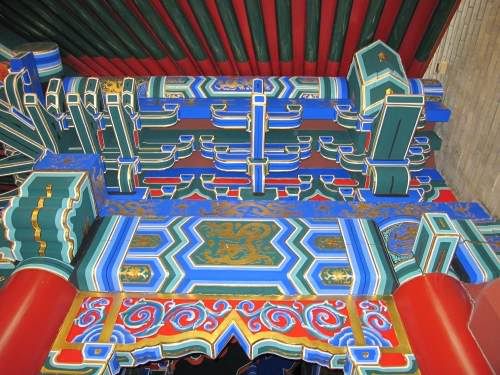 Back to Chinese collection. Here is a look at Chinese imperial building coloring scheme. I love it.
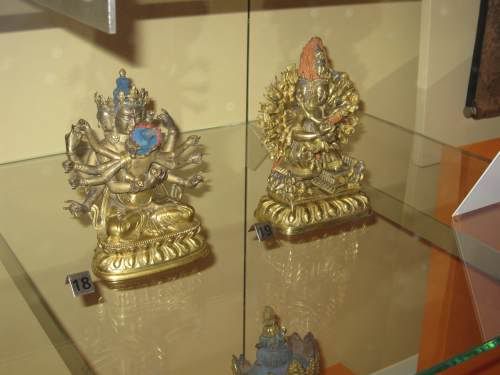 Some South Asian art. Here are some Hindu sculptures. It appears that in both examples, a male deity and a female deity are bonded together. The casual Western observer would interpret them as sex scenes, but in reality, these are not erotic, but express the Hindu understanding of making something whole by combining the male and the female.
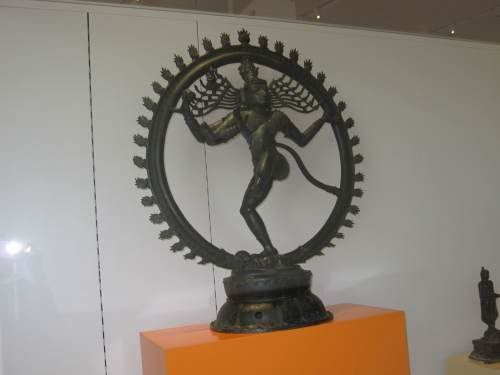 Six-armed Shiva, of course.
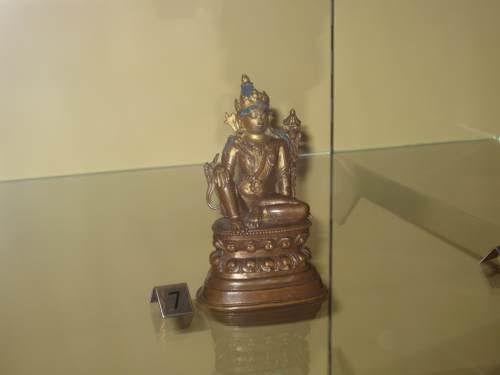 Tibetan Avalokitesvara - or the male version of Kwan Yin.
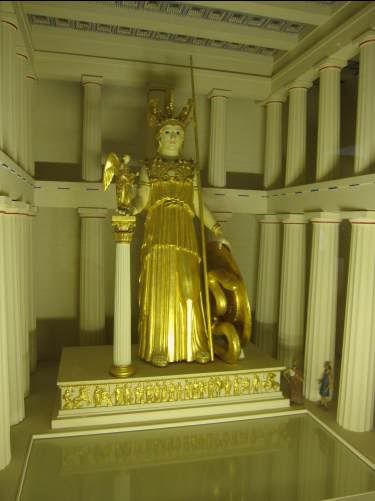 A model of the gigantic Athena statue that once stood in the Parthenon in Athens. The statue was removed after Greece became an Orthodox Christian nation, and the Parthenon was converted to a church. Eventually, the Parthenon became a gunpowder storage area, and an explosion reduced it to today's ruins.
Speaking of Athena, I'm back at that airline simulation game again - again flying Air Athena out of Athens. This game is set in the 1970s, however, and I am required to battle the spiking fuel prices and interest rates using the short-range, inefficient airplanes of the era. So far, I'm doing well.
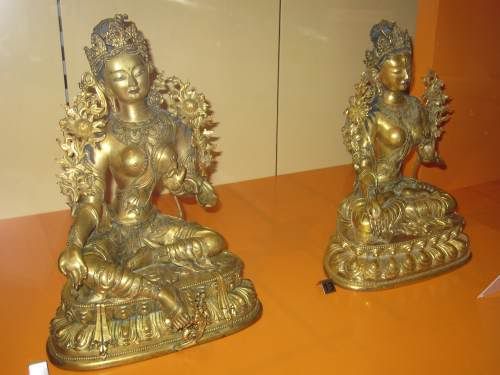 Two examples of Tibetan goddess Tara. Tara is often considered another version of Kwan Yin, as she is born from the tears of Avalokitesvara. The left is the Green Tara while the right is the White Tara. There is no ambiguity as to the gender identity of Tara; she is always female. I need to study Tara more, however, including the significance of the various varieties.
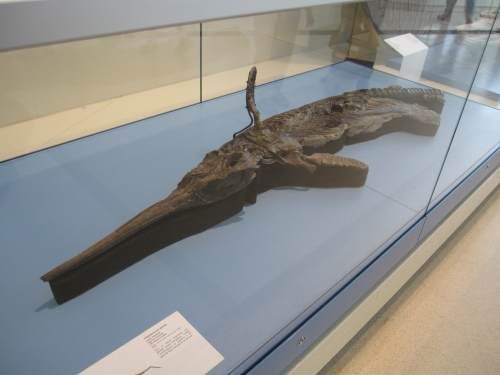 My favorite extinct animal would have to be the ichthyosaur, which was a dolphin-shaped marine reptile that lived during the dinosaur era. Here is a really nice example of an ichthyosaur, found in England, but not identifiable as a specific species. Of course, Britain, being a shallow sea 150 million years ago, had a huge ichthyosaur population.
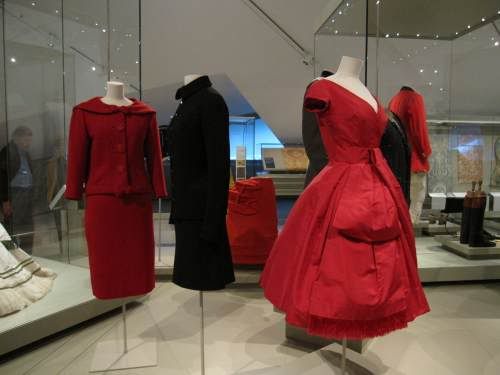 There is a textile department at Royal Ontario Museum. Here are three modern outfits I like. The red suit and dress are from the 1950s while the black suit is from 2004. The red suit had been in a very poor shape, with torn linings and all, but was nicely restored.
I was wishing for a 1990s miniskirt suit, however. :)
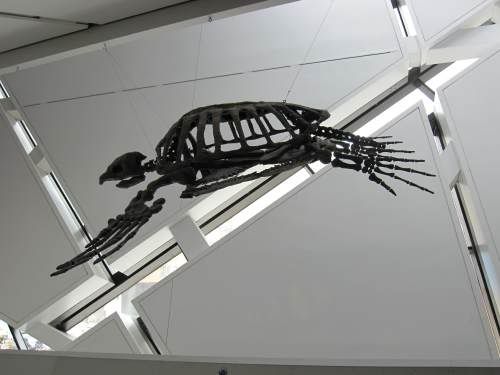 An extinct species of a huge turtle, suspended from the ceiling. That's a cast of a fossil rather than a real fossil.
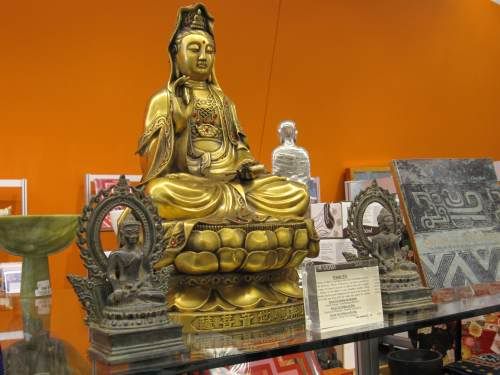 Museum shop, with a huge Kwan Yin for sale. Glad to continue encountering my transgender matron saint.
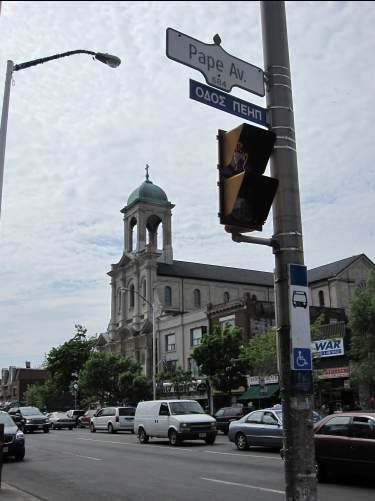 A shot east on the Bloor subway line brought me to Danforth Avenue, home of Greektown, probably the most famous/important of Toronto's ethnic neighborhoods. Greektown is the largest Greek enclave in North America, and Toronto as a whole has more Greeks than any North American city except New York.
As I had eaten a rather large breakfast at Fran's next to my hotel (Fran's is a Canadian equivalent chain to Denny's in the US), I didn't eat here. I'll be eating here later on, however. The Greek restaurants here run the gamut from run-down hole-in-the-wall places to touristy trendy expensive places to everything in between.
As seen in the photo, the street signs are in Greek as well as English. The word "avenue" is translated into "odos" but some of the Greek spellings of non-Greek names end up being interesting.
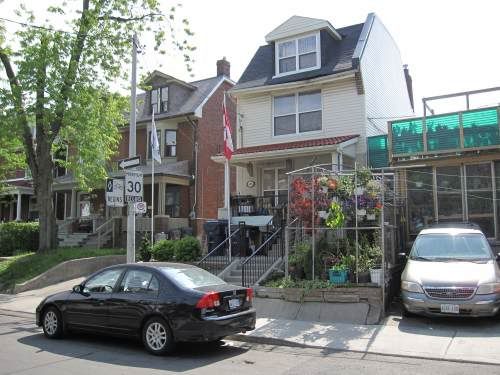 I had a bit extra time, so I shot back west on Bloor to Christie Street, the west end of Koreatown. There is a nice park in that area, but I decided to walk east across Koreatown.
Here is the Korean Senior Citizens' Center, marked by flags of South Korea and Canada.
This Koreatown is a pittance compared to the humongous one in Los Angeles, but is nevertheless respectable. A Korean speaker in Toronto can find just about everything s/he needs - grocery stores, travel agencies for those airline tickets to Seoul, restaurants, even karaoke bars. I was happy to not have to come across extremist megachurches, though the grocery store had a Christian propaganda newspaper published in the US.
Thanks to a more sensible immigration policy on the part of the Canadian government, and thanks to a different demographic of Koreans coming to Canada (more of a lifestyle choice than an economic opportunity), the Korean-Canadians on the whole are probably more sensible than the Korean-Americans. On the other hand, Korean Christianity is never to be trusted, and Christianity does play a key role in all Korean communities of the Western world; many Korean-Canadians, after all, are Christian extremists who are waiting for an opportunity to move on to the US. Another reason to move to the US: the Korean-Canadian community, unlike the massive Korean-American community (or the Chinese-Canadian community for that matter), is not at a self-sustaining level yet.
There is one more Korean note to write down. Toronto's subway system feels a lot like a better-maintained version of the New York subway, but it does have modern LCD TV status monitors that run news updates. Those monitors stated that South Korea's Roh Moo-hyun, who was the President as recently as 15 months ago, committed suicide. The last thing South Korea needs is another high-profile suicide!
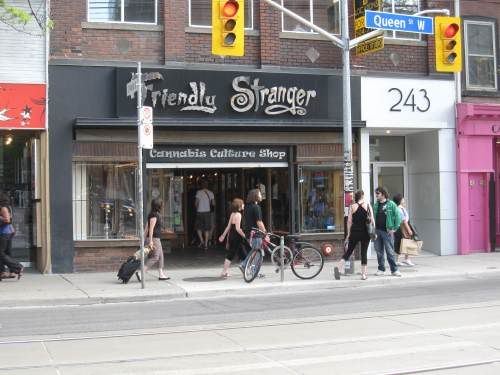 After walking across Koreatown, I returned to Bathurst, but instead of the subway, I took the streetcar down to Queen Street West. After going one stop east on Queen on another streetcar, I walked all the way back to Yonge.
There are lots of boutiques here - I ended up with a $9 belt from American Apparel (as American Apparel is made in Los Angeles and therefore cheaper in the US, I decided not to buy its other products today), as well as a $60 white shirt from Aritzia, a Canadian boutique chain. At Aritzia, the fitting rooms are a bit odd; I am required to store my purse in a locker, and the cubicles do not have mirrors so I must come outside for a check on the mirror. Not fun when I was working a sheer tunic blouse as a dress (with a cami and tights underneath) and the shirt was barely covering my derriere. I do have to say that I was far from alone in doing that "tights as pants" thing on the streets of Toronto today. And in terms of fashion in general, Torontonians are not standouts, but they do express their individualism and accessorizing very well - certainly better than Angelenos.
Walking further east, I came across this sight. This is another of those things I don't think I'll ever get to see stateside. The US is running its War on Drugs not as a serious attempt to regulate drug usage for the public's safety and health, but as some sort of a vendetta. The Canadians are a bit more level-headed on this issue, but of course there is a lot of American pressure to crack down. I hate drugs of any kind (even tobacco and alcohol are too much for me usually) but I don't like the US policy at all (which has actually turned the illicit drug industry into a very lucrative one).
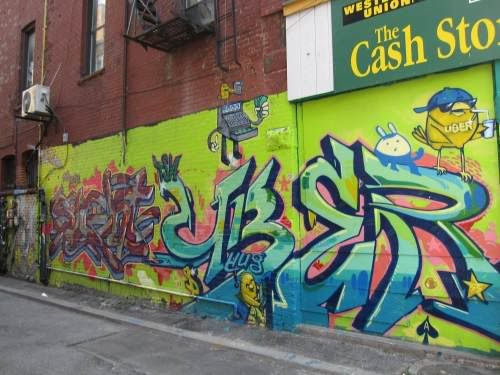 Lovely graffiti on a side alley branching off of Queen Street West. This is something my Seattle-based friend DiAnne Grieser would like (in addition to all the Kwan Yins and turtles). She is known to photograph local and foreign graffiti all the time.
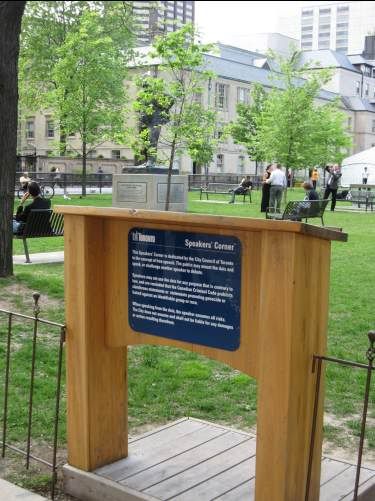 The British, through the Magna Carta, established the concept of freedom of speech. Today, the northeast corner of London's Hyde Park has a Speakers' Corner, where anyone can give a speech on any subject.
Toronto is doing just the same. Here is Toronto's own Speakers' Corner. The only rules are that I may not give hate speeches targeting a specific demographic (I guess Miss "I Believe in Opposite Marriages Only" California will have to shut up here), and that I am responsible for anything and everything I say, including any adverse reactions from listeners.
Another British reminder: there is a Winston Churchill statue in the distance.
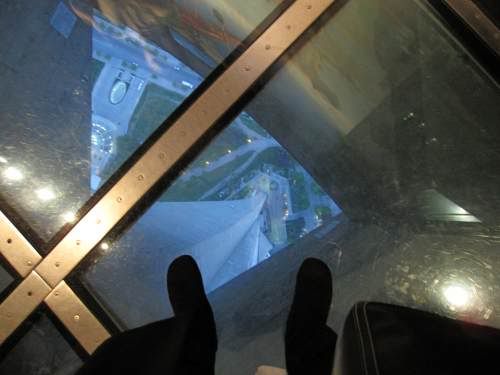 It was a warm, humid day, and my feet hurt, so I returned to my hotel room for a quick rest and change, then after a quick Mexican dinner at Eaton Centre, went to CN Tower.
CN Tower may not be the tallest building in the world anymore (there is a taller structure in Dubai now), but its top observatory remains the highest man-made observation platform in the world.
I am at the main observatory, which includes this glass floor section. I am looking 114 stories below to the ground level. And if anyone on the ground is looking up, they can see all the visitors lying down on the glass - as well as my lingerie preferences. (I did change into that white Aritzia shirt, and added a long suit jacket, but I am still doing that "tights as pants" thing, just like that other lesbian fashion icon, Lindsay Lohan.)
The top observatory, called the Skypod in English and la Nacelle in French, is 147 stories above ground level. I do have to say that with the Toronto area lacking any major geographical features, most of the inland views were quite generic, and not too impressive. But the Lake Ontario views were quite nice, from the Toronto Island and its airport in front to the faraway shores of New York State. On a very good day, I am told that I can even see the plumes of Niagara Falls - and the buildings of Rochester, NY.
That wrapped up Day 1. Now I need to figure out what Day 2 will be like, though I'll be sleeping in a bit as the TTC subway doesn't start its Sunday service until 9 in the morning.
I was supposed to fly United Airlines to Chicago yesterday, then change planes there to reach Toronto. But about four hours before departure, an automated call from United informed me that my Chicago flight was cancelled. United rebooked me automatically, but due to the long weekend, my next possible flight had to wait until this morning, reaching Toronto 16 1/2 hours behind schedule. I called the Premier dedicated hotline - and had myself rebooked on an Air Canada nonstop instead. It turned out be a great flight, and I arrived in Toronto 45 minutes earlier than I would have otherwise.
As I await my Air Canada flight, I am getting a look at another fine member of Star Alliance, the alliance that both United and Air Canada founded. That is an Asiana 747, with registration HL7428, operating as Asiana 201 and heading for the runway to start its 13-hour journey to Seoul. The last time I left the US, it was on that very aircraft, for the second installment of my 3-month Seoul stint (which eventually also took me to Hong Kong).My flight on Air Canada (my first ever on Air Canada, and the third Star Alliance member I fly on) was on a standard Airbus A319, which nevertheless featured a video-on-demand system. Selections were not great, and air show was not available, but it did keep me busy almost all the way to Toronto. My re-booking was done as a full-fare economy ticket, so I did not even have to pay for the inflight snacks and sandwiches, but I did pay $6 Canadian for a can of Molson Canadian beer, just to set the mood right. (Not too impressed with Molson's taste, however, and I'll never drink any alcohol during a flight ever again.)
Pearson International is a lovely airport - reminds me a lot of Incheon, even down to crummy ground connections to the city. Due to the late-night arrival I shelled out $49 (Canadian, of course) plus tip for a cab ride downtown.
It's late morning, and I'm out for my first day in Toronto. I'm passing by Eaton Centre, located on Yonge Street, Toronto's main north-south street and also known as the longest street in Canada. My hotel, for that matter, is meditation-themed Pantages, only a block to the east.Loving those billboards. There is an HMV record store, where I can buy the newest albums from two fine Canadian chanteuses - Celine Dion (representing Quebec and the French-speakers) and Sarah McLachlan (representing Nova Scotia & British Columbia, and the English-speakers).
During the previous day's Air Canada flight, I did find the Sarah McLachlan album - the Closer compilation - and make sure to listen to it. Did not find Celine Dion, but I substituted with an American, Mariah Carey.
My first sight: St. Lawrence Market. There are lots of weird things available there, including sausages and other food items. Some are imported from Ukraine - or wherever else the various immigrant communities of Toronto hail from.These sausages are Canadian domestic, but I took a photo to note its gender stereotyping.
Canada is very proactive about recruiting immigrants, and has a much better immigration policy than the US policy full of political calculations. Toronto overflows with a zillion nationalities - I see plenty of Muslim women with headscarves (and even a burka) around, and hear more languages than I can ever count. Even Spanish, which I associate more with the US than with Canada, is widely taught. And even though Ontario is an English-speaking province, I don't think a French speaker would have too much of a problem here (unlike Quebec, where speaking English is difficult, and British Columbia, where virtually nobody speaks French). And even with this flow of immigrants, Toronto managed to be the first North American locale to legalize gay marriages. Shame on you again, California!
Leaving the market. I took this photo just to remind myself that I am in Toronto. Yes, I am back at Yonge Street (pronounced Young). And the CN Tower can be seen from just about anywhere in town.Another photo seen around the market. Sure, I may be north of the border, but President Obama is quite popular even here (maybe even more so than in many parts of the US). The Obama Presidency does signal that the US is walking away from 8 years of W cowboy diplomacy, and that Canada's own W puppet, Stephen Harper, is with fewer political options. I don't imagine that Toronto would have too many Harper supporters - most of them are out west in Calgary and Edmonton.Back on the subway. I am using a $9 flash pass, good until 5:30 AM the next morning for unlimited travel on the Toronto Transit Commission (TTC) system.Even though Canadian government services are more extensive than those in the US, community organizations still have key roles to play. Again, I am reminded of Toronto's polyglot makeup. Residents can get mental health services in the languages listed in this ad.
My intended destination was Royal Ontario Museum, which would require me to turn east from St. George station served by both of TTC's main subway lines. But as station vicinity maps always show north first (and I am used to them oriented the same way I'm facing, as was standard in Seoul), I got confused and walked west. Now I'm getting lost on the main east-west artery, Bloor Street, but getting lost is part of the fun.Here is a liberal Christian congregation, which appears to welcome LGBTs. The congregation also has a Korean-language service. I don't think I'd see this mix back in the US - no Korean Christian church in the US would be caught dead sharing facilities with an LGBT-friendly congregation.
Speaking of the Korean community in Toronto, Koreatown sits on Bloor, further ahead to the west. In fact, I'll reach its eastern end at Bathurst before getting back on the subway to return to St. George and Royal Ontario Museum.
Still walking west on Bloor. Here is a sexy poster for sale at an alternative art gallery.Now I am at Royal Ontario Museum, which combines a natural history museum with a world arts museum. And in either capacity, the collections are outstanding.The Chinese collection is especially exhaustive. Thanks to the clout of the Chinese-Canadians (especially with all the Hong Kong wealth that migrated to Vancouver, and to a lesser extent, here to Toronto), Chinese culture gets healthy respect in Canada.
The above are three Chinese Kwan Yin statues, including an eleven-faced example and a fertility example. At Royal Ontario Museum, Kwan Yin is always referred to by male pronouns, but the captions do make it clear that from the 12th Century on, Kwan Yin was depicted in an increasingly female manner.
Two more Kwan Yins. There are over a dozen examples of all descriptions at Royal Ontario Museum. It was great to be reminded of my Hong Kong trip six months ago, where I got a near-overload of my transgender matron saint.The Korean collection doesn't enjoy the support that the Chinese collection (from Chinese-Canadians) and the Japanese collection (from Japanese corporations) do, but it's still healthy.No Kwan Yins, but I do see a newborn miniskirted Buddha, which is extremely rare even in Korea. The bronze water pitcher is also a familiar shape (though I'm more likely to see it in the form of the blue celadons). Speaking of blue celadons, there are a few dozen here, but none really stood out.
Back to Chinese collection. Here is a look at Chinese imperial building coloring scheme. I love it.Some South Asian art. Here are some Hindu sculptures. It appears that in both examples, a male deity and a female deity are bonded together. The casual Western observer would interpret them as sex scenes, but in reality, these are not erotic, but express the Hindu understanding of making something whole by combining the male and the female.Six-armed Shiva, of course.Tibetan Avalokitesvara - or the male version of Kwan Yin.A model of the gigantic Athena statue that once stood in the Parthenon in Athens. The statue was removed after Greece became an Orthodox Christian nation, and the Parthenon was converted to a church. Eventually, the Parthenon became a gunpowder storage area, and an explosion reduced it to today's ruins.Speaking of Athena, I'm back at that airline simulation game again - again flying Air Athena out of Athens. This game is set in the 1970s, however, and I am required to battle the spiking fuel prices and interest rates using the short-range, inefficient airplanes of the era. So far, I'm doing well.
Two examples of Tibetan goddess Tara. Tara is often considered another version of Kwan Yin, as she is born from the tears of Avalokitesvara. The left is the Green Tara while the right is the White Tara. There is no ambiguity as to the gender identity of Tara; she is always female. I need to study Tara more, however, including the significance of the various varieties.My favorite extinct animal would have to be the ichthyosaur, which was a dolphin-shaped marine reptile that lived during the dinosaur era. Here is a really nice example of an ichthyosaur, found in England, but not identifiable as a specific species. Of course, Britain, being a shallow sea 150 million years ago, had a huge ichthyosaur population.There is a textile department at Royal Ontario Museum. Here are three modern outfits I like. The red suit and dress are from the 1950s while the black suit is from 2004. The red suit had been in a very poor shape, with torn linings and all, but was nicely restored.I was wishing for a 1990s miniskirt suit, however. :)
An extinct species of a huge turtle, suspended from the ceiling. That's a cast of a fossil rather than a real fossil.Museum shop, with a huge Kwan Yin for sale. Glad to continue encountering my transgender matron saint.A shot east on the Bloor subway line brought me to Danforth Avenue, home of Greektown, probably the most famous/important of Toronto's ethnic neighborhoods. Greektown is the largest Greek enclave in North America, and Toronto as a whole has more Greeks than any North American city except New York.As I had eaten a rather large breakfast at Fran's next to my hotel (Fran's is a Canadian equivalent chain to Denny's in the US), I didn't eat here. I'll be eating here later on, however. The Greek restaurants here run the gamut from run-down hole-in-the-wall places to touristy trendy expensive places to everything in between.
As seen in the photo, the street signs are in Greek as well as English. The word "avenue" is translated into "odos" but some of the Greek spellings of non-Greek names end up being interesting.
I had a bit extra time, so I shot back west on Bloor to Christie Street, the west end of Koreatown. There is a nice park in that area, but I decided to walk east across Koreatown.Here is the Korean Senior Citizens' Center, marked by flags of South Korea and Canada.
This Koreatown is a pittance compared to the humongous one in Los Angeles, but is nevertheless respectable. A Korean speaker in Toronto can find just about everything s/he needs - grocery stores, travel agencies for those airline tickets to Seoul, restaurants, even karaoke bars. I was happy to not have to come across extremist megachurches, though the grocery store had a Christian propaganda newspaper published in the US.
Thanks to a more sensible immigration policy on the part of the Canadian government, and thanks to a different demographic of Koreans coming to Canada (more of a lifestyle choice than an economic opportunity), the Korean-Canadians on the whole are probably more sensible than the Korean-Americans. On the other hand, Korean Christianity is never to be trusted, and Christianity does play a key role in all Korean communities of the Western world; many Korean-Canadians, after all, are Christian extremists who are waiting for an opportunity to move on to the US. Another reason to move to the US: the Korean-Canadian community, unlike the massive Korean-American community (or the Chinese-Canadian community for that matter), is not at a self-sustaining level yet.
There is one more Korean note to write down. Toronto's subway system feels a lot like a better-maintained version of the New York subway, but it does have modern LCD TV status monitors that run news updates. Those monitors stated that South Korea's Roh Moo-hyun, who was the President as recently as 15 months ago, committed suicide. The last thing South Korea needs is another high-profile suicide!
After walking across Koreatown, I returned to Bathurst, but instead of the subway, I took the streetcar down to Queen Street West. After going one stop east on Queen on another streetcar, I walked all the way back to Yonge.There are lots of boutiques here - I ended up with a $9 belt from American Apparel (as American Apparel is made in Los Angeles and therefore cheaper in the US, I decided not to buy its other products today), as well as a $60 white shirt from Aritzia, a Canadian boutique chain. At Aritzia, the fitting rooms are a bit odd; I am required to store my purse in a locker, and the cubicles do not have mirrors so I must come outside for a check on the mirror. Not fun when I was working a sheer tunic blouse as a dress (with a cami and tights underneath) and the shirt was barely covering my derriere. I do have to say that I was far from alone in doing that "tights as pants" thing on the streets of Toronto today. And in terms of fashion in general, Torontonians are not standouts, but they do express their individualism and accessorizing very well - certainly better than Angelenos.
Walking further east, I came across this sight. This is another of those things I don't think I'll ever get to see stateside. The US is running its War on Drugs not as a serious attempt to regulate drug usage for the public's safety and health, but as some sort of a vendetta. The Canadians are a bit more level-headed on this issue, but of course there is a lot of American pressure to crack down. I hate drugs of any kind (even tobacco and alcohol are too much for me usually) but I don't like the US policy at all (which has actually turned the illicit drug industry into a very lucrative one).
Lovely graffiti on a side alley branching off of Queen Street West. This is something my Seattle-based friend DiAnne Grieser would like (in addition to all the Kwan Yins and turtles). She is known to photograph local and foreign graffiti all the time.The British, through the Magna Carta, established the concept of freedom of speech. Today, the northeast corner of London's Hyde Park has a Speakers' Corner, where anyone can give a speech on any subject.Toronto is doing just the same. Here is Toronto's own Speakers' Corner. The only rules are that I may not give hate speeches targeting a specific demographic (I guess Miss "I Believe in Opposite Marriages Only" California will have to shut up here), and that I am responsible for anything and everything I say, including any adverse reactions from listeners.
Another British reminder: there is a Winston Churchill statue in the distance.
It was a warm, humid day, and my feet hurt, so I returned to my hotel room for a quick rest and change, then after a quick Mexican dinner at Eaton Centre, went to CN Tower.CN Tower may not be the tallest building in the world anymore (there is a taller structure in Dubai now), but its top observatory remains the highest man-made observation platform in the world.
I am at the main observatory, which includes this glass floor section. I am looking 114 stories below to the ground level. And if anyone on the ground is looking up, they can see all the visitors lying down on the glass - as well as my lingerie preferences. (I did change into that white Aritzia shirt, and added a long suit jacket, but I am still doing that "tights as pants" thing, just like that other lesbian fashion icon, Lindsay Lohan.)
The top observatory, called the Skypod in English and la Nacelle in French, is 147 stories above ground level. I do have to say that with the Toronto area lacking any major geographical features, most of the inland views were quite generic, and not too impressive. But the Lake Ontario views were quite nice, from the Toronto Island and its airport in front to the faraway shores of New York State. On a very good day, I am told that I can even see the plumes of Niagara Falls - and the buildings of Rochester, NY.
That wrapped up Day 1. Now I need to figure out what Day 2 will be like, though I'll be sleeping in a bit as the TTC subway doesn't start its Sunday service until 9 in the morning.
Subscribe to:
Posts (Atom)