I saw this on YouTube a few weeks back. This is Haydn's Emperor Hymn, which also is the German national anthem, with a slideshow of various sights of Germany to accompany it. A lovely reminder of a lovely country where I had a great time last year. Again, there is nothing like listening to this composition while driving a Mercedes-Benz, speeding away through the German countryside on an Autobahn.
I even rooted for the German squad during the FIFA World Cup that just ended - Germany has always been my favorite European soccer squad anyway. The Germans did a well-deserved third place.
Showing posts with label Europe 2009. Show all posts
Showing posts with label Europe 2009. Show all posts
13 July 2010
01 May 2010
Europe recap: Days 13-14, Paris and the end
This will be the final Europe recap post, covering photos from Friday, November 6th, 2009, as well as the logistics of my US return the following day. So my recap of the two weeks, which started three months after the fact, now ends, six months after the fact. This was a lovely trip that will go down the memory lanes, and more importantly, I felt a new sense of connection to the Europeans in ways I had never done since the disaster called Amsterdam in 1999.
The final sightseeing day started out with a morning visit to Versailles, and its world-famous royal Château. I bought the full fare to Versailles at the local subway station, making sure not to repeat the mistake I had made back in 1998, when I had used a basic subway fare to get to the RER transfer point, then had to buy a full RER Versailles fare at that point. As I waited for the RER trains, I noted that each train had a catchy four-letter name, the first letter corresponding to the first letter of the destination station. The French have a sense of humor like that. I have to say, however, that the graffiti-laden RER trains were less than pleasant, made worse by a musician who asked for my change even though I was clearly NOT interested in his music. (I gave him only 20 cents.)
Versailles, again, is a repeat visit.
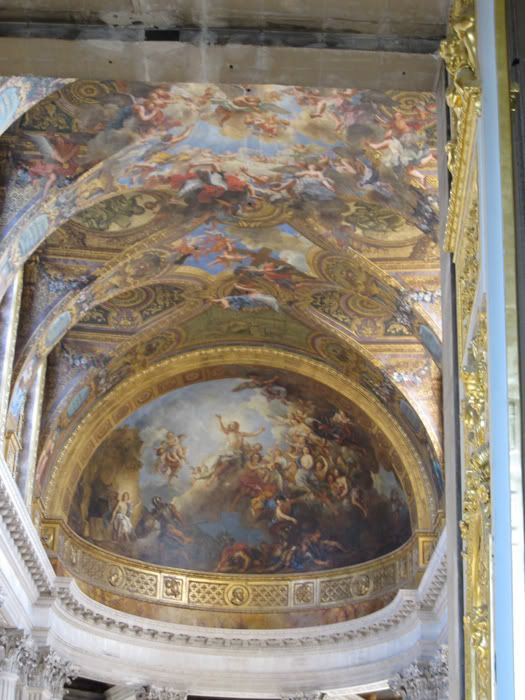
One of the first rooms visited is this royal chapel, with all these marvelous wall and ceiling paintings.
The price of admission includes audio tour guides in a choice of ten languages, where I need to press a three-digit number for each room to listen to whatever's relevant. I made sure to specify Korean for my mother, since that way, there would be a lot less translation for me to do for her, and that would also make things less obnoxious for fellow visitors. Nevertheless, there was a large group of Chinese-speaking visitors, and they did make things obnoxious between their loud chats and tendency to photograph anything/everything in sight.
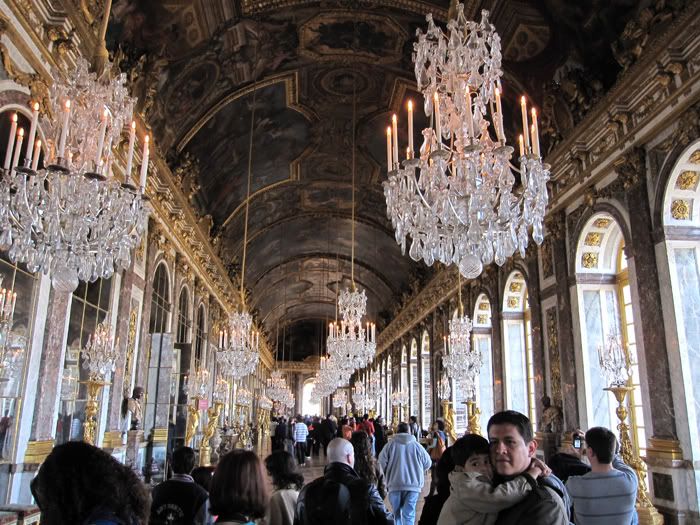
The Hall of Mirrors. Glad to be here again.
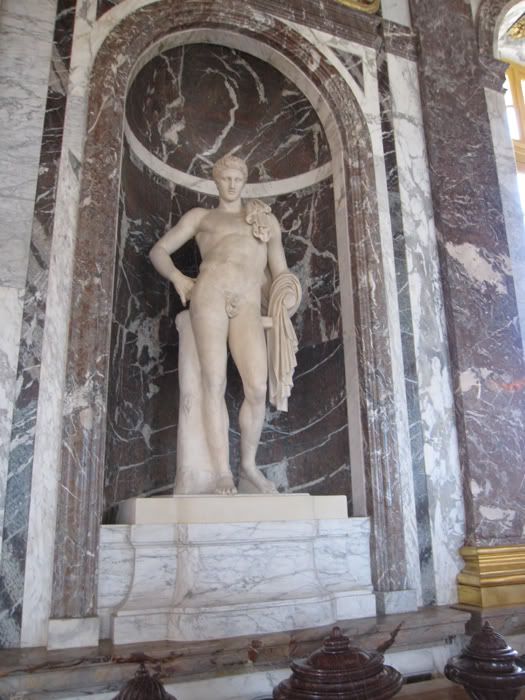
One recurring theme in royal palaces is propaganda. Just like the Wittelsbachs back in Germany, the French monarchy wanted to legitimize itself by linking itself to ancient Roman emperors. This Roman teabagger statue should do it.
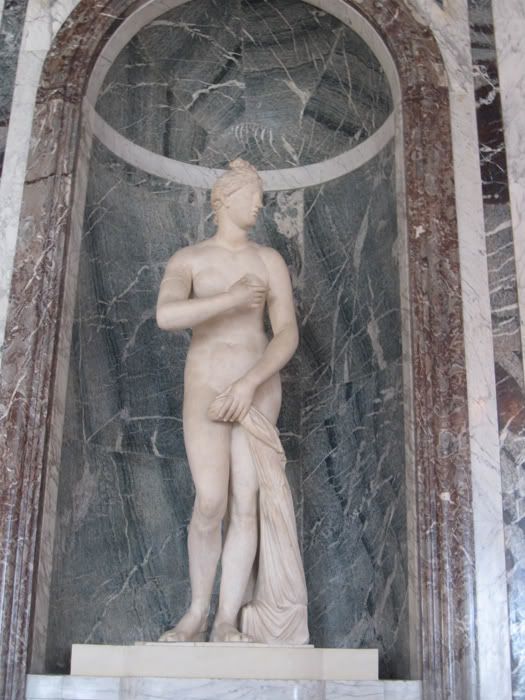
And here is a companion for him - an ancient carpetmuncher statue. Given the US political developments which are NOT exactly to my liking, I am nevertheless turning them into an excuse for humor. Again, every male nude is a teabagger in my books, and every female nude is a carpetmuncher.
Teabaggers and carpetmunchers will remain my recurring theme for the whole day.
And I am starting to feel tired of the same royal propaganda over and over. My mother and I both agree at this point - two weeks on the road is a bit more than we can take at one time.
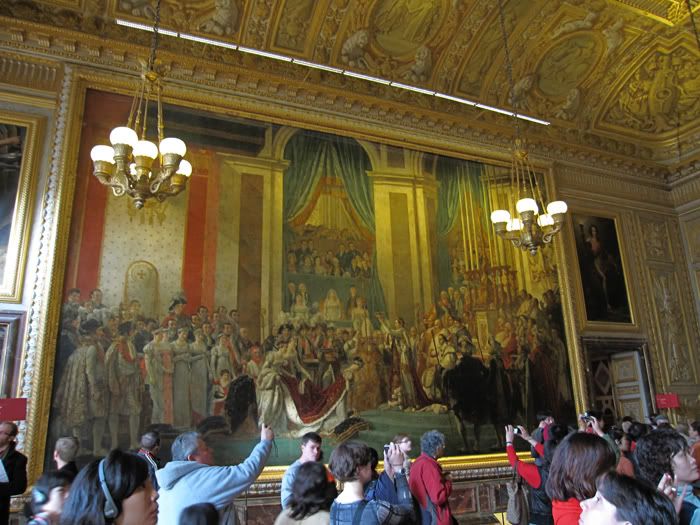
Here is a more contemporary propaganda - a painting showing the coronation of Emperor Napoleon.
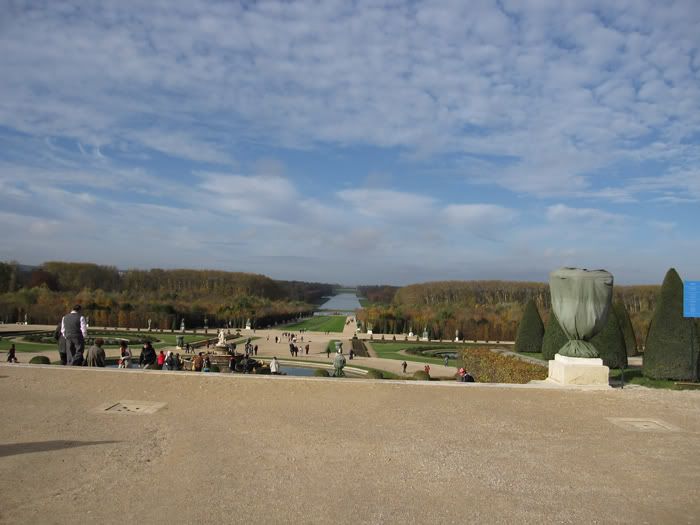
Now we're outside, in the huge royal garden to the rear of the palace. Again, glad to see that mile-long reservoir again.
Back in 1998, I had dined at a café somewhere out there, named La Flotille - implying that the body of water was so large, it had its own naval flotilla.
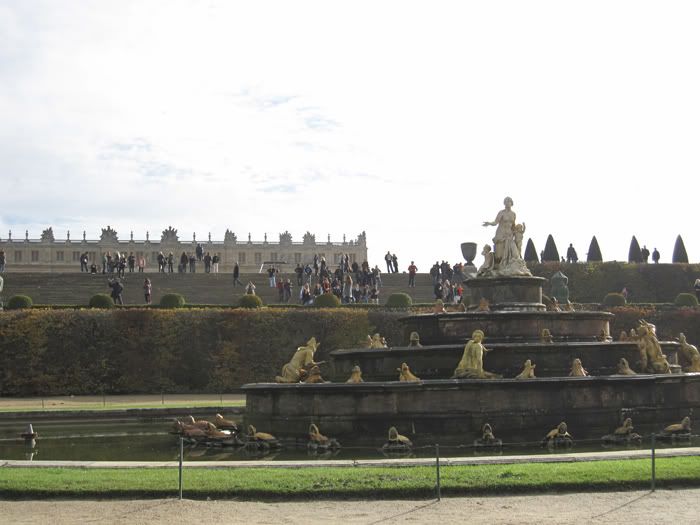
Looking back toward the palace, with details of a fountain.
I'm not liking it too much - it's partly sunny and bright out, but the winds are quite fierce. I'm blaming it on the geography of this part of Europe, where there are no major mountain ranges, and winds from the north can easily blow in without much in the way of obstructions. In fact, this is the Europe I've known from all my previous visits, until earlier this trip, when I was actually hitting some rugged mountains.
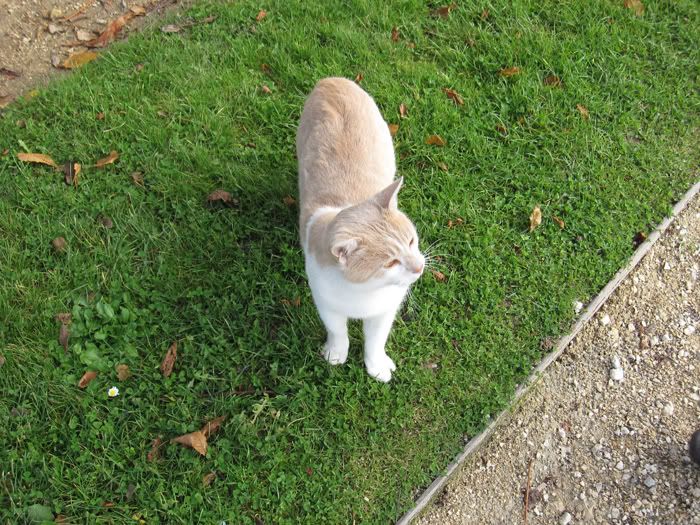
The gardeners keep a few cats around, and this one at least seems very friendly.
Back to Paris, having napped a bit on a quieter RER train. Now we're shooting for a walking tour of the Marais District. While the hotel is located in the far north fringes of the Marais in the 10th District, the real Marais is mostly the 3rd District.
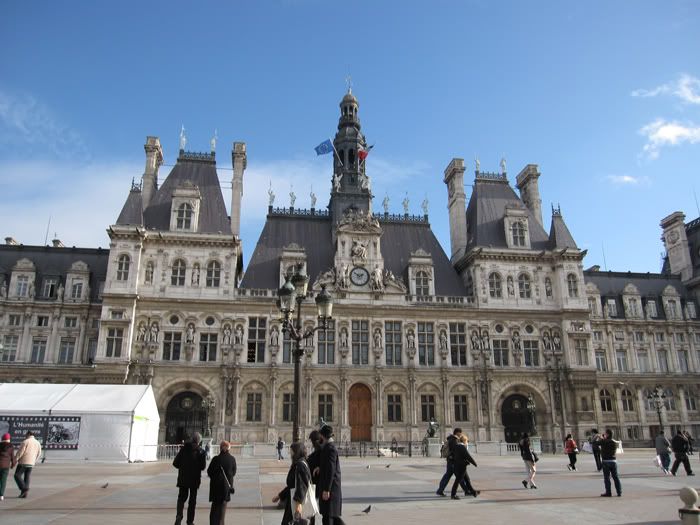
On the way, we're passing Hôtel de Ville. While foreigners often mistake a "Hôtel de Ville" for a hotel, especially in smaller towns that don't have hotels, "Hôtel de Ville" is simply French for a city hall.
The previous night, I had gotten an email letting me know that Bank of America had placed my mother's debit card on hold, due to the large, unusual transaction done earlier in the day (Louis Vuitton purses, paid for in Euro). I ducked into a pay phone and tried to call Bank of America, using the instructions in the phone booth for a US-bound phone call service. Had no luck getting through - the US-based operator couldn't help me. At least I was using an American Express to pay for travel expenses, so I wasn't too worried, besides I'd be back in the US the next day anyway.
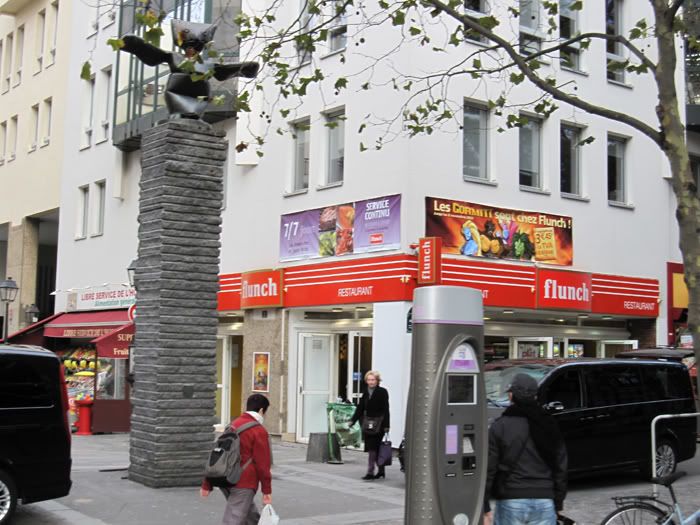
Walking past Centre Pompidou. And here is a location of Flunch - another French take on fast food. This place will certainly be worth a try, but I would not get a chance to go in this time.
In fact, my mother had insisted on going back to the very same Japanese place from the previous day, while my intention was to grab a light salad from a neighborhood café - often the cheapest dining option in Paris. Honestly, when I came all the way to Europe, the last thing I wanted to do was to eat the same Asian stuff, stuff that I eat both in the US and in Asia, over and over, At least I should've been grateful that Asian eateries in Europe don't come with Christian extremist propaganda, the way every Korean diner in the US does.
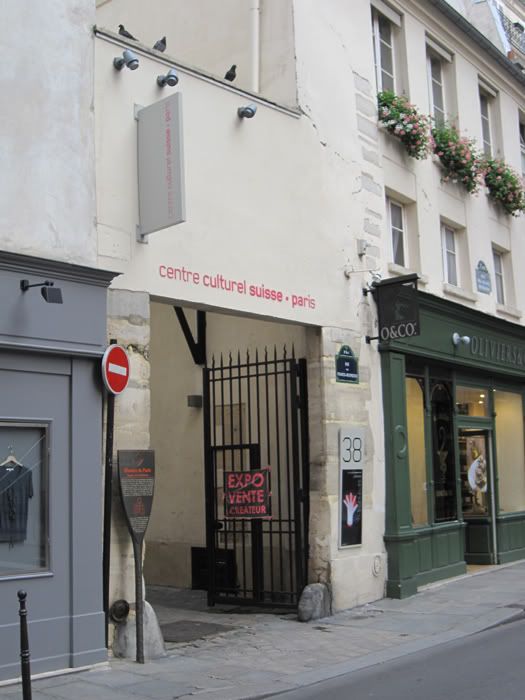
Paris is a major cultural center of the world, and also the only national capital included in this trip (I am not counting the drive through Bern). That means foreign countries' cultural centers are a very common sight throughout the city.
The Swiss Cultural Center is located on a quiet side street in the Marais, as seen above.
The Marais, just like Montmartre, did not get modernized wide boulevards in the 19th Century, one reason why it is a very desirable neighborhood today.
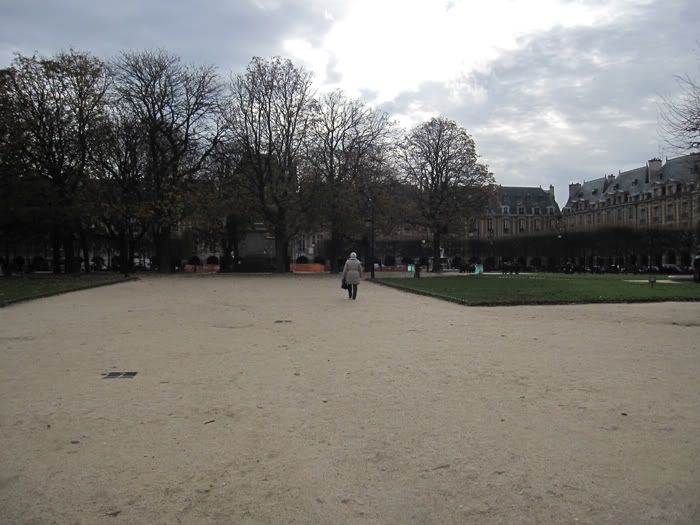
Place des Vosges, the main neighborhood plaza of the Marais.
I'd like to hang around, but my mother is showing zero interest. Tired from two weeks on the road, she is now only looking for big "bragging rights" sights before going home, rather than having any thoughts on French cultural nuances. Even my attempts to explain French pronunciation rules (which final consonants get pronounced and which ones don't) are more information than she wants to ever bother with.
Now we've walked through the Marais, and are nearing the site of the Bastille Prison.
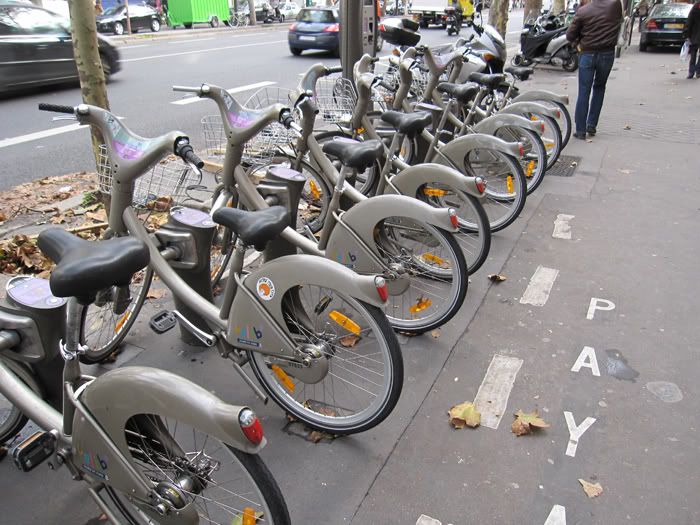
These bicycles belong to Vélib, a city program that allows citizens to rent a bicycle for free, for up to 30 minutes at a time. With hundreds of bicycle racks throughout the city like this, it's possible to rent a bike here, ride a short distance, return the bike, do a few things, then rent another bike for another short hop elsewhere. Nice idea.
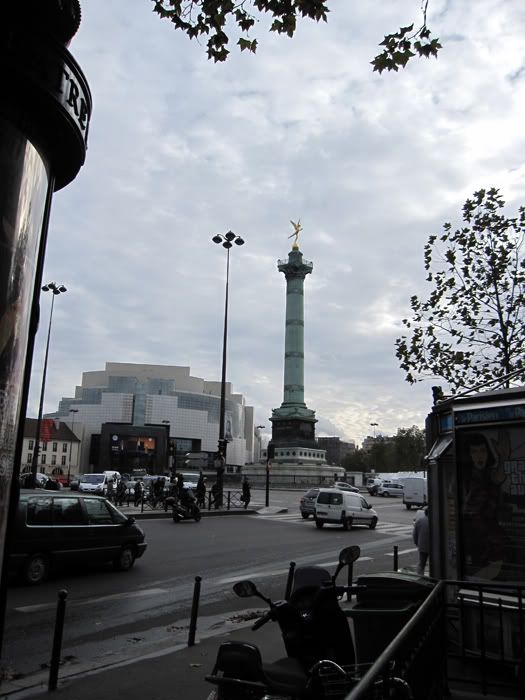
Now at Bastille. The prison was destroyed in the 1789 Revolution, and has been France's greatest non-sight ever since. Today, Bastille is better known for a modern opera house, on the left.
The peasants' rise to overthrow the monarchy, behead the elites, and destroy the elites' tools of oppression, made for a strong message to powered elites everywhere. Ironically, the French monarchy had bankrupted the economy while fighting a war in North America against the hated British, ensuring the independence of the United States, and the promotion of its own radical ideas, in the process. But now, the US is a mature society with its own haves and have-nots as well, and the US powered elites, having seen what happened during the French Revolution, have really rigged the system from the era of President Reagan on, to ensure that the peasants will NOT rise to overthrow them. That explains why the US is one of the few countries that refuses to use the metric system, which was a product of the French Revolution, and also why the US media/propaganda machine has been so well-oiled, to a point where the peasants are now ready for a revolution, but to further weaken themselves and give more power to the aristocracy - the whole point of the teabagging movement.
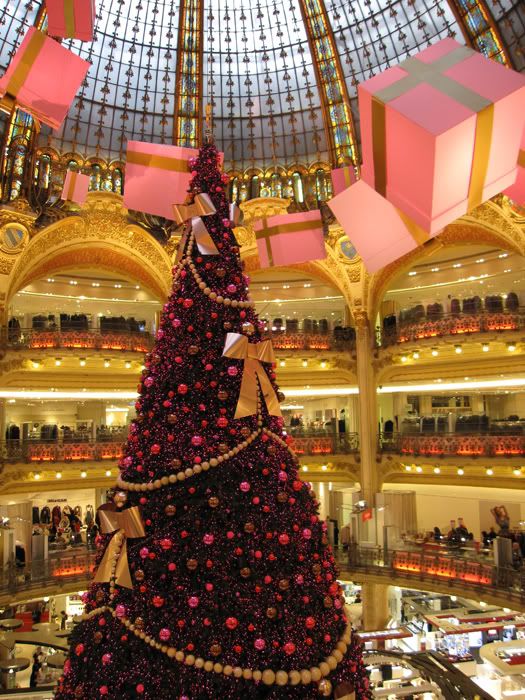
Next up: one of Paris' storied department stores. We're visiting Galeries Lafayette, where the Christmas decorations are already up in full force. Love the glass dome on the top.
This building is dedicated to women's fashion, so I am taking good mental notes on the French fashion trends. The French women have a "je ne sais quoi" quality when it comes to their fashion statements - always subdued, never obsessed with the "it" trends, but nevertheless far more chic than Americans and Asians. I didn't do any shopping here though.
Men's fashion and other items are in an adjacent building.
The department store was next to the Garnier opera house, where I also located a stop for Roissybus, Paris' city bus service that goes nonstop to Charles de Gaulle Airport. I needed to locate it, as I wanted to use the service, rather than the overpriced Air France coaches or the pickpocket-infested RER, to get to the airport the next day to fly home.
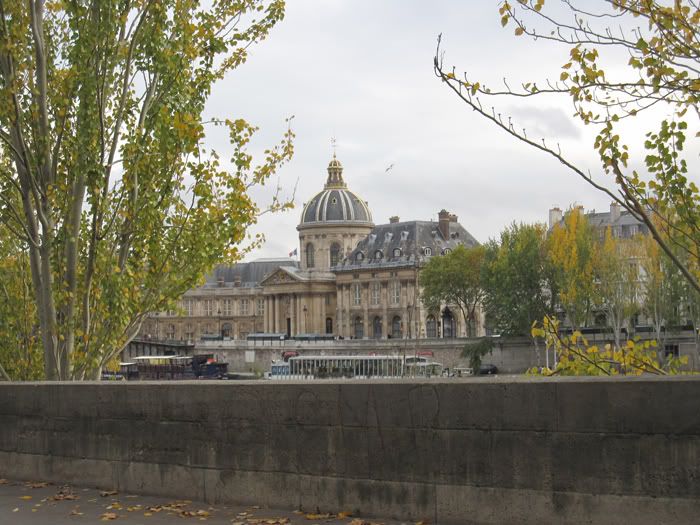
A wide boulevard runs from Opera Garnier straight toward the Louvre, and I have crossed the Louvre onto the Seine shore. Across the river, I see l'Academie Française, the national academy best known for "defending the purity of the French language," by, for example, coming up with French equivalent words to such commonly used English expressions as the Web or e-mail, and encouraging French speakers to use them. Its work sees mixed success.
The evening was spent frantically running through the Louvre, the absolute final sight of this two-week trip through Europe. We waited for the reduced-price admissions hour at 5PM, during which we had a salad dinner at the Louvre's own café (I paid a bit more, just for the privilege of sitting down a table). We also picked up the museum map to plot an efficient route through the "big hits" at the museum; again, my mother was looking for the big hits, not interested in taking an impromptu art history lesson at all. Besides, the Louvre's huge size makes it impossible to see it all in just a few hours (I know, I tried in 1998).
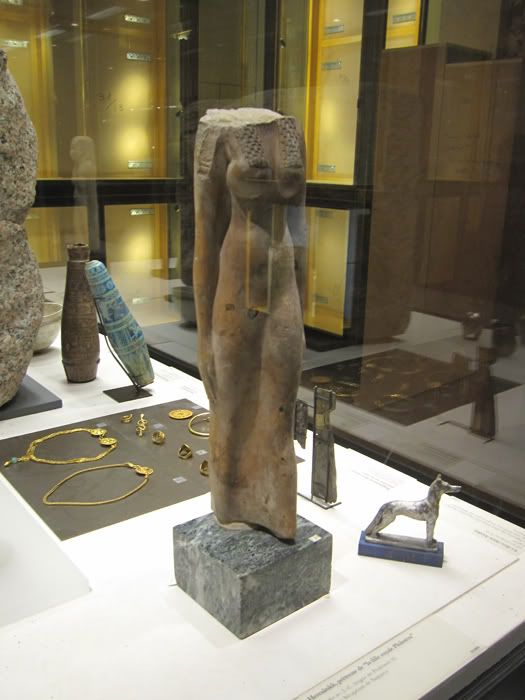
The Louvre is mostly concerned with European art, but it does have a good collection of Egyptian art too, as seen in this female statue. She is posed very similar to the idealized Greek male nude statues (kouros) that followed centuries later.
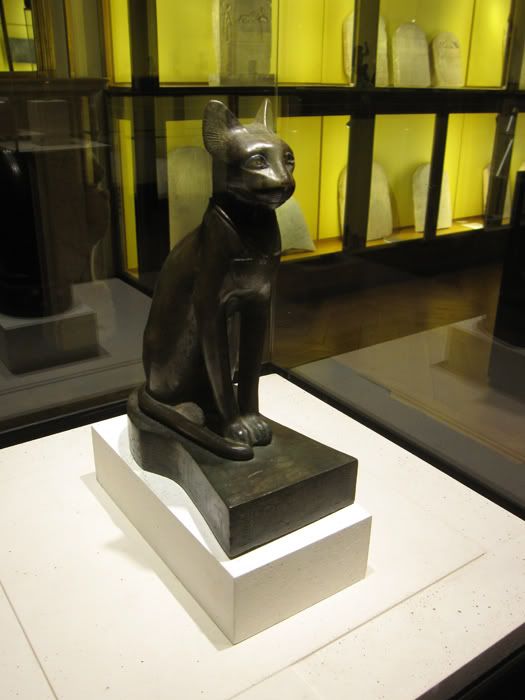
And when it comes to Egyptian art, I cannot skip my favorite Egyptian deity - Goddess Bastet, who often takes the form of a cat, like this. Not as large as the example that sits in London as the symbol of the British Museum, but just as spectacular.
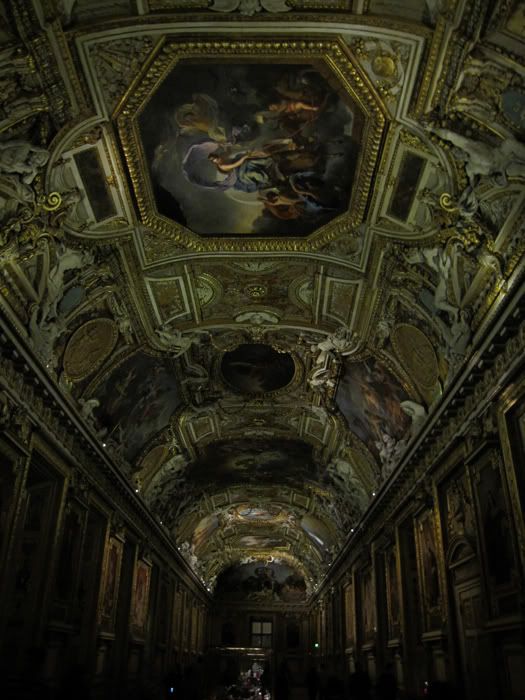
The Louvre was itself a royal palace back in the day, and served as a royal museum, before becoming public in the wake of the 1789 Revolution. And these ceiling friezes give away that royal grandeur of the past. This room is dedicated to royal jewelry and heirlooms.
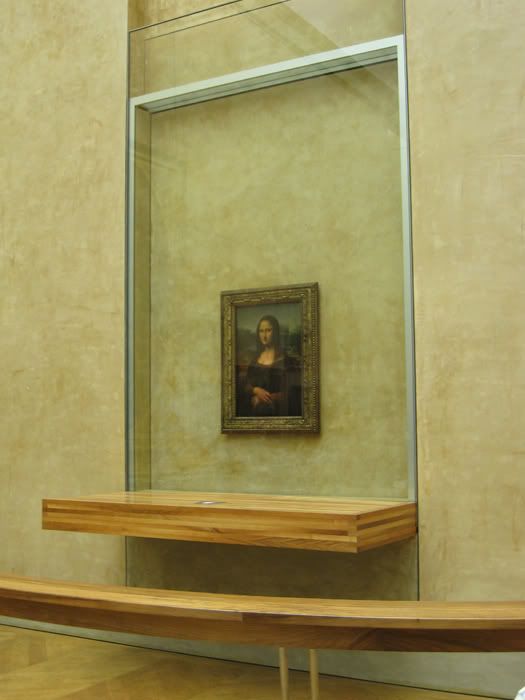
Possibly the biggest star at the Louvre - Mona Lisa, known as La Joconde in French.
I was lucky enough to get a clear shot of the painting without any adoring tourist masses in the way.
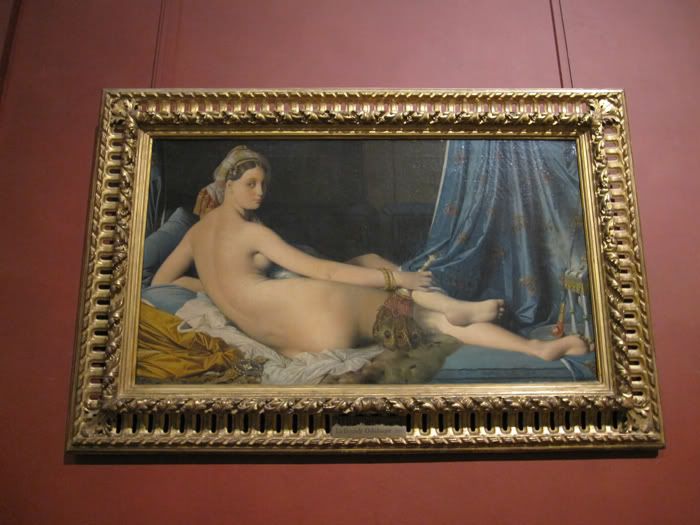
La Grande Odalisque, by Jean-Auguste-Dominique Ingres in 1804. A well-known painting, and over at the now-dormant Christy's Art Blog, uploaded a few times back in the day as Christy's concession to me. She originally had a series of "Art for Boys" featuring female nudes, and "Art for Girls" featuring male nudes, but upon my protest, added a "Vintage for Ally McLesbian" series featuring vintage female nudes just for me.
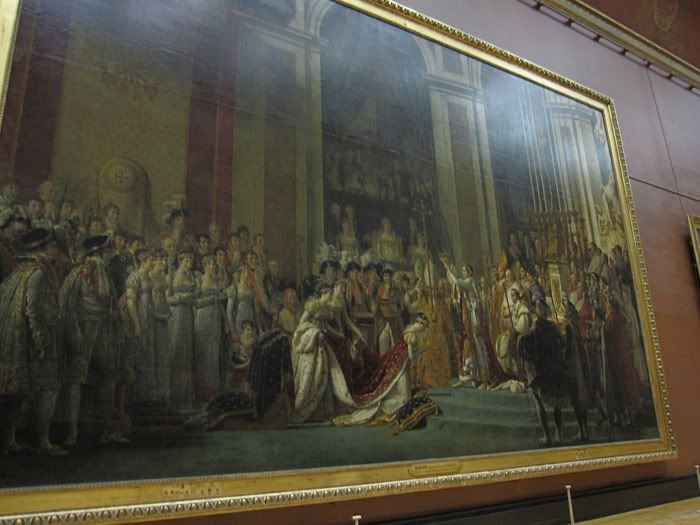
I had seen this one over at Versailles just hours before. Coronation of Napoleon, as painted by Louis David in 1806-1807 for a 1808 exhibition.
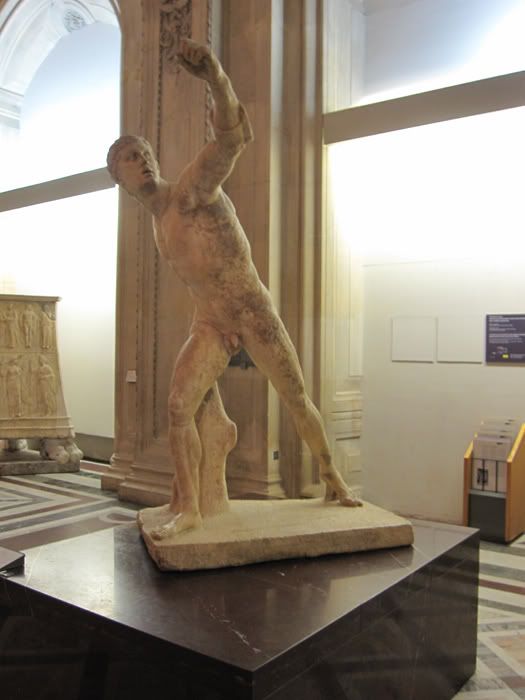
This teabagger is simply labeled as a fighting warrior. It is on loan from Villa Borghese in Rome, alongside many others. Estimated date for the statue is about 100 BC.

This is a Roman Venus statue, dated to 2nd Century, but labeled as "completed in 6th Century."
While the Louvre overflows with teabaggers, there are enough carpetmunchers like this to keep the place sane.
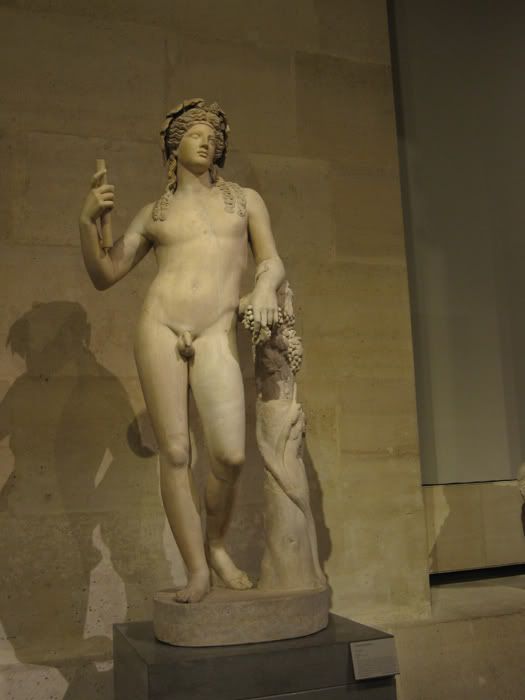
The presence of grapes and wine gives away the identity of this particular teabagger as Bacchus. It is from the 2nd Century.
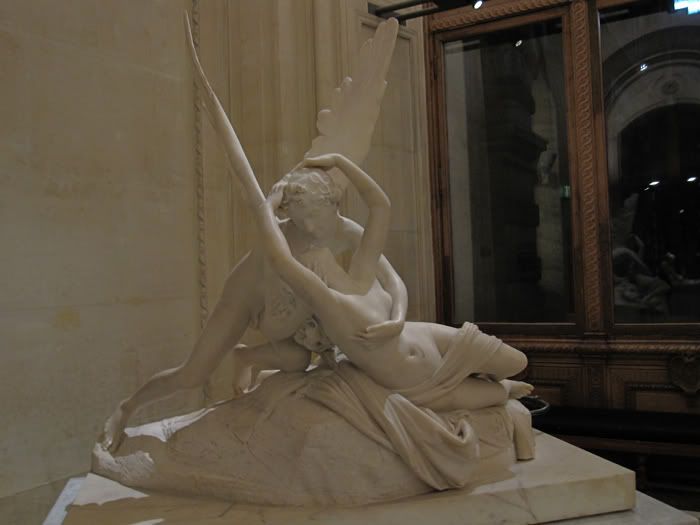
Love this Cupid sculpture.
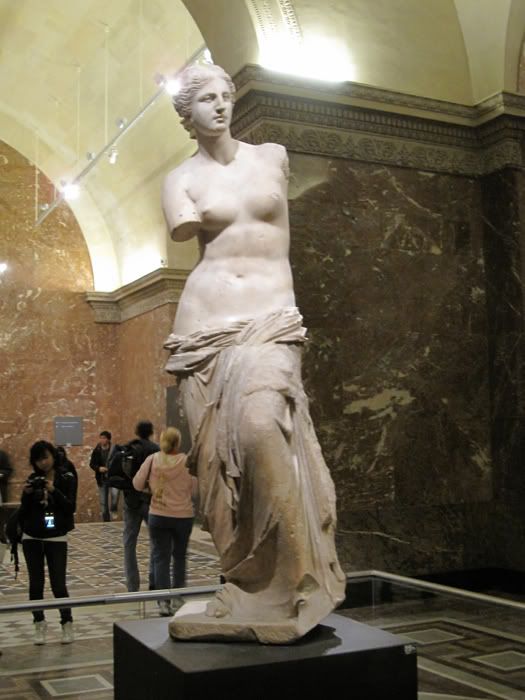
Another major star at the Louvre - Venus de Milo, found on the Greek island of Milos (therefore being Venus' original Greek version, Aphrodite, instead of Roman Venus), and made of two pieces of marble.
This is one Greek Goddess who can keep me smitten.
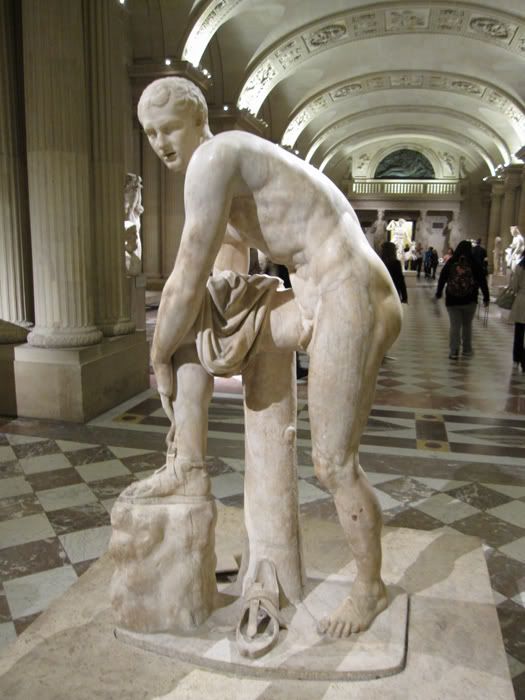
This teabagger turns out to be messenger Hermes, based on the way he puts the sandals on. He dates to approximately the 2nd Century, and was found at the Marcellus Theatre in Rome.
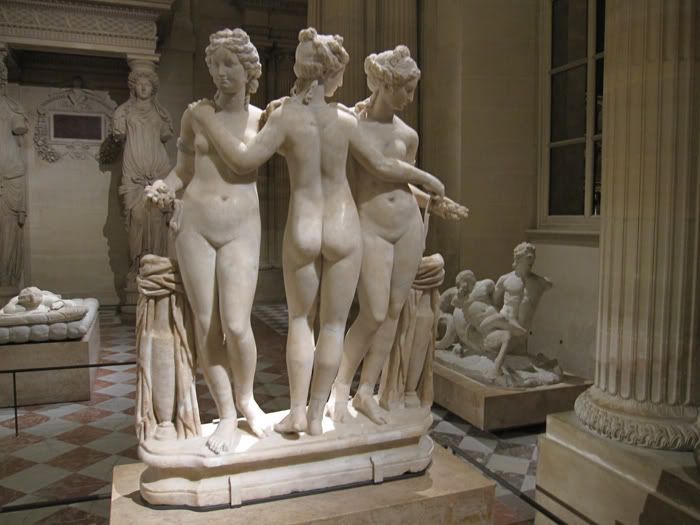
Three lovely nymphs found at a Roman villa, date unknown but assumed to be about 2nd Century. They are entitled "Three Graces." What a lovely sight - again, there are enough carpetmunchers around here to relieve me from the sight of all those numerous, hideous teabaggers.
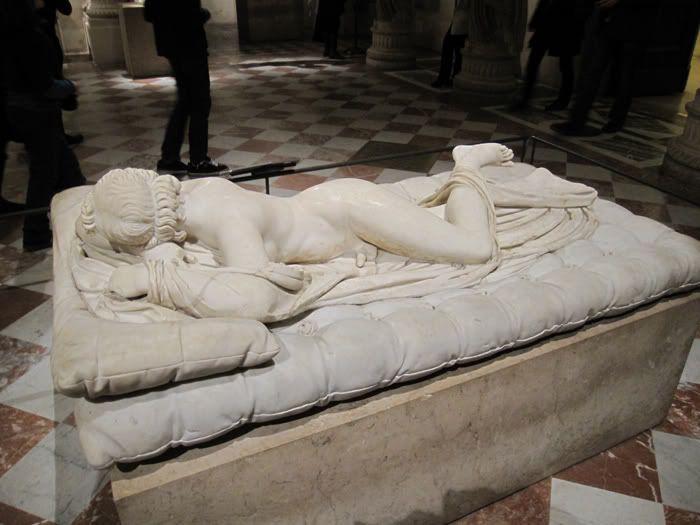
Though I was not happy with this sculpture at all. I first approached from the back, where the sculpture looked the part of a lovely nymph, with soft, round, feminine curves. The sculpture was labeled "Hermaphrodite" - and is a 16th Century reproduction of a 1st Century Roman original. And coming around to this side, I continue to notice feminine features, including boobs, but I also do see a sizable manhood. In fact, this "nymph" has a bigger manhood than the macho muscular teabagger warriors standing throughout the museum.
I was expecting Hermaphrodite to be more ambiguous, rather than being the loveliest nymph who also happened to be the most phallic. Apparently, the ancient Romans weren't merely into teabagging, they were into shemale porn as well. Not a good thought for me.
And this pretty much marked the end of my Paris and European sightseeing, as the next day, Saturday the 7th, was dedicated to the return journey.
The journey started with a midmorning bus hop to Opera Garnier (even paying the bus fare involved buying subway-style magnetic tickets from the driver, then having them punch validated, though the tickets were useless for transfers). Roissybus promptly took us to De Gaulle Airport, and its aged Terminal 1, where we killed time at the Lufthansa lounge (courtesy of Mercedes-Benz) for a few hours. The initial leg, leaving around 1PM, took us back to Munich, on an Embraer 195 regional jet flown by Augsburg Airways, a regional affiliate of Lufthansa; I was pleased with the clockwork-like service of flight attendants, as well as a snack (yes, even on this very short flight).
We arrived in Munich right on time to clear the EU departure check, get the tax-free refund form stamped by German customs, and to board Lufthansa 452 to Los Angeles - again, an Airbus 340-600. I also noted that my flight was leaving from a dedicated area at the south end of Terminal 2, to comply with any additional US security checks needed - all US-bound Lufthansa flights, and all United flights, were operating from the three southernmost gates. The long flight back to Los Angeles took a very northerly route, straying well north of the Arctic Circle and in the dark for the first half of the flight, before the sun came back up from the west for the flight over Canada. Entry into Canada was well to the north of Hudson Bay, and after passing Edmonton and Banff, entry to the US was toward Spokane, where the sun started to set again. The rest of the flight path into Los Angeles was due south over Reno, and was uneventful, and I was again appreciating the highly professional Lufthansa service, down to tips on filling out US immigration forms (no umlauts if I have a German name - add an E after the offending vowel, otherwise US Department of Homeland Security can't process the forms) and navigating through the Bradley International Terminal. An on-time arrival at 7PM local time in Los Angeles marked the end of this lovely two-week adventure through Europe, one that introduced me to three new countries, gave me a true introduction to a fourth, and allowed me to fall in love with an old favorite too. And again, shaking the Amsterdam demons off was probably the biggest plus of the trip.
And I continue to travel on. My United Premier status renewed into 2010 thanks to this journey, and New Orleans shall await me later in May.
The final sightseeing day started out with a morning visit to Versailles, and its world-famous royal Château. I bought the full fare to Versailles at the local subway station, making sure not to repeat the mistake I had made back in 1998, when I had used a basic subway fare to get to the RER transfer point, then had to buy a full RER Versailles fare at that point. As I waited for the RER trains, I noted that each train had a catchy four-letter name, the first letter corresponding to the first letter of the destination station. The French have a sense of humor like that. I have to say, however, that the graffiti-laden RER trains were less than pleasant, made worse by a musician who asked for my change even though I was clearly NOT interested in his music. (I gave him only 20 cents.)
Versailles, again, is a repeat visit.
One of the first rooms visited is this royal chapel, with all these marvelous wall and ceiling paintings.
The price of admission includes audio tour guides in a choice of ten languages, where I need to press a three-digit number for each room to listen to whatever's relevant. I made sure to specify Korean for my mother, since that way, there would be a lot less translation for me to do for her, and that would also make things less obnoxious for fellow visitors. Nevertheless, there was a large group of Chinese-speaking visitors, and they did make things obnoxious between their loud chats and tendency to photograph anything/everything in sight.
The Hall of Mirrors. Glad to be here again.
One recurring theme in royal palaces is propaganda. Just like the Wittelsbachs back in Germany, the French monarchy wanted to legitimize itself by linking itself to ancient Roman emperors. This Roman teabagger statue should do it.
And here is a companion for him - an ancient carpetmuncher statue. Given the US political developments which are NOT exactly to my liking, I am nevertheless turning them into an excuse for humor. Again, every male nude is a teabagger in my books, and every female nude is a carpetmuncher.
Teabaggers and carpetmunchers will remain my recurring theme for the whole day.
And I am starting to feel tired of the same royal propaganda over and over. My mother and I both agree at this point - two weeks on the road is a bit more than we can take at one time.
Here is a more contemporary propaganda - a painting showing the coronation of Emperor Napoleon.
Now we're outside, in the huge royal garden to the rear of the palace. Again, glad to see that mile-long reservoir again.
Back in 1998, I had dined at a café somewhere out there, named La Flotille - implying that the body of water was so large, it had its own naval flotilla.
Looking back toward the palace, with details of a fountain.
I'm not liking it too much - it's partly sunny and bright out, but the winds are quite fierce. I'm blaming it on the geography of this part of Europe, where there are no major mountain ranges, and winds from the north can easily blow in without much in the way of obstructions. In fact, this is the Europe I've known from all my previous visits, until earlier this trip, when I was actually hitting some rugged mountains.
The gardeners keep a few cats around, and this one at least seems very friendly.
Back to Paris, having napped a bit on a quieter RER train. Now we're shooting for a walking tour of the Marais District. While the hotel is located in the far north fringes of the Marais in the 10th District, the real Marais is mostly the 3rd District.
On the way, we're passing Hôtel de Ville. While foreigners often mistake a "Hôtel de Ville" for a hotel, especially in smaller towns that don't have hotels, "Hôtel de Ville" is simply French for a city hall.
The previous night, I had gotten an email letting me know that Bank of America had placed my mother's debit card on hold, due to the large, unusual transaction done earlier in the day (Louis Vuitton purses, paid for in Euro). I ducked into a pay phone and tried to call Bank of America, using the instructions in the phone booth for a US-bound phone call service. Had no luck getting through - the US-based operator couldn't help me. At least I was using an American Express to pay for travel expenses, so I wasn't too worried, besides I'd be back in the US the next day anyway.
Walking past Centre Pompidou. And here is a location of Flunch - another French take on fast food. This place will certainly be worth a try, but I would not get a chance to go in this time.
In fact, my mother had insisted on going back to the very same Japanese place from the previous day, while my intention was to grab a light salad from a neighborhood café - often the cheapest dining option in Paris. Honestly, when I came all the way to Europe, the last thing I wanted to do was to eat the same Asian stuff, stuff that I eat both in the US and in Asia, over and over, At least I should've been grateful that Asian eateries in Europe don't come with Christian extremist propaganda, the way every Korean diner in the US does.
Paris is a major cultural center of the world, and also the only national capital included in this trip (I am not counting the drive through Bern). That means foreign countries' cultural centers are a very common sight throughout the city.
The Swiss Cultural Center is located on a quiet side street in the Marais, as seen above.
The Marais, just like Montmartre, did not get modernized wide boulevards in the 19th Century, one reason why it is a very desirable neighborhood today.
Place des Vosges, the main neighborhood plaza of the Marais.
I'd like to hang around, but my mother is showing zero interest. Tired from two weeks on the road, she is now only looking for big "bragging rights" sights before going home, rather than having any thoughts on French cultural nuances. Even my attempts to explain French pronunciation rules (which final consonants get pronounced and which ones don't) are more information than she wants to ever bother with.
Now we've walked through the Marais, and are nearing the site of the Bastille Prison.
These bicycles belong to Vélib, a city program that allows citizens to rent a bicycle for free, for up to 30 minutes at a time. With hundreds of bicycle racks throughout the city like this, it's possible to rent a bike here, ride a short distance, return the bike, do a few things, then rent another bike for another short hop elsewhere. Nice idea.
Now at Bastille. The prison was destroyed in the 1789 Revolution, and has been France's greatest non-sight ever since. Today, Bastille is better known for a modern opera house, on the left.
The peasants' rise to overthrow the monarchy, behead the elites, and destroy the elites' tools of oppression, made for a strong message to powered elites everywhere. Ironically, the French monarchy had bankrupted the economy while fighting a war in North America against the hated British, ensuring the independence of the United States, and the promotion of its own radical ideas, in the process. But now, the US is a mature society with its own haves and have-nots as well, and the US powered elites, having seen what happened during the French Revolution, have really rigged the system from the era of President Reagan on, to ensure that the peasants will NOT rise to overthrow them. That explains why the US is one of the few countries that refuses to use the metric system, which was a product of the French Revolution, and also why the US media/propaganda machine has been so well-oiled, to a point where the peasants are now ready for a revolution, but to further weaken themselves and give more power to the aristocracy - the whole point of the teabagging movement.
Next up: one of Paris' storied department stores. We're visiting Galeries Lafayette, where the Christmas decorations are already up in full force. Love the glass dome on the top.
This building is dedicated to women's fashion, so I am taking good mental notes on the French fashion trends. The French women have a "je ne sais quoi" quality when it comes to their fashion statements - always subdued, never obsessed with the "it" trends, but nevertheless far more chic than Americans and Asians. I didn't do any shopping here though.
Men's fashion and other items are in an adjacent building.
The department store was next to the Garnier opera house, where I also located a stop for Roissybus, Paris' city bus service that goes nonstop to Charles de Gaulle Airport. I needed to locate it, as I wanted to use the service, rather than the overpriced Air France coaches or the pickpocket-infested RER, to get to the airport the next day to fly home.
A wide boulevard runs from Opera Garnier straight toward the Louvre, and I have crossed the Louvre onto the Seine shore. Across the river, I see l'Academie Française, the national academy best known for "defending the purity of the French language," by, for example, coming up with French equivalent words to such commonly used English expressions as the Web or e-mail, and encouraging French speakers to use them. Its work sees mixed success.
The evening was spent frantically running through the Louvre, the absolute final sight of this two-week trip through Europe. We waited for the reduced-price admissions hour at 5PM, during which we had a salad dinner at the Louvre's own café (I paid a bit more, just for the privilege of sitting down a table). We also picked up the museum map to plot an efficient route through the "big hits" at the museum; again, my mother was looking for the big hits, not interested in taking an impromptu art history lesson at all. Besides, the Louvre's huge size makes it impossible to see it all in just a few hours (I know, I tried in 1998).
The Louvre is mostly concerned with European art, but it does have a good collection of Egyptian art too, as seen in this female statue. She is posed very similar to the idealized Greek male nude statues (kouros) that followed centuries later.
And when it comes to Egyptian art, I cannot skip my favorite Egyptian deity - Goddess Bastet, who often takes the form of a cat, like this. Not as large as the example that sits in London as the symbol of the British Museum, but just as spectacular.
The Louvre was itself a royal palace back in the day, and served as a royal museum, before becoming public in the wake of the 1789 Revolution. And these ceiling friezes give away that royal grandeur of the past. This room is dedicated to royal jewelry and heirlooms.
Possibly the biggest star at the Louvre - Mona Lisa, known as La Joconde in French.
I was lucky enough to get a clear shot of the painting without any adoring tourist masses in the way.
La Grande Odalisque, by Jean-Auguste-Dominique Ingres in 1804. A well-known painting, and over at the now-dormant Christy's Art Blog, uploaded a few times back in the day as Christy's concession to me. She originally had a series of "Art for Boys" featuring female nudes, and "Art for Girls" featuring male nudes, but upon my protest, added a "Vintage for Ally McLesbian" series featuring vintage female nudes just for me.
I had seen this one over at Versailles just hours before. Coronation of Napoleon, as painted by Louis David in 1806-1807 for a 1808 exhibition.
This teabagger is simply labeled as a fighting warrior. It is on loan from Villa Borghese in Rome, alongside many others. Estimated date for the statue is about 100 BC.
This is a Roman Venus statue, dated to 2nd Century, but labeled as "completed in 6th Century."
While the Louvre overflows with teabaggers, there are enough carpetmunchers like this to keep the place sane.
The presence of grapes and wine gives away the identity of this particular teabagger as Bacchus. It is from the 2nd Century.
Love this Cupid sculpture.
Another major star at the Louvre - Venus de Milo, found on the Greek island of Milos (therefore being Venus' original Greek version, Aphrodite, instead of Roman Venus), and made of two pieces of marble.
This is one Greek Goddess who can keep me smitten.
This teabagger turns out to be messenger Hermes, based on the way he puts the sandals on. He dates to approximately the 2nd Century, and was found at the Marcellus Theatre in Rome.
Three lovely nymphs found at a Roman villa, date unknown but assumed to be about 2nd Century. They are entitled "Three Graces." What a lovely sight - again, there are enough carpetmunchers around here to relieve me from the sight of all those numerous, hideous teabaggers.
Though I was not happy with this sculpture at all. I first approached from the back, where the sculpture looked the part of a lovely nymph, with soft, round, feminine curves. The sculpture was labeled "Hermaphrodite" - and is a 16th Century reproduction of a 1st Century Roman original. And coming around to this side, I continue to notice feminine features, including boobs, but I also do see a sizable manhood. In fact, this "nymph" has a bigger manhood than the macho muscular teabagger warriors standing throughout the museum.
I was expecting Hermaphrodite to be more ambiguous, rather than being the loveliest nymph who also happened to be the most phallic. Apparently, the ancient Romans weren't merely into teabagging, they were into shemale porn as well. Not a good thought for me.
And this pretty much marked the end of my Paris and European sightseeing, as the next day, Saturday the 7th, was dedicated to the return journey.
The journey started with a midmorning bus hop to Opera Garnier (even paying the bus fare involved buying subway-style magnetic tickets from the driver, then having them punch validated, though the tickets were useless for transfers). Roissybus promptly took us to De Gaulle Airport, and its aged Terminal 1, where we killed time at the Lufthansa lounge (courtesy of Mercedes-Benz) for a few hours. The initial leg, leaving around 1PM, took us back to Munich, on an Embraer 195 regional jet flown by Augsburg Airways, a regional affiliate of Lufthansa; I was pleased with the clockwork-like service of flight attendants, as well as a snack (yes, even on this very short flight).
We arrived in Munich right on time to clear the EU departure check, get the tax-free refund form stamped by German customs, and to board Lufthansa 452 to Los Angeles - again, an Airbus 340-600. I also noted that my flight was leaving from a dedicated area at the south end of Terminal 2, to comply with any additional US security checks needed - all US-bound Lufthansa flights, and all United flights, were operating from the three southernmost gates. The long flight back to Los Angeles took a very northerly route, straying well north of the Arctic Circle and in the dark for the first half of the flight, before the sun came back up from the west for the flight over Canada. Entry into Canada was well to the north of Hudson Bay, and after passing Edmonton and Banff, entry to the US was toward Spokane, where the sun started to set again. The rest of the flight path into Los Angeles was due south over Reno, and was uneventful, and I was again appreciating the highly professional Lufthansa service, down to tips on filling out US immigration forms (no umlauts if I have a German name - add an E after the offending vowel, otherwise US Department of Homeland Security can't process the forms) and navigating through the Bradley International Terminal. An on-time arrival at 7PM local time in Los Angeles marked the end of this lovely two-week adventure through Europe, one that introduced me to three new countries, gave me a true introduction to a fourth, and allowed me to fall in love with an old favorite too. And again, shaking the Amsterdam demons off was probably the biggest plus of the trip.
And I continue to travel on. My United Premier status renewed into 2010 thanks to this journey, and New Orleans shall await me later in May.

26 April 2010
Europe recap, Day 12: Paris, Day 1
This is my 1,000th blog post - I am glad to hit this milestone. And this post will recap Thursday, November 5th, 2009, which was spent as the first of two full days in France as I wrapped up my two-week European tour. This also happened to be exactly six years after wrapping up my previous Paris visit, when I had come in from London on Eurostar and spent two nights.
While all my previous sights in this trip were brand-new territory for me, Paris is a return visit, done primarily for the benefit of my mother. I simply did not want to leave Europe without taking her to one of Europe's three "star attraction" cities - London, Paris, and Rome - and Paris made the most sense, as including Rome in an itinerary involving a new luxury car was asking for trouble, and London was just too far away (and the UK does not arouse my mother's curiosity all that much). I am navigating Paris and playing tour guide for my mother, using not only tips from Rick Steves' guidebook but also from my own past experiences. It also helps that I know enough French to eavesdrop in on some conversations, and to read subway ads and discover their nuances - two luxuries I did not have in German-speaking regions and Italy.
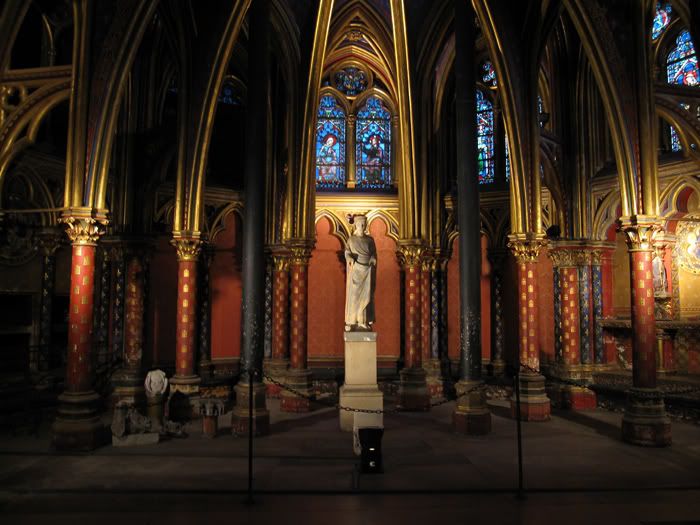
To stick to my "repeat visit" theme, I am starting my Parisian tour at my favorite sight in all of the city, which I had previously discovered during my very first visit in 1998. This is Sainte-Chapelle, a two-tiered chapel on Ile de la Cité in the dead middle of the city.
This is a two-tiered royal chapel, and I am starting on the lower level, which is already quite stunning in its own right. This level would've been used for visitors to the royal facilities.
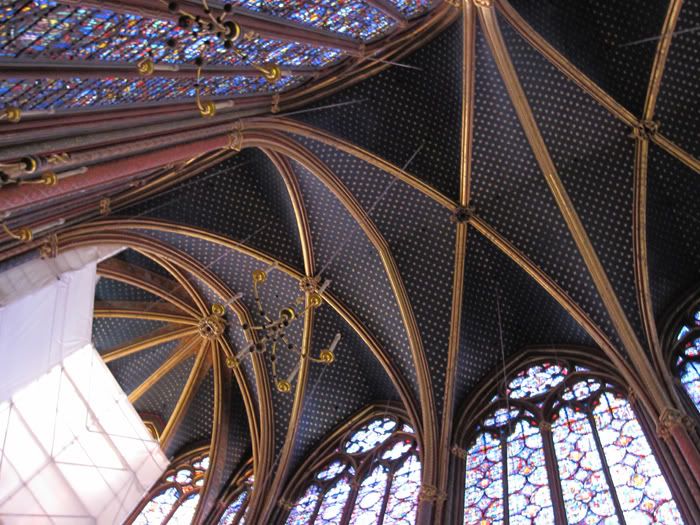
But the lower level pales when compared to the magnificent upper level, reserved for the royalty, renowned for its stained-glass windows. Back in 1998, this place had left me awestruck - and I wanted my mother to have that same awestruck feeling, the reason for starting my Paris tour here.
The stained-glass windows were intended to tell the biblical stories in an era when many people were illiterate. They go from the Creation to the Resurrection of Jesus in clockwise order.
It's not as awesome as it should be, thanks to a somewhat hazy/cloudy weather for the day, but it's still quite a sight.
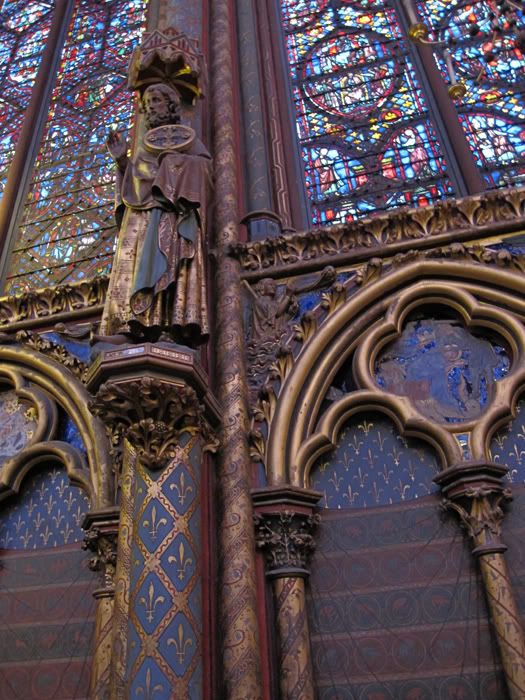
Details on the wall. The stained glass windows, one saint statue, and the unmistakable fleur-de-lis, a French motif also commonly seen in formerly French areas of North America, like Québec and Louisiana.
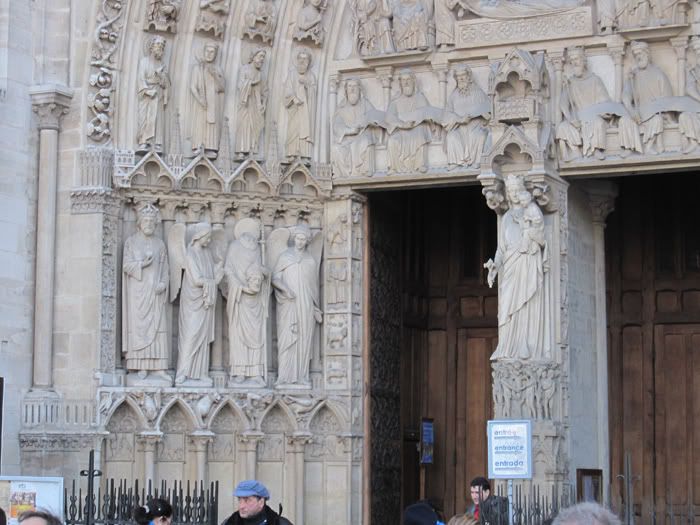
It's only a short walk from Sainte-Chapelle to the Notre-Dame Cathedral. While I don't really need any more cathedrals at this point of my trip, I do need to squeeze in a bragging rights sight for my mother while I can.
Here is one of the entryways, with a prominent "Madonna with Child" statue on the center pillar and flanked by angels, disciples, and saints.
On the left side, third from the left, there is a headless saint standing, holding his head in his hands. That would be St. Denis, a local martyr. Legends say that when he was beheaded for his Christian faith, he simply picked up his severed head and walked away. Such imagery to reinforce people's faith in Christianity have widely been used throughout the Middle Ages and beyond in Europe, and even in today's more secular era, religion continues on - though mercifully, more as a cultural relic and heritage rather than an obsession that it is stateside.
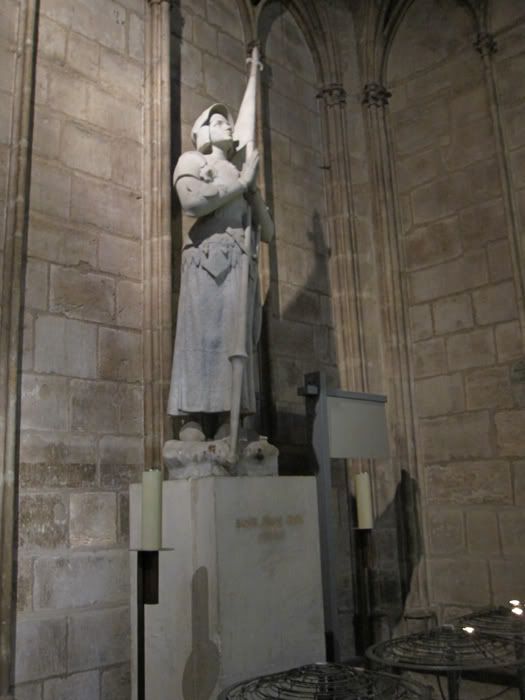
Jeanne d'Arc, housed in Notre-Dame Cathedral as a saint.
Ironic, considering that Jeanne d'Arc was burned at the stake during the Hundred Years' War, not because of her patriotism, but because of her gender-bending ways and refusal to follow conventions. Which makes it all the sweeter to come across her likeness here - almost like meeting a pair of Kwan Yins in the midst of a teabagger-infested Residenz back in Munich.
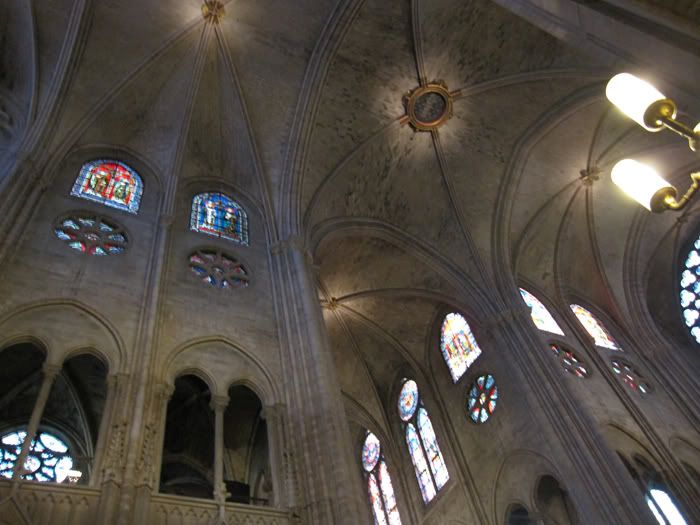
The lofty ceiling of Notre-Dame Cathedral with its own stained-glass windows.
The last time I came here in 1998, I could not get a good photograph of the interior, only a glow of the stained-glass windows. Back then, my camera was a very cheap Kodak Advanced Photo System model, and I had thought the easy film cartridge loading and the adjustable photo aspect ratio were awesome things! How times have changed - I am now on my third digital camera, purchased duty-free at the end of the 2008 Korean stint, one that also happens to do very well in low-light conditions.
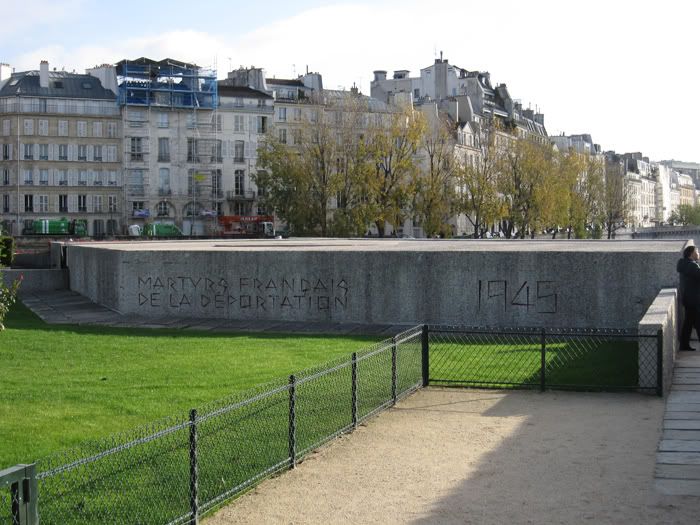
Just behind the Notre-Dame Catheral is this sight I had not visited before: the Deportation Memorial. It remembers the 200,000 French people who were sent off to the Nazi concentration camps for one reason or another during World War II, never to return. The interior of the memorial is purposely built to be very stifling, to symbolize the arbitrary taking away of freedoms and basic rights, and the only view out is the flowing waters of the Seine.
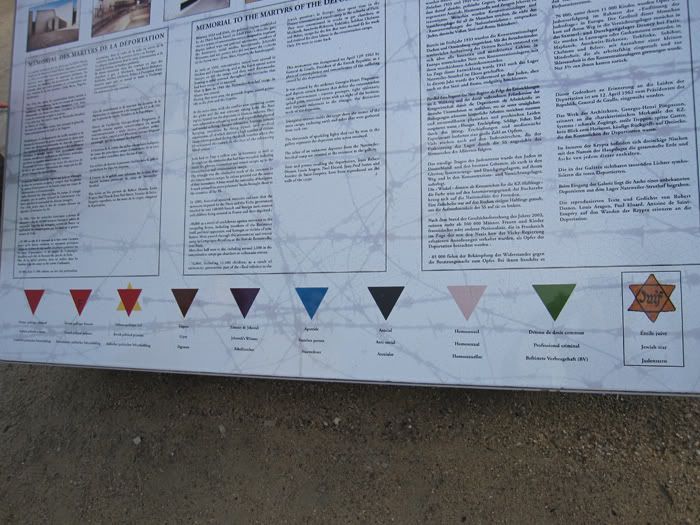
This sign explains the various "undesirable" categories of people the Nazis wanted to exterminate. Each category had an upside-down triangle which would be sewed on to the prison uniform of the person in question, as shown in the legend above. The legend is as follows:
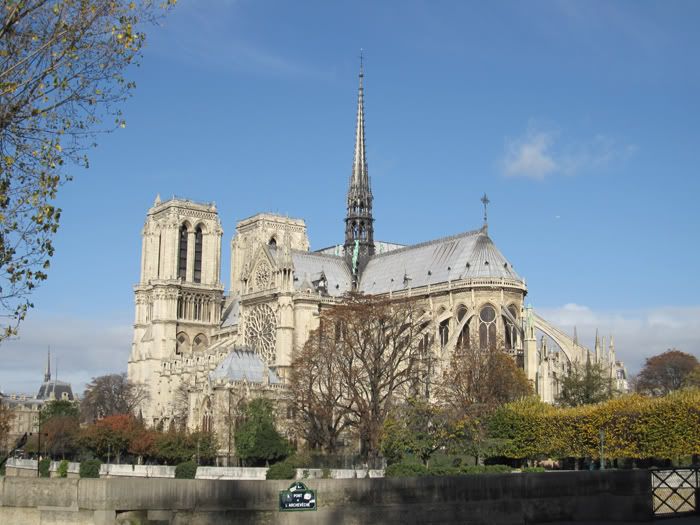
Now walking around on the Left Bank, with this postcard view of the Notre-Dame Cathedral. This cathedral's flying buttresses are especially spectacular, even though flying buttresses were a common means of supporting a cathedral's structural weight in the Gothic era (and a state-of-the-art innovation at the time).
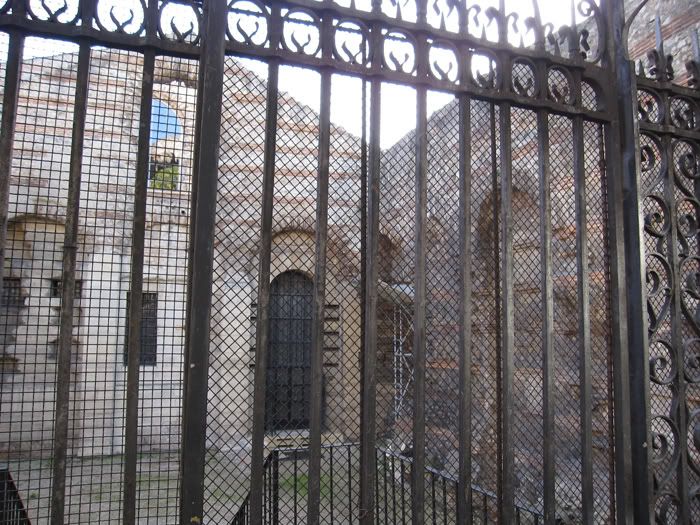
I am walking around the Left Bank, especially around the Latin Quarter, an area I had neglected in my previous Paris visits. This photo is the preserved ruins of what appears to have been a house of worship or a study hall.
The Latin Quarter got its name due to its universities, where the language of choice for all scholarly pursuits was, of course, Latin. It feels less academic today, but used book cubicles still line the Seine shore.

I emerged onto a nice expanse of open space. This is Jardin du Luxembourg, which belongs to Luxembourg Palace and now is a city park just like all other former royal gardens.
Loving all those classical statues toward the distance.
The black monolith toward the distance is Montparnasse Tower, one of the few modern skyscrapers within Paris city limits. Some say that its observatory is the best place to take in Paris city views, because from there, you can see the Eiffel Tower but cannot see the ugly Montparnasse Tower itself. I would not get a chance to find out on this visit. All subsequent skyscrapers in Paris were actually built to the northwest, in La Défense outside city limits.
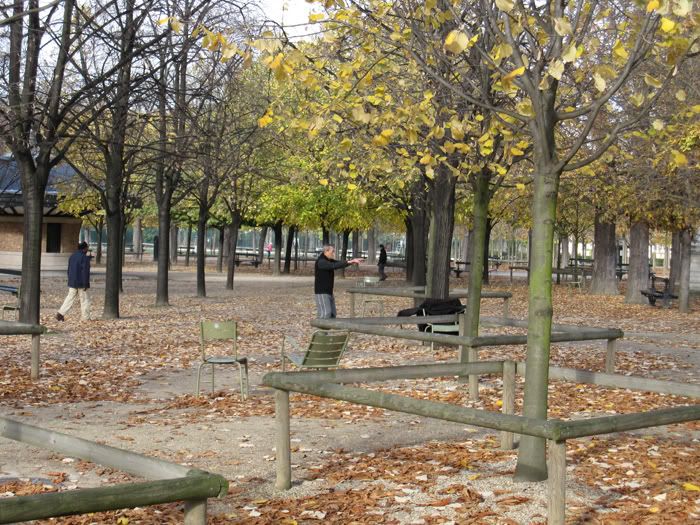
And here is a mix of cultures. An East Asian man doing tai chi on the grounds of Jardin du Luxembourg.
Paris is one humongous melting pot of cultures. West African migrants with very dark complexion are especially common, having arrived from former French colonies. France today is actually more of "a nation of immigrants" than the US ever was. My mother is surprised and a bit shocked at all the West Africans, and I am doing my best to fill her in on the social developments in France, especially in regards to the high immigrant populations, the challenges posed by Muslims not integrating into the mainstream, the anti-immigrant backlash especially in the form of the far-right National Front, and even the fact that the current center-right President, Nicolas Sarkozy, is himself the son of Hungarian immigrants. I even went back to some of the colonial history itself, and recalled the opening match of FIFA World Cup 2002, where Senegal's soccer squad had upset the former colonial master (and defending champion) France and felt VERY proud of it.
At this time, we were looking for a place to eat lunch. My mother wanted some warm soup/porridge type of meal, and she wanted to get to a Japanese place that we had passed earlier, under the shadows of Notre-Dame Cathedral. We ate a cheap lunch there.
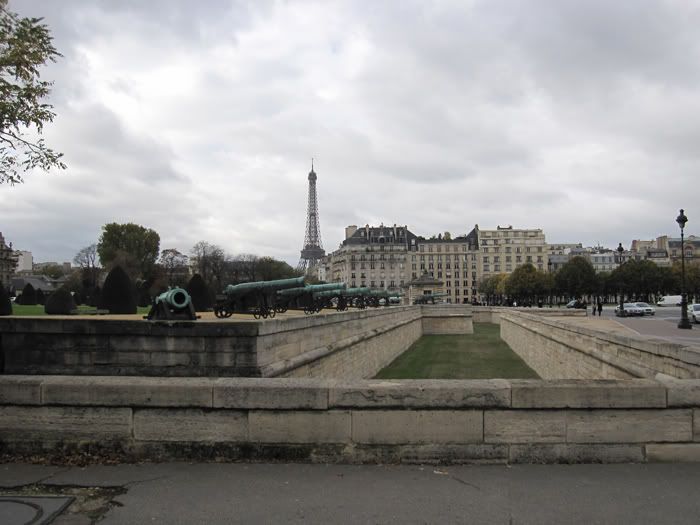
We are now at the Invalides, having come here via a quick hop on the RER commuter train system. The RER trains are analogous to the German S-Bahns, since they are part of the national rail system but use standard subway tickets. And speaking of subway fares, I am using a carnet of ten tickets as much as possible, which saves about 40% over single fares. The base fare is good for any journey within Paris city limits. I also noted that the RER trains were now boasting a new name - "transilien," or trans-Ile de France (the region that includes Paris) service.
The Invalides is an early form of veterans' hospital. And sure enough, I love the sight of all those cannons as well as a defensive moat. This is certainly a reminder that for a long time, France was one of the world's leading military powers, and its spread its power and influence through warfare. However, devastation from the two World Wars has changed the French, to a point where the Americans now consider the French to be "surrender monkeys" for their refusal to support American war efforts, especially the Iraq War of 2003.
France weakened primarily because it had expended its resources too much via warfare. That's certainly something for America, a nation that counts France as its first ally, to learn from. On the other hand, French nationalism, evidenced from all the tricouleurs fluttering around every Paris block, is as blatant as ever, unmatched in Europe and matched only by the Americans and the Koreans in my experience, though French nationalism is saner as far as I can tell.
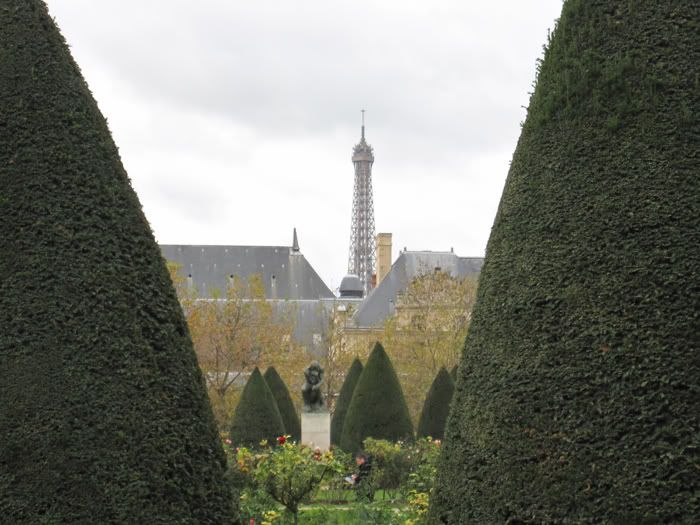
The Invalides was not a destination for us - it simply happened to be on the way to Musée Rodin. This is another return visit for me. While my mother couldn't care less about art, she is familiar with Rodin, which justified this particular museum. This, and the Louvre, would be the only Paris museums I would hit (though another fine one, Musée d'Orsay, was part of my 2003 visit).
And it can't get more Paris than the garden, with Le Penseur still pondering something in the middle, and the spire of the Eiffel Tower in the background. According to the Rick Steves guidebook, Le Penseur would've been the typical star football player or frat boy of his day, suddenly realizing that there was more to life than all the booze, parties, and sex, and starting to develop intellectual processes in response. Certainly, his muscular build alludes to that frat boy background.
I am not uploading too many Musée Rodin photos as they are of artwork well known worldwide via easily seen photos and replica casts.
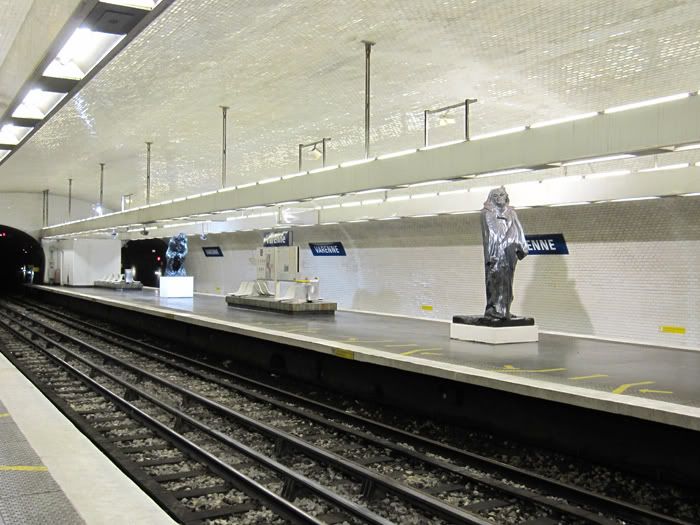
Though this subway station is worth photographing. This is the Varenne Station on Line 13, which is the closest station to Musée Rodin. Even more Rodin sculptures here, to make the point.
Our next order of business, as rain starts to drop and suddenly pour, is to hit the Champs-Elysées and do some shopping. In particular, we looked for a Louis Vuitton store, to buy two purses - one for my mother, and one as a gift. And sure enough, there was the largest Louis Vuitton store of my life - a three-floor example at that. Normally I couldn't care less about brand-name luxury fashion goods, but this Louis Vuitton store had me all smitten, starting from entry, where we were given plastic bags to put our wet umbrellas away in. Granted, the visit was really to ensure that we could buy the purses and get the Value-Added Tax refunded for huge savings over US prices (which would also include tariffs), but even without that, the store was quite something. I was corrupted this day - and now I can definitely see myself buying a Louis Vuitton purse in the future (and use it as the pink straps stain to a nice shade of tan, as intended). Indeed, we bought the two purses we wanted, had the purchase charged in Euro (rather than US dollars, a convenience service done at lousy exchange rates and fees), and had the tax refund paperwork filled out, which would require a customs stamp at my final European Union departure point (which would be Munich, Germany, in this case).
Due to the rain, and with no desire to lug those purses around Paris, we returned to the hotel for a bit of break. I also talked to the hotel receptionist - who was a very unresponsive West African with so-so English - to get the Internet access code, since I had not gotten online after leaving Austria five days prior. The news feed over the Internet wasn't too great - Maine had re-banned gay marriage in a repeat of the previous year's Prop 8 fight in California, and teabaggers had won key victories in Virginia - but a good news was that Washington State had approved Referendum 71, which was necessary to keep the legalization of the domestic partnership law in force.
While my mother tuned in to some television, I briefed her a bit more on French politics, complete with the utter breakdown of the center-left Socialists that led to the current unpopular Sarkozy government. I also described Sarkozy's wild personal life, including divorce and remarriage in office, the current wife Carla Bruni, and his reputation as "Monsieur Bling" with a penchant for shiny things. I compared Sarkozy and the current French state of affairs to something my mother has good knowledge of - South Korea's Lee Myung-bak government and a broken left there as well - though I made sure to stress that Sarkozy is a pragmatic center-rightist, rather than a far-right nutjob that Lee is.
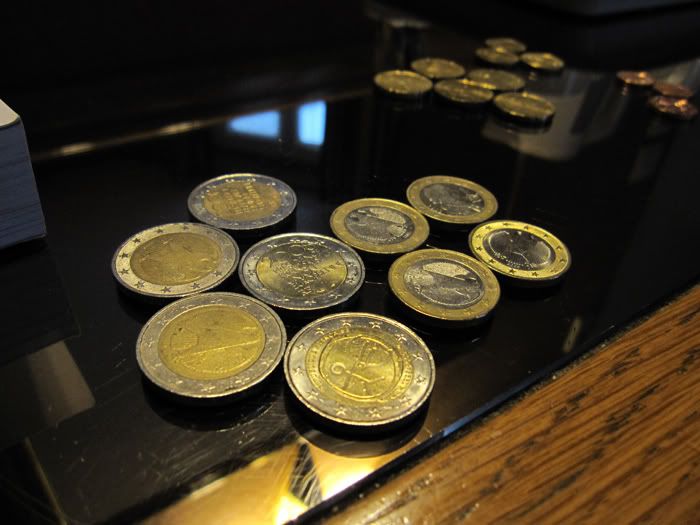
While the discussions go on, I decided to photograph the Euro coins in my possession. Since every Eurozone nation designs its own national side, collecting Euro coins can be a very interesting activity. Regardless of national designs, any Euro coin is legal tender throughout the Eurozone.
Here are the big-value coins, with the €2 being brass with silver border, and €1 reversing that. My coin captions below are a copy-paste of what I had written for my Facebook profile photo album.
The foremost €2 piece is a 2009 issue commemorating the tenth anniversary of the implementation of the Euro in France. (In reality, the franc, with its value fixed to the Euro in 1999, continued to exist in cash form for three more years, since a large amount of physical Euro currency had to be made for circulation.) The two left ones show the German eagle; German coins were the most common during my journey, due to the amount of time I spent there, and due to Germany's larger economy. The other two commemorate France's European Union presidency in 2008.
The €1 piece has an Austrian example with Mozart in the far back, and the other three have the German eagle.
The Italian €1 uses the Leonardo da Vinci study of the male nude as its national design. It was too phallic for my hardcore lesbian (and anti-teabagging) tastes, so I tended to dump it as soon as I could, which is why it is not in these photos.
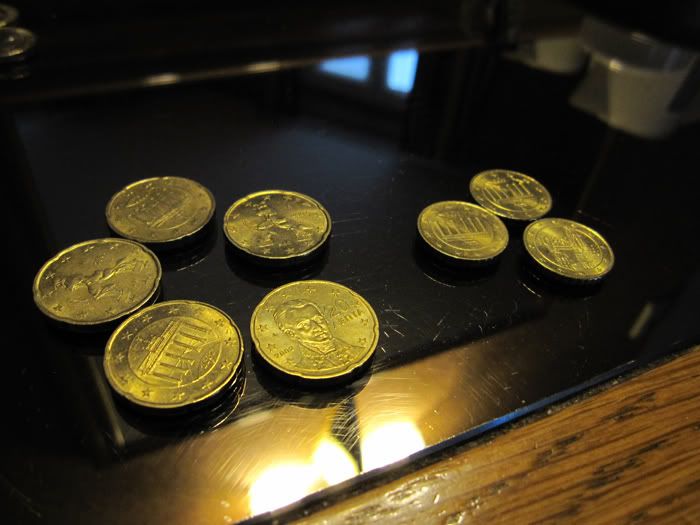
The brass coins are in 50, 20, and 10 cent denominations. I didn't have any 50 cent coins in my possession, and these are all 20s (left, petaled) and 10s (right).
At first, I had found these three denominations to be very difficult to distinguish. But remembering that the 20 has its own unique design, the 50 is large, and the 10 is small, things became easier. The 20's unique design is also similar to the British pound giving the 20-pence coin a unique design (one of my favorite coin designs).
The front right 20-cent piece is Greek. The others show an Italian sculpture (identified by the RI mark) or the German Brandenburg Gate.
The front right 10-cent piece is St. Stephen's Cathedral in Vienna; Austrians have tended to put the coin denomination even into the national sides, a practice that the European Central Bank discourages. The other two are the German Brandenburg Gate.
While the vast majority of Euro coins I had used were German, I came home with very few of them, more likely bringing French ones instead.
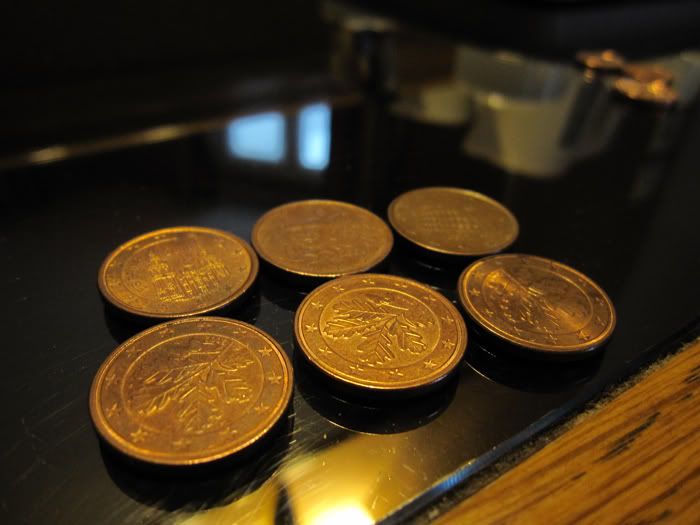
The copper pieces make up the 1, 2, and 5 cent coins in the Euro system. In Europe, posted prices always include sales taxes, and depending on the country, the tendency is to use nice even numbers, making these smaller coins unnecessary. I saw plenty of use for these smaller coins in Germany, but never in France.
These are 5-cent pieces. The front three are German oak leaves - an image previously seen on the old pfennig coins.
The rear, from left to right are: Spanish (cathedral), French (Marianne, the feminine presentation of France), and Italian (Colosseum).
I am finding Wikipedia to be very useful as I try to figure out where each design originates, and what the design stands for.
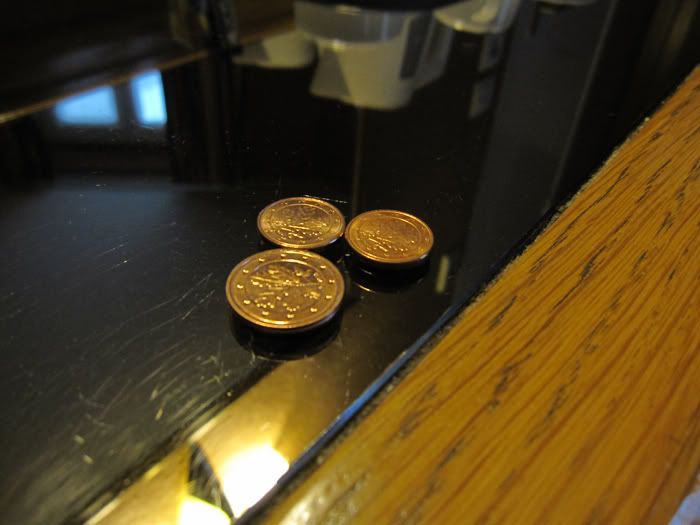
Finally, a 2-cent (front) and two 1-cent (rear) coins. And yes, they are all German.
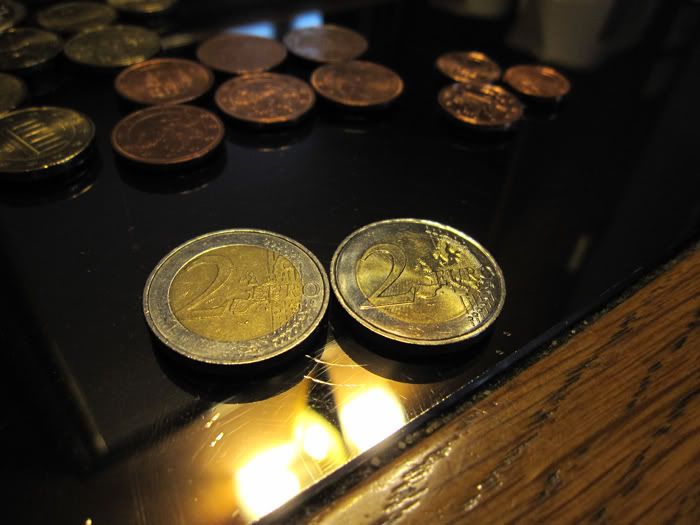
Even the common side of the Euro coin has been redesigned since the introduction of the cash Euro, as seen here.
The left is the original design, dating back to 1999 when the first coins started to be minted. Its map of Europe shows the fifteen members of the EU that existed at that time - regardless of their actual participation in the Euro currency. (Norway and Switzerland are notably missing.)
The right is the current design, and shows all of the European continent, even non-EU members. The EU expanded to 25 members, including many Eastern Bloc countries, in 2004.
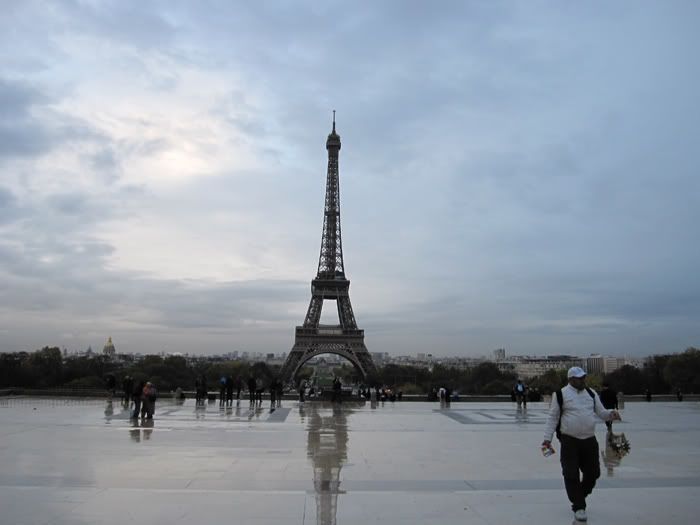
Back out after some relaxation. The Trocadéro is a very good place to resume sightseeing, as the rain stops, it starts to get dark, and the city lights start to come alive. There is nothing like approaching the Eiffel Tower from here across the Seine.
Many African immigrants are along the way, trying hard to sell us Eiffel Tower souvenirs.
I remember being surprised at just how sturdy the Eiffel Tower actually was, despite its delicate appearance from the distance and in the photos, when I first visited in person in 1998. Back then, I ended up going all the way to the top level, but this time, my mother has declined, and we will settle for a city vista from the Montmartre at night. But she certainly got a good look at the tower's sturdy construction, from right underneath. Another thing I remember then, and missing now, is a countdown display on the tower, which was counting the number of days remaining until January 1st, 2000.
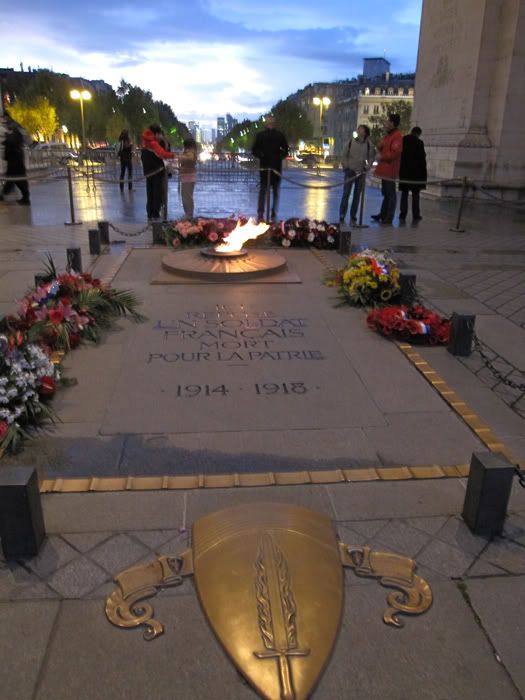
A quick shot on Métro Line 6 (with its peculiar ride, thanks to rubber tires) brought us back to the Champs-Elysées. And that calls for a visit to the Arc de Triomphe, in the middle of the Etoile, a traffic circle with 12 streets radiating out.
A climb to the top is another pay activity that my mother has declined; I am not too keen on it either since I had done it in 1998 (though I certainly remember the 12 streets of the Etoile radiating at exact 30-degree angles, quite a sight). But even at the ground level, I can be reminded of France's past military history, again.
This is the grave of an unknown soldier from World War I who "died for his fatherland" - and has an eternal flame.
In the far distance can be seen the modern developments of La Défense, with its 110-meter-high La Grande Arche, which is a modern-day complement to Arc de Triomphe.
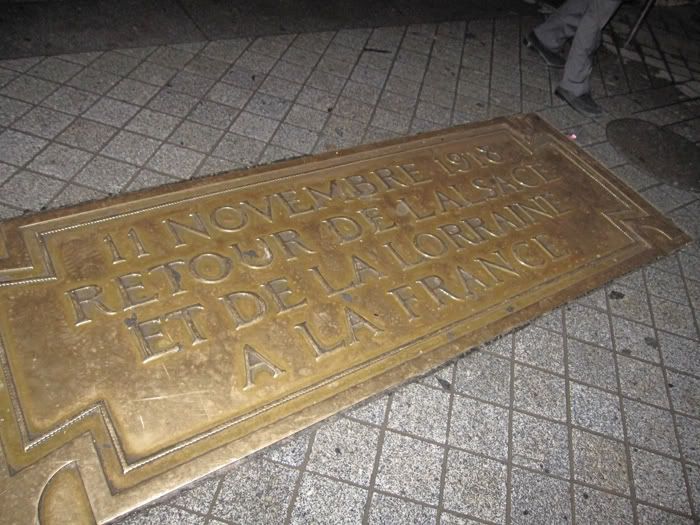
And here is another marker. It says: "11 November 1918. Alsace and Lorraine return to France."
Alsace and Lorraine are along the Rhine shore, frequently swapping hands between France and Germany, most recently becoming French at the end of World War I. Of course, Strasbourg is the main city in the area. No wonder the Germans are p*ssed, still insisting on spelling Strasbourg as Straßburg. Thankfully, the modern-day cooperation under the European Union framework has made France and Germany strategic partners rather than bitter enemies, leaving the UK, and the US (the prime sponsor of European integration to prevent future wars), in the cold by comparison.
As promised back in Switzerland to my mother, the dinner takes the form of a visit to a Quick restaurant and its hamburgers. Quick's menus are very similar to its primary competitor McDonald's, but it is always nice to eat American-style fast food with a French flair, complete with dipping pommes frites (French fries, which are actually a Belgian invention) in my choice of either ketchup (as is usually done stateside) or mayonnaise (almost never done stateside). I also made sure to explain to my mother that unlike in the US, where fast food hamburgers are the cheapest and the least desirable form of eating, a Quick meal is more expensive than a neighborhood café meal and is done as a cultural novelty of sorts. And I do love eating hamburgers overseas - if only because the ingredients are better and the cashiers actually able to count my money correctly.
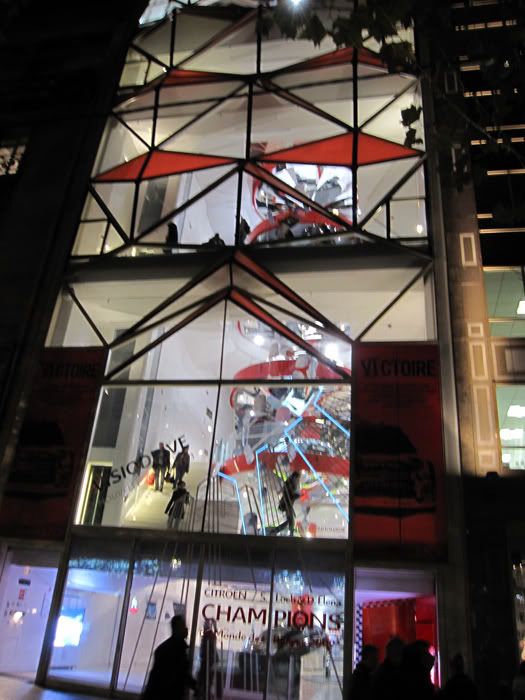
Time to leave the Champs-Elysées, as I take a quick snapshot of this Citroën showroom. Already my mother is noting that Citroën is an automotive brand I am smitten with - thanks to my penchant for classic cars like the 2CV and the DS, as well as my 1998 England drive having used the Xantia, not to mention my continuing adoration for some current-model Citroëns (the C6 executive car is very reminiscent of the DS, in fact) and their sleek designs.
I didn't bother going in, however, because even though this showroom showcases Citroën's racing successes, it uses current-model vehicles, not classics, to tell the story (it's a showroom for selling cars after all), and I'd rather see a few examples of the DS (déesse - "goddess") or its cheaper version ID (idée - "idea") than a generic C3 or C4.
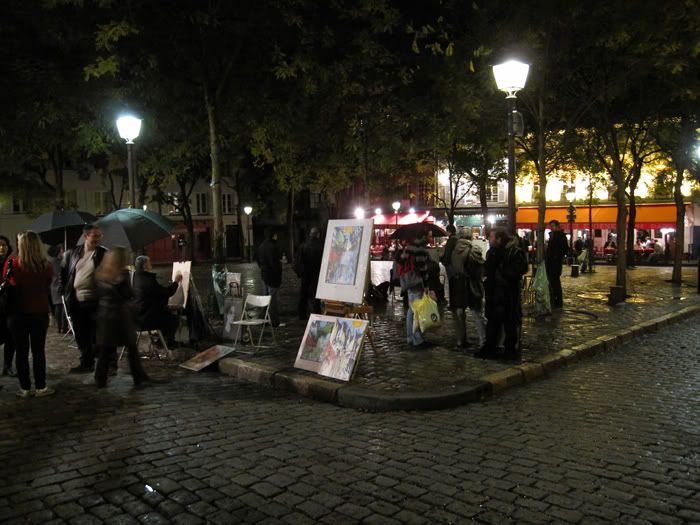
I am wrapping up by walking around the Montmartre district, which was my "home neighborhood" for my two previous Paris visits. After climbing up the hill on foot (rather than using the funicular, which involves a long line AND a full subway fare), I am looking at modern-day painters selling their works of art, just like back in the old days. Gentrification has made Montmartre a bit too pricey for struggling artists today, so it's very nice to still be able to see scenes like this.
I did not get as good a view from Sacre-Coeur Basilica as I had hoped, but it was still a decent view (though no photos to show for it). At my mother's suggestion, we even ducked into the basilica itself to catch the tail end of a midweek Mass, complete with a lovely choir and a benediction; even though we are not Catholics and I strongly denounce the Vatican, there is no harm done in anonymously ducking into a worship service and taking in some music. We also loved walking around the narrow streets that are so typical of most European cities but not so typical of Paris, as most of Paris had its streets significantly widened in the 19th Century for military and transportation purposes; the narrower Montmartre streets also meant that buildings from before the 19th Century still have a chance to stand and show off their charms. Granted, tacky souvenir shops crashed some of the ambiance, but that was just about the only downside. The only way to add to this experience would've been to enter a café to sip some wine, but it was late and we were full already.
We proceeded to the Pigalle subway station, located at the fringes of the notorious red-light district of the same name (nicknamed "Pig Alley" by American soldiers during World War II, which I certainly noted) to return to the hotel and wrap up the day.
The next post will be the final post for this recap of Europe. It will cover Versailles, the Grands Magasins, and the Louvre, as well as the return journey to Los Angeles.
While all my previous sights in this trip were brand-new territory for me, Paris is a return visit, done primarily for the benefit of my mother. I simply did not want to leave Europe without taking her to one of Europe's three "star attraction" cities - London, Paris, and Rome - and Paris made the most sense, as including Rome in an itinerary involving a new luxury car was asking for trouble, and London was just too far away (and the UK does not arouse my mother's curiosity all that much). I am navigating Paris and playing tour guide for my mother, using not only tips from Rick Steves' guidebook but also from my own past experiences. It also helps that I know enough French to eavesdrop in on some conversations, and to read subway ads and discover their nuances - two luxuries I did not have in German-speaking regions and Italy.
To stick to my "repeat visit" theme, I am starting my Parisian tour at my favorite sight in all of the city, which I had previously discovered during my very first visit in 1998. This is Sainte-Chapelle, a two-tiered chapel on Ile de la Cité in the dead middle of the city.
This is a two-tiered royal chapel, and I am starting on the lower level, which is already quite stunning in its own right. This level would've been used for visitors to the royal facilities.
But the lower level pales when compared to the magnificent upper level, reserved for the royalty, renowned for its stained-glass windows. Back in 1998, this place had left me awestruck - and I wanted my mother to have that same awestruck feeling, the reason for starting my Paris tour here.
The stained-glass windows were intended to tell the biblical stories in an era when many people were illiterate. They go from the Creation to the Resurrection of Jesus in clockwise order.
It's not as awesome as it should be, thanks to a somewhat hazy/cloudy weather for the day, but it's still quite a sight.
Details on the wall. The stained glass windows, one saint statue, and the unmistakable fleur-de-lis, a French motif also commonly seen in formerly French areas of North America, like Québec and Louisiana.
It's only a short walk from Sainte-Chapelle to the Notre-Dame Cathedral. While I don't really need any more cathedrals at this point of my trip, I do need to squeeze in a bragging rights sight for my mother while I can.
Here is one of the entryways, with a prominent "Madonna with Child" statue on the center pillar and flanked by angels, disciples, and saints.
On the left side, third from the left, there is a headless saint standing, holding his head in his hands. That would be St. Denis, a local martyr. Legends say that when he was beheaded for his Christian faith, he simply picked up his severed head and walked away. Such imagery to reinforce people's faith in Christianity have widely been used throughout the Middle Ages and beyond in Europe, and even in today's more secular era, religion continues on - though mercifully, more as a cultural relic and heritage rather than an obsession that it is stateside.
Jeanne d'Arc, housed in Notre-Dame Cathedral as a saint.
Ironic, considering that Jeanne d'Arc was burned at the stake during the Hundred Years' War, not because of her patriotism, but because of her gender-bending ways and refusal to follow conventions. Which makes it all the sweeter to come across her likeness here - almost like meeting a pair of Kwan Yins in the midst of a teabagger-infested Residenz back in Munich.
The lofty ceiling of Notre-Dame Cathedral with its own stained-glass windows.
The last time I came here in 1998, I could not get a good photograph of the interior, only a glow of the stained-glass windows. Back then, my camera was a very cheap Kodak Advanced Photo System model, and I had thought the easy film cartridge loading and the adjustable photo aspect ratio were awesome things! How times have changed - I am now on my third digital camera, purchased duty-free at the end of the 2008 Korean stint, one that also happens to do very well in low-light conditions.
Just behind the Notre-Dame Catheral is this sight I had not visited before: the Deportation Memorial. It remembers the 200,000 French people who were sent off to the Nazi concentration camps for one reason or another during World War II, never to return. The interior of the memorial is purposely built to be very stifling, to symbolize the arbitrary taking away of freedoms and basic rights, and the only view out is the flowing waters of the Seine.
This sign explains the various "undesirable" categories of people the Nazis wanted to exterminate. Each category had an upside-down triangle which would be sewed on to the prison uniform of the person in question, as shown in the legend above. The legend is as follows:
- Red: German political prisoner
- Red, with letter F: French political prisoner
- Red, with yellow imposed for a Star of David appearance: Jewish political prisoner
- Brown: Gypsy
- Violet: Jehovah's Witness
- Blue: Stateless person
- Black: "Antisocial" which was a catch word for many things, including mental illness
- Pink: Homosexual
- Green: Professional criminal
- Yellow Star of David: Jewish, with the word "Jew" in the local language
Now walking around on the Left Bank, with this postcard view of the Notre-Dame Cathedral. This cathedral's flying buttresses are especially spectacular, even though flying buttresses were a common means of supporting a cathedral's structural weight in the Gothic era (and a state-of-the-art innovation at the time).
I am walking around the Left Bank, especially around the Latin Quarter, an area I had neglected in my previous Paris visits. This photo is the preserved ruins of what appears to have been a house of worship or a study hall.
The Latin Quarter got its name due to its universities, where the language of choice for all scholarly pursuits was, of course, Latin. It feels less academic today, but used book cubicles still line the Seine shore.
I emerged onto a nice expanse of open space. This is Jardin du Luxembourg, which belongs to Luxembourg Palace and now is a city park just like all other former royal gardens.
Loving all those classical statues toward the distance.
The black monolith toward the distance is Montparnasse Tower, one of the few modern skyscrapers within Paris city limits. Some say that its observatory is the best place to take in Paris city views, because from there, you can see the Eiffel Tower but cannot see the ugly Montparnasse Tower itself. I would not get a chance to find out on this visit. All subsequent skyscrapers in Paris were actually built to the northwest, in La Défense outside city limits.
And here is a mix of cultures. An East Asian man doing tai chi on the grounds of Jardin du Luxembourg.
Paris is one humongous melting pot of cultures. West African migrants with very dark complexion are especially common, having arrived from former French colonies. France today is actually more of "a nation of immigrants" than the US ever was. My mother is surprised and a bit shocked at all the West Africans, and I am doing my best to fill her in on the social developments in France, especially in regards to the high immigrant populations, the challenges posed by Muslims not integrating into the mainstream, the anti-immigrant backlash especially in the form of the far-right National Front, and even the fact that the current center-right President, Nicolas Sarkozy, is himself the son of Hungarian immigrants. I even went back to some of the colonial history itself, and recalled the opening match of FIFA World Cup 2002, where Senegal's soccer squad had upset the former colonial master (and defending champion) France and felt VERY proud of it.
At this time, we were looking for a place to eat lunch. My mother wanted some warm soup/porridge type of meal, and she wanted to get to a Japanese place that we had passed earlier, under the shadows of Notre-Dame Cathedral. We ate a cheap lunch there.
We are now at the Invalides, having come here via a quick hop on the RER commuter train system. The RER trains are analogous to the German S-Bahns, since they are part of the national rail system but use standard subway tickets. And speaking of subway fares, I am using a carnet of ten tickets as much as possible, which saves about 40% over single fares. The base fare is good for any journey within Paris city limits. I also noted that the RER trains were now boasting a new name - "transilien," or trans-Ile de France (the region that includes Paris) service.
The Invalides is an early form of veterans' hospital. And sure enough, I love the sight of all those cannons as well as a defensive moat. This is certainly a reminder that for a long time, France was one of the world's leading military powers, and its spread its power and influence through warfare. However, devastation from the two World Wars has changed the French, to a point where the Americans now consider the French to be "surrender monkeys" for their refusal to support American war efforts, especially the Iraq War of 2003.
France weakened primarily because it had expended its resources too much via warfare. That's certainly something for America, a nation that counts France as its first ally, to learn from. On the other hand, French nationalism, evidenced from all the tricouleurs fluttering around every Paris block, is as blatant as ever, unmatched in Europe and matched only by the Americans and the Koreans in my experience, though French nationalism is saner as far as I can tell.
The Invalides was not a destination for us - it simply happened to be on the way to Musée Rodin. This is another return visit for me. While my mother couldn't care less about art, she is familiar with Rodin, which justified this particular museum. This, and the Louvre, would be the only Paris museums I would hit (though another fine one, Musée d'Orsay, was part of my 2003 visit).
And it can't get more Paris than the garden, with Le Penseur still pondering something in the middle, and the spire of the Eiffel Tower in the background. According to the Rick Steves guidebook, Le Penseur would've been the typical star football player or frat boy of his day, suddenly realizing that there was more to life than all the booze, parties, and sex, and starting to develop intellectual processes in response. Certainly, his muscular build alludes to that frat boy background.
I am not uploading too many Musée Rodin photos as they are of artwork well known worldwide via easily seen photos and replica casts.
Though this subway station is worth photographing. This is the Varenne Station on Line 13, which is the closest station to Musée Rodin. Even more Rodin sculptures here, to make the point.
Our next order of business, as rain starts to drop and suddenly pour, is to hit the Champs-Elysées and do some shopping. In particular, we looked for a Louis Vuitton store, to buy two purses - one for my mother, and one as a gift. And sure enough, there was the largest Louis Vuitton store of my life - a three-floor example at that. Normally I couldn't care less about brand-name luxury fashion goods, but this Louis Vuitton store had me all smitten, starting from entry, where we were given plastic bags to put our wet umbrellas away in. Granted, the visit was really to ensure that we could buy the purses and get the Value-Added Tax refunded for huge savings over US prices (which would also include tariffs), but even without that, the store was quite something. I was corrupted this day - and now I can definitely see myself buying a Louis Vuitton purse in the future (and use it as the pink straps stain to a nice shade of tan, as intended). Indeed, we bought the two purses we wanted, had the purchase charged in Euro (rather than US dollars, a convenience service done at lousy exchange rates and fees), and had the tax refund paperwork filled out, which would require a customs stamp at my final European Union departure point (which would be Munich, Germany, in this case).
Due to the rain, and with no desire to lug those purses around Paris, we returned to the hotel for a bit of break. I also talked to the hotel receptionist - who was a very unresponsive West African with so-so English - to get the Internet access code, since I had not gotten online after leaving Austria five days prior. The news feed over the Internet wasn't too great - Maine had re-banned gay marriage in a repeat of the previous year's Prop 8 fight in California, and teabaggers had won key victories in Virginia - but a good news was that Washington State had approved Referendum 71, which was necessary to keep the legalization of the domestic partnership law in force.
While my mother tuned in to some television, I briefed her a bit more on French politics, complete with the utter breakdown of the center-left Socialists that led to the current unpopular Sarkozy government. I also described Sarkozy's wild personal life, including divorce and remarriage in office, the current wife Carla Bruni, and his reputation as "Monsieur Bling" with a penchant for shiny things. I compared Sarkozy and the current French state of affairs to something my mother has good knowledge of - South Korea's Lee Myung-bak government and a broken left there as well - though I made sure to stress that Sarkozy is a pragmatic center-rightist, rather than a far-right nutjob that Lee is.
While the discussions go on, I decided to photograph the Euro coins in my possession. Since every Eurozone nation designs its own national side, collecting Euro coins can be a very interesting activity. Regardless of national designs, any Euro coin is legal tender throughout the Eurozone.
Here are the big-value coins, with the €2 being brass with silver border, and €1 reversing that. My coin captions below are a copy-paste of what I had written for my Facebook profile photo album.
The foremost €2 piece is a 2009 issue commemorating the tenth anniversary of the implementation of the Euro in France. (In reality, the franc, with its value fixed to the Euro in 1999, continued to exist in cash form for three more years, since a large amount of physical Euro currency had to be made for circulation.) The two left ones show the German eagle; German coins were the most common during my journey, due to the amount of time I spent there, and due to Germany's larger economy. The other two commemorate France's European Union presidency in 2008.
The €1 piece has an Austrian example with Mozart in the far back, and the other three have the German eagle.
The Italian €1 uses the Leonardo da Vinci study of the male nude as its national design. It was too phallic for my hardcore lesbian (and anti-teabagging) tastes, so I tended to dump it as soon as I could, which is why it is not in these photos.
The brass coins are in 50, 20, and 10 cent denominations. I didn't have any 50 cent coins in my possession, and these are all 20s (left, petaled) and 10s (right).
At first, I had found these three denominations to be very difficult to distinguish. But remembering that the 20 has its own unique design, the 50 is large, and the 10 is small, things became easier. The 20's unique design is also similar to the British pound giving the 20-pence coin a unique design (one of my favorite coin designs).
The front right 20-cent piece is Greek. The others show an Italian sculpture (identified by the RI mark) or the German Brandenburg Gate.
The front right 10-cent piece is St. Stephen's Cathedral in Vienna; Austrians have tended to put the coin denomination even into the national sides, a practice that the European Central Bank discourages. The other two are the German Brandenburg Gate.
While the vast majority of Euro coins I had used were German, I came home with very few of them, more likely bringing French ones instead.
The copper pieces make up the 1, 2, and 5 cent coins in the Euro system. In Europe, posted prices always include sales taxes, and depending on the country, the tendency is to use nice even numbers, making these smaller coins unnecessary. I saw plenty of use for these smaller coins in Germany, but never in France.
These are 5-cent pieces. The front three are German oak leaves - an image previously seen on the old pfennig coins.
The rear, from left to right are: Spanish (cathedral), French (Marianne, the feminine presentation of France), and Italian (Colosseum).
I am finding Wikipedia to be very useful as I try to figure out where each design originates, and what the design stands for.
Finally, a 2-cent (front) and two 1-cent (rear) coins. And yes, they are all German.
Even the common side of the Euro coin has been redesigned since the introduction of the cash Euro, as seen here.
The left is the original design, dating back to 1999 when the first coins started to be minted. Its map of Europe shows the fifteen members of the EU that existed at that time - regardless of their actual participation in the Euro currency. (Norway and Switzerland are notably missing.)
The right is the current design, and shows all of the European continent, even non-EU members. The EU expanded to 25 members, including many Eastern Bloc countries, in 2004.
Back out after some relaxation. The Trocadéro is a very good place to resume sightseeing, as the rain stops, it starts to get dark, and the city lights start to come alive. There is nothing like approaching the Eiffel Tower from here across the Seine.
Many African immigrants are along the way, trying hard to sell us Eiffel Tower souvenirs.
I remember being surprised at just how sturdy the Eiffel Tower actually was, despite its delicate appearance from the distance and in the photos, when I first visited in person in 1998. Back then, I ended up going all the way to the top level, but this time, my mother has declined, and we will settle for a city vista from the Montmartre at night. But she certainly got a good look at the tower's sturdy construction, from right underneath. Another thing I remember then, and missing now, is a countdown display on the tower, which was counting the number of days remaining until January 1st, 2000.
A quick shot on Métro Line 6 (with its peculiar ride, thanks to rubber tires) brought us back to the Champs-Elysées. And that calls for a visit to the Arc de Triomphe, in the middle of the Etoile, a traffic circle with 12 streets radiating out.
A climb to the top is another pay activity that my mother has declined; I am not too keen on it either since I had done it in 1998 (though I certainly remember the 12 streets of the Etoile radiating at exact 30-degree angles, quite a sight). But even at the ground level, I can be reminded of France's past military history, again.
This is the grave of an unknown soldier from World War I who "died for his fatherland" - and has an eternal flame.
In the far distance can be seen the modern developments of La Défense, with its 110-meter-high La Grande Arche, which is a modern-day complement to Arc de Triomphe.
And here is another marker. It says: "11 November 1918. Alsace and Lorraine return to France."
Alsace and Lorraine are along the Rhine shore, frequently swapping hands between France and Germany, most recently becoming French at the end of World War I. Of course, Strasbourg is the main city in the area. No wonder the Germans are p*ssed, still insisting on spelling Strasbourg as Straßburg. Thankfully, the modern-day cooperation under the European Union framework has made France and Germany strategic partners rather than bitter enemies, leaving the UK, and the US (the prime sponsor of European integration to prevent future wars), in the cold by comparison.
As promised back in Switzerland to my mother, the dinner takes the form of a visit to a Quick restaurant and its hamburgers. Quick's menus are very similar to its primary competitor McDonald's, but it is always nice to eat American-style fast food with a French flair, complete with dipping pommes frites (French fries, which are actually a Belgian invention) in my choice of either ketchup (as is usually done stateside) or mayonnaise (almost never done stateside). I also made sure to explain to my mother that unlike in the US, where fast food hamburgers are the cheapest and the least desirable form of eating, a Quick meal is more expensive than a neighborhood café meal and is done as a cultural novelty of sorts. And I do love eating hamburgers overseas - if only because the ingredients are better and the cashiers actually able to count my money correctly.
Time to leave the Champs-Elysées, as I take a quick snapshot of this Citroën showroom. Already my mother is noting that Citroën is an automotive brand I am smitten with - thanks to my penchant for classic cars like the 2CV and the DS, as well as my 1998 England drive having used the Xantia, not to mention my continuing adoration for some current-model Citroëns (the C6 executive car is very reminiscent of the DS, in fact) and their sleek designs.
I didn't bother going in, however, because even though this showroom showcases Citroën's racing successes, it uses current-model vehicles, not classics, to tell the story (it's a showroom for selling cars after all), and I'd rather see a few examples of the DS (déesse - "goddess") or its cheaper version ID (idée - "idea") than a generic C3 or C4.
I am wrapping up by walking around the Montmartre district, which was my "home neighborhood" for my two previous Paris visits. After climbing up the hill on foot (rather than using the funicular, which involves a long line AND a full subway fare), I am looking at modern-day painters selling their works of art, just like back in the old days. Gentrification has made Montmartre a bit too pricey for struggling artists today, so it's very nice to still be able to see scenes like this.
I did not get as good a view from Sacre-Coeur Basilica as I had hoped, but it was still a decent view (though no photos to show for it). At my mother's suggestion, we even ducked into the basilica itself to catch the tail end of a midweek Mass, complete with a lovely choir and a benediction; even though we are not Catholics and I strongly denounce the Vatican, there is no harm done in anonymously ducking into a worship service and taking in some music. We also loved walking around the narrow streets that are so typical of most European cities but not so typical of Paris, as most of Paris had its streets significantly widened in the 19th Century for military and transportation purposes; the narrower Montmartre streets also meant that buildings from before the 19th Century still have a chance to stand and show off their charms. Granted, tacky souvenir shops crashed some of the ambiance, but that was just about the only downside. The only way to add to this experience would've been to enter a café to sip some wine, but it was late and we were full already.
We proceeded to the Pigalle subway station, located at the fringes of the notorious red-light district of the same name (nicknamed "Pig Alley" by American soldiers during World War II, which I certainly noted) to return to the hotel and wrap up the day.
The next post will be the final post for this recap of Europe. It will cover Versailles, the Grands Magasins, and the Louvre, as well as the return journey to Los Angeles.
Subscribe to:
Posts (Atom)