Here is a recap of my visit to Tucson on the first weekend of March 2010, which I had meant to upload right away but put off for months.
Tucson had been my poverty-era home, from January to September 2001, though I absolutely hated being there, between lack of economic opportunities and a very different mentality. Sure, the natural scenery was top-notch and the University of Arizona brought badly needed groove into town, but the fact remained that it was a Third World economy located in a far right tyranny state - and that is still the case in 2010, made even worse with the racist Governor Jan Brewer (though, honestly, I fully support profiling of socially conservative immigrants).
I had arrived after an overnight drive, checking into a Hampton Inn on Grant and I-10 early in the morning. Now that I am awake, I am heading for my first sight - Sabino Canyon, Tucson's best kept secret and a good place to go hiking.
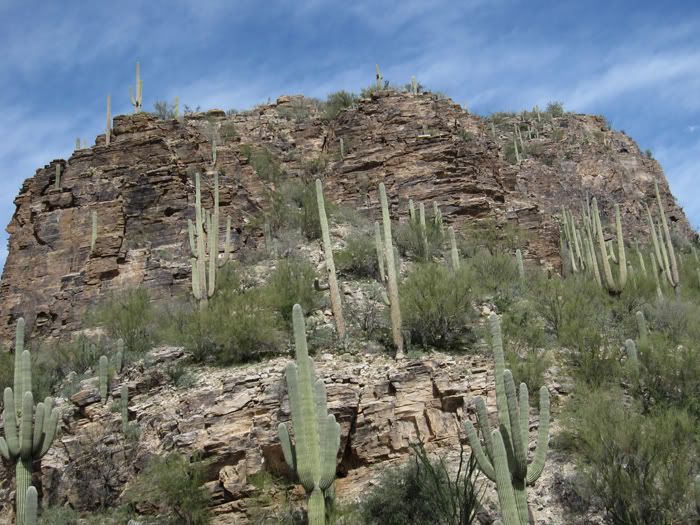
As it is early March, Tucson was warm rather than hot. And by being in Tucson, 460 miles east of home, I am also ducking the consecutive weekends of rain that had been plaguing Los Angeles. Low 70s, low humidity, and partly cloudy day - perfect for hiking.
Arizona is famous for its saguaro cactus - and the saguaros tend to grow the best in the Tucson area, where it's comparatively higher, cooler and wetter than the rest of the desert portions of Arizona. Sabino Canyon is covered with saguaros as far as eyes can see. Quite a sight!
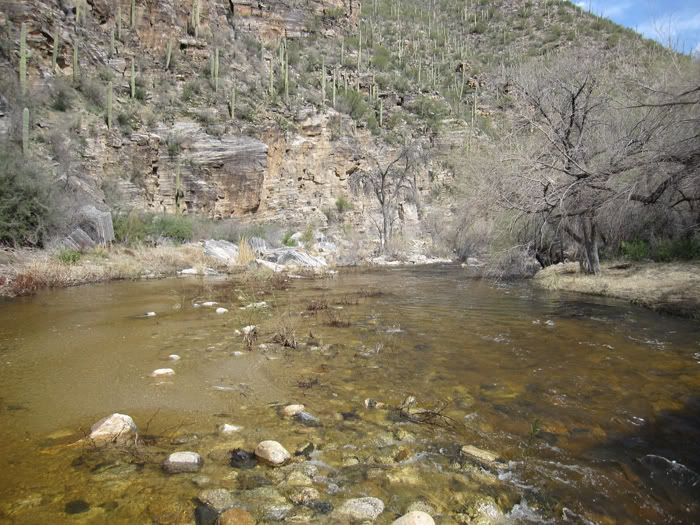
The word "sabino" in Spanish means rust. And while nobody remembers why the canyon got the name, a good guess is that it came from the color of the water; the water gets the rusty hue from the roots of oak trees that line the creek.
The immediate creek area gets plants that require lots of water, like oaks. Otherwise, this is all desert with severe conditions - extreme heat and thunderstorms in summer, and snow in winter. Yes, plenty of snow, as Mt. Lemmon, where the stream originates, stands quite high and is cold enough to host the southernmost ski resort in the US.
Sabino Canyon has a road that runs a few miles into the canyon. Built by the Civilian Conservation Corps during the Great Depression, the one-lane road crosses the creek several times before dead-ending; it had originally been meant to go all the way up to Mt. Lemmon, but the wider Catalina Highway fulfills that role instead. The road is served by visitor shuttles with driver narrations.
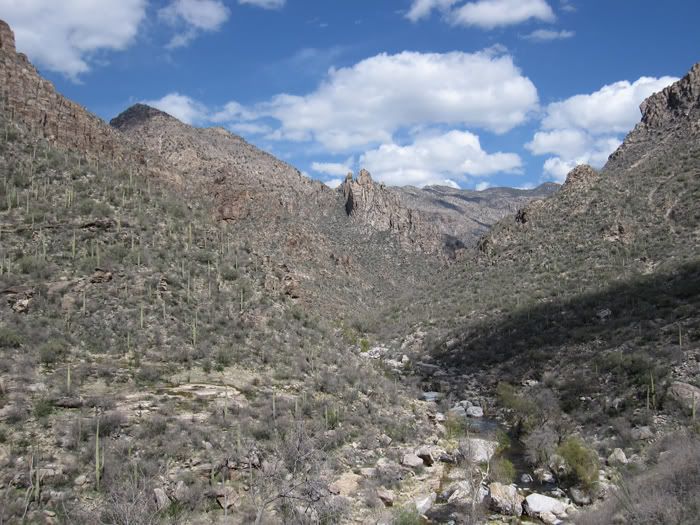
A look at Sabino Canyon. I have walked a bit from the dead-end of the road, and am facing the Mt. Lemmon direction. Quite a sight!
After Sabino Canyon, I had lunch, then drove west along Speedway Boulevard, the main east-west axis, toward the University of Arizona. I remembered driving the same stretch in a wrecked Ford Contour, unable to even buy gasoline, back in the day; now, I actually had some money in my purse, and my luxury Hyundai land yacht was all paid off, and it felt quite strange to drive the same streets of Tucson under much better circumstances. Though I do have to say, the run-down buildings and evidence of cut-rate economy remained very depressing in my mind, and those Eegee's fast food outlets, unique to Tucson, were as mysterious as ever.
I am now on Fourth Avenue just west of University of Arizona campus.
Antigone Books is the place to be if I want to buy feminist, or any other progressive/subversive, books. I can also buy related items, including bumper stickers and pendants. This would indeed be the place to buy a double-female symbol necklace, which I always wear.
When I called Tucson home, this was one of the few places I liked to hang out at.
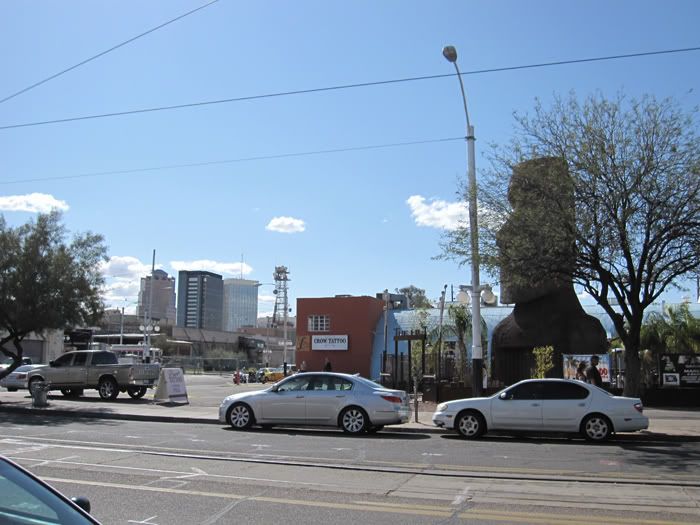
Thanks to its location next to the University, Fourth Avenue is the progressive/hippie/groovy part of Tucson, delivering a dose of personality to a city that badly needs it. I have to love that iron plate replica of the Easter Island statues.
Yes, that Hyundai Genesis is mine.
The three high-rise buildings in the back are in downtown, across the railroad tracks (Amtrak's Sunset Limited between Los Angeles and New Orleans uses those tracks), and are the only real highrises in Tucson. While Tucson does have over half a million people, it doesn't feel like it (and I don't mean this in a good way).
As seen in this photo, Fourth Avenue has a streetcar track, and Tucson does have a small fleet of vintage streetcars from foreign cities, similar to San Francisco's vintage fleet. They only run on special occasions, however.
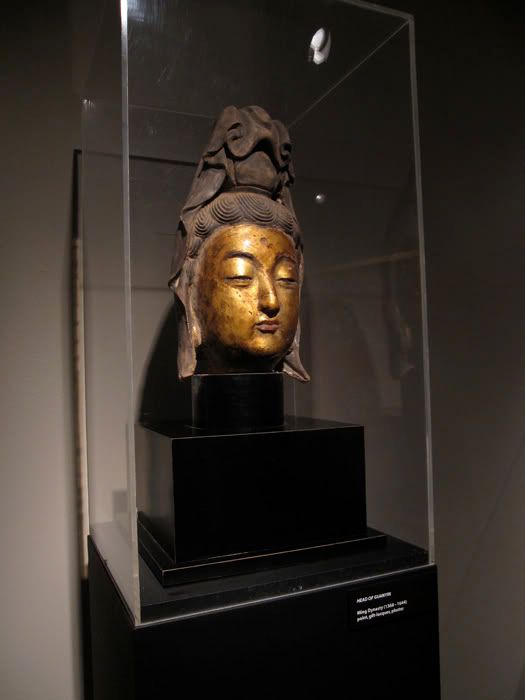
Tucson does have an art museum in downtown, though it's not all that big. I'm cooling off there during the early afternoon hours before heading off for more hiking.
Due to proximity to Mexico's west coast, and the heavy Spanish influence in the local culture/population, the matron saint of choice in Tucson would most likely be Lady Guadalupe. But fortunately, the museum is hosting a limited-time exhibition of Chinese art, and here is a lacquer head of my transgender matron saint, Kwan Yin, dating from the Ming Dynasty, though the exhibition is centered around the much older Han.
The museum is close to Old Town with its super-narrow streets and adobe buildings resembling those of an old Mexican village. Also nearby is a hotel that used to be a Ramada Inn, where I used to attend weekly Mary Kay sales group meetings; the hotel is now a no-name independent property, and I'm so glad that I am no longer selling the Christian theocratic cosmetics. My entry into Mary Kay sales was itself a desperation measure due to extreme poverty.
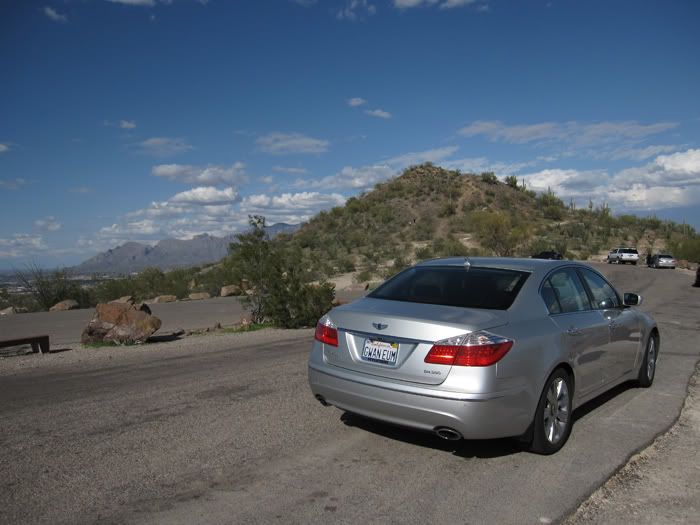
My next destination: Sentinel Hill, located just west of downtown across I-10. On its downtown-facing (eastern) slope, there is a large white letter A, standing for the University of Arizona, so the hill is also known as the A Mountain.
It's a good place to get bird's-eye views of Tucson, as well as the four out-of-this-world mountain ranges surrounding the city: Santa Catalina Mountains to the north (pictured to the left), Rincon Mountains to the east (snow-capped at this time), Santa Rita Mountains to the south, and Tucson Mountains to the west.
The human sprawl, compared to the stunning natural beauty, is very homely however. Though I could make out Davis-Monthan Air Force Base and its "Boneyard" that hosts retired military aircraft, as well as Tucson's only freeway interchange, where I-19 branches off from I-10 and heads south to connect to Mexican Highway 15.
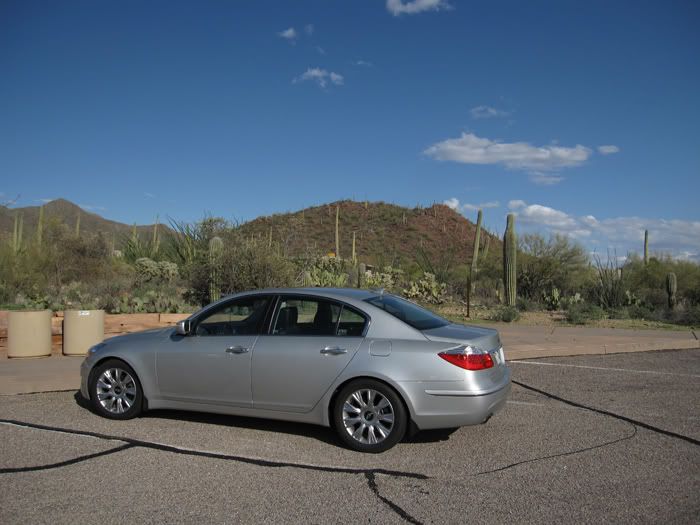
I returned to Speedway Boulevard, then headed further west. Speedway Boulevard becomes Gates Pass Road, and goes over the Tucson Mountains into the wide expanse of Avra Valley. Avra Valley is home to Old Tucson Studios, Arizona-Sonora Desert Museum (excellent zoo/botanical garden I had visited twice before), and the western portion of Saguaro National Park. Both Gates Pass and Avra Valley are lined with saguaros and other desert plants - it's quite a sight.
Now I have arrived at the park visitor center, to pay admissions and get acquainted.
While the park also has an eastern portion on the slopes of the Rincons, I won't have time to get out there this time.
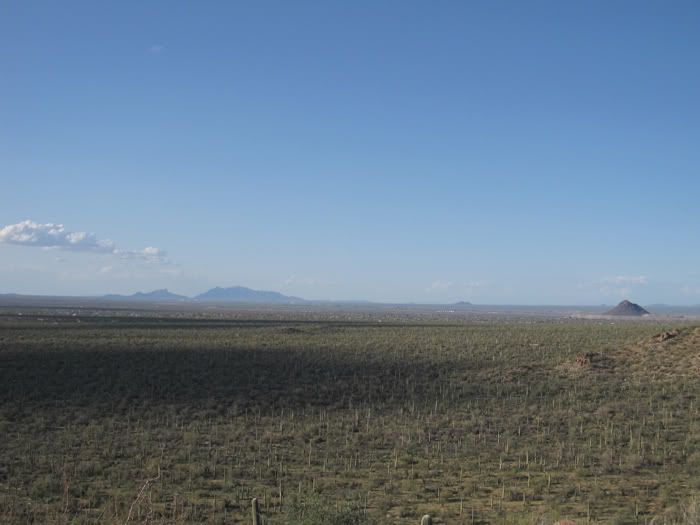
I am now driving the dirt loop inside the park, with great views of the surrounding landscape.
At the end of one pedestrian trail, I am looking due north. Those two peaks on the left are Picacho Peak, a major landmark for travelers between California and Texas. In fact, Tucson joined the US as part of the Gadsden Purchase in 1853, because the logical travel path between California and Texas, both new US territories as of 1848, came through here, still part of Mexico then. Railroads, and now I-10, go through Picacho Peak.
I continue to see saguaros as far as my eyes can see. Quite a sight! It's also notable that the scenery is much greener than I used to remember; that is due to record levels of precipitation during the winter. In fact, I would meet some heavy downpours on my drive back to California the next day.
Although this photo looks as if there is no human presence out there, there is actually quite a bit. There are some random shacks that belong to the town of Marana, which is now the northern bedroom community for Tucson. In addition, Pinal Airpark, a huge airfield that takes in and dismantles old airliners, is somewhere out there too - the dry desert climate is conducive to aircraft storage, the same reason why military aircraft are stored and dismantled in Tucson.
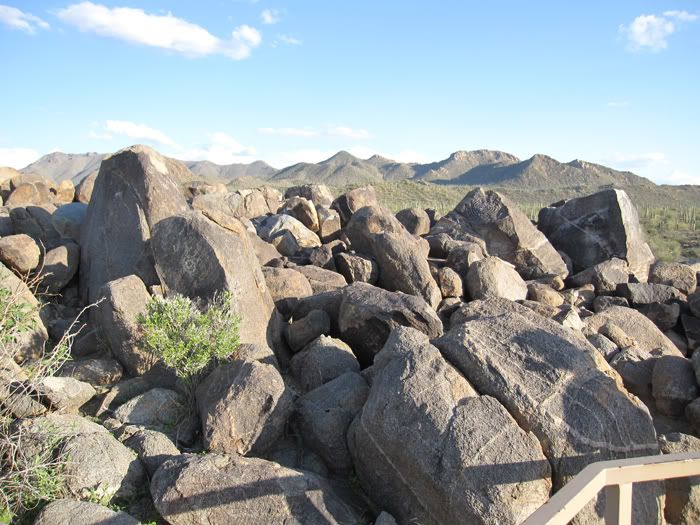
Here are some petroglyphs, left behind by the Hohokam, or the "Forgotten People." Not much is known about them; they are as mysterious as the Anasazi, who also left petroglyphs and disappeared.
The Tohono O'odham (Desert People) tribe, whose reservation takes up much of Avra Valley, are probable descendants of the Hohokam.
I wound down for the evening, by heading up Oracle Road from downtown. Oracle and Miracle Mile is only a block away from my apartment in those poverty days - and a very familiar area for me still. I drove up further on Oracle, until hitting Tucson Mall at the northwestern edge of the city, where I had dinner and did some window shopping. I wrapped up by stopping at the nearby Borders Bookstore, which was my "home" big box chain bookstore during my Tucson days, and reading some magazines and current event books.
All in all, this trip was a good reminder of all the things I used to like, and hate, about Tucson. And I am so glad to be out of that economic dead-end.
Formerly political commentary, now travelogue and photo gallery.
I proudly documented and featured three months of life in Seoul, South Korea, toward the end of 2008, and added two weeks of Europe in late 2009. Photos from various older travels are coming online as well.
I'm not a teabagger, I'm a carpetmuncher.
Showing posts with label North America 2010. Show all posts
18 July 2010
01 June 2010
New Orleans update
Nothing to say, except that I returned safely, with another complimentary upgrade. And I was also very pleased with the cabin crew.
A year ago, I flew back from Toronto on United Airlines, and I hated the cabin crew on that flight. It had also left a bad aftertaste in my mouth regarding United Airlines - an airline I had consistently preferred since my very first flight in 1988. This New Orleans trip was booked on United partly because of my elite benefits, but primarily because of the $150 apology credit that resulted from that nightmare last year.
Well, I was very happy with the crew and its approach to passengers today. It was very obvious that they share my thoughts - that air travel, by bringing peoples together from all around the world, contribute to a better world for everyone to live in - and that they took serious pride in their work. A very welcome about-face from the a-hole last year!
United has once again earned my business, after almost losing it. And hoping to do some more travel later this year (including Seoul and/or Tokyo) - and extend my elite status for another year while at it.
A year ago, I flew back from Toronto on United Airlines, and I hated the cabin crew on that flight. It had also left a bad aftertaste in my mouth regarding United Airlines - an airline I had consistently preferred since my very first flight in 1988. This New Orleans trip was booked on United partly because of my elite benefits, but primarily because of the $150 apology credit that resulted from that nightmare last year.
Well, I was very happy with the crew and its approach to passengers today. It was very obvious that they share my thoughts - that air travel, by bringing peoples together from all around the world, contribute to a better world for everyone to live in - and that they took serious pride in their work. A very welcome about-face from the a-hole last year!
United has once again earned my business, after almost losing it. And hoping to do some more travel later this year (including Seoul and/or Tokyo) - and extend my elite status for another year while at it.
31 May 2010
New Orleans: Winding down
My three exciting days in Big Easy are already over. I'll relax for the evening and fly home tomorrow.
My itinerary had me visit Uptown - taking me to Audubon Park and Magazine Street.
After a breakfast at the Krystal's location at Canal and Bourbon, I came out to Audubon Park, via the St. Charles (Morwen refers to the street as St. Chuck) streetcar.
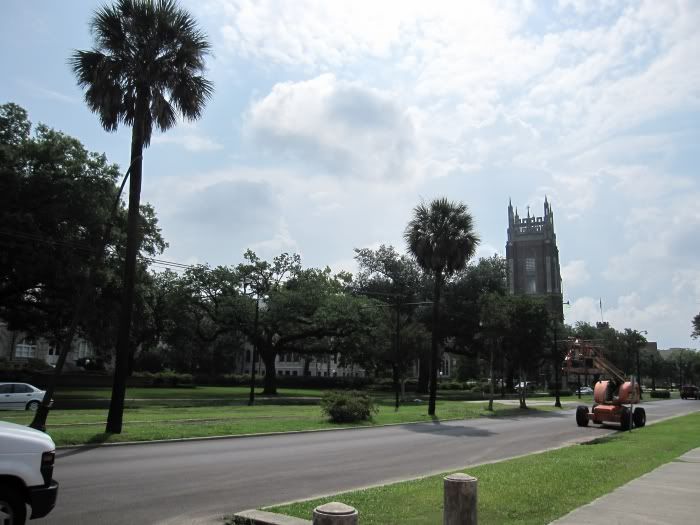
I have a glimpse of Loyola University campus as I am about to head into the park. A reminder of the region's French Catholic roots - though the current reactionary Catholicism does NOT seem to enjoy much support within New Orleans, thankfully.
The park has a tree-lined circular jogging/cycling trail which cuts through a public golf course. Quite a sight, though the humidity gets in the way, even in the shade.
I ended up at the zoo. Because of my Audubon Experience ticket from my first day, which paid for the aquarium, the insectarium, the IMAX movie, AND the zoo, I simply walked in without paying for admissions again. And this zoo is as much about the presentation as it is about the animals.
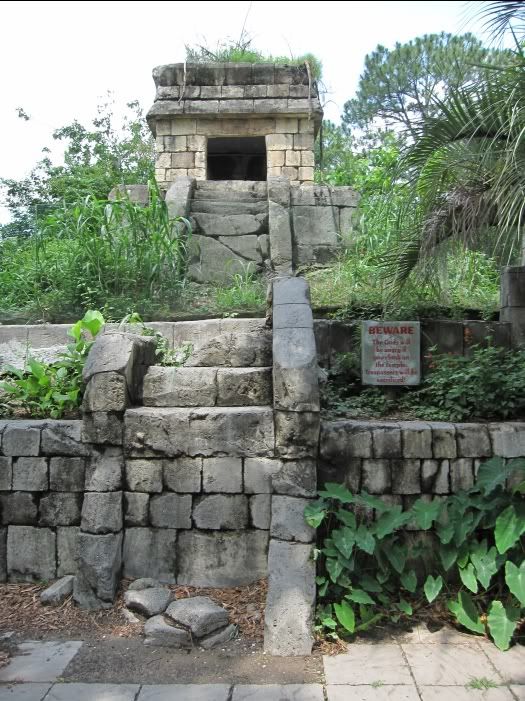
I love this replica of a Mayan temple. I am warned not to trespass, otherwise I will have to be sacrificed to the gods. This Mayan themed area features a pair of jaguars as the star attraction, alongside a few other select animals of the Maya territory.
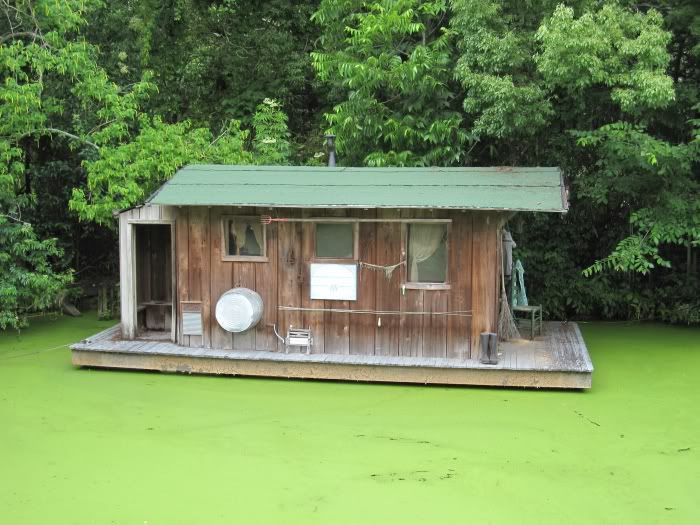
Since I am in Louisiana, a sizable portion of the zoo is dedicated to local animals. And here is an example of a human adaptation to the area as well - a floating house that is anchored most of the time, but towed by a fishing boat to different locations whenever the fisherman feels a need to move to more fertile fishing grounds. This type of dwelling was typical of the wetlands to the south of New Orleans for a long time.
The interior has three equal-sized partitions - one bedroom, one living room, and one kitchen. The left deck has a toilet, and the right deck is open-air balcony.
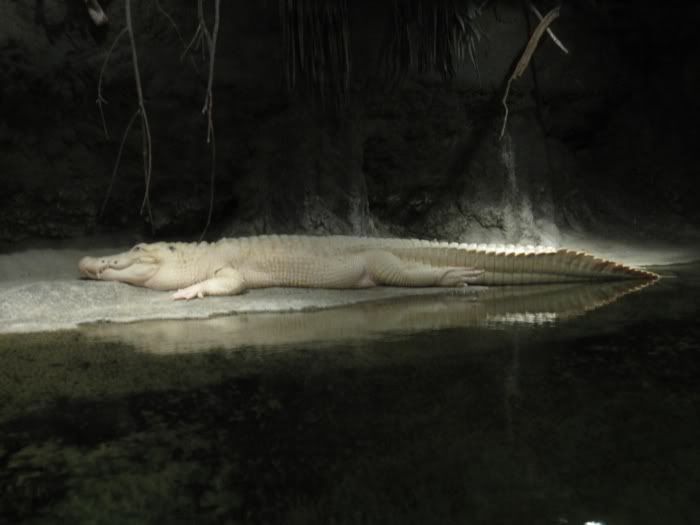
White alligators have been found only twice in the wild - in 1987 and 1994, both in Louisiana. The 1987 find consisted of over a dozen hatchlings, and they were kept in captivity for study and exhibit purposes. White alligators have gone on to become new "wonder of the world" for Louisiana, and even traveled on temporary exhibitions to other zoos around the world.
These alligators are not albinos, though their condition is similar to albinism. Nevertheless, their eyes do have blue pigmentation, and they do not suffer from health problems that normally afflict albinos. White alligators are vulnerable in the wild, however, when young, because of their higher visibility.
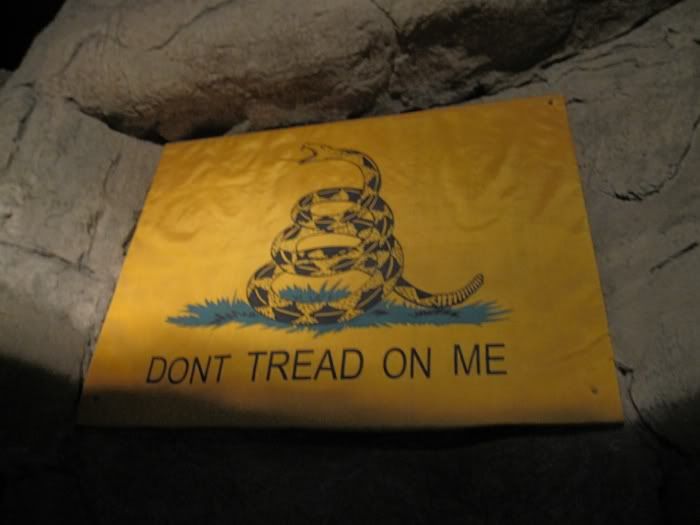
I am now entering a rattlesnake area - and the yellow "Don't Tread on Me" flag announces the rattlesnake exhibit.
Of course, this flag is now one of my least favorites, because it has represented American neoliberalism ("libertarianism") and now represents the teabaggers.
Upon leaving the zoo, a very heavy shower moved in, and I was drenched - with my socks becoming completely soaked. Miserable, I hopped on the No. 11 bus, which returns to Canal Street by taking Magazine Street, the main shopping drag of Uptown.
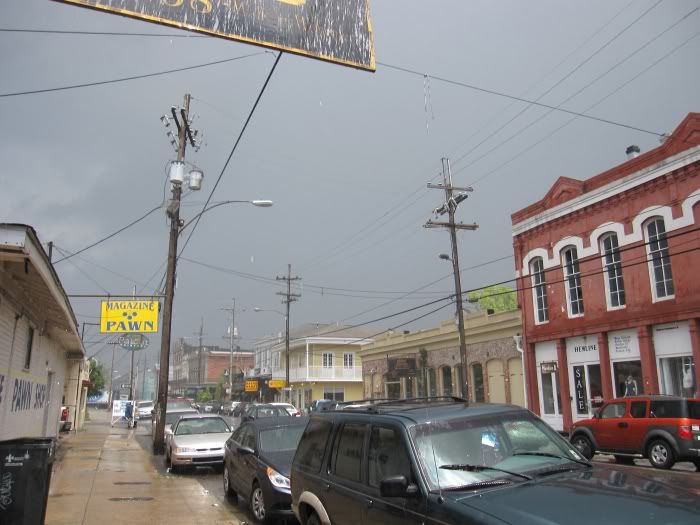
I am walking the portion of Magazine Street between Louisiana and Washington Avenues.
Magazine is narrow, and lined with unique shops run by locals or smaller chains, rather than big chains. There is a lot of personality here. I would consider this to be the New Orleans equivalent to San Francisco's Haight Street or Los Angeles's Melrose Avenue. In addition to clothing boutiques and stores for daily necessities, I can also find restaurants at all price levels.
I checked out Francesca's Collections, right behind me. Lovely collection of clothing and accessories, though I wasn't exactly in a shopping mood. I will return to one of its locations closer to my home before long, however.
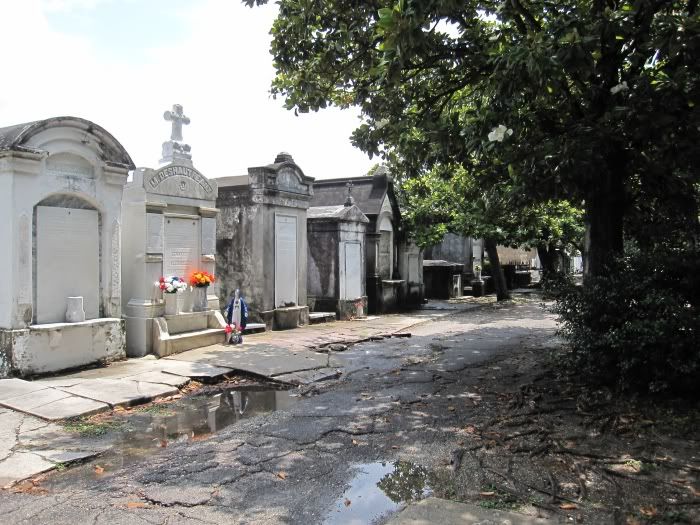
Walking up Washington Avenue to return to St. Charles. And here is a peek into a typical Louisiana cemetery.
Because of the moist ground close to sea level in this part of the world, it makes no sense to bury the deceased in underground graves; too often, the wooden coffin may rot and collapse (along with the tombstone above it) as it fills with water, or if the coffin is watertight, it will simply float up and away in a flood. As a result, graves are above the ground. New Orleans grave tours are actually popular, though I'll have to save that for a future return visit.
I especially love the grave that has a Virgin Mary standing in front.
I took the streetcar back to the nearest stop to my hotel - at Robert E. Lee memorial at the foot of the bridge. And returning to my hotel takes me in front of the official National World War II Memorial (official by an Act of US Congress) - so I made sure to stop by, especially fitting since it's Memorial Day. The exhibits covered civilian sacrifices and a ramp-up of the war effort, as well as political developments in Allied and Axis nations and the logistics of the warfighting both in the Atlantic and Pacific theaters. All in excruciating detail, just so that I have a faint idea of what it would feel like to try to land in Normandy, carrying 75 pounds of gear, with bullets flying all around. I ended up spending over two hours in the museum.
The reason for locating the World War II Memorial in New Orleans is due to the amphibious landing boats used in Normandy and elsewhere in the war being designed and built in New Orleans. General Eisenhower is quoted as saying that had it not been for the boats, a whole different strategy would have been required to retake Europe from the Nazis. The designer/builder of the boats, Andrew Jackson Higgins, is remembered with a street named after him - the street that runs from my hotel via the Memorial to the Robert E. Lee Memorial and its streetcar stops.
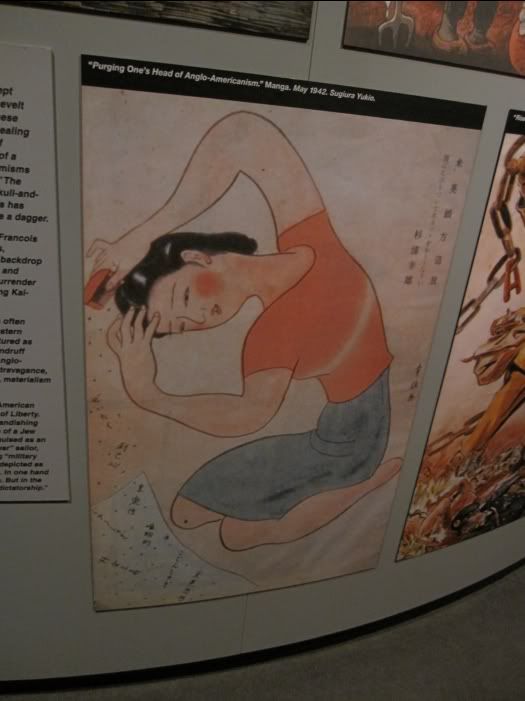
Sometimes it's the propaganda that is the most memorable about wars. And American propaganda posters depicting the Japanese as savage beasts, rats, or other despicable subhuman beings, are well known. But what really stuck to my mind is this Japanese propaganda poster.
The poster uses a young woman to symbolize Japan. She is washing her hair - and as she does so, corrupting Western barbarian influences - such as individualism, liberalism, and materialism - are being washed away. Japan framed its fight against the US and the Allies, as a "noble struggle to protect the people of Asia from the Western barbarians, under the benevolence of the almighty superior, pure Yamato race." The reason why this poster stuck out in my mind is because it pits the communal, authoritarian mindset of Asian cultures against the more individual mindset of the West - a culture clash that continues to play out in Asian-American communities, and in my own life as well.
Indeed, Japan was one formidable enemy. Trained under bushido, Japanese soldiers valued honor more than life, and would rather take their own lives (or launch a suicidal attack, like banzai or kamikaze) than peacefully surrender. Japan's navy was also formidable, and the Pacific theater of WWII indeed saw the largest naval battle and the largest air carrier battle ever fought. And it bears remembering Japan's outright barbaric treatment of the people it had conquered, between surrendered American troops in Bataan, Philippines to the civilians of Nanjing and other Chinese cities. This may have precipitated the nuking of Hiroshima and Nagasaki, rather than risking a huge amphibious assault on Kyushu, codenamed Olympic, that had originally been planned.
I do hope to go to Japan later this year (just like New Orleans before this weekend, a glaring gap in my travels), for a look at this past and culture, though under a more peaceful context of course. And this wraps up my New Orleans experience as well - I am glad to have come, and hope to come back before too long. Though next time, I hope to come in my car, as part of a longer road trip - and as I see numerous cars around New Orleans sporting California or Atlantic seaboard license plates, I hope to be driving one of them myself in the future.
My itinerary had me visit Uptown - taking me to Audubon Park and Magazine Street.
After a breakfast at the Krystal's location at Canal and Bourbon, I came out to Audubon Park, via the St. Charles (Morwen refers to the street as St. Chuck) streetcar.
I have a glimpse of Loyola University campus as I am about to head into the park. A reminder of the region's French Catholic roots - though the current reactionary Catholicism does NOT seem to enjoy much support within New Orleans, thankfully.
The park has a tree-lined circular jogging/cycling trail which cuts through a public golf course. Quite a sight, though the humidity gets in the way, even in the shade.
I ended up at the zoo. Because of my Audubon Experience ticket from my first day, which paid for the aquarium, the insectarium, the IMAX movie, AND the zoo, I simply walked in without paying for admissions again. And this zoo is as much about the presentation as it is about the animals.
I love this replica of a Mayan temple. I am warned not to trespass, otherwise I will have to be sacrificed to the gods. This Mayan themed area features a pair of jaguars as the star attraction, alongside a few other select animals of the Maya territory.
Since I am in Louisiana, a sizable portion of the zoo is dedicated to local animals. And here is an example of a human adaptation to the area as well - a floating house that is anchored most of the time, but towed by a fishing boat to different locations whenever the fisherman feels a need to move to more fertile fishing grounds. This type of dwelling was typical of the wetlands to the south of New Orleans for a long time.
The interior has three equal-sized partitions - one bedroom, one living room, and one kitchen. The left deck has a toilet, and the right deck is open-air balcony.
White alligators have been found only twice in the wild - in 1987 and 1994, both in Louisiana. The 1987 find consisted of over a dozen hatchlings, and they were kept in captivity for study and exhibit purposes. White alligators have gone on to become new "wonder of the world" for Louisiana, and even traveled on temporary exhibitions to other zoos around the world.
These alligators are not albinos, though their condition is similar to albinism. Nevertheless, their eyes do have blue pigmentation, and they do not suffer from health problems that normally afflict albinos. White alligators are vulnerable in the wild, however, when young, because of their higher visibility.
I am now entering a rattlesnake area - and the yellow "Don't Tread on Me" flag announces the rattlesnake exhibit.
Of course, this flag is now one of my least favorites, because it has represented American neoliberalism ("libertarianism") and now represents the teabaggers.
Upon leaving the zoo, a very heavy shower moved in, and I was drenched - with my socks becoming completely soaked. Miserable, I hopped on the No. 11 bus, which returns to Canal Street by taking Magazine Street, the main shopping drag of Uptown.
I am walking the portion of Magazine Street between Louisiana and Washington Avenues.
Magazine is narrow, and lined with unique shops run by locals or smaller chains, rather than big chains. There is a lot of personality here. I would consider this to be the New Orleans equivalent to San Francisco's Haight Street or Los Angeles's Melrose Avenue. In addition to clothing boutiques and stores for daily necessities, I can also find restaurants at all price levels.
I checked out Francesca's Collections, right behind me. Lovely collection of clothing and accessories, though I wasn't exactly in a shopping mood. I will return to one of its locations closer to my home before long, however.
Walking up Washington Avenue to return to St. Charles. And here is a peek into a typical Louisiana cemetery.
Because of the moist ground close to sea level in this part of the world, it makes no sense to bury the deceased in underground graves; too often, the wooden coffin may rot and collapse (along with the tombstone above it) as it fills with water, or if the coffin is watertight, it will simply float up and away in a flood. As a result, graves are above the ground. New Orleans grave tours are actually popular, though I'll have to save that for a future return visit.
I especially love the grave that has a Virgin Mary standing in front.
I took the streetcar back to the nearest stop to my hotel - at Robert E. Lee memorial at the foot of the bridge. And returning to my hotel takes me in front of the official National World War II Memorial (official by an Act of US Congress) - so I made sure to stop by, especially fitting since it's Memorial Day. The exhibits covered civilian sacrifices and a ramp-up of the war effort, as well as political developments in Allied and Axis nations and the logistics of the warfighting both in the Atlantic and Pacific theaters. All in excruciating detail, just so that I have a faint idea of what it would feel like to try to land in Normandy, carrying 75 pounds of gear, with bullets flying all around. I ended up spending over two hours in the museum.
The reason for locating the World War II Memorial in New Orleans is due to the amphibious landing boats used in Normandy and elsewhere in the war being designed and built in New Orleans. General Eisenhower is quoted as saying that had it not been for the boats, a whole different strategy would have been required to retake Europe from the Nazis. The designer/builder of the boats, Andrew Jackson Higgins, is remembered with a street named after him - the street that runs from my hotel via the Memorial to the Robert E. Lee Memorial and its streetcar stops.
Sometimes it's the propaganda that is the most memorable about wars. And American propaganda posters depicting the Japanese as savage beasts, rats, or other despicable subhuman beings, are well known. But what really stuck to my mind is this Japanese propaganda poster.
The poster uses a young woman to symbolize Japan. She is washing her hair - and as she does so, corrupting Western barbarian influences - such as individualism, liberalism, and materialism - are being washed away. Japan framed its fight against the US and the Allies, as a "noble struggle to protect the people of Asia from the Western barbarians, under the benevolence of the almighty superior, pure Yamato race." The reason why this poster stuck out in my mind is because it pits the communal, authoritarian mindset of Asian cultures against the more individual mindset of the West - a culture clash that continues to play out in Asian-American communities, and in my own life as well.
Indeed, Japan was one formidable enemy. Trained under bushido, Japanese soldiers valued honor more than life, and would rather take their own lives (or launch a suicidal attack, like banzai or kamikaze) than peacefully surrender. Japan's navy was also formidable, and the Pacific theater of WWII indeed saw the largest naval battle and the largest air carrier battle ever fought. And it bears remembering Japan's outright barbaric treatment of the people it had conquered, between surrendered American troops in Bataan, Philippines to the civilians of Nanjing and other Chinese cities. This may have precipitated the nuking of Hiroshima and Nagasaki, rather than risking a huge amphibious assault on Kyushu, codenamed Olympic, that had originally been planned.
I do hope to go to Japan later this year (just like New Orleans before this weekend, a glaring gap in my travels), for a look at this past and culture, though under a more peaceful context of course. And this wraps up my New Orleans experience as well - I am glad to have come, and hope to come back before too long. Though next time, I hope to come in my car, as part of a longer road trip - and as I see numerous cars around New Orleans sporting California or Atlantic seaboard license plates, I hope to be driving one of them myself in the future.
30 May 2010
New Orleans, Day 2 of 3
New Orleans is keeping me quite engaged, despite the humidity that wears me down fast. Here is a recap of my day.
I started late morning by taking the St. Charles streetcar to Canal Street, for a McDonald's lunch. Afterwards, I transferred to the Canal Street streetcar and took it to the terminus at the City Park, leaving me only a quick walk away from New Orleans Museum of Art.
This museum does have a decent Asian art collection. I am starting on a familiar note, with a wooden Chinese Kwan Yin from about 1175.
The Chinese and Japanese collections put some emphasis on pottery made for European export. One of the Chinese examples was made for France's Louis XV, complete with a fleur-de-lis - and that's very appropriate for New Orleans, given that the fleur-de-lis continues to represent New Orleans and its French heritage.
The museum's Asian collections also include the other major culture, India. Here is one of two bronze Indian Avalokitesvaras in the collection. Of course, Avalokitesvara is the earlier, Indian male form of Kwan Yin.
Other Asian cultures are hard to find here. There are a couple of Cambodian stone sculptures in the hallway, but that's about it. While some larger museums elsewhere are trying to get their hands on some Korean art, that's not happened here yet, and I can forget about Thai or Vietnamese art as well.
It does have a nice overview of art of the Americas (various North American tribes, as well as some civilizations in and around Aztec and Maya areas, and even some Nazca art) as well as a look at African art, where art is in everyday objects, and animist religions put no emphasis on a higher power but heavy emphasis on various initiation ceremonies (where some of the art objects would come to use).
The museum's claim to fame, honestly, is the Faberge collection, seen here. A Facebook friend of mine, Wendy Westfaul, who is based in Houston but considers New Orleans her hometown, recommended the museum to me for this collection alone.
Love that turquoise serpent paperweight on the right, under the portrait!
The museum also has a great collection of miniature porcelain art, primarily from Meissen in Germany but some also from its key competitor Sevres in France.
This is a monkey band made by Meissen.
This museum is not known for British paintings, but this one made it here. It is entitled The Fifth Plague of Egypt, and was painted in 1800 by Joseph Mallord William Turner. While it depicts one of the plagues that descended on Egypt according to the Book of Exodus in the Bible, it really depicts the seventh plague, hailstorm, rather than the actual fifth, the death of livestock.
It actually belongs to the Indianapolis Museum of Art, known for its outstanding collection of British paintings. I was supposed to visit it during my Indianapolis visit in 2008, but ended up not going there, as I had to cut my miserable business trip early.
There is a story for the painting coming down to New Orleans. As the Indianapolis Colts and the New Orleans Saints became the two teams facing off in Super Bowl XLIV earlier this year, the two museums made a bet. Namely, the losing city's museum would loan a key artwork to the winning city's museum for three months. Of course, with the Saints' win, Indianapolis ended up sending this masterpiece this way.
The caption from the curator made that clear - and also made sure to add, GEAUX SAINTS!
It's pouring outside as I wrap up the museum. But it's still hot and muggy. I'm not liking this weather at all.
At least the view out is wonderful. City Park also has lots of oak trees. It is one of the largest urban parks in the US, in the same league as New York's Central Park, San Francisco's Golden Gate Park, and Chicago's Grant Park - though Los Angeles's mountainous Griffith Park trumps them all. Flooded and severely damaged by Hurricane Katrina, restorations and improvements are ongoing.
Nearby is this lovely botanical garden, home to some rose gardens, a small Japanese garden, a model railroad garden that uses rolling stock and buildings native to New Orleans, and a conservatory housing "living fossil" plants.
This waterlily pond is my favorite, however. But the muggy weather and the showers do make it miserable.
After a lengthy wait, I took the streetcars back to the hotel, for some Internet surfing, before coming back out to Bourbon Street around sunset, for a Philly cheesesteak sandwich and some soaking in of the atmosphere. This was also the first time I actually ventured into Bourbon beyond St. Ann Street. St. Ann is the de facto dividing line between the heterosexual Bourbon and the gay Bourbon (and the quiet residential areas beyond). The gay Bourbon had great men's activity, not so much in terms of lesbians.
While I was out and about, I picked up a phone message from local friend Morwen Madrigal. After phone tagging a few times, I got one final message from her - from her cell phone that had a 909 (yes, as in my neck of woods) area code! She used to have a work assignment in Southern California at the time, hence the 909 cell phone. I eventually met up with her, and her partner Betty Ann Davis, for a nice chat at a quiet local bar - we talked about lots of current events related things, including the oil spill, the teabaggers, the Catholic pedophile priests, and more. Morwen and I talk about these things over Facebook anyway, but it was a lovely opportunity to move the talk into the real world. The night ended with Betty driving me back to my hotel - saving me the trouble of walking all the way back to Canal for the streetcar.
I started late morning by taking the St. Charles streetcar to Canal Street, for a McDonald's lunch. Afterwards, I transferred to the Canal Street streetcar and took it to the terminus at the City Park, leaving me only a quick walk away from New Orleans Museum of Art.
This museum does have a decent Asian art collection. I am starting on a familiar note, with a wooden Chinese Kwan Yin from about 1175.
The Chinese and Japanese collections put some emphasis on pottery made for European export. One of the Chinese examples was made for France's Louis XV, complete with a fleur-de-lis - and that's very appropriate for New Orleans, given that the fleur-de-lis continues to represent New Orleans and its French heritage.
The museum's Asian collections also include the other major culture, India. Here is one of two bronze Indian Avalokitesvaras in the collection. Of course, Avalokitesvara is the earlier, Indian male form of Kwan Yin.
Other Asian cultures are hard to find here. There are a couple of Cambodian stone sculptures in the hallway, but that's about it. While some larger museums elsewhere are trying to get their hands on some Korean art, that's not happened here yet, and I can forget about Thai or Vietnamese art as well.
It does have a nice overview of art of the Americas (various North American tribes, as well as some civilizations in and around Aztec and Maya areas, and even some Nazca art) as well as a look at African art, where art is in everyday objects, and animist religions put no emphasis on a higher power but heavy emphasis on various initiation ceremonies (where some of the art objects would come to use).
The museum's claim to fame, honestly, is the Faberge collection, seen here. A Facebook friend of mine, Wendy Westfaul, who is based in Houston but considers New Orleans her hometown, recommended the museum to me for this collection alone.
Love that turquoise serpent paperweight on the right, under the portrait!
The museum also has a great collection of miniature porcelain art, primarily from Meissen in Germany but some also from its key competitor Sevres in France.
This is a monkey band made by Meissen.
This museum is not known for British paintings, but this one made it here. It is entitled The Fifth Plague of Egypt, and was painted in 1800 by Joseph Mallord William Turner. While it depicts one of the plagues that descended on Egypt according to the Book of Exodus in the Bible, it really depicts the seventh plague, hailstorm, rather than the actual fifth, the death of livestock.
It actually belongs to the Indianapolis Museum of Art, known for its outstanding collection of British paintings. I was supposed to visit it during my Indianapolis visit in 2008, but ended up not going there, as I had to cut my miserable business trip early.
There is a story for the painting coming down to New Orleans. As the Indianapolis Colts and the New Orleans Saints became the two teams facing off in Super Bowl XLIV earlier this year, the two museums made a bet. Namely, the losing city's museum would loan a key artwork to the winning city's museum for three months. Of course, with the Saints' win, Indianapolis ended up sending this masterpiece this way.
The caption from the curator made that clear - and also made sure to add, GEAUX SAINTS!
It's pouring outside as I wrap up the museum. But it's still hot and muggy. I'm not liking this weather at all.
At least the view out is wonderful. City Park also has lots of oak trees. It is one of the largest urban parks in the US, in the same league as New York's Central Park, San Francisco's Golden Gate Park, and Chicago's Grant Park - though Los Angeles's mountainous Griffith Park trumps them all. Flooded and severely damaged by Hurricane Katrina, restorations and improvements are ongoing.
Nearby is this lovely botanical garden, home to some rose gardens, a small Japanese garden, a model railroad garden that uses rolling stock and buildings native to New Orleans, and a conservatory housing "living fossil" plants.
This waterlily pond is my favorite, however. But the muggy weather and the showers do make it miserable.
After a lengthy wait, I took the streetcars back to the hotel, for some Internet surfing, before coming back out to Bourbon Street around sunset, for a Philly cheesesteak sandwich and some soaking in of the atmosphere. This was also the first time I actually ventured into Bourbon beyond St. Ann Street. St. Ann is the de facto dividing line between the heterosexual Bourbon and the gay Bourbon (and the quiet residential areas beyond). The gay Bourbon had great men's activity, not so much in terms of lesbians.
While I was out and about, I picked up a phone message from local friend Morwen Madrigal. After phone tagging a few times, I got one final message from her - from her cell phone that had a 909 (yes, as in my neck of woods) area code! She used to have a work assignment in Southern California at the time, hence the 909 cell phone. I eventually met up with her, and her partner Betty Ann Davis, for a nice chat at a quiet local bar - we talked about lots of current events related things, including the oil spill, the teabaggers, the Catholic pedophile priests, and more. Morwen and I talk about these things over Facebook anyway, but it was a lovely opportunity to move the talk into the real world. The night ended with Betty driving me back to my hotel - saving me the trouble of walking all the way back to Canal for the streetcar.
29 May 2010
New Orleans: kickoff
Pausing my old Europe recap for a minute, as I am on the road NOW.
I have just finished my first of three days in New Orleans - this is my first-ever visit, and so far I am very pleased, despite the heat and humidity. I especially love le Vieux Carre (French Quarter), and especially Bourbon Street, where just about anything goes!
Here is my recap of today.
This is actually yesterday afternoon, as I leave Los Angeles on United Airlines.
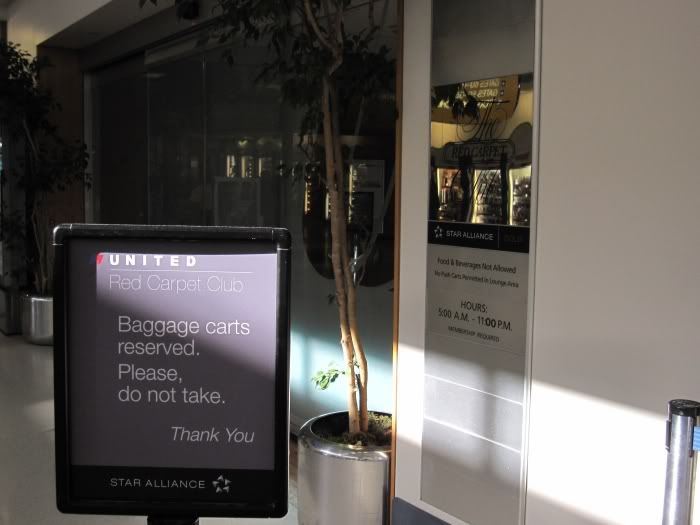
I am only a Premier, the lowest-level elite (though that's still more than what I'm used to), so I don't qualify to use the lounge for free. But I took the photo anyway, because of the name. United Airlines' lounge is named the Red Carpet Club, and since I've been working on a novel involving a redhead lesbian United flight attendant for forever, the lounge name is a perfect double-entendre for me.
United logistics were dreadful yesterday. Mechanical delays galore, including an Australia-bound flight running 23 1/2 hours late. My New Orleans run was itself 2 hours late - and actually had to use a plane from Orlando, rather than the originally scheduled plane from San Francisco. On the other hand, the Orlando plane had a larger first class section, and I got an automatic upgrade to an empty first class seat as part of my elite benefits.
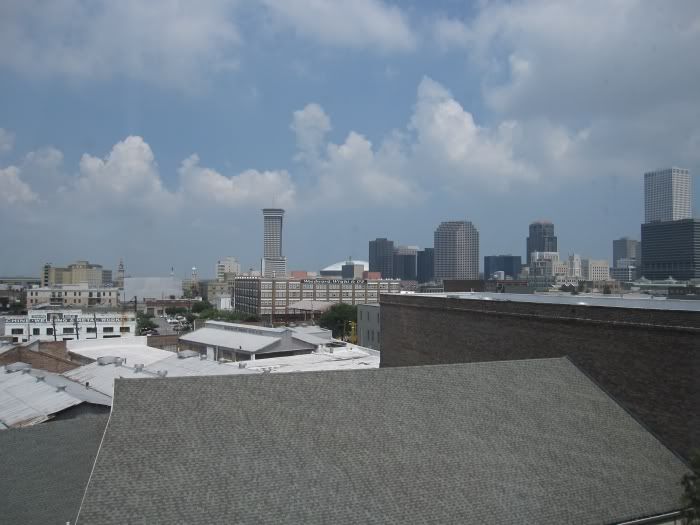
Despite the late arrival, I was up and running before too long, once the sun was up. This is the view from my hotel room. My hotel is in the Warehouse District at the foot of the Mississippi River Bridge (US-90 Business), and I have a view of the Superdome (a mess during Katrina evacuations, but now a symbol of triumph with the Saints' win of Super Bowl) and the skyscrapers of the business district. A block behind me is the Convention Center, which hosted the 1988 Republican National Convention that nominated Vice President Poppy Bush as the presidential candidate, and Dan Quayle as his running mate.
I took in the hotel's breakfast buffet, before coming back to my room to do the research for my initial sightseeing.
My initial plans were to take the streetcar to the French Quarter, but given that the nearest streetcar stop was already halfway to the French Quarter, and that service frequency was a joke, I decided to walk along the waterfront toward the foot of Canal Street, and tour the Audubon Aquarium.
Here is one of the exhibits.
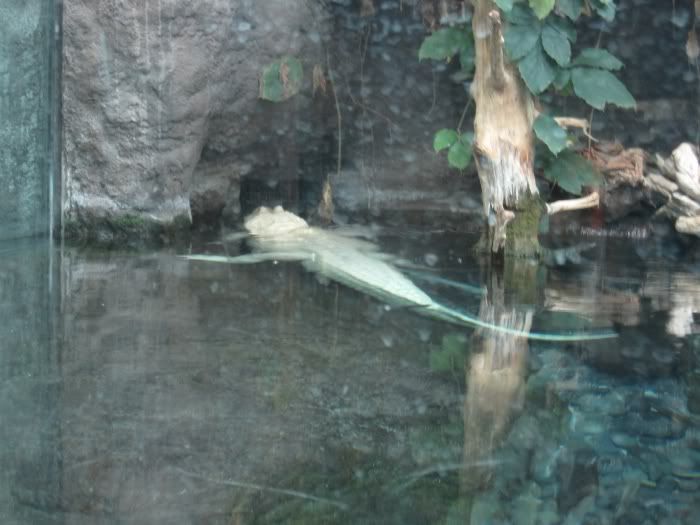
Louisiana's wetlands south of New Orleans, stretching into the sea as the Mississippi empties, are known for their alligators. Here is an albino alligator.
I was thinking of a local friend here in New Orleans, Morwen Madrigal (yes, the one who told me she had licked all the Grand Tetons back in the day), who likes to joke about feeding the "Conservamooks" to the bayou alligators. I am in touch with her and plan on getting together with her and her partner later on during the stay.
The aquarium also hosts an IMAX theater, and I took in a movie about Hurricane Katrina's impact on the Louisiana coastline, and the effect of human developments (levees in particular) in stopping the flow of sediment into the wetlands, the resulting erosion of existing wetlands, and the shrunken wetlands being less able to protect New Orleans from hurricane surges.
The Audubon Institute runs, in addition to the aquarium, an insectarium and a zoo. I bought a combination ticket that allows me to visit all three AND watch an IMAX movie for barely more than just two of the sights - for $34.95. The insectarium is located on the ground floor of the old US Customs House.
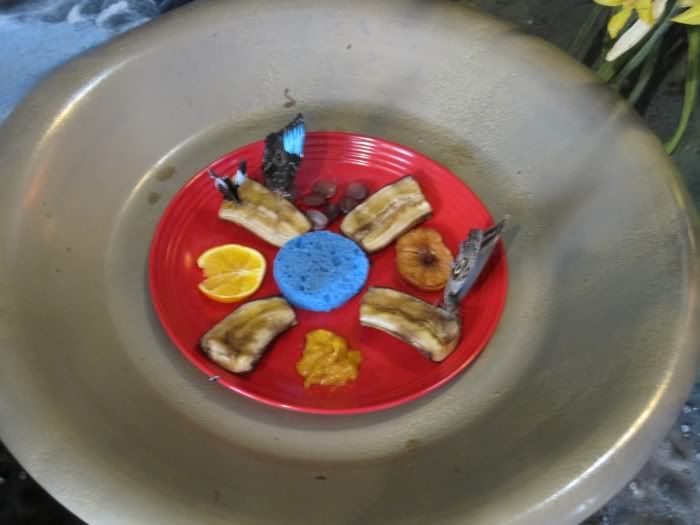
While the insectarium has many interesting displays - including a cockroach-infested kitchen and various termite labs - this one, a butterfly house in the form of a Japanese garden. And sure enough, these butterflies are having a Japanese lunch.
I walked further up Canal Street, which is the main wide thoroughfare in New Orleans with plenty of shopping. To its north-northeast is the French Quarter. To its south-southwest is the newer part of New Orleans for Anglo Americans. I walked up to Bourbon, then turned right to enter the heart of the French Quarter.
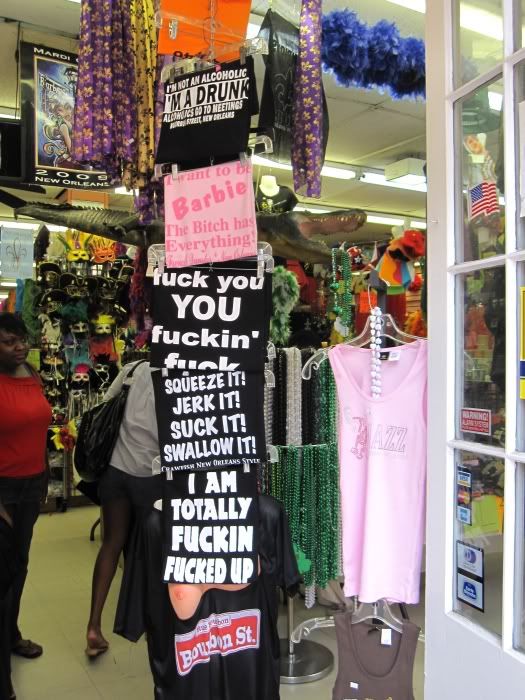
Here is a souvenir shop with T-shirts for sale. Loving them all - especially the one with the built-in boobs.
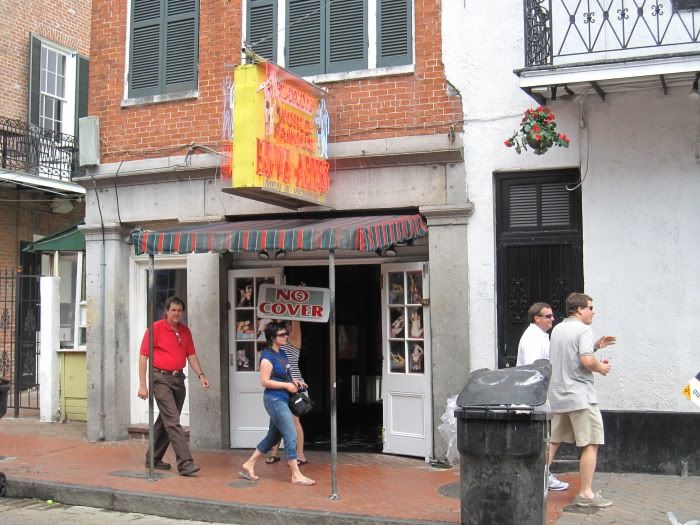
Bourbon is the street of debauchery. It is full of bars, clubs, strip clubs, and yes, even a club where I can watch live sex acts. Based on the photos, it looks like I can watch hetero acts and lesbian acts.
While I am loving all the debauchery, I would rather come back in the future with a pervert friend or two. I just don't feel like going into that live sex club alone, as a lone female.
Royal is the street immediately to the south of Bourbon. It is a more sedate street primarily lined with art galleries.
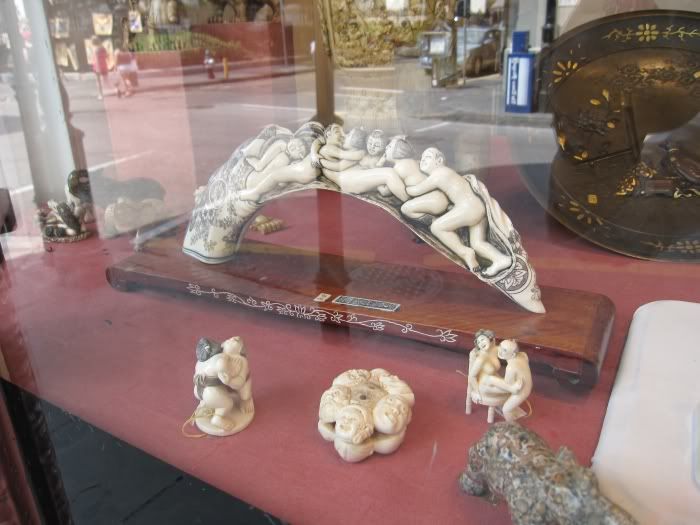
But this particular antiques store still manages to get sexy. Here are some East Asian sculptures depicting sexy scenes - including the group sex arch on the top.
It was only mid-afternoon, but I was already worn out thanks to the short sleep in the morning as well as the humidity, so I made a long walk back to the hotel for a quick shower and rest. But upon finding that the Riverwalk, the shopping mall next to the Convention Center and the closest eateries to me, was closing at 7 in the evening, I had to hurry and get back out, intending only to eat dinner and come right back.
But I thought it would be very stupid to go back in, without experiencing the debauchery of Bourbon Street at night. I headed back to the French Quarter, this time walking on Chartres Street.
And I love this bumper sticker, found on a Toyota pickup truck. Louisiana may be a teabagger state best known for Senator David Vitter and Governor Piyush "Bobby" Jindal, and even New Orleans' own Congressman is Vietnamese refugee and Republican Joseph Cao, but New Orleans is more of a carpetmuncher city overall, and I certainly appreciate the anything-goes atmosphere of the French Quarter.
Continuing to follow Chartres Street toward Jackson Square, the most iconic spot in New Orleans due to it bordering a cathedral.
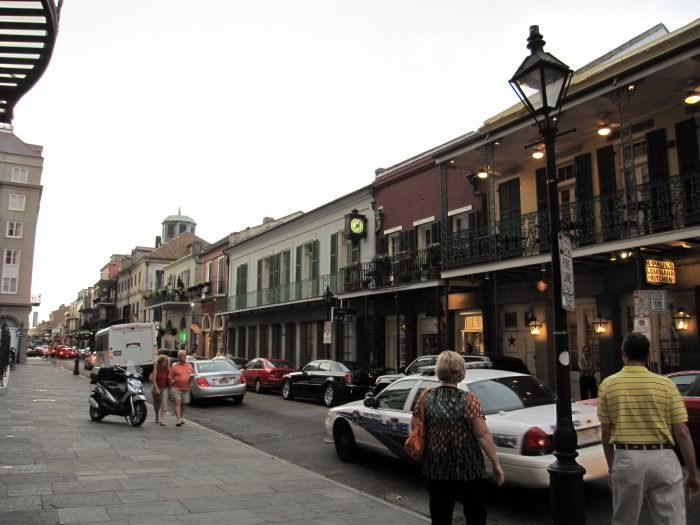
These buildings really show off the trademark architecture of the French Quarter. I especially love the balconies and their ornate railings.
Between the architecture and the narrow streets, it almost feels like France. The fleur-de-lis, the symbol of French heritage, is everywhere as well (and is used by the city government and the Saints football team). Despite the fact that no place in France is actually this muggy, and despite the fact that the French Quarter street grid is typical North American rectangular rather than the irregular pattern I would find back in France, I really feel that French vibe. Of course, New Orleans adds its own Cajun and creole culture to really make things far more interesting.
It's not quite dark, but it's about sunset. And there is a shower. Thunder rumbles in the distance. Bourbon is really starting to come alive - a lounge singer was doing a great rendition of Melissa Etheridge's "Come to My Window" at one of the bars, and several other bars were really starting to come alive.
I think Bourbon Street alone justifies all the trouble one goes through in order to visit New Orleans, though the city definitely has more to offer, and I have two more days to find out.
I walked Bourbon back to Canal, and found and checked out a Hustler store near Canal. Loved some of the sex toys there (especially vaginas that claim to be molded after those of famous porn actresses), and also went through tons of porn DVDs, though I wasn't too impressed with girl-on-girl porn that was clearly intended for male consumption rather than any realistic depiction of lesbianism, and I was certainly NOT happy with all the "Asian tranny" porn that I consider to be exploitation of disowned young Asian gay boys (give them shelter, but feed them estrogen and make them do porn against their will...).
Glad to have finally gotten to know New Orleans, which I had recently been seeing as the "last American destination worth visiting that I haven't visited." I expect to spend the remaining two days using the streetcars to venture out to outlying parks - Audubon Park and its zoo, and City Park and the Conservatory. Audubon Park is connected to central New Orleans by Magazine Street, which has its own bus line and is also the greatest shopping street supposedly. Those two parks plus any extra sightseeing around the French Quarter should wrap things up nicely.
I have just finished my first of three days in New Orleans - this is my first-ever visit, and so far I am very pleased, despite the heat and humidity. I especially love le Vieux Carre (French Quarter), and especially Bourbon Street, where just about anything goes!
Here is my recap of today.
This is actually yesterday afternoon, as I leave Los Angeles on United Airlines.
I am only a Premier, the lowest-level elite (though that's still more than what I'm used to), so I don't qualify to use the lounge for free. But I took the photo anyway, because of the name. United Airlines' lounge is named the Red Carpet Club, and since I've been working on a novel involving a redhead lesbian United flight attendant for forever, the lounge name is a perfect double-entendre for me.
United logistics were dreadful yesterday. Mechanical delays galore, including an Australia-bound flight running 23 1/2 hours late. My New Orleans run was itself 2 hours late - and actually had to use a plane from Orlando, rather than the originally scheduled plane from San Francisco. On the other hand, the Orlando plane had a larger first class section, and I got an automatic upgrade to an empty first class seat as part of my elite benefits.
Despite the late arrival, I was up and running before too long, once the sun was up. This is the view from my hotel room. My hotel is in the Warehouse District at the foot of the Mississippi River Bridge (US-90 Business), and I have a view of the Superdome (a mess during Katrina evacuations, but now a symbol of triumph with the Saints' win of Super Bowl) and the skyscrapers of the business district. A block behind me is the Convention Center, which hosted the 1988 Republican National Convention that nominated Vice President Poppy Bush as the presidential candidate, and Dan Quayle as his running mate.
I took in the hotel's breakfast buffet, before coming back to my room to do the research for my initial sightseeing.
My initial plans were to take the streetcar to the French Quarter, but given that the nearest streetcar stop was already halfway to the French Quarter, and that service frequency was a joke, I decided to walk along the waterfront toward the foot of Canal Street, and tour the Audubon Aquarium.
Here is one of the exhibits.
Louisiana's wetlands south of New Orleans, stretching into the sea as the Mississippi empties, are known for their alligators. Here is an albino alligator.
I was thinking of a local friend here in New Orleans, Morwen Madrigal (yes, the one who told me she had licked all the Grand Tetons back in the day), who likes to joke about feeding the "Conservamooks" to the bayou alligators. I am in touch with her and plan on getting together with her and her partner later on during the stay.
The aquarium also hosts an IMAX theater, and I took in a movie about Hurricane Katrina's impact on the Louisiana coastline, and the effect of human developments (levees in particular) in stopping the flow of sediment into the wetlands, the resulting erosion of existing wetlands, and the shrunken wetlands being less able to protect New Orleans from hurricane surges.
The Audubon Institute runs, in addition to the aquarium, an insectarium and a zoo. I bought a combination ticket that allows me to visit all three AND watch an IMAX movie for barely more than just two of the sights - for $34.95. The insectarium is located on the ground floor of the old US Customs House.
While the insectarium has many interesting displays - including a cockroach-infested kitchen and various termite labs - this one, a butterfly house in the form of a Japanese garden. And sure enough, these butterflies are having a Japanese lunch.
I walked further up Canal Street, which is the main wide thoroughfare in New Orleans with plenty of shopping. To its north-northeast is the French Quarter. To its south-southwest is the newer part of New Orleans for Anglo Americans. I walked up to Bourbon, then turned right to enter the heart of the French Quarter.
Here is a souvenir shop with T-shirts for sale. Loving them all - especially the one with the built-in boobs.
Bourbon is the street of debauchery. It is full of bars, clubs, strip clubs, and yes, even a club where I can watch live sex acts. Based on the photos, it looks like I can watch hetero acts and lesbian acts.
While I am loving all the debauchery, I would rather come back in the future with a pervert friend or two. I just don't feel like going into that live sex club alone, as a lone female.
Royal is the street immediately to the south of Bourbon. It is a more sedate street primarily lined with art galleries.
But this particular antiques store still manages to get sexy. Here are some East Asian sculptures depicting sexy scenes - including the group sex arch on the top.
It was only mid-afternoon, but I was already worn out thanks to the short sleep in the morning as well as the humidity, so I made a long walk back to the hotel for a quick shower and rest. But upon finding that the Riverwalk, the shopping mall next to the Convention Center and the closest eateries to me, was closing at 7 in the evening, I had to hurry and get back out, intending only to eat dinner and come right back.
But I thought it would be very stupid to go back in, without experiencing the debauchery of Bourbon Street at night. I headed back to the French Quarter, this time walking on Chartres Street.
And I love this bumper sticker, found on a Toyota pickup truck. Louisiana may be a teabagger state best known for Senator David Vitter and Governor Piyush "Bobby" Jindal, and even New Orleans' own Congressman is Vietnamese refugee and Republican Joseph Cao, but New Orleans is more of a carpetmuncher city overall, and I certainly appreciate the anything-goes atmosphere of the French Quarter.
Continuing to follow Chartres Street toward Jackson Square, the most iconic spot in New Orleans due to it bordering a cathedral.
These buildings really show off the trademark architecture of the French Quarter. I especially love the balconies and their ornate railings.
Between the architecture and the narrow streets, it almost feels like France. The fleur-de-lis, the symbol of French heritage, is everywhere as well (and is used by the city government and the Saints football team). Despite the fact that no place in France is actually this muggy, and despite the fact that the French Quarter street grid is typical North American rectangular rather than the irregular pattern I would find back in France, I really feel that French vibe. Of course, New Orleans adds its own Cajun and creole culture to really make things far more interesting.
It's not quite dark, but it's about sunset. And there is a shower. Thunder rumbles in the distance. Bourbon is really starting to come alive - a lounge singer was doing a great rendition of Melissa Etheridge's "Come to My Window" at one of the bars, and several other bars were really starting to come alive.
I think Bourbon Street alone justifies all the trouble one goes through in order to visit New Orleans, though the city definitely has more to offer, and I have two more days to find out.
I walked Bourbon back to Canal, and found and checked out a Hustler store near Canal. Loved some of the sex toys there (especially vaginas that claim to be molded after those of famous porn actresses), and also went through tons of porn DVDs, though I wasn't too impressed with girl-on-girl porn that was clearly intended for male consumption rather than any realistic depiction of lesbianism, and I was certainly NOT happy with all the "Asian tranny" porn that I consider to be exploitation of disowned young Asian gay boys (give them shelter, but feed them estrogen and make them do porn against their will...).
Glad to have finally gotten to know New Orleans, which I had recently been seeing as the "last American destination worth visiting that I haven't visited." I expect to spend the remaining two days using the streetcars to venture out to outlying parks - Audubon Park and its zoo, and City Park and the Conservatory. Audubon Park is connected to central New Orleans by Magazine Street, which has its own bus line and is also the greatest shopping street supposedly. Those two parks plus any extra sightseeing around the French Quarter should wrap things up nicely.
Subscribe to:
Posts (Atom)