Showing posts with label Austria. Show all posts

05 April 2010

Europe recap, Day 7: Brenner Pass into Venice

This post recaps my Halloween 2009, which saw me halfway into a two-week tour of Europe. It was my first introduction to Italy, as I entered via Brenner Pass and the Dolomites, and headed for the famed water city of Venice. Italy became the seventh European country I get to check off.

As noted in the Day 6 recap, I ended up not visiting any of the salt mines near Salzburg. I simply took the shortest route out to Autobahn 1, then headed west back into Germany; even though the approach to Brenner Pass is via Innsbruck in western Austria, it is actually faster to dip briefly into Germany, due to lack of Autobahn connections between Salzburg and Innsbruck. After driving on German Autobahn 8 toward Munich for about 30 minutes, I found the Autobahn 93 turn-off, with clearly marked "I" oval, denoting access to Italy.

Autobahn 93 followed up the course of the Inn River, and before long, took me back into Austria, becoming Austrian Autobahn 12. Surrounded by old castles and snow-capped Alpine peaks, I made sure to enjoy the drive to the fullest. The CD player played the soundtrack to The Sound of Music movie from 1965, and I followed up with my modern-day favorite from back in California, Anna Nalick.


I am now taking a brief toilet break in Innsbruck, as Autobahn 13 splits off from the 12 to climb up the Brenner Pass and take me to Italy.

Innsbruck ("Bridge on the Inn River") is a very scenic town, best known as a ski resort, particularly attractive to those who live in countries without steep mountains (think England and the Netherlands). Unfortunately, between my need to continue to Venice and the difficulties I would certainly experience driving into town and parking, this will be all the Innsbruck I end up experiencing. Having to mind my mother's constant concerns regarding possible damage to the car is really piling on my stress level.
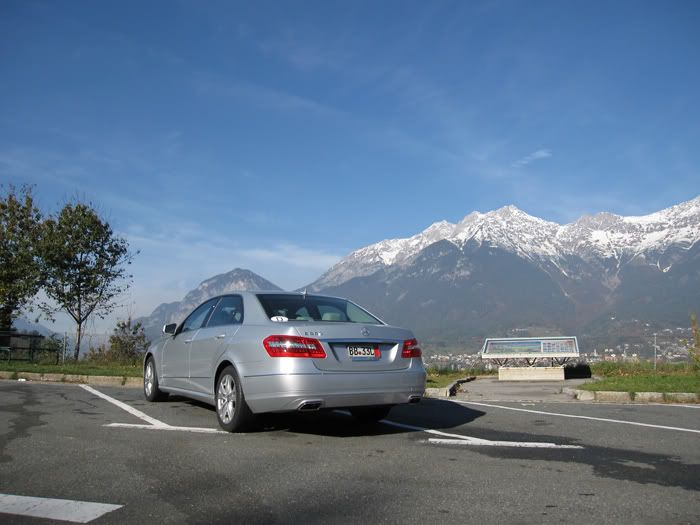

And here is an obligatory shot of the car against the Alpine peaks.

Austria has the strictest motorist regulations among the countries I am driving in. In addition to a toll sticker for the Autobahn system, I am also required to carry a safety vest inside the passenger compartment, to be worn in case of a roadside emergency; the vest was provided free of charge by Mercedes-Benz back in Sindelfingen. And more importantly, I am required to use winter tires between November and April, but that is also taken care of, since (1) I am leaving Austria for good on this October 31st, and (2) this car's all-season tires, thanks to their Mud + Snow designation, meet the requirement. Austrian driving in the winter on performance summer tires is not only dangerous, it is outright illegal, with a fine of €5,000.

Brenner Pass is only 30 minutes from Innsbruck, but in order to drive this short distance, I am required to pay a supplemental toll of €8 in cash on top of the toll sticker. Before long, the obligatory border slowdown took place, and in the midst of outlet stores, I could see a sign - European Union flag with the word "ITALIA" in the middle. I entered Italy. Shortly following were the default speed limit sign, showing Italian speed limits at 50 km/h urban, 90 rural, 110 on blue-signed free motorways, and 130 on green-signed toll motorways (Autostrada); the days of German-style unlimited Italian autostrade were long gone.

The initial drive through the rugged terrain was kept at 110 km/h, despite being a green-signed Autostrada. This 110 would persist throughout my drive on Autostrada 22 (the Italian extension of Austrian Autobahn 13). Soon, a toll booth issued me a magnetic toll ticket; Italian autostrade use a thruway-type toll collection system using tickets or transponders.
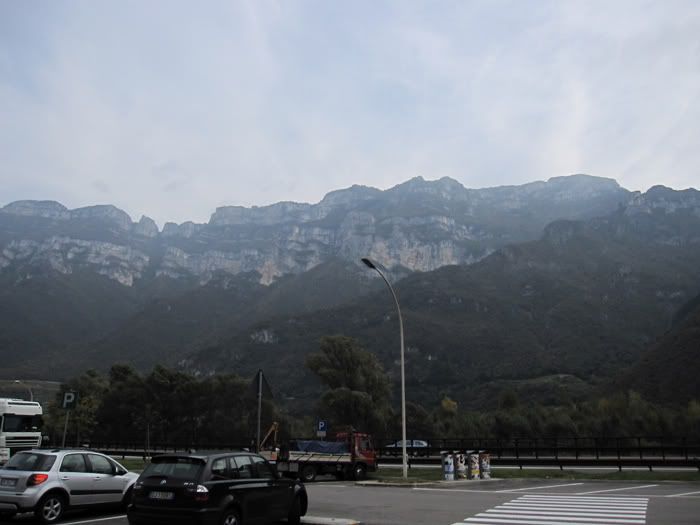

Autostrada 22 heads south from the Brenner Pass, through the lovely, rugged Dolomite Mountains, known for their stunning marble cliffs like this photo. This photo is just a tiny hint of all the gorgeous cliffs I could spot while driving, but couldn't photograph due to my need to put driving first. This photo is from a rest stop about 30 minutes north of Verona, where I would take the eastbound Autostrada 4 toward Venice (marked as Venezia on signs).

Up to this point, I am in the region known as Alto Adige, and as this region is historically populated by the Germanic people, all placenames have Italian and German versions, and all road signs and messages are in both Italian and German. Indeed, I am reminded that back when Germany's national anthem was sung as "Deutschland über alles," its lyrics included the phrase "From the Meuse to the Memel, From the Adige to the Belt" - a swath of territory that is now lost through losses in two World Wars. The Brenner Pass has historically connected this region to the rest of the Germanic world, and this road is dotted with castles - tollbooths back in the day, complete with accommodations for tolljumpers.

But make no mistakes, this is Italy. I am actually finding the Autostrada system to be better built and maintained than the German Autobahns; thanks to the nicer Italian climate, the road surfaces are in even better shape than the already excellent ones in Germany. Aside from acceleration and deceleration lanes which are mere afterthoughts drawn onto the shoulder, the autostrada is built to higher standards than the autobahn.

But I have to say that the real reminder of Italy comes from the reckless drivers. In Germany, I could count on all drivers obeying the strict regulations, such as no-passing-on-right and adherence to any mandatory speed limits. But here in Italy, I am finding that traffic regulations were meant to be ignored. Speeding and lane changes without signaling were very common, and while passing on the right was nowhere near the epidemic levels I see in California, I could still occasionally see it. I could also count on a mad flash of the high beams from behind if I did not vacate the fast lane in a microsecond, and a frustrated honk if I decided to treat stop signs (i.e. at this rest stop) as a full stop rather than a California stop.

I found that the worst a-holes on Italian autostrade were Audi drivers, filling in the niche occupied by BMW drivers in California. The worst slowpokes, just like in California, were Toyota drivers. Van drivers, be it the Central American theocrats in California driving a Chevrolet Astro, or brutes in South Korea driving a Hyundai Starex, used to push my buttons a lot, but they are less of a factor in Europe; the Astro is nonexistent, and drivers of the Starex and similar vans are well-behaved in Europe (aside from an occasional tendency to speed). Another demographic that used to push my buttons in South Korea - drivers of Ssangyong SUVs - also drove pretty well in Europe.

I refueled at this rest stop before continuing my way. Italian gas prices are similar to Austrian levels and much cheaper than German levels; I could expect to pay €1.00 per liter, and I only needed to pay for regular unleaded, which was already 95 octane (91 US octane), making premium at 98 octane a useless splurge. While Autostrada 22 continues south to Modena, home of Ferrari, I was more than happy to transfer to eastbound Autostrada 4 once in Verona, enjoying its 3 lanes all the way to Venice as well as consistent 130 km/h speed limit. It went through a flatter landscape surrounded by rolling hills, farms, and even an American military base. As I approached Venice, I stumbled into a "KARTE" lane at the toll booth, and paid with a debit card; the toll came out to be €21, definitely not cheap, and I had intended to pay at a cash lane, whose money icon I couldn't recognize right away. (Good thing I didn't use the TELEPASS lane for transponders.) Thanks to European distances being delightfully short and motorway speeds being fast, I arrived in Venice ahead of schedule - something that happened on every major driving day for me.

Once in Venice, I proceeded through Mestre before getting on the 2.5-mile Liberty Causeway to the water city itself. I parked at the enormous Tronchetto Garage, which I appreciated for its American-scale ramps and parking spaces, and fumbled my way to the vaporetto (water bus) stop, for a ride on the No. 2 water bus to Rialto Bridge. My mother was thinking "Harlem slum style decay" rather than "a former powerhouse" as the water bus made its way into the Grand Canal, and upon reaching Pensione Guerrato (Rick Steves' favorite hotel) and finding that the €130/night room I had booked was an attic room above fourth floor (sixth floor if counted American style) with no television, she was fuming. I fumed right back too, telling her to shove it with her Asian-American model minority materialism and excess. This trip was at its breaking point.


Cooler heads eventually prevailed, as I gladly let my mother know that I've myself been let down by another European city that other visitors rave about - namely, Amsterdam and its Surinamese thugs. Now the goal has become salvaging the Venice experience somehow, even if Venice falls way short of the sanitized/romanticized depictions in the movies and as seen at the Venetian Hotel and Casino in Las Vegas.

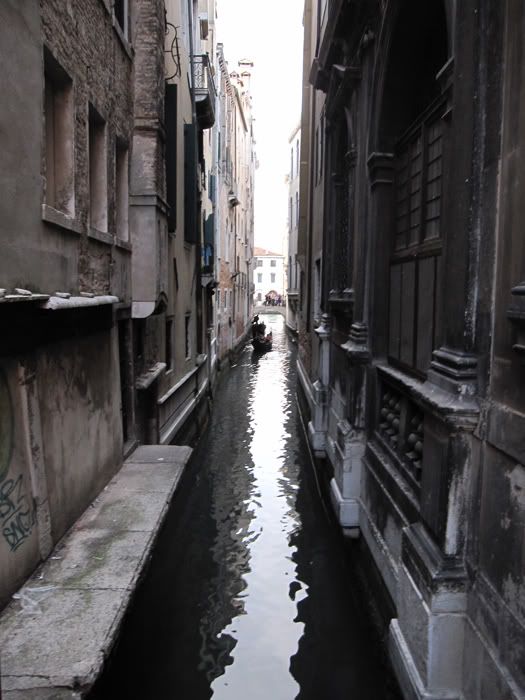
From the hotel near the Rialto Bridge, we are walking in the general direction of "Piazza San Marco" (St. Mark's Square). And every time a pedestrian path goes over a water canal, I am treated to views like this, an alleyway accessible only by water, served by a gondola. The path crosses the canal in the form of an elevated bridge, with a few steps up and down on either side, and that gets tiring after a while walking around Venice.

The primary method of getting around Venice is by walking through very narrow pathways, as this is a water city without any land vehicles, and land area is at a huge premium. In particular, the pathways between the Rialto Bridge and the St. Mark's Square, the two tourist magnets of Venice, can be extremely crowded.

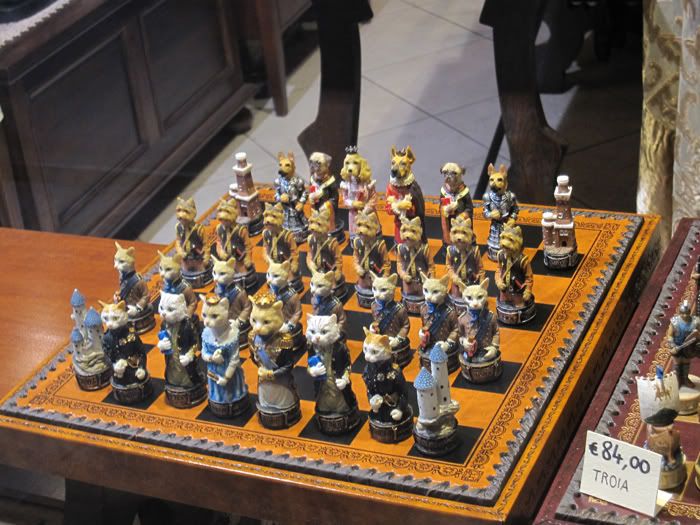
And with all the tourist traffic passing by, the stores often sell very catchy items, like this chess set made up of cats and dogs. I almost wanted to buy one.
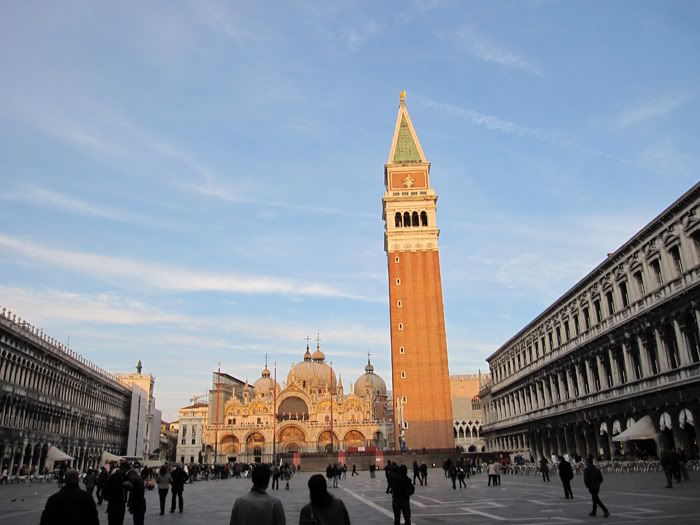

Now this is a bit more like it - an open expanse. This is St. Mark's Square, with the Campanile and St. Mark's Basilica standing proudly as ever.

I would quickly learn that open spaces like this are at a very huge premium in Venice, and that I would need to enjoy every moment I spend in one.

As it's sunset already, I am not planning on doing any sightseeing this day. I am supposed to stay in Venice for two nights, and that gives me all of All Saints' Day as a full day to explore the city. I will now walk back toward the Rialto Bridge.
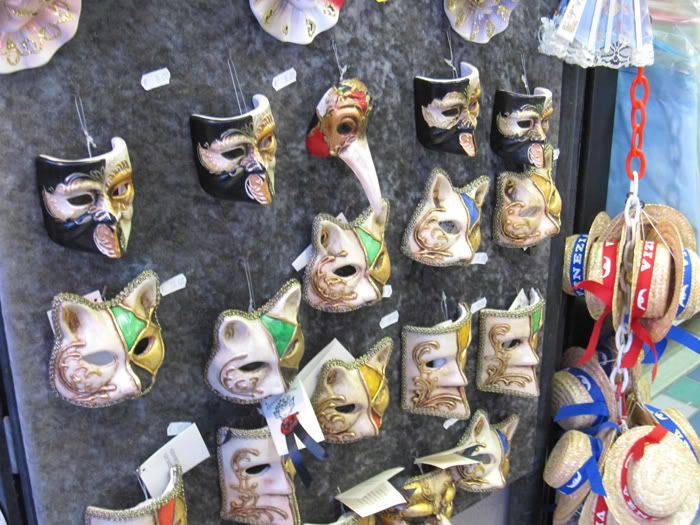

Another store, selling masks that are a good reminder of Venice's past decadence in the form of masquerade parties. I am loving the fact that many of the masks are cat-shaped.
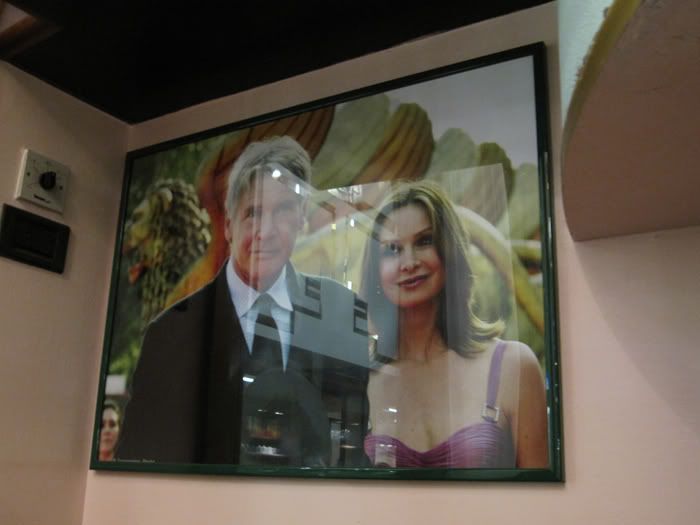

It's dinnertime. As Venice is now a place where tourists outnumber residents, getting into a non-touristy restaurant is wishful thinking in many parts of town. And since I am still on the main paths between St. Mark's and Rialto, I need to duck into a touristy eatery - and entered a spaghetti joint run by an East Asian immigrant.

This joint's walls are covered with photos of international movie actors who have attended the annual Venice Film Festival. And I am lucky to be eating under the photo of my favorite - Calista Flockhart and Harrison Ford. I'm always fond of Calista Flockhart for her portrayal of that neurotic skinny miniskirt-suited lesbian lawyer Ally McBeal; glad to be reminded of her here in faraway Italy. I am also realizing that in just eleven days, Calista would turn 45; when Ally had first aired, Calista was only 33, and Ally was supposed to be merely 28. Certainly, a key part of looking young is having a geriatric boyfriend, in the form of Harrison Ford.
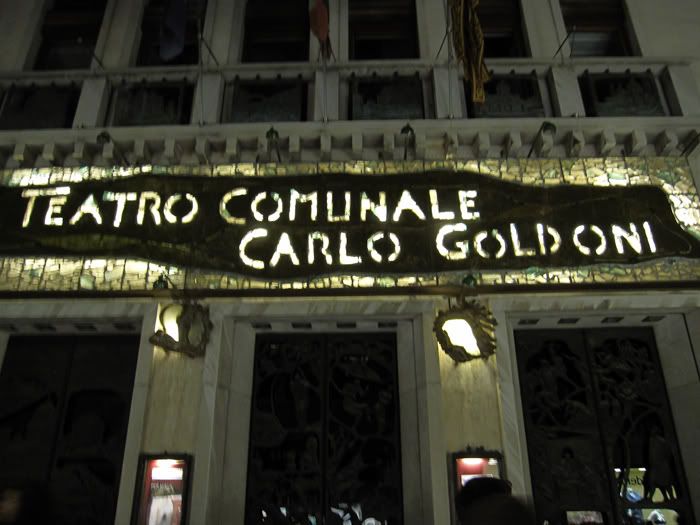

Continuing past Rialto toward the northeastern portions of Venice, the one part of the city that actually still has residents.

I don't know what the significance of this community theater is, nor who the namesake, Carlo Goldoni, is, but I had to take this photo for the lovely lighting on the sign.

In Venice's labyrinthine path pattern, navigating by street names is impossible. One's sense of directions completely melts away after a few minutes of walking. The only way to keep going is to refer to yellow signs pointing to the direction of a major landmark (S. MARCO for St. Mark's Square, P. RIALTO for Rialto Bridge, FERROVIA for train station, etc.), and use that landmark as a reference point to get to the final destination from. I'm actually walking toward the train station at the north end of the water city.
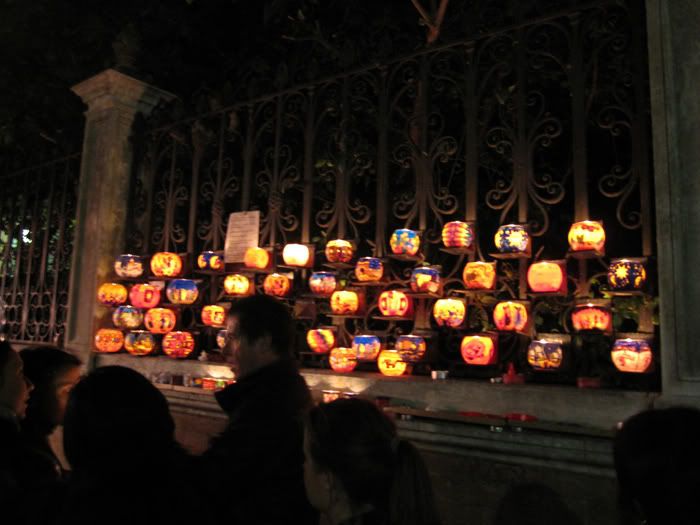

I am looking at some lanterns lit to mark All Saints' Day the next day.

I am walking on a rather wide pathway - wide enough to handle two trucks easily, if trucks had a way of getting there. This is the residential part of Venice, complete with a grocery market and other services catering to residents rather than tourists. And this being Halloween, I am seeing costumed children out trick-or-treating. While Americans tend to treat Halloween as a commercialized holiday, Europeans give it the same treatment AND celebrate the very reason for Halloween's existence - All Saints' Day the next day.

I'm actually liking the fact that I am spending Halloween in Venice, a city known for masquerades and other disguises.


I am now next to the train station. I am inside the Church of St. Mary of Nazareth, which I am not visiting for any particular reason, but because I needed a place to take a quick breath - and to photograph some lovely interior elements.


And now I am outside, crossing the Grand Canal via one of only four pedestrian bridges spanning it.

To the right is the Church of St. Mary of Nazareth. Toward the back is what is referred to on the signs as "Ferrovia" - Santa Lucia train station, where trains terminate after coming in from the mainland over the Liberty Causeway. Needless to say, the presence of the train station makes this place a transportation hub. In front of the train station are docks that serve as water bus stops, and indeed a couple of water buses are operating. In front of the church, smaller docks serve water taxis. Even a water bus ride in Venice is expensive - €6.50 for a ticket good for an hour - and a taxi ride is prohibitively expensive. (However, passes can bring the cost of water bus rides down significantly.)

Within walking distance, behind the train station, is Piazzale Roma, where Venice residents have a parking garage to keep their cars in. Piazzale Roma is the only part of Venice accessible to land vehicles, and is served by land buses from the mainland.
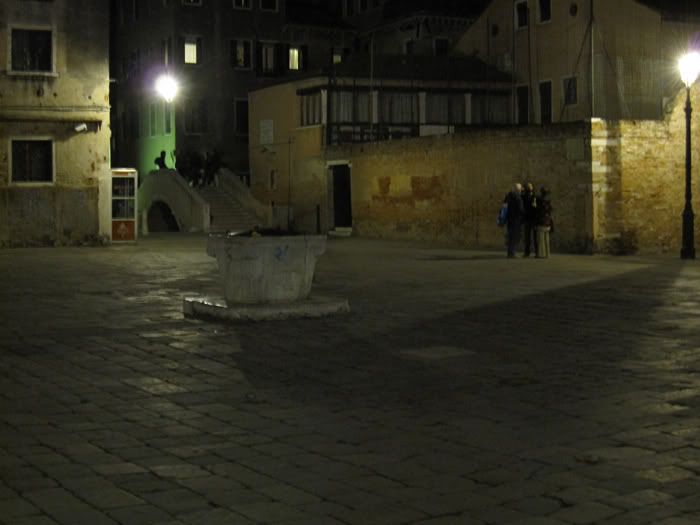


While my hotel is on the west side of the Grand Canal, most of the sights covered above are on the east side. Now that I crossed back west at the train station, now I am wondering again through a new set of labyrinthine paths to attempt to get to Rialto Bridge (and the hotel).

This open square is an example of Venice's traditional water collection systems. As Venice sits 2.5 miles off the coast and has no source of fresh water, residents used squares like this as water collection systems. Rainwater would pool toward the center of the square and lower into a well below, collected there for the residents' use. This system remained in use until the 19th Century, when an aqueduct was built to the mainland, bringing water from the Italian Alps.

Toward the back is a typical bridge going over a narrow side canal. After dozens of those in an hour or two, walking around in Venice can get very tiresome, fast.

Eventually we stumbled back to the hotel and retired to the attic room. The windows remained open for ventilation - but my mother continued to complain, primarily thanks to the Halloween revelers' noise outside. She simply was NOT liking Venice, period, and a decision was made to leave the next morning - a day early. I'd have to cancel the second night's reservation, and would have to try to find a place to sleep on the way to Switzerland. Driving hotshot through Europe without a confirmed hotel room - that in itself could be exciting!

28 March 2010

Europe recap: Day 6, Salzburg

As I recap my Europe trip (now 5 months in the past), I have a very good reminder of that trip today. Namely, the very star of this trip, the European Delivery Mercedes-Benz E-class, is now sitting in my garage. Ever since the end of this trip, it had been a sleeping beauty - first on a transatlantic freighter, then in my folks' garage. I needed to drive it a bit during my folks' absence, in order to keep it in good working order; and of course, I also wanted to re-live the memories.

Back to the recap. This post covers Friday, October 30, 2009, which had me explore Salzburg, Austria, on foot all day, with no driving involved. At the Best Western I was staying at, I found that I had free Internet access in the lobby; this was a big deal, since most other places wanted to charge me about €8 per hour on average. Taking advantage of this, I made sure to do some of my sightseeing research while I could - and also catch up with work email.

The Best Western also provided me with complimentary hot breakfast buffet, hearty enough to last me all day.


The sightseeing began with a short walk to Mirabell Palace and its gardens. Due to the timing of my visit, I could not see much in the way of actual roses. But this is certainly a familiar angle; behind me are some stone steps, and this is where the last few phrases of "Do, Re, Mi" were sung in the 1965 movie adaptation of the musical, The Sound of Music.

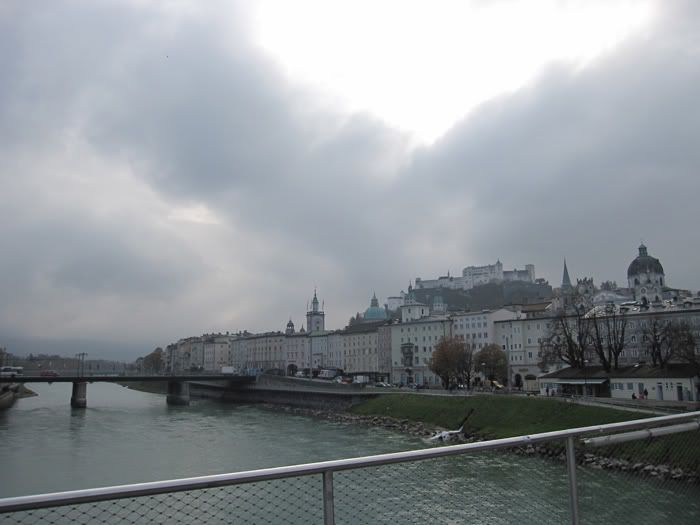
And if that fortress in the distance, Hohensalzburg, doesn't tell me I'm in Salzburg, I don't know what does. I am remindful of the fact that for the first time in ten years, I am exploring a brand-new European country. So far, I am grateful that I am connecting with the locals quite well, and that I am doing a reasonably good job of putting those Amsterdam demons from 1999 to rest. At least Austria is another Germanic country, so signs remain in familiar-by-now German and it's not too difficult to figure things out.


My first sight, in fact, will be Hohensalzburg Fortress. Hohensalzburg means "Upper Salzburg." And Salzburg, for that matter, means "Salt Fortress," due to huge deposits of salt in the surrounding areas. Salzburg had built its fortune on mining and exporting its salt, and the Salzach River, which I'm crossing, was the main means of transportation for exporting salt.

The Salzach is spanned by several bridges, some of them footbridges, some vehicular. I am crossing from Mirabell Gardens toward the Altstadt (old town), and getting up to Hohensalzburg will require me to walk through Altstadt.


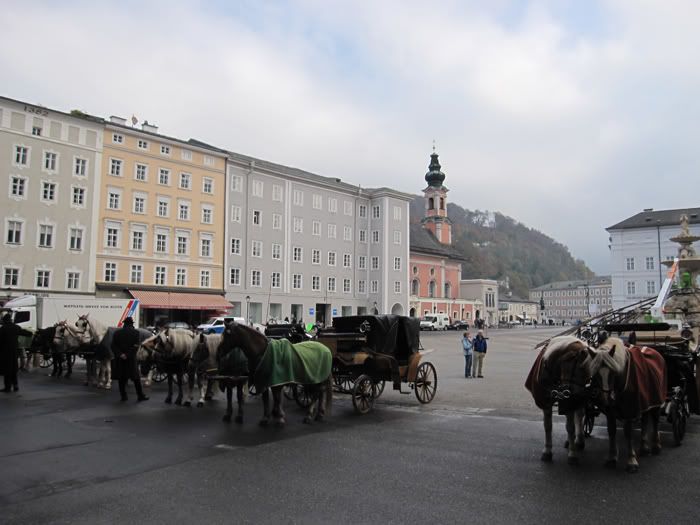
I am still walking toward Hohensalzburg, having passed through most of Altstadt. I am now passing through a large square near the main cathedral.

I am loving the sight of these horse carriages. The Sound of Music had had the seven children and Maria riding through Altstadt on one of them.

Also in The Sound of Music, this square was featured in a scene - being heavily covered with Nazi insignia, in the wake of the Anschluss (the annexation of Austria by Nazi Germany). The movie (and the musical), of course, had featured Captain Von Trapp, and a key element of the storyline was his principled, strong opposition to the Nazis.


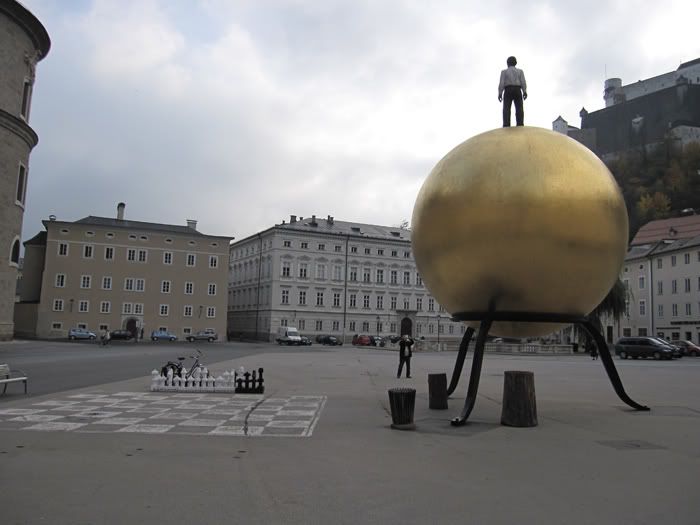
Another, smaller plaza, as I near the funicular that will bring me up to Hohensalzburg.

On the right, the ball is a piece of artwork. And the boy on top of the ball - not real, but part of the artwork too.

On the left, there is a giant chess set and board. Nobody is playing chess on this cool, overcast day, however.


Now I have entered the fortress.

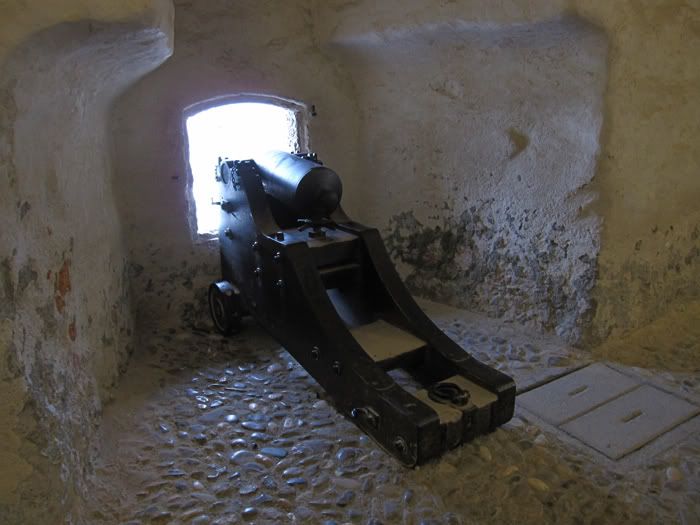
This cannon, along with the thick wall, is a reminder that Hohensalzburg, unlike the Mad King Ludwig fantasy castles, is a real fortress built with defense as a key consideration. Its history stretches back almost a thousand years, and the fortress was rebuilt and expanded several times over its lifetime. And thanks to its sturdy defenses, it was never successfully overrun by invaders.


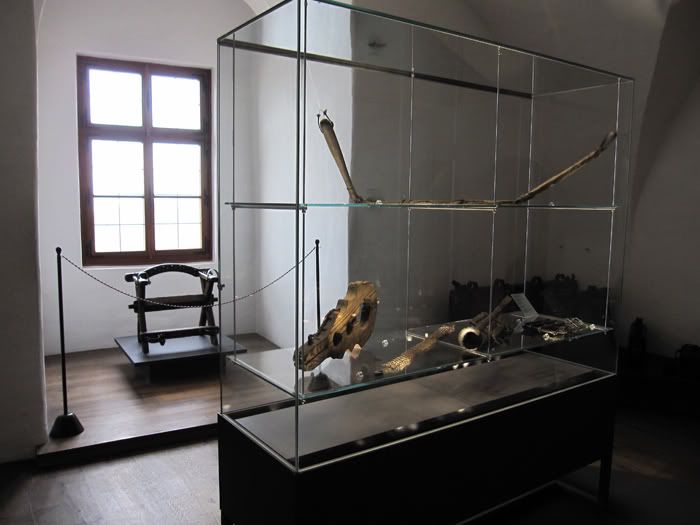
In medieval times, torture was a very common means of punishment. Here are some torture instruments.

The interior areas of the fortress are managed as museums, some of them showcasing the rulers' living quarters and others dedicated to military history and other relevant topics.


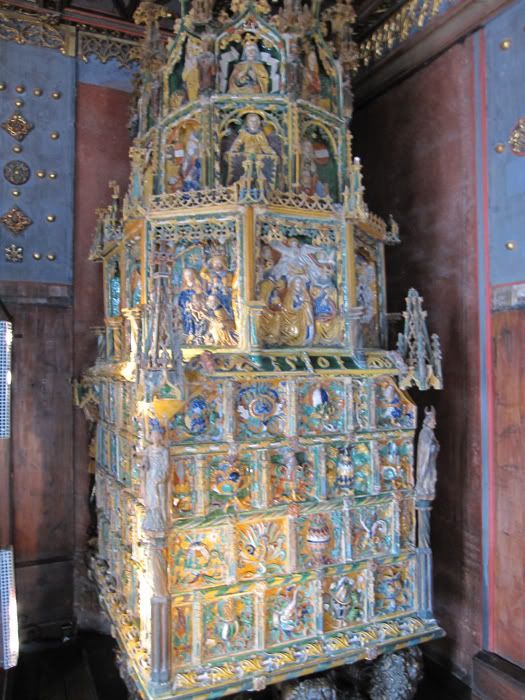
Here is a three-tiered fireplace. This ceramic contraption carries motifs that represent the royal coat of arms, Christian beliefs, and more.

This fireplace is very similar to fireplaces I had seen, but couldn't photograph, over at the fantasy castles.

Modern-day heating is done via electric heaters. And I am walking on an elevated walkway, to protect the royal quarters' original wooden floors. Compared to contemporary buildings, this place was state of the art; while indoor plumbing was an unknown (and would remain so for a few more centuries), I could see an indoor toilet at a bedroom (though I am pretty sure that it would've smelled very badly, and had to be manually emptied by servants).


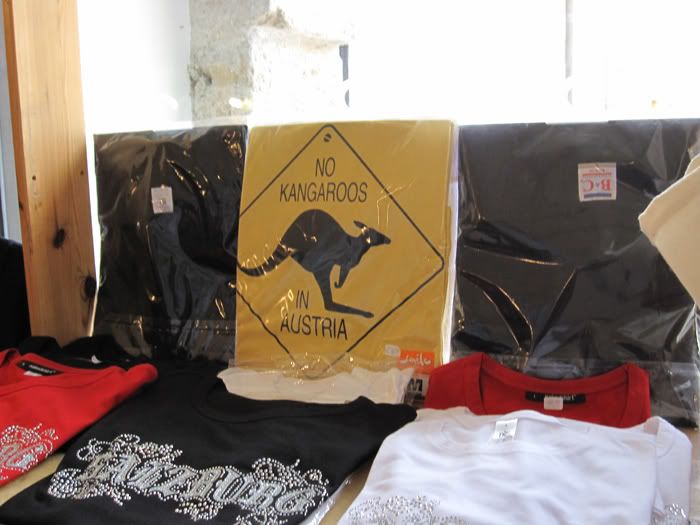
Seen at a souvenir shop within Hohensalzburg: this souvenir T-shirt. And it's a common sight throughout Salzburg.

Of course, most international visitors easily mix up Austria and Australia. But it bears remembering that Australia is Southern Land, based on the Latin word austral, while Austria's correct spelling is Österreich, or Eastern Kingdom.

Austria, of course, forms the eastern portions of traditional Germanic territory. While most Germans lived in a Holy Roman Empire that was a collection of a few hundred independent principalities, Austria was ruled by the powerful Habsburgs early on, and was a strong, well-defined nation-state that also included Hungary and the Magyar people until World War I. In fact, modern-day Germany, dating back only to 1871, consists of the Germanic territory that Austria didn't cover - and even then, about half of it was lost through the two World Wars.

In fact, Austrians seem to see themselves as the true heritage keepers of the Germanic people. And they note that by using the Austrian flag, rather than the German flag, to denote that a given caption/service is provided in German (alongside British/American split flag for English, French tricouleurs for French, and so forth).


Leaving the fortress, I stayed close to the hill, and went through some very narrow, steep alleyways, with good peeks into some apartment balconies and private backyards. That led me to this place - Nonnberg Convent.

Of course, this is where the nuns in The Sound of Music lived, including aspiring nun Maria.

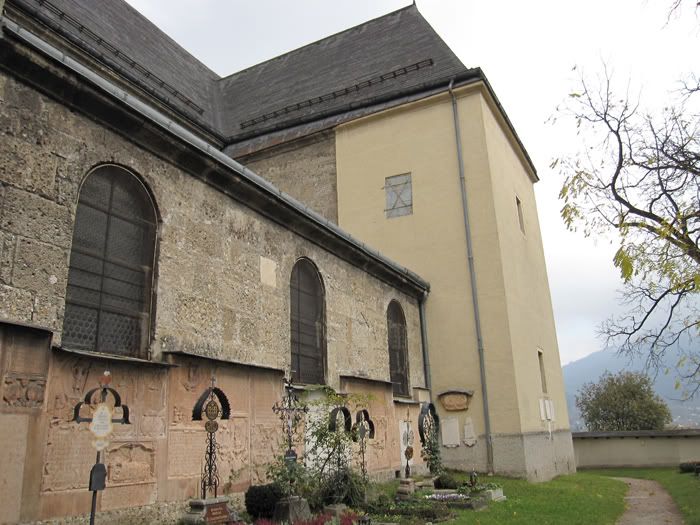
There is a cemetery outside for past nuns as seen in the photo, and inside, there is a dark yet cozy and lovely sanctuary. A 50-cent coin illuminates some old paintings in the back of the sanctuary, but of course, I declined that option.

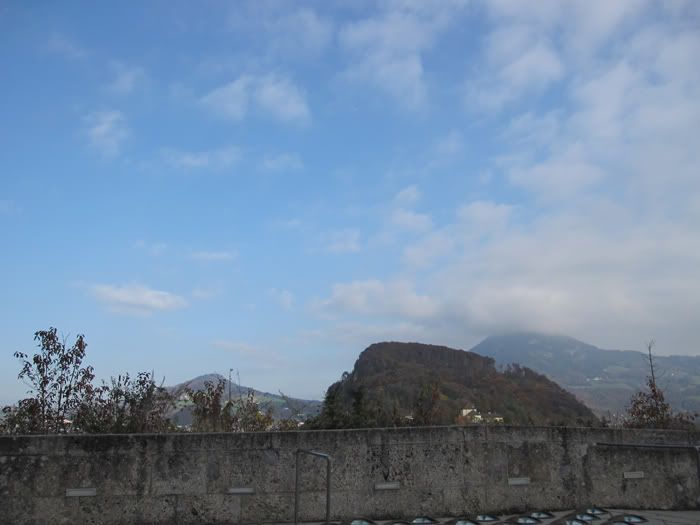
The views of the southwestern fringes of town, from the street just outside the convent, are marvelous, with green hills and beautiful houses framed by jagged mountains. Truly, the hills are alive, with the sound of music...


Crossing back to the Mirabell side, I am now walking an alley called Steingasse, which runs southeast out of town. It may be a very narrow back alley today, but it was the main Roman trading road back in its day.

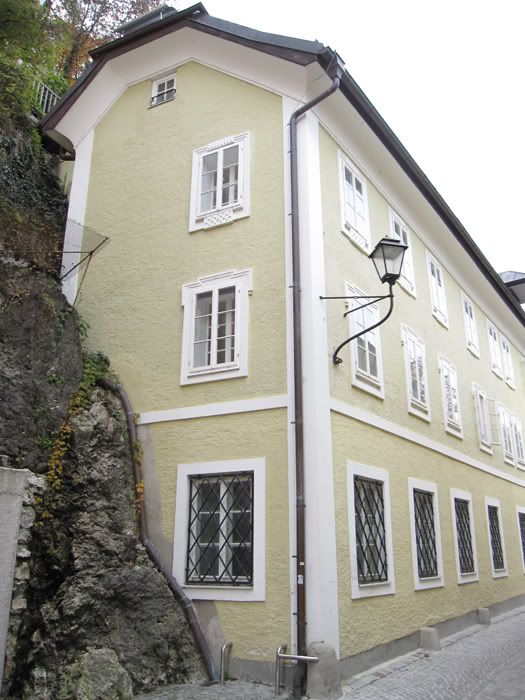
This house is very typical of buildings built on Steingasse - and in many other parts of Salzburg. Due to the steep rocky hills and cliffs that characterize the city terrain, many buildings are built with very little depth, as seen here. And the cliff wall simply becomes the back wall of the house.

Of course, rocks fall from the cliff often, and some falling rock used to result in damaged buildings and even dead occupants. Rock climbers, removing loose rock before they became rock slides, became a very important occupation in Salzburg as a result.


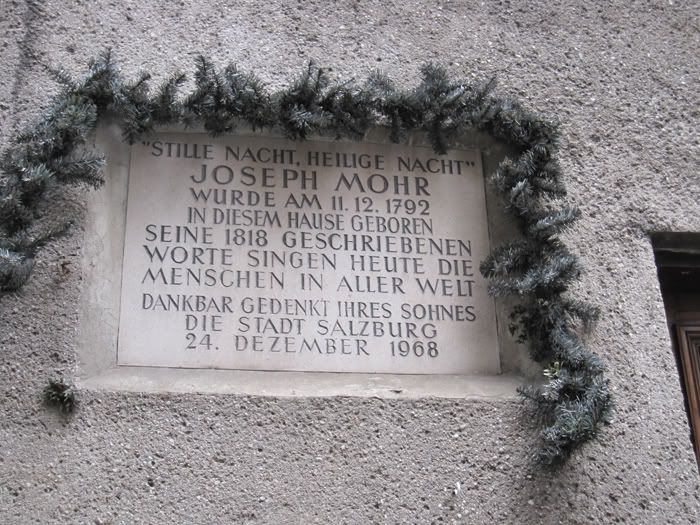
Seen at the No. 9 house on Steingasse: this marker claims that Joseph Mohr, the composer of the well-known Christmas tune "Silent Night, Holy Night," was born at this house on December 11th, 1792.

I found this marker thanks to my Fodor's guidebook covering both Bavaria and Salzburg. The guidebook, however, noted that Mohr's actual birthplace was No. 31, rather than this house.

Salzburg certainly has more music connections than the impressive credentials already established by Mozart and The Sound of Music.

Emerging out of Steingasse onto a more populated pedestrian street, I did some window shopping at a few of the stores lining the eastbound street.


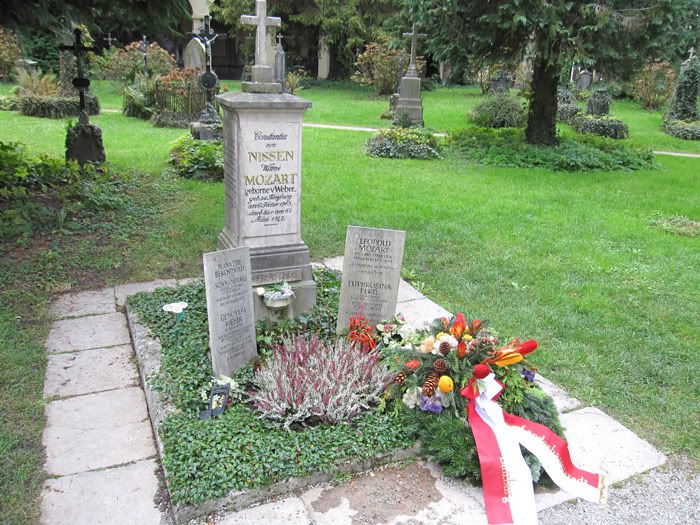
I am at a church cemetery. This is the grave of Constance Mozart, the wife of the famous composer Wolfgang Amadeus Mozart. Mozart himself was thrown into an unmarked grave - the 1984 movie Amadeus had that scene.

And back to that 1965 The Sound of Music movie, this cemetery was the scene where the Von Trapp family hid out while trying to run from the Nazis, and where Rolfe, the former telegram delivery boy turned into a Nazi soldier, faced off with Captain Von Trapp who was trying to talk him out of Nazism. Rolfe eventually stuck to Nazism - and the family ran away using the nunnery car toward nearby mountains, then walking their way to neutral Switzerland. (Of course, in real life, Switzerland is 100 miles away, but the musical and the movie moved Switzerland closer for dramatic effect.)

Salzburg feels very religious, just like Bavaria, only a few miles away. In fact, the Bavarian greeting "Grüß Gott" (God's Greetings), used nowhere else in the German-speaking world, could be seen at a restaurant nearby.


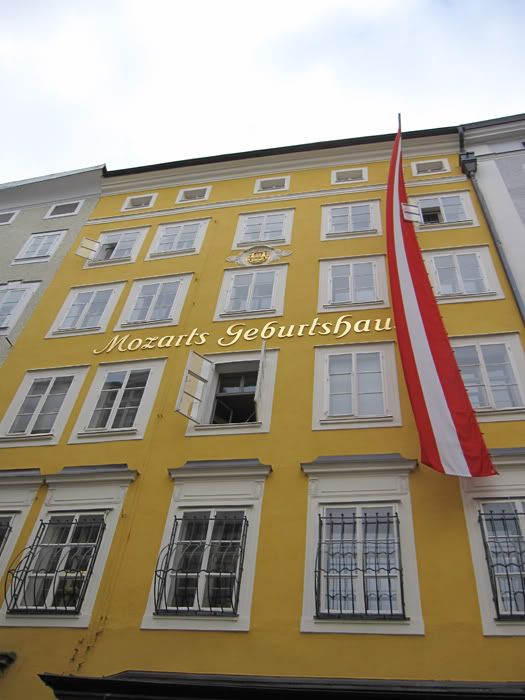
Salzburg preserves two Mozart houses. The one in front of Mirabell Palace is where Mozart grew up as a teen. And this one in Altstadt is where he was born.

There are some exhibits in here, but very few of them really belong to Mozart and his family. This was a mere rental apartment back in the day.


And this is where my walking tour ends for the day.

Using a pay elevator, I climbed up Mönchsberg, a rocky cliff just northwest of Altstadt. This is where Julie Andrews, playing Maria, taught the seven Von Trapp children the basics of singing, with that famous song "Do, Re, Mi." I am not at that exact spot, however; this is as close as I can get, as the exact spot now has a modern art museum, erected in 2004.

Of course, the challenge is to run down the hill on foot (rather than cheating with an elevator), ride all over Altstadt on a horse carriage, then run to Mirabell Gardens to finish the song off, all in the space of just a few minutes. I couldn't do it. Even cheating by using the elevator, I simply couldn't see how I could run across the river back to Mirabell Gardens and continue singing in that timeframe; I figured I'd need 15 minutes (and I'd be out of breath and unable to sing) for myself, and 30 minutes at least for the youngest Von Trapp children.

It was only mid-afternoon when I returned to the hotel. My initial plan was to attend a Mozart concert in the early evening hours - after all, it'd be only appropriate as part of a visit to his hometown. But after the jet lag-induced nap stretched too long, neither my mother nor I felt like going out on the town again - so this was all the Salzburg I ended up seeing and experiencing. I will have to return on a future visit to this part of the world - combining with Munich again.

Another reason to return: I ended up not visiting any of the salt mines in the area. The nearest one, Hallein, was only a short drive away on Autobahn 10, with ample free parking according to the mine's website, but my mother simply wanted to have none of me driving more than absolutely necessary, by the time I was starting to make my drive out of Salzburg the next morning. The next post, covering Halloween 2009, will start with the skipping of the salt mines, and will cover my drive over the Brenner Pass into Italy, with some first impressions of Venice.

23 March 2010

Europe Recap: Day 5, Fantasy Castles

It's already Thursday, October 29th - about a third of the way into the trip already, even though it felt like I was just getting started. Already, the previous night in the town of Hohenschwangau was going to be my last of five nights in German territory; at the end of the day, I was going into Austria.


Again, jet lag has gotten the better of me. It's about 4 in the morning, and sleepless again, I am out and about in the hotel parking area, where the temperatures are barely above freezing. Sure, sheltering myself in the car helps a bit, since I need to continue to fiddle with its settings to get to know them better. At least the factory had made sure to provide me with the North American English manuals for the car itself, and for the COMAND navigation system, so that I wouldn't be left in the dark regarding the car's features. (I would get another set of the manuals upon redelivery in the US.)

At least I am enjoying this stunning view of floodlit Hohenschwangau Castle. Hohenschwangau remains lit all night, while Neuschwanstein's floodlights are turned off at 1:30 in the morning, according to the hotel night clerk. Though it's gonna still be a long wait before morning comes, the castles open for visit, and I take my turn visiting each.


It's morning, and I have just purchased tickets for the combined Royal Tour, covering both castles in order. However, since it will be a while before my English-language tour starts, so I'm walking around the town.

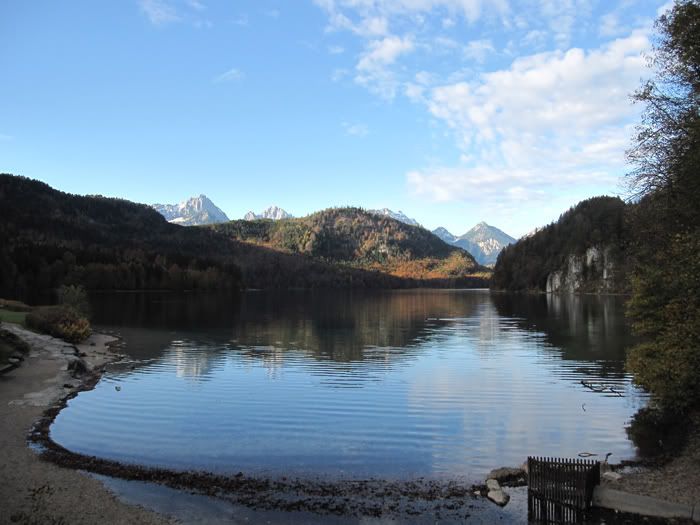
This is Alpsee. In German, a placename ending with "-see" can be any body of water, often a lake. This lake is usually framed as the stunning backdrop on posters depicting an aerial view of Neuschwanstein. It's still chilly this morning, but feels extremely fresh here at the base of the Alps, and I'm loving it. And for the record, this is my first time experiencing rugged terrain in Europe.

Nearby trails indicate that a short walk along the lake's shores and beyond will take me into Austria's Tirol province.


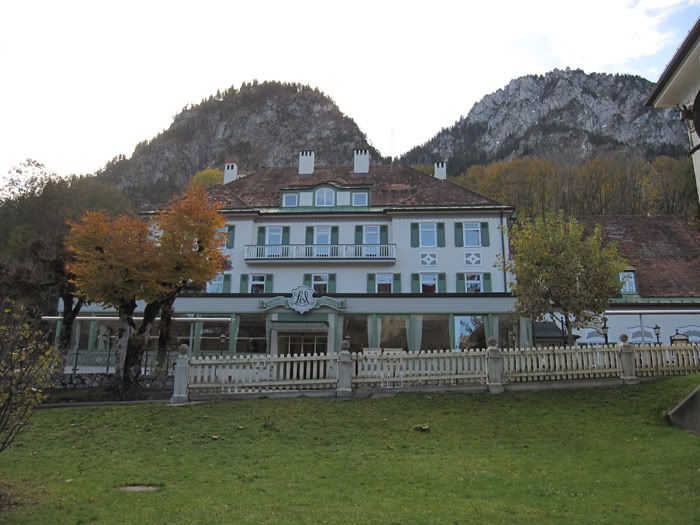
Now checked out of the Lisl, and I am looking back at this pricey but very charming hotel.

As it turned out, breakfast was not part of my rate, and it cost me another €20 for two buffet breakfasts. Final cost for the night was €140 or so with the breakfasts - just over USD $200 as shown on my credit card statement, certainly NOT cheap for just a night. If I were traveling alone that'd be prohibitively expensive, but for two, this was a nice splurge.

The Lisl was the only hotel in my itinerary that had been booked for only one night. All other hotels involved at least two nights (though plans would eventually change...).


Now it's time for the first castle tour - Hohenschwangau. I have now climbed up to the courtyard of the castle, waiting for my tour.

The two castles feature many custom frescoes on the interior walls, and due to copyright issues over them, all interior photographs are prohibited. That means I have very few photos to share for this particular day. The only sure way to fully experience these castles is simply to visit in person.

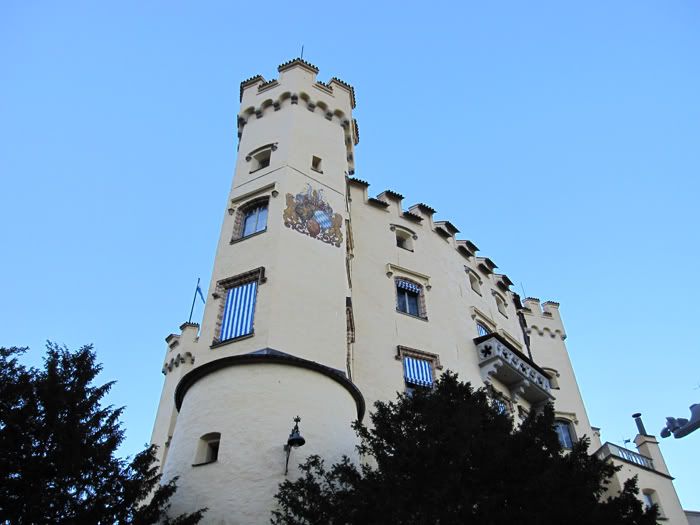
Hohenschwangau's architecture resembles that of traditional medieval castles, but it's really a 19th Century Romantic reinterpretation of medieval themes, a motif that had been popular at the time. The interior frescoes are Romanticized motifs of knights and chivalry; while there are many battle scenes, there is no bloodshed, for example. The room that was used by Ludwig II has images of frolicking nude maidens - and I liked that.

In this photo, I can see the window shades, and they feature the Bavarian color scheme again. Between BMWs, the logo of the famous FC Bayern soccer club of the Bundesliga, and all the blatant displays of Bavarian nationalism, it's impossible to miss the Blau mit Weiß. Even now, every sight of a BMW automobile immediately reminds me of my Bavarian moments, and a BMW with color-altered roundels (red/white and black/silver are two common examples), common in Los Angeles but NEVER seen within Bavaria, makes me cringe. (But then, I now cringe at all BMWs anyway thanks to its involvement with the Pope.)


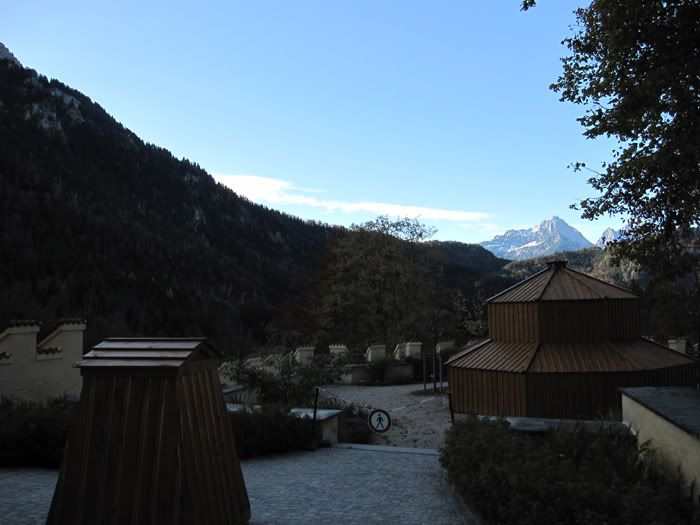
There is this nice patio garden at the courtyard level, but as it's cold today, I am not seeing much life. On a summer day this place would be much nicer. But then, maybe the tourist mob may NOT be such a good idea. These castles are notorious for long lines and sold-out tours, but since my visit is at the tail end of October, I am spared from that insanity.


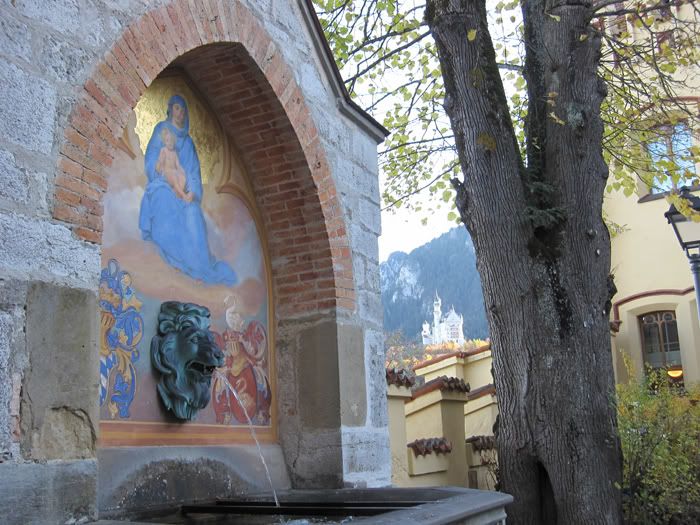
Here is a detail of a courtyard fountain, showing a Catholic motif of Madonna and Child. After all, Bavaria's Catholicism is to be duly noted again and again. The gold-leafed halo is, again, a medieval inspiration. Also love the balance of the Bavarian blue/white on the left with the red swan knight imagery on the right.

Neuschwanstein is visible in the distance. When the sun rises, the sun rays strike Neuschwanstein first - it's quite a sight. It had been the site of two previous medieval castles, and for the same reasons, King Ludwig II placed the castle there in the 1880s.

Ludwig II ruled at a time when Bavaria ended up losing its sovereignty. He simply refused to deal with the political headaches, and simply withdrew himself to his longtime fantasy, castle-building, which had been inspired by his father. He bankrupted the national treasury and his own family fortune building a number of fantasy castles throughout Bavaria; the largest of them, at Herrechiemsee (on a huge lake on the way to Salzburg), was to feature a huge Hall of Mirrors even grander than the famous one at Versailles in France. Eventually, he was declared mentally unfit to rule (hence the "Mad King" title), and two days later, he was found dead; suicide or murder, the cause of death was never conclusively proven. The castles eventually opened to the public for tours within weeks.


Done with Hohenschwangau, now I have arrived at Neuschwanstein, after a mile-long hike from the town. The climb can also be done with horse-pulled carriages or a bus, though at a price. A nice waterfall at Marienbrücke (St. Mary's Bridge), on a back trail, was a stunning sight that I did not get to experience up close, though I could constantly hear the waterfall roar while waiting for this castle's tours and afterwards.

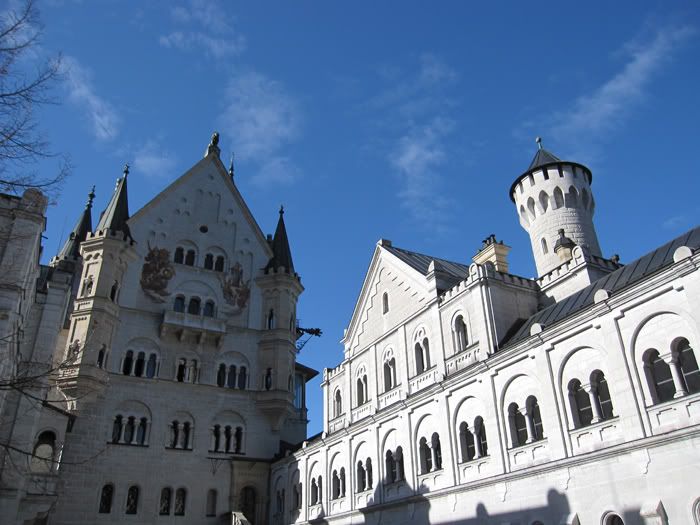
While the castle's architecture is very medieval Gothic, again, it dates only from the 1880s. And the walls are so clean and stain-free that from this point, the castle looks even newer.

The interior features a stunning Byzantine throne room, but otherwise is disappointing. The castle had been designed with five levels, but only the top two were ever completed, and one of the uncompleted levels served as a souvenir shop. The living level, to fulfill Ludwig's fantasies, even had a miniature cavern, which I walked through.


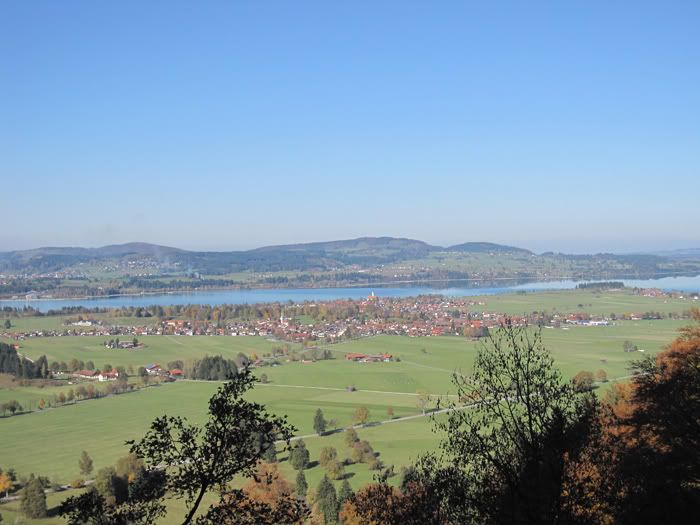
Neuschwanstein affords an excellent view of the town of Füssen as well. Those red tiled roofs are quite a sight - and a very common motif throughout Bavaria.

The body of water seen here, Forggensee, is an artificial reservoir dating back only to 1959. That means my view is even better than the view that Mad King Ludwig himself had ever had.


And here is a truly magnificent view of Alpsee from Neuschwanstein, as I wrap up my tour. Because of the fall foliage, October is considered by many to be the best time to visit the castles, and I am glad that this is indeed my timeframe.

It is early afternoon, and aside from the two castles, there are no other sights of interest in the immediate area. Time to start driving again. I headed back into Füssen first, to buy some gasoline as well as the Austrian toll sticker. While a supermarket sold me premium 95-octane (91-octane by US methods, German regular is 91 European/87 US) gasoline at about €1.38 or so per liter, it could not sell me a toll sticker, so I had to go to a retail gas station down the street. Unfortunately, when I asked the elderly lady cashier there "Sprechen-Sie Englisch?" the answer was a flat-out "Nein," and that simply became an opportunity for me to put the scraps of German I had picked up to good use. She and I strung together the words "Österreich vignette zehn Tagen" (Austrian toll sticker, ten days validity), and I walked away with a properly validated ten-day toll sticker for €7.70.

I returned to Autobahn 7, where the onramp indeed indicated "Austrian toll sticker required beyond this point" - and the Autobahn immediately entered a tunnel, and there was a European Union sign with the letter A in the middle. Yes, it was the Austrian border - and the border crossing was as much of a non-event as crossing US state lines. Austria became my sixth European country with this entry, and the first new European country I entered since entering Germany from Amsterdam for a day trip in December 1999.

My routing started on Austrian Highway 179, the natural extension of Autobahn 7, proceeding through a very scenic Alpine country straight out of postcards. A turn-off onto Highway 187 would take me back to Germany, right under the slopes of the Zugspitze and into Garmisch-Partenkirchen. I loved the Austrian scenery, but did not care for Garmisch too much; on a future visit, I would love to return to Garmisch, if only to ride the Zugspitzebahn up to Germany's highest point, but on this trip, where Jungfrau is on the agenda, it was better to push ahead.

Back in Germany, I picked up Autobahn 95 out of Garmisch, which returned me to Munich - in fact, within a few blocks of the neighborhood I had stayed in a few days earlier. After some surface street driving to navigate the ring road, I finally picked up the eastbound Autobahn 8 for the hourlong drive to Salzburg.

Just outside Munich, I pulled into a rest area, where I decided to eat a Burger King meal (my mother's suggestion, I would've chosen something more local). The young lady at the cash register, presumably an Eastern European immigrant, spoke no English; again, time to string together a few German words to place my order. As I ate, I was able to watch a family-friendly television program; but this being Europe rather than puritan US, even a family-friendly television program could easily involve nudity - in this case, a woman trying on new bras after a reconstructive surgery. And no, no need to pixelate the nipples either; this was nonsexual nudity and necessary to tell the positive story of self-image, so it would actually be a subversion of the message to pixelate anything. I love this European no-nonsense approach to nudity and body image, vastly preferable to the US BS where a mere sight of an exposed nipple is supposed to scar a child for life.

Back on the road, a bit of traffic build-up around Autobahn 93 junction (the turn-off for Innsbruck and Italy) tested my patience a bit. I slipped into my bad California habits and almost passed a fast-lane slowpoke on the right, before pulling back at the last minute; my mother protested, and when I explained the no-passing-on-right rule, she refused to believe it, at least until I showed other motorists obeying the same rule. Eventually the slowpoke moved right and traffic resumed at a normal speed, but Autobahn 8 was an old, curvy road, and while there was no hard speed limit, even the "recommended speed limit" (blue rectangle, rather than red-bordered white circle used for hard limits) was a mere 110 km/h rather than the standard 130, so I had to keep my speed down and be careful. There were plenty of rest stops on the way offering more Austrian toll stickers, and I could buy toll stickers all the way to the border itself, so there was no excuse for not having one.

As it started to darken, I found myself again in mountainous territory, and speed limits dropped significantly as I neared the customs checkpoints at the German-Austrian border. Sure, a passenger car can breeze right through - there are no checkpoints anymore in the main lanes - but trucks were still expected to pull over for an inspection, as well as cars that still needed to get a toll sticker. I also noted the "default speed limit" signs that are found at every European national border - the only reminders of a given country's speed limits, which I am expected to remember and obey in the absence of any other limits. (That'd be 90 km/h surface and 130 km/h motorway for Austria, and 50 km/h urban, 100 km/h rural, and "recommended 130 km/h but can be legally exceeded" motorway for Germany.)

In Austria, the 8 immediately split into two - Autobahn 1 toward Vienna, and Autobahn 10 toward Graz. I took the 1 for a few kilometers, and picking out a route I had previously studied, exited the motorway to proceed slowly into the heart of Salzburg. I ended up at a nice Best Western, located between the train station and the old city core, for a two-night stay, while the car, not necessary within town, would be parked at a dedicated outdoors lot, for the duration of my stay, for free as a paying guest of the hotel.

The Salzburg walking tour, covering sights related to Wolfgang Amadeus Mozart, The Sound of Music, and more, would make up the next day, and will be the next post.

10 November 2009

Back from Europe

Internet access in Europe was expensive, so no time to really blog.

My accounts and photos will be uploaded over the next few weeks. This was a great trip - though not perfect, it was finally a way for me to drive away the demons of my disastrous 1999 Amsterdam visit, and get intimate with Europe again once and for all.

22 October 2009

Departing soon...

I have been so stressed out, from work and personal matters, that I have done no further preparatory posts on the cultures of Germany and my other European destinations, even though I did enough Wikipedia searches on the topics.

But I am happy to say that my departure is imminent. This will be my last post before Europe. I do expect to have Internet access at all my European locations, but that cannot be counted on 100%.

It'll be priceless being away from the teabaggers and their Third World anti-individual mindsets, if only for a few weeks. (Yes, much of my stress is due to Asian Confucian BS - even from people well outside my circle of acquaintances.) Sure, Asian-Americans are considered elitist a-holes by most of Europe (since Asian-Americans often consider themselves white equivalents, and bring in the worst of America's right-wing elitist attitudes right into Europe), but I don't have to advertise being an American. Just to be sure, I will not have any US dollars on me as I depart - only Euro.

Despite the tight schedule, I hope to accomplish much of what I managed to do in Seoul and Hong Kong last year. And that alone will be priceless.

I have already changed my "current location" on Facebook to Munich.

10 October 2009

Travel reservations complete

Now I have almost all aspects of my European trip nailed down.

My last missing hotel piece - three nights in Paris - was resolved, with a booking at a Best Western in the Marais district. My friend DiAnne Grieser of Seattle, a huge Francophile and a frequent Paris visitor, steered me toward the Marais, since it's still quite close to the Latin Quarter, and I am glad she did; the Marais has cheaper hotels that are just as charming and comfortable. Plus, I do think the Marais - between its elite past, its Jewish population, and its gay culture - will be quite interesting. Most importantly, it's close enough to Gare de l'Est and Gare du Nord that I won't have to lug my bags through the Metro, but far enough to be saner.

I also have two train legs: the first from Munich to Stuttgart for the car pickup, and the second from Stuttgart to Paris after the car dropoff. The second leg was booked on a dirt-cheap price (reservation fee included), and it will be a direct TGV run. The only downside will be late-night arrival in Paris, but on the other hand, I will not have to rush my way into Stuttgart that day, since I will need to drive in from Interlaken. Sure, past Zurich, it will be on the A81 Autobahn, the speed demon's dream, but traffic jams can, and will, often happen! The first leg does not offer early booking discount, and because trains are very plentiful on the leg, reserving a specific train will probably be more foolish, so I will wait until I actually need to leave Munich before buying the ticket.

Another open item is arranging for the dropoff/shipping of the Mercedes-Benz. I will have to visit the shipper's Stuttgart office immediately after taking possession of the car; the shipper requests that in the delivery package, plus I need to give a week's advance notice before dropoff anyway (at least I'll come back to Stuttgart for the dropoff).

All this means I have all flights and hotels, and some of the ground transportation figured out. I also have tentative ideas on which sights I want to tackle in each city. I'll need to keep some flexibility in my plans, however, to prevent my trip from being a mad rush to meet a timetable, a common problem in my past trips. And of course, within the first day or two of driving, I will need to also buy a safety vest and expressway toll stickers - requirements for driving in Austria and Switzerland.

15 September 2009

Before I drive the Mercedes...

Some Wikipedia information on the fabled German Autobahn system:

Wikipedia

The word "Autobahn" simply means motorway, and could refer to any motorway in a German-speaking country. The German Autobahn system is specifically known as Bundesautobahnen (federal motorways). Its total network length is over 12,000 kilometers - surpassed only by the US interstates and the new Chinese expressway system, in a much smaller country.

The routes are numbered in a very logical fashion. The primary routes have single-digit numbers, the major regional routes double-digit, and the local spurs triple-digit. I'll most likely be driving on the A8, the southernmost main east-west route, as well as the A7, a major north-south route in western Bavaria.

The Autobahns are most famous for their lack of a speed limit. I should, however, expect a speed limit in urban areas and construction zones. Even in no-limit areas, there is a recommended limit of 130 km/h (81 mph), and I can expect an average cruising speed of 150 km/h (93 mph) - still wicked fast. My Mercedes has been ordered with a self-adjusting air suspension system, which will lower the car at the 150 km/h mark for improved stability and aerodynamics; I guess it's a feature I'll never get to use stateside. The best bets for no limits are in sparsely populated stretches, like the A8 and the A81, both of which I indeed expect to drive.

Finding a rest area shouldn't be too difficult. There should be one every 55 km or so. Beats California, where I can go over 150 miles easily without a rest stop in sight. The rest areas have meals and drinks - even alcohol, which of course I must stay away from.

I will have to make sure to understand the very strict regulations that keep those insane speeds safe. The article explains many of the regulations, and some paraphrased are:
  • No passing on the right, except in traffic jams.
  • Absolutely no tailgating. Minimum following distance in meters is half of my current speed in km/h. For example, if I do 120 km/h (75 mph), I must leave a 60-meter space in front. If my following distance is under 30% of minimum (18m in this case), I can expect to be fined and have my license confiscated on the spot.
  • It is okay to flash headlights to ask a slower driver in the fast lane to move over. But again, no tailgating as I do it. If I tailgate and flash headlights, that's an act of coercion, and subject to citation.
  • On the flip side, hogging the fast lane and impeding the smooth flow of traffic is just as illegal.
  • No stopping unless there is no option (accident or traffic jam). Running out of fuel is NOT a valid excuse, since it's completely preventable.
  • I must watch for any vehicle over 3.5 metric tons. Such vehicles are limited to 80 km/h.
  • Automated cameras exist on many stretches, to provide hard evidence of such offenses as tailgating that are otherwise extremely difficult to prove. However, Autobahnpolizei do patrol in person as well.
And of course, I must remember that all I have is a California driver's license, which says absolutely nothing about my actual ability to drive. It's exceedingly difficult to be licensed in Germany, and while drivers of many countries, including some US states, can easily exchange their driver's licenses for a German license without a driving test (of course, only if they're staying in Germany long-term or permanently), Californians don't have that perk due to the mediocrity of California drivers. I must know my limits and drive defensively. Given that I have a brand-new car to break in, I won't be a speed demon right away anyway.

Once I cross into Austria, to visit Salzburg and on my way to Venice, I'll have to deal with a few more regulations. Mercedes-Benz has advised me that I must have all-season tires whenever the temperature is below 7C, or I can be fined EUR 5,000; my car will have all-seasons, so this won't be an issue. I must also have an International Driving Permit, as well as a safety vest. Most importantly, tolls will be paid in the form of a windshield sticker. In other words, better be ready as I near the border.

Looking forward to a great drive. My drive in South Korea last year was one of the best things I ever did, and my British drive of 1998 was also a great one. This drive will top them both.

02 September 2009

Europe planning

Given that much of my trip will be by car, I will need to maximize sightseeing in remote rural places where trains are not as convenient, and stick to big cities only when I am not driving. Also, all the territory to be covered in this trip, with the exception of Paris, is brand-new to me, so I have a lot to look forward to, but proper planning is crucial.

The first four nights are set in stone now with firm reservations. I will fly to Munich and stay there for two nights. I have one and a half days in Munich, but the full day will be Sunday (shops closed) and the half day will be Monday (museums closed). I'll stick to the parks/gardens and a museum on Sunday, then walk around some downtown sights Monday, before heading for Stuttgart for two more nights. The hop to Stuttgart will use a train; there are very frequent train runs, mostly of IC and ICE grades (though the ICE isn't fast on this line).

The full day in Stuttgart will involve the delivery of my folks' Mercedes-Benz, and a visit to the Mercedes-Benz Museum, but I will also make sure to devote some time to the city's scenic downtown.

After those four nights, my plans are still in flux, though I have a rudimentary outline. I'll drive portions of the Romantic Road with a stop at Rothenburg, and will probably overnight at Fussen, next to Mad King Ludwig's fantasy castles. I am also looking at overnighting in Salzburg, Austria, and another fine Austrian town, Innsbruck, will be a brief stop. Venice will be my lovely Italian introduction (I hope the large garage at the island city's entrance will be safe), and if driving conditions are not too bad, I will squeeze in a bit of Switzerland, primarily Interlaken but maybe Zurich. I won't go deeper into Italy given Italy's high car theft rates and the expense of the car (even riskier given the car's tourist plates).

I will return to Stuttgart, after a week on the road, to ship the Mercedes to the US, then hop on a French TGV for a relatively fast hop to Paris, using a new high-speed line from Strasbourg. I am devoting three full days to Paris, which I insisted on, not for myself (this is my third Paris visit), but for my mother (her first European visit). I will revisit most major sights, but will try to find a new, unique Paris experience.

My US return will be fourteen days after my initial Munich arrival. Out of Paris' Charles de Gaulle Airport, I am booked on a Lufthansa flight backtracking to Munich, where I will then catch a Los Angeles-bound flight.

The rest of the planning will be at least as fun as the trip itself. But I need to make sure to build some flexibility in. Some sights may be duds, others may be gems requiring more time. Will see what I end up with.