Just spent a quick weekend in Las Vegas, attending a sales presentation for additional rights to my existing timeshare.
However, what I enjoyed more (despite my continuing sore throat) was the ability to experience Cher's Caesars Palace residency in person. That means I have seen all four residencies at Caesars - Celine Dion, Sir Elton John, and Bette Midler being the other three. (Though with Celine Dion slated to return in 2011, I may have to check her out again.) Despite her age, Cher was awesome as ever, with the show giving a lot of emphasis to her early days (with the late Sonny Bono) and her crazy exhibitionist costumes (yes, she looks good in them even today). The historical footage included even a photo where Cher and Sonny were seen with their baby daughter Chastity (who is, of course, now a transman named Chaz). This was, based on presentation, my favorite Caesars show to date (even though I personally did enjoy Sir Elton more, since I am actually a fan of his).
But more important was a change in my road trip paradigm. The last time I took a long drive like this, in a plain four-cylinder car, was back in my teens, using a carbureted Toyota Corolla, because that's all the car my family could afford. All my stateside drives in the past 15 years or so involved used at least six cylinders - and in recent years, I went ever more posh, relying on such luxuries as outside temperature gauge, as I insisted on using a BMW 3-series, then a Hyundai Genesis, for my long drives. But this time, I was back to a plain-jane four-banger - specifically, a beater Honda Accord from work that is now legally mine. The car had had some mechanical issues due to previous improper maintenance and repairs, but I've had them all worked out in the past month, and now it runs like a dream. This was the first time I roadtripped in a car over five years old (this car is 8 1/2 years old) or with odometer reading over 50,000 miles (135,000 in this case), but even on those long, steep inclines between Baker and the Nevada state line, I did just fine. I didn't save too much on fuel costs, as the Accord's fuel economy isn't significantly better than the Genesis's, but I am still happy, since the Accord is cheaper to maintain, and I'd rather save the Genesis for much longer drives (i.e. to Seattle and Vancouver) where I can really use its quietness and comfort.
Photos will upload in a few days.
Showing posts with label automotive. Show all posts
Showing posts with label automotive. Show all posts
17 May 2010
05 April 2010
Europe recap, Day 7: Brenner Pass into Venice
This post recaps my Halloween 2009, which saw me halfway into a two-week tour of Europe. It was my first introduction to Italy, as I entered via Brenner Pass and the Dolomites, and headed for the famed water city of Venice. Italy became the seventh European country I get to check off.
As noted in the Day 6 recap, I ended up not visiting any of the salt mines near Salzburg. I simply took the shortest route out to Autobahn 1, then headed west back into Germany; even though the approach to Brenner Pass is via Innsbruck in western Austria, it is actually faster to dip briefly into Germany, due to lack of Autobahn connections between Salzburg and Innsbruck. After driving on German Autobahn 8 toward Munich for about 30 minutes, I found the Autobahn 93 turn-off, with clearly marked "I" oval, denoting access to Italy.
Autobahn 93 followed up the course of the Inn River, and before long, took me back into Austria, becoming Austrian Autobahn 12. Surrounded by old castles and snow-capped Alpine peaks, I made sure to enjoy the drive to the fullest. The CD player played the soundtrack to The Sound of Music movie from 1965, and I followed up with my modern-day favorite from back in California, Anna Nalick.

I am now taking a brief toilet break in Innsbruck, as Autobahn 13 splits off from the 12 to climb up the Brenner Pass and take me to Italy.
Innsbruck ("Bridge on the Inn River") is a very scenic town, best known as a ski resort, particularly attractive to those who live in countries without steep mountains (think England and the Netherlands). Unfortunately, between my need to continue to Venice and the difficulties I would certainly experience driving into town and parking, this will be all the Innsbruck I end up experiencing. Having to mind my mother's constant concerns regarding possible damage to the car is really piling on my stress level.
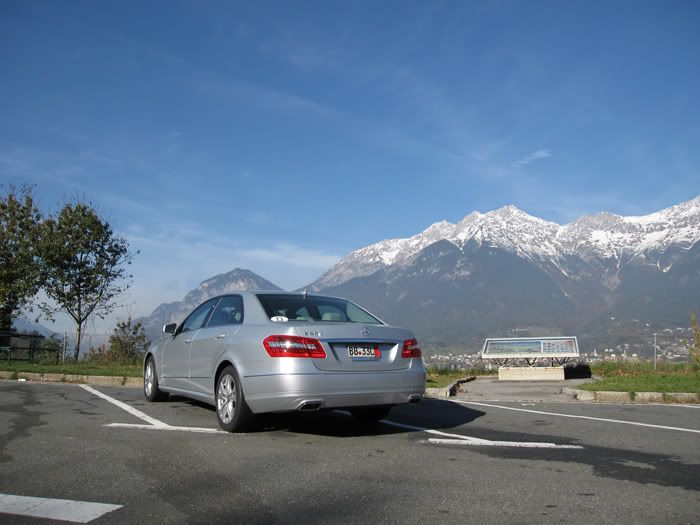
And here is an obligatory shot of the car against the Alpine peaks.
Austria has the strictest motorist regulations among the countries I am driving in. In addition to a toll sticker for the Autobahn system, I am also required to carry a safety vest inside the passenger compartment, to be worn in case of a roadside emergency; the vest was provided free of charge by Mercedes-Benz back in Sindelfingen. And more importantly, I am required to use winter tires between November and April, but that is also taken care of, since (1) I am leaving Austria for good on this October 31st, and (2) this car's all-season tires, thanks to their Mud + Snow designation, meet the requirement. Austrian driving in the winter on performance summer tires is not only dangerous, it is outright illegal, with a fine of €5,000.
Brenner Pass is only 30 minutes from Innsbruck, but in order to drive this short distance, I am required to pay a supplemental toll of €8 in cash on top of the toll sticker. Before long, the obligatory border slowdown took place, and in the midst of outlet stores, I could see a sign - European Union flag with the word "ITALIA" in the middle. I entered Italy. Shortly following were the default speed limit sign, showing Italian speed limits at 50 km/h urban, 90 rural, 110 on blue-signed free motorways, and 130 on green-signed toll motorways (Autostrada); the days of German-style unlimited Italian autostrade were long gone.
The initial drive through the rugged terrain was kept at 110 km/h, despite being a green-signed Autostrada. This 110 would persist throughout my drive on Autostrada 22 (the Italian extension of Austrian Autobahn 13). Soon, a toll booth issued me a magnetic toll ticket; Italian autostrade use a thruway-type toll collection system using tickets or transponders.
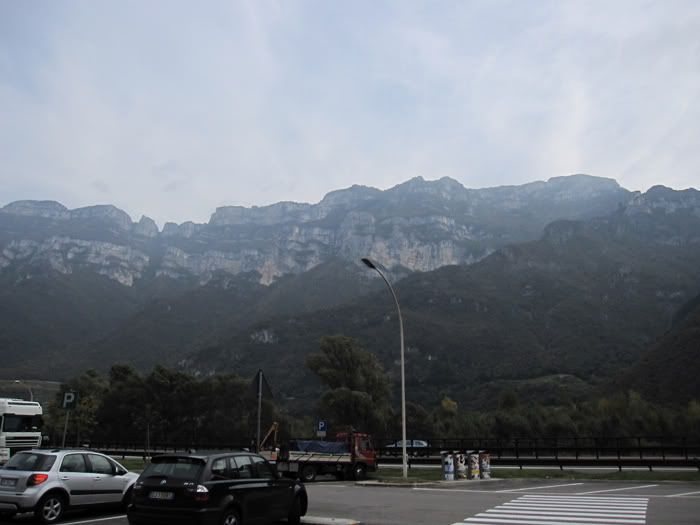
Autostrada 22 heads south from the Brenner Pass, through the lovely, rugged Dolomite Mountains, known for their stunning marble cliffs like this photo. This photo is just a tiny hint of all the gorgeous cliffs I could spot while driving, but couldn't photograph due to my need to put driving first. This photo is from a rest stop about 30 minutes north of Verona, where I would take the eastbound Autostrada 4 toward Venice (marked as Venezia on signs).
Up to this point, I am in the region known as Alto Adige, and as this region is historically populated by the Germanic people, all placenames have Italian and German versions, and all road signs and messages are in both Italian and German. Indeed, I am reminded that back when Germany's national anthem was sung as "Deutschland über alles," its lyrics included the phrase "From the Meuse to the Memel, From the Adige to the Belt" - a swath of territory that is now lost through losses in two World Wars. The Brenner Pass has historically connected this region to the rest of the Germanic world, and this road is dotted with castles - tollbooths back in the day, complete with accommodations for tolljumpers.
But make no mistakes, this is Italy. I am actually finding the Autostrada system to be better built and maintained than the German Autobahns; thanks to the nicer Italian climate, the road surfaces are in even better shape than the already excellent ones in Germany. Aside from acceleration and deceleration lanes which are mere afterthoughts drawn onto the shoulder, the autostrada is built to higher standards than the autobahn.
But I have to say that the real reminder of Italy comes from the reckless drivers. In Germany, I could count on all drivers obeying the strict regulations, such as no-passing-on-right and adherence to any mandatory speed limits. But here in Italy, I am finding that traffic regulations were meant to be ignored. Speeding and lane changes without signaling were very common, and while passing on the right was nowhere near the epidemic levels I see in California, I could still occasionally see it. I could also count on a mad flash of the high beams from behind if I did not vacate the fast lane in a microsecond, and a frustrated honk if I decided to treat stop signs (i.e. at this rest stop) as a full stop rather than a California stop.
I found that the worst a-holes on Italian autostrade were Audi drivers, filling in the niche occupied by BMW drivers in California. The worst slowpokes, just like in California, were Toyota drivers. Van drivers, be it the Central American theocrats in California driving a Chevrolet Astro, or brutes in South Korea driving a Hyundai Starex, used to push my buttons a lot, but they are less of a factor in Europe; the Astro is nonexistent, and drivers of the Starex and similar vans are well-behaved in Europe (aside from an occasional tendency to speed). Another demographic that used to push my buttons in South Korea - drivers of Ssangyong SUVs - also drove pretty well in Europe.
I refueled at this rest stop before continuing my way. Italian gas prices are similar to Austrian levels and much cheaper than German levels; I could expect to pay €1.00 per liter, and I only needed to pay for regular unleaded, which was already 95 octane (91 US octane), making premium at 98 octane a useless splurge. While Autostrada 22 continues south to Modena, home of Ferrari, I was more than happy to transfer to eastbound Autostrada 4 once in Verona, enjoying its 3 lanes all the way to Venice as well as consistent 130 km/h speed limit. It went through a flatter landscape surrounded by rolling hills, farms, and even an American military base. As I approached Venice, I stumbled into a "KARTE" lane at the toll booth, and paid with a debit card; the toll came out to be €21, definitely not cheap, and I had intended to pay at a cash lane, whose money icon I couldn't recognize right away. (Good thing I didn't use the TELEPASS lane for transponders.) Thanks to European distances being delightfully short and motorway speeds being fast, I arrived in Venice ahead of schedule - something that happened on every major driving day for me.
Once in Venice, I proceeded through Mestre before getting on the 2.5-mile Liberty Causeway to the water city itself. I parked at the enormous Tronchetto Garage, which I appreciated for its American-scale ramps and parking spaces, and fumbled my way to the vaporetto (water bus) stop, for a ride on the No. 2 water bus to Rialto Bridge. My mother was thinking "Harlem slum style decay" rather than "a former powerhouse" as the water bus made its way into the Grand Canal, and upon reaching Pensione Guerrato (Rick Steves' favorite hotel) and finding that the €130/night room I had booked was an attic room above fourth floor (sixth floor if counted American style) with no television, she was fuming. I fumed right back too, telling her to shove it with her Asian-American model minority materialism and excess. This trip was at its breaking point.
Cooler heads eventually prevailed, as I gladly let my mother know that I've myself been let down by another European city that other visitors rave about - namely, Amsterdam and its Surinamese thugs. Now the goal has become salvaging the Venice experience somehow, even if Venice falls way short of the sanitized/romanticized depictions in the movies and as seen at the Venetian Hotel and Casino in Las Vegas.
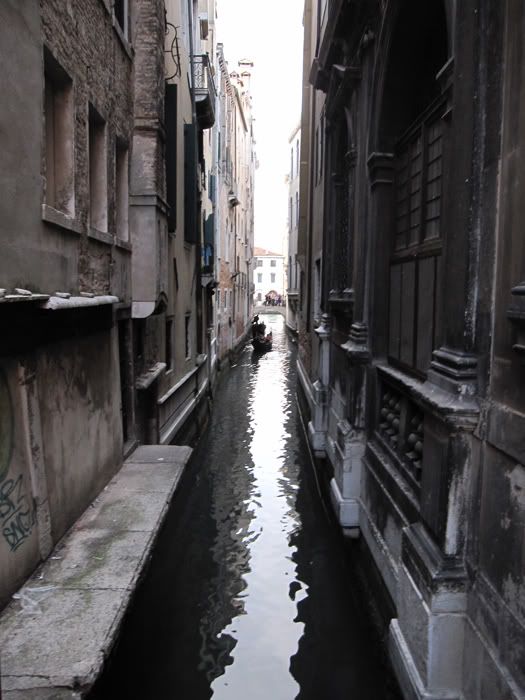
From the hotel near the Rialto Bridge, we are walking in the general direction of "Piazza San Marco" (St. Mark's Square). And every time a pedestrian path goes over a water canal, I am treated to views like this, an alleyway accessible only by water, served by a gondola. The path crosses the canal in the form of an elevated bridge, with a few steps up and down on either side, and that gets tiring after a while walking around Venice.
The primary method of getting around Venice is by walking through very narrow pathways, as this is a water city without any land vehicles, and land area is at a huge premium. In particular, the pathways between the Rialto Bridge and the St. Mark's Square, the two tourist magnets of Venice, can be extremely crowded.
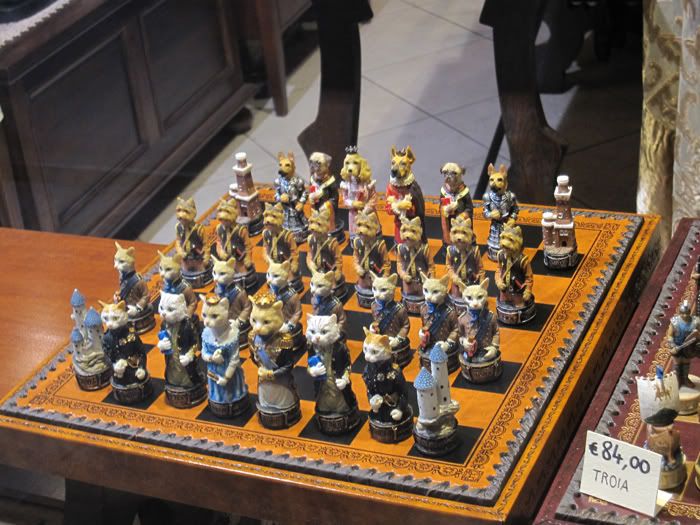
And with all the tourist traffic passing by, the stores often sell very catchy items, like this chess set made up of cats and dogs. I almost wanted to buy one.
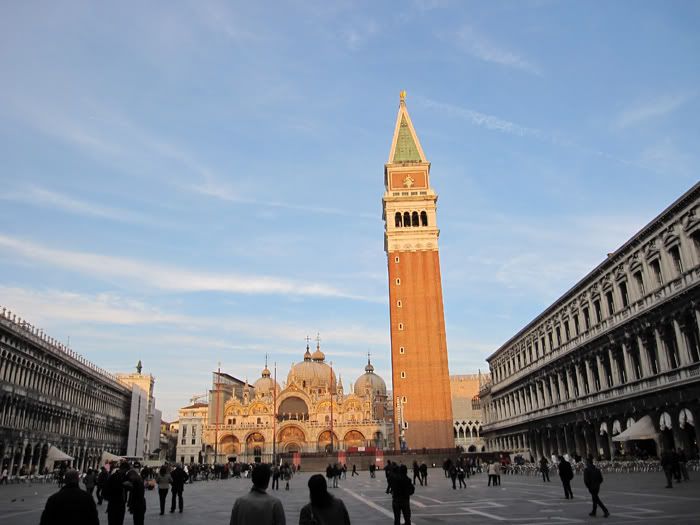
Now this is a bit more like it - an open expanse. This is St. Mark's Square, with the Campanile and St. Mark's Basilica standing proudly as ever.
I would quickly learn that open spaces like this are at a very huge premium in Venice, and that I would need to enjoy every moment I spend in one.
As it's sunset already, I am not planning on doing any sightseeing this day. I am supposed to stay in Venice for two nights, and that gives me all of All Saints' Day as a full day to explore the city. I will now walk back toward the Rialto Bridge.
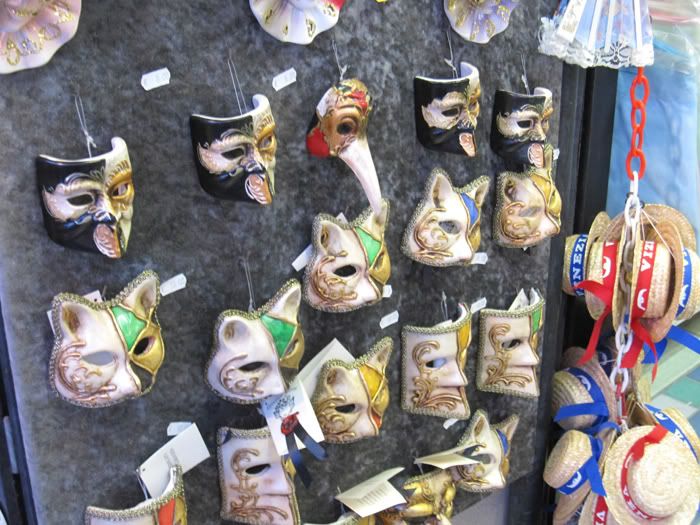
Another store, selling masks that are a good reminder of Venice's past decadence in the form of masquerade parties. I am loving the fact that many of the masks are cat-shaped.
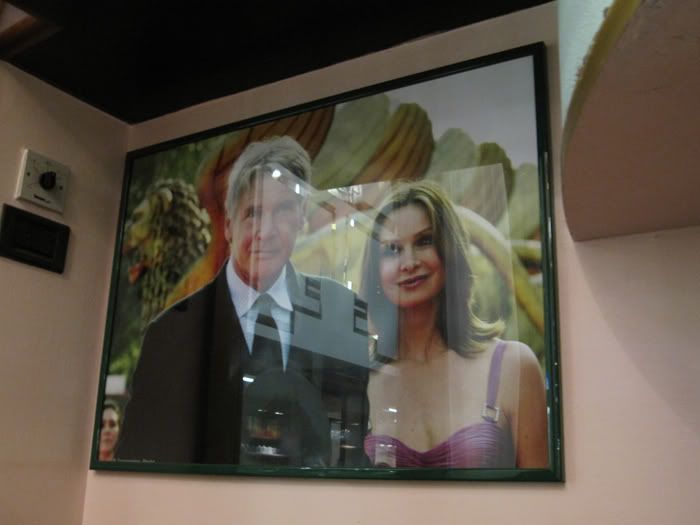
It's dinnertime. As Venice is now a place where tourists outnumber residents, getting into a non-touristy restaurant is wishful thinking in many parts of town. And since I am still on the main paths between St. Mark's and Rialto, I need to duck into a touristy eatery - and entered a spaghetti joint run by an East Asian immigrant.
This joint's walls are covered with photos of international movie actors who have attended the annual Venice Film Festival. And I am lucky to be eating under the photo of my favorite - Calista Flockhart and Harrison Ford. I'm always fond of Calista Flockhart for her portrayal of that neurotic skinny miniskirt-suited lesbian lawyer Ally McBeal; glad to be reminded of her here in faraway Italy. I am also realizing that in just eleven days, Calista would turn 45; when Ally had first aired, Calista was only 33, and Ally was supposed to be merely 28. Certainly, a key part of looking young is having a geriatric boyfriend, in the form of Harrison Ford.
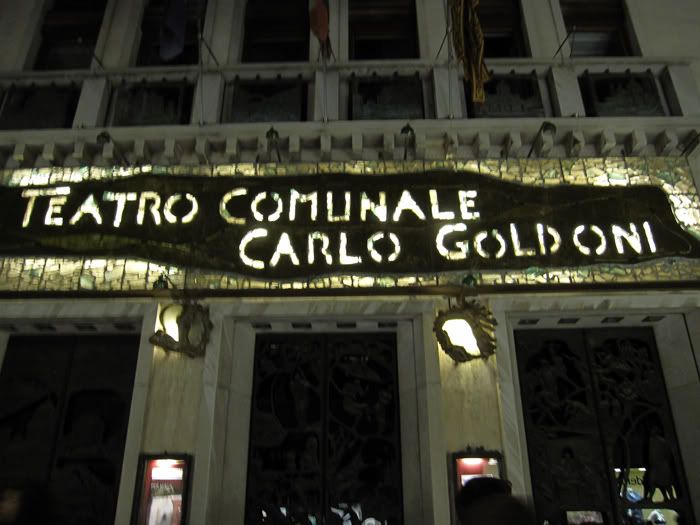
Continuing past Rialto toward the northeastern portions of Venice, the one part of the city that actually still has residents.
I don't know what the significance of this community theater is, nor who the namesake, Carlo Goldoni, is, but I had to take this photo for the lovely lighting on the sign.
In Venice's labyrinthine path pattern, navigating by street names is impossible. One's sense of directions completely melts away after a few minutes of walking. The only way to keep going is to refer to yellow signs pointing to the direction of a major landmark (S. MARCO for St. Mark's Square, P. RIALTO for Rialto Bridge, FERROVIA for train station, etc.), and use that landmark as a reference point to get to the final destination from. I'm actually walking toward the train station at the north end of the water city.
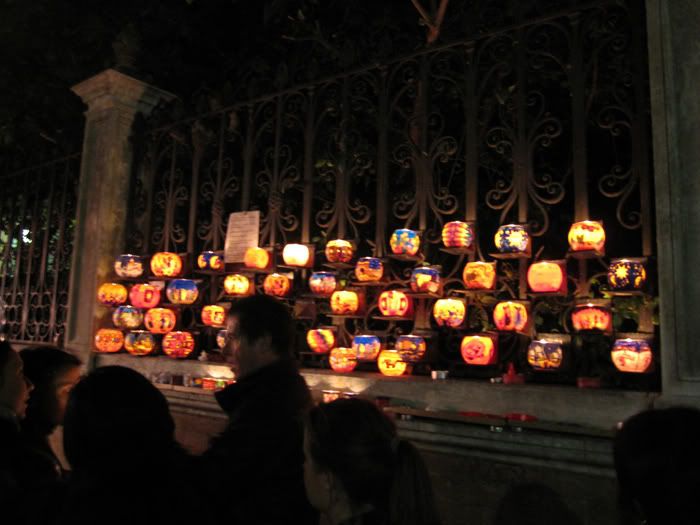
I am looking at some lanterns lit to mark All Saints' Day the next day.
I am walking on a rather wide pathway - wide enough to handle two trucks easily, if trucks had a way of getting there. This is the residential part of Venice, complete with a grocery market and other services catering to residents rather than tourists. And this being Halloween, I am seeing costumed children out trick-or-treating. While Americans tend to treat Halloween as a commercialized holiday, Europeans give it the same treatment AND celebrate the very reason for Halloween's existence - All Saints' Day the next day.
I'm actually liking the fact that I am spending Halloween in Venice, a city known for masquerades and other disguises.

I am now next to the train station. I am inside the Church of St. Mary of Nazareth, which I am not visiting for any particular reason, but because I needed a place to take a quick breath - and to photograph some lovely interior elements.

And now I am outside, crossing the Grand Canal via one of only four pedestrian bridges spanning it.
To the right is the Church of St. Mary of Nazareth. Toward the back is what is referred to on the signs as "Ferrovia" - Santa Lucia train station, where trains terminate after coming in from the mainland over the Liberty Causeway. Needless to say, the presence of the train station makes this place a transportation hub. In front of the train station are docks that serve as water bus stops, and indeed a couple of water buses are operating. In front of the church, smaller docks serve water taxis. Even a water bus ride in Venice is expensive - €6.50 for a ticket good for an hour - and a taxi ride is prohibitively expensive. (However, passes can bring the cost of water bus rides down significantly.)
Within walking distance, behind the train station, is Piazzale Roma, where Venice residents have a parking garage to keep their cars in. Piazzale Roma is the only part of Venice accessible to land vehicles, and is served by land buses from the mainland.
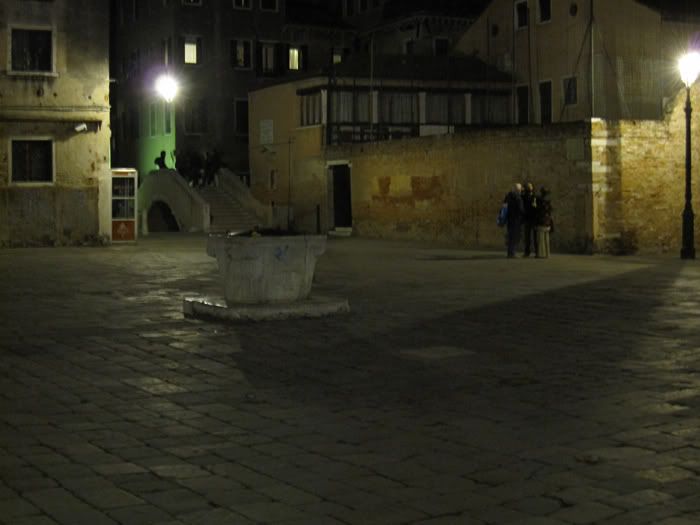
While my hotel is on the west side of the Grand Canal, most of the sights covered above are on the east side. Now that I crossed back west at the train station, now I am wondering again through a new set of labyrinthine paths to attempt to get to Rialto Bridge (and the hotel).
This open square is an example of Venice's traditional water collection systems. As Venice sits 2.5 miles off the coast and has no source of fresh water, residents used squares like this as water collection systems. Rainwater would pool toward the center of the square and lower into a well below, collected there for the residents' use. This system remained in use until the 19th Century, when an aqueduct was built to the mainland, bringing water from the Italian Alps.
Toward the back is a typical bridge going over a narrow side canal. After dozens of those in an hour or two, walking around in Venice can get very tiresome, fast.
Eventually we stumbled back to the hotel and retired to the attic room. The windows remained open for ventilation - but my mother continued to complain, primarily thanks to the Halloween revelers' noise outside. She simply was NOT liking Venice, period, and a decision was made to leave the next morning - a day early. I'd have to cancel the second night's reservation, and would have to try to find a place to sleep on the way to Switzerland. Driving hotshot through Europe without a confirmed hotel room - that in itself could be exciting!
As noted in the Day 6 recap, I ended up not visiting any of the salt mines near Salzburg. I simply took the shortest route out to Autobahn 1, then headed west back into Germany; even though the approach to Brenner Pass is via Innsbruck in western Austria, it is actually faster to dip briefly into Germany, due to lack of Autobahn connections between Salzburg and Innsbruck. After driving on German Autobahn 8 toward Munich for about 30 minutes, I found the Autobahn 93 turn-off, with clearly marked "I" oval, denoting access to Italy.
Autobahn 93 followed up the course of the Inn River, and before long, took me back into Austria, becoming Austrian Autobahn 12. Surrounded by old castles and snow-capped Alpine peaks, I made sure to enjoy the drive to the fullest. The CD player played the soundtrack to The Sound of Music movie from 1965, and I followed up with my modern-day favorite from back in California, Anna Nalick.
I am now taking a brief toilet break in Innsbruck, as Autobahn 13 splits off from the 12 to climb up the Brenner Pass and take me to Italy.
Innsbruck ("Bridge on the Inn River") is a very scenic town, best known as a ski resort, particularly attractive to those who live in countries without steep mountains (think England and the Netherlands). Unfortunately, between my need to continue to Venice and the difficulties I would certainly experience driving into town and parking, this will be all the Innsbruck I end up experiencing. Having to mind my mother's constant concerns regarding possible damage to the car is really piling on my stress level.
And here is an obligatory shot of the car against the Alpine peaks.
Austria has the strictest motorist regulations among the countries I am driving in. In addition to a toll sticker for the Autobahn system, I am also required to carry a safety vest inside the passenger compartment, to be worn in case of a roadside emergency; the vest was provided free of charge by Mercedes-Benz back in Sindelfingen. And more importantly, I am required to use winter tires between November and April, but that is also taken care of, since (1) I am leaving Austria for good on this October 31st, and (2) this car's all-season tires, thanks to their Mud + Snow designation, meet the requirement. Austrian driving in the winter on performance summer tires is not only dangerous, it is outright illegal, with a fine of €5,000.
Brenner Pass is only 30 minutes from Innsbruck, but in order to drive this short distance, I am required to pay a supplemental toll of €8 in cash on top of the toll sticker. Before long, the obligatory border slowdown took place, and in the midst of outlet stores, I could see a sign - European Union flag with the word "ITALIA" in the middle. I entered Italy. Shortly following were the default speed limit sign, showing Italian speed limits at 50 km/h urban, 90 rural, 110 on blue-signed free motorways, and 130 on green-signed toll motorways (Autostrada); the days of German-style unlimited Italian autostrade were long gone.
The initial drive through the rugged terrain was kept at 110 km/h, despite being a green-signed Autostrada. This 110 would persist throughout my drive on Autostrada 22 (the Italian extension of Austrian Autobahn 13). Soon, a toll booth issued me a magnetic toll ticket; Italian autostrade use a thruway-type toll collection system using tickets or transponders.
Autostrada 22 heads south from the Brenner Pass, through the lovely, rugged Dolomite Mountains, known for their stunning marble cliffs like this photo. This photo is just a tiny hint of all the gorgeous cliffs I could spot while driving, but couldn't photograph due to my need to put driving first. This photo is from a rest stop about 30 minutes north of Verona, where I would take the eastbound Autostrada 4 toward Venice (marked as Venezia on signs).
Up to this point, I am in the region known as Alto Adige, and as this region is historically populated by the Germanic people, all placenames have Italian and German versions, and all road signs and messages are in both Italian and German. Indeed, I am reminded that back when Germany's national anthem was sung as "Deutschland über alles," its lyrics included the phrase "From the Meuse to the Memel, From the Adige to the Belt" - a swath of territory that is now lost through losses in two World Wars. The Brenner Pass has historically connected this region to the rest of the Germanic world, and this road is dotted with castles - tollbooths back in the day, complete with accommodations for tolljumpers.
But make no mistakes, this is Italy. I am actually finding the Autostrada system to be better built and maintained than the German Autobahns; thanks to the nicer Italian climate, the road surfaces are in even better shape than the already excellent ones in Germany. Aside from acceleration and deceleration lanes which are mere afterthoughts drawn onto the shoulder, the autostrada is built to higher standards than the autobahn.
But I have to say that the real reminder of Italy comes from the reckless drivers. In Germany, I could count on all drivers obeying the strict regulations, such as no-passing-on-right and adherence to any mandatory speed limits. But here in Italy, I am finding that traffic regulations were meant to be ignored. Speeding and lane changes without signaling were very common, and while passing on the right was nowhere near the epidemic levels I see in California, I could still occasionally see it. I could also count on a mad flash of the high beams from behind if I did not vacate the fast lane in a microsecond, and a frustrated honk if I decided to treat stop signs (i.e. at this rest stop) as a full stop rather than a California stop.
I found that the worst a-holes on Italian autostrade were Audi drivers, filling in the niche occupied by BMW drivers in California. The worst slowpokes, just like in California, were Toyota drivers. Van drivers, be it the Central American theocrats in California driving a Chevrolet Astro, or brutes in South Korea driving a Hyundai Starex, used to push my buttons a lot, but they are less of a factor in Europe; the Astro is nonexistent, and drivers of the Starex and similar vans are well-behaved in Europe (aside from an occasional tendency to speed). Another demographic that used to push my buttons in South Korea - drivers of Ssangyong SUVs - also drove pretty well in Europe.
I refueled at this rest stop before continuing my way. Italian gas prices are similar to Austrian levels and much cheaper than German levels; I could expect to pay €1.00 per liter, and I only needed to pay for regular unleaded, which was already 95 octane (91 US octane), making premium at 98 octane a useless splurge. While Autostrada 22 continues south to Modena, home of Ferrari, I was more than happy to transfer to eastbound Autostrada 4 once in Verona, enjoying its 3 lanes all the way to Venice as well as consistent 130 km/h speed limit. It went through a flatter landscape surrounded by rolling hills, farms, and even an American military base. As I approached Venice, I stumbled into a "KARTE" lane at the toll booth, and paid with a debit card; the toll came out to be €21, definitely not cheap, and I had intended to pay at a cash lane, whose money icon I couldn't recognize right away. (Good thing I didn't use the TELEPASS lane for transponders.) Thanks to European distances being delightfully short and motorway speeds being fast, I arrived in Venice ahead of schedule - something that happened on every major driving day for me.
Once in Venice, I proceeded through Mestre before getting on the 2.5-mile Liberty Causeway to the water city itself. I parked at the enormous Tronchetto Garage, which I appreciated for its American-scale ramps and parking spaces, and fumbled my way to the vaporetto (water bus) stop, for a ride on the No. 2 water bus to Rialto Bridge. My mother was thinking "Harlem slum style decay" rather than "a former powerhouse" as the water bus made its way into the Grand Canal, and upon reaching Pensione Guerrato (Rick Steves' favorite hotel) and finding that the €130/night room I had booked was an attic room above fourth floor (sixth floor if counted American style) with no television, she was fuming. I fumed right back too, telling her to shove it with her Asian-American model minority materialism and excess. This trip was at its breaking point.
Cooler heads eventually prevailed, as I gladly let my mother know that I've myself been let down by another European city that other visitors rave about - namely, Amsterdam and its Surinamese thugs. Now the goal has become salvaging the Venice experience somehow, even if Venice falls way short of the sanitized/romanticized depictions in the movies and as seen at the Venetian Hotel and Casino in Las Vegas.
From the hotel near the Rialto Bridge, we are walking in the general direction of "Piazza San Marco" (St. Mark's Square). And every time a pedestrian path goes over a water canal, I am treated to views like this, an alleyway accessible only by water, served by a gondola. The path crosses the canal in the form of an elevated bridge, with a few steps up and down on either side, and that gets tiring after a while walking around Venice.
The primary method of getting around Venice is by walking through very narrow pathways, as this is a water city without any land vehicles, and land area is at a huge premium. In particular, the pathways between the Rialto Bridge and the St. Mark's Square, the two tourist magnets of Venice, can be extremely crowded.
And with all the tourist traffic passing by, the stores often sell very catchy items, like this chess set made up of cats and dogs. I almost wanted to buy one.
Now this is a bit more like it - an open expanse. This is St. Mark's Square, with the Campanile and St. Mark's Basilica standing proudly as ever.
I would quickly learn that open spaces like this are at a very huge premium in Venice, and that I would need to enjoy every moment I spend in one.
As it's sunset already, I am not planning on doing any sightseeing this day. I am supposed to stay in Venice for two nights, and that gives me all of All Saints' Day as a full day to explore the city. I will now walk back toward the Rialto Bridge.
Another store, selling masks that are a good reminder of Venice's past decadence in the form of masquerade parties. I am loving the fact that many of the masks are cat-shaped.
It's dinnertime. As Venice is now a place where tourists outnumber residents, getting into a non-touristy restaurant is wishful thinking in many parts of town. And since I am still on the main paths between St. Mark's and Rialto, I need to duck into a touristy eatery - and entered a spaghetti joint run by an East Asian immigrant.
This joint's walls are covered with photos of international movie actors who have attended the annual Venice Film Festival. And I am lucky to be eating under the photo of my favorite - Calista Flockhart and Harrison Ford. I'm always fond of Calista Flockhart for her portrayal of that neurotic skinny miniskirt-suited lesbian lawyer Ally McBeal; glad to be reminded of her here in faraway Italy. I am also realizing that in just eleven days, Calista would turn 45; when Ally had first aired, Calista was only 33, and Ally was supposed to be merely 28. Certainly, a key part of looking young is having a geriatric boyfriend, in the form of Harrison Ford.
Continuing past Rialto toward the northeastern portions of Venice, the one part of the city that actually still has residents.
I don't know what the significance of this community theater is, nor who the namesake, Carlo Goldoni, is, but I had to take this photo for the lovely lighting on the sign.
In Venice's labyrinthine path pattern, navigating by street names is impossible. One's sense of directions completely melts away after a few minutes of walking. The only way to keep going is to refer to yellow signs pointing to the direction of a major landmark (S. MARCO for St. Mark's Square, P. RIALTO for Rialto Bridge, FERROVIA for train station, etc.), and use that landmark as a reference point to get to the final destination from. I'm actually walking toward the train station at the north end of the water city.
I am looking at some lanterns lit to mark All Saints' Day the next day.
I am walking on a rather wide pathway - wide enough to handle two trucks easily, if trucks had a way of getting there. This is the residential part of Venice, complete with a grocery market and other services catering to residents rather than tourists. And this being Halloween, I am seeing costumed children out trick-or-treating. While Americans tend to treat Halloween as a commercialized holiday, Europeans give it the same treatment AND celebrate the very reason for Halloween's existence - All Saints' Day the next day.
I'm actually liking the fact that I am spending Halloween in Venice, a city known for masquerades and other disguises.
I am now next to the train station. I am inside the Church of St. Mary of Nazareth, which I am not visiting for any particular reason, but because I needed a place to take a quick breath - and to photograph some lovely interior elements.
And now I am outside, crossing the Grand Canal via one of only four pedestrian bridges spanning it.
To the right is the Church of St. Mary of Nazareth. Toward the back is what is referred to on the signs as "Ferrovia" - Santa Lucia train station, where trains terminate after coming in from the mainland over the Liberty Causeway. Needless to say, the presence of the train station makes this place a transportation hub. In front of the train station are docks that serve as water bus stops, and indeed a couple of water buses are operating. In front of the church, smaller docks serve water taxis. Even a water bus ride in Venice is expensive - €6.50 for a ticket good for an hour - and a taxi ride is prohibitively expensive. (However, passes can bring the cost of water bus rides down significantly.)
Within walking distance, behind the train station, is Piazzale Roma, where Venice residents have a parking garage to keep their cars in. Piazzale Roma is the only part of Venice accessible to land vehicles, and is served by land buses from the mainland.
While my hotel is on the west side of the Grand Canal, most of the sights covered above are on the east side. Now that I crossed back west at the train station, now I am wondering again through a new set of labyrinthine paths to attempt to get to Rialto Bridge (and the hotel).
This open square is an example of Venice's traditional water collection systems. As Venice sits 2.5 miles off the coast and has no source of fresh water, residents used squares like this as water collection systems. Rainwater would pool toward the center of the square and lower into a well below, collected there for the residents' use. This system remained in use until the 19th Century, when an aqueduct was built to the mainland, bringing water from the Italian Alps.
Toward the back is a typical bridge going over a narrow side canal. After dozens of those in an hour or two, walking around in Venice can get very tiresome, fast.
Eventually we stumbled back to the hotel and retired to the attic room. The windows remained open for ventilation - but my mother continued to complain, primarily thanks to the Halloween revelers' noise outside. She simply was NOT liking Venice, period, and a decision was made to leave the next morning - a day early. I'd have to cancel the second night's reservation, and would have to try to find a place to sleep on the way to Switzerland. Driving hotshot through Europe without a confirmed hotel room - that in itself could be exciting!

16 March 2010
Europe recap: Day 3, Sindelfingen/Stuttgart
Updates halted again as I spent some time here and there, including back in Tucson for the first real time since I was forced to leave in my poverty days. But for now, I want to continue my European travelogue.
This post goes back to the big day - Tuesday, October 27th, the day I took delivery of the Mercedes-Benz. Although Mercedes-Benz USA advises a three-month lead time for European Delivery orders, I was able to secure a delivery date with only a 2-month notice, thanks to ordering the most common color - silver. And this was going to be a LONG day that would really involve anything/everything Mercedes-Benz. This may be the one post on this blog that will come the closest to being a Mercedes-Benz commercial.
The Customer Center ("Kundencenter" in German) is located at the main Mercedes-Benz factory in Sindelfingen, about a 30-minute taxi ride away. I had to take a cab ride, paid for with a Mercedes-Benz voucher. Interestingly enough, the cab itself was a previous E-class, with cheaper interior and a diesel engine. The cab ride, had I paid out of my pocket, would've been €45 plus tips - NOT cheap. The ride took me on Bundesbahn 14, proceeding through city streets and through a LONG tunnel (complete with an intersection in the middle) before taking me on to Autobahn 831 and 81; although 831 and 81 were Autobahnen, they were hopelessly congested construction zones, and speed limit was set at 100 km/h anyway.
My Kundencenter arrival time was around 8:30 AM, and after check-in, I had to wait for a while due to extra paperwork required for a US-market car.
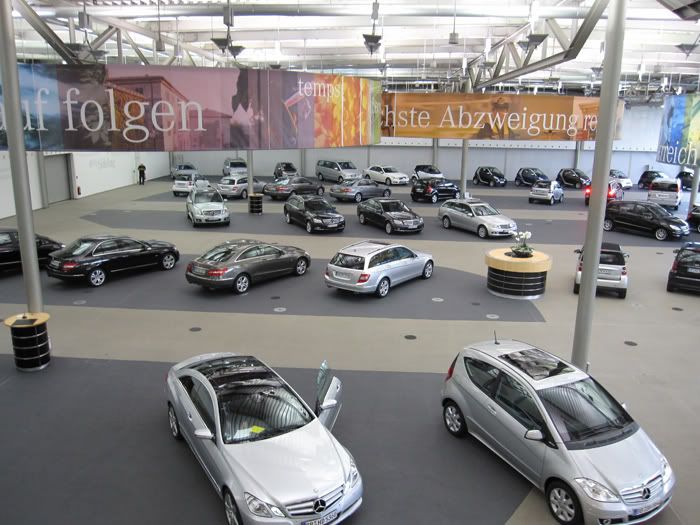
The delivery bay is a very pleasant place, as I am finding out while having a continental breakfast on an upper-level terrace. Factory delivery is a popular option for European owners of Mercedes-Benz vehicles; they show up, take delivery, and take the leisurely drive home. But occasionally, North American market models show up here as well, for Americans and Canadians who want to come to the factory for the car, then use the car for some European sightseeing. North Americans, for obvious reasons, are not allowed to take delivery of models that are built only in North America, such as the M-class and the R-class.
This huge space has cars coming in and leaving constantly. Despite the exhaust, I am not feeling anything - the ventilation system here is robust. And despite all the amount of airflow required, I am not feeling even a hint of a breeze inside. I do airflow for a living, so I had to take note of this.
I am loving this place. It has all the feel of a nursery for newborn babies, complete with brightly colored banners. The "babies" here are brand-new cars waiting to meet their owners for the first time, of course. All the cars have been built to order, so they were spoken for before they were ever scheduled for production. This place is really designed to bring out the maternal instinct in the owner - there is a reason why according to my saleswoman, women love European Delivery more than men do.
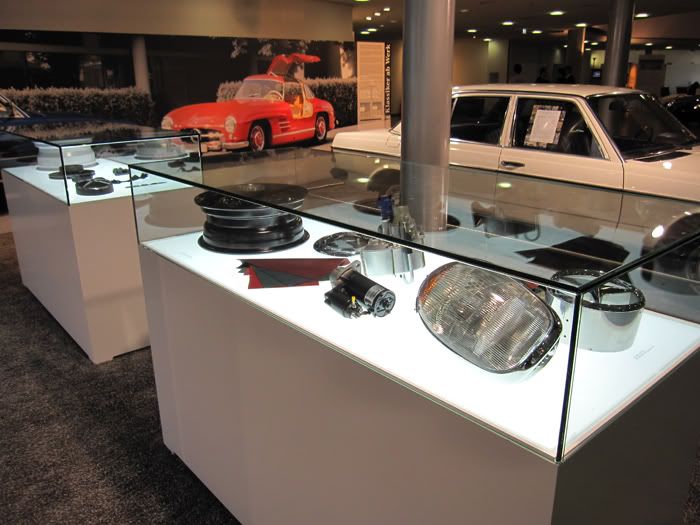
I'm still waiting, walking around a merchandise store and other displays introducing various Mercedes-Benz products and programs.
This display showcases the Young Classics program, which restores, sells, and services vintage Mercedes-Benz models. The 1982 model in the back is a good example of cars available under this program. The front display has various OEM parts for 1970s models - and they are all still available via the Young Classics program.
If it turns out that the relationship my mother and I start on this day with the E-class end up stretching for a LONG time, it looks like I won't have trouble getting parts and service. After all, Young Classics has a US showroom too - in Irvine, California.
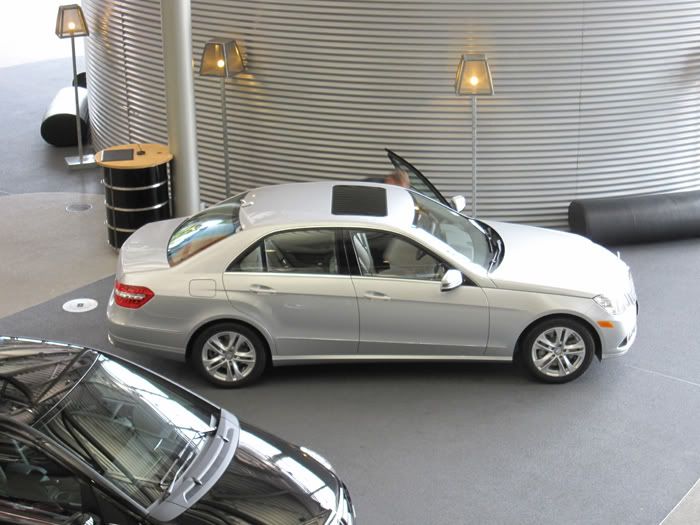
I'm still waiting to do the paperwork, but I am seeing this silver E-class come in. The front side amber reflectors indicate that this is a North American model. I also noticed the red-striped export plates as the car came in. It may as well be the car that I am here to pick up.
Sure enough, I was summoned by an English-speaking rep in a minute, to start the paperwork, confirming my initial order for the vehicle. I had to sign and verify a number of forms, including German and international registration cards, German and international ("Green Card") insurance booklets, a waiver from the State of Baden-Württemberg allowing registration of a US-market car, and acknowledgment of the terms and conditions of the tourist registration.
I was also given two telephone hotlines: one for roadside assistance, and one for AXA insurance adjusters in the unlikely case of a claim. I was instructed that as this is a US-market car, European service and roadside assistance will need to use the chassis VIN rather than the VIN for the fully completed vehicle.
A few more minutes of wait, and an English-speaking gentleman introduced me to the features of the vehicle. His break-in recommendation was to stay under 90 MPH and 4,000 RPM. Yes, as this is a US-market car, speedometer is in miles per hour only, and I had to turn on a setting to enable the digital speedometer in kilometers per hour, and to use metric units for the trip computer. I also took possession of a free rental Garmin GPS unit, as the COMAND unit built into the car was specific to North America and couldn't take European maps.
Odometer reading: 7 miles or 11 kilometers, totally brand-new except for a standard test run within the factory. I drove out the delivery bay door, and parked at a lot just outside, to further review the car's features while waiting for a complimentary factory tour.
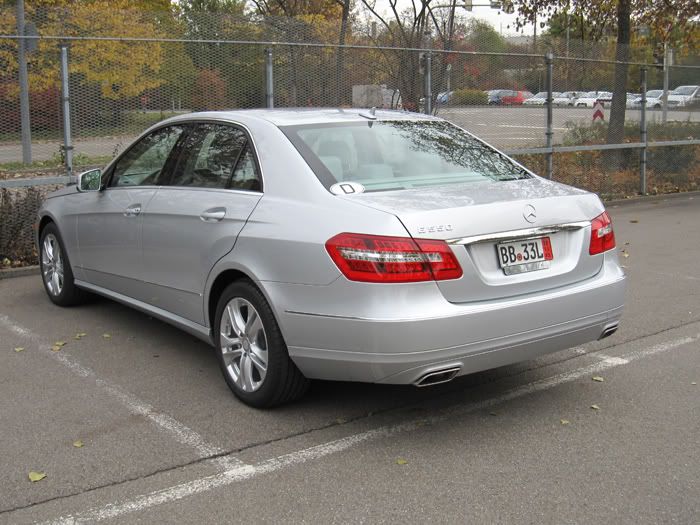
And it's waiting time for now. I am at last in possession of a Mercedes-Benz! This one is an E550, with a big honking V8; while I had insisted that the V6-powered E350 was more than adequate, my folks put in the order as the E550, just for a larger number on the trunk. After all, Mercedes-Benz used to use numbers, rather than lettered series, to identify models until 1993.
The export plate was issued at the town of Böblingen, on the other side of Autobahn 81, as indicated by the "BB" label. The three numbers on the red stripe - 10 11 09 - indicate that the plates expire on November 10th, 2009; while the basic registration tax covers up to 3 months, the standard insurance that came with the car lasts only two weeks (more than enough for me), and the plates are set to expire with the insurance. If I wanted longer insurance, I could've prepaid the extra amount, but would have had to do so about a week prior to enable proper processing of registration and insurance.
Because the export plate does not have a nationality indicator, I have to indicate the registration nationality the old-fashion way - with an oval decal. D, of course, indicates Germany. Without this oval, I cannot leave Germany.
Also, the front windshield has had an emissions level sticker added as well. This car's emissions level is 4, the most stringent, applicable to any gasoline-powered car built in 1996 and later; without it, I am banned from entering many German metropolitan areas, otherwise I will need to pay a fine. And I need to enter Stuttgart later in the day, just to park at the hotel.
I am also finding out, as a rude awakening, that the rear turn signals blink red, unlike the amber that's standard within Europe and in the rest of the world. I consider red turn signals to be a uniquely American annoyance, like libertarianism and some aspects of the gun culture, and I'm appalled that more and more German cars are using red blinkers on US-market models.
After a while, I joined an English-language tour of the Sindelfingen factory. It is home to the C-class, the E-class (including this example), the S-class, and the CLS-class. The tour banned all photographs, but I still remember all the burning metal smell from the stamping and welding shops. Quite an amazing sight. It is one thing to build a solid car, but another to design a solid car that is easy to weld and assemble; I am glad to have seen the process at work. The stamping and welding shops I toured were for the E-class (yes, the very stamping molds and welding robots that built this car), while the final assembly line, still primarily done with manual labor, was for the S-class; every car in the final assembly had a paper slip attached, listing the destination market of the car and the list of options to be installed, and I noted that the vast majority of cars being built this day were going to China. I thoroughly enjoyed the tour - my first-ever for a car factory.
I wrapped up with a lunch (paid for by Mercedes-Benz) at the Kundencenter restaurant. Nice lunch, but not THAT great, in my opinion. It was early afternoon already, and my first drive in the E550 would take me back to Stuttgart, and to Mercedes-Benz's outstanding museum in the eastern part of the city.
Getting here turned out to be a bit troublesome. I had some trouble navigating the narrow surface streets of Stuttgart. And when I arrived at the museum and was parking in the garage (located below a Bundesbahn-grade freeway between the museum and the Mercedes-Benz engine plant next door), the narrow entryways meant that I ended up scraping the left rear tire sidewall against the curb. All of this was driving up my mother's hysteria level; she was convinced that I was going to permanently damage a $63K luxury car on its first day out of the factory.
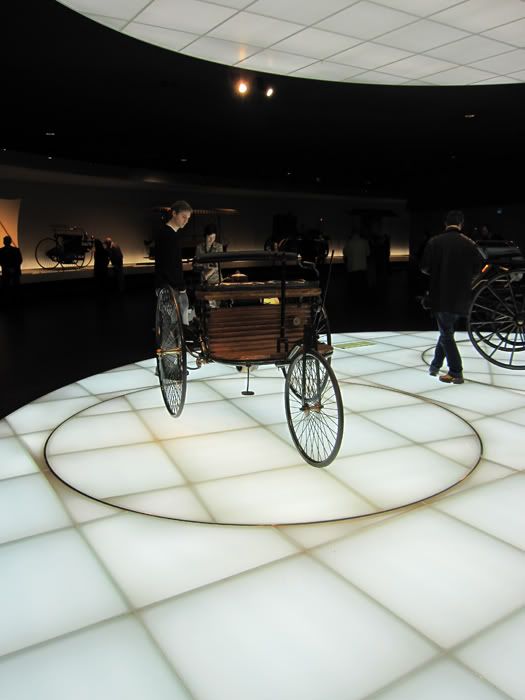
At least the museum was a good place to calm down. This is a very lovely museum with all sorts of cars, including this one: the 1886 Benz Patent-Wagen. This three-wheeled contraption was powered by a single-cylinder engine and could run at 10 miles per hour; it was the first car built by Karl Benz. While only one genuine example exists, a few hundred replicas have also been built in recent years; I can have one for myself for about USD $60,000.
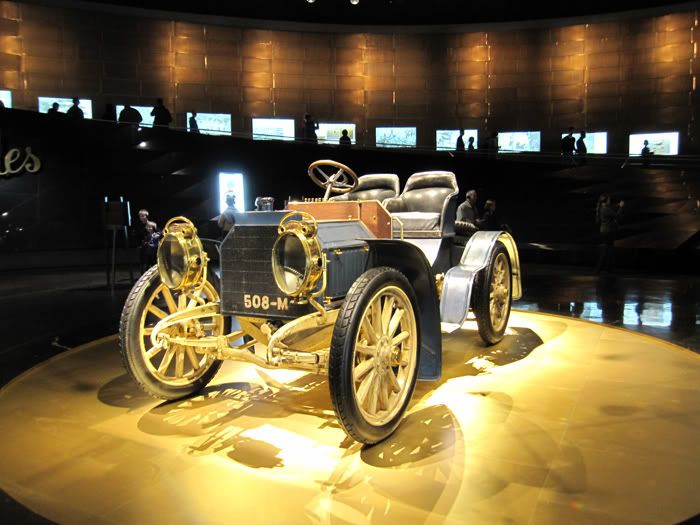
This is a 1902 Mercedes-Simplex 40 PS, a touring car with a 6.8-liter 4-cylinder engine producing 40 horsepower and doing 50 MPH.
In the beginning, Gottlieb Daimler and Karl Benz operated separately. Benz was more of a master of gasoline engines while Daimler tried to use steam and other propulsion methods in his vehicles. One of the Daimler brand names was Mercedes, named after the daughter of a prominent customer. The post-World War I Germany's difficult economy forced Daimler and Benz to merge forces; in 1924, the two combined into a company named Daimler-Benz, and the product line took the current name Mercedes-Benz. The full Mercedes-Benz symbol incorporates the Daimler three-pointed star, surrounded by the Benz laurel. Most Americans simply reduce the name to Mercedes, while most Asians reduce the name to Benz (with some great meanings if written in Chinese characters), but the only truthful way to refer to the post-1924 product line is to use the full Mercedes-Benz name, reserving the Mercedes and Benz names only for cars before then.
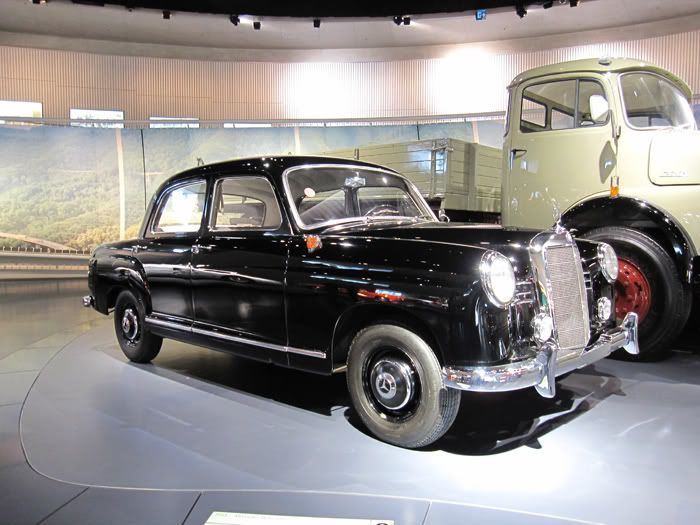
This is a 1955 180. It is better known by its nickname, the Ponton. After World War II devastated Germany, Mercedes-Benz had to build a rugged, reliable model to reassert its place in the marketplace, and this was it. All Mercedes-Benz sedans ever since can trace their ancestry back to the Ponton - including the 2010 E550 that I just picked up earlier in the day.

Mercedes-Benz also made some sleeker, less practical models at the same time. The 300SL was a very desirable sports car in its day (it still is now), available in either a cabriolet (background) or a gullwing coupe (foreground).
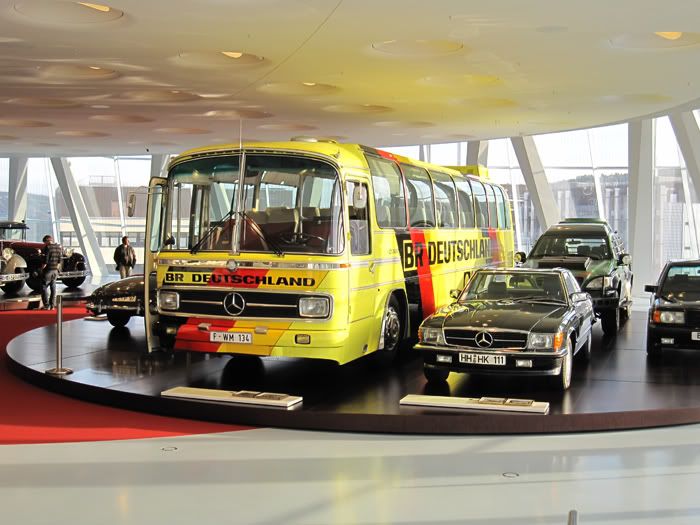
Some exhibits at this museum are dedicated to certain themes. This section has vehicles that had seen use in some prominent fashion - including the unthinkable, Britain's Princess Diana driving a 1991 SL. The star attraction in this photo is the yellow bus, which was the official transportation for the West German soccer squad in the 1974 FIFA World Cup, indeed hosted in and won by West Germany.
This particular model of motorcoach was one of the models licensed by a budding South Korean upstart named Hyundai; while Hyundai had gotten its first passenger cars from Ford, it indeed got its first bus from Mercedes-Benz. Today, Hyundai, alongside Ford, has won a place in my heart as a manufacturer of cars that play a key role in my travels; those two companies had done something even the almighty Bavarians at BMW had failed to do. Various Hyundai and Ford vehicles have made my heart race with anticipation for that next great trip - joined by other travel vehicles like TGV trains and Boeing 777 airliners; now, can Mercedes-Benz, with the brand-spanking-new E550, match that feat? I'm about to find out over the next week or so.
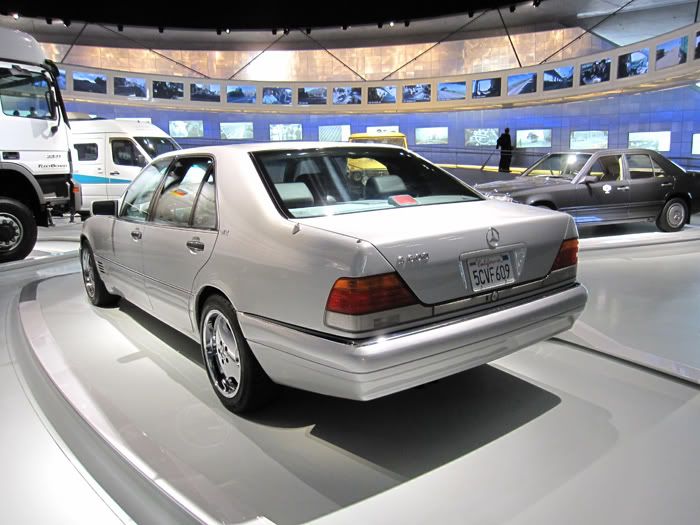
More interesting exhibits continue. This exhibit hall is dedicated to the expansion of Mercedes-Benz into worldwide markets as a purveyor of fine luxury cars. And this particular car is a 1995 S600, sold new to actor Arnold Schwarzenegger. It served with Schwarzenegger until 2003, the year he became California's governor. Now, the car has returned to Stuttgart to become a museum exhibit.
In fact, it still carries California license plates - though the plate number (5CVF609) was certainly issued at the time Schwarzenegger had sold the car, rather than when he had the car. It is the only car in the museum with US license plates.
I guess from now on, "goodbye" in German is not "Auf Wiedersehen," but rather, "Hasta la Vista, Baby."
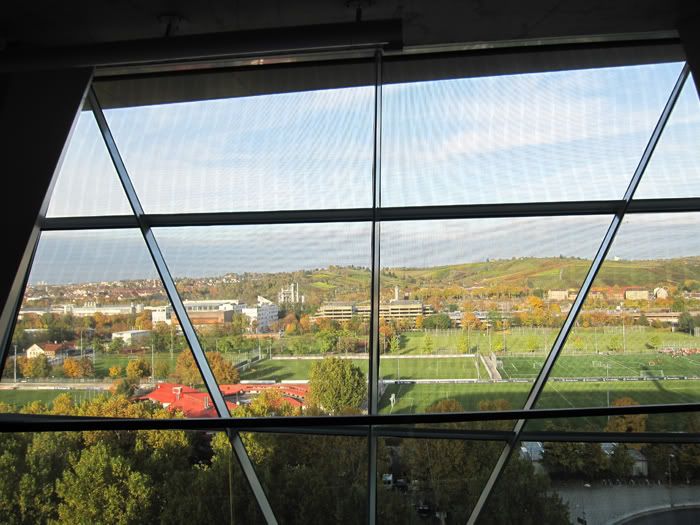
And while I'm obsessing with the cars, I also happen to get a nice glimpse of the outside world. This is Stuttgart landscape in a nutshell - a hilly city, with many of the hills occupied by wineries. Again, this is the first hilly locale in Europe that I am visiting, and I certainly had expected Stuttgart to be an industrial powerhouse (thanks to Mercedes-Benz and Porsche) rather than a pleasant, scenic city full of wineries. The beauty of Stuttgart is very mesmerizing; it more than makes up for the lack of major sights there.
If I had to pick a hometown in Germany, Stuttgart would easily be at the top of the list, not because it's flashy, but because it's pleasant.
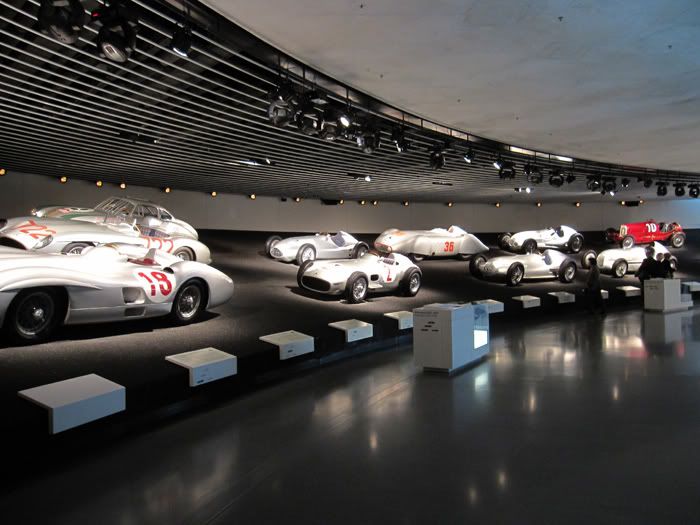
Mercedes-Benz's race cars are well known by the legendary Silver Arrow name. Here is a fleet of Silver Arrows from over the decades. What a sight!
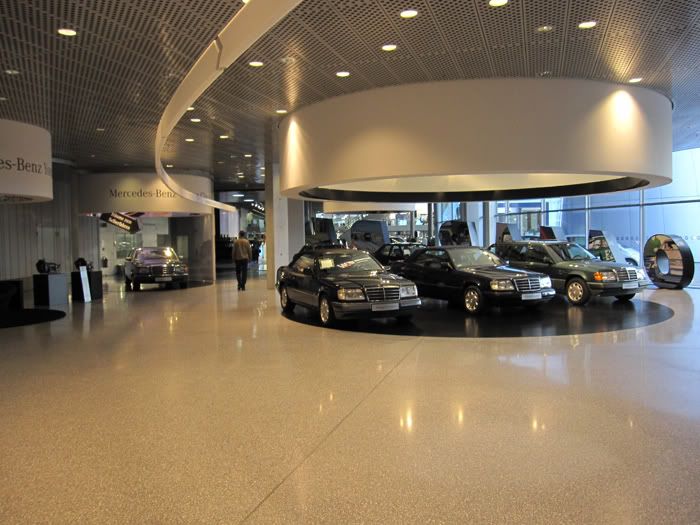
The museum includes a gift shop as well as a full-fledged new car dealership and a Young Classics showroom. That's quite an impressive fleet of 1980s vintage vehicles, at prices around €10,000 or so.
Getting back to the hotel was in itself quite dicey, due to the Stuttgart street layout, confusing instructions from the Garmin GPS, and the cramped parking garage under the hotel. By this point, my mother was begging me to reconsider my driving plans; she hadn't even considered that European driving conditions are more Asian cramped than American spacious! She was absolutely convinced, again, that if I insist on sticking to my schedule, I was guaranteed to do some damage to a brand-new $63K luxury car. We ended up winding down with a stroll on Königstraße (this time together, rather than by myself as was the case the previous night) to further take in the lovely Stuttgart atmosphere, before retiring early for the night to ensure proper rest for the long drive the next day.
Though as it would turn out, I'd end up waking up way too early, and spending three hours or so of the pre-dawn hours camping out in the car to further figure out its functions. I activated the COMAND navigation system anyway - and programmed my folks' address into it; it wanted to take a long swim to Baltimore, then take the US interstate system to California, to make the 9,500-kilometer trip. At least it had a rudimentary map of Europe with terrain data, but no road data. I also made sure to load six CDs into the CD changer to prepare for the drive, then back in the room just before dawn, pulled out my laptop, found that Microsoft AutoRoute (European version of Streets & Trips) had been installed after all, and used it to plot my route out of Stuttgart and toward the day's destinations.
This post goes back to the big day - Tuesday, October 27th, the day I took delivery of the Mercedes-Benz. Although Mercedes-Benz USA advises a three-month lead time for European Delivery orders, I was able to secure a delivery date with only a 2-month notice, thanks to ordering the most common color - silver. And this was going to be a LONG day that would really involve anything/everything Mercedes-Benz. This may be the one post on this blog that will come the closest to being a Mercedes-Benz commercial.
The Customer Center ("Kundencenter" in German) is located at the main Mercedes-Benz factory in Sindelfingen, about a 30-minute taxi ride away. I had to take a cab ride, paid for with a Mercedes-Benz voucher. Interestingly enough, the cab itself was a previous E-class, with cheaper interior and a diesel engine. The cab ride, had I paid out of my pocket, would've been €45 plus tips - NOT cheap. The ride took me on Bundesbahn 14, proceeding through city streets and through a LONG tunnel (complete with an intersection in the middle) before taking me on to Autobahn 831 and 81; although 831 and 81 were Autobahnen, they were hopelessly congested construction zones, and speed limit was set at 100 km/h anyway.
My Kundencenter arrival time was around 8:30 AM, and after check-in, I had to wait for a while due to extra paperwork required for a US-market car.
The delivery bay is a very pleasant place, as I am finding out while having a continental breakfast on an upper-level terrace. Factory delivery is a popular option for European owners of Mercedes-Benz vehicles; they show up, take delivery, and take the leisurely drive home. But occasionally, North American market models show up here as well, for Americans and Canadians who want to come to the factory for the car, then use the car for some European sightseeing. North Americans, for obvious reasons, are not allowed to take delivery of models that are built only in North America, such as the M-class and the R-class.
This huge space has cars coming in and leaving constantly. Despite the exhaust, I am not feeling anything - the ventilation system here is robust. And despite all the amount of airflow required, I am not feeling even a hint of a breeze inside. I do airflow for a living, so I had to take note of this.
I am loving this place. It has all the feel of a nursery for newborn babies, complete with brightly colored banners. The "babies" here are brand-new cars waiting to meet their owners for the first time, of course. All the cars have been built to order, so they were spoken for before they were ever scheduled for production. This place is really designed to bring out the maternal instinct in the owner - there is a reason why according to my saleswoman, women love European Delivery more than men do.
I'm still waiting, walking around a merchandise store and other displays introducing various Mercedes-Benz products and programs.
This display showcases the Young Classics program, which restores, sells, and services vintage Mercedes-Benz models. The 1982 model in the back is a good example of cars available under this program. The front display has various OEM parts for 1970s models - and they are all still available via the Young Classics program.
If it turns out that the relationship my mother and I start on this day with the E-class end up stretching for a LONG time, it looks like I won't have trouble getting parts and service. After all, Young Classics has a US showroom too - in Irvine, California.
I'm still waiting to do the paperwork, but I am seeing this silver E-class come in. The front side amber reflectors indicate that this is a North American model. I also noticed the red-striped export plates as the car came in. It may as well be the car that I am here to pick up.
Sure enough, I was summoned by an English-speaking rep in a minute, to start the paperwork, confirming my initial order for the vehicle. I had to sign and verify a number of forms, including German and international registration cards, German and international ("Green Card") insurance booklets, a waiver from the State of Baden-Württemberg allowing registration of a US-market car, and acknowledgment of the terms and conditions of the tourist registration.
I was also given two telephone hotlines: one for roadside assistance, and one for AXA insurance adjusters in the unlikely case of a claim. I was instructed that as this is a US-market car, European service and roadside assistance will need to use the chassis VIN rather than the VIN for the fully completed vehicle.
A few more minutes of wait, and an English-speaking gentleman introduced me to the features of the vehicle. His break-in recommendation was to stay under 90 MPH and 4,000 RPM. Yes, as this is a US-market car, speedometer is in miles per hour only, and I had to turn on a setting to enable the digital speedometer in kilometers per hour, and to use metric units for the trip computer. I also took possession of a free rental Garmin GPS unit, as the COMAND unit built into the car was specific to North America and couldn't take European maps.
Odometer reading: 7 miles or 11 kilometers, totally brand-new except for a standard test run within the factory. I drove out the delivery bay door, and parked at a lot just outside, to further review the car's features while waiting for a complimentary factory tour.
And it's waiting time for now. I am at last in possession of a Mercedes-Benz! This one is an E550, with a big honking V8; while I had insisted that the V6-powered E350 was more than adequate, my folks put in the order as the E550, just for a larger number on the trunk. After all, Mercedes-Benz used to use numbers, rather than lettered series, to identify models until 1993.
The export plate was issued at the town of Böblingen, on the other side of Autobahn 81, as indicated by the "BB" label. The three numbers on the red stripe - 10 11 09 - indicate that the plates expire on November 10th, 2009; while the basic registration tax covers up to 3 months, the standard insurance that came with the car lasts only two weeks (more than enough for me), and the plates are set to expire with the insurance. If I wanted longer insurance, I could've prepaid the extra amount, but would have had to do so about a week prior to enable proper processing of registration and insurance.
Because the export plate does not have a nationality indicator, I have to indicate the registration nationality the old-fashion way - with an oval decal. D, of course, indicates Germany. Without this oval, I cannot leave Germany.
Also, the front windshield has had an emissions level sticker added as well. This car's emissions level is 4, the most stringent, applicable to any gasoline-powered car built in 1996 and later; without it, I am banned from entering many German metropolitan areas, otherwise I will need to pay a fine. And I need to enter Stuttgart later in the day, just to park at the hotel.
I am also finding out, as a rude awakening, that the rear turn signals blink red, unlike the amber that's standard within Europe and in the rest of the world. I consider red turn signals to be a uniquely American annoyance, like libertarianism and some aspects of the gun culture, and I'm appalled that more and more German cars are using red blinkers on US-market models.
After a while, I joined an English-language tour of the Sindelfingen factory. It is home to the C-class, the E-class (including this example), the S-class, and the CLS-class. The tour banned all photographs, but I still remember all the burning metal smell from the stamping and welding shops. Quite an amazing sight. It is one thing to build a solid car, but another to design a solid car that is easy to weld and assemble; I am glad to have seen the process at work. The stamping and welding shops I toured were for the E-class (yes, the very stamping molds and welding robots that built this car), while the final assembly line, still primarily done with manual labor, was for the S-class; every car in the final assembly had a paper slip attached, listing the destination market of the car and the list of options to be installed, and I noted that the vast majority of cars being built this day were going to China. I thoroughly enjoyed the tour - my first-ever for a car factory.
I wrapped up with a lunch (paid for by Mercedes-Benz) at the Kundencenter restaurant. Nice lunch, but not THAT great, in my opinion. It was early afternoon already, and my first drive in the E550 would take me back to Stuttgart, and to Mercedes-Benz's outstanding museum in the eastern part of the city.
Getting here turned out to be a bit troublesome. I had some trouble navigating the narrow surface streets of Stuttgart. And when I arrived at the museum and was parking in the garage (located below a Bundesbahn-grade freeway between the museum and the Mercedes-Benz engine plant next door), the narrow entryways meant that I ended up scraping the left rear tire sidewall against the curb. All of this was driving up my mother's hysteria level; she was convinced that I was going to permanently damage a $63K luxury car on its first day out of the factory.
At least the museum was a good place to calm down. This is a very lovely museum with all sorts of cars, including this one: the 1886 Benz Patent-Wagen. This three-wheeled contraption was powered by a single-cylinder engine and could run at 10 miles per hour; it was the first car built by Karl Benz. While only one genuine example exists, a few hundred replicas have also been built in recent years; I can have one for myself for about USD $60,000.
This is a 1902 Mercedes-Simplex 40 PS, a touring car with a 6.8-liter 4-cylinder engine producing 40 horsepower and doing 50 MPH.
In the beginning, Gottlieb Daimler and Karl Benz operated separately. Benz was more of a master of gasoline engines while Daimler tried to use steam and other propulsion methods in his vehicles. One of the Daimler brand names was Mercedes, named after the daughter of a prominent customer. The post-World War I Germany's difficult economy forced Daimler and Benz to merge forces; in 1924, the two combined into a company named Daimler-Benz, and the product line took the current name Mercedes-Benz. The full Mercedes-Benz symbol incorporates the Daimler three-pointed star, surrounded by the Benz laurel. Most Americans simply reduce the name to Mercedes, while most Asians reduce the name to Benz (with some great meanings if written in Chinese characters), but the only truthful way to refer to the post-1924 product line is to use the full Mercedes-Benz name, reserving the Mercedes and Benz names only for cars before then.
This is a 1955 180. It is better known by its nickname, the Ponton. After World War II devastated Germany, Mercedes-Benz had to build a rugged, reliable model to reassert its place in the marketplace, and this was it. All Mercedes-Benz sedans ever since can trace their ancestry back to the Ponton - including the 2010 E550 that I just picked up earlier in the day.
Mercedes-Benz also made some sleeker, less practical models at the same time. The 300SL was a very desirable sports car in its day (it still is now), available in either a cabriolet (background) or a gullwing coupe (foreground).
Some exhibits at this museum are dedicated to certain themes. This section has vehicles that had seen use in some prominent fashion - including the unthinkable, Britain's Princess Diana driving a 1991 SL. The star attraction in this photo is the yellow bus, which was the official transportation for the West German soccer squad in the 1974 FIFA World Cup, indeed hosted in and won by West Germany.
This particular model of motorcoach was one of the models licensed by a budding South Korean upstart named Hyundai; while Hyundai had gotten its first passenger cars from Ford, it indeed got its first bus from Mercedes-Benz. Today, Hyundai, alongside Ford, has won a place in my heart as a manufacturer of cars that play a key role in my travels; those two companies had done something even the almighty Bavarians at BMW had failed to do. Various Hyundai and Ford vehicles have made my heart race with anticipation for that next great trip - joined by other travel vehicles like TGV trains and Boeing 777 airliners; now, can Mercedes-Benz, with the brand-spanking-new E550, match that feat? I'm about to find out over the next week or so.
More interesting exhibits continue. This exhibit hall is dedicated to the expansion of Mercedes-Benz into worldwide markets as a purveyor of fine luxury cars. And this particular car is a 1995 S600, sold new to actor Arnold Schwarzenegger. It served with Schwarzenegger until 2003, the year he became California's governor. Now, the car has returned to Stuttgart to become a museum exhibit.
In fact, it still carries California license plates - though the plate number (5CVF609) was certainly issued at the time Schwarzenegger had sold the car, rather than when he had the car. It is the only car in the museum with US license plates.
I guess from now on, "goodbye" in German is not "Auf Wiedersehen," but rather, "Hasta la Vista, Baby."
And while I'm obsessing with the cars, I also happen to get a nice glimpse of the outside world. This is Stuttgart landscape in a nutshell - a hilly city, with many of the hills occupied by wineries. Again, this is the first hilly locale in Europe that I am visiting, and I certainly had expected Stuttgart to be an industrial powerhouse (thanks to Mercedes-Benz and Porsche) rather than a pleasant, scenic city full of wineries. The beauty of Stuttgart is very mesmerizing; it more than makes up for the lack of major sights there.
If I had to pick a hometown in Germany, Stuttgart would easily be at the top of the list, not because it's flashy, but because it's pleasant.
Mercedes-Benz's race cars are well known by the legendary Silver Arrow name. Here is a fleet of Silver Arrows from over the decades. What a sight!
The museum includes a gift shop as well as a full-fledged new car dealership and a Young Classics showroom. That's quite an impressive fleet of 1980s vintage vehicles, at prices around €10,000 or so.
Getting back to the hotel was in itself quite dicey, due to the Stuttgart street layout, confusing instructions from the Garmin GPS, and the cramped parking garage under the hotel. By this point, my mother was begging me to reconsider my driving plans; she hadn't even considered that European driving conditions are more Asian cramped than American spacious! She was absolutely convinced, again, that if I insist on sticking to my schedule, I was guaranteed to do some damage to a brand-new $63K luxury car. We ended up winding down with a stroll on Königstraße (this time together, rather than by myself as was the case the previous night) to further take in the lovely Stuttgart atmosphere, before retiring early for the night to ensure proper rest for the long drive the next day.
Though as it would turn out, I'd end up waking up way too early, and spending three hours or so of the pre-dawn hours camping out in the car to further figure out its functions. I activated the COMAND navigation system anyway - and programmed my folks' address into it; it wanted to take a long swim to Baltimore, then take the US interstate system to California, to make the 9,500-kilometer trip. At least it had a rudimentary map of Europe with terrain data, but no road data. I also made sure to load six CDs into the CD changer to prepare for the drive, then back in the room just before dawn, pulled out my laptop, found that Microsoft AutoRoute (European version of Streets & Trips) had been installed after all, and used it to plot my route out of Stuttgart and toward the day's destinations.
25 February 2010
Europe recap: Day 2, Munich
These are photos from the morning hours of October 26th, 2009, as I wrapped up my Munich itinerary and moved on to Stuttgart. My brief Munich fling was only a mere teaser, little more than time to lose the jet lag, but Munich nevertheless managed to impress; I will certainly be back.
I started on a sleepless morning, by taking a walk around my hotel area in the southern part of the city. With the fresh air and the rain-dampened streets, it was quite pleasant.

Automotive observations continue, since this trip IS automotive in character. And again, drawing my attention are small, spunky cars, like this Kia cee'd, that I cannot find stateside.
Back when American car companies ruled the world, they marketed completely separate lineups of vehicles for North America and Europe, with very little commonality, if any, between them. Then the Japanese rose to prominence, and while they eventually started to differentiate their American and European models to fit market tastes and needs, they kept more commonality in. Now that the Koreans are rising to their own prominence, they are following the Japanese example; this cee'd, designed at Hyundai-Kia's European research center in Germany, is made and sold only in Europe, but it is related to the Hyundai i30, which is available throughout the world outside North America (and in case of the wagon, even in North America as the Elantra Touring) as well as the Hyundai Elantra (primarily for South Korean domestic market and North America).
The Koreans do have a sizable presence in Europe. Daewoo used to do well before its bankruptcy, and even now, Daewoo-built models, like the Matiz microcar and the Captiva SUV, continue to sell well, though now that Daewoo is part of General Motors, they now make up the European Chevrolet range. SUV builder Ssangyong also manages to move a few of its light trucks in the European market as well, though its raised-wingspan logo is different from the Korean domestic market double-oval logo. Hyundai-Kia offers most of its lineup, including commercial vehicles, but does not offer the bad-ass Genesis luxury sedan, which is just way too big for Europe.
I also want to note the German license plate format. A standard plate, like the one above, has a blue nationality band on the left (EU stars and "D" for Germany), and letters/numbers to identify the vehicle. The first batch (GM in this case) identifies the registration office that processed the car's registration; since Munich is just M, this car is an out-of-towner. My Mercedes-Benz won't get the standard plate, but a special temporary plate reserved for export vehicles driven by tourists.

Now on to pop culture observations.
I am looking at a pole being used as an advertising board, featuring various concerts. While most are of interest to locals primarily, I am noticing a very familiar name: P!nk. Yes, the bad-ass punk girl with very catchy songs - and I especially love her confrontational lyrics - and someone I would definitely love to see myself.
P!nk's Munich performance will be on June 6th, 2010, taking place at a venue in the eastern suburb of Riem.

Continuing my walkaround, now I spot this street scene.
The signs indicate that I can either walk down the stairs to take the U-Bahn, or stay on the street level and take a streetcar (Stadtbahn). I can even do a "park-and-ride" here, judging from the bike rack.
In the background, I see a Deutsche Telekom store, with the familiar pink T. Deutsche Telekom's mobile phone division is known as T-Mobile, and it is a major player not only within Germany, but in the UK and the US as well, though very few Americans ever realize that T-Mobile is really a German company. Deutsche Telekom also operates pretty much all pay phones in Germany, so this is the company to talk to if I need calling cards to use the pay phones.
And that "Einbahnstraße" sign can only be Onewaystreet. German is a language constructed like building blocks, where complex concepts can be described using a compound word made up of simpler words. It is also very logical in its grammar and syntax. For someone who is logic-obsessed (read: me), German is a great language to learn and speak. Unfortunately for me, German is not all that useful in my everyday life; even my French has pretty much gone to waste, and what I really need to speak are Spanish and East Asian languages.

Back to automotive observations. Here is a Fahrschule, or a driving school, where the window shows some of the international traffic signs that are standard in Europe and the rest of the world outside North America. I will need to get familiar with them before I hit the road; at least, they are vastly preferable to anything written out in verbose German that I cannot comprehend. Fortunately, verbose words are not used in Europe, unlike the US where trying to drive without understanding English can be REALLY dicey.
In fact, I would indeed find that there were only 6-7 words of "traffic German" I needed to understand, in order to navigate. I had already studied up on European traffic regulations, so I knew that the primary means of navigating into/out of towns was signs written as "town center" or "all directions" in the local language ("Stadtmitte" and "alle Richtungen" in German respectively), and that I would need to follow numbered routes using destination cities, rather than a cardinal direction.
If I were to move to Germany permanently, I would need to enroll in a driving school like this, and spend a fortune studying for the written exam, as my first step in getting a German driving license. It would then be followed up with an exhaustive behind-the-wheels program and a thorough health exam. And yes, I would need to do the whole thing; while Germany has reciprocity agreements for drivers from within the European Union as well as Canada and major East Asian nations, its treatment for US drivers depends on the state, and drivers from states notorious for cut-rate driving (that means California and Nevada) must start over from scratch.

Another European car worth a look. This is the current European Ford Focus.
The Focus was the first Ford that truly was a global car. The 1981 Escort was supposed to have been that global car, but massive bickering between North American and European engineers resulted in completely different cars. The 1994 Mondeo was almost a success in being a global car, but while it was an upscale family car in most of the world, it was marketed as a cheaper personal car in North America (where it was known as the Contour, with some external differences), and cost-cutting to fit the target North American market resulted in severe quality compromises for the Contour (something I know too well personally, as I used to drive a '99 Contour which I really hated).
And while the original Focus was identical across the world at last, it eventually diverged. The European version got a full redesign in 2005, and this is the redesign. The American version only got a facelift, before getting its own 2008 redesign, and now the two cars are no longer identical. The 2012 Focus will once again be identical across the world, however. In any case I hate the styling of this Focus; I vastly prefer the original.
The tighter streets and parking spots of Europe necessitate that a Focus-class car serve as a mainstream family car, a duty usually left to much larger cars like the Toyota Camry in North America. High fuel costs also necessitate the smaller size - and smaller engine displacement as well (also since engine displacement is a common basis for taxation). Despite being smaller and underpowered, the European versions of a given car often come with high-end options and higher price tags, to fit their higher-up market duties.

Another concert poster. This one features a familiar Irish name - U2. I can expect to see them at the Olympic Stadium on September 15th, 2010, according to the poster.
It's fitting that the poster is located at the entrance to a subway station, which is served by none other than the U2 line. The U2 line, in fact, will terminate at Olympic Stadium, so yes, someone in this neighborhood will ride the U2 to see U2.
Due to my presence in Germany, I am missing out on a U2 concert back home at Rose Bowl in Pasadena. I am making up for this with another U2 show in Anaheim, on June 6th, 2010 - the same day I can expect to find P!nk here in Munich.
At this point, I checked out of the hotel, and stored my bags at the pay lockers at Hauptbahnhof (the central train station in a given German city). Due to frequent train service to Stuttgart (twice an hour on InterCity-grade trains), I had not reserved seats in advance; I went to a vending machine to make sure to buy a pair of tickets, and to also buy reservations just in case, for a departure close to noon.

Now I am walking around one of the pedestrian shopping streets that fan out from Marienplatz. It's about 10 in the morning and the shops are starting to open up. These are my first moments on a German shopping street during normal business hours; my only previous German experience, a day trip into Cologne from Amsterdam, had been a Sunday too.
Walking around a German shopping area like this is always a joy. In addition to Bavarian themed tourist souvenirs, there are lots of things to look at, and a department store is also a delight as well. Some shops are specific to Germany, while others are well known international chains, like Sweden's H&M or San Francisco's Gap. And even some familiar names carry surprises; Esprit, which I normally consider to be a women's brand, sells both women's and men's clothing in its German stores, while H&M tends to be spread out over 3-4 adjacent smaller stores, rather than one larger store as is often the case in the US.
I'm also noting the trends favored by the German fashionistas: leather equestrian boots, usually black, paired with matching-colored tights and coat. German women are businesslike and rather masculine in their presentation. Those equestrian boots did give me a case of shoe envy, in any case. If I were to pick a pair up, I could expect to pay around €100 for a good example.
In addition to shopping and window-shopping, I am also doing some minor sightseeing as well.

My chosen sight for this morning is Frauenkirche, the building with the twin onion-domed bell towers. I am still incensed at the Vatican and its hatemongering ways, so my policy during this trip is to visit cathedrals to take in the sights and the arts but refuse to support the Church in any form. The Frauenkirche, where the nave is free but the bell towers charge admissions, is my first application of the philosophy.
I am, again, reminded that Cardinal Joseph Ratzinger, now Pope Benedict XVI, is a Bavarian, and was the Archibishop of Munich around 1980, being based out of this very church.
This footprint goes back much longer, however. It is from the legend that arose from the construction of the church between 1468 and 1488 (fast by cathedral standards). As the architect designed the church, Satan approached him, and offered to help with the construction if the church would be built with no windows. The architect took up on the offer, and upon completion of the church, brought Satan to this very spot, at the nave entrance. While the church does have many lovely stained-glass windows, from this particular spot only one window is visible. Realizing that he's been had, Satan stomped his foot in anger, leaving this footprint, before descending back into Hell.

And I have that view Satan had back in the day. Indeed, that's the only window I can see. The church's interior is also very plain.
And this wrapped up my Munich tour. I soon walked back to Hauptbahnhof, grabbing some lunch snacks on the way, retrieved my bags, and hopped on the EuroCity (that's InterCity with an international portion - this particular train, though German, had originated in Graz, Austria) train, which arrived 20 minutes behind schedule. Nevertheless, I was only 10 minutes late into Stuttgart, and before long, was relaxing in the luxury hotel next to Stuttgart's own Hauptbahnhof, where I had a two-night reservation that was paid for by Mercedes-Benz.
The first Stuttgart photos from that evening will be my next installment.
I started on a sleepless morning, by taking a walk around my hotel area in the southern part of the city. With the fresh air and the rain-dampened streets, it was quite pleasant.
Automotive observations continue, since this trip IS automotive in character. And again, drawing my attention are small, spunky cars, like this Kia cee'd, that I cannot find stateside.
Back when American car companies ruled the world, they marketed completely separate lineups of vehicles for North America and Europe, with very little commonality, if any, between them. Then the Japanese rose to prominence, and while they eventually started to differentiate their American and European models to fit market tastes and needs, they kept more commonality in. Now that the Koreans are rising to their own prominence, they are following the Japanese example; this cee'd, designed at Hyundai-Kia's European research center in Germany, is made and sold only in Europe, but it is related to the Hyundai i30, which is available throughout the world outside North America (and in case of the wagon, even in North America as the Elantra Touring) as well as the Hyundai Elantra (primarily for South Korean domestic market and North America).
The Koreans do have a sizable presence in Europe. Daewoo used to do well before its bankruptcy, and even now, Daewoo-built models, like the Matiz microcar and the Captiva SUV, continue to sell well, though now that Daewoo is part of General Motors, they now make up the European Chevrolet range. SUV builder Ssangyong also manages to move a few of its light trucks in the European market as well, though its raised-wingspan logo is different from the Korean domestic market double-oval logo. Hyundai-Kia offers most of its lineup, including commercial vehicles, but does not offer the bad-ass Genesis luxury sedan, which is just way too big for Europe.
I also want to note the German license plate format. A standard plate, like the one above, has a blue nationality band on the left (EU stars and "D" for Germany), and letters/numbers to identify the vehicle. The first batch (GM in this case) identifies the registration office that processed the car's registration; since Munich is just M, this car is an out-of-towner. My Mercedes-Benz won't get the standard plate, but a special temporary plate reserved for export vehicles driven by tourists.
Now on to pop culture observations.
I am looking at a pole being used as an advertising board, featuring various concerts. While most are of interest to locals primarily, I am noticing a very familiar name: P!nk. Yes, the bad-ass punk girl with very catchy songs - and I especially love her confrontational lyrics - and someone I would definitely love to see myself.
P!nk's Munich performance will be on June 6th, 2010, taking place at a venue in the eastern suburb of Riem.
Continuing my walkaround, now I spot this street scene.
The signs indicate that I can either walk down the stairs to take the U-Bahn, or stay on the street level and take a streetcar (Stadtbahn). I can even do a "park-and-ride" here, judging from the bike rack.
In the background, I see a Deutsche Telekom store, with the familiar pink T. Deutsche Telekom's mobile phone division is known as T-Mobile, and it is a major player not only within Germany, but in the UK and the US as well, though very few Americans ever realize that T-Mobile is really a German company. Deutsche Telekom also operates pretty much all pay phones in Germany, so this is the company to talk to if I need calling cards to use the pay phones.
And that "Einbahnstraße" sign can only be Onewaystreet. German is a language constructed like building blocks, where complex concepts can be described using a compound word made up of simpler words. It is also very logical in its grammar and syntax. For someone who is logic-obsessed (read: me), German is a great language to learn and speak. Unfortunately for me, German is not all that useful in my everyday life; even my French has pretty much gone to waste, and what I really need to speak are Spanish and East Asian languages.
Back to automotive observations. Here is a Fahrschule, or a driving school, where the window shows some of the international traffic signs that are standard in Europe and the rest of the world outside North America. I will need to get familiar with them before I hit the road; at least, they are vastly preferable to anything written out in verbose German that I cannot comprehend. Fortunately, verbose words are not used in Europe, unlike the US where trying to drive without understanding English can be REALLY dicey.
In fact, I would indeed find that there were only 6-7 words of "traffic German" I needed to understand, in order to navigate. I had already studied up on European traffic regulations, so I knew that the primary means of navigating into/out of towns was signs written as "town center" or "all directions" in the local language ("Stadtmitte" and "alle Richtungen" in German respectively), and that I would need to follow numbered routes using destination cities, rather than a cardinal direction.
If I were to move to Germany permanently, I would need to enroll in a driving school like this, and spend a fortune studying for the written exam, as my first step in getting a German driving license. It would then be followed up with an exhaustive behind-the-wheels program and a thorough health exam. And yes, I would need to do the whole thing; while Germany has reciprocity agreements for drivers from within the European Union as well as Canada and major East Asian nations, its treatment for US drivers depends on the state, and drivers from states notorious for cut-rate driving (that means California and Nevada) must start over from scratch.
Another European car worth a look. This is the current European Ford Focus.
The Focus was the first Ford that truly was a global car. The 1981 Escort was supposed to have been that global car, but massive bickering between North American and European engineers resulted in completely different cars. The 1994 Mondeo was almost a success in being a global car, but while it was an upscale family car in most of the world, it was marketed as a cheaper personal car in North America (where it was known as the Contour, with some external differences), and cost-cutting to fit the target North American market resulted in severe quality compromises for the Contour (something I know too well personally, as I used to drive a '99 Contour which I really hated).
And while the original Focus was identical across the world at last, it eventually diverged. The European version got a full redesign in 2005, and this is the redesign. The American version only got a facelift, before getting its own 2008 redesign, and now the two cars are no longer identical. The 2012 Focus will once again be identical across the world, however. In any case I hate the styling of this Focus; I vastly prefer the original.
The tighter streets and parking spots of Europe necessitate that a Focus-class car serve as a mainstream family car, a duty usually left to much larger cars like the Toyota Camry in North America. High fuel costs also necessitate the smaller size - and smaller engine displacement as well (also since engine displacement is a common basis for taxation). Despite being smaller and underpowered, the European versions of a given car often come with high-end options and higher price tags, to fit their higher-up market duties.
Another concert poster. This one features a familiar Irish name - U2. I can expect to see them at the Olympic Stadium on September 15th, 2010, according to the poster.
It's fitting that the poster is located at the entrance to a subway station, which is served by none other than the U2 line. The U2 line, in fact, will terminate at Olympic Stadium, so yes, someone in this neighborhood will ride the U2 to see U2.
Due to my presence in Germany, I am missing out on a U2 concert back home at Rose Bowl in Pasadena. I am making up for this with another U2 show in Anaheim, on June 6th, 2010 - the same day I can expect to find P!nk here in Munich.
At this point, I checked out of the hotel, and stored my bags at the pay lockers at Hauptbahnhof (the central train station in a given German city). Due to frequent train service to Stuttgart (twice an hour on InterCity-grade trains), I had not reserved seats in advance; I went to a vending machine to make sure to buy a pair of tickets, and to also buy reservations just in case, for a departure close to noon.
Now I am walking around one of the pedestrian shopping streets that fan out from Marienplatz. It's about 10 in the morning and the shops are starting to open up. These are my first moments on a German shopping street during normal business hours; my only previous German experience, a day trip into Cologne from Amsterdam, had been a Sunday too.
Walking around a German shopping area like this is always a joy. In addition to Bavarian themed tourist souvenirs, there are lots of things to look at, and a department store is also a delight as well. Some shops are specific to Germany, while others are well known international chains, like Sweden's H&M or San Francisco's Gap. And even some familiar names carry surprises; Esprit, which I normally consider to be a women's brand, sells both women's and men's clothing in its German stores, while H&M tends to be spread out over 3-4 adjacent smaller stores, rather than one larger store as is often the case in the US.
I'm also noting the trends favored by the German fashionistas: leather equestrian boots, usually black, paired with matching-colored tights and coat. German women are businesslike and rather masculine in their presentation. Those equestrian boots did give me a case of shoe envy, in any case. If I were to pick a pair up, I could expect to pay around €100 for a good example.
In addition to shopping and window-shopping, I am also doing some minor sightseeing as well.
My chosen sight for this morning is Frauenkirche, the building with the twin onion-domed bell towers. I am still incensed at the Vatican and its hatemongering ways, so my policy during this trip is to visit cathedrals to take in the sights and the arts but refuse to support the Church in any form. The Frauenkirche, where the nave is free but the bell towers charge admissions, is my first application of the philosophy.
I am, again, reminded that Cardinal Joseph Ratzinger, now Pope Benedict XVI, is a Bavarian, and was the Archibishop of Munich around 1980, being based out of this very church.
This footprint goes back much longer, however. It is from the legend that arose from the construction of the church between 1468 and 1488 (fast by cathedral standards). As the architect designed the church, Satan approached him, and offered to help with the construction if the church would be built with no windows. The architect took up on the offer, and upon completion of the church, brought Satan to this very spot, at the nave entrance. While the church does have many lovely stained-glass windows, from this particular spot only one window is visible. Realizing that he's been had, Satan stomped his foot in anger, leaving this footprint, before descending back into Hell.
And I have that view Satan had back in the day. Indeed, that's the only window I can see. The church's interior is also very plain.
And this wrapped up my Munich tour. I soon walked back to Hauptbahnhof, grabbing some lunch snacks on the way, retrieved my bags, and hopped on the EuroCity (that's InterCity with an international portion - this particular train, though German, had originated in Graz, Austria) train, which arrived 20 minutes behind schedule. Nevertheless, I was only 10 minutes late into Stuttgart, and before long, was relaxing in the luxury hotel next to Stuttgart's own Hauptbahnhof, where I had a two-night reservation that was paid for by Mercedes-Benz.
The first Stuttgart photos from that evening will be my next installment.
09 February 2010
Europe recap: Day 1, Munich, Part 2
The rest of my Munich experience on 25 October 2009, after wrapping up the Residenz tour... The Residenz was much bigger than I had expected, and due to the Quiet Day Sunday rendering even convenience stores closed, I was growing hungry.
My first goal after the Residenz was to walk over to the three Pinakotheks ("picture galleries") - Alte Pinakothek (pre-1800), Neue Pinakothek (19th Century), and Pinakothek der Moderne (20th Century) - for some art. Sunday admissions was supposed to be only a single Euro anyway, so time to take in some art.
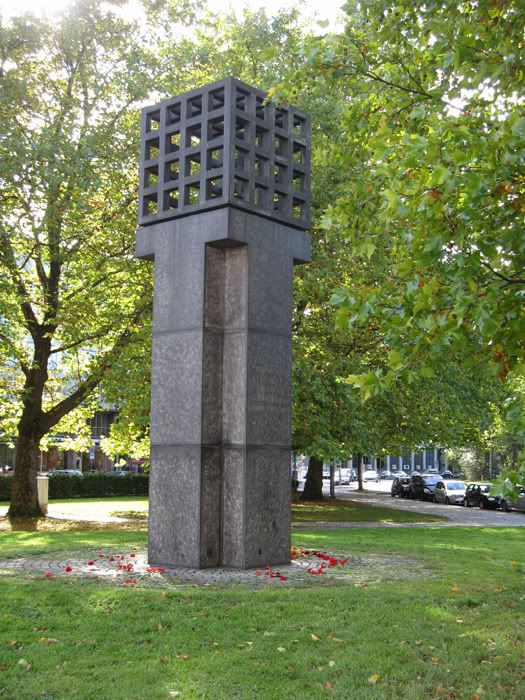
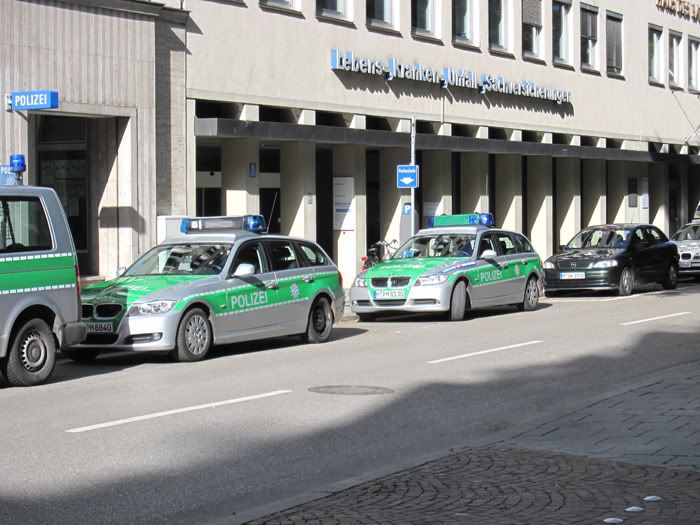
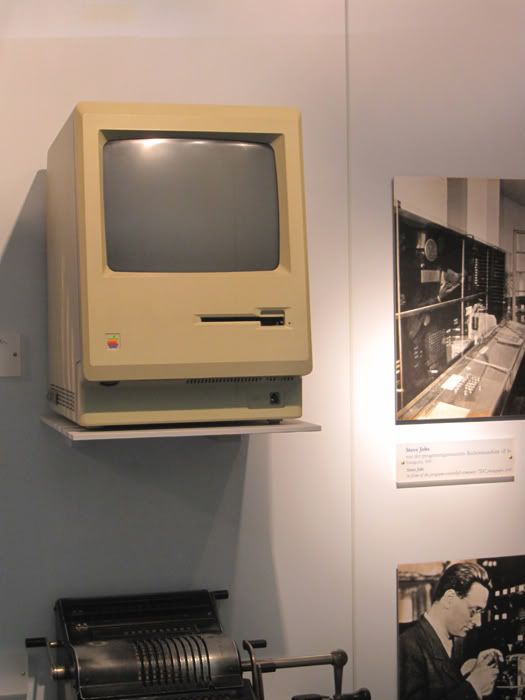
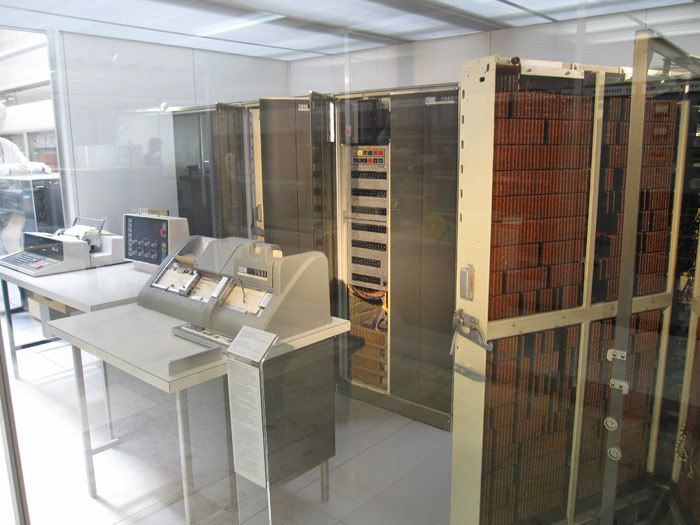
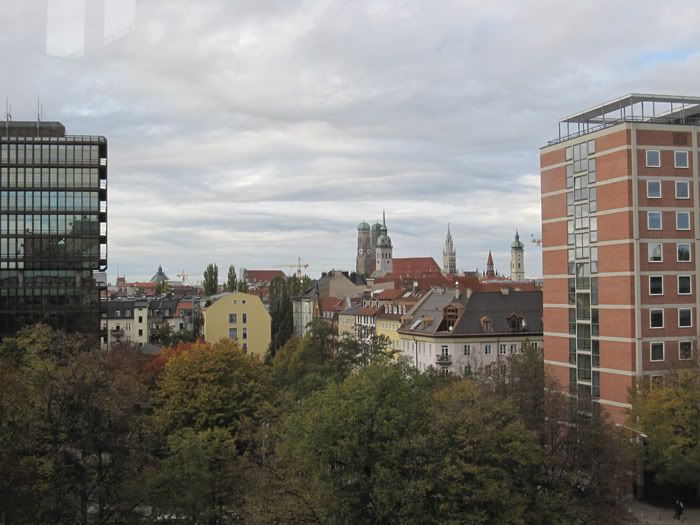
My first goal after the Residenz was to walk over to the three Pinakotheks ("picture galleries") - Alte Pinakothek (pre-1800), Neue Pinakothek (19th Century), and Pinakothek der Moderne (20th Century) - for some art. Sunday admissions was supposed to be only a single Euro anyway, so time to take in some art.
On my way, I came across this plaza with this eternal flame. A nearby sign read Platz der Opfer des Nationalsozialismus, or Place for the Victims of National Socialism. It bore remembering that Bavaria's conservatism played a key part in the formation of the Nazi ideology. Adolf Hitler, though Austrian by birth, started his movement right here in Bavaria, and while the Nazis were fringe extremists at first, Hitler's masterful manipulation of public opinion won him ever more support, until he was the Führer once and for all, and destroyed millions and millions of lives.
While Bavaria remains very conservative, Munich is the liberal hotspot of the region, and I am treasuring its vibrancy. If Bavaria is indeed Texas, then Munich is its Austin. And for that matter, if Bavaria is California (since California is very conservative as well), then Munich is its San Francisco.
More reminder that I am in Bavaria. Even the police cruisers are made by Bayerische Motorenwerke, better known by its English name Bavarian Motor Works, and shortened to BMW. And sure enough, Munich is BMW's home city.
The BMW emblem, called the Roundel, depicts a spinning aircraft propeller, since BMW's first product line was aircraft engines. And its colors are blue and white - the colors of Bavaria. In fact, the letters BMW officially also stand for Blau mit Weiß, or Blue and White. Driving a BMW is, when it comes down to it, all about the Bavarian pride.
I am once again reminded that for several years, I had dreamed of coming to Munich, to take delivery of a BMW of my own. My original goal, in fact, was to simply terminate the lease on my 2004 325i (fourth generation, codename E46) in early 2007, order a fifth-generation 3-series (E90/91, like the ones above) as a replacement, and come to Munich for the pickup. But eventually, I ended up purchasing the 2004 outright - and selling it in anger over BMW's continued support of far-right causes, including the Pope and Fox News Channel.
And yes, Pope Benedict XVI, a noted homophobic a-hole, is Bavarian, and thanks to BMW's generous corporate sponsorship, hasn't bought a car in decades.
I am glad to finally be in Munich, as a stopover on my way to Stuttgart to pick up a Mercedes-Benz instead. And to keep the Mercedes-Benz theme, I am skipping the BMW Welt next to Olympic Park in the northern reaches of the city. BMW Welt has a museum consisting of vintage BMWs, but very few vintage BMWs are of any interest to me anyway.
Shortly thereafter, I arrived at the Pinakotheks. My intention was to only see the Alte Pinakothek, since it was mid-afternoon already and I wanted to save the greatest artwork for Paris and its Louvre. But with the admission jacked up to €7 for a temporary exhibition I couldn't opt out of, I decided to skip all Pinakotheks. Instead, I decided to hop on the U-Bahn for a quick hop over to Deutsches Museum, Germany's answer to the Smithsonian science museums in Washington, DC and one of the finest science museums in the world.
Here is a display I liked - the original Apple Macintosh.
The Deutsches Museum is extremely hardcore. When it comes to computers, I don't just see a Mac - I see a zillion other computers throughout history, all the way back to rudimentary adding machines of the 19th Century. This particular example is an IBM 7074, built in 1962, and used by Allianz. It was state-of-the-art for its day, using punchcards for data input and using something more reliable than vacuum tubes for memory. Even then, its storage capacity was well under a megabyte.
The museum is so hardcore, and covers so many subjects, that trying to cram it into an afternoon, as I tried, is utterly hopeless. I can go from the watermills that powered the Industrial Revolution to a whole catalog of Pratt & Whitney jet engines, and a lot more, even including agricultural technologies. For an engineering enthusiast, this place is pure fantasy.
The museum also runs separate facilities elsewhere in the Munich area to house its land vehicles and aircraft. They will have to wait for a future visit.
But when it comes down to it, Munich's Old World charms are far important than all the technology and the sights. And I am getting yet another glimpse of the city skyline from one of the Deutsches Museum staircases. I can see the spires of the Frauenkirche and the Neue Rathaus, among other buildings. This is a skyline that I don't get tired of easily.
I had to wind the day down at this point, given the realities of Quiet Day Sunday and also my mother's foot pains. The jet lag was also bugging me, and a bottle of water that I had bought in the U-Bahn turned out to be carbonated water, and not so great tasting. I had to retire, collapse on my hotel bed, and try to figure out a way to overcome the jet lag.
Next up: Monday, October 26th, involving some final moments in Munich before the train run to Stuttgart.
26 October 2009
Current Location: Stuttgart
A nasty secret of European travel is that Internet access can be very pricey - about 8 Euro for one hour, if done from a hotel. And while I can visit an Internet cafe easily, I cannot do work email from there, so I have to bite the bullet.
But for now, I enjoyed a few days in Munich, and now find myself in lovely Stuttgart. I'm also pleasantly surprised that my iPhone can roam in Europe, with roaming already set up - though at a steep price.
I will not blog extensively until I return home, but I'm taking tons of photos in the meantime. Until then, here is a teaser.

This gazebo is seen at a royal park in front of a palace, and sits on the long Koenigstrasse pedestrian shopping street. I had to take a photo because a Facebook friend of mine, Saniye McFadden, a Turkish-German who married an American soldier and has since moved to Virginia, had a photo of herself taken here a long time ago. In fact, she's loving the photo, which I posted to her Facebook profile.
The Mercedes-Benz will be picked up tomorrow morning. Looking forward to my first Continental European road trip!
08 October 2009
More road trip prep
As my European road trip inches closer, I came across more resources of value.
A Texas-based driving enthusiast, who had once lived in Germany, put together a comprehensive resource of not just the Autobahn system, but everything about driving and other forms of transportation in Germany. There are even detailed descriptions of the traffic laws that apply specifically to Germany and Europe, differing from those in the US and elsewhere; for example, unless indicated otherwise, cars entering from the right have priority over through traffic, and right turn is normally not permitted on red. Granted, the author appears to support an evil neoliberal organization (and certainly links to it) that equates all speed limits with socialism, but I still have a resource that could save me a lot of headache once I am busy trying to conquer the Autobahn or the Romantic Road.
Getting Around Germany: Driving
And I also came across a resource that deals with sound driving practices, from a certain Uncle Bob based in the Phoenix area. He has 70 tips, which are far more informative than any traffic violator school will ever be. I'll surely need these tips, whether I am trying to negotiate the A8 Autobahn between Stuttgart and Munich, or the mundane traffic in Los Angeles (even more challenging, thanks to all the moronic California drivers).
Road Trip America
For actual sightseeing outside my car, I am going back to a resource I used to frequent: Europe for Visitors. It also has special sections on Paris and Venice, which I will rely heavily on. It looks like my Venice arrival will not be all that challenging - I can drive right into Venice itself, park at the Tronchetto artificial island and its huge garage, then take the No. 2 water bus, which will take me to Rialto Bridge - and my hotel. It's a shame I'll only have one full day in Venice; I'll try to make the most of what I do have.
Speaking of my plans for each destination, I have most of it nailed down, though I haven't yet booked my Paris hotel. My previous Paris stays were in Montmartre, and this time I want a change; I'm still trying to choose between the Latin Quarter (my initial preference) and the Marais (a friend's recommendation). But all other hotels and airfare are set in stone, and I also need to book train tickets, especially for the TGV run into Paris once my driving is finished.
Last, but not the least, Google Maps is proving to be very valuable. Its coverage of the world is expanding, and now, for major cities in North America and Europe, I can get mass transit maps and routing, of varying quality. I can get traffic reports for most of the US and a few major European cities as well, both real-time and average data by day/time of the week. Being able to study, now, the most up-to-date street maps of the European cities I'll be visiting/driving in will help greatly once I'm actually there. I'm also delighted to know that Google Maps is improving its coverage elsewhere as well. In Asia, it's had street-level maps of Japan, Taiwan, and Hong Kong for a while, and now its China maps are up-to-date (with tons of new expressways) and excellent, and South Korea has also been upgraded to full street-level coverage (great for retracing my road trip there last year, especially on a computer not running a Korean-language OS). Even closer to home, I am getting great maps of Mexico that weren't available recently.
I'll find myself in Munich, my first European stop, before too long. Though I don't think I'll ever get used to saying "God's blessings" (Grüss Gott) rather than "Good day" (Guten Tag) as "hello." Grüss Gott is indeed the standard greeting in Bavaria, which is home to Pope Benedict and BMW and can easily be called Europe's Bible Belt, and it's said to be never used elsewhere in Germany. In the meantime, the blog timestamps are being switched to GMT +2, which will be the time zone in Europe when I initially arrive (Central European Time, Daylight Saving Time), though I'll have to fall back to GMT +1 (end of Daylight Saving Time) during my trip.
15 September 2009
Before I drive the Mercedes...
Some Wikipedia information on the fabled German Autobahn system:
Wikipedia
The word "Autobahn" simply means motorway, and could refer to any motorway in a German-speaking country. The German Autobahn system is specifically known as Bundesautobahnen (federal motorways). Its total network length is over 12,000 kilometers - surpassed only by the US interstates and the new Chinese expressway system, in a much smaller country.
The routes are numbered in a very logical fashion. The primary routes have single-digit numbers, the major regional routes double-digit, and the local spurs triple-digit. I'll most likely be driving on the A8, the southernmost main east-west route, as well as the A7, a major north-south route in western Bavaria.
The Autobahns are most famous for their lack of a speed limit. I should, however, expect a speed limit in urban areas and construction zones. Even in no-limit areas, there is a recommended limit of 130 km/h (81 mph), and I can expect an average cruising speed of 150 km/h (93 mph) - still wicked fast. My Mercedes has been ordered with a self-adjusting air suspension system, which will lower the car at the 150 km/h mark for improved stability and aerodynamics; I guess it's a feature I'll never get to use stateside. The best bets for no limits are in sparsely populated stretches, like the A8 and the A81, both of which I indeed expect to drive.
Finding a rest area shouldn't be too difficult. There should be one every 55 km or so. Beats California, where I can go over 150 miles easily without a rest stop in sight. The rest areas have meals and drinks - even alcohol, which of course I must stay away from.
I will have to make sure to understand the very strict regulations that keep those insane speeds safe. The article explains many of the regulations, and some paraphrased are:
Once I cross into Austria, to visit Salzburg and on my way to Venice, I'll have to deal with a few more regulations. Mercedes-Benz has advised me that I must have all-season tires whenever the temperature is below 7C, or I can be fined EUR 5,000; my car will have all-seasons, so this won't be an issue. I must also have an International Driving Permit, as well as a safety vest. Most importantly, tolls will be paid in the form of a windshield sticker. In other words, better be ready as I near the border.
Looking forward to a great drive. My drive in South Korea last year was one of the best things I ever did, and my British drive of 1998 was also a great one. This drive will top them both.
Wikipedia
The word "Autobahn" simply means motorway, and could refer to any motorway in a German-speaking country. The German Autobahn system is specifically known as Bundesautobahnen (federal motorways). Its total network length is over 12,000 kilometers - surpassed only by the US interstates and the new Chinese expressway system, in a much smaller country.
The routes are numbered in a very logical fashion. The primary routes have single-digit numbers, the major regional routes double-digit, and the local spurs triple-digit. I'll most likely be driving on the A8, the southernmost main east-west route, as well as the A7, a major north-south route in western Bavaria.
The Autobahns are most famous for their lack of a speed limit. I should, however, expect a speed limit in urban areas and construction zones. Even in no-limit areas, there is a recommended limit of 130 km/h (81 mph), and I can expect an average cruising speed of 150 km/h (93 mph) - still wicked fast. My Mercedes has been ordered with a self-adjusting air suspension system, which will lower the car at the 150 km/h mark for improved stability and aerodynamics; I guess it's a feature I'll never get to use stateside. The best bets for no limits are in sparsely populated stretches, like the A8 and the A81, both of which I indeed expect to drive.
Finding a rest area shouldn't be too difficult. There should be one every 55 km or so. Beats California, where I can go over 150 miles easily without a rest stop in sight. The rest areas have meals and drinks - even alcohol, which of course I must stay away from.
I will have to make sure to understand the very strict regulations that keep those insane speeds safe. The article explains many of the regulations, and some paraphrased are:
- No passing on the right, except in traffic jams.
- Absolutely no tailgating. Minimum following distance in meters is half of my current speed in km/h. For example, if I do 120 km/h (75 mph), I must leave a 60-meter space in front. If my following distance is under 30% of minimum (18m in this case), I can expect to be fined and have my license confiscated on the spot.
- It is okay to flash headlights to ask a slower driver in the fast lane to move over. But again, no tailgating as I do it. If I tailgate and flash headlights, that's an act of coercion, and subject to citation.
- On the flip side, hogging the fast lane and impeding the smooth flow of traffic is just as illegal.
- No stopping unless there is no option (accident or traffic jam). Running out of fuel is NOT a valid excuse, since it's completely preventable.
- I must watch for any vehicle over 3.5 metric tons. Such vehicles are limited to 80 km/h.
- Automated cameras exist on many stretches, to provide hard evidence of such offenses as tailgating that are otherwise extremely difficult to prove. However, Autobahnpolizei do patrol in person as well.
Once I cross into Austria, to visit Salzburg and on my way to Venice, I'll have to deal with a few more regulations. Mercedes-Benz has advised me that I must have all-season tires whenever the temperature is below 7C, or I can be fined EUR 5,000; my car will have all-seasons, so this won't be an issue. I must also have an International Driving Permit, as well as a safety vest. Most importantly, tolls will be paid in the form of a windshield sticker. In other words, better be ready as I near the border.
Looking forward to a great drive. My drive in South Korea last year was one of the best things I ever did, and my British drive of 1998 was also a great one. This drive will top them both.
25 August 2009
The next few months
I am glad to say that things are looking up a bit in my life.
My folks have finally started the long-delayed move out of my place and into their new place. Most of their belongings have been moved, and all they now need is a bed. I should have my place all to myself before I know it.
They have also decided to order a Mercedes-Benz through the European Delivery program. However, only my mother will travel to Germany - her first European trip - for the vehicle pickup. Since there is no way she will confidently travel through Europe on her own (not to mention having the nerves to brave the Autobahn speed demons), I will be joining the trip. While my friends on Facebook are jealous that I get to become an Autobahn speed demon myself, I think that'll be the most mundane part of the trip. A bit more interesting will be finding that every Autobahn exit leads to the town of Ausfahrt (of course, Ausfahrt is simply German for exit), and far more priceless will be learning the quirks of European automotive culture, similar to my Korean road trip experience last year. I'm also happy because my trip will have to be on Lufthansa, offering a 2-for-1 special in conjunction with the car order, and this means my elite status at United Airlines will renew into next year.
While it'll be well into autumn before I head for Germany, I will be in Las Vegas much sooner than that, again. My occasion will be a Mariah Carey concert. This is my second Mariah Carey concert in Las Vegas, my fourth overall, and adding an autographing session, my fifth Mariah Carey encounter. This will be one of four special intimate concerts done at a cozy theater at The Palms. I chose to splurge on a mid-priced ticket ($200 after taxes/fees). I hope this will be an even better experience than the 2006 show at MGM Grand, which was a standard arena show and part of a nationwide tour. This trip will also mark the first time I am actually using my timeshare privileges; I can do 7-8 of these weekend trips to Vegas per year with my timeshare, though I prefer to use some of my privileges at affiliated properties elsewhere as well.
Looking forward to everything.
05 July 2009
Leaving Denver
Just a quick update.
I left Denver at 6AM local time, arriving back at my Southern California place at 9:30 PM. Counting one hour of time difference, I made the 1,000-mile trip in 16 1/2 hours, and that included one hour lost in Las Vegas for refueling and buffet dinner at the Luxor, and one hour lost in the heavy traffic leaving Las Vegas for California.
Since I had been well rested the previous evening, I did not feel tired at all. My car is extremely comfortable, and was a perfect companion for this long drive, which was the longest one-day drive I ever did. My previous record was way back in 2000, when I drove from Concord in the San Francisco Bay Area to Tucson, Arizona, a distance of about 850 miles, over 13 1/2 hours.
Denver locals had told me that when driving between Denver and Southern California, it's easier going westbound than going eastbound. I found that to be very true - because the hypoxia of 11,000-foot-high Eisenhower Tunnel happens at the beginning of the drive when going westbound, rather than at the end of a very tiring day during the eastbound drive. Also, going westbound, I gain one hour from the time difference.
I fueled up in Fruita, just west of Grand Junction, to prepare for the long hop across Utah and Arizona. When I got to Mesquite, the first Nevada town, I was still showing 90 miles or so of cruising range on the trip computer, so I continued to Las Vegas, hoping to refuel at a Costco, but that Costco's gas station was now permanently closed, and I had to run on fumes to refuel on Flamingo just east of the Strip. I had driven 490 miles without refueling!
I'm very glad to have made the drive. This trip was less about Denver, and more about getting there and back; the drive was indeed very scenic! I do hope for even longer drives ahead. If Denver can be done in a day, then I can get to Chicago in two days, or New York in three days.
14 June 2009
Automotive Statements
Some automotive statements seen today at Neighborhood Unitarian Universalist Church, one of two large-scale Unitarian congregations in Pasadena (Throop is the other), my home church, and a rare island of sanity in the Southern California theocracy.
 My car on the left, complete with vanity plate and Korean domestic market style re-badging. I never thought I'd go all the way with the re-badging, but after doing the wheel caps, I had to also add the front emblem, and before long, re-doing the rear became a requirement.
To the right is a Toyota RAV4 belonging to a church member. It's got lots of pro-Obama bumper stickers, and the owner proudly proclaims his/her membership in the Religious Left. In a region where the Religious Right owns the political discourse, a sight like this is always a gem to behold.
 This hardcore lesbian loves this vanity plate, seen at the church as well on a Chrysler minivan. It also happens to be the pricier Yosemite vanity plate that funds various conservation projects at Yosemite National Park. By contrast, my plain vanity plate is designated as an "environmental" plate, and California DMV funds various environmental programs of its choosing using the vanity plate surcharge.
Neighborhood Church was a major force in leading to California's gay marriage legalization on May 15, 2008, and one of the major mobilizers against Proposition 8, which overturned the legalization when passed by the voters on November 4, 2008. The church's straight members are even more committed to gay marriage rights than most gays themselves, and this commitment to social justice is truly inspiring.
Today's church service was done in the form of a review of the past fiscal year, and after the service, the members held an election to decide on the church policy for the following fiscal year. There was major emphasis on the fate of California's gay marriage, both in its legalization and in its re-ban, as the church had been so involved.
It's nice to be back in touch with friendlier people again. Hoping to carry this good spirit forward!
07 April 2009
Some developments
Word has it that Iowa and Vermont have legalized gay marriage, and the District of Columbia is close to legalizing it. Iowa did it via a court decision similar to California's, while Vermont did it by a legislative override of the governor's veto. As I look back to the freeways of Southern California, where Latin American and Asian theocracy rules supreme, I am more reminded than ever that despite the talk about all the evils that the white people and their imperialism spread throughout the world (including Christian theocracy itself), the whites do have one good trick up their sleeve - respect for individual happiness, which they discovered during the Renaissance (their own way of overthrowing theocracy). I am also reminded more than ever that California, which is fast approaching Hispanic majority, will not be re-legalizing gay marriage anytime soon, unless the whites can somehow translate their individualist mindset into conceptual terms that the immigrant cultures can understand.
I found myself so fed up with Southern California and its theocratic culture, in fact, that I had to make a last-minute getaway to Las Vegas last weekend. Nevada, despite the Las Vegas anything-goes attitude, can still get theocratic at times, due to significant Mormon influence; nevertheless, I found Vegas to be far more to my liking than Southern California. Despite California's reputation as the "vanity plate capital of the world," I found that Nevada actually had more vanity plates - and more fun-loving ones at that too (compared to the theocratic crap that usually qualifies for vanity plates in California). Even when it came to my own vanity plates, I felt that they fit right into the Vegas landscape; at least, my plates were referring to a non-theocratic goddess, though Kwan Yin isn't exactly a sex symbol, unlike someone like Aphrodite.
More on driving around Vegas, indeed there were tons of obscenely expensive cars around (try renting a Ferrari convertible for a nighttime cruise on the Strip). The most obnoxious ones, however, were huge SUVs (not limos, but private vehicles) splattered with Christian theocratic messages. And needless to say, they always came with California plates. More reminder that California is a far-right theocracy, plain and simple, despite the ridiculously liberal makeup of the state government. I was glad that even though I was driving a "lowly" Hyundai, it was the one Hyundai that fit right into the vain Strip streetscape, with more attitude than even the Crapsler 300, the favorite of many rap stars.
I went to Vegas for the Mystere show, one of the numerous Cirque du Soleil productions now on the Strip; the show itself was a dud IMO. However, I did fairly well at the blackjack table, and also managed to do a bit of shopping. I ended up with an American Apparel shirtdress that's really tailored like a nice men's dress shirt; it's also quite short, and it'd indeed be a mere shirt if it were any shorter. I guess people will now start asking me when I suddenly turned heterosexual, as it really does look like I just got out of a boyfriend's bed and borrowed his shirt. (Of course, I wear the shirtdress with my favorite double-female-symbol necklace, to put the questions to rest once and for all. I'm still a notoriously hardcore dyke.)
Hoping that my own life picks up sooner than later. I do think going away to a saner place more often will really help. In addition to my great car, I also need to remind myself that I am an elite customer at United Airlines, and that I must take advantage of the perks while they last. I'll certainly be frequenting the United website quite often to price some itineraries, once I have some schedule worked out. (I'd love Europe, especially!)
28 February 2009
Car update and a few more items
 There have been a few more updates with Gwaneum One.
First, the vanity plate finally arrived, and now, I drive the freeways of the Southern California Catholic theocracy carrying the spirits of my matron saint.
Second, I now have 4,000 miles on the car - and even though the manufacturer's schedule calls for the first oil change at 7,500, I decided to do it a bit early, as a prudence measure. The dealership did it today - and I'll let the dealership do most of the work on my car, at least while the warranty is in effect, if only to build a relationship that will come in handy should a major repair or warranty work ever become necessary.
Third, I somehow ended up driving the car really hard today. I think I finally hit the limits today. While Gwaneum One handles well, I *can* get her to fishtail through a ridiculously tight turn (though the stability control will correct it eventually); by contrast, I never got even close to the limit on a BMW. Also, Gwaneum One's brakes, while excellent, fade extremely fast, and after repeated hard stops, I have dangerously little braking ability. This gets so bad that the front brakes start smoking, and the stability control quits until the brakes cool. I've never seen such severe brake fade in any other car. I'll have to find out where Hyundai gets the brake pads, and if there are reasonable alternative pads available (even if they generate tons of brake dust, like BMW pads).
I was reminded that Gwaneum One is NEVER designed to be driven at the limit on a sustained basis. That's one reason why its price tag is unbelievably low, and this is the same thing that Lexus had done 20 years ago. On the other hand, it's extremely unusual for me to drive hard the way I did today. Under everyday conditions, Gwaneum One is a far better alternative to any BMW, and I'm not making contributions to some reactionary asshole either. (Well, actually I am, as Hyundai must pay taxes to the 2MB government, but BMW's enthusiastic commitment to the Nazi agenda is far more genuine and enduring.) Eventually I'll again shell out a small fortune for some overpriced German car just so that I can thrash it - but that won't be anytime soon, and it certainly won't ever be a BMW.
Part of my hard driving today was due to my lunch, where I overheard conversations on the passage of Proposition 8, and why the San Francisco liberals and the homosexual agenda activists don't get the message that the voters of California have clearly sent them twice (the first time was Prop 22 of 2000). I do agree with one thing: the San Francisco white liberals, indeed, don't get it. They will never admit to the fact that Southern California is a Catholic theocracy, made possible by a strategic influx of Third World immigrants who have also managed to destroy the job market in many industries. I continue to be told that these immigrants are passive victims, and not to be blamed for Prop 8, but nothing can be further from the truth. Once the Republicans stop being stupid on the immigration issue, the Republicans will own the immigrant vote due to their shared backward social values, the Democrats' current stronghold in California will be finished forever, and even the national Democratic Party, which is much saner, will have a much harder time keeping up, as it currently depends so much on California as its key pillar.
Between the immigrant theocrats here, and the moronic liberals up north, California is beyond hope. I'm actually not too thrilled about my new vanity plate right now, as it's another $30 per year to a state that no longer deserves to see my money. I'm thinking it may be time to actually start looking at other states/nations again. The truth is that California will never get around to giving me healthcare, even cut-rate government healthcare, because the Orange County Republicans will never stand for it. Same with quality education - be it continuing education for me, or K-12 schools for any kids I may have in the future. (Of course, the theocrats don't consider me a suitable parent, so I'll give them a favor and never have kids in California.) And the truth also is that California will continue giving my rights away to the theocrats, because those theocrats, as nonwhite immigrants, can't be bad people, according to the San Francisco white liberals. I'm feeling like I am now living in El Salvador del Norte.
There are plenty of sane places, including some within the US. Although I don't like Washington State due to its cloudy climate, its Democratic Party is pro-business and sensible, unlike the one in California. At least it doesn't hate me simply because Gwaneum One is powered by an internal-combustion engine, a far cry from the virulently anti-motorist politics of the California Democrats. And Washington State is just one example. For now, I'll see what kinds of existing and new business opportunities I can set up (even in this cut-rate economy, undoubtedly thanks to destructive economic ideas springing from Southern California, I am getting leads), and once I progress to a point where my physical place of residence doesn't matter so much, I will move in a heartbeat. (Actually, one business contact of mine - the very one who also set up my Seoul retreat - is indeed moving to Seattle, calling SoCal a cursed land.)
I'm so fed up with California that on Facebook, I removed myself from the Los Angeles geographical network, and listed my hometown (I must list one hometown) as Seoul, alluding to my three months there late last year. I also added that it could've just as well been New York or London, two more deserving places as my hometown (and I did live in NYC for a while).
Back to Gwaneum One, I am scheduled to now make a midweek drive up to Monterey and San Jose in a few days. I am no longer looking forward to it, as it takes me from one fucked-up California to another. Yes, it's a different California up there, and the ideology/religion up there is far more compatible with my beliefs than the ones down here, but the extremism, and the detachment from reality, are all the more identical too. Maybe the only solace must come from the fact that California hasn't started issuing Christian theocratic plates (similar to the ones already available in Colorado, Indiana, Florida, and a few other places) yet, but sooner or later, they will come out, and they will make up the vast majority of Southern California's plates.
Subscribe to:
Posts (Atom)