Showing posts with label Italy. Show all posts

12 April 2010

Europe recap, Day 9: on to Interlaken

The journey continues on November 2nd, 2009, as I push my way out of Italy and into Switzerland.

I woke up to a very cloudy, drizzly morning in the Como area, and after eating the ample breakfast buffet at Hotel Cruise, checked out and continued driving. I do want to say that Hotel Cruise was one of the most modern places I had ever stayed in, although it had all the character of a business/convention hotel rather than one that leaves an impression in the minds of tourists. Nevertheless, if I ever find myself driving around Como again, I will stay there again.

Although re-entering Autostrada 9 would have led immediately to Swiss Autobahn 2, I decided not to do that; instead, I decided to take a leisurely drive along the west shore of the Como. Although I honestly wanted to get to the village of Bellagio (the namesake of Las Vegas's posh Hotel Bellagio, which comes with its own Lake Como) in the dead middle of the lake, my study of the Microsoft AutoRoute map hinted that its streets seemed impossible to negotiate, so I decided to settle for Menaggio halfway up the west shore, from where I could drive on to the Swiss city of Lugano and join Autobahn 2 there.

I fueled up at a Shell station at the edge of Como, but had no luck buying a Swiss toll sticker. I decided to continue on, following a road that was signed as SS340; despite the numbered route status, the road was ridiculously narrow, and I was forced to share the road with big vans and other awkward vehicles, on a road that was too often barely 1 lane wide. My progress was painfully slow, and although the cliffs and the villas looked as fabulous as they had on the Rick Steves videos, I had zero view of the lake nor the mountains around thanks to the fog. Moreover, my mother was really getting on my nerves; due to the narrow road, she was convinced that I was going to scratch her brand-new luxury car right here, and every moment she shouted and whined, I was being distracted, and stepping ever closer to actually getting the car scratched. I was relieved to reach Menaggio, where SS340 took a tunnel and turned west toward Lugano - but even then, the road was just as narrow and dreadful, with hardly any view.

I entered Switzerland through a narrow pass under a cliff and through tunnels. As Switzerland is now part of the Schengen Zone, I could enter without flashing my passport, but as it is still a neutral country and not part of the European Union, I did see prominent customs checkpoints through which I had to slow down, ready to stop as needed. Now, I was in my fourth country of the trip and eighth European country overall, noting the default speed limits of 50 km/h urban, 80 rural, and 120 motorway. Another Shell gas station, just beyond the Swiss border, was where I ended up stopping to get the required Swiss motorway toll sticker - 40 Swiss francs or 26 Euro for a sticker good from December 2008 to January 2010 (I cannot get any shorter duration in Switzerland).

I was very relieved to emerge into the Lugano city street grid; at least, I had two to three lanes to choose from in my travel direction. Following the signs carefully, I eventually entered the northbound Autobahn 2, in the direction of San Gottardo (St. Gottthard Tunnel). For now, I was still in an Italian-speaking zone, with placenames in Italian and motorway exits labeled as "USCITA." I noted the gasoline prices around 1.60 - thinking it was expensive as hell.

As I climbed up the hills, the two-lane motorway shrank to one, and it was two-way traffic, as I entered St. Gotthard Tunnel, with the speed limit down to 80. This tunnel passage took forever - it appeared the tunnel was over 25 kilometers long (it certainly looked pretty long on the map), and with the lower speed, transit took a while. And I did note the outside temperature climbing up into the 80s Fahrenheit (the US-market car's temperature readings were all permanently fixed into Fahrenheit) as I continued through the nearly endless tunnel. At least there were no exhaust fume smells, thanks to excellent ventilation.

When I finally emerged outside the tunnel, I started noting placenames in German again, and indeed, exits were labeled as "AUSFAHRT." Soon afterwards, I pulled into a rest area for a quick meal, and also to obtain Swiss francs. At that time, I realized that those high fuel prices were in Swiss francs, rather than in Euro; at that point, those prices looked a lot more friendly, because Swiss francs were at parity to the US dollar, while one Euro was 1.40 in either currency. That would make Swiss gas prices at around $6.25 or so per US gallon, while German prices would be closer to $8. In any case, having filled up back in Como, I didn't need to fill up again just yet, and that was just fine, since there is nothing fun in spending well over USD $100 to fill up a passenger car.

With 200 Swiss francs in hand, I continued to drive, until the Autobahn 8 turnoff. There was less than an hour's driving left until Interlaken. Switzerland is a truly compact country, and I was overestimating my distances and travel times again. Sure, 250 miles is a long way to go, but it sounds worse when it's expressed as 400 kilometers, because of the higher numerical value.


I am proceeding westward through a very scenic landscape that is picture perfect Switzerland, filled with glacial lakes like this photo.

In fact, Interlaken itself is squeezed between two very similar lakes - hence its name, "between the lakes."


I have pulled over into a turnout for a quick nap and rest.

Yes, I am seeing turnouts, rather than rest areas. Autobahn 8 is an Autobahn in name only; it uses sections of normal highways for its routing, and often is reduced to a main street going through a rural town. It is a nice two-way traffic, two-lane road, but that's about it. Speed limit is only 80 km/h as a result. There are some sections that are truly crooked and I have to really slow down to around 40. The dual carriageway Autobahn-grade section wouldn't even start until I actually was within a few kilometers of Interlaken.


I have now arrived, and having parked the car at the hotel, now I am walking into Interlaken to get information on the Jungfrau trains.

That town in the distance is Goldswil, just outside Interlaken town limits. That's where I am staying - I am at a hut-style hotel named Schönegg, a very nice property with lots of personality and decent rates.

Interlaken Ost train station is only a 5-minute walk from Goldswil, and that is my reason for staying there. Interlaken Ost is the departure point for all train services toward Jungfrau.

In fact, I ducked into Interlaken Ost Station first, to get the timetable for the Jungfrau trains, and to buy a morning special ticket for 160 francs per person. The morning special would allow me to board only the first two trains of the next day - 6:35 and 7:05. This would be probably the most expensive train ticket of my life, given the rather short distance traveled.


I am continuing into town - and passing this Japanese friendship garden. I would spend a bit more time here the next day.


This is Interlaken's grandest hotel, built when the town became a key tourist stop in the 19th Century, with the opening of Jungfraubahn, the cogwheel railway up the slopes of Jungfrau. In fact, I am here to ride that very railway the next morning.

This hotel also holds a casino, which caters to the big East Asian tour groups that descend on Interlaken all the time.

And as evidenced in this photo, I can also find a Hooters restaurant here. Hooters is the most revolting excuse of a restaurant that I know of - cut-rate food and crummy service, the only draw being the scantily clad young women for the guys' viewing pleasure.


On the town's main green, cows graze on the grass. I am loving this sight!

Of course, I can't forget the Swiss cowbells either...


Another tourist-oriented business: "Last Sex-Shop before the Jungfrau," where I can go in and watch some porn videos. I skipped, of course.

I did walk around the entire length of town, however, spending some time in shopping centers. Near Interlaken West train station (even this tiny town has two train stations), I found a shopping center that seemed to have a department store of sorts inside; I could also find an Asian grocery store nearby, presumably doing business off of the East Asian tour groups. And back near the Interlaken Ost station (only 15 minutes from Interlaken West on foot), I found another shopping center, where I ended up doing some minor grocery shopping at the supermarket on the ground floor. I had tried to pay for some fruits having only bagged them, without weighing the contents and putting on a price tag first - the cashier had to run back and do it for me, quite embarrassing.

While out and about in Interlaken, I had also ducked into a McDonald's for an early dinner. Again, thank my mother's lack of adventurous spirit when it comes to food. This turned out to be the most expensive Big Mac meal of my life: 12 Swiss francs. I had to ask my mother not to keep going back to McDonald's - and also promised her that once we hit Paris, I'd take her to the French competitor, Quick.


Now I am walking back to Goldswil. And this is the waterway that links the two lakes which frame Interlaken (and give the town its name). It's certainly glacial melt. I have never before, and never since, seen water in this color. What a sight!


And I am now back in Goldswil, looking back toward Interlaken Ost and the majestic peaks further south. The valley leading there would be Lauterbrunnen Valley, and that's where my train ride would go through the next morning.

And the road in the foreground is the bridge that goes over the glacial waterway of the previous photo, to connect Goldswil to Interlaken. And that's also how I had driven into Goldswil in the first place.

It's still early evening, and I would spend the rest of the evening getting some rest, watching TV, and plotting the next day's sightseeing up in the mountains. And since this was trilingual Switzerland, I could actually stick to local French-language channels (plus additional ones from France) which I could somewhat comprehend, rather than German and Italian stuff I had zero comprehension of; I no longer had to rely on English language channels alone, though it was fun tuning into BBC and watch an installment of The Weakest Link the way it was meant to seen - without the commercial breaks that had driven the American version to failure.

08 April 2010

Europe recap, Day 8: Venice

I am now proud to say that after having attracted the wrath of supporters of South Korea's far-right government as a result of my commentaries from Seoul in 2008, I am now attracting similar wrath from the People's Republic of China, where some bloggers are leaving me comments about how obscene the contents of this free-wheeling, Western liberalism-corrupted blog are. Of course, none of them will ever squeak past the moderation stage. It is notable that the Chinese are making their comments in Simplified Chinese, whereas the Koreans did in English, the language of the almighty superior masters of the US neocon movement; nevertheless, even between the far-right South Korean government and the nominally communist Chinese government, I see a common thread - that of Confucian authoritarianism.

In the meantime, I am glad to keep on traveling to places where Confucian authoritarianism is rightfully dismissed as backward barbarism. Like permissive Europe. And my recap continues - this covers November 1st, 2009, and my walks throughout the marvelous Italian water city of Venice.

As noted in my previous post, my Venice stay was cut from two planned nights to one, due to my mother's complaints. In the morning, I took the hotel's nice continental breakfast, then checked out, expressing my regrets to Signore Piero, the handsome son of Signore Roberto, the proprietor of the hotel who had checked me in. After paying for just one night, I did return to the hotel's guestbook, and did put in positive notes there - my mother's protests notwithstanding, I did like Pensione Guerrato, recommend it as heartily as Rick Steves does, and intend to return there on a future Venice visit.

I wasn't quite done with Venice, however; when I bought the water bus ticket, I made sure to choose the 12-hour pass at €16, since after getting to Tronchetto to load the car up, I wanted to come back into town to cram as much sightseeing as I could into the day. I was not going to leave this unique place without at least scratching the surface.


I am using the No. 2 water bus to get around. Starting at Rialto (or in some cases, St. Mark's), it travels up the Grand Canal toward the train station, Piazzale Roma, and Tronchetto, then continues on around the western periphery between Venice proper and an island to the west, before finishing at St. Mark's (and runs the other direction as well). For the Grand Canal portion only between St. Mark's and Piazzale Roma, the No. 2 runs as an express service, while the No. 1 makes all local stops.

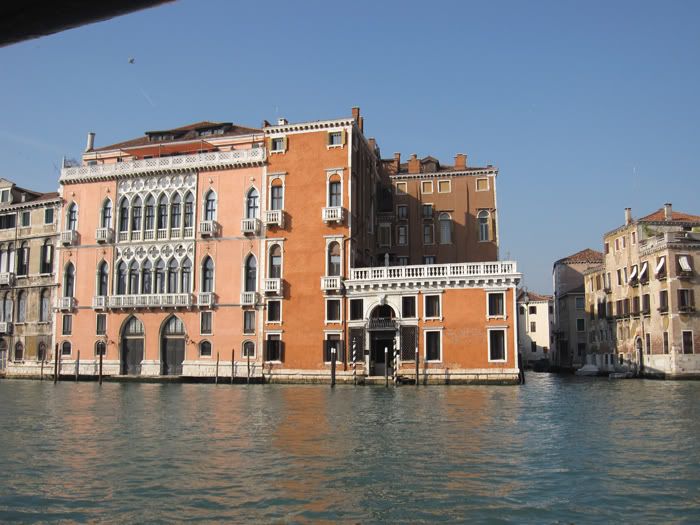
And riding around in a water bus can give me some really lovely views of some of the buildings along the way, like the above. Only in Venice.


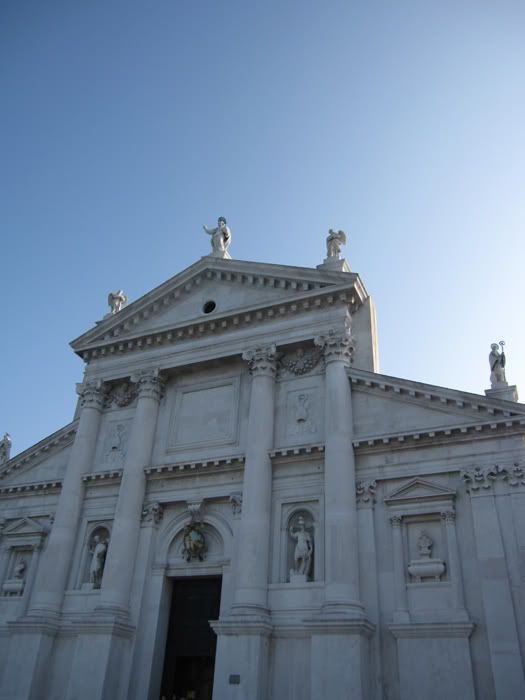
The last stop on No. 2 before it terminates at St. Mark's is San Giorgio Island, home to this lovely cathedral. I disembarked to check the place out.

Although the cathedral comes with its own Campanile-like tower that offers great views (the tower is very visible when looking from St. Mark's), I refused to pay the admission.


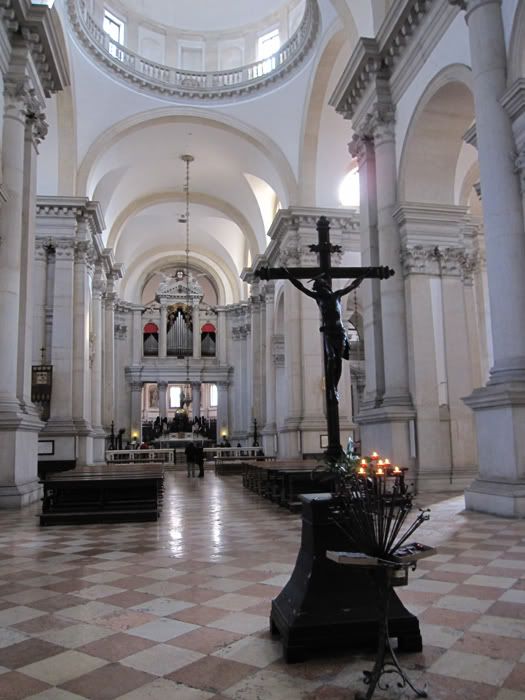
This is the interior of the cathedral. Small and cozy, a contrast from the grand cathedrals I tend to see elsewhere in Europe and North America.


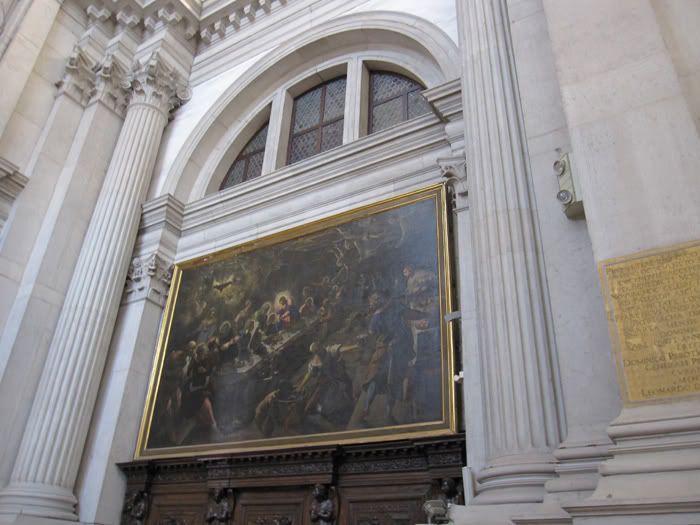
This cathedral's claim to fame is Tintoretto's rendition of the Last Supper. It was one of the paintings I had studied in my college art humanities class, as a contrast from the earlier Michelangelo version and its Renaissance geometric balance.


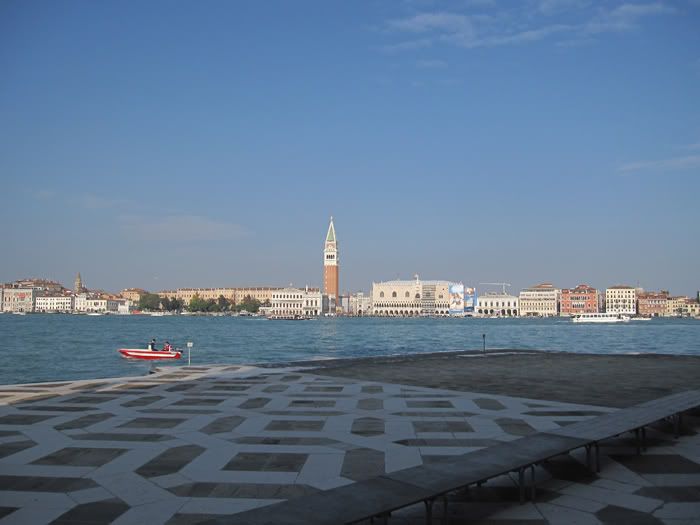
And now I'm looking back at St. Mark's Square.

In front, the water is almost up to the pavement level. It's high tide, and back at Rialto Bridge as I was leaving the hotel, I had noted that the water was starting to flood a sidewalk.

Venice had been built on a former sandy river delta (the river is today's Grand Canal), that had shrunk to an island 2.5 miles off the shore due to sinking. The sinking continues, and global warming and the resulting rise in sea levels don't help either. And sure enough, after I leave on this day, Venice would see an Acqua Alta - or High Water - that left St. Mark's Square under two feet of water on Christmas.


Now I am back at St. Mark's, and my next sight will be the Doge's Palace (Palazzo Ducalo), Venice's greatest sight. The Doge was an "elected" leader of Venice who nevertheless wielded dictatorial powers, and because of Venice's status as a maritime power and a trade powerhouse, the Doge was easily the most powerful man in Europe.

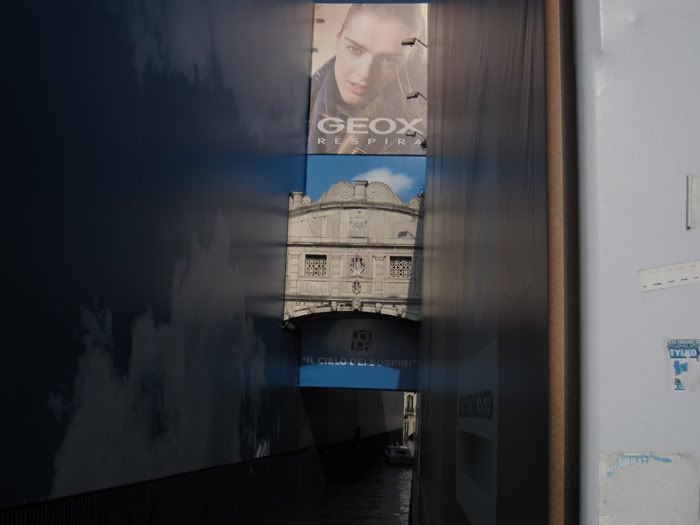
That is the Bridge of Sighs, which connects the palace to its prison annex. Condemned prisoners, as they are led away to their cell, would sigh here, looking out toward the beauty of Venice and knowing that it would be a long time before they would see it again. A psychological taunt, much like Alcatraz that's so near, yet so far, from San Francisco.

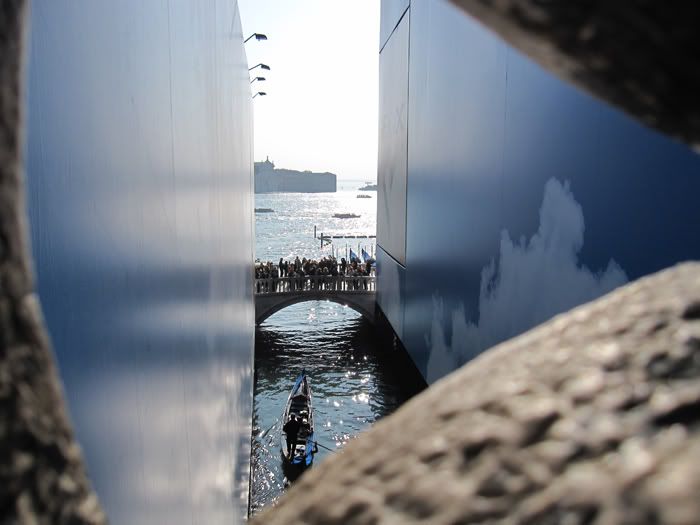
Both the palace and the prison annex are undergoing facade cleaning/restoration. The scaffolding is covered with advertisement, in order to generate income for the city government. This is controversial, of course.

Behind me along the waterfront, African immigrants are peddling fake purses and other fashion goods. While they are illegal - by buying from them, even I break the law and become subject to a €1,000 fine - they somehow find ways to keep themselves in business.


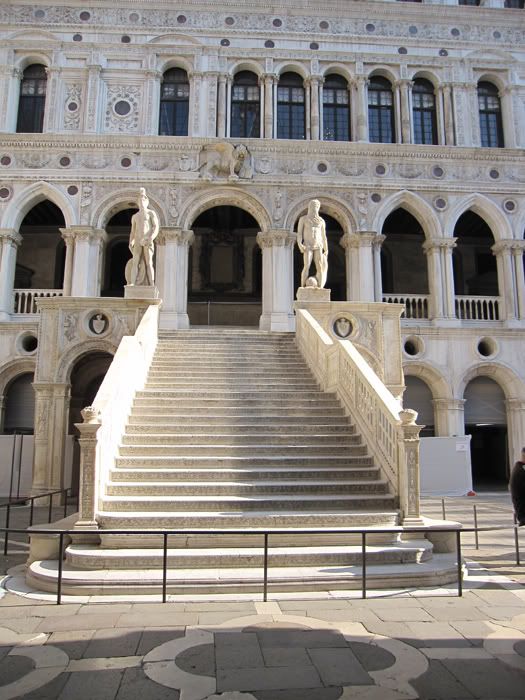
I have now paid admissions and entered the Doge's Palace. This staircase would've been where the visiting guests were welcomed into the palace.

The palace's elements are like other palaces' - including the Residenz back in Munich. In other words, propaganda elements to assert the power, legitimacy, and superiority of the inhabitant. Now that I am a week into this trip, I am starting to feel tired of the palaces. My mother's interest in home decorations leads her to palaces, while I would rather hit a museum for art history, which she can't stand.

The Doge's Palace does not offer a stand-alone admissions ticket. Starting this day, for the winter season it sells a ticket which also allows entrance to the Correr Museum next door, showcasing city treasures. For the summer season, the ticket costs a bit more, and I can choose from one of seven additional museums throughout Venice and nearby islands. Although I bought the winter combination ticket, I really didn't feel like going to Correr.


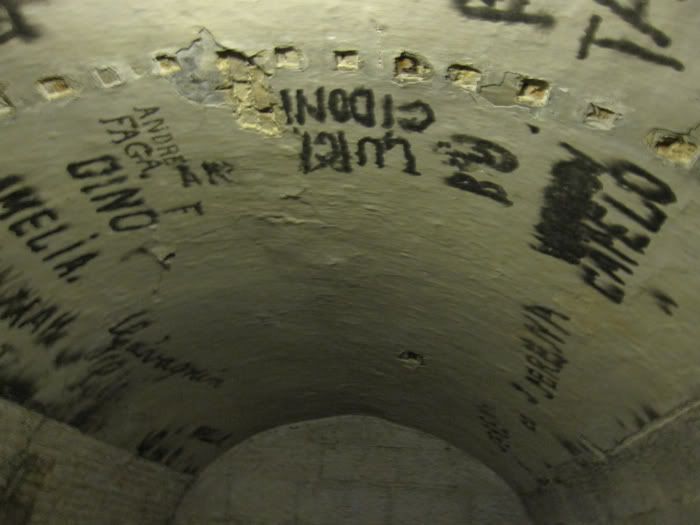
At least this is preferable to stuffy royal decorations. I am in the prison annex, and this is the ceiling of one of the cells, with prisoners' graffiti.

Casanova was known to have spent some time in this prison himself. His love prowess was such that according to Rick Steves' guidebook, when Venice's police was out in full force trying to apprehend Casanova, Casanova himself was enjoying some wild sex with the police chief's wife!


As I walk back to the palace to finish my tour, it's now my turn to peek out from the Bridge of Sighs, and sigh. Thanks to the scaffolding, the view out isn't as beautiful as I'd like.


I walked back in the direction or Rialto Bridge, and had a slice of pizza in the vicinity, thankfully in a pizzeria that was not too touristy.

Now, I am at a water bus stop for the No. 1, trying to get in the direction of Accademia, then walking from there back to St. Mark's Square, in time to enter St. Mark's Basilica, the other major Venice sight. The basilica, of course, had been closed in the morning due to the Sunday mass.

Loving this Grand Canal scene. The Grand Canal homes, back in their heyday, were the most opulent palaces/residences in the city. They still look grand.

I can also spot a water taxi. Here in Venice, every vehicle is water vehicle - even UPS delivery trucks have to be boats.


Now moving on toward Accademia. A look at more Grand Canal palaces, as well as a narrow side canal, one of many.

Historical preservation laws prevent major remodeling and demolition, and too often it's easier to let the buildings decay than to modernize them. Also, the rising water level also means for some of the buildings, the ground floor is no longer usable due to flooding.

This is clearly a city that is slowly dying, or at least becoming a tourist trap rather than a real city, as the residents flee. But because of the tourist traffic, efforts are being made to control water levels and ensure Venice's existence for many, many more years.

As mentioned in the last post, the Grand Canal can be crossed by only four bridges: two near the train station, one in the middle (Rialto), and one toward the south end (Accademia). To make crossings easier, traghetti (singular: traghetto) operate at seven points along the Grand Canal. The traghetti are retired gondola boats that are converted to shuttle duty, and cost 50 cents to ride; as they are privately operated independent of the mass transit, they don't accept transit passes.

Of course, the gondolas themselves are iconic of Venice as well, but prices are pretty high for a 50-minute ride. My mother didn't seem too interested, and I didn't feel like riding without her either, so I guess a Venice gondola ride will have to wait for a future visit.

I did get to St. Mark's Basilica, and waited a bit in line until its opening time. But its true gems are in a paid area, an upstairs museum that houses the original four horses from Constantinople (the current ones outside are modern replicas) and other relics; again, I refused to pay. The sanctuary was rather a dud.


At this point, I didn't see much point in extending my Venice experience. Walking through the crowds was not too fun, my mother was sick and tired of the place, and even for me, I wanted to be somewhere with more open space, and wanted to come back to Venice on a future visit to explore my favorite sights in-depth at a more leisurely pace. Besides, I wanted to get going toward my next destination, Switzerland, and try to get to a comfortable hotel on the way for the night.

Now I am back on the No. 2 water bus, returning from St. Mark's to Tronchetto via the periphery route. This is my farewell look at Venice. The crowds, the decay, and my mother's complaints really put a damper in my mood, but from this vantage point, it looks fabulous. And the fact that such a lovely city can rise out of the water, in itself, is simply incredible. Venice is one of those places that I didn't love too much while I was there, but lingers in my mind long after I left for good.

Back at Tronchetto, my parking came out to be €21, the 24-hour rate. I exited Venice the same way I came in - Liberty Causeway, drive through Mestre, and Autostrada 4. I decided to push west and just stop at some hotel when I got tired; I pushed past Verona, where I had come in via Autostrada 22, without stopping. I did stop at a nearby rest stop for a nap and a snack, during which I could hear German (!) national anthem in the concessions area (turns out, it was a telecast of a soccer game) and see some Italian men flock around the Mercedes-Benz (the E550 with a German export plate is certainly an unusual sight in Italy, and in any case, the E550 designation is for North America only, the European domestic models are designated as E500 even with 5.5L engine displacement).

Continuing to push west took me through some scenic areas, interspersed with sizable towns, though I continued to fight the Italian drivers and their reckless driving. It felt a lot like Los Angeles, though I must make it clear that unlike Los Angeles drivers, at least Italian drivers know how to drive, they simply show no respect to the law. Autostrada 4 continued to have three smooth lanes, increasing to four once I entered the Milan area. The tollway ended there, I paid another €18 or so in tolls, and I transferred to Autostrada 9, heading north through two turnpike-style toll booths to the Lake Como area and the Swiss border.

I exited at Como South exit, right after the last turnpike toll booth, when I spotted some "Drive Motel" signs guiding me off the autostrada. I had trouble finding Drive Motel, and after a while I switched my search over to a Hotel Ibis at €69. But I had even less luck finding Ibis, so I reverted my search to Drive Motel. Its signs appeared alongside signs for Hotel Cruise, which turned out to be its sister property. I eventually found the joint property, to find a nice surprise; in this case, the "motel" referred to a motor hotel, not a cheap hotel, and that meant that check-in and check-out were drive-through, and every room had its own garage. I went to the drive-through check-in, where a light-skinned, blue-eyed blonde greeted me (she certainly looked more Northern European than typical Italian), and advised me that while a night at the Drive Motel would cost me €95 with no breakfast, checking in on the Hotel Cruise side would be €90 with breakfast. I heeded her advice, went around to the Hotel Cruise side, and checked in for one night. This was a very modern, nice property, and I was glad to stay there - and so was my mother, thanks to television service.

The next morning would have me continue my journey. Como is on the Swiss border, so most of my driving would be in Switzerland, and I would find myself in Interlaken, my destination, by early afternoon.

05 April 2010

Europe recap, Day 7: Brenner Pass into Venice

This post recaps my Halloween 2009, which saw me halfway into a two-week tour of Europe. It was my first introduction to Italy, as I entered via Brenner Pass and the Dolomites, and headed for the famed water city of Venice. Italy became the seventh European country I get to check off.

As noted in the Day 6 recap, I ended up not visiting any of the salt mines near Salzburg. I simply took the shortest route out to Autobahn 1, then headed west back into Germany; even though the approach to Brenner Pass is via Innsbruck in western Austria, it is actually faster to dip briefly into Germany, due to lack of Autobahn connections between Salzburg and Innsbruck. After driving on German Autobahn 8 toward Munich for about 30 minutes, I found the Autobahn 93 turn-off, with clearly marked "I" oval, denoting access to Italy.

Autobahn 93 followed up the course of the Inn River, and before long, took me back into Austria, becoming Austrian Autobahn 12. Surrounded by old castles and snow-capped Alpine peaks, I made sure to enjoy the drive to the fullest. The CD player played the soundtrack to The Sound of Music movie from 1965, and I followed up with my modern-day favorite from back in California, Anna Nalick.


I am now taking a brief toilet break in Innsbruck, as Autobahn 13 splits off from the 12 to climb up the Brenner Pass and take me to Italy.

Innsbruck ("Bridge on the Inn River") is a very scenic town, best known as a ski resort, particularly attractive to those who live in countries without steep mountains (think England and the Netherlands). Unfortunately, between my need to continue to Venice and the difficulties I would certainly experience driving into town and parking, this will be all the Innsbruck I end up experiencing. Having to mind my mother's constant concerns regarding possible damage to the car is really piling on my stress level.


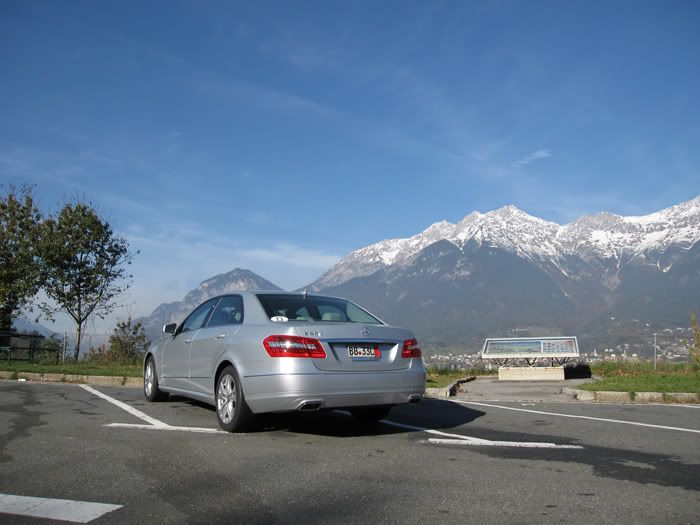
And here is an obligatory shot of the car against the Alpine peaks.

Austria has the strictest motorist regulations among the countries I am driving in. In addition to a toll sticker for the Autobahn system, I am also required to carry a safety vest inside the passenger compartment, to be worn in case of a roadside emergency; the vest was provided free of charge by Mercedes-Benz back in Sindelfingen. And more importantly, I am required to use winter tires between November and April, but that is also taken care of, since (1) I am leaving Austria for good on this October 31st, and (2) this car's all-season tires, thanks to their Mud + Snow designation, meet the requirement. Austrian driving in the winter on performance summer tires is not only dangerous, it is outright illegal, with a fine of €5,000.

Brenner Pass is only 30 minutes from Innsbruck, but in order to drive this short distance, I am required to pay a supplemental toll of €8 in cash on top of the toll sticker. Before long, the obligatory border slowdown took place, and in the midst of outlet stores, I could see a sign - European Union flag with the word "ITALIA" in the middle. I entered Italy. Shortly following were the default speed limit sign, showing Italian speed limits at 50 km/h urban, 90 rural, 110 on blue-signed free motorways, and 130 on green-signed toll motorways (Autostrada); the days of German-style unlimited Italian autostrade were long gone.

The initial drive through the rugged terrain was kept at 110 km/h, despite being a green-signed Autostrada. This 110 would persist throughout my drive on Autostrada 22 (the Italian extension of Austrian Autobahn 13). Soon, a toll booth issued me a magnetic toll ticket; Italian autostrade use a thruway-type toll collection system using tickets or transponders.


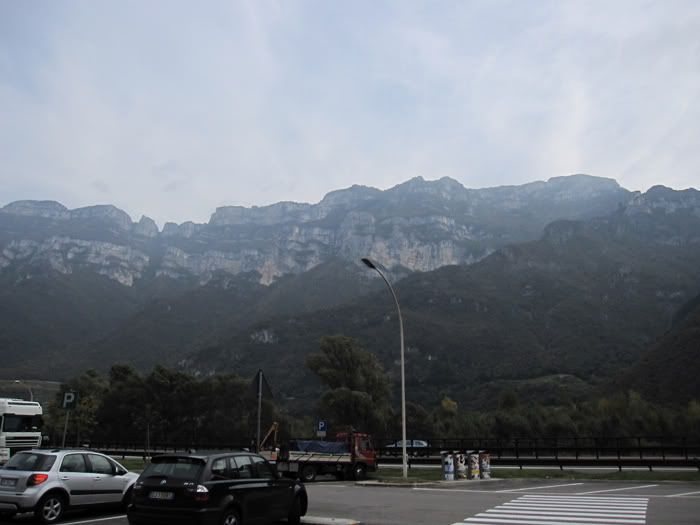
Autostrada 22 heads south from the Brenner Pass, through the lovely, rugged Dolomite Mountains, known for their stunning marble cliffs like this photo. This photo is just a tiny hint of all the gorgeous cliffs I could spot while driving, but couldn't photograph due to my need to put driving first. This photo is from a rest stop about 30 minutes north of Verona, where I would take the eastbound Autostrada 4 toward Venice (marked as Venezia on signs).

Up to this point, I am in the region known as Alto Adige, and as this region is historically populated by the Germanic people, all placenames have Italian and German versions, and all road signs and messages are in both Italian and German. Indeed, I am reminded that back when Germany's national anthem was sung as "Deutschland über alles," its lyrics included the phrase "From the Meuse to the Memel, From the Adige to the Belt" - a swath of territory that is now lost through losses in two World Wars. The Brenner Pass has historically connected this region to the rest of the Germanic world, and this road is dotted with castles - tollbooths back in the day, complete with accommodations for tolljumpers.

But make no mistakes, this is Italy. I am actually finding the Autostrada system to be better built and maintained than the German Autobahns; thanks to the nicer Italian climate, the road surfaces are in even better shape than the already excellent ones in Germany. Aside from acceleration and deceleration lanes which are mere afterthoughts drawn onto the shoulder, the autostrada is built to higher standards than the autobahn.

But I have to say that the real reminder of Italy comes from the reckless drivers. In Germany, I could count on all drivers obeying the strict regulations, such as no-passing-on-right and adherence to any mandatory speed limits. But here in Italy, I am finding that traffic regulations were meant to be ignored. Speeding and lane changes without signaling were very common, and while passing on the right was nowhere near the epidemic levels I see in California, I could still occasionally see it. I could also count on a mad flash of the high beams from behind if I did not vacate the fast lane in a microsecond, and a frustrated honk if I decided to treat stop signs (i.e. at this rest stop) as a full stop rather than a California stop.

I found that the worst a-holes on Italian autostrade were Audi drivers, filling in the niche occupied by BMW drivers in California. The worst slowpokes, just like in California, were Toyota drivers. Van drivers, be it the Central American theocrats in California driving a Chevrolet Astro, or brutes in South Korea driving a Hyundai Starex, used to push my buttons a lot, but they are less of a factor in Europe; the Astro is nonexistent, and drivers of the Starex and similar vans are well-behaved in Europe (aside from an occasional tendency to speed). Another demographic that used to push my buttons in South Korea - drivers of Ssangyong SUVs - also drove pretty well in Europe.

I refueled at this rest stop before continuing my way. Italian gas prices are similar to Austrian levels and much cheaper than German levels; I could expect to pay €1.00 per liter, and I only needed to pay for regular unleaded, which was already 95 octane (91 US octane), making premium at 98 octane a useless splurge. While Autostrada 22 continues south to Modena, home of Ferrari, I was more than happy to transfer to eastbound Autostrada 4 once in Verona, enjoying its 3 lanes all the way to Venice as well as consistent 130 km/h speed limit. It went through a flatter landscape surrounded by rolling hills, farms, and even an American military base. As I approached Venice, I stumbled into a "KARTE" lane at the toll booth, and paid with a debit card; the toll came out to be €21, definitely not cheap, and I had intended to pay at a cash lane, whose money icon I couldn't recognize right away. (Good thing I didn't use the TELEPASS lane for transponders.) Thanks to European distances being delightfully short and motorway speeds being fast, I arrived in Venice ahead of schedule - something that happened on every major driving day for me.

Once in Venice, I proceeded through Mestre before getting on the 2.5-mile Liberty Causeway to the water city itself. I parked at the enormous Tronchetto Garage, which I appreciated for its American-scale ramps and parking spaces, and fumbled my way to the vaporetto (water bus) stop, for a ride on the No. 2 water bus to Rialto Bridge. My mother was thinking "Harlem slum style decay" rather than "a former powerhouse" as the water bus made its way into the Grand Canal, and upon reaching Pensione Guerrato (Rick Steves' favorite hotel) and finding that the €130/night room I had booked was an attic room above fourth floor (sixth floor if counted American style) with no television, she was fuming. I fumed right back too, telling her to shove it with her Asian-American model minority materialism and excess. This trip was at its breaking point.


Cooler heads eventually prevailed, as I gladly let my mother know that I've myself been let down by another European city that other visitors rave about - namely, Amsterdam and its Surinamese thugs. Now the goal has become salvaging the Venice experience somehow, even if Venice falls way short of the sanitized/romanticized depictions in the movies and as seen at the Venetian Hotel and Casino in Las Vegas.

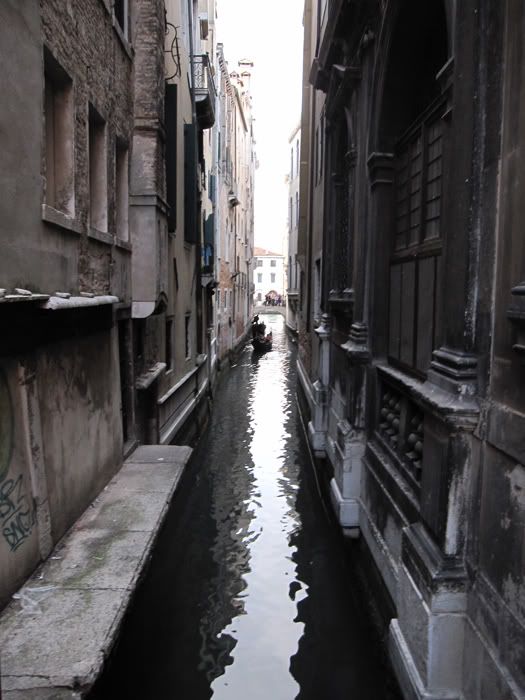
From the hotel near the Rialto Bridge, we are walking in the general direction of "Piazza San Marco" (St. Mark's Square). And every time a pedestrian path goes over a water canal, I am treated to views like this, an alleyway accessible only by water, served by a gondola. The path crosses the canal in the form of an elevated bridge, with a few steps up and down on either side, and that gets tiring after a while walking around Venice.


The primary method of getting around Venice is by walking through very narrow pathways, as this is a water city without any land vehicles, and land area is at a huge premium. In particular, the pathways between the Rialto Bridge and the St. Mark's Square, the two tourist magnets of Venice, can be extremely crowded.

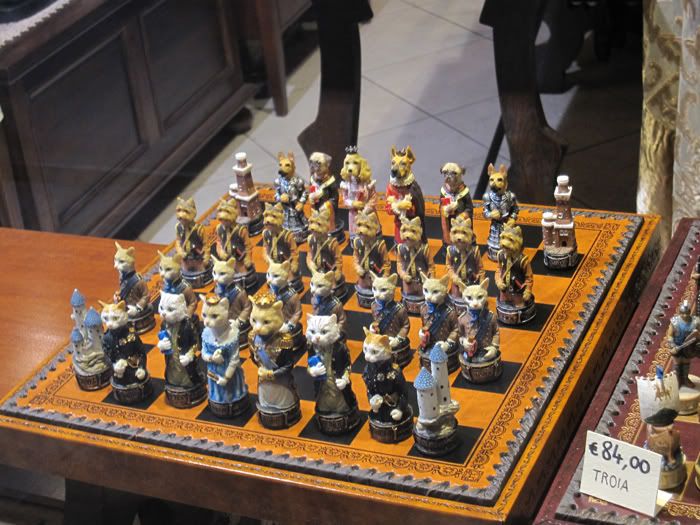
And with all the tourist traffic passing by, the stores often sell very catchy items, like this chess set made up of cats and dogs. I almost wanted to buy one.


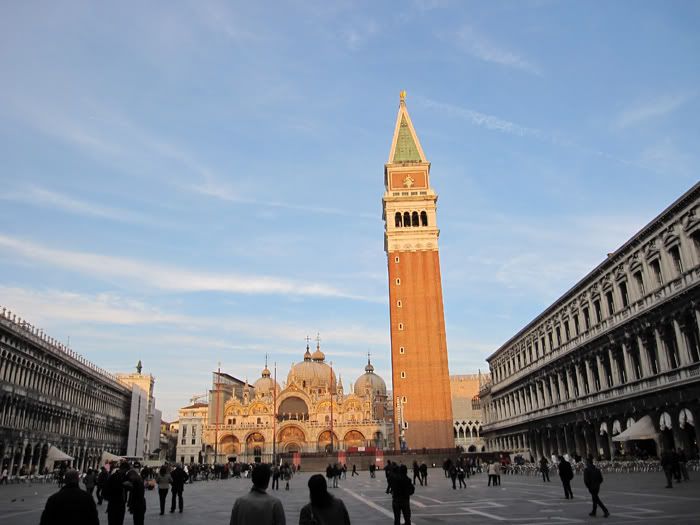
Now this is a bit more like it - an open expanse. This is St. Mark's Square, with the Campanile and St. Mark's Basilica standing proudly as ever.

I would quickly learn that open spaces like this are at a very huge premium in Venice, and that I would need to enjoy every moment I spend in one.

As it's sunset already, I am not planning on doing any sightseeing this day. I am supposed to stay in Venice for two nights, and that gives me all of All Saints' Day as a full day to explore the city. I will now walk back toward the Rialto Bridge.


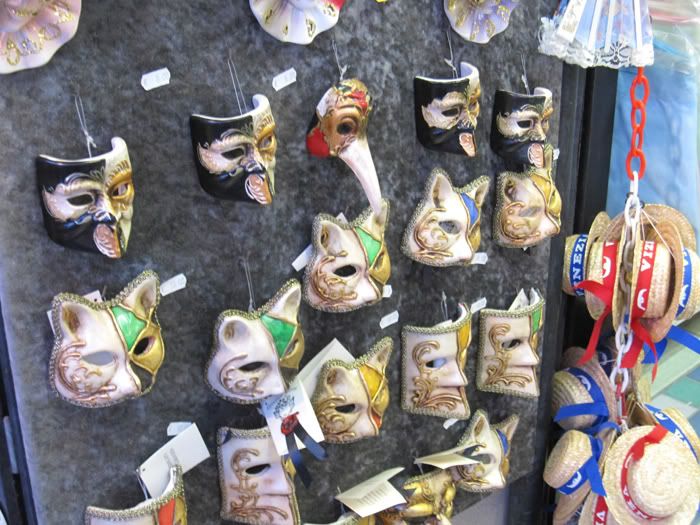
Another store, selling masks that are a good reminder of Venice's past decadence in the form of masquerade parties. I am loving the fact that many of the masks are cat-shaped.


It's dinnertime. As Venice is now a place where tourists outnumber residents, getting into a non-touristy restaurant is wishful thinking in many parts of town. And since I am still on the main paths between St. Mark's and Rialto, I need to duck into a touristy eatery - and entered a spaghetti joint run by an East Asian immigrant.

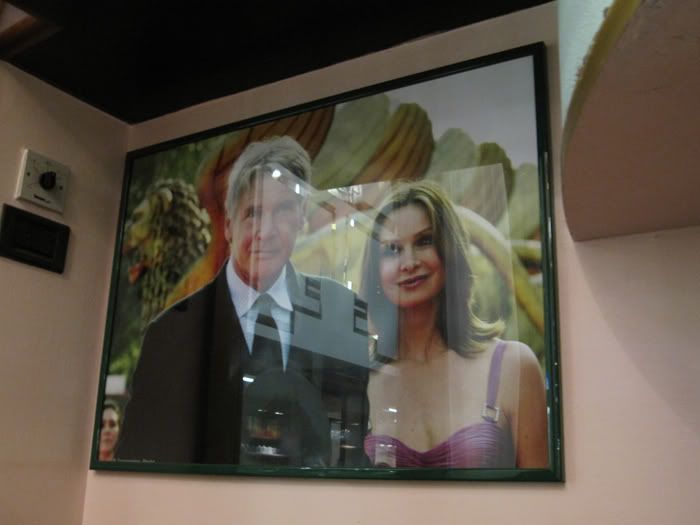
This joint's walls are covered with photos of international movie actors who have attended the annual Venice Film Festival. And I am lucky to be eating under the photo of my favorite - Calista Flockhart and Harrison Ford. I'm always fond of Calista Flockhart for her portrayal of that neurotic skinny miniskirt-suited lesbian lawyer Ally McBeal; glad to be reminded of her here in faraway Italy. I am also realizing that in just eleven days, Calista would turn 45; when Ally had first aired, Calista was only 33, and Ally was supposed to be merely 28. Certainly, a key part of looking young is having a geriatric boyfriend, in the form of Harrison Ford.


Continuing past Rialto toward the northeastern portions of Venice, the one part of the city that actually still has residents.

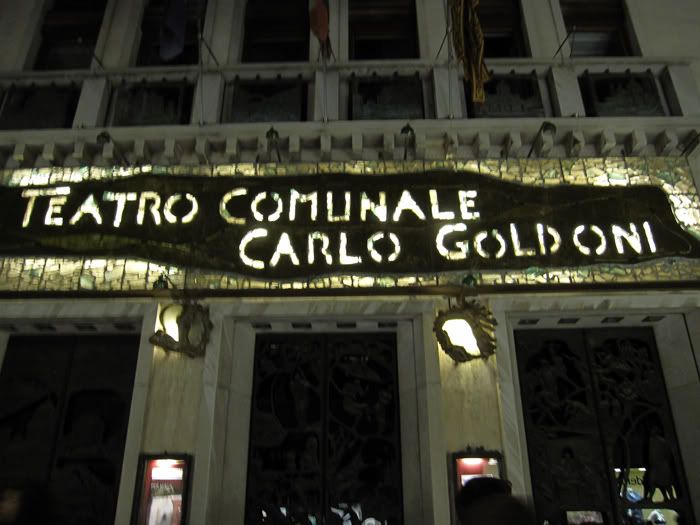
I don't know what the significance of this community theater is, nor who the namesake, Carlo Goldoni, is, but I had to take this photo for the lovely lighting on the sign.

In Venice's labyrinthine path pattern, navigating by street names is impossible. One's sense of directions completely melts away after a few minutes of walking. The only way to keep going is to refer to yellow signs pointing to the direction of a major landmark (S. MARCO for St. Mark's Square, P. RIALTO for Rialto Bridge, FERROVIA for train station, etc.), and use that landmark as a reference point to get to the final destination from. I'm actually walking toward the train station at the north end of the water city.


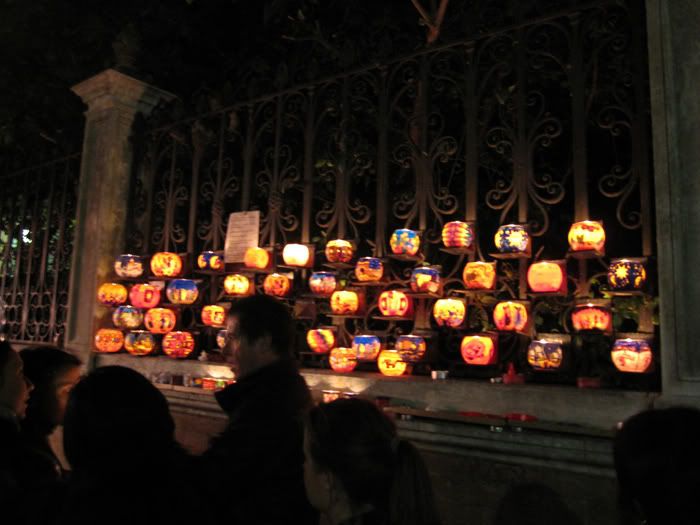
I am looking at some lanterns lit to mark All Saints' Day the next day.

I am walking on a rather wide pathway - wide enough to handle two trucks easily, if trucks had a way of getting there. This is the residential part of Venice, complete with a grocery market and other services catering to residents rather than tourists. And this being Halloween, I am seeing costumed children out trick-or-treating. While Americans tend to treat Halloween as a commercialized holiday, Europeans give it the same treatment AND celebrate the very reason for Halloween's existence - All Saints' Day the next day.

I'm actually liking the fact that I am spending Halloween in Venice, a city known for masquerades and other disguises.


I am now next to the train station. I am inside the Church of St. Mary of Nazareth, which I am not visiting for any particular reason, but because I needed a place to take a quick breath - and to photograph some lovely interior elements.


And now I am outside, crossing the Grand Canal via one of only four pedestrian bridges spanning it.

To the right is the Church of St. Mary of Nazareth. Toward the back is what is referred to on the signs as "Ferrovia" - Santa Lucia train station, where trains terminate after coming in from the mainland over the Liberty Causeway. Needless to say, the presence of the train station makes this place a transportation hub. In front of the train station are docks that serve as water bus stops, and indeed a couple of water buses are operating. In front of the church, smaller docks serve water taxis. Even a water bus ride in Venice is expensive - €6.50 for a ticket good for an hour - and a taxi ride is prohibitively expensive. (However, passes can bring the cost of water bus rides down significantly.)

Within walking distance, behind the train station, is Piazzale Roma, where Venice residents have a parking garage to keep their cars in. Piazzale Roma is the only part of Venice accessible to land vehicles, and is served by land buses from the mainland.


While my hotel is on the west side of the Grand Canal, most of the sights covered above are on the east side. Now that I crossed back west at the train station, now I am wondering again through a new set of labyrinthine paths to attempt to get to Rialto Bridge (and the hotel).

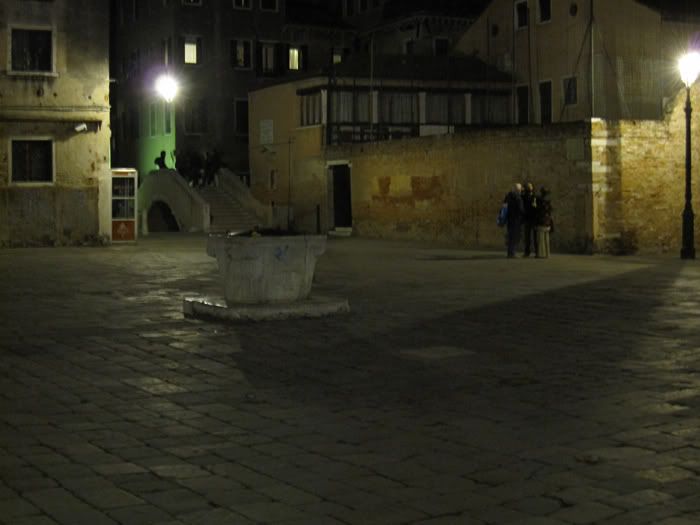
This open square is an example of Venice's traditional water collection systems. As Venice sits 2.5 miles off the coast and has no source of fresh water, residents used squares like this as water collection systems. Rainwater would pool toward the center of the square and lower into a well below, collected there for the residents' use. This system remained in use until the 19th Century, when an aqueduct was built to the mainland, bringing water from the Italian Alps.

Toward the back is a typical bridge going over a narrow side canal. After dozens of those in an hour or two, walking around in Venice can get very tiresome, fast.

Eventually we stumbled back to the hotel and retired to the attic room. The windows remained open for ventilation - but my mother continued to complain, primarily thanks to the Halloween revelers' noise outside. She simply was NOT liking Venice, period, and a decision was made to leave the next morning - a day early. I'd have to cancel the second night's reservation, and would have to try to find a place to sleep on the way to Switzerland. Driving hotshot through Europe without a confirmed hotel room - that in itself could be exciting!

10 November 2009

Back from Europe

Internet access in Europe was expensive, so no time to really blog.

My accounts and photos will be uploaded over the next few weeks. This was a great trip - though not perfect, it was finally a way for me to drive away the demons of my disastrous 1999 Amsterdam visit, and get intimate with Europe again once and for all.

22 October 2009

Departing soon...

I have been so stressed out, from work and personal matters, that I have done no further preparatory posts on the cultures of Germany and my other European destinations, even though I did enough Wikipedia searches on the topics.

But I am happy to say that my departure is imminent. This will be my last post before Europe. I do expect to have Internet access at all my European locations, but that cannot be counted on 100%.

It'll be priceless being away from the teabaggers and their Third World anti-individual mindsets, if only for a few weeks. (Yes, much of my stress is due to Asian Confucian BS - even from people well outside my circle of acquaintances.) Sure, Asian-Americans are considered elitist a-holes by most of Europe (since Asian-Americans often consider themselves white equivalents, and bring in the worst of America's right-wing elitist attitudes right into Europe), but I don't have to advertise being an American. Just to be sure, I will not have any US dollars on me as I depart - only Euro.

Despite the tight schedule, I hope to accomplish much of what I managed to do in Seoul and Hong Kong last year. And that alone will be priceless.

I have already changed my "current location" on Facebook to Munich.

10 October 2009

Travel reservations complete

Now I have almost all aspects of my European trip nailed down.

My last missing hotel piece - three nights in Paris - was resolved, with a booking at a Best Western in the Marais district. My friend DiAnne Grieser of Seattle, a huge Francophile and a frequent Paris visitor, steered me toward the Marais, since it's still quite close to the Latin Quarter, and I am glad she did; the Marais has cheaper hotels that are just as charming and comfortable. Plus, I do think the Marais - between its elite past, its Jewish population, and its gay culture - will be quite interesting. Most importantly, it's close enough to Gare de l'Est and Gare du Nord that I won't have to lug my bags through the Metro, but far enough to be saner.

I also have two train legs: the first from Munich to Stuttgart for the car pickup, and the second from Stuttgart to Paris after the car dropoff. The second leg was booked on a dirt-cheap price (reservation fee included), and it will be a direct TGV run. The only downside will be late-night arrival in Paris, but on the other hand, I will not have to rush my way into Stuttgart that day, since I will need to drive in from Interlaken. Sure, past Zurich, it will be on the A81 Autobahn, the speed demon's dream, but traffic jams can, and will, often happen! The first leg does not offer early booking discount, and because trains are very plentiful on the leg, reserving a specific train will probably be more foolish, so I will wait until I actually need to leave Munich before buying the ticket.

Another open item is arranging for the dropoff/shipping of the Mercedes-Benz. I will have to visit the shipper's Stuttgart office immediately after taking possession of the car; the shipper requests that in the delivery package, plus I need to give a week's advance notice before dropoff anyway (at least I'll come back to Stuttgart for the dropoff).

All this means I have all flights and hotels, and some of the ground transportation figured out. I also have tentative ideas on which sights I want to tackle in each city. I'll need to keep some flexibility in my plans, however, to prevent my trip from being a mad rush to meet a timetable, a common problem in my past trips. And of course, within the first day or two of driving, I will need to also buy a safety vest and expressway toll stickers - requirements for driving in Austria and Switzerland.

08 October 2009

More road trip prep

As my European road trip inches closer, I came across more resources of value.

A Texas-based driving enthusiast, who had once lived in Germany, put together a comprehensive resource of not just the Autobahn system, but everything about driving and other forms of transportation in Germany. There are even detailed descriptions of the traffic laws that apply specifically to Germany and Europe, differing from those in the US and elsewhere; for example, unless indicated otherwise, cars entering from the right have priority over through traffic, and right turn is normally not permitted on red. Granted, the author appears to support an evil neoliberal organization (and certainly links to it) that equates all speed limits with socialism, but I still have a resource that could save me a lot of headache once I am busy trying to conquer the Autobahn or the Romantic Road.

Getting Around Germany: Driving

And I also came across a resource that deals with sound driving practices, from a certain Uncle Bob based in the Phoenix area. He has 70 tips, which are far more informative than any traffic violator school will ever be. I'll surely need these tips, whether I am trying to negotiate the A8 Autobahn between Stuttgart and Munich, or the mundane traffic in Los Angeles (even more challenging, thanks to all the moronic California drivers).

Road Trip America

For actual sightseeing outside my car, I am going back to a resource I used to frequent: Europe for Visitors. It also has special sections on Paris and Venice, which I will rely heavily on. It looks like my Venice arrival will not be all that challenging - I can drive right into Venice itself, park at the Tronchetto artificial island and its huge garage, then take the No. 2 water bus, which will take me to Rialto Bridge - and my hotel. It's a shame I'll only have one full day in Venice; I'll try to make the most of what I do have.

Speaking of my plans for each destination, I have most of it nailed down, though I haven't yet booked my Paris hotel. My previous Paris stays were in Montmartre, and this time I want a change; I'm still trying to choose between the Latin Quarter (my initial preference) and the Marais (a friend's recommendation). But all other hotels and airfare are set in stone, and I also need to book train tickets, especially for the TGV run into Paris once my driving is finished.

Last, but not the least, Google Maps is proving to be very valuable. Its coverage of the world is expanding, and now, for major cities in North America and Europe, I can get mass transit maps and routing, of varying quality. I can get traffic reports for most of the US and a few major European cities as well, both real-time and average data by day/time of the week. Being able to study, now, the most up-to-date street maps of the European cities I'll be visiting/driving in will help greatly once I'm actually there. I'm also delighted to know that Google Maps is improving its coverage elsewhere as well. In Asia, it's had street-level maps of Japan, Taiwan, and Hong Kong for a while, and now its China maps are up-to-date (with tons of new expressways) and excellent, and South Korea has also been upgraded to full street-level coverage (great for retracing my road trip there last year, especially on a computer not running a Korean-language OS). Even closer to home, I am getting great maps of Mexico that weren't available recently.

I'll find myself in Munich, my first European stop, before too long. Though I don't think I'll ever get used to saying "God's blessings" (Grüss Gott) rather than "Good day" (Guten Tag) as "hello."  Grüss Gott is indeed the standard greeting in Bavaria, which is home to Pope Benedict and BMW and can easily be called Europe's Bible Belt, and it's said to be never used elsewhere in Germany. In the meantime, the blog timestamps are being switched to GMT +2, which will be the time zone in Europe when I initially arrive (Central European Time, Daylight Saving Time), though I'll have to fall back to GMT +1 (end of Daylight Saving Time) during my trip.

02 September 2009

Europe planning

Given that much of my trip will be by car, I will need to maximize sightseeing in remote rural places where trains are not as convenient, and stick to big cities only when I am not driving. Also, all the territory to be covered in this trip, with the exception of Paris, is brand-new to me, so I have a lot to look forward to, but proper planning is crucial.

The first four nights are set in stone now with firm reservations. I will fly to Munich and stay there for two nights. I have one and a half days in Munich, but the full day will be Sunday (shops closed) and the half day will be Monday (museums closed). I'll stick to the parks/gardens and a museum on Sunday, then walk around some downtown sights Monday, before heading for Stuttgart for two more nights. The hop to Stuttgart will use a train; there are very frequent train runs, mostly of IC and ICE grades (though the ICE isn't fast on this line).

The full day in Stuttgart will involve the delivery of my folks' Mercedes-Benz, and a visit to the Mercedes-Benz Museum, but I will also make sure to devote some time to the city's scenic downtown.

After those four nights, my plans are still in flux, though I have a rudimentary outline. I'll drive portions of the Romantic Road with a stop at Rothenburg, and will probably overnight at Fussen, next to Mad King Ludwig's fantasy castles. I am also looking at overnighting in Salzburg, Austria, and another fine Austrian town, Innsbruck, will be a brief stop. Venice will be my lovely Italian introduction (I hope the large garage at the island city's entrance will be safe), and if driving conditions are not too bad, I will squeeze in a bit of Switzerland, primarily Interlaken but maybe Zurich. I won't go deeper into Italy given Italy's high car theft rates and the expense of the car (even riskier given the car's tourist plates).

I will return to Stuttgart, after a week on the road, to ship the Mercedes to the US, then hop on a French TGV for a relatively fast hop to Paris, using a new high-speed line from Strasbourg. I am devoting three full days to Paris, which I insisted on, not for myself (this is my third Paris visit), but for my mother (her first European visit). I will revisit most major sights, but will try to find a new, unique Paris experience.

My US return will be fourteen days after my initial Munich arrival. Out of Paris' Charles de Gaulle Airport, I am booked on a Lufthansa flight backtracking to Munich, where I will then catch a Los Angeles-bound flight.

The rest of the planning will be at least as fun as the trip itself. But I need to make sure to build some flexibility in. Some sights may be duds, others may be gems requiring more time. Will see what I end up with.