Showing posts with label Switzerland. Show all posts

21 April 2010

Europe recap, Day 11: Stuttgart to Paris

Only five photos from Wednesday, November 4th, 2009, as it was a long day heavy on driving and paperwork, with little downtime except for a few late afternoon hours in Stuttgart.

The morning began again at Goldswil just outside Interlaken, Switzerland, with a hearty hotel breakfast, before checking out. The cost for the two nights came out to about 200 Swiss francs - pretty nice, especially given tons of personality in that rustic cabin type building. After bidding the proprietors farewell, it was time to get moving again.

Driving back into Interlaken to check back on one particular souvenir store turned out to be tough luck; the owner probably was taking a lengthy holiday somewhere, and the store remained closed. I decided in the meantime, to pull into an unmanned Avia gas station to buy a bit extra gasoline, to ensure that I could make it to Stuttgart; unfortunately, the German-only instructions left me confounded, and the pump only issued a receipt saying that I deposited 20 francs without fueling - which indeed was the case! I decided I'd have to visit another Avia later on to redeem the credit.

My originally planned routing would have taken me from Bern toward Zurich, entering Germany on surface roads and shooting straight to Sindelfingen on Autobahn 81. But I had decided the previous night that I wanted to enjoy the Rhine and Black Forest scenery, by entering Germany from Basel and heading north on Autobahn 5. The first stretch to the Swiss capital, Bern, was the same as originally planned, heading west on Autobahn 8 and merging onto Autobahn 6 at Thun (motorway-grade roads all the way from here); from there on, I continued on Autobahn 1, which would indeed be the routing to Zurich, but upon meeting Autobahn 2 again, turned off onto it to head for Basel and connect to German Autobahn 5 there. As the high Alpine peaks faded away, the landscape was replaced by rolling hills, farms, picturesque houses, and pretty cityscapes - what little Bern I could see from the motorway, it was definitely nicer than many other cities around the world. My driving music for this stretch would've best been Swiss yodeling or classical, but actually I was rocking away to a 2-CD Michael Jackson compilation, still finding it hard to believe of his passing, followed by a Mariah Carey compilation CD that had done some heavy duty during my mad South Korean drive of 2008.

I had no luck finding an Avia gas station on the way, but just before Basel, I did pull into a rest area, to shop for extra Swiss souvenirs for my extended family. Besides, it looked like I would have enough fuel to continue well into Germany, so I drove on. I noted that Basel was forming a metropolitan area with the French city of Mulhouse and the German city of Freiburg, and that Basel's airport was actually sitting in Mulhouse.

At the German border, which was a bridge on the Rhine River, signs indicated that I still had to have my passport ready at this particular checkpoint. But just holding up a closed passport booklet was good enough for me to be waved through the checkpoint, and soon I was cruising the Rhine shore along Autobahn 5, though the trees were completely blocking my view of the river. It was rainy and wet, and a 120 km/h speed limit sign with an additional sign bei Nässe under it (with a skidding car diagram) indicated that I had to obey the limit while it was wet. Now that the Mercedes-Benz was fully broken in and I was back in Germany, I wanted to do some speeding before sending the car off to America, but the 120 wet speed limit remained on for about 30 minutes! At least I played the Haydn Emperor Hymn again - it may be a long time before I ever listen to the German national anthem while speeding on an Autobahn in a Mercedes-Benz again.

Just as I was starting to note that I was not too far from the French city of Strasbourg, and that German road signs were often insisting on the German-style spelling Straßburg to indicate that the city had once indeed been German (unusual in modern-day Europe, where the spelling locally used in the given city is always officially recognized), I could finally find an unlimited stretch, and seeing that the pavement was dry, started to speed. Previously, my mother had not thought too much of the analog speedometer readings, but now that I had told her that the analog needle was in MILES per hour, she started freaking out again as soon as she saw the needle go up toward the 90 mark. She was determined to not let me speed within Germany, but save it for a future stateside drive, but I was NOT happy about it, as the US not only has strict speed limits, but unpredictable cut-rate drivers too. And sure enough, I was enjoying the courteous, predictable German drivers, even though the best I could do this day - and the whole trip - was 147 km/h. Based on prevailing conditions, I judged that I could do 160-170 quite safely, so it was disappointing.

Before too long, I approached Karlsruhe, where I picked up Autobahn 8 heading back toward Stuttgart. The 8, again, is an older Autobahn, built early on under the Nazi rule, so many sections remain curvy and tight - so it was a bit more difficult to maintain speed, made worse by steep inclines that slowed trucks down. Sections remained wet - and as I drove on a particular empty wet section, I noted that among the three lanes, only the far right lane had dry tire tracks on it; this was proof that indeed, everyone is expected to drive as far right as possible except to pass. I also noted that with under 100 kilometers to Stuttgart, I would be making it in with fuel to spare - it's not fun shipping the car to America with a fairly full tank of overpriced European gasoline.

With only 20 kilometers remaining, however, I ran into a severe traffic jam, the worst I had seen anywhere in the world. I had no idea what was going on - had no way of getting the info short of radio traffic reports, and even then, I wouldn't be able to understand the face-paced German-language traffic updates. At this point, I had to remember the traffic jam rules on the Autobahn: make a gap between lanes 1 and 2 to allow emergency vehicles through, and I may also pass on the right assuming that I am going no faster than 60 km/h. With Leonberg and Stuttgart not too far away, I decided to ride the traffic jam out, especially since it was only after 1 in the afternoon, and the shipping company would remain open until 4. While stuck in traffic, I also noted a white US-market S-class cruising alongside me, with export plates expiring 3 days after mine.

But the traffic was so horrendous, it was well past 2 already, and I had to take an exit right after the northbound Autobahn 81 junction. My intention was to follow clearly posted official detour routes (indicated by the letter U followed by a number) toward the southbound Autobahn 81 turnoff. But just as I started driving on the official detour, I noticed a yellow sign pointing me off of it toward Sindelfingen - it was a shortcut I had not been aware of! I started driving on the shortcut, which indeed brought me into the older section of Sindelfingen, and back to the Mercedes-Benz assembly plant, in no time.

Not sure of my bearings, I made an almost full counterclockwise circle around the assembly plant. My mother noted that returning to Sindelfingen after a week on the road was kind of like coming back to an old hometown; I replied that for the car, it was indeed homecoming - a return to the birthplace it will never see again. After making the circle, I located the Kundencenter, where I had taken delivery of the vehicle - and made a further short drive, crossing the railroad tracks that take finished cars to ports in northern Germany for shipment worldwide, before ending up on an alley, flanked by a Muslim mosque on the left and an office of Simovic Car Service on the right. Simovic would be the agent for E. H. Harms, the company responsible for shipment of the car to North America.

Now I have arrived at Simovic. I am about to head into the office to start the paperwork for shipping the Mercedes-Benz.

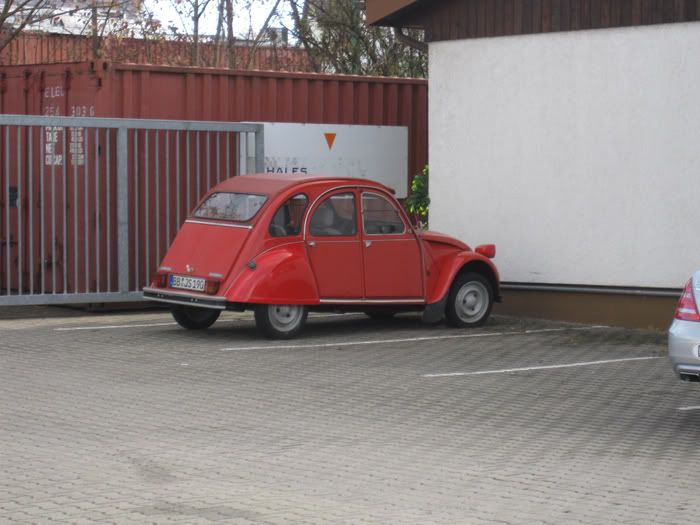
And a nice sight of an old, yet charming, Citroën 2CV. It more than stands its ground in a lot full of North America-bound luxury cars.

Upon entering the office - adorned with, among other things, a map of the United States - the lady inside let me know that it was a 600-liter gasoline spill that had caused the massive backup on Autobahn 8. That explained everything! The paperwork proceeded. I had to fill out a US EPA form certifying that the vehicle fully meets applicable US emissions standards, sign a shipping contract that stated that the car is to be delivered to Mercedes-Benz's Vehicle Preparation Center in Long Beach, California with the cost prepaid, a US power of attorney authorizing E. H. Harms to customs-clear the car on my behalf, and an inspection form indicating that no damage to the car was done, aside from leaves stuck on the doors due to the rain, during the European drive. (That relieved my mother of her biggest worry.)

At this point, I had to empty everything that was NOT listed as part of the car's factory equipment - all personal belongings, the manuals, the registration papers, and even a sample CD provided with the car for testing the Harman-Kardon Logic7 sound system. I made sure to remove all the CDs from the CD changer as well. Copies of registration papers were made to indicate to the US Customs that this car was being imported as privately owned, while I got to keep the originals.

Soon, the white S-class came in as well. Turned out that it was driven by an elderly Cuban emigré couple sending the car to Miami. The gentleman who had been driving asked me how I beat him - and I told him about the shortcut I took, which he had not been aware of. He asked me where I was from, and when I said Los Angeles, we did an instant comparison between Miami's Little Havana and Los Angeles's Koreatown. Two very similar ethnic communities indeed, with the strongest common link being McCarthyism, though there was no need for me to disclose my severe displeasure toward Little Havana and Koreatown to him. The Cuban-American couple was about to miss the flight to Paris due to the traffic jam; on the other hand, my mother and I still had ample time left over for the train hop to Paris.
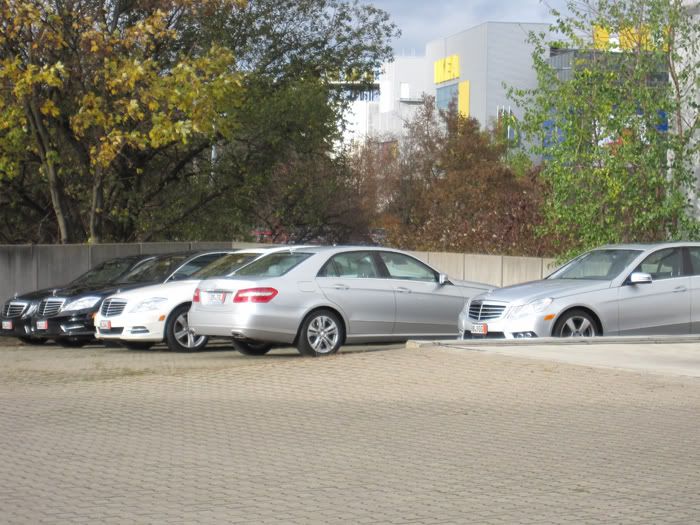

My final look at the car before shipment, surrounded by a number of other export Mercedes-Benz vehicles. There is also a BMW 7-series in the lot, though not pictured - E. H. Harms is the designated European Delivery shipper for all European automakers that offer the program to Americans.

As it would turn out, the car would be taken by train to Bremerhaven in northern Germany on Saturday the 7th, and put on an NYK Lines ship on the 14th. The ship would arrive in Long Beach on December 10th, and the car customs-cleared by the 16th, though due to the Christmas holidays, Vehicle Preparation Center wouldn't add the iPod connector and US-spec First Aid Kit and deliver the car to the dealership until January 5th. The dealership refueled, detailed, and re-delivered the car to me the following day.

The shipping office lady informed me that the car would be shipped to the US as is, complete with the toll stickers and German export plates. I did know that the car would have to be washed in the US for the USDA agricultural inspection, but expected the car to show up as is otherwise. But I was later told that the Vehicle Preparation Center removed all stickers (I didn't care for the toll stickers, but wanted to keep the emissions and German nationality stickers), and the car came to the dealership with only the German export plates, plus the window sticker that's normally given to new cars imported for sale but not to privately owned European Delivery cars like this. Bummer. The export plates were removed by the dealership, replaced with dealer insignia, but the saleswoman made sure to give the removed export plates to me as souvenirs - my mother still has them.

Now it was time to move on. I had the shipping office call a local cab company, so that my mother and I could head for the nearest S-Bahn station at Böblingen to get into Stuttgart. I was again finding it frustrating that my mother was leaving all logistics up to me, and not even bothering to know what an S-Bahn was, despite having spent days in Munich and Stuttgart at the beginning of this trip. At the station, we lucked out - the next train to Stuttgart was actually a nonstop Regio train, which I could still ride with the S-Bahn fare. As the train approached Stuttgart, I was glad to see the rolling hills with vineyards again, as well as charming residential neighborhoods. I also noted a blue French TGV bullet train in the yard as the Regio train approached the station - I knew that would be my ride to Paris.
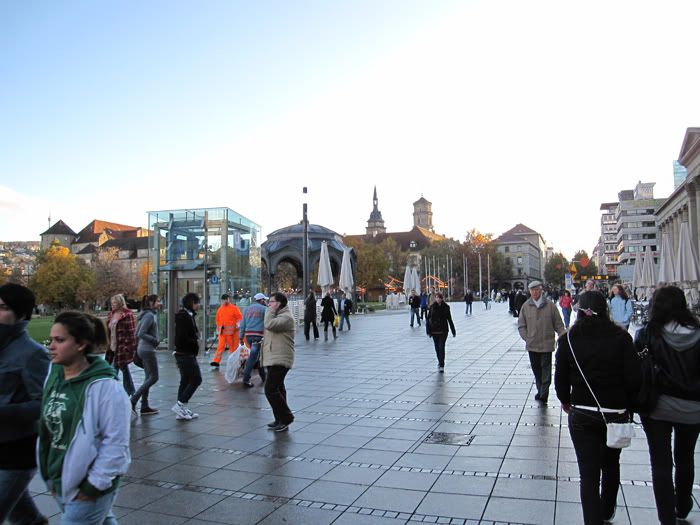

Back in Stuttgart. I arrived around 3:50ish thanks to the fast nonstop Regio train. With the Paris train leaving at 6:52, I had three hours available. Just like back in Munich, all bags were put away in a station locker, and I am back on Königstraße one final time.

Glad to see the vibrancy from the people and in the air. Again, I was feeling that Stuttgart region was not merely the hometown of the Mercedes-Benz that I have just sent to America - it was becoming a hometown of sorts for me too.
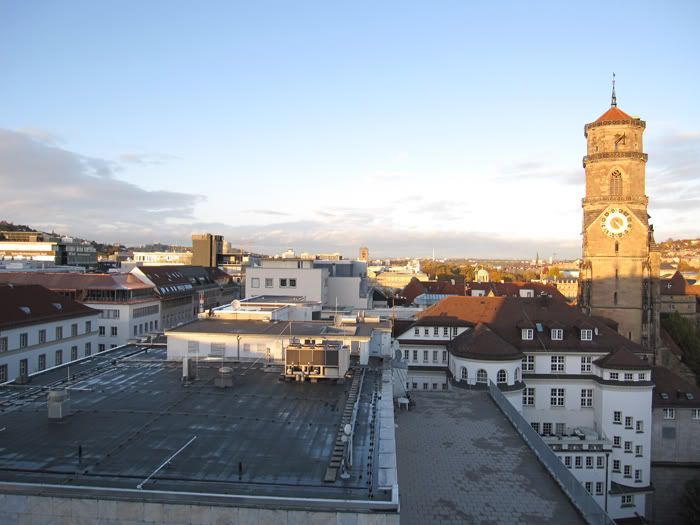

Having an early, light dinner. My vantage point is the outdoors terrace of the sixth floor café at Karstadt department store. (Of course, I'm eating inside, it's too cold out here especially after the rain, I'm out only for photo ops.)

Looking north toward the train station. I definitely remember that old church clock tower from the previous week.
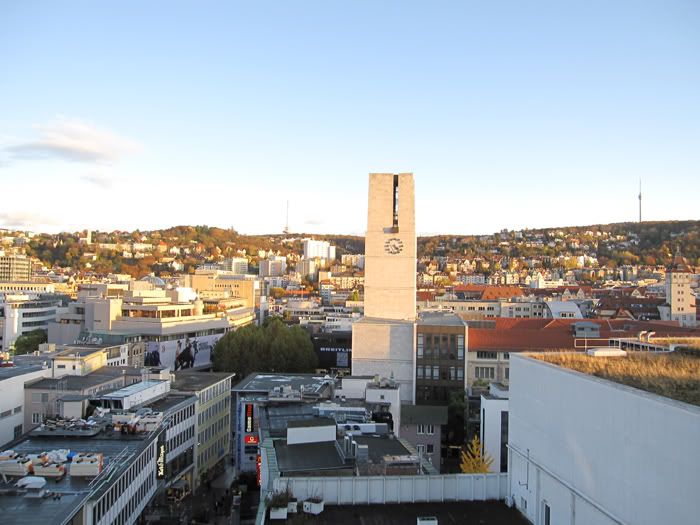

And looking east toward a newer clock tower, with the hills and an observation tower in the distance.

Karstadt turned out to be more than a meal stop. Shopping continued - though this time, my mother was shopping for Christmas ornaments for her new home, in the form of three porcelain angels with glitter wings. And in any case, window-shopping an upscale German department store is never a bad thing - especially when I am walking around in the toy section and finding that not all stuffed animals have to come from Chinese sweatshops.

I also made my own purchase - Mariah Carey's newest album, Memoirs of an Imperfect Angel, which features a lovely cover of a 1980s Foreigner hit, "I Want to Know What Love Is." I had been in Las Vegas in mid-September to see a special Mariah Carey concert and enjoy that particular song (though admittedly, this concert was a dud, and I had to make up for it with another, far superior, Mariah concert in Los Angeles in February). My original plan had been to buy the CD before starting the drive to listen while driving, but that didn't quite turn out - but better than never. This also meant that I was buying my Mariah Carey CDs from four different markets - US, UK, South Korea, and now Germany.

(But as it would turn out, I wouldn't open the CD packaging until arriving in the US - only to find that it had a manufacturing defect, packaging with no CD inside. Too late to ask for a refund without a lot of costly hassles.)

We returned to Hauptbahnhof about an hour before departure, saying our final farewells to Stuttgart, now an adopted hometown and certainly the most pleasant surprise during this trip. After grabbing some ice cream and retrieving our bags, we finally found the TGV boarding - though disappointed to see that our seats faced backward. I made sure to remind my mother of the previous year's train trip together - Seoul to Busan on South Korea's KTX bullet train - and also remind her that this train was exactly the same model, except for crummier passenger cabin and slightly newer locomotives.

The train departed with mostly German commuters on board, disembarking at the first stop of Karlsruhe. All announcements were in German, French, then English - and from Strasbourg on, French coming before German. The train crewmembers had both Deutsche Bahn and SNCF pins on their uniforms. As the train entered Strasbourg, I clearly saw the German phone signals fade away, and manually switched to French phone carriers and French-language dates and times. Dead tired by now, both of us slept soundly through the high-speed run, waking up barely in time for the arrival at Paris' Gare de l'Est around 10:30 at night. The hotel I booked, a Best Western "in the Marais district" - actually the very northern fringes of the Marais, not really Marais at all - was two longish blocks away, and the walk went through unexpectedly seedy neighborhoods. We were knocked out by the time we entered our corner double room, though glad that we wouldn't have to hop around hotels again, this Best Western being our final European hotel.

14 April 2010

Europe recap, Day 10: Jungfrau

Tuesday, November 3, 2009. No driving involved this day, as all my day was spent hiking up in the Alps. As Rick Steves likes to say, any day in Switzerland that is not spent hiking in the Alps is outright criminal.

The day started with the first Jungfraubahn train leaving Interlaken Ost Station at 6:35. I was glad to see that at every row on the train, I could see the map of the area, showing major points of interest (transfer points, villages, etc.) and their altitude in meters. I was starting at Interlaken, which was at under 600 meters altitude (around 1,800 feet), and ending up two hours later at Jungfraujoch, at 3,500 meters altitude (close to 12,000 feet!). A fairly conventional train took me as far as Lauterbrunnen, from where I had to transfer to a narrow-gauge cogwheel train, full of aged Alpine flair, for the second leg up to Kleine Scheidegg.


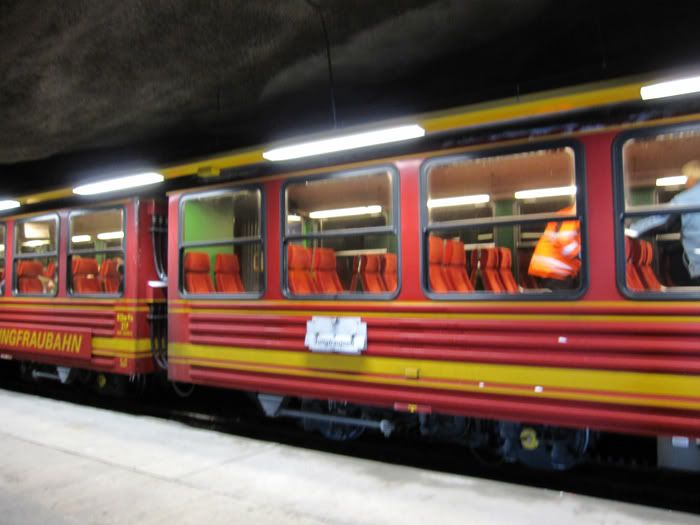
Now, I am on another cogwheel train, having just pulled out of snow-covered Kleine Scheidegg Station, for the final push up to Jungfrau. It's quite chilly outside already, and altitude at this point is already over 2,000 meters.

The train, intended for tourist use, is quite posh, and the cabin has video screens playing introductory video to the region and the railway. Narrations are in eight languages: German, English, French, Italian, Spanish, Japanese, Mandarin Chinese, then Korean. The crowd this day was very Asian indeed.

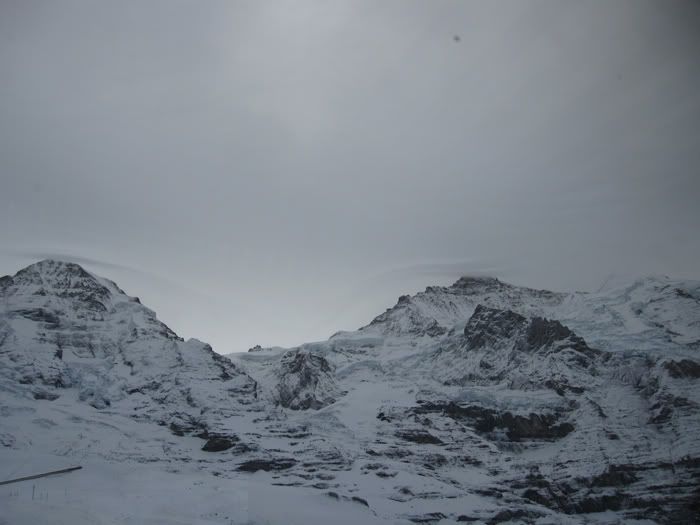
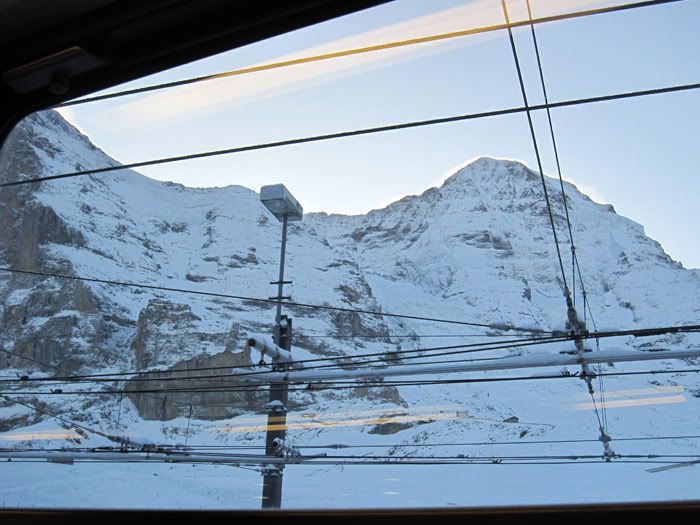
The wall on the left is part of Eiger (Ogre), while the peak on the right is Mönch (Monk). In the legends, Mönch protects Jungfrau (Maiden), further to the right, from Eiger.


Another look at Eiger, and its infamous North Face, before entering the tunnel portion.

The tunnel starts at Eiger's anus (ewww!) and works up his intestines, before transferring to Mönch and going under his robe, to finish at Jungfraujoch, the mountain pass between Mönch and Jungfrau.


Inside the tunnel, the train makes a couple of intermediate stops, to allow passengers to disembark and take a look outside.

The outside views are okay, but not spectacular, as the Plexiglass windows are all fogged up. It's quite chilly in the tunnel, but still balmy (at least above freezing) compared to the harsh conditions outside.

The first stop, well inside Eiger's guts, is already at 2,700 meters above sea level. From this point on, hypoxia becomes a real issue; staying fully alert becomes a bit of a challenge, and nausea is common for weaker travelers.


I am now at the Sphinx, the observatory located on top of Jungfraujoch. It is a lengthy elevator ride (about 100 meters up) from Jungfraujoch's train station.

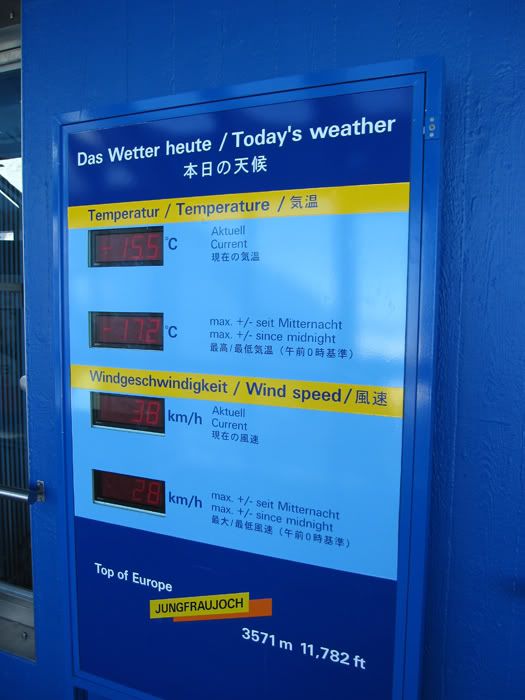
My elevation is now at 3,571 meters, or 11,782 feet, above sea level; Jungfraujoch is, indeed, called the "Top of Europe," and its railway station is the highest in Europe. And those temperature readings (barely above zero, if converted to Fahrenheit) and wind gusts are certainly NOT conducive for a hike outside. Between the hypoxia, the cold, and the wind chills, I'd pass out within minutes and freeze to death, if I ever dared to go all the way to Jungfrau's summit.

At least I am able to move about. My mother is completely clobbered, and she is forced to lie down on a bench near the train platforms and rest.


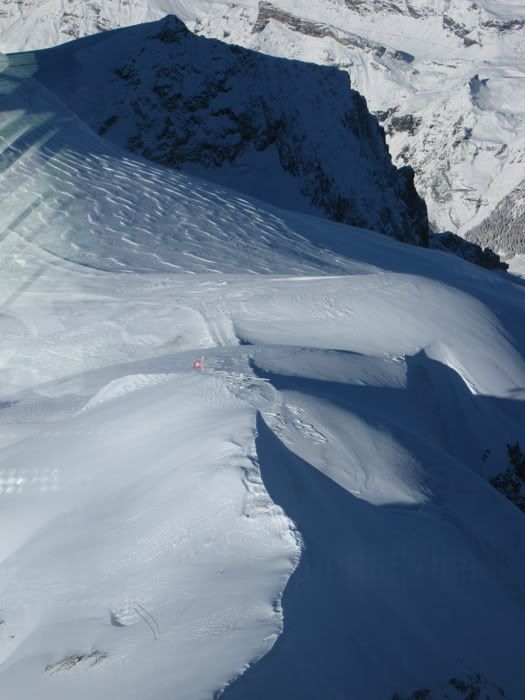
I am looking north in the direction of Interlaken, which would be hidden in the east-west valley in the distance. Gotta love these glacier-carved mountain cliffs and valleys, something I don't see on a daily basis.


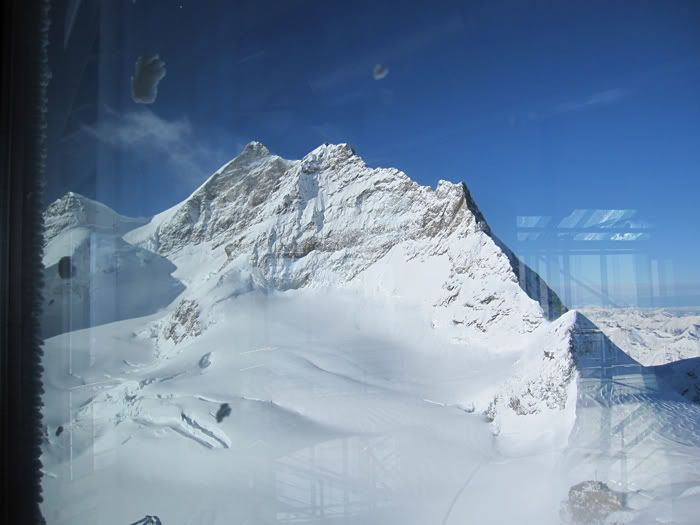
Looking west at Jungfrau herself.

Before I came on this trip, I was having some mountain-related discussions with two Facebook friends - Morwen Madrigal of New Orleans, who used to work for the US Geological Survey back in the day and brags about "having licked all the Grand Tetons," and Angela LaChic of Calgary, who loves to climb the Canadian Rockies close to her home. As all three of us are lesbians, we joked about selectively climbing, and licking, the summits of mountains with female names, and of course, I had to mention my planned visit to Jungfrau.

Unfortunately, again, due to the bitter conditions outside, this is as close as I'll ever get to licking the summit of that maiden, clad in a beautiful white dress.


That Swiss flag marks an observation point, and the start of the trail to the Jungfrau summit. But then, again, due to the brisk conditions, it'll be a challenge for me to get even that far, and walk on the glacier, much less attempt the summit of Jungfrau, which is at 4,100 meters above sea level, and will definitely clobber me.

Granted, I've been at high altitudes like this before - just four months prior, I had been at Rocky Mountain National Park, where I actually drove to 12,000 feet in a car - but it is harder now, due to a much faster ascent this time. At Rocky Mountain, I had spent the previous day or two at altitudes around 5,000 feet and a bit higher, so I had some chance to get used to the thinner air, but I don't have that benefit here at Jungfraujoch.


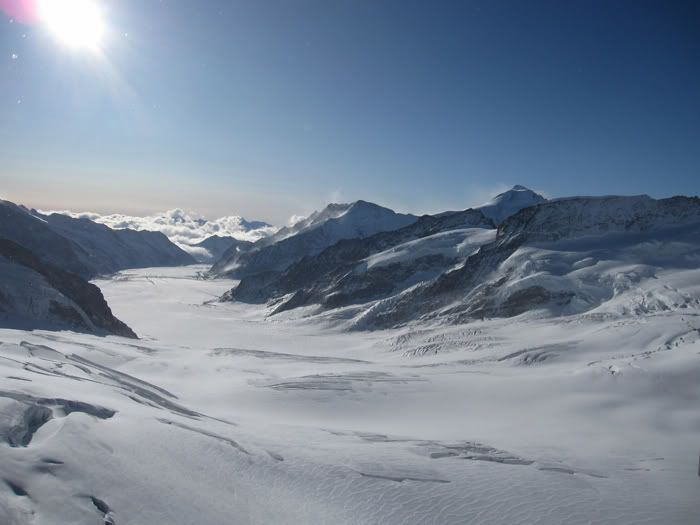
This is a lovely view to the south, showing a glacier stretching in the direction of Italy.

It won't be Italy right away where the glacier disappears into the clouds, but over there, I do have to speak Italian. Over here at the Top of Europe, the language spoken is German, though I can easily get by in English and Asian languages due to the tourist traffic.


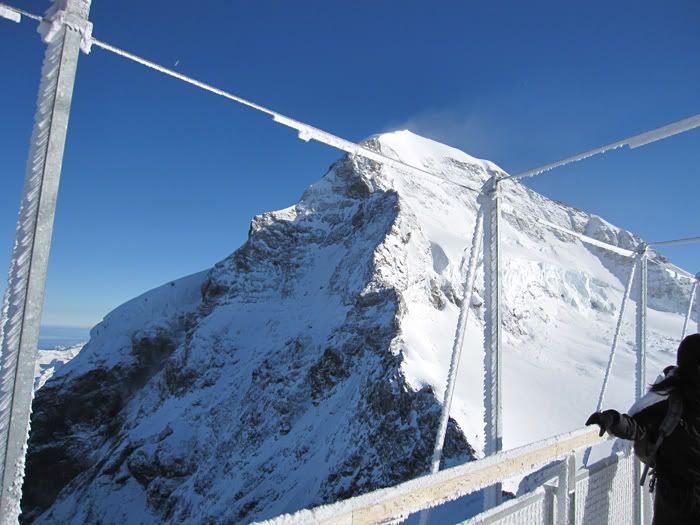
To the east lies Mönch. Nice view of snow blowing off the summit.

To my mountaineering friends and others, I jokingly refer to Mönch as "your stereotypical Catholic pedophile priest" - one who has gone commando under his robe, and whose pee-pee I had to endure watching as I had ridden up the tunnel. According to tradition, Mönch protects Jungfrau from Eiger behind him, but right now, it's me protecting Jungfrau from that pervert monk.

I took this particular photo outside the sheltered dome of the Sphinx. I found it impossible to stand outside for more than 30 seconds at a time.


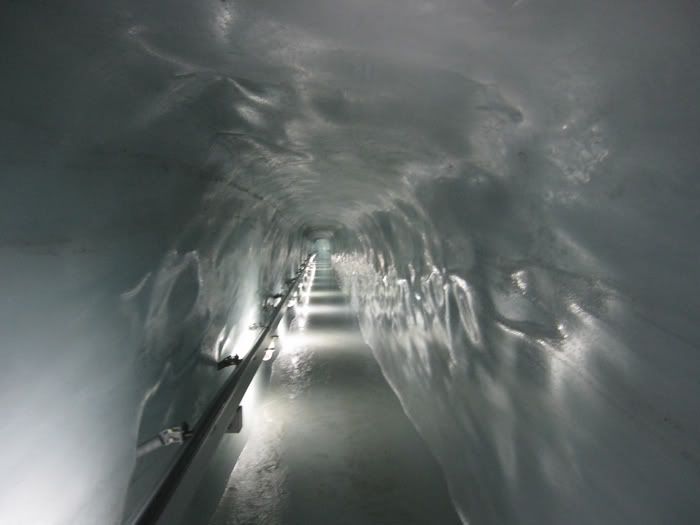
I am back into the visitor services area. One of its features is the Ice Palace, a tunnel dug into the glacier.

It is surely cold in here, and hypoxia is still trying to clobber me. But I am finding that moving around is the best defense against hypoxia.


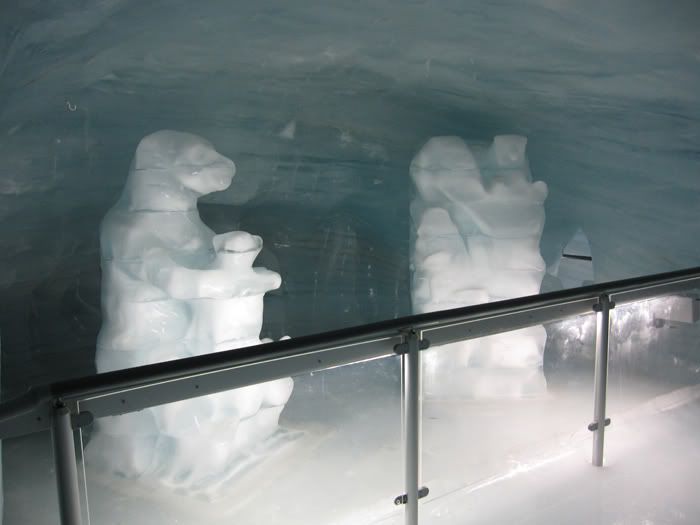
The Ice Palace is lined with many ice sculptures, like these polar bears.


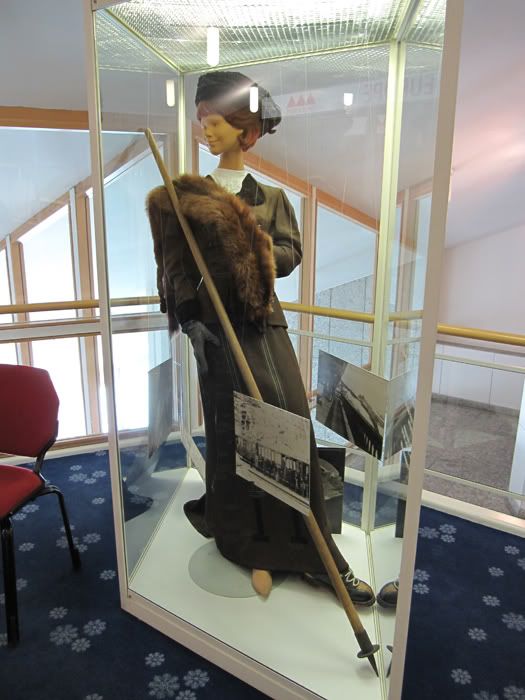
Early visitors to Jungfraujoch would have come dressed in outfits similar to this.

Practicality and warmth, while still showing off style and femininity, that's really my thing.


A number of snack items are available, but everything is grossly overpriced, because of the added complexity of hauling everything up from Interlaken.

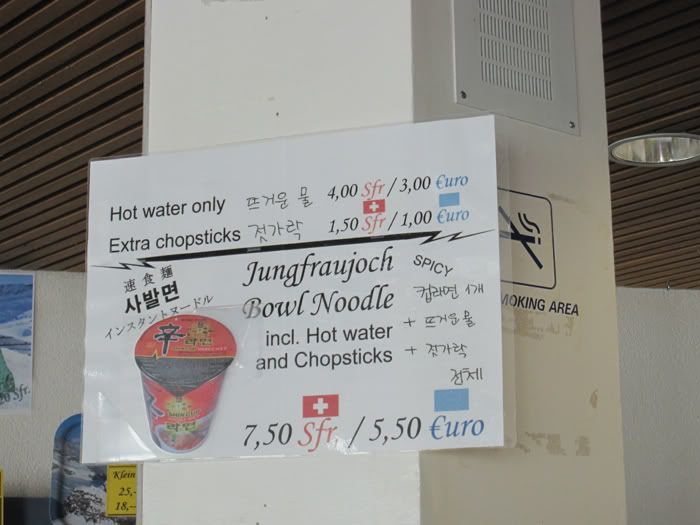
Here is an interesting choice. I can buy a small cup of "Jungfraujoch Bowl Noodle" - which is just standard bowl of instant ramen from South Korea's Nongshim Foods. The price is an obscene 7.50 Swiss francs, and if I need extra hot water or chopsticks on top of what the attendant provides, that will cost me a small fortune as well. For comparison, buying the same bowl at a grocery store in Seoul or Los Angeles will cost under a franc - and not much more at one of the Asian grocery stores back in Interlaken.

Not exactly the most authentic way to go, but I took up on the offer, just for the experience. The chilly environs of Jungfraujoch make the hot noodles a good choice, as well as a memory to savor.

It is notable that the menu is done not in local languages, but in English and Korean, indicating that the noodles are targeted to Asian tour groups. And sure enough, every visitor today is either Japanese or Korean. My mother and I are chatting with the Korean visitors in Korean - though they have no idea (and no need to know) that we are really Americans independently traveling in a European Delivery Mercedes-Benz, rather than fellow group tourists from South Korea.


Now I am back to saner altitudes of Kleine Scheidegg, and my mother has finally come back to full vitality.

I have been previously advised that Jungfraujoch tends to be sunny in the early morning hours, before clouding up very fast for the rest of the day. And I am finding that to be indeed true. Good thing I took the early morning train. This photo shows Mönch on the left, Jungfrau on the right, and the Sphinx observatory in the middle.

Jungfrau would soon hide in the clouds and never show herself to my eyes again. She is indeed one very shy maiden. Glad to have come face to face with her.


We proceeded downhill, to Wengen, just below the snowline. The initial plan was to take a cable car over to Grindelwald, and return to Interlaken there. But as it turns out, the cable cars are all shut down throughout the region; between the summer hiking season and the winter ski season, they were all shut down for routine maintenance, and indeed, that also explained why the Jungfrau Region was overrun primarily by Asian tour groups, rather than independent travelers and locals.

It would be another hour before another train would come to Wengen to allow me to continue downhill to Lauterbrunnen. Since the nearby hiking signs indicated that walking to Lauterbrunnen would take an hour anyway, I decided to walk down instead. This would also be an opportunity for my mother to enjoy the fresh Swiss Alpine air and fully recover from the hypoxia.

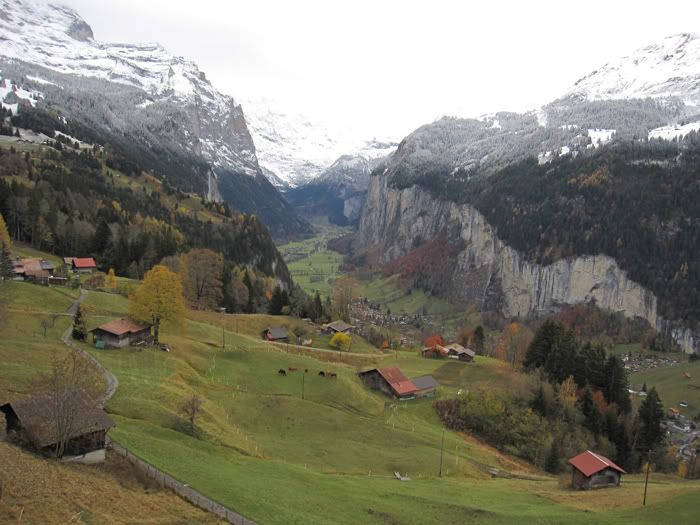
Downhill hiking is the best way to really take in the postcard Switzerland - the huts, the cows, the cowbell sounds, and the lush grass, as well as gorgeous views of the glacial valleys that look similar to Yosemite Valley (itself glacial). And excellent signage keep indicating which way to walk toward my destination, as well as estimated walking time.

The Lauterbrunnen walk time of one hour was said to have been timed by local senior citizen volunteers. Even at my more youthful walking pace, the one-hour estimate was right on the mark; these senior citizen volunteers are certainly master hikers.


As I walk further downhill, I can see a waterfall on the other side of the Lauterbrunnen Valley. I am again reminded of Yosemite Valley back in California.


And now I close in on Lauterbrunnen. In the lower left, I can see the cogwheel railroad.

As I walk down, I am sharing with my mother the basics of how the European economy works. I discussed the role of the European Union, even though I also stressed that neutral Switzerland is not an EU member, and also that the UK, despite being a member, tends to not march in lockstep with the Continent. I also discussed the European taxation policies with hefty income and sales taxes but smaller to no property taxes, as well as how the taxation pays for various government services, including universal healthcare and top-notch transportation network. I compared and contrasted the European Union's mechanisms with those of the US federal government, and wrapped up with an observation that while Americans may possess more materially (including the Mercedes-Benz we're driving around in, and sending to America the next day), Europeans have the basics (i.e. healthcare) better covered while consuming only a fraction of the resources.


Now I am back in Lauterbrunnen, with only a few more minutes to go to the train station.

More evidence of heavy Asian tourist traffic. That hostel-style accommodation displays a South Korean flag, and has signs in Korean, though it turns out to actually have a Japanese owner.

For East Asian independent travelers to Europe, places like these can be a very good way to mingle with fellow travelers speaking the same language, eat the home cuisine, and gather travel information. This American with full English and limited French proficiency prefers to hang out with the locals and eat local food, but can certainly appreciate the value of this travel infrastructure for East Asians who want to go beyond the group tours but don't have the advantage of European language proficiency. It's thanks to places like this hostel that South Koreans have learned to travel through Europe on a budget - and also learned that the neoliberalism, Christian conservatism, and homophobia, taught to them by their former military dictatorship and its US Republican masters, are not the prevailing ways of the civilized world (and I am grateful, having seen the mentality improvements back in South Korea first-hand in 2008).


From Lauterbrunnen, twice-hourly commuter trains run back to Interlaken Ost. Now I am back in Interlaken but am not retiring to my hotel just yet.

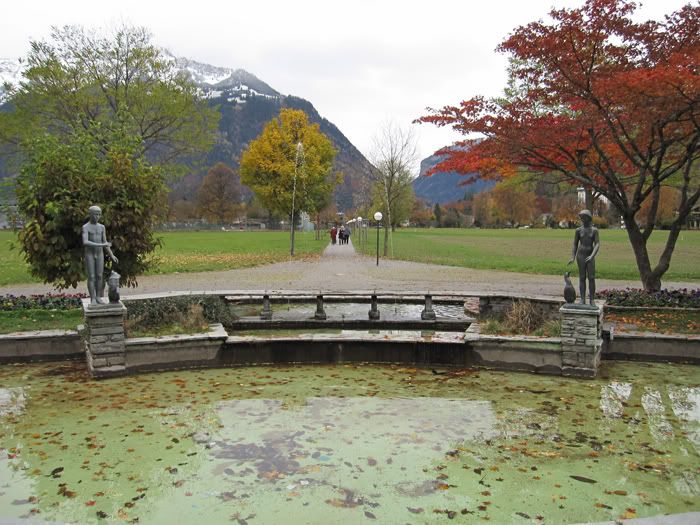
I am at the expanse of grass where I had seen grazing cows the previous day. Cows are still grazing, but this time I have the photo of these statues instead.

Again, thanks to the rise of the word "Tea Party" and "teabagging" to denote the anti-Obama neoliberal protests in the US, I am referring to all male nudes as "teabaggers," and chuckling at them. In this case, however, the male nude has a female companion, and I have chosen to call the female nudes "carpetmunchers" for a contrast. I was indeed wishing that a sane, progressive countermovement to the teabaggers would start in the US, and that it would indeed call itself the "carpetmunchers"; that would eventually happen in early 2010, though its name would be the Coffee Party USA instead.


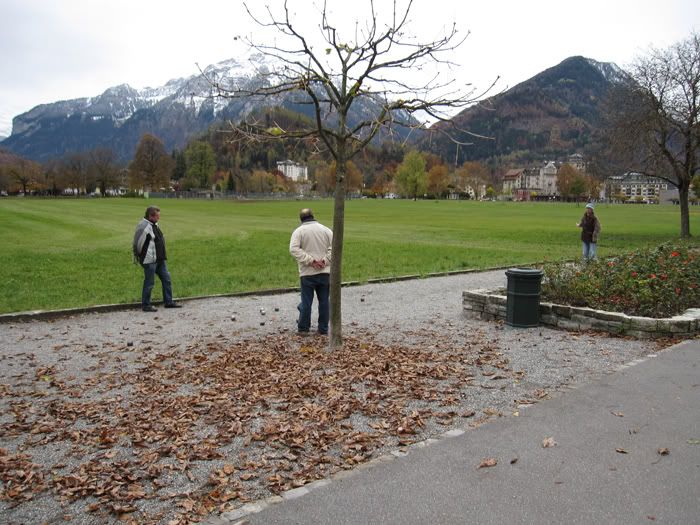
And nearby, these elderly men are playing a game of boules - a game where the objective is to roll a large metal ball as close to the smaller target ball as possible without hitting it.

I had seen the game in the Rick Steves videos, and am glad to see it in action.


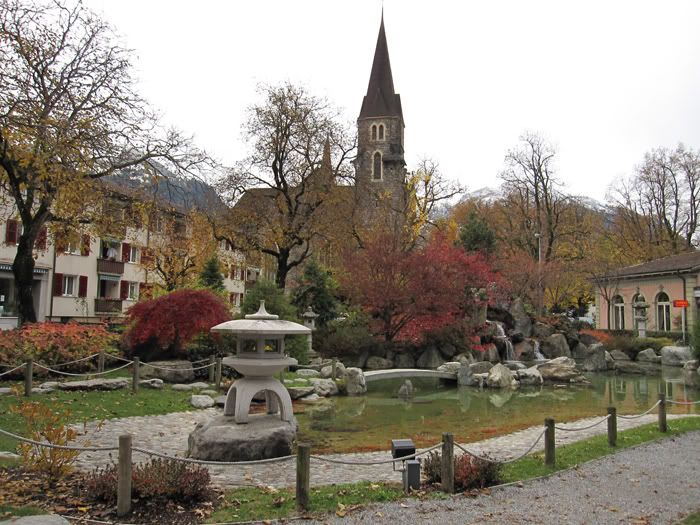
Now heading back to the train station, then on to the hotel in Goldswil. Here is a better look at the Japanese garden that I had seen the previous day.

As it turns out, this garden was a gift of the Japanese city of Otsu, which had been an Interlaken sister city since 1978, when Japanese tourists started arriving here in droves. The garden was built in 1995, with elements symbolizing the Berner Oberland mountains and lakes.

At this point, my mother and I did some souvenir shopping - though one particular souvenir shop, featuring some bells (not cowbells, but ceramic) that my mother wanted, was not open. In fact, it was the only shop with such bells, and it would not open for the duration of my Interlaken stay. Also, the cold air and hypoxia in the mountains had done their work on my mother, and she wanted to buy some cold medication; a pharmacie (as opposed to a smaller Apotheke which I normally see in German-speaking areas) next to Interlaken Ost helped us. While the English-speaking pharmacist did not recognize the American brand name Tylenol, she did choose a local-brand equivalent, and upon reading the packaging and the instruction sheet, I could indeed discern that it was a cold medicine, and could also figure out the proper doses. This being Switzerland, the instructions were trilingual - and again, when three languages are used, chances are good that I understand at least one (French in my case).

Upon retiring to the hotel, I took time to clean out and prepare the Mercedes-Benz for the shipping the next day, while my mother took it easy in the room. I also fired up my laptop and its Microsoft AutoRoute, so that my mother would finally have an idea of the route I had taken her through so far - as well as the route remaining (drive to Stuttgart, then TGV to Paris for a 3-night stay before flying home via Munich). Speaking of the car, its odometer reading was approaching 2,000 kilometers - and just over 1,200 miles when the units were switched to Imperial. I had driven a lot, and there was some more driving to do the next day.

The return to Stuttgart, the shipment of the vehicle, and the continuation to Paris will be the next post.

12 April 2010

Europe recap, Day 9: on to Interlaken

The journey continues on November 2nd, 2009, as I push my way out of Italy and into Switzerland.

I woke up to a very cloudy, drizzly morning in the Como area, and after eating the ample breakfast buffet at Hotel Cruise, checked out and continued driving. I do want to say that Hotel Cruise was one of the most modern places I had ever stayed in, although it had all the character of a business/convention hotel rather than one that leaves an impression in the minds of tourists. Nevertheless, if I ever find myself driving around Como again, I will stay there again.

Although re-entering Autostrada 9 would have led immediately to Swiss Autobahn 2, I decided not to do that; instead, I decided to take a leisurely drive along the west shore of the Como. Although I honestly wanted to get to the village of Bellagio (the namesake of Las Vegas's posh Hotel Bellagio, which comes with its own Lake Como) in the dead middle of the lake, my study of the Microsoft AutoRoute map hinted that its streets seemed impossible to negotiate, so I decided to settle for Menaggio halfway up the west shore, from where I could drive on to the Swiss city of Lugano and join Autobahn 2 there.

I fueled up at a Shell station at the edge of Como, but had no luck buying a Swiss toll sticker. I decided to continue on, following a road that was signed as SS340; despite the numbered route status, the road was ridiculously narrow, and I was forced to share the road with big vans and other awkward vehicles, on a road that was too often barely 1 lane wide. My progress was painfully slow, and although the cliffs and the villas looked as fabulous as they had on the Rick Steves videos, I had zero view of the lake nor the mountains around thanks to the fog. Moreover, my mother was really getting on my nerves; due to the narrow road, she was convinced that I was going to scratch her brand-new luxury car right here, and every moment she shouted and whined, I was being distracted, and stepping ever closer to actually getting the car scratched. I was relieved to reach Menaggio, where SS340 took a tunnel and turned west toward Lugano - but even then, the road was just as narrow and dreadful, with hardly any view.

I entered Switzerland through a narrow pass under a cliff and through tunnels. As Switzerland is now part of the Schengen Zone, I could enter without flashing my passport, but as it is still a neutral country and not part of the European Union, I did see prominent customs checkpoints through which I had to slow down, ready to stop as needed. Now, I was in my fourth country of the trip and eighth European country overall, noting the default speed limits of 50 km/h urban, 80 rural, and 120 motorway. Another Shell gas station, just beyond the Swiss border, was where I ended up stopping to get the required Swiss motorway toll sticker - 40 Swiss francs or 26 Euro for a sticker good from December 2008 to January 2010 (I cannot get any shorter duration in Switzerland).

I was very relieved to emerge into the Lugano city street grid; at least, I had two to three lanes to choose from in my travel direction. Following the signs carefully, I eventually entered the northbound Autobahn 2, in the direction of San Gottardo (St. Gottthard Tunnel). For now, I was still in an Italian-speaking zone, with placenames in Italian and motorway exits labeled as "USCITA." I noted the gasoline prices around 1.60 - thinking it was expensive as hell.

As I climbed up the hills, the two-lane motorway shrank to one, and it was two-way traffic, as I entered St. Gotthard Tunnel, with the speed limit down to 80. This tunnel passage took forever - it appeared the tunnel was over 25 kilometers long (it certainly looked pretty long on the map), and with the lower speed, transit took a while. And I did note the outside temperature climbing up into the 80s Fahrenheit (the US-market car's temperature readings were all permanently fixed into Fahrenheit) as I continued through the nearly endless tunnel. At least there were no exhaust fume smells, thanks to excellent ventilation.

When I finally emerged outside the tunnel, I started noting placenames in German again, and indeed, exits were labeled as "AUSFAHRT." Soon afterwards, I pulled into a rest area for a quick meal, and also to obtain Swiss francs. At that time, I realized that those high fuel prices were in Swiss francs, rather than in Euro; at that point, those prices looked a lot more friendly, because Swiss francs were at parity to the US dollar, while one Euro was 1.40 in either currency. That would make Swiss gas prices at around $6.25 or so per US gallon, while German prices would be closer to $8. In any case, having filled up back in Como, I didn't need to fill up again just yet, and that was just fine, since there is nothing fun in spending well over USD $100 to fill up a passenger car.

With 200 Swiss francs in hand, I continued to drive, until the Autobahn 8 turnoff. There was less than an hour's driving left until Interlaken. Switzerland is a truly compact country, and I was overestimating my distances and travel times again. Sure, 250 miles is a long way to go, but it sounds worse when it's expressed as 400 kilometers, because of the higher numerical value.


I am proceeding westward through a very scenic landscape that is picture perfect Switzerland, filled with glacial lakes like this photo.

In fact, Interlaken itself is squeezed between two very similar lakes - hence its name, "between the lakes."


I have pulled over into a turnout for a quick nap and rest.

Yes, I am seeing turnouts, rather than rest areas. Autobahn 8 is an Autobahn in name only; it uses sections of normal highways for its routing, and often is reduced to a main street going through a rural town. It is a nice two-way traffic, two-lane road, but that's about it. Speed limit is only 80 km/h as a result. There are some sections that are truly crooked and I have to really slow down to around 40. The dual carriageway Autobahn-grade section wouldn't even start until I actually was within a few kilometers of Interlaken.


I have now arrived, and having parked the car at the hotel, now I am walking into Interlaken to get information on the Jungfrau trains.

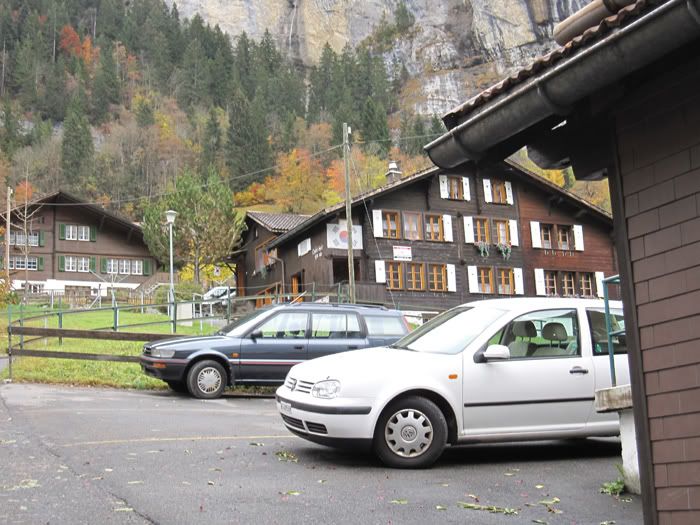
That town in the distance is Goldswil, just outside Interlaken town limits. That's where I am staying - I am at a hut-style hotel named Schönegg, a very nice property with lots of personality and decent rates.

Interlaken Ost train station is only a 5-minute walk from Goldswil, and that is my reason for staying there. Interlaken Ost is the departure point for all train services toward Jungfrau.

In fact, I ducked into Interlaken Ost Station first, to get the timetable for the Jungfrau trains, and to buy a morning special ticket for 160 francs per person. The morning special would allow me to board only the first two trains of the next day - 6:35 and 7:05. This would be probably the most expensive train ticket of my life, given the rather short distance traveled.


I am continuing into town - and passing this Japanese friendship garden. I would spend a bit more time here the next day.


This is Interlaken's grandest hotel, built when the town became a key tourist stop in the 19th Century, with the opening of Jungfraubahn, the cogwheel railway up the slopes of Jungfrau. In fact, I am here to ride that very railway the next morning.

This hotel also holds a casino, which caters to the big East Asian tour groups that descend on Interlaken all the time.

And as evidenced in this photo, I can also find a Hooters restaurant here. Hooters is the most revolting excuse of a restaurant that I know of - cut-rate food and crummy service, the only draw being the scantily clad young women for the guys' viewing pleasure.


On the town's main green, cows graze on the grass. I am loving this sight!

Of course, I can't forget the Swiss cowbells either...


Another tourist-oriented business: "Last Sex-Shop before the Jungfrau," where I can go in and watch some porn videos. I skipped, of course.

I did walk around the entire length of town, however, spending some time in shopping centers. Near Interlaken West train station (even this tiny town has two train stations), I found a shopping center that seemed to have a department store of sorts inside; I could also find an Asian grocery store nearby, presumably doing business off of the East Asian tour groups. And back near the Interlaken Ost station (only 15 minutes from Interlaken West on foot), I found another shopping center, where I ended up doing some minor grocery shopping at the supermarket on the ground floor. I had tried to pay for some fruits having only bagged them, without weighing the contents and putting on a price tag first - the cashier had to run back and do it for me, quite embarrassing.

While out and about in Interlaken, I had also ducked into a McDonald's for an early dinner. Again, thank my mother's lack of adventurous spirit when it comes to food. This turned out to be the most expensive Big Mac meal of my life: 12 Swiss francs. I had to ask my mother not to keep going back to McDonald's - and also promised her that once we hit Paris, I'd take her to the French competitor, Quick.


Now I am walking back to Goldswil. And this is the waterway that links the two lakes which frame Interlaken (and give the town its name). It's certainly glacial melt. I have never before, and never since, seen water in this color. What a sight!


And I am now back in Goldswil, looking back toward Interlaken Ost and the majestic peaks further south. The valley leading there would be Lauterbrunnen Valley, and that's where my train ride would go through the next morning.

And the road in the foreground is the bridge that goes over the glacial waterway of the previous photo, to connect Goldswil to Interlaken. And that's also how I had driven into Goldswil in the first place.

It's still early evening, and I would spend the rest of the evening getting some rest, watching TV, and plotting the next day's sightseeing up in the mountains. And since this was trilingual Switzerland, I could actually stick to local French-language channels (plus additional ones from France) which I could somewhat comprehend, rather than German and Italian stuff I had zero comprehension of; I no longer had to rely on English language channels alone, though it was fun tuning into BBC and watch an installment of The Weakest Link the way it was meant to seen - without the commercial breaks that had driven the American version to failure.

10 November 2009

Back from Europe

Internet access in Europe was expensive, so no time to really blog.

My accounts and photos will be uploaded over the next few weeks. This was a great trip - though not perfect, it was finally a way for me to drive away the demons of my disastrous 1999 Amsterdam visit, and get intimate with Europe again once and for all.

22 October 2009

Departing soon...

I have been so stressed out, from work and personal matters, that I have done no further preparatory posts on the cultures of Germany and my other European destinations, even though I did enough Wikipedia searches on the topics.

But I am happy to say that my departure is imminent. This will be my last post before Europe. I do expect to have Internet access at all my European locations, but that cannot be counted on 100%.

It'll be priceless being away from the teabaggers and their Third World anti-individual mindsets, if only for a few weeks. (Yes, much of my stress is due to Asian Confucian BS - even from people well outside my circle of acquaintances.) Sure, Asian-Americans are considered elitist a-holes by most of Europe (since Asian-Americans often consider themselves white equivalents, and bring in the worst of America's right-wing elitist attitudes right into Europe), but I don't have to advertise being an American. Just to be sure, I will not have any US dollars on me as I depart - only Euro.

Despite the tight schedule, I hope to accomplish much of what I managed to do in Seoul and Hong Kong last year. And that alone will be priceless.

I have already changed my "current location" on Facebook to Munich.

10 October 2009

Travel reservations complete

Now I have almost all aspects of my European trip nailed down.

My last missing hotel piece - three nights in Paris - was resolved, with a booking at a Best Western in the Marais district. My friend DiAnne Grieser of Seattle, a huge Francophile and a frequent Paris visitor, steered me toward the Marais, since it's still quite close to the Latin Quarter, and I am glad she did; the Marais has cheaper hotels that are just as charming and comfortable. Plus, I do think the Marais - between its elite past, its Jewish population, and its gay culture - will be quite interesting. Most importantly, it's close enough to Gare de l'Est and Gare du Nord that I won't have to lug my bags through the Metro, but far enough to be saner.

I also have two train legs: the first from Munich to Stuttgart for the car pickup, and the second from Stuttgart to Paris after the car dropoff. The second leg was booked on a dirt-cheap price (reservation fee included), and it will be a direct TGV run. The only downside will be late-night arrival in Paris, but on the other hand, I will not have to rush my way into Stuttgart that day, since I will need to drive in from Interlaken. Sure, past Zurich, it will be on the A81 Autobahn, the speed demon's dream, but traffic jams can, and will, often happen! The first leg does not offer early booking discount, and because trains are very plentiful on the leg, reserving a specific train will probably be more foolish, so I will wait until I actually need to leave Munich before buying the ticket.

Another open item is arranging for the dropoff/shipping of the Mercedes-Benz. I will have to visit the shipper's Stuttgart office immediately after taking possession of the car; the shipper requests that in the delivery package, plus I need to give a week's advance notice before dropoff anyway (at least I'll come back to Stuttgart for the dropoff).

All this means I have all flights and hotels, and some of the ground transportation figured out. I also have tentative ideas on which sights I want to tackle in each city. I'll need to keep some flexibility in my plans, however, to prevent my trip from being a mad rush to meet a timetable, a common problem in my past trips. And of course, within the first day or two of driving, I will need to also buy a safety vest and expressway toll stickers - requirements for driving in Austria and Switzerland.

02 September 2009

Europe planning

Given that much of my trip will be by car, I will need to maximize sightseeing in remote rural places where trains are not as convenient, and stick to big cities only when I am not driving. Also, all the territory to be covered in this trip, with the exception of Paris, is brand-new to me, so I have a lot to look forward to, but proper planning is crucial.

The first four nights are set in stone now with firm reservations. I will fly to Munich and stay there for two nights. I have one and a half days in Munich, but the full day will be Sunday (shops closed) and the half day will be Monday (museums closed). I'll stick to the parks/gardens and a museum on Sunday, then walk around some downtown sights Monday, before heading for Stuttgart for two more nights. The hop to Stuttgart will use a train; there are very frequent train runs, mostly of IC and ICE grades (though the ICE isn't fast on this line).

The full day in Stuttgart will involve the delivery of my folks' Mercedes-Benz, and a visit to the Mercedes-Benz Museum, but I will also make sure to devote some time to the city's scenic downtown.

After those four nights, my plans are still in flux, though I have a rudimentary outline. I'll drive portions of the Romantic Road with a stop at Rothenburg, and will probably overnight at Fussen, next to Mad King Ludwig's fantasy castles. I am also looking at overnighting in Salzburg, Austria, and another fine Austrian town, Innsbruck, will be a brief stop. Venice will be my lovely Italian introduction (I hope the large garage at the island city's entrance will be safe), and if driving conditions are not too bad, I will squeeze in a bit of Switzerland, primarily Interlaken but maybe Zurich. I won't go deeper into Italy given Italy's high car theft rates and the expense of the car (even riskier given the car's tourist plates).

I will return to Stuttgart, after a week on the road, to ship the Mercedes to the US, then hop on a French TGV for a relatively fast hop to Paris, using a new high-speed line from Strasbourg. I am devoting three full days to Paris, which I insisted on, not for myself (this is my third Paris visit), but for my mother (her first European visit). I will revisit most major sights, but will try to find a new, unique Paris experience.

My US return will be fourteen days after my initial Munich arrival. Out of Paris' Charles de Gaulle Airport, I am booked on a Lufthansa flight backtracking to Munich, where I will then catch a Los Angeles-bound flight.

The rest of the planning will be at least as fun as the trip itself. But I need to make sure to build some flexibility in. Some sights may be duds, others may be gems requiring more time. Will see what I end up with.