Showing posts with label economics. Show all posts

14 April 2010

Europe recap, Day 10: Jungfrau

Tuesday, November 3, 2009. No driving involved this day, as all my day was spent hiking up in the Alps. As Rick Steves likes to say, any day in Switzerland that is not spent hiking in the Alps is outright criminal.

The day started with the first Jungfraubahn train leaving Interlaken Ost Station at 6:35. I was glad to see that at every row on the train, I could see the map of the area, showing major points of interest (transfer points, villages, etc.) and their altitude in meters. I was starting at Interlaken, which was at under 600 meters altitude (around 1,800 feet), and ending up two hours later at Jungfraujoch, at 3,500 meters altitude (close to 12,000 feet!). A fairly conventional train took me as far as Lauterbrunnen, from where I had to transfer to a narrow-gauge cogwheel train, full of aged Alpine flair, for the second leg up to Kleine Scheidegg.
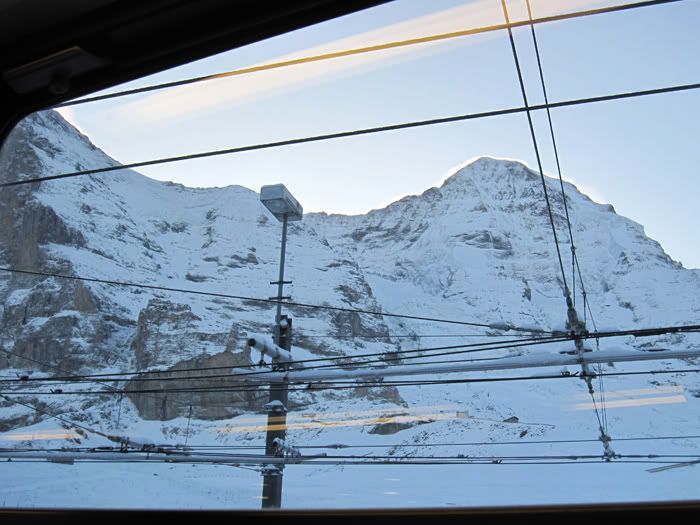

Now, I am on another cogwheel train, having just pulled out of snow-covered Kleine Scheidegg Station, for the final push up to Jungfrau. It's quite chilly outside already, and altitude at this point is already over 2,000 meters.

The train, intended for tourist use, is quite posh, and the cabin has video screens playing introductory video to the region and the railway. Narrations are in eight languages: German, English, French, Italian, Spanish, Japanese, Mandarin Chinese, then Korean. The crowd this day was very Asian indeed.

The wall on the left is part of Eiger (Ogre), while the peak on the right is Mönch (Monk). In the legends, Mönch protects Jungfrau (Maiden), further to the right, from Eiger.


Another look at Eiger, and its infamous North Face, before entering the tunnel portion.

The tunnel starts at Eiger's anus (ewww!) and works up his intestines, before transferring to Mönch and going under his robe, to finish at Jungfraujoch, the mountain pass between Mönch and Jungfrau.
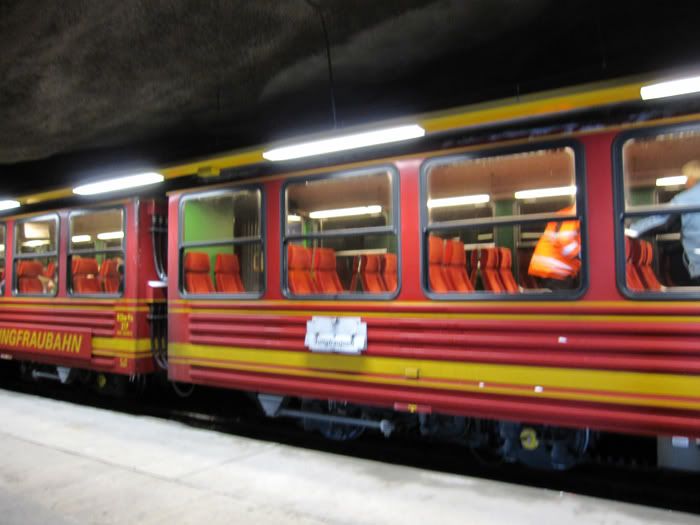


Inside the tunnel, the train makes a couple of intermediate stops, to allow passengers to disembark and take a look outside.

The outside views are okay, but not spectacular, as the Plexiglass windows are all fogged up. It's quite chilly in the tunnel, but still balmy (at least above freezing) compared to the harsh conditions outside.

The first stop, well inside Eiger's guts, is already at 2,700 meters above sea level. From this point on, hypoxia becomes a real issue; staying fully alert becomes a bit of a challenge, and nausea is common for weaker travelers.
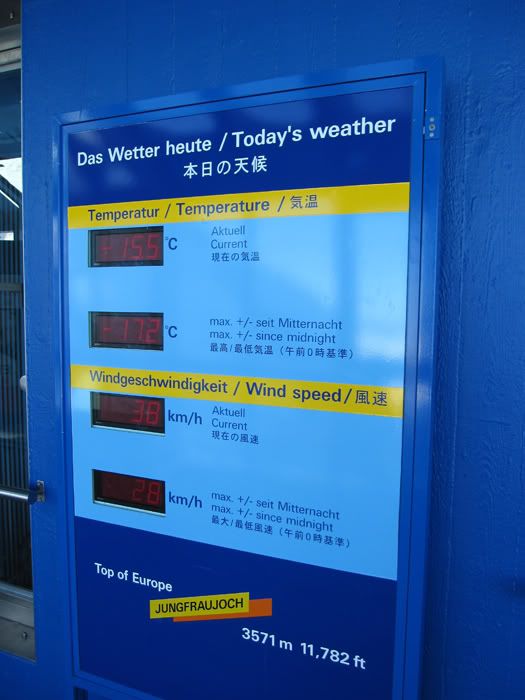

I am now at the Sphinx, the observatory located on top of Jungfraujoch. It is a lengthy elevator ride (about 100 meters up) from Jungfraujoch's train station.

My elevation is now at 3,571 meters, or 11,782 feet, above sea level; Jungfraujoch is, indeed, called the "Top of Europe," and its railway station is the highest in Europe. And those temperature readings (barely above zero, if converted to Fahrenheit) and wind gusts are certainly NOT conducive for a hike outside. Between the hypoxia, the cold, and the wind chills, I'd pass out within minutes and freeze to death, if I ever dared to go all the way to Jungfrau's summit.

At least I am able to move about. My mother is completely clobbered, and she is forced to lie down on a bench near the train platforms and rest.


I am looking north in the direction of Interlaken, which would be hidden in the east-west valley in the distance. Gotta love these glacier-carved mountain cliffs and valleys, something I don't see on a daily basis.
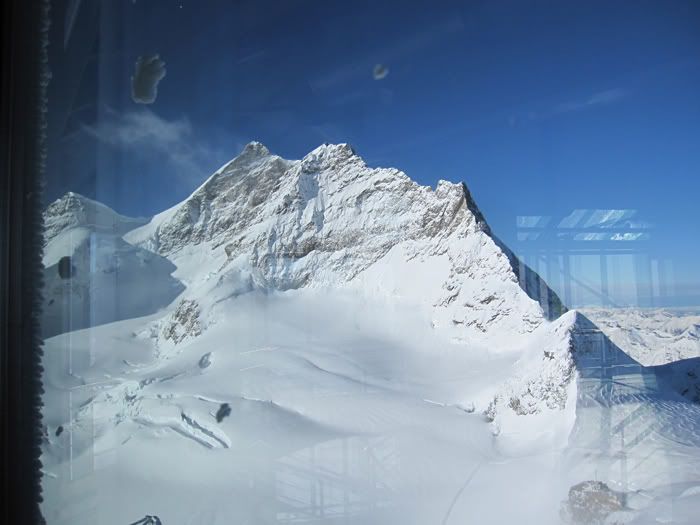

Looking west at Jungfrau herself.

Before I came on this trip, I was having some mountain-related discussions with two Facebook friends - Morwen Madrigal of New Orleans, who used to work for the US Geological Survey back in the day and brags about "having licked all the Grand Tetons," and Angela LaChic of Calgary, who loves to climb the Canadian Rockies close to her home. As all three of us are lesbians, we joked about selectively climbing, and licking, the summits of mountains with female names, and of course, I had to mention my planned visit to Jungfrau.

Unfortunately, again, due to the bitter conditions outside, this is as close as I'll ever get to licking the summit of that maiden, clad in a beautiful white dress.
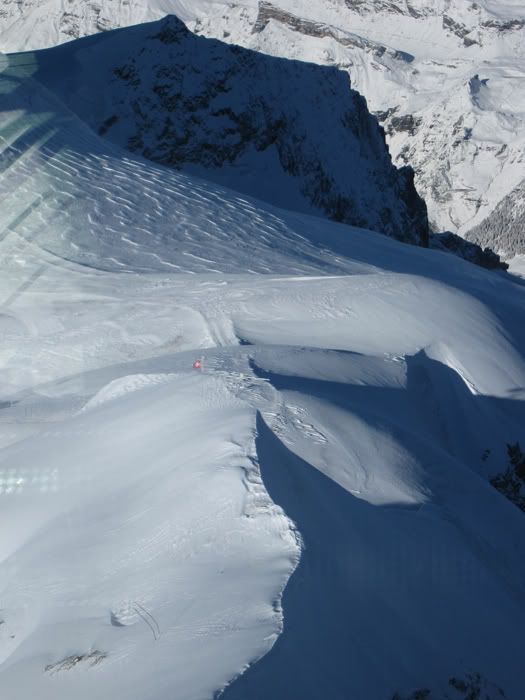


That Swiss flag marks an observation point, and the start of the trail to the Jungfrau summit. But then, again, due to the brisk conditions, it'll be a challenge for me to get even that far, and walk on the glacier, much less attempt the summit of Jungfrau, which is at 4,100 meters above sea level, and will definitely clobber me.

Granted, I've been at high altitudes like this before - just four months prior, I had been at Rocky Mountain National Park, where I actually drove to 12,000 feet in a car - but it is harder now, due to a much faster ascent this time. At Rocky Mountain, I had spent the previous day or two at altitudes around 5,000 feet and a bit higher, so I had some chance to get used to the thinner air, but I don't have that benefit here at Jungfraujoch.
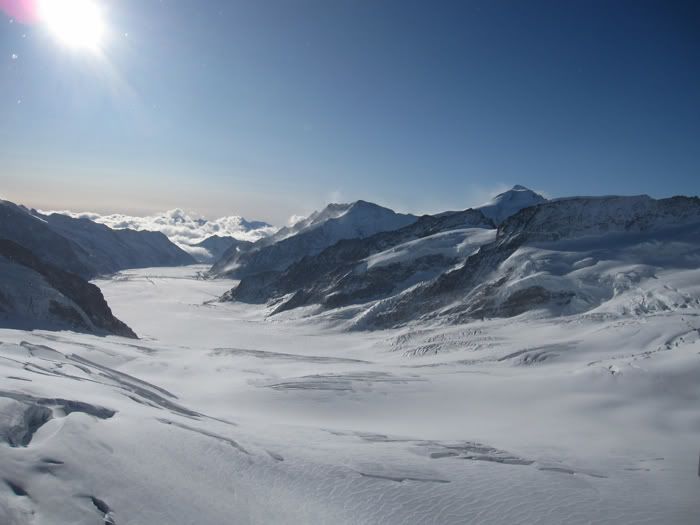

This is a lovely view to the south, showing a glacier stretching in the direction of Italy.

It won't be Italy right away where the glacier disappears into the clouds, but over there, I do have to speak Italian. Over here at the Top of Europe, the language spoken is German, though I can easily get by in English and Asian languages due to the tourist traffic.
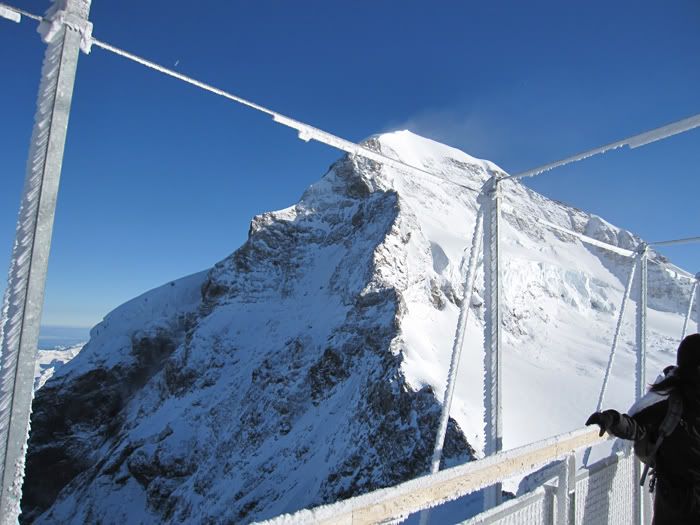


To the east lies Mönch. Nice view of snow blowing off the summit.

To my mountaineering friends and others, I jokingly refer to Mönch as "your stereotypical Catholic pedophile priest" - one who has gone commando under his robe, and whose pee-pee I had to endure watching as I had ridden up the tunnel. According to tradition, Mönch protects Jungfrau from Eiger behind him, but right now, it's me protecting Jungfrau from that pervert monk.

I took this particular photo outside the sheltered dome of the Sphinx. I found it impossible to stand outside for more than 30 seconds at a time.
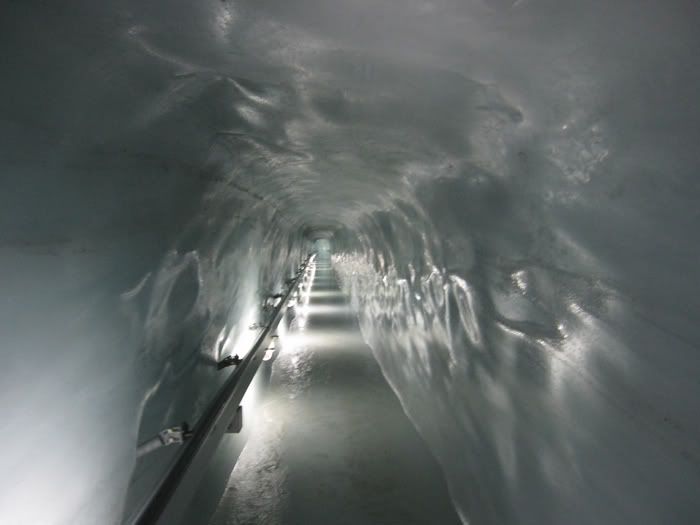

I am back into the visitor services area. One of its features is the Ice Palace, a tunnel dug into the glacier.

It is surely cold in here, and hypoxia is still trying to clobber me. But I am finding that moving around is the best defense against hypoxia.
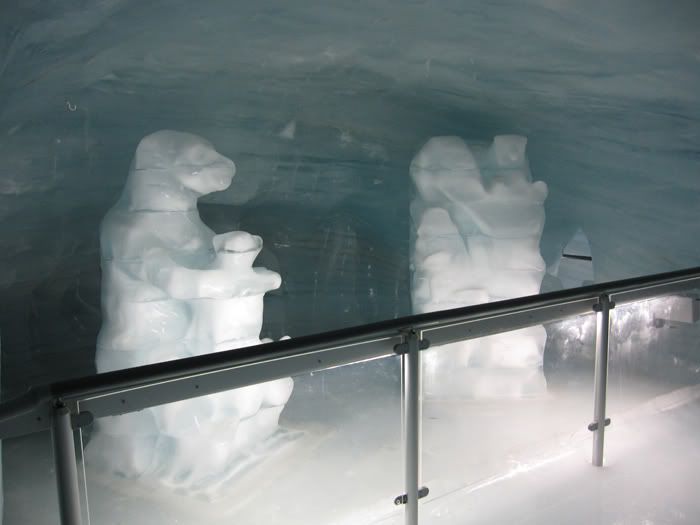

The Ice Palace is lined with many ice sculptures, like these polar bears.
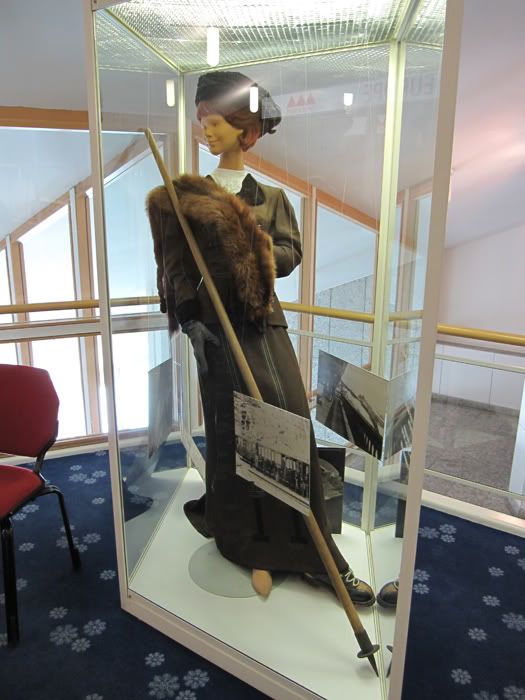

Early visitors to Jungfraujoch would have come dressed in outfits similar to this.

Practicality and warmth, while still showing off style and femininity, that's really my thing.
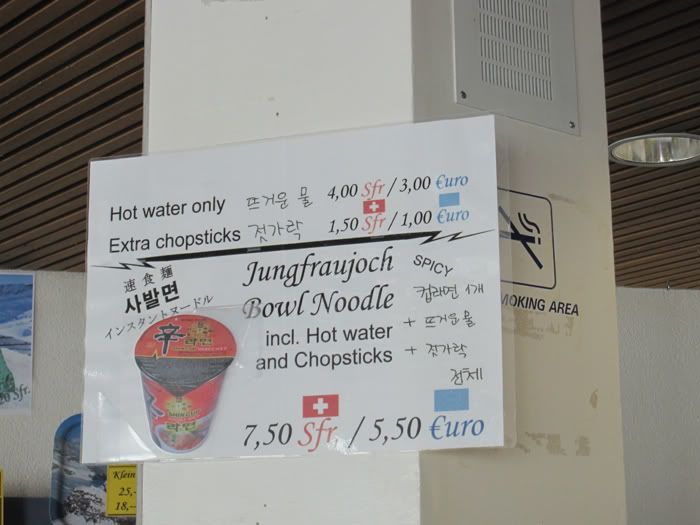

A number of snack items are available, but everything is grossly overpriced, because of the added complexity of hauling everything up from Interlaken.

Here is an interesting choice. I can buy a small cup of "Jungfraujoch Bowl Noodle" - which is just standard bowl of instant ramen from South Korea's Nongshim Foods. The price is an obscene 7.50 Swiss francs, and if I need extra hot water or chopsticks on top of what the attendant provides, that will cost me a small fortune as well. For comparison, buying the same bowl at a grocery store in Seoul or Los Angeles will cost under a franc - and not much more at one of the Asian grocery stores back in Interlaken.

Not exactly the most authentic way to go, but I took up on the offer, just for the experience. The chilly environs of Jungfraujoch make the hot noodles a good choice, as well as a memory to savor.

It is notable that the menu is done not in local languages, but in English and Korean, indicating that the noodles are targeted to Asian tour groups. And sure enough, every visitor today is either Japanese or Korean. My mother and I are chatting with the Korean visitors in Korean - though they have no idea (and no need to know) that we are really Americans independently traveling in a European Delivery Mercedes-Benz, rather than fellow group tourists from South Korea.
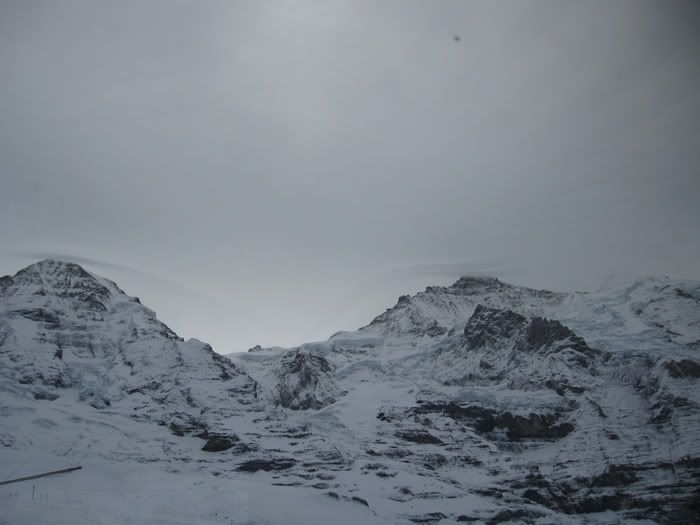

Now I am back to saner altitudes of Kleine Scheidegg, and my mother has finally come back to full vitality.

I have been previously advised that Jungfraujoch tends to be sunny in the early morning hours, before clouding up very fast for the rest of the day. And I am finding that to be indeed true. Good thing I took the early morning train. This photo shows Mönch on the left, Jungfrau on the right, and the Sphinx observatory in the middle.

Jungfrau would soon hide in the clouds and never show herself to my eyes again. She is indeed one very shy maiden. Glad to have come face to face with her.
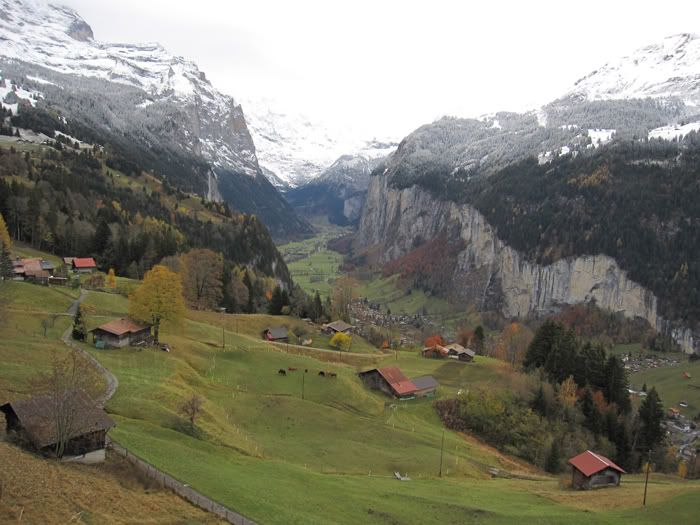

We proceeded downhill, to Wengen, just below the snowline. The initial plan was to take a cable car over to Grindelwald, and return to Interlaken there. But as it turns out, the cable cars are all shut down throughout the region; between the summer hiking season and the winter ski season, they were all shut down for routine maintenance, and indeed, that also explained why the Jungfrau Region was overrun primarily by Asian tour groups, rather than independent travelers and locals.

It would be another hour before another train would come to Wengen to allow me to continue downhill to Lauterbrunnen. Since the nearby hiking signs indicated that walking to Lauterbrunnen would take an hour anyway, I decided to walk down instead. This would also be an opportunity for my mother to enjoy the fresh Swiss Alpine air and fully recover from the hypoxia.

Downhill hiking is the best way to really take in the postcard Switzerland - the huts, the cows, the cowbell sounds, and the lush grass, as well as gorgeous views of the glacial valleys that look similar to Yosemite Valley (itself glacial). And excellent signage keep indicating which way to walk toward my destination, as well as estimated walking time.

The Lauterbrunnen walk time of one hour was said to have been timed by local senior citizen volunteers. Even at my more youthful walking pace, the one-hour estimate was right on the mark; these senior citizen volunteers are certainly master hikers.


As I walk further downhill, I can see a waterfall on the other side of the Lauterbrunnen Valley. I am again reminded of Yosemite Valley back in California.


And now I close in on Lauterbrunnen. In the lower left, I can see the cogwheel railroad.

As I walk down, I am sharing with my mother the basics of how the European economy works. I discussed the role of the European Union, even though I also stressed that neutral Switzerland is not an EU member, and also that the UK, despite being a member, tends to not march in lockstep with the Continent. I also discussed the European taxation policies with hefty income and sales taxes but smaller to no property taxes, as well as how the taxation pays for various government services, including universal healthcare and top-notch transportation network. I compared and contrasted the European Union's mechanisms with those of the US federal government, and wrapped up with an observation that while Americans may possess more materially (including the Mercedes-Benz we're driving around in, and sending to America the next day), Europeans have the basics (i.e. healthcare) better covered while consuming only a fraction of the resources.
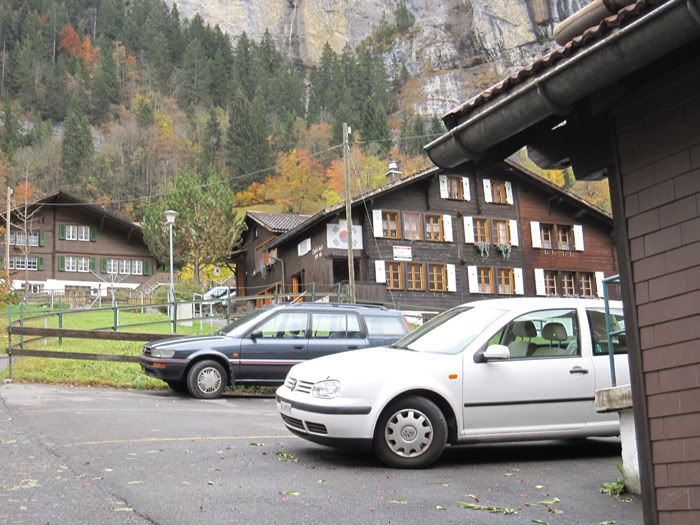

Now I am back in Lauterbrunnen, with only a few more minutes to go to the train station.

More evidence of heavy Asian tourist traffic. That hostel-style accommodation displays a South Korean flag, and has signs in Korean, though it turns out to actually have a Japanese owner.

For East Asian independent travelers to Europe, places like these can be a very good way to mingle with fellow travelers speaking the same language, eat the home cuisine, and gather travel information. This American with full English and limited French proficiency prefers to hang out with the locals and eat local food, but can certainly appreciate the value of this travel infrastructure for East Asians who want to go beyond the group tours but don't have the advantage of European language proficiency. It's thanks to places like this hostel that South Koreans have learned to travel through Europe on a budget - and also learned that the neoliberalism, Christian conservatism, and homophobia, taught to them by their former military dictatorship and its US Republican masters, are not the prevailing ways of the civilized world (and I am grateful, having seen the mentality improvements back in South Korea first-hand in 2008).

From Lauterbrunnen, twice-hourly commuter trains run back to Interlaken Ost. Now I am back in Interlaken but am not retiring to my hotel just yet.

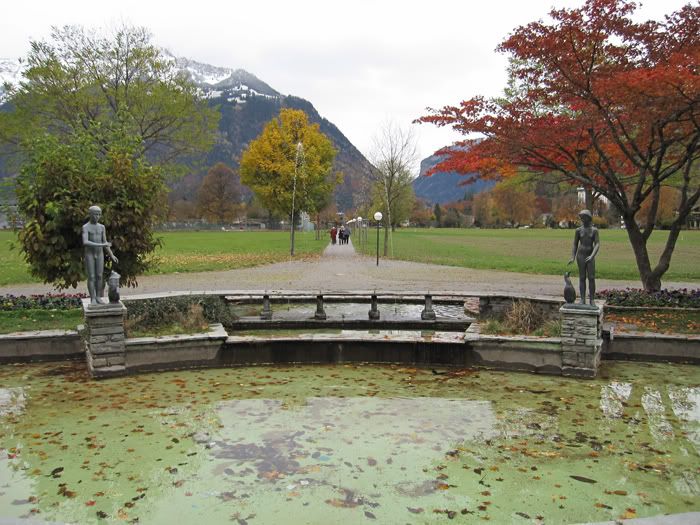
I am at the expanse of grass where I had seen grazing cows the previous day. Cows are still grazing, but this time I have the photo of these statues instead.

Again, thanks to the rise of the word "Tea Party" and "teabagging" to denote the anti-Obama neoliberal protests in the US, I am referring to all male nudes as "teabaggers," and chuckling at them. In this case, however, the male nude has a female companion, and I have chosen to call the female nudes "carpetmunchers" for a contrast. I was indeed wishing that a sane, progressive countermovement to the teabaggers would start in the US, and that it would indeed call itself the "carpetmunchers"; that would eventually happen in early 2010, though its name would be the Coffee Party USA instead.
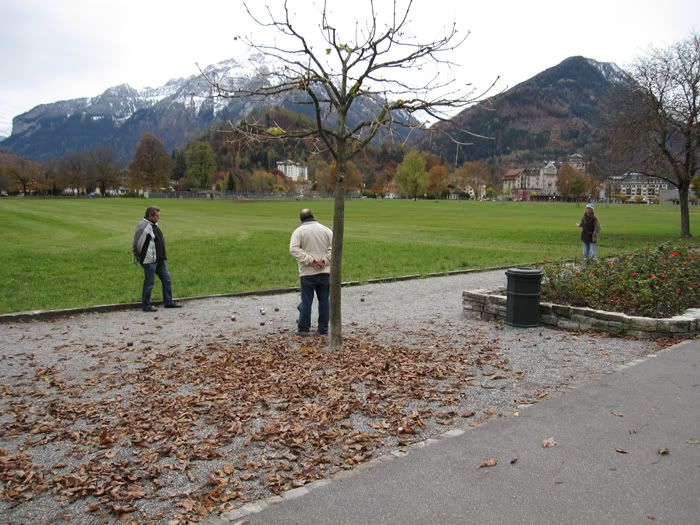

And nearby, these elderly men are playing a game of boules - a game where the objective is to roll a large metal ball as close to the smaller target ball as possible without hitting it.

I had seen the game in the Rick Steves videos, and am glad to see it in action.
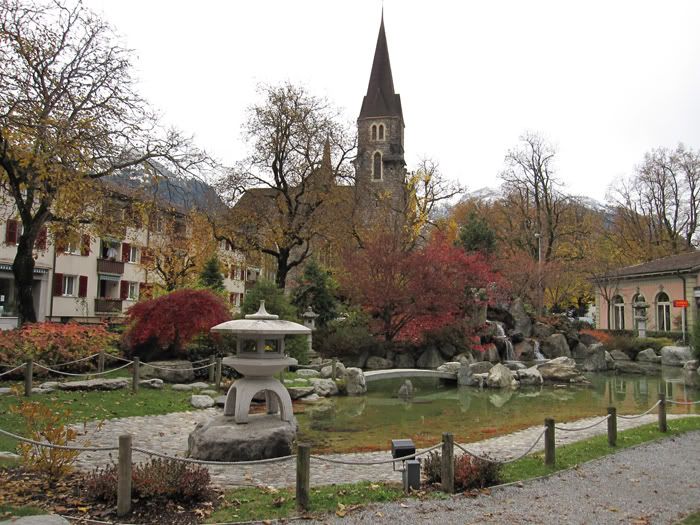

Now heading back to the train station, then on to the hotel in Goldswil. Here is a better look at the Japanese garden that I had seen the previous day.

As it turns out, this garden was a gift of the Japanese city of Otsu, which had been an Interlaken sister city since 1978, when Japanese tourists started arriving here in droves. The garden was built in 1995, with elements symbolizing the Berner Oberland mountains and lakes.

At this point, my mother and I did some souvenir shopping - though one particular souvenir shop, featuring some bells (not cowbells, but ceramic) that my mother wanted, was not open. In fact, it was the only shop with such bells, and it would not open for the duration of my Interlaken stay. Also, the cold air and hypoxia in the mountains had done their work on my mother, and she wanted to buy some cold medication; a pharmacie (as opposed to a smaller Apotheke which I normally see in German-speaking areas) next to Interlaken Ost helped us. While the English-speaking pharmacist did not recognize the American brand name Tylenol, she did choose a local-brand equivalent, and upon reading the packaging and the instruction sheet, I could indeed discern that it was a cold medicine, and could also figure out the proper doses. This being Switzerland, the instructions were trilingual - and again, when three languages are used, chances are good that I understand at least one (French in my case).

Upon retiring to the hotel, I took time to clean out and prepare the Mercedes-Benz for the shipping the next day, while my mother took it easy in the room. I also fired up my laptop and its Microsoft AutoRoute, so that my mother would finally have an idea of the route I had taken her through so far - as well as the route remaining (drive to Stuttgart, then TGV to Paris for a 3-night stay before flying home via Munich). Speaking of the car, its odometer reading was approaching 2,000 kilometers - and just over 1,200 miles when the units were switched to Imperial. I had driven a lot, and there was some more driving to do the next day.

The return to Stuttgart, the shipment of the vehicle, and the continuation to Paris will be the next post.

09 August 2009

Quick update

Facebook has been my main means of Internet activity, so my blog has been at a standstill.

I do have a busy life, as well as a Las Vegas timeshare. I'm grateful for that. As for that "relationship" I started in San Francisco - it was a nonstarter, given that despite the unusual Dutch family name, my girlfriend turned out to be a stereotypical uneducated southern white trash, with the attitudes and the politics to match. She's been so intimidating and demanding lately, that I've blocked her from accessing my Facebook profile.

Now, I want to start plotting some travel plans again. After all, I do want to keep my elite status at United Airlines, even though United has been so mismanaged in recent years that the airline's very survival is questionable. A retired United flight attendant (who will eventually help with my novel) gives his former airline 5-10 years at most before it fails or is merged into a stronger competitor. And if my most recent flights are of any indication, getting back into the skies is NOT something to look forward to. But the destination will be more than worth it!

19 April 2009

Back at it again

Somehow I decided to get back into the simulated airline business.

I'm in a new game world, running from March 1995 to March 2011. (Goddess help me when the fuel prices spike in 2008.) I am keeping the goddess theme - except that I'm now based in Athens, and I honor Athena rather than Kwan Yin. Athena is the goddess that I like the most (though Aphrodite is a close second).

Air Athena's first plane was a 767, which I immediately sent to London and New York for some great cash flow; I hope it helps me build up a solid regional European network fast for a good, stable income. Later on, I'll squeeze in a flight to Los Angeles, if only to capitalize on the popularity of Friends and get my favorite modern-day Greek Goddess, Jennifer Aniston (who has qualities of both Athena and Aphrodite), on board for an advertising blitz. (As Greek Orthodox extremism, unlike Korean-American Christian extremism, is not an issue in Los Angeles, I won't have to pull Athena out from Los Angeles the way I pulled Mercy/Kwan Yin out.)

Currently it's late April 1995, and in addition to flying a BAe 146-300 on domestic routes (including Lesbos - I am one hopeless dyke), I'm about to start building a fleet of Fokker F100s to serve Continental Europe.

I hope the lessons I learned, when I ran the Airline of Kwan Yin into the ground the last time around, will help me with this game (and the real world).

Update 21Apr09 The game had a fatal bug and had to be reset (some people were getting 10 planes after ordering just one, ending up with 20-aircraft fleets when I was patiently waiting for my third plane). And the reset had to happen while I was at an all-day conference; by the time I could do a thing about it, three weeks had already passed, and I had already been taxed despite zero activity. I had to withdraw from the game - though I have full refunds. I'll return to a future game, where I do look forward to carrying the spirit of Athena or Kwan Yin again.

10 March 2009

Update on that game from a few posts ago

I bankrupted my once-successful simulated airline, and left the game.

My increasing workload leaves me with little time to check the game. Moreover, the game time was 2000, and the tripling of fuel prices, and the expensive leases on my large 747 fleet (which also required long downtimes for scheduled maintenance), proved to be too much. A 3-week annual check on a single 747 cost me $1.5 million US in lease fees (for a plane I couldn't even use), plus lost revenue adding up to another $2 million or so, in addition to the actual maintenance fee of around $1 million. That's $4.5 million per plane, and I had 27 - adding up to well over $100 million in losses, per year, something I couldn't cover. And I'm not even counting the major overhaul, which must be done about every 8 years, grounds the plane for 3 months, and costs at least $5 million on top of lease and lost revenue.

Aggressive overexpansion, without steady revenue stream from shorter flights and more efficient planes to keep my income positive, was what killed me. $100 million could've just as well been used to purchase - not lease, but purchase - three or even four brand-new smaller airliners, fly them on short, frequent, high-demand routes, and make tons of money.

My demise has similarities to the 2002 bankruptcy of United Airlines, whose aggressive international expansion in the 1990s backfired when the neglected employee unions started striking, and when the costs (fuel, etc.) started going up. At least I didn't neglect my unions - and made sure to bankrupt my airline while I could still afford severance packages for my staff. For that matter, American automakers are not all that different, as their reliance on low-tech, gas-guzzling SUVs, which were very profitable, meant that their cars were neglected, and their long-term reputation (and ability to survive a spike in fuel prices) suffered.

I don't know if I'll start up another simulated business online, airline or otherwise. If I do, I'll certainly run it more conservatively. Even with this game, my initial success was due to my conservative management, sacrificing short-term profits for long-term gain, and next time, I'll have to keep that in mind.

28 February 2009

On another note...


About a month and a half ago, I somehow found and joined an online game, where I try my luck at the airline business against 350 other real human competitors. (I mentioned this game a few times over on my novel blog, as this was done partly to enhance my understanding of the airline industry, therefore making my protagonist's work environment a bit more realistic.)

The game works as follows. I must pay a small amount to enter a game, which starts on June 1, 1992 and ends on June 1, 2005. Each game day lasts 25 minutes in real time. I may set up my hub at any airport in the world, but all my flights must start/end there. I may continue flying from my destination to a second destination, but from that point on, I must return home, either nonstop or through the first destination. (I may also make a very long flight with one refueling stop, but in that case, I cannot fly to a second destination.) I have 4 million US dollars of startup capital. My first plane will join my fleet immediately, but all other airplanes will require two weeks of preparation (if used) or a lengthy wait in the production queue (if new). I have customization options, including staffing levels, advertising, aircraft seating configuration, fare levels, and more. There is even a message board system where I can discuss strategies with fellow players, issue "press releases" regarding my airline, and more.

I joined a bit late - May 6th, 1993. I had wanted to set up my airline in Hong Kong, but due to a strong competitor there already, settled for Seoul Incheon, home to a cut-rate airline. (Incheon didn't even exist until 2001, but for some reason, this game has Incheon available in 1992.) My airline was named Mercy Airlines in English, and its name in Chinese script translates to "Kwan Shih Yin Airlines." Yes, I decided to take my transgender matron saint right into the game. I started with an 8-year-old Boeing 737-300 seating 118 passengers, and after gathering a small fleet of mostly junk airplanes and establishing some key routes, immediately started upgrading my fleet. At that point, my best plane was a 20-year-old Boeing 727, whose annual check would've been expensive enough to drive me to bankruptcy! By 1995, I had a fairly newish 35-aircraft fleet, killed off my high-maintenance competitor, and started flying some cash-cow routes, including a one-stop service to Orlando. In 1996, I even got to acquire 17 Boeing 777s, the newest and greatest airplane available at the time.

Now, it's late 1999. I now operate a fleet of 143 aircraft, owning at least 10 of them outright to cut costs. I own a further 8 aircraft which are leased out to other airlines. I have dozens of new planes on order, and will be the first to fly the Boeing 767-400 (in 2000) and the Embraer 170 (in 2004). My planes are spreading the spirit of Kwan Yin to countless destinations on every continent except Antarctica. My service ratings are top-notch, thanks to my young fleet (average age of just over 3 years), on-time performance, and most importantly, generous pay and benefits for my employees. I practically let my unions write their own paychecks via an automatic setting - and that has kept my labor costs high, but my staff motivated at 100% morale. Competing against airlines of lesser ratings, I can charge higher fares, still steal customers via my superior reputation, and eventually drive the competitors (whose older planes cost more to run) out. I was even invited into an alliance (I got the invitation back when I only had 12 junk planes), so I get to share tips and strategies with alliance partners, all of whom are at least as well-run as I am.

Up until recently, I've run Mercy Airlines as a strict virtual business, concentrating on profit margins. I took the mercy and compassion of Kwan Yin into all aspects of my operations, which trimmed my profit margins at first but eventually paid off in better reputation and higher profitability. But now, I am starting to change this - and I am starting to turn Mercy into a bit of a political statement (though I am not using any labels, such as "liberal" or "conservative," much less political party names, and I am certainly never using any real person's names, except for a single minor reference to President Bill Clinton).

Chasing profits, I even fly to some real hellholes, including Tehran and Kabul, and make good money in those places. I won't touch those flights for now, even though flying into Kabul in 1999 is probably sucking up to the Taliban. But I will make my beliefs known in other places:
  • First, I launched small-scale services to San Francisco, even though I have an alliance partner based there who already oversupplies the route. I did that partly to come up with an excuse for banning discrimination based on gender and sexual orientation at Mercy Airlines - which I did, via a "press release," in 1997, and would've been an unprecedented first for a South Korean corporation.
  • Second, also through "press releases," I've been stepping up my criticism of the South Korean government for giving preferential treatment to my foreign competitors, who indeed use predatory tactics at my hub that are allowed in the game but never allowed in real life. Such tactics include scheduling 8 flights to depart to the same destination at the exact same time daily. And yes, South Korea's government, be it run by 2MB, Roh Moo-hyun, or anyone else of any political persuasion, tends to stiff its own subjects in favor of foreign powers, and I want that to be known (while painting myself and the staff of Mercy Airlines as the allies of the Korean people). I painted the right-wing Kim Young-sam government as a puppet of the Moonies and the US Republicans, and just to be fair, I am painting leftist Kim Dae-jung (the President in 1999) as a puppet of the Chinese Communists. When Roh Moo-hyun comes in in 2003, I'll certainly blast his political vendettas and anti-business policies. Too bad I don't get to play past 2005, and blast 2MB and his treasonous behavior come 2008.
  • Third, I am actually starting to redraw my route map. To fight back against predatory Chinese airlines, I am running flights from Beijing and Hong Kong to London, and the 747s that will get it done will join my fleet in a few more hours of real life. But more importantly, I am fed up with the theocracy in Los Angeles in real life, so I will pull out my profitable Los Angeles flights. Sure, it's not 2000 yet, so Proposition 22 is cleared for the ballot - but hasn't been voted on yet. But I won't wait until March 2000, and its passage, to pull my flights out of Los Angeles. I have nine weekly flights to Los Angeles, but the planes can just as well serve Seattle and Vancouver, where I already run lots of flights but still have room to grow. I won't touch San Francisco, as dumping more flights there only hurts my partner, and San Francisco is part of the problem too. I'll also have some choice comments on the Korean-Americans, their support of Proposition 22 (and the impeachment of Bill Clinton and the George W. Bush presidential ticket), and my decision to discontinue my service to them. Once the Los Angeles pullout is done, I could probably free my Kabul and Tehran flights to serve saner markets too. These moves will hurt my profits, but I do need to make my statements even at significant cost.
  • Fourth, I run a sizable operation to Latin America. Mexico City is nonstop, while Lima is served with a refueling stop in Ontario in Southern California, and Caracas is served with an Anchorage refueling stop. As part of my Los Angeles pullout, Lima refueling stop will be transferred to Oakland. I'll certainly never serve the likes of Guatemala City, San Salvador, and Managua - they probably don't have enough demand to support my service anyway. Similarly, I'm staying out of the most problematic places on other continents, even though they can generate money for me. Forget about ever seeing Mercy planes in Warsaw, Harare, Kingston, or Riyadh. Sure, Caracas could be considered "problematic" too, but as it's only 1999 for now, I'll take a "wait-and-see" attitude toward Hugo Chavez, and will maintain my Caracas presence through the end of the game.
I'm loving the fact that I can transfer my economic philosophy into this simulation, and see results against other approaches by other players. And while at it, I learn enough about the airline industry to help out with my novel, and even get to make a few thinly veiled political statements.

Now, I need to go back to my game, so that I can pull out of Southern California and other theocracies. I also have three A320s and three 767s coming in anytime now, which must be assigned schedules. I need to not only add new destinations, but fight back against the predatory Chinese competitors, whose phenomenal growth is fueled by huge demands within the Chinese domestic market, an advantage I'll never enjoy in Seoul.

UPDATE After another day in real time, I've gone through my intentions. I am no longer flying to Los Angeles and Kabul, though I am hanging on to Tehran, to let President Khatami get a chance to fix things. I decided to launch a new service to Boston in the meantime. In the meantime, rising fuel prices are starting to choke me, so I've grounded some inefficient planes and routed others into super-lucrative Japanese domestic runs (even though I lose money getting my planes into Japan in the first place, revenue within Japan more than makes up for it). And speaking of Los Angeles, the route was picked up by a competitor based in Amsterdam - very apt, because Amsterdam, just like Los Angeles, is a mess thanks to reactionary immigrants (and the white liberal political correctness).

19 December 2008

Final Insult

Due to the neoliberal mismanagement of the US and world economy, it looks like my mint-condition BMW will fetch a pitiful amount.

I got a good no-obligation appraisal, and it's just as pitiful as all other preliminary values I had obtained. The vehicle was checked out to be in tiptop condition, so it appears that the real issue is more of a luxury car glut in the market. Sure, I have a fantastic deal on the Hyundai to make up for it, but it doesn't make up for the massive clobbering I am getting on my BMW.

A 5-year-old BMW should still hold about 45% of its original value, but it appears that it'll only hold a third in this market. I guess this is the final insult that the neoliberal bastards, funded in part by all the money I've paid to BMW, have in store. I even had a few second thoughts about making the trade.

But I must go ahead with the trade. If buying a car were all rational, nobody would ever buy luxury cars anyway. There is quite a bit of emotional factor involved, and again, life is way too short to be spent driving a car that doesn't speak for me. I would rather give up my BMW before it loses even more value, and it really starts to deteriorate. Plus, it looks like the Hyundai Genesis is on track to become the next North American Car of the Year at the Detroit Auto Show in January (that'd be a first for a South Korean car), and it'll be priceless to be driving around in a winner.

I've made final arrangements with the purchasing service, and the whole swap should be complete by midday tomorrow.

De-briefing and more

Over a family dinner, I was debriefed as to what had happened during my absence:
  • The wildfires had forced an evacuation of my place, and my BMW and other things had been moved for the duration.
  • Los Angeles County, during the general election, voted for a 1% sales tax increase to fund transportation improvements. That makes my sales tax rate 9 1/4 %, and honestly, I don't think Southern California deserves any more of my money than what it already gets from me.
  • Gay marriage is again banned, though by a very narrow margin. Duh.
I also shared some of my South Korean and Hong Kong observations, and further stated that if 2MB and the Moonies are behind the Obama-bashing and other US right-wing initiatives in any way, they must get their behinds kicked. Also, I do feel that there is a parallel between North Koreans destroying South Korean LGBT rights under the blessing of the 2MB government, and Third World immigrants destroying Californian LGBT rights under the blessing of the Republicans. I'll stand for neither, and the fair-minded people of both areas are with me on this.

The biggest statement I can make to the world, and most importantly to myself, over these developments, of course, is to proceed with my car swap. I made sure to clean out my BMW already; documents and other items that I must give up with my car are already loaded in it (except for spare parts, which will be taken care of today), while things I must transfer to my new Hyundai have already been taken out of the car. Today, I'll drive the BMW for the first time since my return; first, it'll allow me to assess its condition, and second, I'll get to drive it to a CarMax for a written appraisal. I'll continue to drive it through tomorrow, when I finally give it up and take delivery of the Hyundai.

I've still given no one any indication of my car swap. And that's the way I intend it. Nevertheless, I can no longer feel good/ethical about driving my BMW, and life is too short to be wasted in cars like that. The only reason I can even stand driving it from now on, is only because I am driving it to get rid of it.

And one more thing. I still can't believe that Hyundai now makes cars good enough to replace my BMW! I did discuss the Genesis with my coworkers and others - and all of them are telling me about how every review raves about the car. I guess it really is time to shut up, and start actually driving the thing. Sure, I was too young and too poor to drive the Lexus LS400 twenty years ago (and I still wouldn't, as I really hate Toyota), but I'm counting myself fortunate that I can afford the Genesis now, and make up for that. If my new Hyundai inspires someone else to buy his/her own, hopefully in place of a BMW, then I'll be happy.

11 December 2008

Assholes...

The colonial 2MB government and its supporters are total bastards.

Even though I am going to be boosting their bottom line, by buying a Hyundai Genesis (therefore resulting in extra taxable income for both Hyundai and its employees, resulting in extra tax revenue for 2MB), they don't seem to want it. They are determined to keep blocking my Internet access, and prevent me from getting the information I want on this car.

I guess they are so PO'd with Hyundai's management and unionized workforce, that they are determined to kill the company, just like the US government policies helped kill off the Big Three. Suppliers, including LG (who makes the navigation system), will suffer too. For that matter, I think the only company the colonials can accept is Samsung. And I do believe that the colonials would rather have me keep driving my Nazi BMW and keep buying overpriced BMW parts to keep it on the road.

This will make my life harder, but I am not being derailed. A purchase request is already in, and the purchasing service is asking me to call as soon as I return home.

And even politics aside, I'm going for the best car I can get for my money, and by getting in the way, the colonials are demonstrating that they are NOT supporting the free-market capitalism that they claim to love so much. In fact, they look just like their hated enemies, the North Koreans - starving the economy and the people for minor gains for the regime.

Maybe I do need to visit Koreatown in my Genesis. If only to offend the largest number of Korean-American colonial supporters possible!

10 December 2008

Seoul: Starting to wind down

I can't believe that three months of South Korea (except for a week back in Los Angeles, and half a week in Hong Kong) have flown by, and will end soon. I had thought I would be slowing down, but that was not to be; it looks like I'll be busy wandering around to the very end.

Today's initial agenda was to visit the Japanese embassy and join a special International Human Rights Day protest by the former Comfort Women and their supporters. Again, the most logical routing was to Anguk Station on Line 3. With each ride on the line, I am hating it even more; not only is its routing very crooked and its rolling stock outright junk (when the Vietnamese take the trains next year, they'll need to do some serious refurbishment before putting them in service), but its stations have too-tiny platforms for their traffic level. At least Line 3 uses more island platforms, which allow easier direction reversals, than other lines, and its trains tend to carry less propaganda than other Seoul Metro lines.

I did find the embassy, a diminutive building identifiable only by the Japanese flag overhead, without much trouble. But there was very heavy police presence, and it was pretty much impossible to get past the police lines. The police line, using several armed buses, was so thick that I couldn't even see the demonstration itself. I had to walk away.

Seen at a major fire station near the Japanese embassy: a Kia Pride (Rio in the US) with hybrid powertrain, as indicated by decals and badges. Both the Pride and its corporate twin Hyundai Verna (Accent in the US) can be ordered as gasoline-electric hybrids for fleet use. Can Hyundai-Kia send a few of these stateside as well, so that I can consider buying one and saving a bundle on gasoline?

The fire station, as it turns out, is right across the alley from the rear fence of the US embassy.

Until last month, this place had the longest line in the world for obtaining a US visa. But today, the line is empty, thanks to South Koreans now being able to enter the US visa-free. While short-term tourist and business trips up to 90 days can now be done visa-free, all other US entries, including study, investment, work, or immigration, still require a visa. Those who had been denied US visas in the past also need to get a visa first, as they will not be pre-cleared by the Homeland Security website. Nevertheless, this does open up the US to South Koreans who couldn't previously travel there; the most notable such demographic is single women tourists, as the US visa policy has been to treat every single female casual visitor as a potential sex worker looking for illegal US employment, and therefore deny visas. I do hope that more of these newly eligible travelers can visit the US, and take the initiative in US-South Korean relations away from the Moonies, the neocons, and their puppets.

The bilingual signs above advise that applicants for immigration visas need not stand in line, but go straight to a dedicated window for them. Also, all visa applicants are advised to not submit any fradulent documents; submitting fradulent documents may ban the applicant from the US for life, and even adversely effect South Korea's status in the US Visa Waiver program. In fact, a number of Latin American nations, including Argentina and Uruguay, have had their US Visa Waiver participation status revoked, when too many of their nationals were staying in the US illegally.

There are a number of legal services within a block of the US embassy that assist US-bound travelers. Some notarize and translate documents, while others offer legal consultation and assistance in obtaining any necessary US visas, including study, business, and immigration, especially to those who had previously been denied US visas.

I am now heading for my next destination, the Hongdae/Sinchon district, to look for a Greek lunch. From the US embassy, it's five stops - two stops on Line 5, three more on Line 2.

I am on a Line 2 train. This ad was taken out by Amnesty International, and urges South Koreans to "keep a promise that hasn't been kept for the past sixty years." Of course, it's a reference to the Universal Declaration of Human Rights, whose Korean translation is in the background. Amnesty International has certainly done a lot of good in South Korea, for conscientious objectors of military service, for political prisoners in the past, and for the LGBT community.

But I am reminded that things are looking very grim again. After all, I am on a Seoul Metro train, featuring tons of propaganda from the colonial government. I continue to be encouraged to turn in any left-winger in sight for a 30 million won reward. An ad behind me, from the Republicans, has a whole bunch of empty promises targeted to college students and the middle class, including "removal of regulations" to create 200,000 new jobs; unfortunately, the Republicans will only remove necessary regulations, and keep truly harmful regulations intact (or make them even worse).

I took a look at a newsstand on a subway platform when I had some time. It looks like Dong-A Ilbo, a very pro-independence and anti-Japanese newspaper during the Japanese rule, is just as much of a right-wing mouthpiece today as Chosun Ilbo; maybe Dong-A opposed the Japanese, not because they were foreigners, but because colonial rule by the US Republicans or some other similar power would've been vastly more preferable. This is the same mentality shown by South Korea's Christian establishment. Much saner reads are the venerable Gyeonghyang Shinmun, which had once been shut down for opposing the Syngman Rhee dictatorship, and which I now see as a mildly left-wing paper, as well as the Hankyoreh, a more strongly worded center-left paper; if I were to be in Seoul long-term and actually start reading newspapers, I'd make these two papers my primary sources. I'll also read the prominent center-right papers, especially the familiar Hankook Ilbo and its English edition The Korea Times, quite a bit too, but I'll certainly do everything to avoid the lies and propaganda of Chosun Ilbo and Dong-A Ilbo. Sure enough, in the subway cars, elderly passengers in reserved seats always read Chosun Ilbo and Dong-A Ilbo, while younger passengers in non-reserved seats are more likely to read a variety of center-right and left-wing papers.

The Greek place was closed for today, and its menu seemed less than authentic anyway. However, I did find a decent Mexican place nearby, and ordered a 8,000-won burrito which turned out to be excellent. Yes, Mexican food is very rare and quite expensive in South Korea, but I'll take what I can get.

Now, I am walking away from the Mexican place. Above is a shot of the Volkswagen Phaeton, an extremely nice but overpriced luxury car that had to be withdrawn from the US due to very slow sales, but quite popular in South Korea.

I was able to read a Korean edition of US car magazine Motor Trend while waiting for my lunch, as well as a glance at a few automotive newspapers in the subway. Anything automotive now grabs me, due to my imminent purchase of a Hyundai, and due to some weird South Korean-market cars that I will not get to see after my US return. Some stuff I picked up today:
  • The Hyundai Genesis V8 (the US-market prototype that Motor Trend tested here in South Korea) has a few flaws - its trunk lining is incomplete, for example. The engine also doesn't perform as well as numbers suggest, and the car itself is more Lexus conservative than BMW sporty. But it still is one heck of a car at a great price. My Genesis will be the V6 model, which is actually a better car, based on what I've gathered.
  • The Hyundai Sonata and the Honda Accord, both 4-cylinder models, were pitted against each other twice: first at a Hyundai event in South Korea, and second at a comparison at Southern California's Santa Anita Park. As my current daily driver is an Accord, and as I did some serious driving in a Sonata for my road trip last month, both cars are of interest to me. The South Korean reviewers liked the Sonata's design better but preferred the Accord for its performance, while the US reviewers, while praising the Accord's engine, still chose the Sonata. The Accord is personally my favorite, but if Honda won't bring a high-efficiency hybrid version to the market anytime soon (as Hyundai will), I'll definitely consider defecting to the Sonata camp, especially if my Genesis turns out to be even half as great as it's supposed to be.
  • A BMW is much harder to justify than before. That's music to my ears. The reason is that the interior ergonomics, which has lots of electronic gizmos that must be controlled through the iDrive knob, is horrible. Sure, BMWs still perform well, but competitors are getting close enough for lower prices.
  • South Korean petroleum market consists of just four players: GS Caltex, Hyundai Oilbank, SK, and S-Oil. (SK's Ulsan refinery is the largest in the world - and neighbors the world's largest car assembly plant and the world's largest shipbuilding dock as well, both owned by Hyundai.) Gasoline taxes have gone up quite a lot recently to pay for highway improvements, leaving South Korean motorists fuming, but tax cuts won't reach consumers due to the collusion of these four refiners. Allowing foreign oil companies in could solve the problem, but be careful what you wish for, as the multinationals like Exxon and Chevron are among the most evil bastards in any industry anywhere in the world.
  • The Japanese are making a full assault on the South Korean market. Toyota has been selling Lexus luxury cars for a while, while Honda has been selling mainstream vehicles. In the past month or two, Nissan and Mitsubishi have also arrived (though Nissan has been selling Infinitis for a few years). Nissans are quite competitive and selling decently, and the boxy Cube is already starting to pop up quite a bit. Mitsubishis are doing very poorly, however, even though South Koreans know Mitsubishi very well due to most early Hyundais using Mitsubishi technologies.
  • GM Daewoo is doing very badly. Its Winstorm SUV is actually pretty good, but the new Winstorm Max, which is a different model and is identical to the US-market Saturn Vue, is a flop due to fewer contents and higher price tag. The Winstorm Max is really intended for European export as an Opel. Meanwhile, Daewoo's last good luxury car was the Opel-designed Prince from over a decade ago, which was replaced by the Ssangyong Chairman (another good car, thanks to Mercedes mechanicals) when Daewoo acquired Ssangyong. But Daewoo then went bankrupt, Ssangyong was divested, and Daewoo itself became part of GM; Daewoo's first luxury car under GM, the Statesman, sold so poorly that I'm lucky to spot even one every other week, and its brand-new replacement, the Veritas, is doing even worse. Over in the US, Suzuki used to be the primary seller of GM Daewoo products in the past five years or so, but it appears that they are now discontinued, leaving the Chevy Aveo (formerly Daewoo Kalos, and now redesigned as Daewoo Gentra) as GM Daewoo's only US offering (and certainly its only product good enough for the US market).
Walking in front of Lesbos again. This place was/is certainly a trendsetter, as South Korea's first lesbian bar. The lesbian culture will continue to evolve and blossom, even as 2MB starts to crack down on the lesbians.

Hongdae is also home to Manyeo ("witch"), another venerable lesbian bar, though I had no luck finding it today either. There are a number of other women-only bars in this area, and I am very well convinced at least some of them are lesbian-oriented, if not outright lesbian.

Lesbian Power, baby!

A women-only bar that I had previously sighted here was Lady First, but now it's under a different name, "Sexy Han Bar," as seen above.

Not a women-only space, but of interest anyway. This is a hip-hop nightclub, named Harlem. Those "Merry Christmas - Happy New Year" signs now let me know that I am not too far away from 2009. I hope it will be a better year - given that Barack Obama takes the Presidency in the US on January 20th, and that will also reduce 2MB to a slave without his master.

Across from Harlem, I can find an American Apparel store. I certainly could use some more of their legwear products, especially leg warmers. Here in South Korea, American Apparel, which is imported from Los Angeles's Garment District, is pricey compared to locally manufactured legwear, however. At least American Apparel is NOT sweatshop!

Now that I'm full, I see a nice Greek restaurant, Greek Joy, that has a better menu. Too late.

There is a nice lunch special at 6,500 won as indicated on the board. Very tempting.

I love eating Greek food, partly because it's unlike other cuisines I eat, and partly out of a nod to the ancestral land of my idol Jennifer Aniston. After months of staring at images of the homewrecker bitch Angelina Jolie, even in the subway, I need to make up for it. Sure, Jennifer Aniston is herself no fan of Greek food, but I don't care - I love Greek culture anyway, and look forward to a visit to Greece in the near future.

The Queen Bar. I wonder if this could be yet another women-only space...

There are so many women-only bars in Hongdae, quite a few of them lesbian, that every sight of anything resembling a women's bar makes me feel good. The sight of local fashionistas, a number of them dressed in wool Ally McLesbian miniskirt suits, also are welcome.

Girls on Top. Love the name. I do hope it's a lesbian hangout, but even if it isn't, just the name itself is more than adequate.

A look at the neighborhood map indicated that Hongdae is easily accessible not only from Line 2 at Hongik University Station, but also from Line 6 at Sangsu Station. In fact, Sangsu is closer to the Hongik University campus itself.

I am now approaching Sangsu Station so that I can finish off for the day. I love the name of this Japanese ramen joint, written in large Japanese letters with small Korean caption. "Onehsan Ra-men" - great name! It means "Older Sister Ramen."

My hatred of 2MB and his cronies is more intense than ever. I'll have to face their base - the Korean-American community - when I get home, and that's not pretty either. Nevertheless, South Korea seems determined to please and inspire me to the last moment, and I appreciate it. I'll make sure to carry these inspirations well into the future once I am back stateside, and of course, buying my new car will be a huge step in the right direction.

09 December 2008

Some South Korean economics and car stuff

A bunch of crazy irrelevant things I picked up today.

First, I had a lengthy chat with a cousin, who gave me lots of insights about South Korea's military life, economy, politics, and more. Not much that I didn't discuss already, except for a few. He made sure to remind me that for almost everyone, a vote for 2MB was a vote for his business background and a potential for ending "politics as usual." Of course, 2MB has failed miserably, and we shared scathing criticism of both 2MB and his master W. We both look forward to America under Obama, and decided that we will give 2MB a chance to get things fixed and back on track (though honestly, I am extremely pessimistic about 2MB's four remaining years in power).

Second, I learned that South Korea's minimum wage is 3,867 won per hour. It's paltry, but at least there are no exceptions under any circumstances, not even part-time job (referred to by the German word "Arbeit" in everyday conversation) or restaurant table waiting. In the US, waiters and waitresses can be paid as little as $2/hr, and are expected to make up the difference to minimum wage with tips, but as tipping is usually nonexistent in South Korea, at least minimum wage must be paid. I'm also being told that if my hourly pay is under 5,000 won, no taxes will be deducted at all. An employer must report new hires to the government labor authorities, and offer them four basic insurances. It does appear that for now, labor law enforcement is pretty strict; anyone caught paying below minimum wage will be in a lot of trouble, very fast. Speaking of low-pay part-time work, Costco now is looking for Christmas seasonal help at 6,550 won per hour; at least, Costco, being the ethical progressive American merchant that it is, doesn't place limits on the applicant's age, sex, marital status, or education level, other than a minimum age of 20 (legal age for full adulthood).

Third, cell phones are so ubiquitous in South Korea that they make more sense, and are cheaper, than landlines. The national government's welfare services now include financial assistance for low-income residents in opening a cell phone account and paying monthly bills. In the US, landline phones are eligible for state-level financial assistance, but cell phones are still not. Glad to know that South Korea's welfare state makes more sense that the one back home in the US. I won't count on it to last, however, given 2MB's Reaganomics which states that the real welfare is "job creation through massive tax cuts for the rich." South Korea's tax burden has risen slowly but steadily in the past two decades, as the economy transitioned from a developing one to a developed one, and various social programs have been enacted since the 1980s; now, the tax burden is at or slightly above US levels, though still well below European levels.

Fourth, almost all merchants are required to accept credit and debit cards. Any transaction over 1,000 won can legally be done with a credit card. Any merchant refusing legal credit card transactions, just for being "too small," will have to pay hefty fines. Visa and MasterCard are the most widely used, though American Express is also common, and Japan Credit Bureau can occasionally be used at tourist traps. There is a difference between Korean domestic and foreign credit cards, however; many self-service kiosks will not accept foreign credit cards, while all cashiers can. (Korean domestic card statements show the merchant's name in Korean, while I get the merchant's arbitrarily romanized English name on my US credit card statements.) And if making a cash transaction, merchants are required to offer a Cash Transaction Receipt (현금영수증) upon request, which has additional information useful for South Korean domestic tax filing and expensing purposes, but not of much use to a foreigner. Even if I decline the Cash Transaction Receipt, I am required to be given a normal receipt, which turns out, more often than not, to be a Cash Transaction Receipt anyway. A South Korean taxpayer can keep track of his/her expenses at the government website http://현금영수증.kr. Yes, a website address can be in Korean!

Fifth, disruptive activities in the subway trains - including vending, leafletting, soliciting, or giving speeches (notably Christian missionaries) - are subject to fines. Unfortunately, this provision is rarely, if ever, enforced, and even then, the fine is only 100,000 won. And in case of vendors, people do seem to like them; I still appreciate the leggings vendors, without whom my legs would have frozen over a few days ago!

Sixth, and the last, and this one's gonna concern me after I return to the US and trade in my BMW. Ward's Automotive in the US makes an annual list of ten most outstanding engines available for automotive use in the US, and the 2009 model year list has just come out. For the first time, a South Korean engine is on the list: Hyundai's 4.6-liter Tau V8 engine, which powers the US-market Genesis and the Kia Borrego (Mohave in the South Korean domestic market). Not bad for a company whose first engine, the Alpha, is only 15 years old. The Tau is also the only engine on this list that can run on regular unleaded gasoline. This is nice news for me, even though I won't be getting the Tau for my Genesis. I'll be content with the 3.8L V6, which, in the Hyundai nomenclature which uses Greek alphabet for engine names, is Lambda; as the letter Lambda is also a longtime symbol of the LGBT community, I'll feel great about driving my new Genesis to various LGBT venues in California. It'll certainly beat driving a pro-Nazi BMW! The Lambda is itself a nice engine that also powers the Veracruz SUV, the Azera, and the Entourage minivan (a Kia Carnival clone that's only for North America), as well as the Kia models of Sedona (Carnival in South Korea) and Amanti (Opirus in South Korea). Smaller Lambdas (3.3L) power the US-market Sonata and the new Optima (Lotze in South Korea) too.

Had I stayed on the BMW path, however, the 3-liter twin turbo, which powers the 135i, 335i, and 535i, is also on the list. But this wouldn't have ever happened. First, my original intention anyway had been to continue driving my existing 325i then replace it with a different make when it wears out; I've simply moved up the replacement. Second, even if I were in the market for another BMW, I would've refused the turbocharger due to its poorer fuel economy and reliability, and chosen the 128i, 328i, or 528i, which has the same engine but without the turbo.

08 December 2008

Human Rights

2MB is now ensuring that I can't even access BBC. Firefox will load BBC headlines, but any attempts to read actual articles now go nowhere. 2MB, why not just stop being chicken, and actually put up an official firewall banning BBC (and other subversive foreign democratic websites) from South Korea, showing your true colors as an undemocratic tyrant? After all, South Korea already runs a firewall - to keep North Korean websites out.

I'm staying in today, my only time skipping a meditation session for a reason other than travel. I'll probably stay in all day and watch some Go matches on TV, and maybe do some offline writing. In the meantime, tomorrow, December 10th, is International Human Rights Day, and I am looking at observances both here in South Korea and back in the US; I will support these observances - if only in spirit - as my sign of severe displeasure against the past 8 years of W rule in the US, the continuing rule of W's puppet 2MB in South Korea, and tyrants elsewhere in the rest of the world.
  • In Seoul, activists from within South Korea and around the world run the House of Sharing, a museum/shelter for survivors of Imperial Japan's Comfort Women program. The website tells lots of painful stories of the former sex slaves, who have been neglected by their own families and government for decades. Thanks to their own courage, however, as well as help of pro-democracy activists and media (including the Hankyoreh, which publicized the plight of the Comfort Women in the early 1990s), the Comfort Women now have a voice. Since 1992, they've been protesting every Wednesday at noon in front of the Japanese embassy in Seoul, and will continue to do so until their seven demands - including official apology from Japan - are met. Tomorrow's protest will coincide with the International Human Rights Day, and will include special events. I think supporting them will be the best thing I can peacefully, safely do to support the everyday South Koreans, and strongly condemn the New Right sellouts who see these former sex slaves as willing volunteers.
  • Back in the US, an AP report on Yahoo! indicates that gay rights activists are planning on doing something along the lines of the massive immigrant walkout of 2006. They are fed up with continuing passage of gay marriage bans nationwide - especially Prop 8 in California. They'll make sure to get heard by withholding their economic contributions (both work and spending), and by volunteering for worthy nonprofits. Many of the participants will be sympathetic straights, and some employers do expect significant work slowdown for the day. While this will certainly make some symbolic impact (how much, I don't know), some activists do point out that a more effective strategy will be to permanently direct spending money away from homophobic companies and toward gay-friendly companies. And by retiring my BMW, I'll be doing just that.
The Korean-American community, overwhelming supporters of both the treasonous New Right movements within South Korea and the homophobia in the US, will certainly see my wrath. They are enemies of democracy worldwide, and I will gladly point that out for the rest of my life.

Seoul: Odds and Ends

Not much to report today. Mostly current events and other tidbits, but they are after the photos below. I traveled to Costco in the northeastern portion of Seoul, then back to COEX Mall for some more blackjack. Temperatures warmed up considerably, and I actually went out without my leggings under my slacks. With the snow turning into slush, it was quite miserable walking in daytime - and as the slush re-froze, nighttime walk was quite slippery.

A look at prototype signage to be possibly used in the Seoul subway system in the future.

Current Seoul Subway signage, consistent across both Seoul Metro and SMRT (and also used at Korail with minor variations), dates back to designs devised by Seoul Metro a quarter-century ago, which made line colors more prominent. (Reminders existed back then everywhere: red = Line 1, green = Line 2, orange = Line 3, blue = Line 4, gray = Korail, yellow = exit.) The station name above the platform screen doors follows the current signage conventions. The 1982 extensions of Line 2 were the first sections to get the new signs, and by 1985, they had spread to the entire Seoul Metro network. Those signs were the first to use the McCune-Reischauer romanization of Korean, officially adopted in 1984 and used through 2000.

Before then, rectangular Japanese-style signs, with no color information whatsoever (Line 1 used black letters on white background, and Line 2 reversed that), had been used.

Back in the 1980s, signs were made only in Korean and English, as spoken Chinese back then was a language only for the dwindling, undesirable local Chinese population, and written Chinese was being seen as a remnant of Japanese colonial rule and therefore severely discouraged. Things have changed, however; numerous visitors, from both Japan and the Chinese-speaking world, demand Chinese characters, and even locals take a much more positive view toward Chinese characters. Some current signs feature Chinese characters as afterthoughts, while others don't even feature them at all.

The black prototype signs overhead were seen at Gunja Station, the transfer point between Lines 5 and 7. They are much sleeker than the current signs, even though the current signs, which use white and the line color as backgrounds, still look quite attractive. They use standard fonts instead of the stylized 1980s subway font. And most importantly, they accommodate both English and Chinese - with more grace than current signs. I'd love to see more of these signs during a future Seoul visit, though it'll be lots of work and money involved to replace all the signs. There was another wholesale sign replacement project just back in 2000, due to the change in romanization, and due to the change of Line 1 from red to dark blue.

On a side note, I personally love Chinese characters, because they allow me to figure out what a given placename means, and even have educated guesses at the place's history. I shared some of that with Bundang Line stations in a recent post.

Speaking of prototype signage, Korea Expressway Corporation has two high-legibility prototype exit signs on northbound Expressway 1 as well, near Suwon. Honestly, one of them is actually much less legible than existing signs.

I am nearing my first stop - Costco. I am passing in front of a cell phone store, located on a thoroughfare that belongs to both National Highways 6 and 47. This promotion poster is done in the format of a political campaign, with the cat as the candidate, and it allows me to note some South Korean political conventions.

First, candidates are given, and listed by, candidate numbers; Candidate 1 is always the one from the political party with the most National Assembly representation (currently the Republicans), the numbers go up with decreasing representation, and independents get the highest candidate numbers. This ensures that it's easier for a candidate from the majority/plurality party to get votes - a major consideration during the dictatorship era.

The cat is Candidate 1, and its political affiliation is 딴나라당 (Other National Party), a derogatory play on 한나라당 (Grand National Party, though it can also be One National Party), the official name of the Republicans. Apparently, the store's owner shares my belief that the Republicans prefer to work for foreign right-wing movements rather than the South Korean people.

The cat's name is 공짜냥 (free money). 냥 (nyang, or ryang) is an old Korean unit of money, and in colloquial Korean, it may be substituted for won. Its campaign promise is that if you enter the store, you can grab a cell phone for 1,000 won.

Some news and other stuff I picked up today. I love continuing to pick up tons of useless stuff about South Korean society - that'll be the one thing I'll miss as I return home.
  • As I was obtaining my vital records (see last post), I saw some news feeds via YTN. South Korea's export tally this year has broken the USD $400 billion mark for the first time ever. It had broken $100 million in 1964, back when human hair wigs were the best things South Korea could export. $10 billion was accomplished in 1977, and $100 billion in the 1990s. South Korea's current leading export products are ships and petrochemicals, with electronics and motor vehicles running close behind. Count me in with the motor vehicle tally, as I take delivery of a Hyundai Genesis later this month; the car should already be sitting either at a dealership or at a Hyundai import processing facility - US territory, in any case. Given that this record was set in a year of crummy world economy, it's impressive.
  • The same news feed also indicated that the favorable exchange rates are leading many Japanese tourists to visit South Korea. Casinos, which normally handle foreigners only, are doing very well. 100 Japanese yen could buy only 1,000 won, but now it can easily buy 1,600 won or more. Speaking of gambling, I lost big at the blackjack table - well in excess of 300,000 won tonight - but due to the favorable exchange rates, I can still afford the loss. My tablemates were Korean-Americans, however, not Japanese tourists.
  • Speaking of the casino, I saw cheques (I'll use the European spelling, though American spelling of "check" may also be used) as valid forms of payment. Handwritten personal/business checks, as in North America and Europe, do not exist in South Korea. But cashier's cheques, with no payor/payee information (therefore allowing reuse, and even use by foreigners and others with no local banking accounts), are very common. The most common variety are the pre-printed ones with 100,000-won value, often used as high-denomination banknotes due to cash going up to only 10,000. Cheques do expire, and require processing, so they don't stay in circulation for long. But the 100,000-won cheques will stick around, as the 2MB government has pretty much killed off the 100,000-won banknote due to its portrait of Kim Ku, a leftist independence fighter/patriot to the vast majority of South Koreans but a vicious terrorist to 2MB and his supporters.
  • The Hankyoreh, the leading center-left newspaper, reports that a new government DVD of South Korea's modern history, made for classroom use in elementary and secondary schools, has now demoted the April 19, 1960 pro-democracy revolution, which overthrew the reactionary Syngman Rhee government and established South Korea's first, short-lived democracy, as a mere "demonstration." The DVD also offers glowing praises of the dictatorial rules of Rhee, Park Chung-hee, and Chun Doo-hwan, and glorifies the accomplishments of 2MB as the Mayor of Seoul (even though they are at best local, not national, topics), while leaving out the inter-Korean summits and other liberal accomplishments altogether. While the Hankyoreh surely uses very biased language, it is certainly truthful and accurate in its reporting, something I cannot claim of, say, the right-wing mouthpiece Chosun Ilbo. 2MB may be laughing for now as he gets to teach his brand of revisionist history, but the losers will be the future leaders of South Korea's society. Again, 2MB and his cronies will never be forgiven.
  • Some stores are now stocking American beef once again, but Costco isn't - just not yet. While I am very well convinced that American beef is safe, I believe that to buy and eat American beef in South Korea today is to give approval to 2MB's refusal to do his independent verification of safety (in other words, dereliction of his duty to the people in order to please W). I'll have plenty of American beef when I go home, and until then, it's either Australian beef or pricey domestic beef for me.
  • Some subway tidbits. Free tickets for seniors and the disabled are being converted from one-use magnetic paper tickets to permanent smart cards; paper tickets will not be issued after mid-May. Some stations issue such free tickets by reading the smart chip inside the passenger's eligible government ID, at a vending machine. On Korail sections, convenience stores are StoryWay, Korail's own brand. And Line 7, which has the only above-water Han River crossing in the SMRT system, offers excellent views of Jamsil and the Olympic Stadium. (Line 5 crosses the river twice, but uses tunnels, while Lines 6 and 8 do not cross the river. By contrast, all Seoul Metro and Korail lines with river crossings use above-water bridges, though Line 7 still offers the best views.)
  • After a subway arson killed dozens in Daegu in 2003, preventing arson is a huge concern on South Korean subway systems. Korail reminds me that if I enter the subway with gasoline or some other flammable, I can expect a year in jail and/or 500,000 won fine. Cold comfort - half a million is a pittance! Hong Kong charges twice as much for merely smoking a cigarette. Seriously, the fine needs to be jacked up to at least 50 million, and jail terms need to be heftier - to be in line with attempted murder, depending on circumstances of the offender.
  • Speaking of the criminal system, it's been standard procedure to get more lenient sentencing for rape, after claiming to be drunk and judgment-impaired. Fortunately, that will no longer work. I don't support Sharia law for anything, but in case of rape, I do support something close to it.
I had good time playing blackjack, but did not communicate much with the Korean-American tablemates, beyond any game calls (and shared joy at a dealer bust). And while losing 400,000+ won over two nights sounds more painful than it really is, it is still a sizable loss, so I will no longer play blackjack for the rest of my South Korean stay. For that matter, I'm reconsidering my year-end Las Vegas trip, which is really intended to break in my new Hyundai. It'll probably make much more sense to head up to San Francisco for two nights instead, as I can do a more scenic drive on California 1 (AND drive flat-out on I-5 in the other direction), and it's probably not a good idea to leave the state with only temporary registration anyway. Doing a photo shoot of my new car at various Bay Area locales - especially Haight-Ashbury, the Castro gay district, and the Unitarian Universalist Church of Berkeley - will be priceless. In any case, I'll be very proud to show up in something other than a BMW, while carrying the spirit of Kwan Yin while at it.

05 December 2008

A few observations

My Internet connection is extremely sluggish, especially with Blogger and some other services. I wonder if the 2MB loyalists have planted a virus inside my computer... I had no problems before and during my Hong Kong visit. If things get really bad, I may have to retire my current laptop and get a MacBook even earlier than planned - and while I can afford it (on top of all my traveling and my new car), I don't want to spend more money than I have to.

First, a bit of good news. The Nazi bastards at BMW are reporting a dramatic drop in November sales - about 26%, to be exact.

BBC

Unfortunately, the people who can afford BMWs are still quite well off, and continue buying them. The more egalitarian brands are suffering even worse; major Japanese and South Korean makes have seen their November US sales drop by at least a third over last year's figures. Sure, I can probably expect some good deals when I return to the US and visit my local Hyundai showroom to purchase my Genesis, but on the other hand, there will be the risk of the Genesis being pulled from the US market, much like the Volkswagen Phaeton, an extremely nice car that happened to be just too expensive. That will hurt the resale value and make long-term parts availability questionable. Of course, the US Big Three are asking for some major financial concessions from the government, and the United Auto Workers are pitching in with their own sacrifices too.

Meanwhile, some observations continue as I reflect on my Hong Kong experience and compare it to my current situation in Seoul. While I continue to feel that Incheon is a superior airport to Chek Lap Kok, there is one huge edge in Chek Lap Kok's favor - transportation into the city. Chek Lap Kok's plans included a dedicated airport rail line, which opened concurrently with the airport, and provides fast, efficient service to Kowloon and Hong Kong. Incheon, however, only had road links to Seoul at its inception - and while a rail link, A'REX, was added later in the planning stages, it didn't even open until 2007, a full six years after the airport opening. Even now, A'REX terminates at Gimpo Airport, requiring a transfer to the subway system, and full service to downtown Seoul will not be reality until 2010. The A'REX tracks are rated for 200 km/h service, but trains on the line are lucky to hit half that speed. This inconvenience makes it virtually useless for now, and even though fares have been steeply discounted, ridership is only a fraction of initial projections, and as a result, frequency is pathetic, further decreasing ridership.

A'REX was the first rail line in the Seoul area built with private funding. Apparently, the private investors had a very lousy business plan, that the authorities accepted not for merit, but for sweetheart connections. For now, the primary method of getting into Seoul from Incheon Airport continues to be the various bus lines, which can be next to impossible to figure out for those on their first visits to Seoul (especially if they don't speak Korean).

The private rail lines are here to stay, however. Seoul's subway system is gaining Line 9 very soon, running along the major population centers of southern Seoul from Gimpo Airport to Olympic Park, and it will be managed by a division of Hyundai Motor Company, using Hyundai-Rotem trainsets. The new residential developments of the Pan-gyo District of Seongnam, under construction right now, will overwhelm the existing Bundang Line, so a New Bundang Line is being built as a parallel relief line, also with private funding. Both Bundang Lines will also link to a light rail line in Yong-in, which will run to the Everland amusement park; it's also private. Even the government lines are seeing private funding, notably the various major stations on Korail lines that are being rebuilt into multi-story shopping malls. I can only hope that the private funding is for better running efficiency and easier capital procurement, rather than crony favoritism, but I am not holding my breath. At least, all these private lines will continue to offer through ticketing with the current government rail lines as an integrated system. (A'REX does not, however, as it is an airport access line and therefore has separate ticketing. T-Money can be used, however, but still, it's a full additional fare.)

On the subject of Seoul area rail lines and their operators, I am taking another look at Seoul's city-owned subway operators. I am currently using SMRT, which runs Lines 5-8, as much as I can. SMRT is short for Seoul Metropolitan Rapid Transit, its official English name, but its real name is 서울도시철도공사 (Seoul Urban Rail Public Corporation). SMRT's official slogan is 행복미소 (Happiness and Smiles). Lines 1-4 are run by the hated Seoul Metro, whose original official name was Seoul Metropolitan Subway Corporation; its Korean name was 서울지하철공사 (Seoul Subway Public Corporation), but now, its Korean name is Seoul Metro too, written as 서울메트로.

26 November 2008

A few observations

Some odd mix of new observations that I've made for a while here in South Korea, but not shared until now.
  • It's possible to watch television using a broadcasting format known as DMB. I think it stands for Digital Media Broadcasting, and if my understanding is correct, it uses the nation's excellent cellular network to broadcast TV signals to portable devices. Many people watch television in the subway, using their cell phones, portable game players, and other similar devices; it's simply amazing. DMB can even be received in a car, if I have some sort of a navigation screen in my car, either factory or aftermarket; however, for safety, the reception will be disabled when the car is in motion (though some people are known to override that). The domestic market Hyundai Genesis has a button for DMB broadcasting, to be watched through its navigation system; the US-market Genesis assigns the same button to XM Satellite Radio.
  • Speaking of electronics, I am learning of even more brand names in use. LG uses XCanvas for televisions, XNote for notebook computers, and Whisen for its air conditioners. Samsung uses PAVV for televisions and Hauzen for home appliances. Of course, all export models use the standard LG and Samsung names.
  • Riding in the subway, I often come across all sorts of people walking through the train and asking for my attention. As all subway trains in South Korea allow me to safely walk through all cars without a problem, such people have the entire train to themselves. Typical of such people are handicapped (mute/deaf, typically) beggars, playing music on a portable radio, head down, and money basket held out in front; vendors selling all sorts of interesting stuff, from shell cutters to bootlegged pop CDs; and doomsday Christian missionaries shouting their nonsense. All of them are illegal, but usually they are tolerated - except today, when a Line 8 train operator loudly asked a vendor to get off a train. With the sour economy, the vendors are working extra aggressively in the subway.
  • Two such vendors today were quite interesting. One sold unwrapped gloves; she claimed that the gloves had been domestically manufactured by a now-defaulted company to be sold at 9,900 won, but with the default, the packaging had to be removed and the gloves sold at severe discount. The other sold something that looked like black scarves, but as it turned out, they were leggings, one size fits all, for 4,000 won. The vendor even encouraged male passengers to buy the leggings, and a few men did take up on the offer; in South Korea's cold winters, thermal underwear is often a good idea, and the high-elasticity leggings sold here make great thermal underwear - even for men. (The not-so-great overpriced legwear that I buy in the US are much less suitable as thermal underwear, for men or for women.)
  • Some of these subway solicitors simply leave flyers for "work at home" multi-level marketing schemes. They are honestly very insulting. Men are offered management positions, at 2.5 million won per month or more; women are offered only assistant positions, at half the pay levels of men. Most require applicants to demonstrate responsibility - by being between ages 40 and 65. Most also do not want any applicants who are ethnic Koreans originating from overseas; many of them, especially the poorer ones from China, are known to embezzle the money, disappear, and go home.
  • A sign at Jamsil's subway station said 행위금지 (no activities), with a letter covered to its front. A closer look revealed that it read 성행위금지 (no sex acts). It looked more like the sign had been tampered with, changing one minor stroke in the first syllable; it should have read 상행위금지 (no vending). Subway station pathways are supposed to be no-vending zones, in order to facilitate movement during rush hours and in emergencies; in reality, however, vendors often set up shop while station managers look the other way. SMRT tends to be more strict about pathway vendors than Seoul Metro and Korail; SMRT stations have very few vendors other than authorized concessionaires, notably 7-Eleven. At Jamsil, served by Line 2 (Seoul Metro) and Line 8 (SMRT), all pathway vendors are in the Seoul Metro section.
I should be in Hong Kong in under 72 hours, but it's really difficult to feel it for now. The Hong Kong state of mind is not coming to me yet, since I am still fresh with memories of the road trip here in South Korea. But before I know it, I'll find myself in Hong Kong - where an all-new culture awaits, ready to give me the experience of my life.