Maybe I need to leave California sooner than I thought. As in, weeks rather than years.
I came back from Canada to the knowledge that I do not have full civil rights in California anymore. That's one thing - and I actually expected Prop 8 to be upheld. However, now I am out of a livelihood as well, as I've been barred from entry to a military base where my company has several contracts. All of this happened on basis of false witness from the civilian uneducated theocratic thugs staffing the passes office for the base - that I was a "threat" to them. Never mind that bearing false witness is a direct violation of Article 9 of the California Constitution (I now consider the Biblical Ten Commandments as the only Constitution that applies to California, knowing how much of a theocracy that it is).
I still have my company and job, but I will need to be working in exile, and have my representatives actually supervise the job sites. At this point, I think I can do everything by email, and it makes no point to remain in the Third World theocratic hellhole known as California.
I'll now plot my move as to where I'm heading next. I've been thinking of a move "on paper," setting up a Nevada address at, say, some dirt-cheap shack in Las Vegas which I could use for my driver's license and car registration. I may actually have to act on it, though I don't consider Las Vegas, great as it is, to be a worthy hometown. For a permanent hometown, I'll need a cultured, well-educated place with a government that works well and is a good value for the taxes I'm expected to pay. Nevada is certainly good value (the state has enough gambling revenues that it doesn't need to tax me much, if at all), but it's certainly not the most educated, and there are Mormon theocrats galore outside the Vegas Strip. The Pacific Northwest, most of the Northeast, and the Chicago area come across my mind as acceptable destinations.
Of course, if I keep running my business long enough to build assets and move into some other opportunities, then my dependence on the US Department of Defense will not be so total. At that point, I'll seriously consider a Canadian entrepreneur or investor visa option. I do not wish to give up on the US, but I do want to add Canada as a second home country, and benefit from its higher standard of living and more enlightened mindsets. Comparing the constructive Canadian immigration system to the destructive US system, I know that Canada is more of "a nation of immigrants" than the US ever was, and if I have something nice to offer to my new hosts of the Canadian society, I will gladly do so. I'll start working more closely with my Canadian contacts to see how I can fit into their society.
In any case, between the anti-business far left and the anti-civil rights far right, both too busy sucking up to the nonwhite theocrats to get anything meaningful done, California is a lost cause. There is no reason for me to be in California anymore, when my means of making a living can easily be taken away at the whims of a theocratic thug. California is now doomed to decay into a pathetic state where nothing meaningful can ever be done and poverty become rampant, much like the Central American homelands of Guatemala, El Salvador, and Nicaragua where many Californians indeed hail from. I hope the saner states and nations take a clue from California, and prevent their own jurisdictions from meeting the same fate.
Showing posts with label immigration. Show all posts
Showing posts with label immigration. Show all posts
28 May 2009
26 May 2009
Toronto: Wrapping Up
A bit overdue - photos from my final Toronto day. I will certainly miss Canada's largest city - though if I were to move to Canada, I'd still pick Vancouver as my hometown.
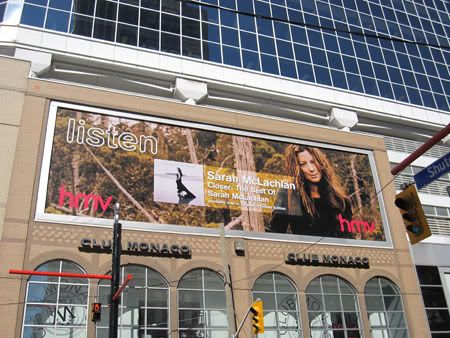 Starting out at Eaton Centre again. I took another photo of the billboards, this time concentrating on Sarah McLachlan. That is the best photo of her I've seen in a long time, if ever. Thanks to the likes of McLachlan, Canadian musicians - and women rockers around the world - have a level ground to compete on.
There is a somewhat pricey diner below this sign - selling eggs-oriented breakfast, lunch, and dinner. It appeared to be part of a national chain as well. I ended up having a late breakfast there.
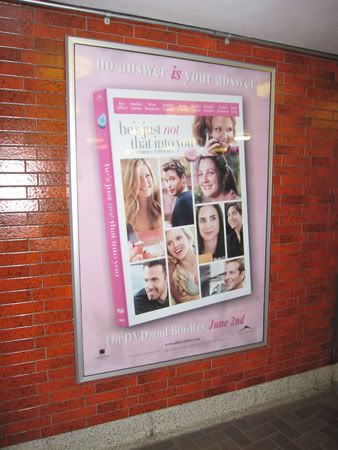 I am in the subway, in order to reach Casa Loma. And I see that on June 2nd, I will be able to buy a DVD of He's Just Not That Into You, with an all-star cast including my favorite Greek Goddess, Jennifer Aniston.
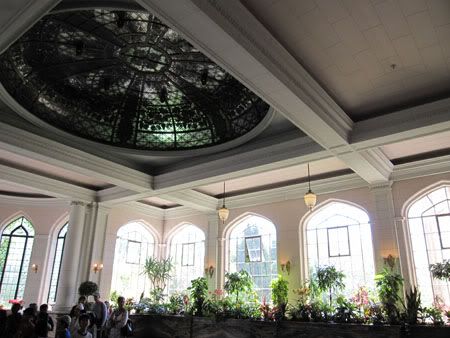 I have reached Casa Loma, the largest residence in Canada. It was the residence of Sir Henry Pallatt, who made a fortune developing hydroelectric power on the Niagara River, and was influential in the economic development of the Toronto area and early Canada as a whole. While such mansions are common in the US, where showing off one's wealth is considered the reward of one's hard work, Casa Loma is one of a kind in Canada. Casa Loma feels a lot like California's Hearst Castle in many ways.
Pallatt lived here until 1924, when business overexpansion drove him into debt, and the loss of his hydroelectric power monopoly forced him to liquidate everything he owned. The Kiwanis Club has maintained the mansion as a tourist attraction since 1937, slowly but steadily restoring many of the sections.
This photo shows the indoor conservatory. Pallatt and his wife were renowned horticulturists, I was told.
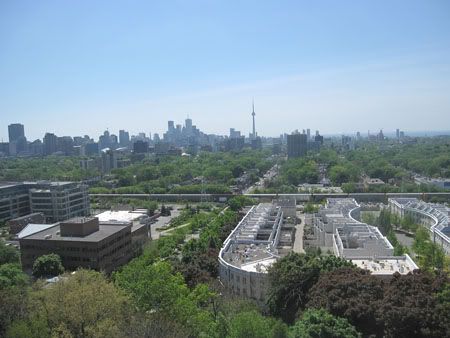 Climbing up the narrow spiral staircase, I have reached the highest level in the mansion tower, with this great look at the city skyline. A lot of bricks were covered with tourist graffiti - some in Asian scripts!
Those row houses in front, which I had passed to get here, felt very British in character. One of these days, I need to get back to England, and really expand my reach well beyond London. Maybe beyond England and into other parts of the UK.
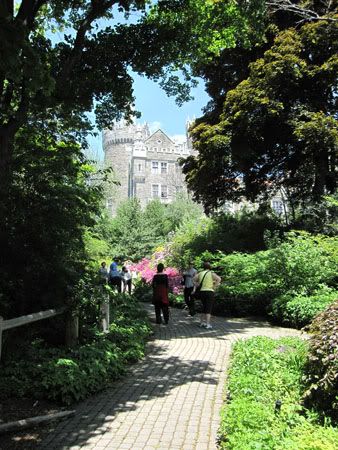 The outdoors garden, open from May to October, is also a gem.
It's starting to get a bit warm again, even though forecasts called for the day's high temperature to be just 19 degrees Celsius. I am again wearing my trusty tights and boots, topping them off with a dress-shaped floral tunic featuring poet's 3/4 sleeves (a very popular look during my teeny bopper years) and a black trench coat. My makeup is also a bit heavier than usual, especially with the eye pencil, and I am feeling a teeny bopper spirit inside my 33-year-old body.
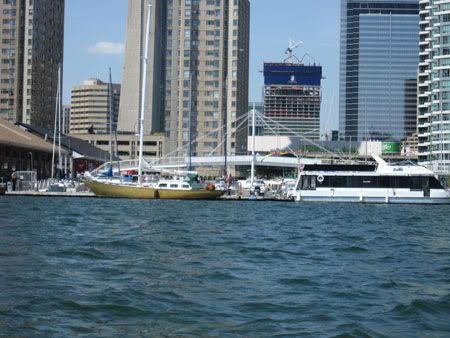 I proceeded to the harbour, where my real age started to catch up with me. My left foot was starting to hurt, as if I had fractured a bone! Walking became very challenging.
I decided to do a touristy harbour boat tour, shellling out $27. That got me an hour in a boat with a guide to explain the various sights, with an option to get off at Toronto Islands and explore.
Here is an interesting sight. This bridge came from an Amsterdam canal, as a gift of the Dutch Royal Family who had been based in Toronto during World War II. The last thing I need right now is a reminder of my past travel hellhole with way too many parallels to the California ethnic theocracy.
Other waterfront sights include former industrial warehouses turned into art galleries, as well as Rogers Centre, the home of Toronto Blue Jays and formerly known as the Skydome. Rogers is one of the three major players of Canada's cell phone industry (Bell Canada and Telus are the other two), and all AT&T phones - including my iPhone - use Rogers when roaming in Canada.
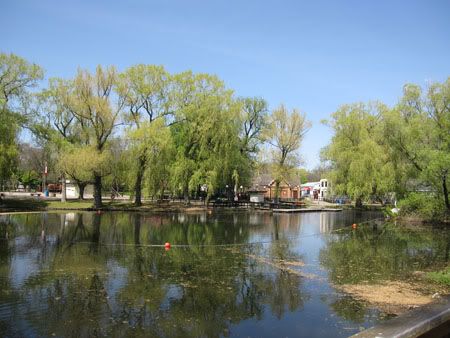 I landed at Centre Island, one of over a dozen islands that make up the Toronto Islands, separating the harbour from Lake Ontario.
The Islands have many features. Some natural sections doubled as the Florida Everglades in a movie - in fact, the CN Tower made a 3-second appearance in Florida in that movie, I was told. There are recreational facilities, including a small amusement park seen above, open daily June-August and weekends May and September. There is even a clothing optional beach on the west side - one of two in Canada - but due to jurisdictional differences, it's legal to be naked on land but illegal to be naked in the water (fine is $65). As the Islands are quite chilly compared to inland, I wouldn't dare get naked here...
The Islands even host an airport, Toronto Island Airport, which hosts Porter Airlines, offering frequent propeller aircraft service to Chicago, New York, and other major cities.
 Due to the foot pain, I decided to return to my hotel for a quick break. Then I added even more eyeliner, changed into that white Aritzia long shirt, topped off with a long suit jacket, and headed back out. Aside from my lack of pants, I could've passed for a Toronto commuter. (Though I was really feeling even more like a teeny bopper this day.)
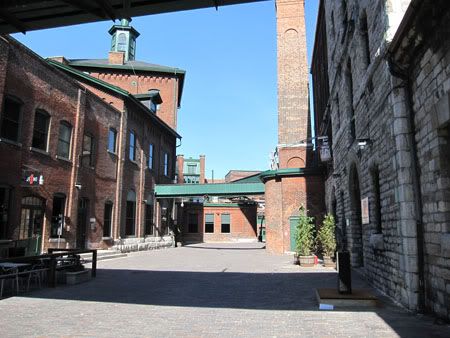
My first destination: the Distillery, a gentrification of a distillery and several other industrial buildings just east of downtown on the waterfront. The gentrification is still ongoing, so not many things to see/do right now. Love the "abandoned factory" ambience, however.
I then headed west on King West, taking a northbound bus (#63) on Shaw so that I could head back east on Queen West. West of Bathurst, Queen West maintains its original rough-and-tumble independent funky vibe, while between Bathurst and Yonge, it feels more corporate and trendy. Again, due to my foot pain, I didn't do much walking. I finished off with a Thai fast food dinner at Eaton Centre, as well as shopping; while I wanted to buy dressy boots as an alternative to my flat suede casual boots (that'd give my "pantsless suit" ensemble a bit more polish), I had no luck, and instead ended up with a Gap black mini, which I kind of needed to replace my worn-out black microminis. Due to Gap's generous sizing, I found that a Size 6 was a good fit.
My journey back to California started after only an hour or two of sleep. I declared only USD $120 worth of purchases to the US customs, who have presence at all major Canadian airports (including Toronto Pearson). The US immigration officer grilled me with a dozen detailed questions, but the questioning was smooth and I cleared US entry formalities without fuss.
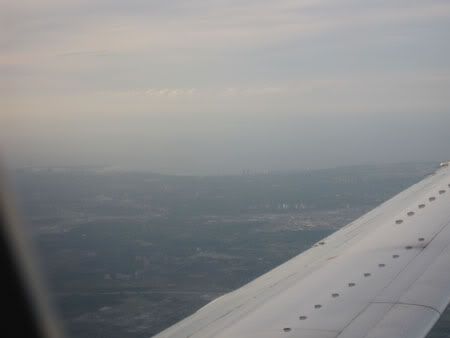 It's now about 7 in the morning. I am on a very old United plane as it leaves Toronto. The left of the shoreline shows the Toronto Harbour as well as faint outlines of the CN Tower and a few other skyscrapers.
This was a very miserable flight due to a very cut-rate purser who had a knack for insulting the passengers' intelligence. If this were my first flight on United Airlines, it would've certainly been my last as well. I usually have far better luck with United's flight crew, both pilots and flight attendants, however.
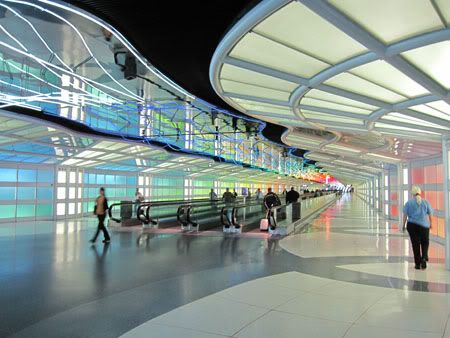 As I had cleared US immigration and customs in Toronto, I was a domestic passenger upon landing at O'Hare Airport in Chicago. This is the underground corridor that links the two main United terminals at O'Hare. Of course, O'Hare is United's home airport, and American also maintains a large presence.
Continuation to Los Angeles was on a newly renovated Boeing 767 aircraft, featuring United's new flat-bed business class and revamped first class. The economy section had seen next to no improvements, however, and I was very unhappy about that. While flying on an airplane in general, and on a United flight in particular, is normally a joyous occasion for me, and usually ends up taking me to a better place than where I leave from, today was certainly NOT one of those days, especially considering that California was reaffirming the ethnic theocrats' greatest contribution to the state politics, the constitutional ban on gay marriage (Proposition 8), as my half-renovated 767 was descending over San Bernardino.
I already miss Canada - especially its constructive approach to immigration (rather that the destructive US approach). I will make sure to visit more often.
Starting out at Eaton Centre again. I took another photo of the billboards, this time concentrating on Sarah McLachlan. That is the best photo of her I've seen in a long time, if ever. Thanks to the likes of McLachlan, Canadian musicians - and women rockers around the world - have a level ground to compete on.There is a somewhat pricey diner below this sign - selling eggs-oriented breakfast, lunch, and dinner. It appeared to be part of a national chain as well. I ended up having a late breakfast there.
I am in the subway, in order to reach Casa Loma. And I see that on June 2nd, I will be able to buy a DVD of He's Just Not That Into You, with an all-star cast including my favorite Greek Goddess, Jennifer Aniston.I have reached Casa Loma, the largest residence in Canada. It was the residence of Sir Henry Pallatt, who made a fortune developing hydroelectric power on the Niagara River, and was influential in the economic development of the Toronto area and early Canada as a whole. While such mansions are common in the US, where showing off one's wealth is considered the reward of one's hard work, Casa Loma is one of a kind in Canada. Casa Loma feels a lot like California's Hearst Castle in many ways.Pallatt lived here until 1924, when business overexpansion drove him into debt, and the loss of his hydroelectric power monopoly forced him to liquidate everything he owned. The Kiwanis Club has maintained the mansion as a tourist attraction since 1937, slowly but steadily restoring many of the sections.
This photo shows the indoor conservatory. Pallatt and his wife were renowned horticulturists, I was told.
Climbing up the narrow spiral staircase, I have reached the highest level in the mansion tower, with this great look at the city skyline. A lot of bricks were covered with tourist graffiti - some in Asian scripts!Those row houses in front, which I had passed to get here, felt very British in character. One of these days, I need to get back to England, and really expand my reach well beyond London. Maybe beyond England and into other parts of the UK.
The outdoors garden, open from May to October, is also a gem.It's starting to get a bit warm again, even though forecasts called for the day's high temperature to be just 19 degrees Celsius. I am again wearing my trusty tights and boots, topping them off with a dress-shaped floral tunic featuring poet's 3/4 sleeves (a very popular look during my teeny bopper years) and a black trench coat. My makeup is also a bit heavier than usual, especially with the eye pencil, and I am feeling a teeny bopper spirit inside my 33-year-old body.
I proceeded to the harbour, where my real age started to catch up with me. My left foot was starting to hurt, as if I had fractured a bone! Walking became very challenging.I decided to do a touristy harbour boat tour, shellling out $27. That got me an hour in a boat with a guide to explain the various sights, with an option to get off at Toronto Islands and explore.
Here is an interesting sight. This bridge came from an Amsterdam canal, as a gift of the Dutch Royal Family who had been based in Toronto during World War II. The last thing I need right now is a reminder of my past travel hellhole with way too many parallels to the California ethnic theocracy.
Other waterfront sights include former industrial warehouses turned into art galleries, as well as Rogers Centre, the home of Toronto Blue Jays and formerly known as the Skydome. Rogers is one of the three major players of Canada's cell phone industry (Bell Canada and Telus are the other two), and all AT&T phones - including my iPhone - use Rogers when roaming in Canada.
I landed at Centre Island, one of over a dozen islands that make up the Toronto Islands, separating the harbour from Lake Ontario.The Islands have many features. Some natural sections doubled as the Florida Everglades in a movie - in fact, the CN Tower made a 3-second appearance in Florida in that movie, I was told. There are recreational facilities, including a small amusement park seen above, open daily June-August and weekends May and September. There is even a clothing optional beach on the west side - one of two in Canada - but due to jurisdictional differences, it's legal to be naked on land but illegal to be naked in the water (fine is $65). As the Islands are quite chilly compared to inland, I wouldn't dare get naked here...
The Islands even host an airport, Toronto Island Airport, which hosts Porter Airlines, offering frequent propeller aircraft service to Chicago, New York, and other major cities.
Due to the foot pain, I decided to return to my hotel for a quick break. Then I added even more eyeliner, changed into that white Aritzia long shirt, topped off with a long suit jacket, and headed back out. Aside from my lack of pants, I could've passed for a Toronto commuter. (Though I was really feeling even more like a teeny bopper this day.)My first destination: the Distillery, a gentrification of a distillery and several other industrial buildings just east of downtown on the waterfront. The gentrification is still ongoing, so not many things to see/do right now. Love the "abandoned factory" ambience, however.
I then headed west on King West, taking a northbound bus (#63) on Shaw so that I could head back east on Queen West. West of Bathurst, Queen West maintains its original rough-and-tumble independent funky vibe, while between Bathurst and Yonge, it feels more corporate and trendy. Again, due to my foot pain, I didn't do much walking. I finished off with a Thai fast food dinner at Eaton Centre, as well as shopping; while I wanted to buy dressy boots as an alternative to my flat suede casual boots (that'd give my "pantsless suit" ensemble a bit more polish), I had no luck, and instead ended up with a Gap black mini, which I kind of needed to replace my worn-out black microminis. Due to Gap's generous sizing, I found that a Size 6 was a good fit.
My journey back to California started after only an hour or two of sleep. I declared only USD $120 worth of purchases to the US customs, who have presence at all major Canadian airports (including Toronto Pearson). The US immigration officer grilled me with a dozen detailed questions, but the questioning was smooth and I cleared US entry formalities without fuss.
It's now about 7 in the morning. I am on a very old United plane as it leaves Toronto. The left of the shoreline shows the Toronto Harbour as well as faint outlines of the CN Tower and a few other skyscrapers.This was a very miserable flight due to a very cut-rate purser who had a knack for insulting the passengers' intelligence. If this were my first flight on United Airlines, it would've certainly been my last as well. I usually have far better luck with United's flight crew, both pilots and flight attendants, however.
As I had cleared US immigration and customs in Toronto, I was a domestic passenger upon landing at O'Hare Airport in Chicago. This is the underground corridor that links the two main United terminals at O'Hare. Of course, O'Hare is United's home airport, and American also maintains a large presence.Continuation to Los Angeles was on a newly renovated Boeing 767 aircraft, featuring United's new flat-bed business class and revamped first class. The economy section had seen next to no improvements, however, and I was very unhappy about that. While flying on an airplane in general, and on a United flight in particular, is normally a joyous occasion for me, and usually ends up taking me to a better place than where I leave from, today was certainly NOT one of those days, especially considering that California was reaffirming the ethnic theocrats' greatest contribution to the state politics, the constitutional ban on gay marriage (Proposition 8), as my half-renovated 767 was descending over San Bernardino.
I already miss Canada - especially its constructive approach to immigration (rather that the destructive US approach). I will make sure to visit more often.

24 May 2009
Toronto: Continuing on...
I continued my tour of Toronto. Waking up late (primarily due to the subway not entering service until 9AM), I ended up spending most of my day at Ontario Science Centre, a fairly nice science museum.
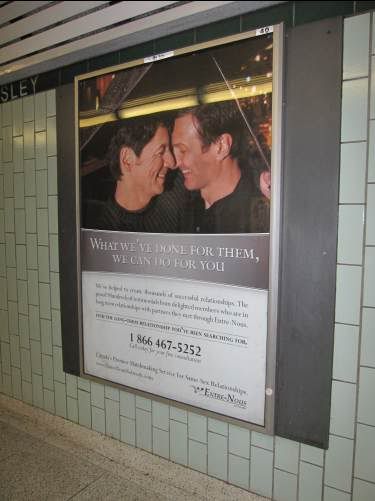 As Toronto is the first North American city to have legalized gay marriages, it's only fair that I start at Church-Wellesley, the heart of gay Toronto. I am at Wellesley Station on the Yonge subway line, where I am being greeted with this gay dating service poster. Entre-Nous features men on its subway ads; I want to see some women too.
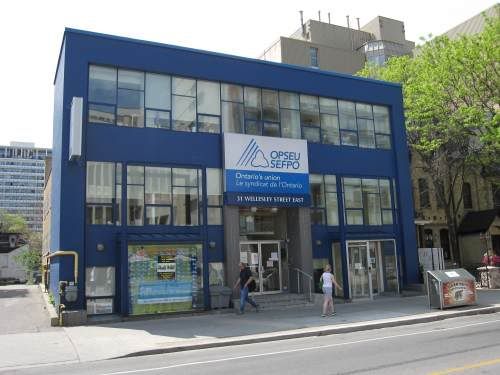 Heading east on Wellesley. Here is a union hall - belonging to Ontario Public Service Employees Union.
Canada's unionization rate is around 28%, which is lower than the European Union but still double the US rate. Unions are a well-accepted part of life in Canada, and union organizers are more concerned with community service and customer relations, and ensuring better working condition for the rank-and-file, than with outright politicking (typical of pro-union states in the US) or the very survival (typical of anti-union US states).
Back in the US, I understand that the Employee Free Choices Act is a major source of political contention - and a major agenda initiative of President Obama. I want to make clear that workers should be able to organize on their own initiative, and that sensible regulations need to be enacted to ensure that not only greedy employers, but also greedy union bosses, are kept in control.
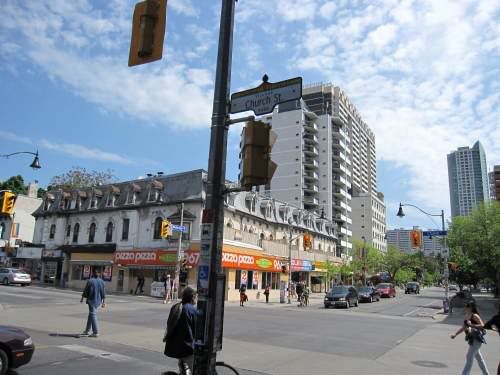 I am at the southwest corner of Church and Wellesley - Toronto's equivalent to, say, San Francisco's Market and Castro. Rainbow flags all around, and yes, the gayness is in the air.
As expected of gay neighborhoods, this area has upscale restaurants, bars, and other hangouts. Plenty of alternative newspapers being given out for free too, as well as posters. At one of the men's bars, there will be an underwear drag show tonight - I'm skipping it (I am finding drag to be too tedious anyway).
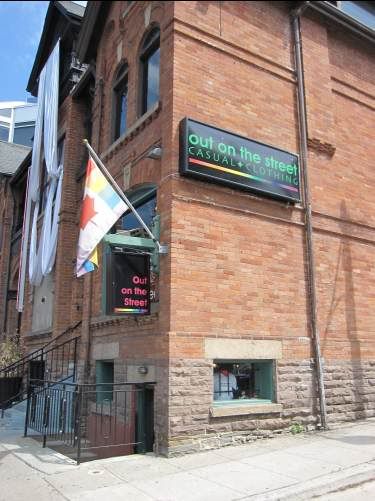 In the US, many gays fly their own version of the Stars and Stripes by keeping the canton but replacing the red-and-white stripes with the rainbow flag. And now I see that Canada also has its own gay version of the national flag as well - replacing the red bars on either side with the rainbow flag. I love it!
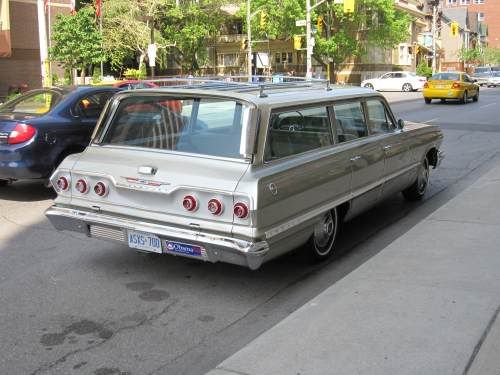 I wonder if this is an expat American, or a Canadian who really has a vested interest in US politics? Glad to see an Obama bumper sticker on this classic Chevy wagon with Ontario plates.
With a car this old, the speedometer will be in miles per hour regardless of whether the car was for US or Canadian duty (Canada didn't go metric until the 1970s). So that leaves me with one less way of figuring out whether this is a transplanted American or a Canadian.
Old cars in this mint of a condition are very rare in Toronto. Most cars rust away after so many brutal winters. It's hard to find cars over 15 years old. (So much for my dreams of finding an ancient Hyundai Pony to park next to my car and restore.)
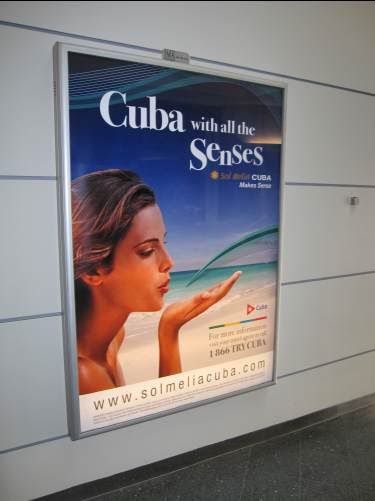 Time to continue. I am at the Yonge-Bloor subway station, looking at a resort ad. Nothing unusual about the Sol Melia name, well-known in Spanish-speaking nations - and outside; in fact, my final London visit had involved four nights at the White House, Sol Melia's premier London property. What is noteworthy is that there are several resorts to choose from, all in Cuba.
When I know I can buy Cuban vacation packages, I definitely know that I am NOT in the US, and therefore outside the sphere of influence of the McCarthyist mentality of Miami's Little Havana.
Again, the US must revisit its Cuban policy (I know that Obama is making minor steps toward this), to ensure the best results possible for the everyday people of Cuba, rather than fulfilling some gripes of the Cuban expats in Miami. Some tell me that the difference between Cubans and Cuban-Americans has strong parallels to the difference between South Koreans and Korean-Americans that I describe to them. Strategic engagement in Cuba will buy influence and improve lives of the ordinary Cubans.
I proceeded east to Greektown for a gyro lunch, which was wonderful - and ended up costing me only $10 after taxes. The restaurant was near Chester station, named Kalyvia, and the waiter, an older Greek native gentleman, was very friendly. He even called me "miss" - despite my age. In fact, people do call me "miss" a bit more often now than a few years ago, and I think maybe it could be the way I dress - less like Calista Flockhart and more like Lindsay Lohan. Yes, I was "pants free" today too - working a long T-shirt as a dress, and adding yesterday's American Apparel $9 belt for an empire waistline.
 I then proceeded to Ontario Science Centre, by taking the No. 25 bus from Pape Station. Many subway stations outside downtown, including Pape, have bus boarding platforms inside paid areas, making life a bit easier. I also loved the views of the various creeks and ravines, densely forested, that interrupt the Toronto cityscape here and there.
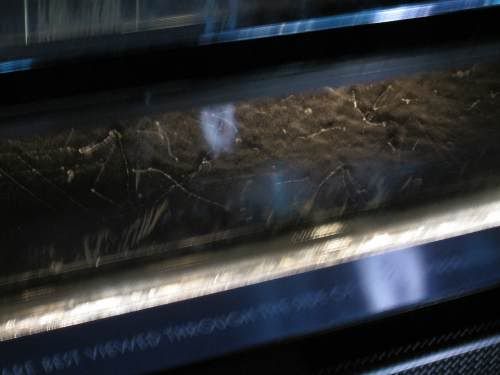
Here is one of the more interesting exhibits at the museum. This exhibit is capturing and showing the cosmic rays that fly through the Earth. Cosmic rays can be a number of different things - alpha particles (naked helium nuclei), protons, etc. It's one thing to study them in college, another to see them for real.
 The museum has five levels, three of which are exhibits. The exhibit levels are located an escalator ride or two down from the admissions kiosk.
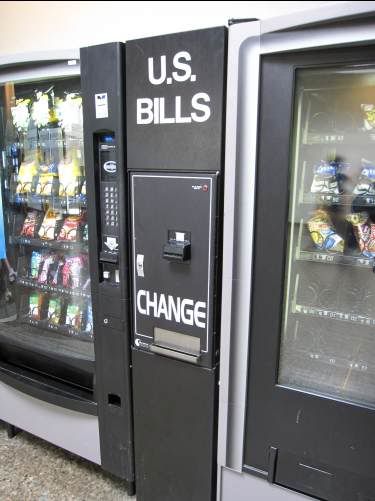
I am about to enter one of the exhibit areas, in front of a row of vending machines. While Canadian coins go up to $2 and the machines themselves can break up to $20, visiting Americans are not so lucky. To buy a $2.75 drink, they may need to pull out a few dollar bills. This machine, made in Indianapolis, exchanges US dollar bills into Canadian coins - though I presume the exchange rate is probably 1:1 or something almost as lousy.
I don't worry about this kind of stuff. I am carrying strictly Canadian currency only in my purse, and will not be touching US currency until it's time to fly home.
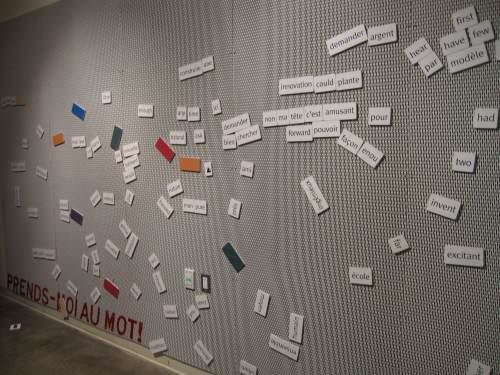 Here is an interactive area. This exhibit allows visitors to string together a series of words to make a sentence. But this being Canada, I need to choose whether I want to make an English sentence or a French one. And even though Toronto speaks English, most of the words available to me are French.
All exhibits are in both languages. It's actually pretty interesting to see how concepts like "black hole" are written in French.
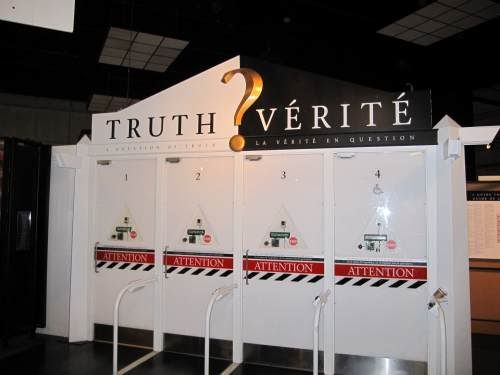 There are a number of special exhibitions. One highly touted one was about espionage, but I didn't find it too interesting. This one, titled Truth, is far more to my liking. It discusses how various cultures have been deemed "inferior" or "primitive," and how even science got a bias against the said cultures, because of the Eurocentric mindset that prevailed for several centuries. Sexism and racism are also well discussed.
After this exhibit, I had a chance to write my feelings to be shared with future visitors. I wrote the following note:
24 May 2009
Thank you for this food for thought.
It bears remembering that all humans are equally capable of good/intelligence/culture. However, different circumstances result in cultural differences that make people, well, different.
Wrong combinations of cultural elements, however, may end up being extremely toxic. While Christianity is taught as a religion of love/liberation, it often becomes tyranny when placed in communal nonwhite cultures (i.e. Latin America, Korea, Asian enclaves in USA). Europe leapfrogged ahead only due to its Renaissance/individualism which happened only due to prevailing circumstances.
I do appreciate Canada for recognizing the good that everyone can potentially offer. The USA, on the other hand, runs a partisan immigration policy that brings in only "desirable" demographics to pit against other demographics. California is paying a heavy price as a result.
The surest way to ensure enlightenment for all cultures is decent standard of living. Central America and former USSR suffer, while East Asia's formerly draconian societies are far more tolerant now, for this precise reason.
Thanks Ontario Science Centre - and thanks Canada!
Rachel K. So
Los Angeles, CA, USA / Seoul, Republic of Korea
Yes, I put down two hometowns, Seoul being the second (and the more enlightened) one. I even used the Republic of Korea moniker as a shout-out to the good people back in Seoul, even though I do not recognize the legitimacy of South Korea's current government. And indeed, great leaps forward in culture and mentalities do happen when a society is affluent enough that people can afford to think and discuss philosophy rather than having to scramble just to survive - a point well demonstrated by none other than South Korea.
I continued my tour of Ontario Science Centre, going even through sections on basic scientific laws and human physiology. I loved the frank talk in the human physiology section about reproduction and birth control options - something that's increasingly harder to get in the US. Not as forward-thinking as the British (who discuss even transgender issues in ways children can swallow), but very impressive nevertheless. Of course, I took in a side view of the male and female reproductive systems as well.
I returned to downtown, getting off at Yonge-Dundas Plaza and heading west on Dundas. Passing the Art Gallery of Ontario, I ended up at Chinatown.
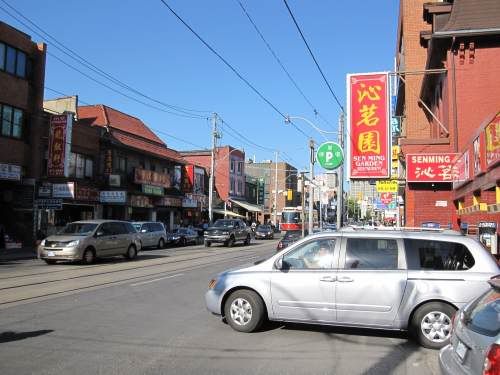 Toronto boasts 300,000 residents of Chinese ancestry, I am told. Needless to say, Chinatown is quite impressive, even though it's not as grand as the Chinatowns of San Francisco, New York, or Vancouver.
When even the municipal parking lot is labeled in Chinese, I know that I am in Chinatown.
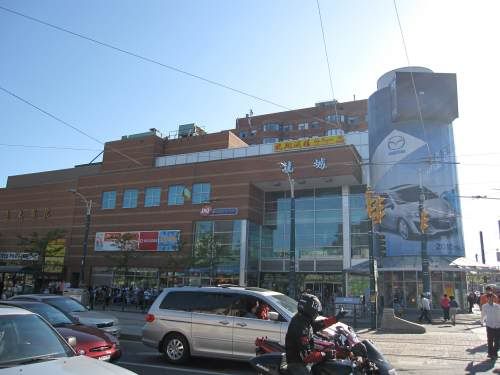 The anchor of Toronto's Chinatown is this shopping mall, named Dragon City. It stands on the southwest corner of Dundas and Spadina.
There was a karaoke room with a happy hour promotion ($10/hr per person until 8:45 PM) but I was too tired to go in. As for the rest of the mall, not as impressive as the grand Asian shopping centers I'm used to elsewhere.
I will NOT be mistaking this area for Hong Kong anytime soon. But again, this is an impressive enclave anyway.
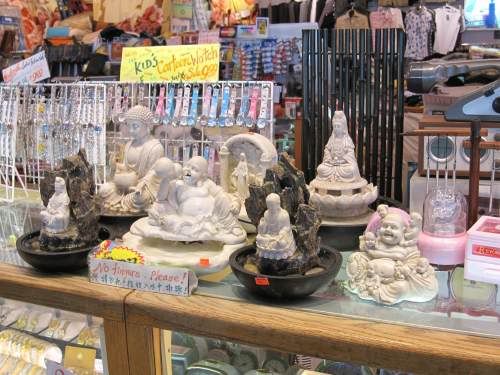 Seen at a store in Dragon City: some Buddhist statues for sale. Mostly Happy Buddhas but two examples of my transgender matron saint too. Can't go wrong with either.
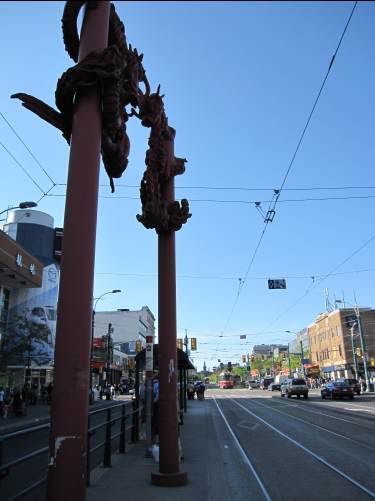 And what good is Chinatown without a gate? Toronto's Chinatown has two gates, both located on Spadina at the streetcar platform. One of them is here, the other is on the other track beyond the traffic signal.
I took the streetcar on Spadina down to Queen West, but as it was almost 6PM on Sunday, everything was closing up. I grabbed a quick pizza dinner for $5 at a Canadian pizza chain, then headed back to my hotel, feet hurting and all. The breeze was also causing my T-shirt to fly up quite a bit - I am pretty sure half of Toronto now knows what my lingerie preference is (it's pretty boring actually - utilitarian black panties, hiding under black tights).
Due to too much time spent at Ontario Science Centre, I didn't make it to Casa Loma. I am thinking that will be the first thing in the morning, as I kick off my final Toronto day. In addition, I need to also squeeze in a harbor cruise, a few extra museums, and maybe extra shopping. The thought of having to go back to California theocracy is NOT appetizing, but I must, and I need to take as much of the good spirits of Canada and the rest of the civilized world as I can.
As Toronto is the first North American city to have legalized gay marriages, it's only fair that I start at Church-Wellesley, the heart of gay Toronto. I am at Wellesley Station on the Yonge subway line, where I am being greeted with this gay dating service poster. Entre-Nous features men on its subway ads; I want to see some women too.Heading east on Wellesley. Here is a union hall - belonging to Ontario Public Service Employees Union.Canada's unionization rate is around 28%, which is lower than the European Union but still double the US rate. Unions are a well-accepted part of life in Canada, and union organizers are more concerned with community service and customer relations, and ensuring better working condition for the rank-and-file, than with outright politicking (typical of pro-union states in the US) or the very survival (typical of anti-union US states).
Back in the US, I understand that the Employee Free Choices Act is a major source of political contention - and a major agenda initiative of President Obama. I want to make clear that workers should be able to organize on their own initiative, and that sensible regulations need to be enacted to ensure that not only greedy employers, but also greedy union bosses, are kept in control.
I am at the southwest corner of Church and Wellesley - Toronto's equivalent to, say, San Francisco's Market and Castro. Rainbow flags all around, and yes, the gayness is in the air.As expected of gay neighborhoods, this area has upscale restaurants, bars, and other hangouts. Plenty of alternative newspapers being given out for free too, as well as posters. At one of the men's bars, there will be an underwear drag show tonight - I'm skipping it (I am finding drag to be too tedious anyway).
In the US, many gays fly their own version of the Stars and Stripes by keeping the canton but replacing the red-and-white stripes with the rainbow flag. And now I see that Canada also has its own gay version of the national flag as well - replacing the red bars on either side with the rainbow flag. I love it!I wonder if this is an expat American, or a Canadian who really has a vested interest in US politics? Glad to see an Obama bumper sticker on this classic Chevy wagon with Ontario plates.With a car this old, the speedometer will be in miles per hour regardless of whether the car was for US or Canadian duty (Canada didn't go metric until the 1970s). So that leaves me with one less way of figuring out whether this is a transplanted American or a Canadian.
Old cars in this mint of a condition are very rare in Toronto. Most cars rust away after so many brutal winters. It's hard to find cars over 15 years old. (So much for my dreams of finding an ancient Hyundai Pony to park next to my car and restore.)
Time to continue. I am at the Yonge-Bloor subway station, looking at a resort ad. Nothing unusual about the Sol Melia name, well-known in Spanish-speaking nations - and outside; in fact, my final London visit had involved four nights at the White House, Sol Melia's premier London property. What is noteworthy is that there are several resorts to choose from, all in Cuba.When I know I can buy Cuban vacation packages, I definitely know that I am NOT in the US, and therefore outside the sphere of influence of the McCarthyist mentality of Miami's Little Havana.
Again, the US must revisit its Cuban policy (I know that Obama is making minor steps toward this), to ensure the best results possible for the everyday people of Cuba, rather than fulfilling some gripes of the Cuban expats in Miami. Some tell me that the difference between Cubans and Cuban-Americans has strong parallels to the difference between South Koreans and Korean-Americans that I describe to them. Strategic engagement in Cuba will buy influence and improve lives of the ordinary Cubans.
I proceeded east to Greektown for a gyro lunch, which was wonderful - and ended up costing me only $10 after taxes. The restaurant was near Chester station, named Kalyvia, and the waiter, an older Greek native gentleman, was very friendly. He even called me "miss" - despite my age. In fact, people do call me "miss" a bit more often now than a few years ago, and I think maybe it could be the way I dress - less like Calista Flockhart and more like Lindsay Lohan. Yes, I was "pants free" today too - working a long T-shirt as a dress, and adding yesterday's American Apparel $9 belt for an empire waistline.
I then proceeded to Ontario Science Centre, by taking the No. 25 bus from Pape Station. Many subway stations outside downtown, including Pape, have bus boarding platforms inside paid areas, making life a bit easier. I also loved the views of the various creeks and ravines, densely forested, that interrupt the Toronto cityscape here and there.Here is one of the more interesting exhibits at the museum. This exhibit is capturing and showing the cosmic rays that fly through the Earth. Cosmic rays can be a number of different things - alpha particles (naked helium nuclei), protons, etc. It's one thing to study them in college, another to see them for real.
The museum has five levels, three of which are exhibits. The exhibit levels are located an escalator ride or two down from the admissions kiosk.I am about to enter one of the exhibit areas, in front of a row of vending machines. While Canadian coins go up to $2 and the machines themselves can break up to $20, visiting Americans are not so lucky. To buy a $2.75 drink, they may need to pull out a few dollar bills. This machine, made in Indianapolis, exchanges US dollar bills into Canadian coins - though I presume the exchange rate is probably 1:1 or something almost as lousy.
I don't worry about this kind of stuff. I am carrying strictly Canadian currency only in my purse, and will not be touching US currency until it's time to fly home.
Here is an interactive area. This exhibit allows visitors to string together a series of words to make a sentence. But this being Canada, I need to choose whether I want to make an English sentence or a French one. And even though Toronto speaks English, most of the words available to me are French.All exhibits are in both languages. It's actually pretty interesting to see how concepts like "black hole" are written in French.
There are a number of special exhibitions. One highly touted one was about espionage, but I didn't find it too interesting. This one, titled Truth, is far more to my liking. It discusses how various cultures have been deemed "inferior" or "primitive," and how even science got a bias against the said cultures, because of the Eurocentric mindset that prevailed for several centuries. Sexism and racism are also well discussed.After this exhibit, I had a chance to write my feelings to be shared with future visitors. I wrote the following note:
24 May 2009
Thank you for this food for thought.
It bears remembering that all humans are equally capable of good/intelligence/culture. However, different circumstances result in cultural differences that make people, well, different.
Wrong combinations of cultural elements, however, may end up being extremely toxic. While Christianity is taught as a religion of love/liberation, it often becomes tyranny when placed in communal nonwhite cultures (i.e. Latin America, Korea, Asian enclaves in USA). Europe leapfrogged ahead only due to its Renaissance/individualism which happened only due to prevailing circumstances.
I do appreciate Canada for recognizing the good that everyone can potentially offer. The USA, on the other hand, runs a partisan immigration policy that brings in only "desirable" demographics to pit against other demographics. California is paying a heavy price as a result.
The surest way to ensure enlightenment for all cultures is decent standard of living. Central America and former USSR suffer, while East Asia's formerly draconian societies are far more tolerant now, for this precise reason.
Thanks Ontario Science Centre - and thanks Canada!
Rachel K. So
Los Angeles, CA, USA / Seoul, Republic of Korea
Yes, I put down two hometowns, Seoul being the second (and the more enlightened) one. I even used the Republic of Korea moniker as a shout-out to the good people back in Seoul, even though I do not recognize the legitimacy of South Korea's current government. And indeed, great leaps forward in culture and mentalities do happen when a society is affluent enough that people can afford to think and discuss philosophy rather than having to scramble just to survive - a point well demonstrated by none other than South Korea.
I continued my tour of Ontario Science Centre, going even through sections on basic scientific laws and human physiology. I loved the frank talk in the human physiology section about reproduction and birth control options - something that's increasingly harder to get in the US. Not as forward-thinking as the British (who discuss even transgender issues in ways children can swallow), but very impressive nevertheless. Of course, I took in a side view of the male and female reproductive systems as well.
I returned to downtown, getting off at Yonge-Dundas Plaza and heading west on Dundas. Passing the Art Gallery of Ontario, I ended up at Chinatown.
Toronto boasts 300,000 residents of Chinese ancestry, I am told. Needless to say, Chinatown is quite impressive, even though it's not as grand as the Chinatowns of San Francisco, New York, or Vancouver.When even the municipal parking lot is labeled in Chinese, I know that I am in Chinatown.
The anchor of Toronto's Chinatown is this shopping mall, named Dragon City. It stands on the southwest corner of Dundas and Spadina.There was a karaoke room with a happy hour promotion ($10/hr per person until 8:45 PM) but I was too tired to go in. As for the rest of the mall, not as impressive as the grand Asian shopping centers I'm used to elsewhere.
I will NOT be mistaking this area for Hong Kong anytime soon. But again, this is an impressive enclave anyway.
Seen at a store in Dragon City: some Buddhist statues for sale. Mostly Happy Buddhas but two examples of my transgender matron saint too. Can't go wrong with either.And what good is Chinatown without a gate? Toronto's Chinatown has two gates, both located on Spadina at the streetcar platform. One of them is here, the other is on the other track beyond the traffic signal.I took the streetcar on Spadina down to Queen West, but as it was almost 6PM on Sunday, everything was closing up. I grabbed a quick pizza dinner for $5 at a Canadian pizza chain, then headed back to my hotel, feet hurting and all. The breeze was also causing my T-shirt to fly up quite a bit - I am pretty sure half of Toronto now knows what my lingerie preference is (it's pretty boring actually - utilitarian black panties, hiding under black tights).
Due to too much time spent at Ontario Science Centre, I didn't make it to Casa Loma. I am thinking that will be the first thing in the morning, as I kick off my final Toronto day. In addition, I need to also squeeze in a harbor cruise, a few extra museums, and maybe extra shopping. The thought of having to go back to California theocracy is NOT appetizing, but I must, and I need to take as much of the good spirits of Canada and the rest of the civilized world as I can.
07 April 2009
Some developments
Word has it that Iowa and Vermont have legalized gay marriage, and the District of Columbia is close to legalizing it. Iowa did it via a court decision similar to California's, while Vermont did it by a legislative override of the governor's veto. As I look back to the freeways of Southern California, where Latin American and Asian theocracy rules supreme, I am more reminded than ever that despite the talk about all the evils that the white people and their imperialism spread throughout the world (including Christian theocracy itself), the whites do have one good trick up their sleeve - respect for individual happiness, which they discovered during the Renaissance (their own way of overthrowing theocracy). I am also reminded more than ever that California, which is fast approaching Hispanic majority, will not be re-legalizing gay marriage anytime soon, unless the whites can somehow translate their individualist mindset into conceptual terms that the immigrant cultures can understand.
I found myself so fed up with Southern California and its theocratic culture, in fact, that I had to make a last-minute getaway to Las Vegas last weekend. Nevada, despite the Las Vegas anything-goes attitude, can still get theocratic at times, due to significant Mormon influence; nevertheless, I found Vegas to be far more to my liking than Southern California. Despite California's reputation as the "vanity plate capital of the world," I found that Nevada actually had more vanity plates - and more fun-loving ones at that too (compared to the theocratic crap that usually qualifies for vanity plates in California). Even when it came to my own vanity plates, I felt that they fit right into the Vegas landscape; at least, my plates were referring to a non-theocratic goddess, though Kwan Yin isn't exactly a sex symbol, unlike someone like Aphrodite.
More on driving around Vegas, indeed there were tons of obscenely expensive cars around (try renting a Ferrari convertible for a nighttime cruise on the Strip). The most obnoxious ones, however, were huge SUVs (not limos, but private vehicles) splattered with Christian theocratic messages. And needless to say, they always came with California plates. More reminder that California is a far-right theocracy, plain and simple, despite the ridiculously liberal makeup of the state government. I was glad that even though I was driving a "lowly" Hyundai, it was the one Hyundai that fit right into the vain Strip streetscape, with more attitude than even the Crapsler 300, the favorite of many rap stars.
I went to Vegas for the Mystere show, one of the numerous Cirque du Soleil productions now on the Strip; the show itself was a dud IMO. However, I did fairly well at the blackjack table, and also managed to do a bit of shopping. I ended up with an American Apparel shirtdress that's really tailored like a nice men's dress shirt; it's also quite short, and it'd indeed be a mere shirt if it were any shorter. I guess people will now start asking me when I suddenly turned heterosexual, as it really does look like I just got out of a boyfriend's bed and borrowed his shirt. (Of course, I wear the shirtdress with my favorite double-female-symbol necklace, to put the questions to rest once and for all. I'm still a notoriously hardcore dyke.)
Hoping that my own life picks up sooner than later. I do think going away to a saner place more often will really help. In addition to my great car, I also need to remind myself that I am an elite customer at United Airlines, and that I must take advantage of the perks while they last. I'll certainly be frequenting the United website quite often to price some itineraries, once I have some schedule worked out. (I'd love Europe, especially!)
I found myself so fed up with Southern California and its theocratic culture, in fact, that I had to make a last-minute getaway to Las Vegas last weekend. Nevada, despite the Las Vegas anything-goes attitude, can still get theocratic at times, due to significant Mormon influence; nevertheless, I found Vegas to be far more to my liking than Southern California. Despite California's reputation as the "vanity plate capital of the world," I found that Nevada actually had more vanity plates - and more fun-loving ones at that too (compared to the theocratic crap that usually qualifies for vanity plates in California). Even when it came to my own vanity plates, I felt that they fit right into the Vegas landscape; at least, my plates were referring to a non-theocratic goddess, though Kwan Yin isn't exactly a sex symbol, unlike someone like Aphrodite.
More on driving around Vegas, indeed there were tons of obscenely expensive cars around (try renting a Ferrari convertible for a nighttime cruise on the Strip). The most obnoxious ones, however, were huge SUVs (not limos, but private vehicles) splattered with Christian theocratic messages. And needless to say, they always came with California plates. More reminder that California is a far-right theocracy, plain and simple, despite the ridiculously liberal makeup of the state government. I was glad that even though I was driving a "lowly" Hyundai, it was the one Hyundai that fit right into the vain Strip streetscape, with more attitude than even the Crapsler 300, the favorite of many rap stars.
I went to Vegas for the Mystere show, one of the numerous Cirque du Soleil productions now on the Strip; the show itself was a dud IMO. However, I did fairly well at the blackjack table, and also managed to do a bit of shopping. I ended up with an American Apparel shirtdress that's really tailored like a nice men's dress shirt; it's also quite short, and it'd indeed be a mere shirt if it were any shorter. I guess people will now start asking me when I suddenly turned heterosexual, as it really does look like I just got out of a boyfriend's bed and borrowed his shirt. (Of course, I wear the shirtdress with my favorite double-female-symbol necklace, to put the questions to rest once and for all. I'm still a notoriously hardcore dyke.)
Hoping that my own life picks up sooner than later. I do think going away to a saner place more often will really help. In addition to my great car, I also need to remind myself that I am an elite customer at United Airlines, and that I must take advantage of the perks while they last. I'll certainly be frequenting the United website quite often to price some itineraries, once I have some schedule worked out. (I'd love Europe, especially!)
20 March 2009
Convert. Or Exterminate.
The Christian and Muslim death cultists of all stripes are now making that the predominant culture of the land in Southern California.
The so-called conservatives, despite their nativist rhetoric, are benefiting too much from the Christian theocracy of the primitive Third World immigrant cultures, and as much as they claim to hate Islam, appreciate the shared barbaric values and teachings contained in Islam.
The so-called liberals are just too scared of ever offending a single nonwhite, so they will never say a thing about the Christian theocrats. And as for Islam? It's not a European religion, so they think it can't possibly be bad.
I've had it. Christianity and Islam are two very bloodthirsty death cults who have grown to dominate the world only because of their most important, overriding dogma: convert, or exterminate. Coexistence with others is not part of their thought system. And they are making it clearly known. It looks like either the fair-minded people must stand up and say no now, or they will forever be themselves exterminated once and for all.
The Christian/Muslim excuse of a "God" is a bloodthirsty asshole, and must be exterminated himself. Though I am pretty sure that whatever "God" turns out to be, it's not a personality at all, more like a force of energy (what the Chinese would call "qi") that abstractly exists in anything and everything. That's the true higher power I shall answer to, not some mean-spirited bloodthirsty asshole that exists only in the pages of the Death Book.
I want to remind the white liberals that to give in to these barbarians is just like being a Jew who gave in to the Nazi rule. Those Jews got exterminated anyway - and that is the fate of white liberalism in California and elsewhere in the civilized world, if nothing is done now.
I made sure to immediately destroy all Death Book verses hanging in my office. And that, in addition to selling my BMW a few months ago, is just a start. I may not be able to move to a saner region right away, but until I do, I will fight tooth and nail to contain and extinguish the death cults - or die trying. I will also oppose any and all immigration policies that serve to fatten the ranks of the death cultists at the expense of the saner society.
The so-called conservatives, despite their nativist rhetoric, are benefiting too much from the Christian theocracy of the primitive Third World immigrant cultures, and as much as they claim to hate Islam, appreciate the shared barbaric values and teachings contained in Islam.
The so-called liberals are just too scared of ever offending a single nonwhite, so they will never say a thing about the Christian theocrats. And as for Islam? It's not a European religion, so they think it can't possibly be bad.
I've had it. Christianity and Islam are two very bloodthirsty death cults who have grown to dominate the world only because of their most important, overriding dogma: convert, or exterminate. Coexistence with others is not part of their thought system. And they are making it clearly known. It looks like either the fair-minded people must stand up and say no now, or they will forever be themselves exterminated once and for all.
The Christian/Muslim excuse of a "God" is a bloodthirsty asshole, and must be exterminated himself. Though I am pretty sure that whatever "God" turns out to be, it's not a personality at all, more like a force of energy (what the Chinese would call "qi") that abstractly exists in anything and everything. That's the true higher power I shall answer to, not some mean-spirited bloodthirsty asshole that exists only in the pages of the Death Book.
I want to remind the white liberals that to give in to these barbarians is just like being a Jew who gave in to the Nazi rule. Those Jews got exterminated anyway - and that is the fate of white liberalism in California and elsewhere in the civilized world, if nothing is done now.
I made sure to immediately destroy all Death Book verses hanging in my office. And that, in addition to selling my BMW a few months ago, is just a start. I may not be able to move to a saner region right away, but until I do, I will fight tooth and nail to contain and extinguish the death cults - or die trying. I will also oppose any and all immigration policies that serve to fatten the ranks of the death cultists at the expense of the saner society.
10 March 2009
Multiculturalism and its possible pitfalls
Multiculturalism has been the guiding principle of the Western world (and to varying degrees, many other societies, including India and China) for the past several decades. Its premise is that foreign cultures can offer some new insights that the prevailing mainstream culture cannot readily achieve on its own. It's certainly worked its magic in the US - it is valuable for me to discuss the message of Kwan Yin, my transgender matron saint, and the belief systems that worship her, with people who used to be exposed only to Christian and related thought systems.
However, there is a pitfall. Not all cultures/religions believe in the same premise of learning from others that the Western world today believes in. And some white liberals are of the mentality that nonwhites are incapable of evil on their own, all nonwhite evil is sourced from white colonizers, and that nonwhite cultures are simply passive victims of white imperialism. Unfortunately, this does not explain the honor killings of a number of Muslim societies, the primitive Sharia laws of many other Muslim nations, and the severe misogyny of Confucianism; these evils have nothing to do with the white cultures.
Sitting in Southern California, where nonwhite conservatism has done severe damage to the society in the form of recurring restrictions on women's reproductive rights and the elimination of gay marriage, I know this too well. And even when it comes to "white problems," the greatest, most faithful torch-bearers of those problems are themselves nonwhites (i.e. the Korean reverence of US southern white supremacy based on Christianity). Tolerance of diversity and other cultures does NOT include tolerance of honor killings and Sharia law, at least in my books.
Over in Europe, particularly in the Netherlands, there is a well-deserved backlash which is a hot social topic today. I do know first hand that Amsterdam is a living hell, because of all the immigrant thugs who have NO respect for the Dutch tolerance for the unconventional (though they themselves benefit from the Dutch tolerance, just by being there and spewing their hate). The majority (well, white Dutch are a mere minority in Amsterdam, but they still have the rest of the country) has now stepped in, by decreeing that while foreign cultures and people are still welcome, there are some ground rules that they need to learn and obey. While the strongest sentiments, including outright ban of Islam and foreign language use in public, belong to the far right, the more moderate sentiments are well echoed by the liberals as well, as they rightfully see that some of these foreign cultural elements are actually destroying the very liberal values that they hoped these nonwhite cultures would uphold. The UK, also home to many immigrants (20% of London, in fact - and Jamaican homophobia does get me), faces similar challenges and arguments.
It's about time that the US, particularly California with its huge conservative immigrant population, did something similar. But given that the conservatives are benefiting too much from the status quo to ever change it, and that the liberals are utterly scared of even remotely hinting that nonwhites are actually capable of evil, I don't see much hope. While many liberals do point to the likes of Los Angeles Mayor Antonio Villaraigosa, descendant of Mexican immigrants who also happens to speak fluent Spanish, as proof that ethnic liberalism is a very strong ideology, the nonwhites that I deal with in real life are far more likely to be along the lines of Alan Keyes, Attorney General Alberto Gonzales, or Counsel John Yoo. Around me, gynecological clinics that supposedly perform abortions are being picketed by Central Americans speaking Spanish, rather than whites speaking English.
Here's a Wikipedia article on multiculturalism that discusses these points very well:
Wikipedia
However, there is a pitfall. Not all cultures/religions believe in the same premise of learning from others that the Western world today believes in. And some white liberals are of the mentality that nonwhites are incapable of evil on their own, all nonwhite evil is sourced from white colonizers, and that nonwhite cultures are simply passive victims of white imperialism. Unfortunately, this does not explain the honor killings of a number of Muslim societies, the primitive Sharia laws of many other Muslim nations, and the severe misogyny of Confucianism; these evils have nothing to do with the white cultures.
Sitting in Southern California, where nonwhite conservatism has done severe damage to the society in the form of recurring restrictions on women's reproductive rights and the elimination of gay marriage, I know this too well. And even when it comes to "white problems," the greatest, most faithful torch-bearers of those problems are themselves nonwhites (i.e. the Korean reverence of US southern white supremacy based on Christianity). Tolerance of diversity and other cultures does NOT include tolerance of honor killings and Sharia law, at least in my books.
Over in Europe, particularly in the Netherlands, there is a well-deserved backlash which is a hot social topic today. I do know first hand that Amsterdam is a living hell, because of all the immigrant thugs who have NO respect for the Dutch tolerance for the unconventional (though they themselves benefit from the Dutch tolerance, just by being there and spewing their hate). The majority (well, white Dutch are a mere minority in Amsterdam, but they still have the rest of the country) has now stepped in, by decreeing that while foreign cultures and people are still welcome, there are some ground rules that they need to learn and obey. While the strongest sentiments, including outright ban of Islam and foreign language use in public, belong to the far right, the more moderate sentiments are well echoed by the liberals as well, as they rightfully see that some of these foreign cultural elements are actually destroying the very liberal values that they hoped these nonwhite cultures would uphold. The UK, also home to many immigrants (20% of London, in fact - and Jamaican homophobia does get me), faces similar challenges and arguments.
It's about time that the US, particularly California with its huge conservative immigrant population, did something similar. But given that the conservatives are benefiting too much from the status quo to ever change it, and that the liberals are utterly scared of even remotely hinting that nonwhites are actually capable of evil, I don't see much hope. While many liberals do point to the likes of Los Angeles Mayor Antonio Villaraigosa, descendant of Mexican immigrants who also happens to speak fluent Spanish, as proof that ethnic liberalism is a very strong ideology, the nonwhites that I deal with in real life are far more likely to be along the lines of Alan Keyes, Attorney General Alberto Gonzales, or Counsel John Yoo. Around me, gynecological clinics that supposedly perform abortions are being picketed by Central Americans speaking Spanish, rather than whites speaking English.
Here's a Wikipedia article on multiculturalism that discusses these points very well:
Wikipedia
04 March 2009
I dunno why I even work anymore
So I come back from a drive up to NorCal for work purposes - and not even a word along the lines of "thanks for the trip, hope the rain wasn't too bad." My so-called "family" will not even open the door for me or even acknowledge my return. There is no need for me to put time into my work and my home, if this is all I ever get in return.
This is the so-called "family values" of the immigrant barbarian cultures that have fucked up California. And they dare legislate their primitive version of morality on the rest of the population?
They better be thankful that the white liberals, who still run the state government (for now), are still full of crap and incapable of recognizing reality. Because if they do, none of this will ever go unpunished.
Rest assured that from now on, any constructive measure that will actually deal with the immigrant menace will have my FULL SUPPORT. Not the crap that FAIR puts out which punishes the necessary high-tech workers and rewards the far-right puppets from El Salvador, but real immigration reform. If they can vote on my civil rights, I can vote on theirs.
I'm also starting to believe that my three months in South Korea was probably just a dream. Based on all the crap I see in SoCal, South Korea can NEVER possibly be the dynamic society that I thought I saw. It must still be a military dictatorship with primitive moral laws - well, politically, it just became one again. But even then, that doesn't explain what I saw from the people there - who are of a caliber too good to be the "brothers and sisters" of the barbarians here. Of course, Koreatown LA has a good explanation: South Korea has been completely infiltrated by Commies taking orders from Pyongyang, which is why its "democratic, free enterprise spirit" has weakened. Well, that doesn't explain Gwaneum One, which I continue to appreciate during all my long drives. And of course, these barbarians are already whining about my decision to patronize Hyundai's unionized labor force (read: Commies) rather than the morally upright Catholics of BMW, and put a Buddhist-themed vanity plate on the car. Some barbarian scums REALLY need their asses kicked across the Pacific.
I have some photos, particularly from Sacramento where I visited the California Museum - and got to discover California's history as a trendsetter for all the evils of the US and the world. Will share them when I actually have time (something I no longer seem to have, as I seem to be the only one in El Salvador del Norte not running on slowpoke Catholic time).
For now, I must say it was strange to actually see white people (many with light-colored eyes) during my time up in NorCal, often behind the wheels of cars bearing "Obama-Biden '08" or some other left wing lunatic slogan bumper sticker. (The few whites still left down in SoCal wish for a Palin presidency, or even better, the Rapture. No joke.) That also means that the one good thing about the white culture - respect for individual rights and happiness - is also probably still alive in NorCal, unlike in SoCal where nobody even remembers. Seriously, the last time I saw someone with light-colored eyes was probably back in Hong Kong or Seoul.
This is the so-called "family values" of the immigrant barbarian cultures that have fucked up California. And they dare legislate their primitive version of morality on the rest of the population?
They better be thankful that the white liberals, who still run the state government (for now), are still full of crap and incapable of recognizing reality. Because if they do, none of this will ever go unpunished.
Rest assured that from now on, any constructive measure that will actually deal with the immigrant menace will have my FULL SUPPORT. Not the crap that FAIR puts out which punishes the necessary high-tech workers and rewards the far-right puppets from El Salvador, but real immigration reform. If they can vote on my civil rights, I can vote on theirs.
I'm also starting to believe that my three months in South Korea was probably just a dream. Based on all the crap I see in SoCal, South Korea can NEVER possibly be the dynamic society that I thought I saw. It must still be a military dictatorship with primitive moral laws - well, politically, it just became one again. But even then, that doesn't explain what I saw from the people there - who are of a caliber too good to be the "brothers and sisters" of the barbarians here. Of course, Koreatown LA has a good explanation: South Korea has been completely infiltrated by Commies taking orders from Pyongyang, which is why its "democratic, free enterprise spirit" has weakened. Well, that doesn't explain Gwaneum One, which I continue to appreciate during all my long drives. And of course, these barbarians are already whining about my decision to patronize Hyundai's unionized labor force (read: Commies) rather than the morally upright Catholics of BMW, and put a Buddhist-themed vanity plate on the car. Some barbarian scums REALLY need their asses kicked across the Pacific.
I have some photos, particularly from Sacramento where I visited the California Museum - and got to discover California's history as a trendsetter for all the evils of the US and the world. Will share them when I actually have time (something I no longer seem to have, as I seem to be the only one in El Salvador del Norte not running on slowpoke Catholic time).
For now, I must say it was strange to actually see white people (many with light-colored eyes) during my time up in NorCal, often behind the wheels of cars bearing "Obama-Biden '08" or some other left wing lunatic slogan bumper sticker. (The few whites still left down in SoCal wish for a Palin presidency, or even better, the Rapture. No joke.) That also means that the one good thing about the white culture - respect for individual rights and happiness - is also probably still alive in NorCal, unlike in SoCal where nobody even remembers. Seriously, the last time I saw someone with light-colored eyes was probably back in Hong Kong or Seoul.
28 February 2009
Car update and a few more items
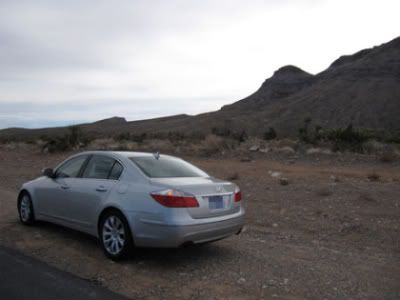 There have been a few more updates with Gwaneum One.
First, the vanity plate finally arrived, and now, I drive the freeways of the Southern California Catholic theocracy carrying the spirits of my matron saint.
Second, I now have 4,000 miles on the car - and even though the manufacturer's schedule calls for the first oil change at 7,500, I decided to do it a bit early, as a prudence measure. The dealership did it today - and I'll let the dealership do most of the work on my car, at least while the warranty is in effect, if only to build a relationship that will come in handy should a major repair or warranty work ever become necessary.
Third, I somehow ended up driving the car really hard today. I think I finally hit the limits today. While Gwaneum One handles well, I *can* get her to fishtail through a ridiculously tight turn (though the stability control will correct it eventually); by contrast, I never got even close to the limit on a BMW. Also, Gwaneum One's brakes, while excellent, fade extremely fast, and after repeated hard stops, I have dangerously little braking ability. This gets so bad that the front brakes start smoking, and the stability control quits until the brakes cool. I've never seen such severe brake fade in any other car. I'll have to find out where Hyundai gets the brake pads, and if there are reasonable alternative pads available (even if they generate tons of brake dust, like BMW pads).
I was reminded that Gwaneum One is NEVER designed to be driven at the limit on a sustained basis. That's one reason why its price tag is unbelievably low, and this is the same thing that Lexus had done 20 years ago. On the other hand, it's extremely unusual for me to drive hard the way I did today. Under everyday conditions, Gwaneum One is a far better alternative to any BMW, and I'm not making contributions to some reactionary asshole either. (Well, actually I am, as Hyundai must pay taxes to the 2MB government, but BMW's enthusiastic commitment to the Nazi agenda is far more genuine and enduring.) Eventually I'll again shell out a small fortune for some overpriced German car just so that I can thrash it - but that won't be anytime soon, and it certainly won't ever be a BMW.
Part of my hard driving today was due to my lunch, where I overheard conversations on the passage of Proposition 8, and why the San Francisco liberals and the homosexual agenda activists don't get the message that the voters of California have clearly sent them twice (the first time was Prop 22 of 2000). I do agree with one thing: the San Francisco white liberals, indeed, don't get it. They will never admit to the fact that Southern California is a Catholic theocracy, made possible by a strategic influx of Third World immigrants who have also managed to destroy the job market in many industries. I continue to be told that these immigrants are passive victims, and not to be blamed for Prop 8, but nothing can be further from the truth. Once the Republicans stop being stupid on the immigration issue, the Republicans will own the immigrant vote due to their shared backward social values, the Democrats' current stronghold in California will be finished forever, and even the national Democratic Party, which is much saner, will have a much harder time keeping up, as it currently depends so much on California as its key pillar.
Between the immigrant theocrats here, and the moronic liberals up north, California is beyond hope. I'm actually not too thrilled about my new vanity plate right now, as it's another $30 per year to a state that no longer deserves to see my money. I'm thinking it may be time to actually start looking at other states/nations again. The truth is that California will never get around to giving me healthcare, even cut-rate government healthcare, because the Orange County Republicans will never stand for it. Same with quality education - be it continuing education for me, or K-12 schools for any kids I may have in the future. (Of course, the theocrats don't consider me a suitable parent, so I'll give them a favor and never have kids in California.) And the truth also is that California will continue giving my rights away to the theocrats, because those theocrats, as nonwhite immigrants, can't be bad people, according to the San Francisco white liberals. I'm feeling like I am now living in El Salvador del Norte.
There are plenty of sane places, including some within the US. Although I don't like Washington State due to its cloudy climate, its Democratic Party is pro-business and sensible, unlike the one in California. At least it doesn't hate me simply because Gwaneum One is powered by an internal-combustion engine, a far cry from the virulently anti-motorist politics of the California Democrats. And Washington State is just one example. For now, I'll see what kinds of existing and new business opportunities I can set up (even in this cut-rate economy, undoubtedly thanks to destructive economic ideas springing from Southern California, I am getting leads), and once I progress to a point where my physical place of residence doesn't matter so much, I will move in a heartbeat. (Actually, one business contact of mine - the very one who also set up my Seoul retreat - is indeed moving to Seattle, calling SoCal a cursed land.)
I'm so fed up with California that on Facebook, I removed myself from the Los Angeles geographical network, and listed my hometown (I must list one hometown) as Seoul, alluding to my three months there late last year. I also added that it could've just as well been New York or London, two more deserving places as my hometown (and I did live in NYC for a while).
Back to Gwaneum One, I am scheduled to now make a midweek drive up to Monterey and San Jose in a few days. I am no longer looking forward to it, as it takes me from one fucked-up California to another. Yes, it's a different California up there, and the ideology/religion up there is far more compatible with my beliefs than the ones down here, but the extremism, and the detachment from reality, are all the more identical too. Maybe the only solace must come from the fact that California hasn't started issuing Christian theocratic plates (similar to the ones already available in Colorado, Indiana, Florida, and a few other places) yet, but sooner or later, they will come out, and they will make up the vast majority of Southern California's plates.
17 December 2008
Korea Recap: Downtown Incheon
Finally, I get to upload my final batches of South Korean photos. This is the first of two batches - covering my downtown Incheon tour of Friday, December 12th. As Incheon is a port city serving the Seoul area, and has enjoyed easy access to China and the rest of the world, my sightseeing reflected that.
My first destination for the day, however, was Sudoguksan Museum of Housing and Living. It's dedicated to life in a South Korean shantytown. Sudoguksan (Water Works Hill) became a shantytown when Japanese colonization, urbanization, and the Korean War forced many rural peasants to crowd Incheon for job opportunities. Today, the shantytown is a nice apartment complex, but a museum remains to carry on the memories into the future.
 Typical sight from a shantytown room. On the right is a boy's high school uniform from the 1960s, styled like the Japanese colonial era military uniforms. The schoolboy would've also had to shave his hair and wear a police-style cap. On the left, newsprints are being used as wallpapers; the newspaper is dated to 1969, and it looks like I can get a GoldStar black-and-white TV on a 7-month installment plan.
Living conditions at the shantytown typically consisted of a tiny shack, measuring about 120 square feet inside (the size of my dorm room in the college years), divided into two partitions, one each for a family, plus a shared kitchen for the two families. There was no running water, and electricity would've been a luxury - and illegally obtained by stealing power from utility lines.
 Some personal documents dating from the 1950s and the 1960s.
The right are a pair of coal cartridge coupons. Due to the oil crisis in the 1970s, many people stockpiled coal cartridges in a panic, and supplies ran low, requiring rationing coupons for purchase.
The middle are provincial identification cards, the primary means of South Korean identification until 1968. The bottom left is the Resident Registration Card, a national card replacing the provincial cards; it is issued to every adult with South Korean nationality and current residency, and designed to make it easier to identify North Korean infiltrators. National IDs were prompted by a 1968 incident where 31 armed North Korean commandos almost reached the Presidential Blue House in an assassination attempt; 30 of them were killed, and one recanted and became a South Korean, though not until a number of South Koreans and Americans were also killed in gunfights.
The upper left identifies the holder as a neighborhood captain. Every month on the 25th, the captain must hold a neighborhood meeting - a provision that continues today.
 As flash is prohibited, I had to take this photo in the dark.
The left asks residents to be vigilant. After all, North Korean infiltrators could be anywhere.
The middle promotes a healthy diet for a better body and a more prosperous future. Remember that well into the 1960s, starving due to the inability to afford food was quite common. Of course, now, South Koreans are overeating and getting overweight - though mercifully, they are still much healthier than Americans.
 A coal cartridge delivery man preparing his load. Due to the very steep alleys of the shantytown (most shantytowns were on hilltops), delivery was always difficult at best. With the freezing winter weather, slippery conditions could've made the delivery outright treacherous.
 Here's a neighborhood store featuring some snacks and toys.
At the end of this museum, I could find a gift shop that sold the exact replicas of toys that I could've found in 1960s South Korea, often at shantytown stores like this.
 Two signs of the times. The left is a stack of Arirang cigarettes, popular in the 1960s but no longer produced today.
The right is an ad for Chilsung Cola and Chilsung Cider. The Chilsung (Seven Stars) brand is used by the Lotte Group, which now manufactures Pepsi products for South Korea; Chilsung Cola no longer exists, replaced by Pepsi, but Chilsung Cider is still around as a sweeter alternative to Sprite and 7-Up. (A "cider" always refers to lemon lime soft drink in South Korea and in Japan.) In the 1960s, soft drinks always came in glass bottles; while the glass bottles are still around today (and served at restaurants and recycled after use), modern stores always now stock them in cans and plastic bottles.
 Another sign of the times. The northern Communists will never give up their desire to unify Korea by force, so vigilance is needed. This poster, dating back to the early to mid-1970s (as evidenced by the "Yushin" label, an early 1970s "restoration" by the military dictatorship for permanent rule), asks for the residents' help in identifying and capturing northern infiltrators.
Infiltrators and suspicious persons can always be reported to the nearest police station or military installation. If I am lucky enough to have a phone, I can also call 112 (police) or 113 (spy hotline). I may be rewarded up to 1 million won for turning in a spy, and up to 5 million won for turning in a spy in the act of entering South Korea; that's not much money today, but a fortune back then. (Modern reward amounts, by comparison, are 100 million and 150 million, respectively.)
If I am an infiltrator myself, or my immediate family member is, I am encouraged to surrender as well. The poster promises that I will escape punishment, and that I will be given assistance in adjusting to South Korean life.
 As the shantytowns had no running water, water had to be obtained at wells like this. With crummy water pumps of the day, hills traditionally lacked running water - no wonder shantytowns liked to be on hilltops.
A number of different materials were used for water containers. Sheet metal was the most expensive, and easy to dent, so special care was required in handling them.
 Typical communal outhouse. Again, there is no running water, so there is no flushing.
A typical scene would've involved long lines at outhouses every morning, and if one takes too much time inside, those in line would've complained mightily and loudly.
 The floor of a living/bedroom, with a cutaway view. The floor has heating ducts under the surface - "ondol" in Korean. It's been the traditional method of heating Korean homes. Burning coal produces very hot air that can be piped into the ducts. After years of use, however, deposits build up in the ducts and reduce effectiveness of the heating; there were specialists doing deposit removals, and they made a good living. Modern South Korean housing units continue to use similar heating systems, though they are more likely to send hot water, heated by an oil/gas boiler at a central plant (especially at apartment complexes), into the ducts.
 A shantytown kitchen, normally shared between two families. Sure, there was no water, but at least there was fire!
 Two social campaign posters, produced by an association of Seoul National University students dedicated to a "new, moral life."
The left one says: "As Japanese pop music fills the air, our national spirit is corrupted."
The right one says: "Six billion hwan disappear into the smoke of imported cigarettes." Imported cigarettes were illegal until the 1980s, and the hwan was a unit of currency that was phased out in 1962 due to rampant inflation.
 Lovely movie posters - more signs of the times. The middle one is Tarzan.
The right has two more slogans. The left: "Every household shall properly learn and realize proper moral etiquettes." The right: "Turn yourself in, claim freedom. Report spies, defend freedom."
Looks like just about any suspicious person should've been assumed to be a northern infiltrator. That's probably what the military dictatorship wanted anyway - to quell political opposition, keep the population in fear, and consolidate its grip on power.
 This household is actually well-off enough to have electricity - and television. There are also other nice furnishing around; some include a telephone, a vanity, and a late-model AM/FM radio.
The TV is showing a boxing match - a very popular form of entertainment back then. South Korea produced many excellent boxers - and one of them died after injuries sustained in a high-profile Las Vegas match in 1981 - but as South Korea has now become very affluent, few men want to be boxers today.
 On December 13th at 5PM, mousetraps will be set up in the neighborhood. Mice were a severe problem in South Korea at this time, as mice had plenty of places to breed in these primitive shacks. Of course, as the poison could harm children too, adults should take a clue and watch their children.
By now, I am using flash, even against regulations. Looks like the exhibits will not be damaged from light, and due to the dark shantytown alley recreations, I couldn't get adequate lighting otherwise. Nobody seemed to mind anyway.
 A special announcement from several government ministers dated to March 1971. The gist is as follows:
The northern Communists are still more eager than ever to reunify Korea under their rule by force. Moreover, the Soviets continue their Asian expansion, and the belligerent Chinese are developing their military, while the United States is withdrawing from South Vietnam and reducing its South Korean presence. In these uncertain times, your vigilance is needed more than ever. To that effect, we declare this month as a special period for turning in northern infiltrators. Again, if you turn in an infiltrator, you will be rewarded. If you are an infiltrator yourself, please turn yourself in; you will be given amnesty, and will be part of the free, democratic South Korean society.
Seriously, in 1971, North Korea had more economic power, due to it taking most of Korea's industrial base; South Korea was little more than the breadbasket. And for that matter, the entire Communist Bloc was still doing quite well. The fear of a northern takeover by force was very real. Things improved dramatically over the next two decades, however, as South Korea built its own industrial base and wealth, the Communist Bloc dissolved, and North Korea became isolated and impoverished.
Nevertheless, I will never forget the fact that the fears of this period drove South Korea to send the Moonies to the US and start messing with its own democratic institutions. I will never forgive.
 This poster details the ideology of the May 16, 1961 revolution, a military coup that ousted a democratic government and installed Park Chung-hee as the Supreme Commander of National Restoration. It's another sign of the times and certainly something of huge interest to me, as for better or for worse, Park played a decisive role in shaping South Korea for the next two decades.
The revolution, according to this poster, runs on six principles as follows:
I always tell people in South Korea, and in the US for that matter, that as impressive as Park's economics was, it will never be replicated by anyone again. During the Park era, the developed nations wanted to offer lots of aid and concessions to South Korea and build its economy, if only to keep South Korea firmly in the capitalist camp. But now that the Cold War is over, Third World economies are now seen only as sources of cheap labor to be exploited - and even South Korea itself sees its Asian neighbors that way. With less benevolence coming from the haves, the have-not nations are no longer able to develop South Korean-style.
 Two more slogans. I can never get enough of these - as I love getting cultural insights into a bygone Cold War era. This is the capitalist counterpart to a strictly controlled communist society. Priceless!
The left: "Rotten people hit the entertainment districts. Patriots hit the workplace." Connotation: shut up and work. Entertainment is evil. (Seriously, entertainers never got respect in traditional Korean society until modern times.)
The right: "Flawless anticommunism and vigilance leads to prosperity for our nation." Courtesy of the Korean Anticommunism Union.
 Here's a government public service announcement announcing a list of to-dos for the month, as follows:
 Yet two more slogans. The right one is the anti-foreign tobacco one that I had explained before.
The left one is interesting, however. "Destroy superstitions, let's achieve a scientific lifestyle. - Ministry of Health and Society" Superstitions would've included lots of indigenous beliefs, including shamanism and feng shui, which are today being revived as proud cultural heritage.
 The crowded living conditions at the shantytown residences meant that academics, including high school students preparing for college entrance exams, had to often go to a study room like this, in order to find a better environment to study. Such study rooms were run by volunteers, and are thought to have existed primarily in the 1960s and the 1970s, based on testimonies from the residents who were teens during that era and named study rooms by actual names.
I was invited to leave feedback for the museum. I wrote something along the likes of this:
I was born in the 1970s, and was relatively affluent due to my father's employment with the US military. I left for the US in the 1980s without ever visiting a shantytown.
The lives of the working poor, and their neighborly community spirit, in the 1960s and 1970s in South Korea leave me a strong impression. I currently live in a car-based affluent suburb of Los Angeles, where the people, coming from different races, cultures, and religions, live in a constant state of mistrust.
Equally impressive were all the posters from the Park military dictatorship, showing its dedication to hardline anticommunism and social conservatism.
Behind me, there was a television screen showing some episodes of Daldongne, a 1980 TV drama. The drama humanized the shantytown life stories, and made sure that the term "daldongne" itself (달동네, which translates into "moonlight neighborhood" referring to the hilltops' ample moonshine) would be popularly used to refer to shantytowns. It didn't last long, due to it being produced by Tongyang Broadcasting Corporation (TBC), which had to shut down in December 1980 due to another military dictatorship (Chun Doo-hwan) and its crackdown on mass media. TBC, which was Channel 7 in Seoul, became the second, entertainment-oriented channel for the government broadcaster KBS, which it remains to this day.
 Life in shantytowns involved lighting fire with matches. Needless to say, matches became a lifestyle and an art form. Incheon had major match manufacturers, as the first Korean town to be exposed to matches and their production. Today, matches are pretty much forgotten due to widespread use of cheap disposable lighters, but the museum had some special exhibits dedicated to matches, matchboxes, and their art, as seen above.
 A poor shantytown child probably couldn't afford real toys. Matches provide excellent play value as toys in themselves; with them, it's possible to solve some puzzles and develop brain power. The above are four puzzles that I can try - though I have no way of solving them. The four puzzles are as follows:
 I'm back outside. Another sign of the times: a 1964 movie poster. It's a very famous movie, "Red Muffler," shot in color and depicting life in South Korea's air force. It was directed by the renowned director Sang Okk Sheen, who was kidnapped by North Korea in 1978, escaped to the US in 1986, returned to South Korea in 1989, and passed away in 2006.
 Sudoguksan is now home to these modern government-built apartments, now ten years old. The shantytown residents had protested loudly over these apartments, as proper compensation for eviction had not been given.
For that matter, the apartment residents today are complaining themselves - over Incheon's plans to put an elevated highway nearby.
 A small section of the shantytown remains. But by shantytown standards, these homes are quite nice and big. Of course, there is no way I can bring a car and park here, but otherwise, it wouldn't be too bad to live here.
 Two traditional markets with different fates. The near market has been promoted to a tourist zone, and is congratulating. The far market, on the other side of the thoroughfare, has been condemned by the Republicans to make way for the plaza for Dongincheon subway station; the storeowners there are not getting proper compensation, and are protesting fiercely over the destruction of Incheon's oldest market.
 I am going through Dongincheon Station to look for a bus to Wolmido, to visit the emigration museum.
This poster informs me about participating in the Temple Stay program, run by the Jogye Order of Korean Buddhism. The program is primarily for foreigners, but this poster is intended for the locals. For about 100,000 won, I can take a bullet train to Jikjisa (a stop on my road trip last month), and eat, live, and meditate like a monk for a night. Not bad!
Incheon's user-unfriendly bus system meant that I had to take the subway one more stop to Incheon Station, then walk a long distance to find a marked bus stop for the No. 15 bus to the museum. Incheon doesn't offer free transfers between subway and buses, and I ended up wasting another 900 won base fare as a result.
The museum is free, but even then, it's kind of out of the way and not visited much.
 The museum is primarily intended to commemorate the 100th anniversary of the first Korean government sanctioned emigrants to a foreign land. Namely, they are the 102 people who left for Hawaii in 1903. Due to the Korean-American funding, most of this museum is about Korean-Americans.
Incheon at that time looked a lot like this. Wolmido, where I am, is the island on the lower left. Today, Wolmido is connected to the mainland and houses many ship docks.
 This announcement, in Korean and English, was put out by a group of American missionaries looking for migrants to Hawaii. Sugar cane plantations in Hawaii needed lots of labor. Initially, native Hawaiians were employed, but they were difficult to control. The Chinese came next, but were banned by the Chinese Exclusion Act of 1882. The Japanese followed, but they protested too much for the plantation owners' comfort. The Koreans ended up being the next choice.
In December 1902, the first party of 122 Koreans sailed from Incheon to Nagasaki, where the party was whittled down to 102 after a health check. The 102 then sailed on the USS Gaelic to Hawaii, arriving on January 13, 1903; of those, 16 had to return to Korea after failing the health checks, and only 86 settled in Hawaii.
Many of the migrants were recruited from Incheon area Protestant churches run by the missionaries. This gave the initial Korean-American community a strong Christian tint, and that continues into today.
 Here is a passport from the imperial government issued to a migrant.
Over 7,000 Koreans moved to Hawaii until 1905, when the flow was cut off due to Japan assuming Korea's foreign relations that year.
 A Korean man works the Hawaii sugar plantation. He would've been paid a monthly wage of $17. Women and children were paid 50 cents per day.
And a date chart to the left details the Korean-American milestones, running all the way up to January 13, 2006 as the Korean-American Day, the only such day in existence for an American immigrant demographic.
 When an entire Korean family settled in Hawaii, it would've been given a spartan housing unit similar to the one above. Single male laborers lived in dormitories.
So many Korean migrants to Hawaii were single men, that eventually, they took in Korean picture brides, who were an average of 15 years younger than the husbands. Marrying a local was not possible due to interracial marriages being taboo/banned in the US.
 The 1920 US Census counted a number of ethnic Koreans spread out over many states. The above map shows Korean population by state, with most of the population being in Hawaii and California.
After the Japanese annexation of Korea in 1910, returning to Korea became a non-option for many, and some Koreans moved to California in search of more opportunities. Sizable Korean communities popped up in San Francisco and San Joaquin Valley. Los Angeles wouldn't pick up until much later, but today, it's Los Angeles that has all the Koreans.
 Some documents belonging to early Korean-Americans. The left is a naturalization application, while the right shows a Social Security card.
 Due to excessive costs and travel time, returning to Korea, even for a visit, was unthinkable. The best many Korean-Americans could do was to buy Korean records (ads on the left) and play them on phonographs like the one on the right. The middle has some records, but they are mainstream American rather than Korean.
The Korean-Americans also organized through their churches and pro-independence organizations, and worked toward ending Japanese rule in Korea.
 A Korean-American classroom in Hawaii would've looked a lot like this. Textbooks are in Korean and English. This is where a young, second-generation or later Korean-American would've learned his/her ancestral culture and language.
 After World War II and the Korean War, the Korean-American community grew by leaps and bounds, thanks to the war brides and the war orphans. And in 1965, US immigration laws were rewritten to allow more non-Europeans to settle in the US. Many professional South Koreans moved to the US in droves, and pretty soon, Los Angeles had a sizable Koreatown.
The photo above, from 1982, shows the City of Los Angeles recognizing Koreatown as an official district, and putting up a sign on Olympic Boulevard to identify Koreatown. Caltrans also put up Koreatown signs on the Santa Monica Freeway (I-10) at the same time.
A brief history of Korean-Canadians also follows at a nearby exhibit. Very few Koreans went to Canada until the 1960s, and even then, they were more likely to be arriving after working in another foreign country (especially West Germany, home to many South Korean miners and nurses) rather than directly from Korea. Today, however, many affluent South Koreans move to Canada as a lifestyle choice, due to Canada's higher standards of living (even higher than the US) and excellent government services and infrastructure.
 There is also some discussion of the Korean community in Mexico. Here, a Korean laborer works a henequén plantation under the scorching Yucatan sun.
Only a single boatload of Koreans went to Mexico, in 1905, under a fradulent immigration scheme that turned out to be four years of slavery. The migrants sailed from Jemulpo (Incheon) and arrived in Merida. After four years of slavery at henequén plantations, the Koreans were free, but being impoverished, were unable to return home. The community scattered due to internal unrest within Mexico, and through intermarriage with locals and lack of contact with Japanese-occupied Korea, lost their Korean identities.
Today, a Calle Chemulpo (an alternative spelling of Jemulpo, and the one that Spanish speakers will properly pronounce) in Merida is the only link to the Korean community that had once existed there. However, starting in the 1960s, South Koreans and Korean-Americans started settling in Mexico, primarily in search of business opportunities. There is a small, sizable Korean population scattered around major Mexican cities today.
A few hundred Korean-Mexicans, unable to survive the Mexican society, moved to Cuba in the early 1920s. They, too, married the locals and disappeared, especially after the 1959 Fidel Castro revolution cut off all contacts to both South Korea and the Korean-Americans. The Korean-Cubans did make some history, however. Some supported the Castro revolution, and one became Castro's right-hand man, while others opposed it, fled to Florida, and became leaders of the Cuban exile community there.
 Other Latin American nations also saw significant Korean influx. Brazil and other South American nations were settled by South Koreans in the 1960s and later, lured by governments with plenty of land and resources but no population to develop them.
The above shows a South Korean passport and a land transfer document, from a Korean-Paraguayan. The land transfer document is interesting, as it is done in Spanish AND Korean.
 A very interesting 1944 relic. The US Postal Service, in the midst of World War II, issued special postage stamps commemorating the flags of thirteen nations that had been overrun by Germany and Japan. The original series consisted of twelve nations, all European, but popular request demanded that a thirteenth, Korea, be added as well, as the only non-European nation.
 I can wrap up my visit by finding out about Incheon-based Inha University. Inha stands for Incheon-Hawaii, and is a place for Korean-Americans to study their ancestral culture. I can also get brief profiles of nations with significant Korean populations, including China, Japan, Russia, Kazakhstan, Uzbekistan, and Germany; for nations outside the Americas, that's as good as it gets, unfortunately. South Korean governmental estimates for Korean populations in all other nations of the world can also be found; even the most remote African nations have a dozen or so Koreans each, there probably for community service or business.
And in the above, I can write messages to the Korean diaspora abroad, and deposit it into the mailbox to the left. The right shows a list of Korean community organizations around the world.
 I returned to Incheon Station. It's a sorry-looking building, honestly, as it's the end of a subway line rather than anything more major. It is set to be renovated into something much nicer over the next few years, however, as a number of other subway lines will terminate here by then. A monorail link to Wolmido and its emigration museum is also under construction.
Incheon Station sits across the street from the only real Chinatown in Korea. Also, this is the starting point for Incheon's bus tours. Three routes are offered: downtown, Incheon International Airport, and Ganghwa Island.
Incheon gained a Chinatown in the 1880s when trade with Manchu China opened, and it blossomed through the Japanese occupation. But the Cold War realities shut off Incheon's links to China, and the Park military government cracked down hard on the Chinese community. Most Chinese-Koreans have moved on to Taiwan or North America. Today's Chinatown is being revitalized as a tourist trap, partly to appeal to the Chinese who are now visiting Incheon again since 1992, when South Korea and Beijing established ties.
 Dragon staircase with red streetlights. If this doesn't say Chinatown, nothing does.
It's still Chinatown, however - not China. There is no mistaking that fact, as there are as many Korean signs as Chinese ones.
 One of three town gates adorning Incheon's Chinatown. Again, any respectable Chinatown must have a gate or two at least.
This is the only one that's presentable. A second one is undergoing renovations and is scaffolded, while a third one was torn down and won't be rebuilt until a Chinese city donates the new gate to Incheon.
Beyond this gate is Jayu (Freedom) Park, the first modern, Western-style urban park in Korea.
 Before going there, however, I am making sure to eat Chinese food. I'm keeping it cheap: all the dishes above are costing me only 10,000 won total, while ordering a small portion of sweet and sour pork would've cost at least 15,000, and well over 20,000 for a decent portion.
The foreground is a Chinese dish that was created in Incheon, and can only be found at Korean-style Chinese restaurants. Its name is chia chiang mein in Chinese, and jjajangmyeon (짜장면) in Korean. It uses black bean sauce. I made sure to load up on as much of this stuff as possible during my stay in South Korea, as despite being "Chinese," it's native to Korea, and can only be found in the US at various Koreatowns, which I do not look forward to visiting anytime soon.
Jjajangmyeon was created in the 1880s as an inexpensive dish that the Chinese coolies settling Incheon could affordably eat. Unfortunately, much of the real circumstances surrounding its creation are undocumented folklore that cannot be reliably verified. The reputed inventing restaurant for the dish doesn't even exist anymore.
I'm paying only 3,000 won for the noodle! The bean curd rice in the back adds another 7,000 won. Great value.
 Entering Freedom Park. In gratitude to the US for its Incheon Landing during the Korean War, the park gained its current name in the 1960s, and was developed as a monument to the American defense of South Korea.
The above monument dates to 1982, and commemorates the 100th anniversary of the 1882 document that established official diplomatic relationship between the United States and the Korean royal government. During the Cold War, South Korea developed the relationship into a strong military alliance, and South Korea has participated in many American wars, from Vietnam to Iraq. Unfortunately, the alliance between the two nations really serves the interests of the far right rather than the average people. I hope that the new Obama Presidency in the US will change that.
 General Douglas MacArthur is remembered here too. This statue was erected in 1956. MacArthur looks over the very harbor where he commanded a massive amphibious attack on September 15, 1950. Due to the severe tides around Incheon (the only larger tides in the world are found in Nova Scotia at Bay of Fundy), an amphibious attack here was a Hail Mary at best. But it was the only option, as South Korea was headed for a certain defeat otherwise. The attack succeeded, the Allies recaptured Seoul two weeks later, all North Korean supply lines into South Korea were cut, and South Korea was restored.
The Allied attacks continued, capturing most of North Korea as well, and the US was looking forward to a unified, capitalist Korea by Christmas 1950. But the Chinese spoiled everything, and the war ended in 1953 as a stalemate, with negligible border changes. Millions of Koreans and tens of thousands of Allied foreign troops had died in vain.
 Today, General MacArthur is overseeing some chess games, at least four by my count. All were played and kibitzed by elderly men.
Korean chess is always fun, even though serious strategy is usually played out through Go instead.
Another peculiarity in Korean chess... In Western chess, the king and queen are flanked by bishops, then by knights, then by rooks at the outermost position. In Korean chess, the elephant (the bishop) and the horse (the knight) may switch positions, so that the horse can be inside and the elephant outside. I am free to switch positions on just one horse-elephant pair, both pairs, or none at all. Once game starts, the switch can't happen, of course.
Another variation, according to Korean Wikipedia, also allows the wagon (the rook) to switch positions as well. But that rule is exclusively used in North Korea, and never seen in South Korea. And North Korean chess sets may also identify each piece in Korean rather than in Chinese, due to Chinese characters no longer being used in North Korea; South Korean sets are always in Chinese.
Last, but not the least, the Korean chess king is identified by a Chinese dynasty name. The green side, which is junior and moves first, is 楚 (Chou), an ancient kingdom that lost out to 漢 (Han), which is the red, senior side.
 Here is a newer US Navy memorial to General MacArthur, as well as those American sailors and marines who did the actual landing at Incheon. It flanks MacArthur himself, which was erected by grateful South Koreans.
 That's the harbor, now very hectic thanks to lots of fishing and cargo ships. Off of the left edge, passenger ferries also dock here, heading for South Korean islands as well as Chinese cities on the Yellow Sea coast.
In the distance is the Incheon Bridge, which will connect southern Incheon to the airport when it opens next year. It will augment the current Yeongjong Bridge, the only link from the airport to the rest of South Korea for now, and primarily serving Seoul-bound traffic.
It's also possible to spot some air traffic making the final approach into Incheon.
 Romance of Three Kingdoms is a well-read Chinese book among many Koreans, especially men. As the story is the most prominent common cultural link between Korea and China, Incheon's Chinatown makes sure to devote 150 meters of a somewhat steep alley to several dozen scenes from it.
In the above, the smaller left pictures show the Yellow Turban Bandits rising to throw China into chaos, in the late 180s. At the same time, the Ten Eunuchs serving the Han Court are murdered, and the Han Dynasty ends. The large picture to the right shows one warlord, the honorable Liu Bei, pledging to restore order and the dynasty; he is swearing brotherhood with Guan Yu and Zhang Fei.
 These scenes show the latter parts of the story. Guan Yu was captured by rival warlord Sun Quan, and was given the choice of serving Sun Quan or dying. Guan Yu chose death. His honor has now turned him into a deity in Chinese Taoism.
Neither Liu Bei nor Sun Quan won in the end. Their other rival, Cao Cao (therefore making up the "Three Kingdoms"), finally prevailed after almost a century, though by then, Cao Cao himself was long dead, and it was his relatives in the Sima family who were around to celebrate.
 A tiny Chinese garden. A rare opportunity to visit a Chinese garden in Korea.
 I'm leaving Chinatown and Incheon now. This building is the Korean-Chinese Cultural Center, which promotes Chinese culture in Incheon. Banners announce that there will soon be a contest measuring the Chinese proficiency of South Korean elementary and middle school students.
Visiting Incheon was a valuable opportunity to get in touch with South Korea under the Cold War industrialization, as well as my Chinese partial ancestry and my American present. I will remember for a long time.
My first destination for the day, however, was Sudoguksan Museum of Housing and Living. It's dedicated to life in a South Korean shantytown. Sudoguksan (Water Works Hill) became a shantytown when Japanese colonization, urbanization, and the Korean War forced many rural peasants to crowd Incheon for job opportunities. Today, the shantytown is a nice apartment complex, but a museum remains to carry on the memories into the future.
 Typical sight from a shantytown room. On the right is a boy's high school uniform from the 1960s, styled like the Japanese colonial era military uniforms. The schoolboy would've also had to shave his hair and wear a police-style cap. On the left, newsprints are being used as wallpapers; the newspaper is dated to 1969, and it looks like I can get a GoldStar black-and-white TV on a 7-month installment plan.
Living conditions at the shantytown typically consisted of a tiny shack, measuring about 120 square feet inside (the size of my dorm room in the college years), divided into two partitions, one each for a family, plus a shared kitchen for the two families. There was no running water, and electricity would've been a luxury - and illegally obtained by stealing power from utility lines.
 Some personal documents dating from the 1950s and the 1960s.
The right are a pair of coal cartridge coupons. Due to the oil crisis in the 1970s, many people stockpiled coal cartridges in a panic, and supplies ran low, requiring rationing coupons for purchase.
The middle are provincial identification cards, the primary means of South Korean identification until 1968. The bottom left is the Resident Registration Card, a national card replacing the provincial cards; it is issued to every adult with South Korean nationality and current residency, and designed to make it easier to identify North Korean infiltrators. National IDs were prompted by a 1968 incident where 31 armed North Korean commandos almost reached the Presidential Blue House in an assassination attempt; 30 of them were killed, and one recanted and became a South Korean, though not until a number of South Koreans and Americans were also killed in gunfights.
The upper left identifies the holder as a neighborhood captain. Every month on the 25th, the captain must hold a neighborhood meeting - a provision that continues today.
 As flash is prohibited, I had to take this photo in the dark.
The left asks residents to be vigilant. After all, North Korean infiltrators could be anywhere.
The middle promotes a healthy diet for a better body and a more prosperous future. Remember that well into the 1960s, starving due to the inability to afford food was quite common. Of course, now, South Koreans are overeating and getting overweight - though mercifully, they are still much healthier than Americans.
 A coal cartridge delivery man preparing his load. Due to the very steep alleys of the shantytown (most shantytowns were on hilltops), delivery was always difficult at best. With the freezing winter weather, slippery conditions could've made the delivery outright treacherous.
 Here's a neighborhood store featuring some snacks and toys.
At the end of this museum, I could find a gift shop that sold the exact replicas of toys that I could've found in 1960s South Korea, often at shantytown stores like this.
 Two signs of the times. The left is a stack of Arirang cigarettes, popular in the 1960s but no longer produced today.
The right is an ad for Chilsung Cola and Chilsung Cider. The Chilsung (Seven Stars) brand is used by the Lotte Group, which now manufactures Pepsi products for South Korea; Chilsung Cola no longer exists, replaced by Pepsi, but Chilsung Cider is still around as a sweeter alternative to Sprite and 7-Up. (A "cider" always refers to lemon lime soft drink in South Korea and in Japan.) In the 1960s, soft drinks always came in glass bottles; while the glass bottles are still around today (and served at restaurants and recycled after use), modern stores always now stock them in cans and plastic bottles.
 Another sign of the times. The northern Communists will never give up their desire to unify Korea by force, so vigilance is needed. This poster, dating back to the early to mid-1970s (as evidenced by the "Yushin" label, an early 1970s "restoration" by the military dictatorship for permanent rule), asks for the residents' help in identifying and capturing northern infiltrators.
Infiltrators and suspicious persons can always be reported to the nearest police station or military installation. If I am lucky enough to have a phone, I can also call 112 (police) or 113 (spy hotline). I may be rewarded up to 1 million won for turning in a spy, and up to 5 million won for turning in a spy in the act of entering South Korea; that's not much money today, but a fortune back then. (Modern reward amounts, by comparison, are 100 million and 150 million, respectively.)
If I am an infiltrator myself, or my immediate family member is, I am encouraged to surrender as well. The poster promises that I will escape punishment, and that I will be given assistance in adjusting to South Korean life.
 As the shantytowns had no running water, water had to be obtained at wells like this. With crummy water pumps of the day, hills traditionally lacked running water - no wonder shantytowns liked to be on hilltops.
A number of different materials were used for water containers. Sheet metal was the most expensive, and easy to dent, so special care was required in handling them.
 Typical communal outhouse. Again, there is no running water, so there is no flushing.
A typical scene would've involved long lines at outhouses every morning, and if one takes too much time inside, those in line would've complained mightily and loudly.
 The floor of a living/bedroom, with a cutaway view. The floor has heating ducts under the surface - "ondol" in Korean. It's been the traditional method of heating Korean homes. Burning coal produces very hot air that can be piped into the ducts. After years of use, however, deposits build up in the ducts and reduce effectiveness of the heating; there were specialists doing deposit removals, and they made a good living. Modern South Korean housing units continue to use similar heating systems, though they are more likely to send hot water, heated by an oil/gas boiler at a central plant (especially at apartment complexes), into the ducts.
 A shantytown kitchen, normally shared between two families. Sure, there was no water, but at least there was fire!
 Two social campaign posters, produced by an association of Seoul National University students dedicated to a "new, moral life."
The left one says: "As Japanese pop music fills the air, our national spirit is corrupted."
The right one says: "Six billion hwan disappear into the smoke of imported cigarettes." Imported cigarettes were illegal until the 1980s, and the hwan was a unit of currency that was phased out in 1962 due to rampant inflation.
 Lovely movie posters - more signs of the times. The middle one is Tarzan.
The right has two more slogans. The left: "Every household shall properly learn and realize proper moral etiquettes." The right: "Turn yourself in, claim freedom. Report spies, defend freedom."
Looks like just about any suspicious person should've been assumed to be a northern infiltrator. That's probably what the military dictatorship wanted anyway - to quell political opposition, keep the population in fear, and consolidate its grip on power.
 This household is actually well-off enough to have electricity - and television. There are also other nice furnishing around; some include a telephone, a vanity, and a late-model AM/FM radio.
The TV is showing a boxing match - a very popular form of entertainment back then. South Korea produced many excellent boxers - and one of them died after injuries sustained in a high-profile Las Vegas match in 1981 - but as South Korea has now become very affluent, few men want to be boxers today.
 On December 13th at 5PM, mousetraps will be set up in the neighborhood. Mice were a severe problem in South Korea at this time, as mice had plenty of places to breed in these primitive shacks. Of course, as the poison could harm children too, adults should take a clue and watch their children.
By now, I am using flash, even against regulations. Looks like the exhibits will not be damaged from light, and due to the dark shantytown alley recreations, I couldn't get adequate lighting otherwise. Nobody seemed to mind anyway.
 A special announcement from several government ministers dated to March 1971. The gist is as follows:
The northern Communists are still more eager than ever to reunify Korea under their rule by force. Moreover, the Soviets continue their Asian expansion, and the belligerent Chinese are developing their military, while the United States is withdrawing from South Vietnam and reducing its South Korean presence. In these uncertain times, your vigilance is needed more than ever. To that effect, we declare this month as a special period for turning in northern infiltrators. Again, if you turn in an infiltrator, you will be rewarded. If you are an infiltrator yourself, please turn yourself in; you will be given amnesty, and will be part of the free, democratic South Korean society.
Seriously, in 1971, North Korea had more economic power, due to it taking most of Korea's industrial base; South Korea was little more than the breadbasket. And for that matter, the entire Communist Bloc was still doing quite well. The fear of a northern takeover by force was very real. Things improved dramatically over the next two decades, however, as South Korea built its own industrial base and wealth, the Communist Bloc dissolved, and North Korea became isolated and impoverished.
Nevertheless, I will never forget the fact that the fears of this period drove South Korea to send the Moonies to the US and start messing with its own democratic institutions. I will never forgive.
 This poster details the ideology of the May 16, 1961 revolution, a military coup that ousted a democratic government and installed Park Chung-hee as the Supreme Commander of National Restoration. It's another sign of the times and certainly something of huge interest to me, as for better or for worse, Park played a decisive role in shaping South Korea for the next two decades.
The revolution, according to this poster, runs on six principles as follows:
- Anticommunism is the national ideology and policy. It had been little more than an empty slogan, but from now on, it will define everything.
- We will honor the UN Charter and international treaties, and will strengthen our ties to the United States-led alliance of free nations.
- We shall eradicate our society's old evils and corruption. To restore the national spirit, morality laws will be enforced.
- We shall do everything to bring hope to the people suffering from hunger and poverty. We will build a self-sufficient economy.
- To achieve the national wish, the unification of Korea, we shall do everything to develop the power and ability to keep up with the Communist forces.
- When our goals are accomplished, we shall cede power to honest, conscientious politicians, and return to our original duties.
I always tell people in South Korea, and in the US for that matter, that as impressive as Park's economics was, it will never be replicated by anyone again. During the Park era, the developed nations wanted to offer lots of aid and concessions to South Korea and build its economy, if only to keep South Korea firmly in the capitalist camp. But now that the Cold War is over, Third World economies are now seen only as sources of cheap labor to be exploited - and even South Korea itself sees its Asian neighbors that way. With less benevolence coming from the haves, the have-not nations are no longer able to develop South Korean-style.
 Two more slogans. I can never get enough of these - as I love getting cultural insights into a bygone Cold War era. This is the capitalist counterpart to a strictly controlled communist society. Priceless!
The left: "Rotten people hit the entertainment districts. Patriots hit the workplace." Connotation: shut up and work. Entertainment is evil. (Seriously, entertainers never got respect in traditional Korean society until modern times.)
The right: "Flawless anticommunism and vigilance leads to prosperity for our nation." Courtesy of the Korean Anticommunism Union.
 Here's a government public service announcement announcing a list of to-dos for the month, as follows:
- If your child is of elementary school age, please register and enroll. You do not need to produce official identity/vital records. (However, enrollees into secondary schools must.)
- Catch mice. Use mousetraps.
- Prevent traffic accidents. Ensure your children don't play in the path of vehicular traffic. (Very few South Koreans understood automobiles then, so accidents were extremely common.)
 Yet two more slogans. The right one is the anti-foreign tobacco one that I had explained before.
The left one is interesting, however. "Destroy superstitions, let's achieve a scientific lifestyle. - Ministry of Health and Society" Superstitions would've included lots of indigenous beliefs, including shamanism and feng shui, which are today being revived as proud cultural heritage.
 The crowded living conditions at the shantytown residences meant that academics, including high school students preparing for college entrance exams, had to often go to a study room like this, in order to find a better environment to study. Such study rooms were run by volunteers, and are thought to have existed primarily in the 1960s and the 1970s, based on testimonies from the residents who were teens during that era and named study rooms by actual names.
I was invited to leave feedback for the museum. I wrote something along the likes of this:
I was born in the 1970s, and was relatively affluent due to my father's employment with the US military. I left for the US in the 1980s without ever visiting a shantytown.
The lives of the working poor, and their neighborly community spirit, in the 1960s and 1970s in South Korea leave me a strong impression. I currently live in a car-based affluent suburb of Los Angeles, where the people, coming from different races, cultures, and religions, live in a constant state of mistrust.
Equally impressive were all the posters from the Park military dictatorship, showing its dedication to hardline anticommunism and social conservatism.
Behind me, there was a television screen showing some episodes of Daldongne, a 1980 TV drama. The drama humanized the shantytown life stories, and made sure that the term "daldongne" itself (달동네, which translates into "moonlight neighborhood" referring to the hilltops' ample moonshine) would be popularly used to refer to shantytowns. It didn't last long, due to it being produced by Tongyang Broadcasting Corporation (TBC), which had to shut down in December 1980 due to another military dictatorship (Chun Doo-hwan) and its crackdown on mass media. TBC, which was Channel 7 in Seoul, became the second, entertainment-oriented channel for the government broadcaster KBS, which it remains to this day.
 Life in shantytowns involved lighting fire with matches. Needless to say, matches became a lifestyle and an art form. Incheon had major match manufacturers, as the first Korean town to be exposed to matches and their production. Today, matches are pretty much forgotten due to widespread use of cheap disposable lighters, but the museum had some special exhibits dedicated to matches, matchboxes, and their art, as seen above.
 A poor shantytown child probably couldn't afford real toys. Matches provide excellent play value as toys in themselves; with them, it's possible to solve some puzzles and develop brain power. The above are four puzzles that I can try - though I have no way of solving them. The four puzzles are as follows:
- Turn these two equilateral triangles into eight equilateral triangles.
- There are four identically sized squares. Move three matches to turn them into three identically sized squares. Alternately, move four matches to make another set of three identically sized squares.
- This hexagon has six triangles inside. Move four matches to turn them into three triangles.
- Turn these four matches into nine. You may not break the matches.
 I'm back outside. Another sign of the times: a 1964 movie poster. It's a very famous movie, "Red Muffler," shot in color and depicting life in South Korea's air force. It was directed by the renowned director Sang Okk Sheen, who was kidnapped by North Korea in 1978, escaped to the US in 1986, returned to South Korea in 1989, and passed away in 2006.
 Sudoguksan is now home to these modern government-built apartments, now ten years old. The shantytown residents had protested loudly over these apartments, as proper compensation for eviction had not been given.
For that matter, the apartment residents today are complaining themselves - over Incheon's plans to put an elevated highway nearby.
 A small section of the shantytown remains. But by shantytown standards, these homes are quite nice and big. Of course, there is no way I can bring a car and park here, but otherwise, it wouldn't be too bad to live here.
 Two traditional markets with different fates. The near market has been promoted to a tourist zone, and is congratulating. The far market, on the other side of the thoroughfare, has been condemned by the Republicans to make way for the plaza for Dongincheon subway station; the storeowners there are not getting proper compensation, and are protesting fiercely over the destruction of Incheon's oldest market.
 I am going through Dongincheon Station to look for a bus to Wolmido, to visit the emigration museum.
This poster informs me about participating in the Temple Stay program, run by the Jogye Order of Korean Buddhism. The program is primarily for foreigners, but this poster is intended for the locals. For about 100,000 won, I can take a bullet train to Jikjisa (a stop on my road trip last month), and eat, live, and meditate like a monk for a night. Not bad!
Incheon's user-unfriendly bus system meant that I had to take the subway one more stop to Incheon Station, then walk a long distance to find a marked bus stop for the No. 15 bus to the museum. Incheon doesn't offer free transfers between subway and buses, and I ended up wasting another 900 won base fare as a result.
The museum is free, but even then, it's kind of out of the way and not visited much.
 The museum is primarily intended to commemorate the 100th anniversary of the first Korean government sanctioned emigrants to a foreign land. Namely, they are the 102 people who left for Hawaii in 1903. Due to the Korean-American funding, most of this museum is about Korean-Americans.
Incheon at that time looked a lot like this. Wolmido, where I am, is the island on the lower left. Today, Wolmido is connected to the mainland and houses many ship docks.
 This announcement, in Korean and English, was put out by a group of American missionaries looking for migrants to Hawaii. Sugar cane plantations in Hawaii needed lots of labor. Initially, native Hawaiians were employed, but they were difficult to control. The Chinese came next, but were banned by the Chinese Exclusion Act of 1882. The Japanese followed, but they protested too much for the plantation owners' comfort. The Koreans ended up being the next choice.
In December 1902, the first party of 122 Koreans sailed from Incheon to Nagasaki, where the party was whittled down to 102 after a health check. The 102 then sailed on the USS Gaelic to Hawaii, arriving on January 13, 1903; of those, 16 had to return to Korea after failing the health checks, and only 86 settled in Hawaii.
Many of the migrants were recruited from Incheon area Protestant churches run by the missionaries. This gave the initial Korean-American community a strong Christian tint, and that continues into today.
 Here is a passport from the imperial government issued to a migrant.
Over 7,000 Koreans moved to Hawaii until 1905, when the flow was cut off due to Japan assuming Korea's foreign relations that year.
 A Korean man works the Hawaii sugar plantation. He would've been paid a monthly wage of $17. Women and children were paid 50 cents per day.
And a date chart to the left details the Korean-American milestones, running all the way up to January 13, 2006 as the Korean-American Day, the only such day in existence for an American immigrant demographic.
 When an entire Korean family settled in Hawaii, it would've been given a spartan housing unit similar to the one above. Single male laborers lived in dormitories.
So many Korean migrants to Hawaii were single men, that eventually, they took in Korean picture brides, who were an average of 15 years younger than the husbands. Marrying a local was not possible due to interracial marriages being taboo/banned in the US.
 The 1920 US Census counted a number of ethnic Koreans spread out over many states. The above map shows Korean population by state, with most of the population being in Hawaii and California.
After the Japanese annexation of Korea in 1910, returning to Korea became a non-option for many, and some Koreans moved to California in search of more opportunities. Sizable Korean communities popped up in San Francisco and San Joaquin Valley. Los Angeles wouldn't pick up until much later, but today, it's Los Angeles that has all the Koreans.
 Some documents belonging to early Korean-Americans. The left is a naturalization application, while the right shows a Social Security card.
 Due to excessive costs and travel time, returning to Korea, even for a visit, was unthinkable. The best many Korean-Americans could do was to buy Korean records (ads on the left) and play them on phonographs like the one on the right. The middle has some records, but they are mainstream American rather than Korean.
The Korean-Americans also organized through their churches and pro-independence organizations, and worked toward ending Japanese rule in Korea.
 A Korean-American classroom in Hawaii would've looked a lot like this. Textbooks are in Korean and English. This is where a young, second-generation or later Korean-American would've learned his/her ancestral culture and language.
 After World War II and the Korean War, the Korean-American community grew by leaps and bounds, thanks to the war brides and the war orphans. And in 1965, US immigration laws were rewritten to allow more non-Europeans to settle in the US. Many professional South Koreans moved to the US in droves, and pretty soon, Los Angeles had a sizable Koreatown.
The photo above, from 1982, shows the City of Los Angeles recognizing Koreatown as an official district, and putting up a sign on Olympic Boulevard to identify Koreatown. Caltrans also put up Koreatown signs on the Santa Monica Freeway (I-10) at the same time.
A brief history of Korean-Canadians also follows at a nearby exhibit. Very few Koreans went to Canada until the 1960s, and even then, they were more likely to be arriving after working in another foreign country (especially West Germany, home to many South Korean miners and nurses) rather than directly from Korea. Today, however, many affluent South Koreans move to Canada as a lifestyle choice, due to Canada's higher standards of living (even higher than the US) and excellent government services and infrastructure.
 There is also some discussion of the Korean community in Mexico. Here, a Korean laborer works a henequén plantation under the scorching Yucatan sun.
Only a single boatload of Koreans went to Mexico, in 1905, under a fradulent immigration scheme that turned out to be four years of slavery. The migrants sailed from Jemulpo (Incheon) and arrived in Merida. After four years of slavery at henequén plantations, the Koreans were free, but being impoverished, were unable to return home. The community scattered due to internal unrest within Mexico, and through intermarriage with locals and lack of contact with Japanese-occupied Korea, lost their Korean identities.
Today, a Calle Chemulpo (an alternative spelling of Jemulpo, and the one that Spanish speakers will properly pronounce) in Merida is the only link to the Korean community that had once existed there. However, starting in the 1960s, South Koreans and Korean-Americans started settling in Mexico, primarily in search of business opportunities. There is a small, sizable Korean population scattered around major Mexican cities today.
A few hundred Korean-Mexicans, unable to survive the Mexican society, moved to Cuba in the early 1920s. They, too, married the locals and disappeared, especially after the 1959 Fidel Castro revolution cut off all contacts to both South Korea and the Korean-Americans. The Korean-Cubans did make some history, however. Some supported the Castro revolution, and one became Castro's right-hand man, while others opposed it, fled to Florida, and became leaders of the Cuban exile community there.
 Other Latin American nations also saw significant Korean influx. Brazil and other South American nations were settled by South Koreans in the 1960s and later, lured by governments with plenty of land and resources but no population to develop them.
The above shows a South Korean passport and a land transfer document, from a Korean-Paraguayan. The land transfer document is interesting, as it is done in Spanish AND Korean.
 A very interesting 1944 relic. The US Postal Service, in the midst of World War II, issued special postage stamps commemorating the flags of thirteen nations that had been overrun by Germany and Japan. The original series consisted of twelve nations, all European, but popular request demanded that a thirteenth, Korea, be added as well, as the only non-European nation.
 I can wrap up my visit by finding out about Incheon-based Inha University. Inha stands for Incheon-Hawaii, and is a place for Korean-Americans to study their ancestral culture. I can also get brief profiles of nations with significant Korean populations, including China, Japan, Russia, Kazakhstan, Uzbekistan, and Germany; for nations outside the Americas, that's as good as it gets, unfortunately. South Korean governmental estimates for Korean populations in all other nations of the world can also be found; even the most remote African nations have a dozen or so Koreans each, there probably for community service or business.
And in the above, I can write messages to the Korean diaspora abroad, and deposit it into the mailbox to the left. The right shows a list of Korean community organizations around the world.
 I returned to Incheon Station. It's a sorry-looking building, honestly, as it's the end of a subway line rather than anything more major. It is set to be renovated into something much nicer over the next few years, however, as a number of other subway lines will terminate here by then. A monorail link to Wolmido and its emigration museum is also under construction.
Incheon Station sits across the street from the only real Chinatown in Korea. Also, this is the starting point for Incheon's bus tours. Three routes are offered: downtown, Incheon International Airport, and Ganghwa Island.
Incheon gained a Chinatown in the 1880s when trade with Manchu China opened, and it blossomed through the Japanese occupation. But the Cold War realities shut off Incheon's links to China, and the Park military government cracked down hard on the Chinese community. Most Chinese-Koreans have moved on to Taiwan or North America. Today's Chinatown is being revitalized as a tourist trap, partly to appeal to the Chinese who are now visiting Incheon again since 1992, when South Korea and Beijing established ties.
 Dragon staircase with red streetlights. If this doesn't say Chinatown, nothing does.
It's still Chinatown, however - not China. There is no mistaking that fact, as there are as many Korean signs as Chinese ones.
 One of three town gates adorning Incheon's Chinatown. Again, any respectable Chinatown must have a gate or two at least.
This is the only one that's presentable. A second one is undergoing renovations and is scaffolded, while a third one was torn down and won't be rebuilt until a Chinese city donates the new gate to Incheon.
Beyond this gate is Jayu (Freedom) Park, the first modern, Western-style urban park in Korea.
 Before going there, however, I am making sure to eat Chinese food. I'm keeping it cheap: all the dishes above are costing me only 10,000 won total, while ordering a small portion of sweet and sour pork would've cost at least 15,000, and well over 20,000 for a decent portion.
The foreground is a Chinese dish that was created in Incheon, and can only be found at Korean-style Chinese restaurants. Its name is chia chiang mein in Chinese, and jjajangmyeon (짜장면) in Korean. It uses black bean sauce. I made sure to load up on as much of this stuff as possible during my stay in South Korea, as despite being "Chinese," it's native to Korea, and can only be found in the US at various Koreatowns, which I do not look forward to visiting anytime soon.
Jjajangmyeon was created in the 1880s as an inexpensive dish that the Chinese coolies settling Incheon could affordably eat. Unfortunately, much of the real circumstances surrounding its creation are undocumented folklore that cannot be reliably verified. The reputed inventing restaurant for the dish doesn't even exist anymore.
I'm paying only 3,000 won for the noodle! The bean curd rice in the back adds another 7,000 won. Great value.
 Entering Freedom Park. In gratitude to the US for its Incheon Landing during the Korean War, the park gained its current name in the 1960s, and was developed as a monument to the American defense of South Korea.
The above monument dates to 1982, and commemorates the 100th anniversary of the 1882 document that established official diplomatic relationship between the United States and the Korean royal government. During the Cold War, South Korea developed the relationship into a strong military alliance, and South Korea has participated in many American wars, from Vietnam to Iraq. Unfortunately, the alliance between the two nations really serves the interests of the far right rather than the average people. I hope that the new Obama Presidency in the US will change that.
 General Douglas MacArthur is remembered here too. This statue was erected in 1956. MacArthur looks over the very harbor where he commanded a massive amphibious attack on September 15, 1950. Due to the severe tides around Incheon (the only larger tides in the world are found in Nova Scotia at Bay of Fundy), an amphibious attack here was a Hail Mary at best. But it was the only option, as South Korea was headed for a certain defeat otherwise. The attack succeeded, the Allies recaptured Seoul two weeks later, all North Korean supply lines into South Korea were cut, and South Korea was restored.
The Allied attacks continued, capturing most of North Korea as well, and the US was looking forward to a unified, capitalist Korea by Christmas 1950. But the Chinese spoiled everything, and the war ended in 1953 as a stalemate, with negligible border changes. Millions of Koreans and tens of thousands of Allied foreign troops had died in vain.
 Today, General MacArthur is overseeing some chess games, at least four by my count. All were played and kibitzed by elderly men.
Korean chess is always fun, even though serious strategy is usually played out through Go instead.
Another peculiarity in Korean chess... In Western chess, the king and queen are flanked by bishops, then by knights, then by rooks at the outermost position. In Korean chess, the elephant (the bishop) and the horse (the knight) may switch positions, so that the horse can be inside and the elephant outside. I am free to switch positions on just one horse-elephant pair, both pairs, or none at all. Once game starts, the switch can't happen, of course.
Another variation, according to Korean Wikipedia, also allows the wagon (the rook) to switch positions as well. But that rule is exclusively used in North Korea, and never seen in South Korea. And North Korean chess sets may also identify each piece in Korean rather than in Chinese, due to Chinese characters no longer being used in North Korea; South Korean sets are always in Chinese.
Last, but not the least, the Korean chess king is identified by a Chinese dynasty name. The green side, which is junior and moves first, is 楚 (Chou), an ancient kingdom that lost out to 漢 (Han), which is the red, senior side.
 Here is a newer US Navy memorial to General MacArthur, as well as those American sailors and marines who did the actual landing at Incheon. It flanks MacArthur himself, which was erected by grateful South Koreans.
 That's the harbor, now very hectic thanks to lots of fishing and cargo ships. Off of the left edge, passenger ferries also dock here, heading for South Korean islands as well as Chinese cities on the Yellow Sea coast.
In the distance is the Incheon Bridge, which will connect southern Incheon to the airport when it opens next year. It will augment the current Yeongjong Bridge, the only link from the airport to the rest of South Korea for now, and primarily serving Seoul-bound traffic.
It's also possible to spot some air traffic making the final approach into Incheon.
 Romance of Three Kingdoms is a well-read Chinese book among many Koreans, especially men. As the story is the most prominent common cultural link between Korea and China, Incheon's Chinatown makes sure to devote 150 meters of a somewhat steep alley to several dozen scenes from it.
In the above, the smaller left pictures show the Yellow Turban Bandits rising to throw China into chaos, in the late 180s. At the same time, the Ten Eunuchs serving the Han Court are murdered, and the Han Dynasty ends. The large picture to the right shows one warlord, the honorable Liu Bei, pledging to restore order and the dynasty; he is swearing brotherhood with Guan Yu and Zhang Fei.
 These scenes show the latter parts of the story. Guan Yu was captured by rival warlord Sun Quan, and was given the choice of serving Sun Quan or dying. Guan Yu chose death. His honor has now turned him into a deity in Chinese Taoism.
Neither Liu Bei nor Sun Quan won in the end. Their other rival, Cao Cao (therefore making up the "Three Kingdoms"), finally prevailed after almost a century, though by then, Cao Cao himself was long dead, and it was his relatives in the Sima family who were around to celebrate.
 A tiny Chinese garden. A rare opportunity to visit a Chinese garden in Korea.
 I'm leaving Chinatown and Incheon now. This building is the Korean-Chinese Cultural Center, which promotes Chinese culture in Incheon. Banners announce that there will soon be a contest measuring the Chinese proficiency of South Korean elementary and middle school students.
Visiting Incheon was a valuable opportunity to get in touch with South Korea under the Cold War industrialization, as well as my Chinese partial ancestry and my American present. I will remember for a long time.
Subscribe to:
Posts (Atom)