Showing posts with label Hong Kong. Show all posts

23 May 2009

Toronto: Kickoff

I have yet to upload my DC photos, but now that I am in Toronto, I will go ahead and upload today's Toronto photos first.

I was supposed to fly United Airlines to Chicago yesterday, then change planes there to reach Toronto. But about four hours before departure, an automated call from United informed me that my Chicago flight was cancelled. United rebooked me automatically, but due to the long weekend, my next possible flight had to wait until this morning, reaching Toronto 16 1/2 hours behind schedule. I called the Premier dedicated hotline - and had myself rebooked on an Air Canada nonstop instead. It turned out be a great flight, and I arrived in Toronto 45 minutes earlier than I would have otherwise.
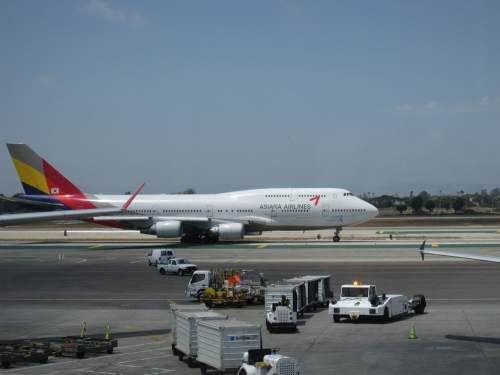
As I await my Air Canada flight, I am getting a look at another fine member of Star Alliance, the alliance that both United and Air Canada founded. That is an Asiana 747, with registration HL7428, operating as Asiana 201 and heading for the runway to start its 13-hour journey to Seoul. The last time I left the US, it was on that very aircraft, for the second installment of my 3-month Seoul stint (which eventually also took me to Hong Kong).

My flight on Air Canada (my first ever on Air Canada, and the third Star Alliance member I fly on) was on a standard Airbus A319, which nevertheless featured a video-on-demand system. Selections were not great, and air show was not available, but it did keep me busy almost all the way to Toronto. My re-booking was done as a full-fare economy ticket, so I did not even have to pay for the inflight snacks and sandwiches, but I did pay $6 Canadian for a can of Molson Canadian beer, just to set the mood right. (Not too impressed with Molson's taste, however, and I'll never drink any alcohol during a flight ever again.)

Pearson International is a lovely airport - reminds me a lot of Incheon, even down to crummy ground connections to the city. Due to the late-night arrival I shelled out $49 (Canadian, of course) plus tip for a cab ride downtown.
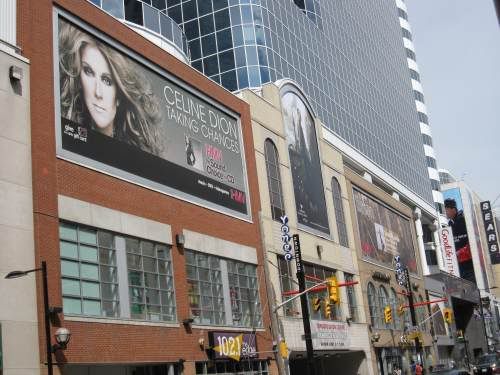
It's late morning, and I'm out for my first day in Toronto. I'm passing by Eaton Centre, located on Yonge Street, Toronto's main north-south street and also known as the longest street in Canada. My hotel, for that matter, is meditation-themed Pantages, only a block to the east.

Loving those billboards. There is an HMV record store, where I can buy the newest albums from two fine Canadian chanteuses - Celine Dion (representing Quebec and the French-speakers) and Sarah McLachlan (representing Nova Scotia & British Columbia, and the English-speakers).

During the previous day's Air Canada flight, I did find the Sarah McLachlan album - the Closer compilation - and make sure to listen to it. Did not find Celine Dion, but I substituted with an American, Mariah Carey.
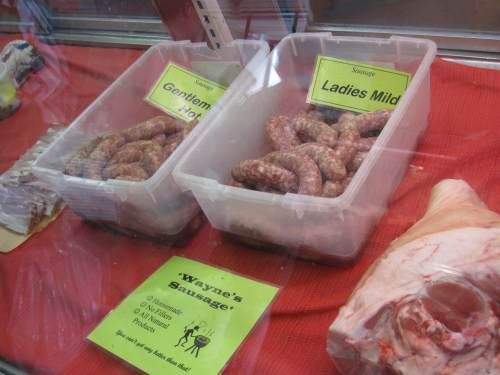
My first sight: St. Lawrence Market. There are lots of weird things available there, including sausages and other food items. Some are imported from Ukraine - or wherever else the various immigrant communities of Toronto hail from.

These sausages are Canadian domestic, but I took a photo to note its gender stereotyping.

Canada is very proactive about recruiting immigrants, and has a much better immigration policy than the US policy full of political calculations. Toronto overflows with a zillion nationalities - I see plenty of Muslim women with headscarves (and even a burka) around, and hear more languages than I can ever count. Even Spanish, which I associate more with the US than with Canada, is widely taught. And even though Ontario is an English-speaking province, I don't think a French speaker would have too much of a problem here (unlike Quebec, where speaking English is difficult, and British Columbia, where virtually nobody speaks French). And even with this flow of immigrants, Toronto managed to be the first North American locale to legalize gay marriages. Shame on you again, California!
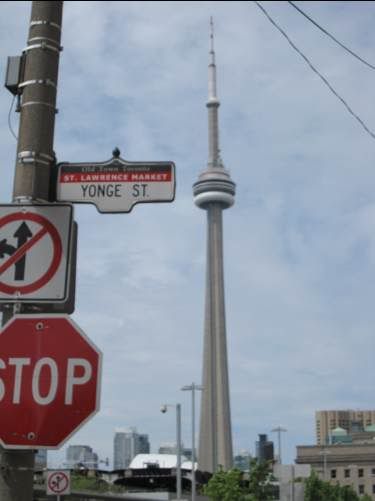
Leaving the market. I took this photo just to remind myself that I am in Toronto. Yes, I am back at Yonge Street (pronounced Young). And the CN Tower can be seen from just about anywhere in town.
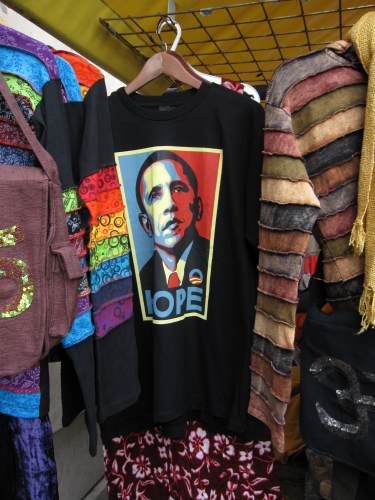
Another photo seen around the market. Sure, I may be north of the border, but President Obama is quite popular even here (maybe even more so than in many parts of the US). The Obama Presidency does signal that the US is walking away from 8 years of W cowboy diplomacy, and that Canada's own W puppet, Stephen Harper, is with fewer political options. I don't imagine that Toronto would have too many Harper supporters - most of them are out west in Calgary and Edmonton.
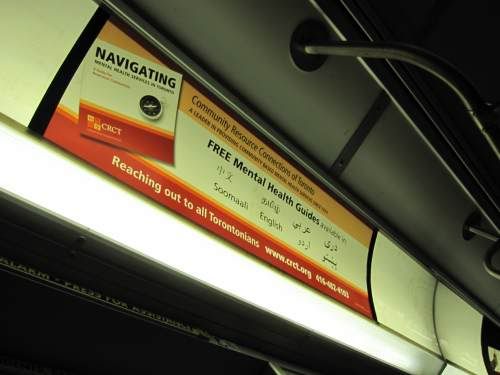
Back on the subway. I am using a $9 flash pass, good until 5:30 AM the next morning for unlimited travel on the Toronto Transit Commission (TTC) system.

Even though Canadian government services are more extensive than those in the US, community organizations still have key roles to play. Again, I am reminded of Toronto's polyglot makeup. Residents can get mental health services in the languages listed in this ad.
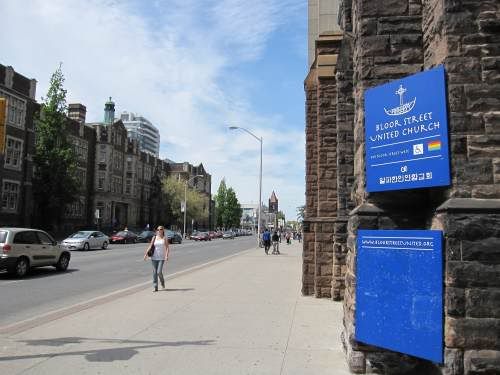
My intended destination was Royal Ontario Museum, which would require me to turn east from St. George station served by both of TTC's main subway lines. But as station vicinity maps always show north first (and I am used to them oriented the same way I'm facing, as was standard in Seoul), I got confused and walked west. Now I'm getting lost on the main east-west artery, Bloor Street, but getting lost is part of the fun.

Here is a liberal Christian congregation, which appears to welcome LGBTs. The congregation also has a Korean-language service. I don't think I'd see this mix back in the US - no Korean Christian church in the US would be caught dead sharing facilities with an LGBT-friendly congregation.

Speaking of the Korean community in Toronto, Koreatown sits on Bloor, further ahead to the west. In fact, I'll reach its eastern end at Bathurst before getting back on the subway to return to St. George and Royal Ontario Museum.
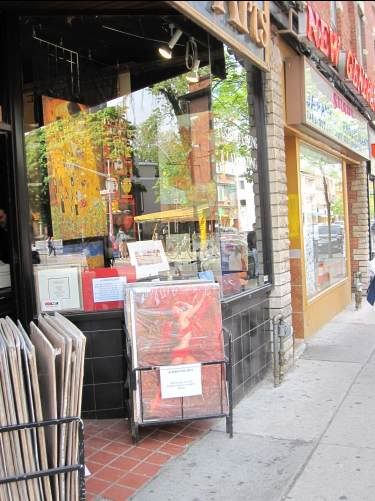
Still walking west on Bloor. Here is a sexy poster for sale at an alternative art gallery.
Now I am at Royal Ontario Museum, which combines a natural history museum with a world arts museum. And in either capacity, the collections are outstanding.

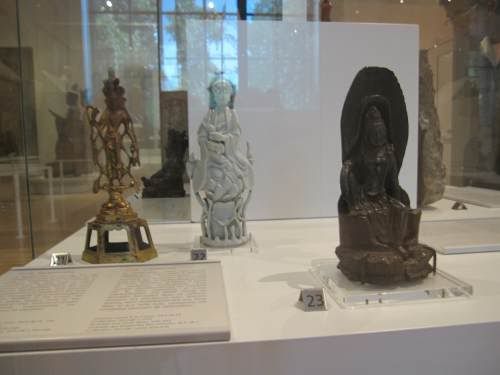
The Chinese collection is especially exhaustive. Thanks to the clout of the Chinese-Canadians (especially with all the Hong Kong wealth that migrated to Vancouver, and to a lesser extent, here to Toronto), Chinese culture gets healthy respect in Canada.

The above are three Chinese Kwan Yin statues, including an eleven-faced example and a fertility example. At Royal Ontario Museum, Kwan Yin is always referred to by male pronouns, but the captions do make it clear that from the 12th Century on, Kwan Yin was depicted in an increasingly female manner.
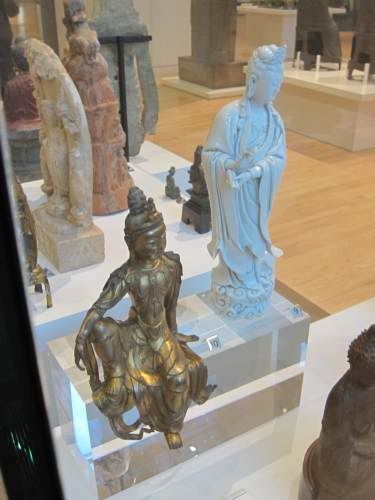
Two more Kwan Yins. There are over a dozen examples of all descriptions at Royal Ontario Museum. It was great to be reminded of my Hong Kong trip six months ago, where I got a near-overload of my transgender matron saint.
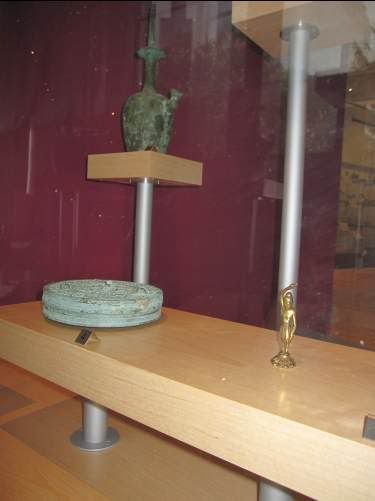
The Korean collection doesn't enjoy the support that the Chinese collection (from Chinese-Canadians) and the Japanese collection (from Japanese corporations) do, but it's still healthy.

No Kwan Yins, but I do see a newborn miniskirted Buddha, which is extremely rare even in Korea. The bronze water pitcher is also a familiar shape (though I'm more likely to see it in the form of the blue celadons). Speaking of blue celadons, there are a few dozen here, but none really stood out.
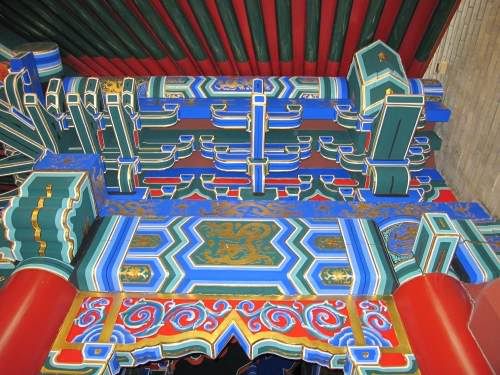
Back to Chinese collection. Here is a look at Chinese imperial building coloring scheme. I love it.
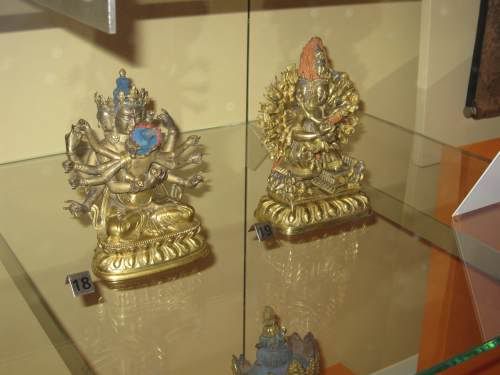
Some South Asian art. Here are some Hindu sculptures. It appears that in both examples, a male deity and a female deity are bonded together. The casual Western observer would interpret them as sex scenes, but in reality, these are not erotic, but express the Hindu understanding of making something whole by combining the male and the female.
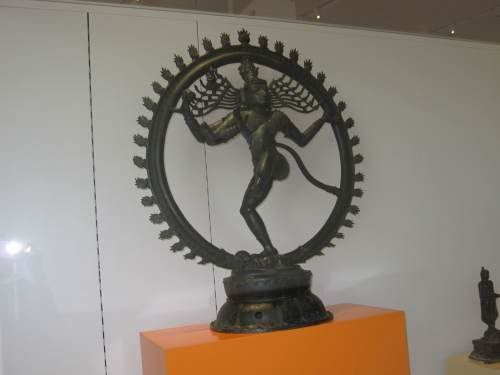
Six-armed Shiva, of course.

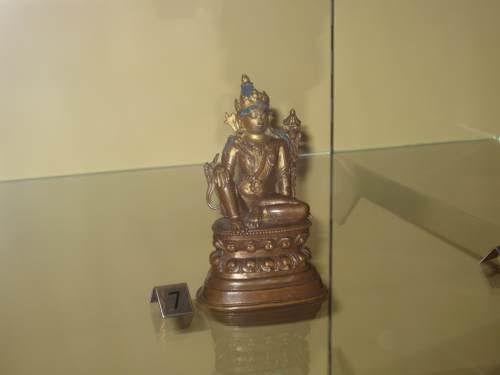
Tibetan Avalokitesvara - or the male version of Kwan Yin.
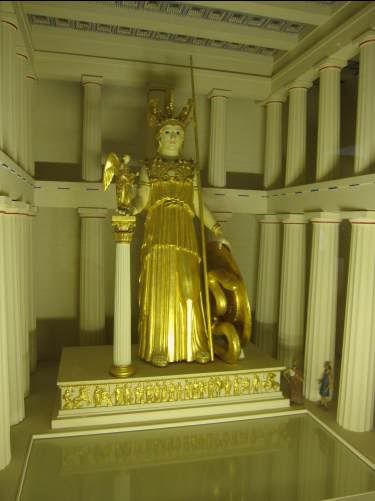
A model of the gigantic Athena statue that once stood in the Parthenon in Athens. The statue was removed after Greece became an Orthodox Christian nation, and the Parthenon was converted to a church. Eventually, the Parthenon became a gunpowder storage area, and an explosion reduced it to today's ruins.

Speaking of Athena, I'm back at that airline simulation game again - again flying Air Athena out of Athens. This game is set in the 1970s, however, and I am required to battle the spiking fuel prices and interest rates using the short-range, inefficient airplanes of the era. So far, I'm doing well.
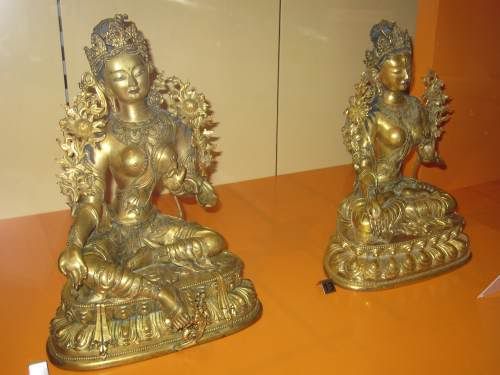
Two examples of Tibetan goddess Tara. Tara is often considered another version of Kwan Yin, as she is born from the tears of Avalokitesvara. The left is the Green Tara while the right is the White Tara. There is no ambiguity as to the gender identity of Tara; she is always female. I need to study Tara more, however, including the significance of the various varieties.
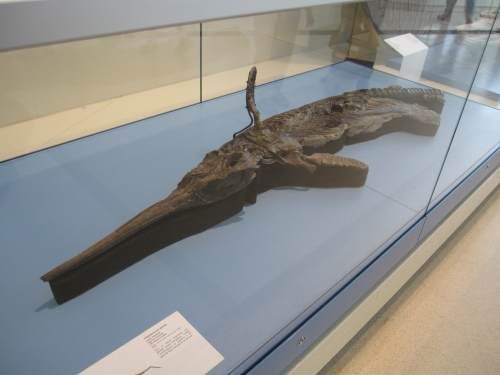
My favorite extinct animal would have to be the ichthyosaur, which was a dolphin-shaped marine reptile that lived during the dinosaur era. Here is a really nice example of an ichthyosaur, found in England, but not identifiable as a specific species. Of course, Britain, being a shallow sea 150 million years ago, had a huge ichthyosaur population.
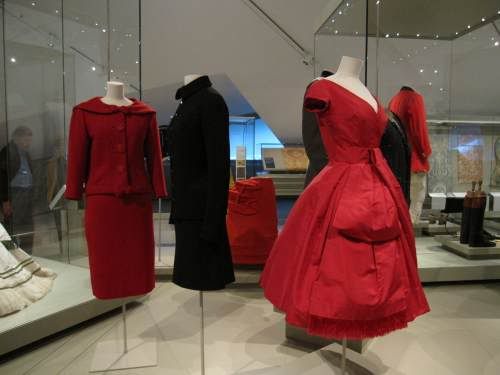
There is a textile department at Royal Ontario Museum. Here are three modern outfits I like. The red suit and dress are from the 1950s while the black suit is from 2004. The red suit had been in a very poor shape, with torn linings and all, but was nicely restored.

I was wishing for a 1990s miniskirt suit, however. :)
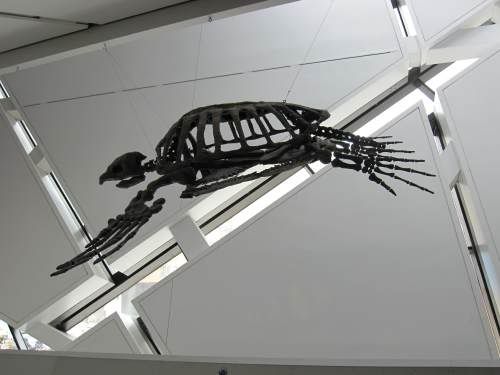
An extinct species of a huge turtle, suspended from the ceiling. That's a cast of a fossil rather than a real fossil.
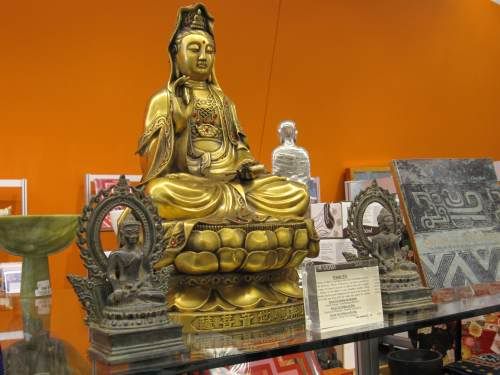
Museum shop, with a huge Kwan Yin for sale. Glad to continue encountering my transgender matron saint.
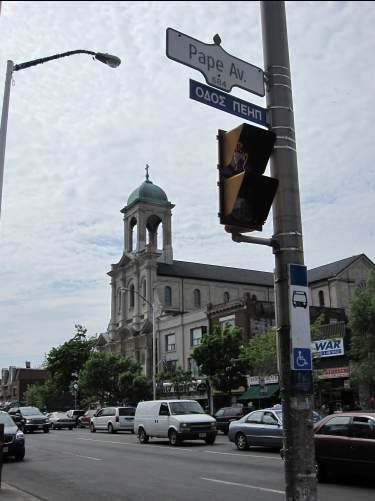
A shot east on the Bloor subway line brought me to Danforth Avenue, home of Greektown, probably the most famous/important of Toronto's ethnic neighborhoods. Greektown is the largest Greek enclave in North America, and Toronto as a whole has more Greeks than any North American city except New York.

As I had eaten a rather large breakfast at Fran's next to my hotel (Fran's is a Canadian equivalent chain to Denny's in the US), I didn't eat here. I'll be eating here later on, however. The Greek restaurants here run the gamut from run-down hole-in-the-wall places to touristy trendy expensive places to everything in between.

As seen in the photo, the street signs are in Greek as well as English. The word "avenue" is translated into "odos" but some of the Greek spellings of non-Greek names end up being interesting.
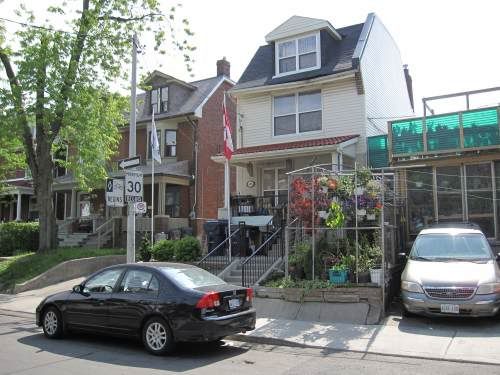
I had a bit extra time, so I shot back west on Bloor to Christie Street, the west end of Koreatown. There is a nice park in that area, but I decided to walk east across Koreatown.

Here is the Korean Senior Citizens' Center, marked by flags of South Korea and Canada.

This Koreatown is a pittance compared to the humongous one in Los Angeles, but is nevertheless respectable. A Korean speaker in Toronto can find just about everything s/he needs - grocery stores, travel agencies for those airline tickets to Seoul, restaurants, even karaoke bars. I was happy to not have to come across extremist megachurches, though the grocery store had a Christian propaganda newspaper published in the US.

Thanks to a more sensible immigration policy on the part of the Canadian government, and thanks to a different demographic of Koreans coming to Canada (more of a lifestyle choice than an economic opportunity), the Korean-Canadians on the whole are probably more sensible than the Korean-Americans. On the other hand, Korean Christianity is never to be trusted, and Christianity does play a key role in all Korean communities of the Western world; many Korean-Canadians, after all, are Christian extremists who are waiting for an opportunity to move on to the US. Another reason to move to the US: the Korean-Canadian community, unlike the massive Korean-American community (or the Chinese-Canadian community for that matter), is not at a self-sustaining level yet.

There is one more Korean note to write down. Toronto's subway system feels a lot like a better-maintained version of the New York subway, but it does have modern LCD TV status monitors that run news updates. Those monitors stated that South Korea's Roh Moo-hyun, who was the President as recently as 15 months ago, committed suicide. The last thing South Korea needs is another high-profile suicide!
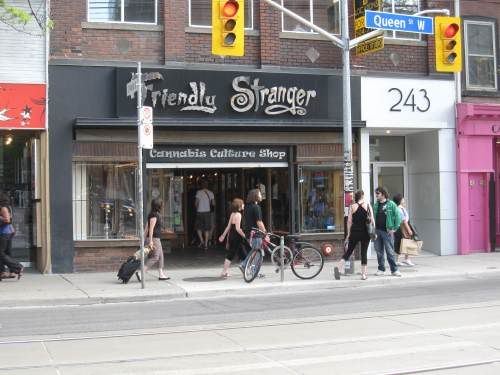
After walking across Koreatown, I returned to Bathurst, but instead of the subway, I took the streetcar down to Queen Street West. After going one stop east on Queen on another streetcar, I walked all the way back to Yonge.

There are lots of boutiques here - I ended up with a $9 belt from American Apparel (as American Apparel is made in Los Angeles and therefore cheaper in the US, I decided not to buy its other products today), as well as a $60 white shirt from Aritzia, a Canadian boutique chain. At Aritzia, the fitting rooms are a bit odd; I am required to store my purse in a locker, and the cubicles do not have mirrors so I must come outside for a check on the mirror. Not fun when I was working a sheer tunic blouse as a dress (with a cami and tights underneath) and the shirt was barely covering my derriere. I do have to say that I was far from alone in doing that "tights as pants" thing on the streets of Toronto today. And in terms of fashion in general, Torontonians are not standouts, but they do express their individualism and accessorizing very well - certainly better than Angelenos.

Walking further east, I came across this sight. This is another of those things I don't think I'll ever get to see stateside. The US is running its War on Drugs not as a serious attempt to regulate drug usage for the public's safety and health, but as some sort of a vendetta. The Canadians are a bit more level-headed on this issue, but of course there is a lot of American pressure to crack down. I hate drugs of any kind (even tobacco and alcohol are too much for me usually) but I don't like the US policy at all (which has actually turned the illicit drug industry into a very lucrative one).
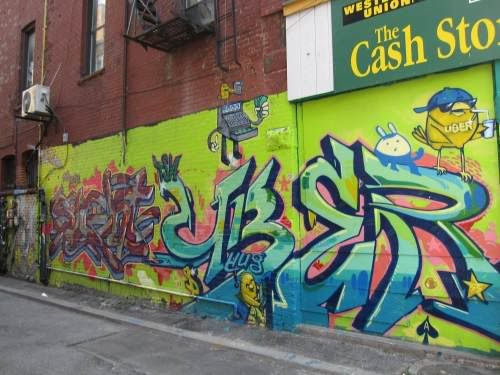
Lovely graffiti on a side alley branching off of Queen Street West. This is something my Seattle-based friend DiAnne Grieser would like (in addition to all the Kwan Yins and turtles). She is known to photograph local and foreign graffiti all the time.
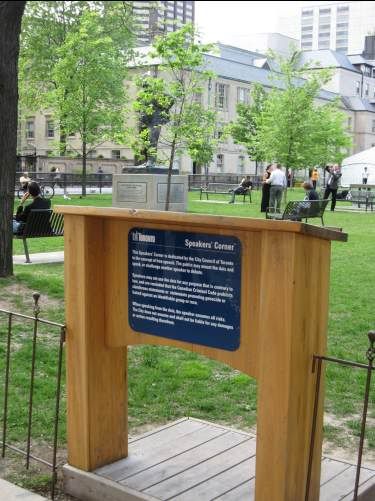
The British, through the Magna Carta, established the concept of freedom of speech. Today, the northeast corner of London's Hyde Park has a Speakers' Corner, where anyone can give a speech on any subject.

Toronto is doing just the same. Here is Toronto's own Speakers' Corner. The only rules are that I may not give hate speeches targeting a specific demographic (I guess Miss "I Believe in Opposite Marriages Only" California will have to shut up here), and that I am responsible for anything and everything I say, including any adverse reactions from listeners.

Another British reminder: there is a Winston Churchill statue in the distance.
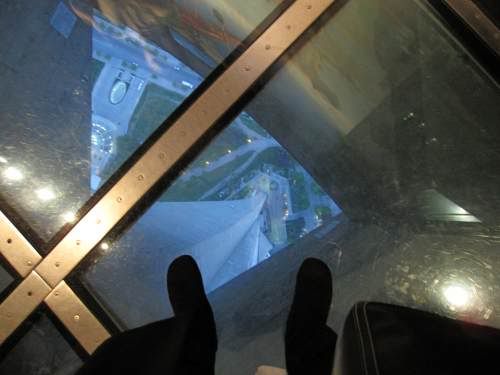
It was a warm, humid day, and my feet hurt, so I returned to my hotel room for a quick rest and change, then after a quick Mexican dinner at Eaton Centre, went to CN Tower.

CN Tower may not be the tallest building in the world anymore (there is a taller structure in Dubai now), but its top observatory remains the highest man-made observation platform in the world.

I am at the main observatory, which includes this glass floor section. I am looking 114 stories below to the ground level. And if anyone on the ground is looking up, they can see all the visitors lying down on the glass - as well as my lingerie preferences. (I did change into that white Aritzia shirt, and added a long suit jacket, but I am still doing that "tights as pants" thing, just like that other lesbian fashion icon, Lindsay Lohan.)

The top observatory, called the Skypod in English and la Nacelle in French, is 147 stories above ground level. I do have to say that with the Toronto area lacking any major geographical features, most of the inland views were quite generic, and not too impressive. But the Lake Ontario views were quite nice, from the Toronto Island and its airport in front to the faraway shores of New York State. On a very good day, I am told that I can even see the plumes of Niagara Falls - and the buildings of Rochester, NY.

That wrapped up Day 1. Now I need to figure out what Day 2 will be like, though I'll be sleeping in a bit as the TTC subway doesn't start its Sunday service until 9 in the morning.

05 December 2008

Seoul: from a Chinese perspective

My Internet connection continues to act up. Finding and connecting to various servers is fast, and so are plain texts. But images and binaries take forever to load - even a 20K image will take at least five minutes to load! Also, Wikipedia and SMRT homepages all refuse to load at all, preventing me from doing my research. I do think 2MB's supporters have hacked into my computer. They shall gladly pay the price. As I'll be gone from South Korea before too long, I'm not too worried. I'll make sure to come back with another computer next time (if there is a next time), probably a MacBook.

I traveled to Jamsil late today, and here are some photos taken from my outing. It was bitterly cold - good thing I had bought my leggings yesterday.

I am reading a poem, one of many posted at subway platforms. This one reminds that both love and rage are really no more than words, and will not last. It's easier said than done, however, given the 2MB government's actions.

This poem was placed by an association of Buddhist employees of Korail. Most poems are placed by religious groups - Buddhist and Christian. While Korail and SMRT source their poems from Buddhists, Catholics, and Protestants alike, Seoul Metro takes exclusively Protestant poems.

My ride on Korail's Bundang Line was my first moment of taking in South Korea from a Chinese perspective. There are currently 20 stations on Bundang Line, and aside from Hanti (한티) Station, which is second-to-the-last stop before the northern terminus and has a purely Korean name, all stations have names that can be written in Chinese characters. And reading the station names in Chinese can be pretty revealing about the placenames. Some names (at least the ones I can read and understand) are as follows, from north to south:
  • Seolleung (宣陵), where indeed some royal tombs are located. This is the current north end of the line, with connection to Line 2. An extension north is being built to Wangsimni across the Han River, where there will be connections to Lines 2 and 5 plus the Jungang Line; completion of this extension will make my life much easier.
  • Guryong (九龍), "Nine Dragons," which continues to remind me of Hong Kong's Kowloon.
  • Daemosan (大母山), "Great Mother Mountain," is named after a nearby mountain to the south. For now, it's part of Seoul's green belt and well forested, but the Republican colonial city government wants to develop it with luxury condos. Residents near the mountain are up in arms and determined to stop the development, which will destroy the area's natural beauty and air quality.
  • Suseo (水西), "West of the Water," is located just west of the Tancheon stream that flows from Seongnam to Jamsil before joining the Han River. It is a transfer point to Line 3, which currently terminates there. The original 1994 Bundang Line had its northern terminus here as well.
  • Bokjeong (福井), "Lucky Well," is named after a water well of that name that used to serve the neighborhood. This is the main transfer point to Line 8, and sits right on the boundary between Seoul and Seongnam.
  • Taepyeong (太平), "Great Peace." Always a nice name.
  • Yatap (野塔), "Field Pagoda," referring to a stone pagoda that apparently once stood here. The station walls indeed have pagoda motifs.
  • Imae (二梅), which refers to two trees of a certain species having previously stood here. This station now serves the Seongnam Arts Center. While the station lies on the original 1994 section of the line, it didn't open for another ten years.
  • Jeongja (亭子), a generic term for a pavilion. Some passengers like to make vulgar remarks about the name, as the Korean word for sperm is a homonym of Jeongja. The New Bundang Line, a reliever line to handle the additional developments of Seongnam, will intersect this existing line at this station.
  • Migeum (美金), "Beautiful Gold."
  • Ori (梧里), a village named after a species of tree found there. This is also another name that passengers make fun of, as it is a homonym to the Korean word for duck. The original southern terminus of the line was at Ori.
  • Jukjeon (竹田), "Bamboo Field." The character 竹 reminds me of Takeshima (竹島), which is currently administered by South Korea as Dokdo (獨島), "Lonely Island," but as the current colonial authorities would rather please the far right of foreign nations (including Japan and the US) rather than serve South Korea's own interests, I no longer recognize the name Dokdo nor its South Korean jurisdiction.
  • Bojeong (寶亭), "Treasure Pavilion." This is the current southern terminus of the line, and it sits near the city of Yong-in as well as Expressway 50. The line is being extended farther south to Suwon (Line 1), with a light rail connection to Everland.
I'm at Bokjeong Station, about to take Line 8 toward Jamsil. I noticed that for some reason, this sign still had Jamsil romanized as Chamshil.

When the subway system first came to Jamsil in 1980, "Jamsil" was indeed the correct romanization, using the incredibly awkward Ministry of Education system. Then in 1984, the system was abolished, in favor of McCune-Reischauer, which dictated Chamshil, and that was the spelling used during the 1988 Olympics, which were indeed mostly hosted by the neighborhood. As a result, Chamshil remains a familiar spelling for many foreigners. Since 2000, the Revised Romanization system, which is a compromise between the Ministry of Education and the McCune-Reischauer systems, once again dictates Jamsil.

I decided to get off a few stops early. I am at Garak Market, three stops short of Jamsil. And yes, when written in Chinese, it indeed is Cola Market!

Unfortunately for the Chinese speakers, this is one of the few places at "Cola Market" where you can actually buy a can of cola. Here's a 7-Eleven inside the subway station; 7-Eleven is a concessionaire of SMRT, and has locations at every SMRT station, including some within paid areas.

I was reminded of two things about Hong Kong. Here in Seoul, most convenience stores are GS 25, and the rest are other local chains; 7-Eleven is a major chain but not predominant. Back in Hong Kong, however, it's mostly 7-Eleven, and the rest are Circle K. Also, Hong Kong does not allow convenience stores inside paid areas, as it is illegal to eat/drink in paid areas and in trains, and being caught will cost HKD $1,500.

Parts of this station have construction barriers, as the Line 3 extension will also serve this station.

I am outside. This walkway leads to a collection of tombstones collected from around the neighborhood, but they didn't seem too significant to me.

The graffiti on the blocks says 大韓民國海兵 - Republic of Korea Marine. South Korea's Marine Corps have a reputation for "catching even the spirits of the dead," but otherwise feel a lot like a cut-rate subdivision of the US Marine Corps, as discussed before.

Time to resume my northward journey toward Jamsil, using the bus for a free transfer (and a look at my old neighborhood, which indeed is in this area). The bus stop also indicates that I am at "Cola Market."

To the south, in the Munjeong ("Literary Well") District, there is a "Rodeo Drive" fashion district. In South Korea, a "Rodeo Drive" is a generic name for an alley filled with high-end boutiques and other related stores; of course, the name comes from the Rodeo Drive located in Beverly Hills, California.

I arrived in Jamsil on a blue No. 320 bus, which starts at Bokjeong Station and runs north to Sangbong Bus Terminal in the northeast of the city. As Sangbong Bus Terminal is next to a Costco, this may be a future travel option for me if I do decide to shop there once more. And this bus turned out to be another low-floor modern Hyundai model, complete with wheelchair lifts, ergonomic seats, and automatic transmission.

I have arrived at Jamsil. A sign indicates that I am a quarter-mile away from Children's Traffic Park, one of several in Seoul. Such parks are in existence so that children, riding on either quadricycles or bicycles on the streets of the park, can learn traffic regulations first-hand, stay safe throughout their childhood, and hopefully grow up into safe drivers in the future. However, South Korean children seem to be taught that it's often enough to raise a hand toward an oncoming car - or flash the backpacks' built-in reflectors toward the car - to have the driver stop for them; the driver never stops in real life.

The left side shows some buildings of the government-built Jamsil Apartment Complex 5th Phase, built about three decades ago. As the complex was my home for several years, I spent a good amount of time myself at the traffic park as a child.

Before I headed into Lotte World, I ducked into a large record/bookstore first. Here are two new releases this week - Britney Spears' Circus and Guns 'N Roses' Chinese Democracy. The latter, for obvious reasons, is banned in mainland China, though I couldn't verify its Hong Kong availability as I had never visited a record store in Hong Kong.

Both albums were very anticipated. Britney Spears is very popular in South Korea, and Guns 'N Roses hasn't had an album in over a decade.

After some ice skating, I toured Lotte World's shopping mall, now featuring a brand-new Toys 'R Us store, where the store's familiar jingles were playing - in Korean. I always love visiting toy stores, if only to look at what the new generations of children are growing up with; as now I am old enough now to be a likely parent of a toddler or a kindergartener, I blend right in.

I first looked at the toy car counters, where I found various domestic and foreign models. While I found more BMWs than I cared for, I couldn't find a Hyundai Genesis yet. I also looked at Lego sets, Star Wars toys, video games for PCs and Nintendo DS's, and more.

But my real love is collectible dolls. Sure, Barbies are well-known even in South Korea. But I got to look at some native fashion dolls - notably, the Mimi series of dolls, first introduced in 1987. The above are a selection of Mimis from 1987 through 1991, performing a variety of occupations; Mimis back then were much shorter than the standard 11 1/2" fashion doll height. There also were even shorter models, named Little Mimis, available.

Here are the currently available Mimi dolls. As they are of standard height now, it's much easier to buy extra costumes for them. It's very tempting for me to pick one up, and give her a United Airlines flight attendant uniform, sort of as a tribute to my novel protagonist.

A familiar sight around South Korea. While Starbucks and The Coffee Bean are common sights, I can also drink some coffee at a local chain, as seen above. Its name is Angel-in-us, a great name and concept; however, I kept misreading it as Angelina Jolie at first, and as everyone knows, I am very anti-Jolie. In any case, I rarely drink coffee at places like these; I tend to buy cheap vending machine coffee from the subway, just 300 won for a few sips.

I then headed back to the music/bookstore, going through Jamsil's subway station. SMRT's Line 8 does stop here, but its section is out of the way, so crossing Jamsil's main intersection involves the subway station for Line 2 (Seoul Metro) and a subterranean shopping mall (city owned but not subway owned).

This protest poster was seen at the subterranean shopping mall. It is currently occupied by mom-and-pop stores, mostly boutiques, and in recent years, the mall has seen its ambience and decorations improve significantly. But all of this is under threat. The Republican colonials running the city hall are now planning to sell the mall to the highest mega-corporate bidder, who will evict the current tenants and bring in more corporate shops with tons of budget. The deputy mayor is the brain behind this plan.

The above message says "Support of economics for the masses in name only. Go away, Grand Nationals. Everyday economics full of lies. Blow yourselves up, Grand Nationals." Of course, I no longer recognize the "Grand National" name itself, as the party is no more than a cut-rate colonial outpost of the neocon wing of the US Republican Party. The Republicans' plans for media ownership rule changes, which will indeed let mega-corporate media empires rise up unchecked (much in the tradition of News Corporation, a key ally of the Republicans in both the US and here), are also under severe criticism.

The mom-and-pop stores, which indeed sell quality fashion goods at competitive prices, must be allowed to remain, so that the citizens of Seoul can continue to vote with their money. If they do want to buy from corporate chain stores, there are plenty of other places they can go to.

Back at the record store, I bought a CD/DVD combo of Mariah Carey's Merry Christmas album, locally manufactured, for 15,600 won. Sure, I already have a copy of the original CD, bought and autographed in New York in 1994. But its packaging is showing signs of wear, and I need to preserve the autograph. Moreover, by buying another copy right here in Seoul, I make my links - to both New York and Seoul - clear. The non-US versions also happen to come with two bonus tracks, and I like that too. The DVD containing eight music videos (Region 0 NTSC) is just icing on the cake.

I decided to take the long way back to Seongnam. I decided to take a ride on the No. 812 bus that I used to take so many times in the 1980s and in 1994. Of course, the bus has a new number - No. 3314 - under the new bus route system, though its route is identical to the old No. 812. After a while waiting in the bitter cold, two No. 3314 buses showed up, both of them Daewoo low-floor buses with, again, ergonomic seats, wheelchair accommodations, and automatic transmissions. It was nice to ride to, and through, my old home neighborhood all over again, enjoying the new night lights that didn't exist back in my day. I finished my ride at Ogeum Station, on a branch of Line 5, then took the subway back to Seongnam, though that necessitated backtracking to Jamsil. The Line 3 extension, which will open next year, will end at Ogeum, with only one stop to Garak Market, but as it is still a Seoul Metro line, I don't look forward to riding it. (As is, it's a 10-stop detour between the two stations, involving one transfer.)

As I ride around the subway and the buses, another thing I notice is all the initiatives that the governments - both at the national and the city level - are rolling out for women. At first, I was very moved. But now, I find them very condescending. Rather than recognizing the "frailty" of women and giving out extra perks that still seem to say women need those perks as inferiors to men, I would rather have the authorities recognize women as full equals of men, outlaw sex discrimination in employment and in pay, and support women of all stripes (including singles and lesbians) rather than just the ones that fit the Confucian social construct. And while at it, instead of punishing adultery, punish sex harassment and sex crimes instead! But then again, I digress - no further progress will ever be made until the Republicans are gone once and for all, and until then, women are no more than incubators and maids for the children of their husbands.

A few observations

My Internet connection is extremely sluggish, especially with Blogger and some other services. I wonder if the 2MB loyalists have planted a virus inside my computer... I had no problems before and during my Hong Kong visit. If things get really bad, I may have to retire my current laptop and get a MacBook even earlier than planned - and while I can afford it (on top of all my traveling and my new car), I don't want to spend more money than I have to.

First, a bit of good news. The Nazi bastards at BMW are reporting a dramatic drop in November sales - about 26%, to be exact.

BBC

Unfortunately, the people who can afford BMWs are still quite well off, and continue buying them. The more egalitarian brands are suffering even worse; major Japanese and South Korean makes have seen their November US sales drop by at least a third over last year's figures. Sure, I can probably expect some good deals when I return to the US and visit my local Hyundai showroom to purchase my Genesis, but on the other hand, there will be the risk of the Genesis being pulled from the US market, much like the Volkswagen Phaeton, an extremely nice car that happened to be just too expensive. That will hurt the resale value and make long-term parts availability questionable. Of course, the US Big Three are asking for some major financial concessions from the government, and the United Auto Workers are pitching in with their own sacrifices too.

Meanwhile, some observations continue as I reflect on my Hong Kong experience and compare it to my current situation in Seoul. While I continue to feel that Incheon is a superior airport to Chek Lap Kok, there is one huge edge in Chek Lap Kok's favor - transportation into the city. Chek Lap Kok's plans included a dedicated airport rail line, which opened concurrently with the airport, and provides fast, efficient service to Kowloon and Hong Kong. Incheon, however, only had road links to Seoul at its inception - and while a rail link, A'REX, was added later in the planning stages, it didn't even open until 2007, a full six years after the airport opening. Even now, A'REX terminates at Gimpo Airport, requiring a transfer to the subway system, and full service to downtown Seoul will not be reality until 2010. The A'REX tracks are rated for 200 km/h service, but trains on the line are lucky to hit half that speed. This inconvenience makes it virtually useless for now, and even though fares have been steeply discounted, ridership is only a fraction of initial projections, and as a result, frequency is pathetic, further decreasing ridership.

A'REX was the first rail line in the Seoul area built with private funding. Apparently, the private investors had a very lousy business plan, that the authorities accepted not for merit, but for sweetheart connections. For now, the primary method of getting into Seoul from Incheon Airport continues to be the various bus lines, which can be next to impossible to figure out for those on their first visits to Seoul (especially if they don't speak Korean).

The private rail lines are here to stay, however. Seoul's subway system is gaining Line 9 very soon, running along the major population centers of southern Seoul from Gimpo Airport to Olympic Park, and it will be managed by a division of Hyundai Motor Company, using Hyundai-Rotem trainsets. The new residential developments of the Pan-gyo District of Seongnam, under construction right now, will overwhelm the existing Bundang Line, so a New Bundang Line is being built as a parallel relief line, also with private funding. Both Bundang Lines will also link to a light rail line in Yong-in, which will run to the Everland amusement park; it's also private. Even the government lines are seeing private funding, notably the various major stations on Korail lines that are being rebuilt into multi-story shopping malls. I can only hope that the private funding is for better running efficiency and easier capital procurement, rather than crony favoritism, but I am not holding my breath. At least, all these private lines will continue to offer through ticketing with the current government rail lines as an integrated system. (A'REX does not, however, as it is an airport access line and therefore has separate ticketing. T-Money can be used, however, but still, it's a full additional fare.)

On the subject of Seoul area rail lines and their operators, I am taking another look at Seoul's city-owned subway operators. I am currently using SMRT, which runs Lines 5-8, as much as I can. SMRT is short for Seoul Metropolitan Rapid Transit, its official English name, but its real name is 서울도시철도공사 (Seoul Urban Rail Public Corporation). SMRT's official slogan is 행복미소 (Happiness and Smiles). Lines 1-4 are run by the hated Seoul Metro, whose original official name was Seoul Metropolitan Subway Corporation; its Korean name was 서울지하철공사 (Seoul Subway Public Corporation), but now, its Korean name is Seoul Metro too, written as 서울메트로.

04 December 2008

Hong Kong debriefing and more

My Hong Kong trip is now history. But with my first full day back in Seoul, I am barely starting to debrief myself. Most of the day was spent in stupor, as I made a long, drowsy trip to my meditation and back.

To start off, I am looking at this subway ad on Line 8 - my only photo for the day. It is a public announcement from the City of Seoul, asking women to give birth to more children.

It reads as follows. ""My generation doesn't know what a "cousin" is." Birth is the most beautiful choice you can make for our future. South Korea's birthrates are among the lowest in the world, and in a generation, children indeed won't know what an uncle, an aunt, or a cousin is."

Just a generation ago, women were being encouraged to have fewer kids, because of the rampant overpopulation. Abortion was technically illegal, but abortion of female fetuses was nevertheless strongly encouraged, leaving a surplus of men who are now forced to marry a Southeast Asian wife. Many South Korean families were also encouraged to emigrate overseas, particularly to the US, in hopes of relieving overcrowding at home and doing some future electioneering in the US. How the times change.

Nevertheless, this ad is still a reminder that Seoul's Republican colonial government still doesn't get it. It relies on token financial incentives and references to primitive Confucian traditions to make its point. (Korea, much like Catholic Latin American societies, has traditionally had large extended families.) The real reason for not having kids these days is that the cutthroat academic competition and starving public schools, which both require extensive tutoring, make raising a child prohibitively expensive. Unfortunately, the Republicans' plans, both in Seoul and nationwide, will only aggravate these factors.

Other observations throughout the day...
  • Seoul's subway system, still excellent, outright pales next to Hong Kong's; often, lengthy walks are required for a transfer, and cross-platform transfers are unheard of. Making analogies to US subway systems, Seoul is like New York, vast but utilitarian and unfriendly, while Hong Kong is like the DC Metro, a limited network but far more modern and user-friendly. Of course, this is only an analogy; Seoul's subway system is still far more modern and tidy than New York will ever be. I can also get away with food and drinks in the Seoul subway, which would cost me a fine of $1,500 back in Hong Kong (USD $200 and KRW 300,000).
  • I stopped at a public toilet in the subway, which had some squat toilets. At least here in Seoul, all squat toilets have front flaps. Over in Hong Kong, some squat toilets had only a hole in the middle; there was a good chance of revealing my private parts to someone outside. At least they still flushed.
  • Back in Hong Kong, smoking in public places can cost $5,000 in fines. That's USD $650, and KRW 1 million. Here in Seoul, it's only 30,000 won - a pittance and not even all that much enforced. I see people flicking cigarette butts at bus shelters, which clearly are no-smoking areas and subject to the fines.
  • I got on a Korail subway train on the Jungang Line that also had a few Sun Moon University ads. Nevertheless, this was far less blatant than Seoul Metro trains. And in any case, a boycott of Korail is out of the question, as that will require me to use buses exclusively (even just to get to the nearest SMRT line), or drive all over again.
  • My current routing into Seoul takes Bundang Line, transfers at Bokjeong to Line 8, then transfers again at Cheonho to Line 5. Mercifully, both transfers involve very short walks. I also like Cheonho Station's color scheme, which is quite pretty between Line 8's pink and Line 5's violet. This routing is my only viable option into Seoul without using Seoul Metro, but it's totally worth it, and I don't miss Seoul Metro's propaganda-laden trains and stations. Travel beyond downtown Seoul can be painfully long, however, as Cheonho is in the far east end of Seoul. (But then, transferring to Line 2, a ridiculously long walk, or to Line 3, with its crooked route, don't save me time at all. And both are Seoul Metro.) Continuing travel on Lines 6 or 7, or the Jungang Line, requires a third transfer.
  • Bundang Line has a station named Guryong. It's written in Chinese as 九龍 (Nine Dragons) - exactly like Hong Kong's Kowloon. That station will always remind me of my Hong Kong trip, just by virtue of its name. However, I will no longer be taking a train through Guryong Station, as proceeding through that part of the line will require me to transfer to Line 2 or 3. Again, I do not wish to take Seoul Metro again, unless I am out of alternatives.
  • For that matter, my current routing on Line 8 takes me through Garak Market Station. Garak is written in Chinese as 可樂, which is how the Chinese speakers spell out "cola." This will certainly be another way to remember Hong Kong - and Beijing, for that matter. Garak Market is for agricultural products, however, not for purchasing Coke or Pepsi.
  • I got on a Seoul city bus, made by Hyundai (just like 70% of all South Korean city buses, Daewoo has the other 30%), that was a pleasant surprise. It was a low-floor model with wheelchair provisions, including lifts and even foldaway seats. Its seats had modern, ergonomic designs, and its transmission was automatic; this solved the two most glaring deficiencies of South Korean city buses. I hope to see more buses like this in the future.
  • News feeds indicate that the Republicans here are about to dramatically cut taxes for those who own more than one residence - another classic case of rule just for the ultra-rich. The Republicans want to also loosen media outlet ownership rules; in other words, Chosun Ilbo can take its propaganda to the radio and TV if this goes ahead. Needless to say, the opposition parties are unanimously opposed.
  • Today was rainy, but not that cold, But the next few days will be so cold that even daytime highs will remain subzero Celsius. I made sure to pick up a pair of 4,000-won leggings from a subway vendor as preparation. I love them - very soft and warm, and excellent elasticity. It is different from American legwear in that the crotch panel doesn't just limit itself to the vagina area, but also covers the anus and extends all the way to the waistband. For now, my new pair of leggings (black again, just like several other pairs I already have back home) will only be cold-weather layers, but pretty soon, they will be fashion statements once I return home.

03 December 2008

Journey Back to Seoul

It's all over, and I'm back in Seoul safe and sound.

My journey started with a short hop to Airport Express's Kowloon Station via a special free bus that runs every 12 minutes; as it turned out, it stopped right in front of my hotel. I appreciated riding it; just like all city buses and tourist motor coaches in Hong Kong, it was well-appointed in European style. In addition, all Hong Kong buses have automatic transmissions, eliminating the jerky shifts that categorize Seoul buses, which are all manual. I guess Seoul bus operators demand manuals for their cheaper cost and fuel savings, even though it must be hell to keep shifting through the massive traffic.

My original plan was to take the Tsuen Wan Line to Central, then take a long walk over to the Airport Express station there. It would've cost me $8.50 and forced me to lug my bags through the staircases in morning rush hour. Good thing I didn't.

I am at Kowloon Station, where it's possible to check in for some of the airlines serving Hong Kong, but I skipped that service. This platform sign advises me to board the front cars of the train for the airlines indicated above. The major airlines of Hong Kong are indicated with such signs, but Asiana isn't considered major, and isn't indicated.

I photographed the sign for a look at how airline names are written in Chinese. Very few foreign airlines have their names written phonetically; the vast majority get translated Chinese names. In the above, British Airways is written as "England Airline Company," as the character 英, which is most often used for England, is just as often used for all of the UK; there is no distinction made between the two. QANTAS is written as "Australia Region Airline Company." United is written as "Union Airline Company" though officially, it needs to have 美國 (America) added to the front, so that it would fully read "American Union Airline Company," to comply with Chinese airline naming conventions and to distinguish from a domestic Chinese airline of similar name. Airlines based in Asia have, and use, their official Chinese names.

It didn't take long for the ride back to the airport, where I disembarked at the check-in level. I first returned my Octopus for a $50 refund, then waited for the Asiana counters to open. I noticed that United (which indeed was written as "American Union Airline" on the airport's own signs) shared counters with Korean Air. Yes, my favorite airline and my least favorite airline, who belong to rival airline alliances (and are founding members in each), are right together.

At Hong Kong, departure immigration check happens before security, which is unusual. Once I cleared both, I took some time to walk around. I still had a good amount of Hong Kong currency to burn, so I browsed the duty free shops (to no avail) and the food court (where I ate a bowl of spicy Japanese ramen with Korean kimchi). I still had plenty of Hong Kong Dollars left, so I decided to sell $63 to get 10,000 South Korean won; it was a lousy exchange rate, but at least this almost paid my bus fare at Incheon Airport. The rest of Hong Kong currency - I am keeping them as souvenirs, and as my initial spending money for my next Hong Kong visit, as ATMs love spitting out $500 banknotes which are very unwieldy in their size and value.

Here's an airport scene. Although Cathay Pacific and its subsidiary Dragonair dominate the airport, there is plenty of service from both mainland Chinese and Taiwanese airlines. In this photo, EVA Air of Taiwan's Evergreen Group has brought in two widebodies.

In the distance, I can also see a United 747, in the airline's older color scheme boasting the phrase "Worldwide Service." Sure, it was probably the greatest lie ever painted on an airplane (United has had the most comprehensive international services of any US airline, but it is nowhere near being worldwide), but it nevertheless is a reminder of all the Pacific and Atlantic crossings I've done on United jumbo jets. I flew United exclusively for international itineraries until my current and recent crop of Asiana flights. The United 747 is operating a nonstop to San Francisco, after having come in from Vietnam earlier.

Finally, my Asiana flight is coming in, and it's a 747 as well. It will park next to its rival Korean Air, operating another 747 to Seoul and leaving an hour ahead of my Asiana flight. Korean Air would later also bring in a 737 from Busan.

The Asiana 747 has come in and is being serviced.

It's a Combi 747-400 (registration HL7417), with the rear 1/3 of the plane being used as cargo hold rather than passenger cabin. It's also fairly old, with only projector screens for entertainment; its air show is so old that its fonts are reminiscent of early 1980s Nintendo video games, and its Korean placenames use the older McCune-Reischauer romanization which hasn't been used since 2000. This plane felt outright primitive when compared to all the newer Asiana planes I've flown on lately; it felt similar to the various US domestic United planes I've flown in recent years. The radar dome on the nose is in the newer all-white color, however.

Asiana is currently in the process of converting its aging 747 Combi fleet to permanent freight-only duty, and bringing in the new, nicer 777s as replacements.

My flight operates with a South African Airways codeshare flight number. The South African flight from Johannesburg sits in the back, and coordinates with Asiana for through service between Johannesburg and Seoul. There is no other through service between the two cities. The South African flight will sit here until around midnight, when Asiana's evening flight from Seoul hands passengers over so that they can continue to Johannesburg.

And for that matter, there is also a United codeshare number, even though United has no evening departures out of Seoul that my Asiana flight can connect to.

And yes, Seoul is really written as 首爾 in Chinese now. 漢城 (Hancheng), the old name that the Chinese speakers had continued to use until a few years ago, is now history. However, Cantonese speakers will NOT pronounce this new name as anything remotely resembling Seoul. The problems over the Chinese name of Seoul continue to linger.

Hong Kong was cloudy, so I never got a farewell look at the world-famous harbor; I was lucky to get a glimpse of the highrise apartments of Tsuen Wan. As the plane continued to climb, a series of short subjects played on the projector screens, which included some South Korean current events. I hated seeing images of former President Roh Moo-hyun; it was his ineptitude and polarizing politics, not to mention his frequent gaffes, that had resulted in the current 2MB government, and I will hold him accountable. The South Korean economy is now shrinking, partly due to the global recession.

There was one bright spot however; a lower-level court ruled that the female employees of KTX bullet trains, which Korail had claimed were contract employees supplied from an agency and therefore not entitled to any benefits of their male counterparts, were deemed to be proper Korail employees after all, and entitled to benefits and representation. It was certainly very telling of South Korea's continuing Confucian social values and its status as the only country in the world with both a bullet train line AND such blatant sex discrimination. But change will come, surely if slowly. I don't think even 2MB will derail that.

I subsisted on a music channel consisting of old English-language pop, even though it was not all that old - mostly 1990s adult contemporary, featuring the likes of Celine Dion, Phil Collins, and Faith Hill.

After about an hour, I entered Taiwan. As I flew over the island's rugged mountain range, I was able to see its west side - where most of the population and industries are. Right now, I am looking at the sprawl and the development of Taichung, which, as its name (臺中) suggests, is in the center portion of Taiwan.

Now, I am about to exit Taiwan, at Taipei (臺北), the north end and the capital. Downtown, with its new fabulous skyscrapers, is right below me and can't be seen. But I can see the western outskirts, a mix of urban sprawl and rice paddies. Two airfields are also visible; the farther and larger of the two, with two parallel runways, is Taiyuan Airport, Taiwan's gateway to the world. Until recently, it had been named after Generalissimo Chiang Kai-shek, whose ironfist rule had tormented Taiwan natives and is now considered as much of a negative as it is a positive.

I'll certainly look forward to visiting Taiwan in the near future. Subway ads in Seoul do entice me to visit Taiwan. The main challenge will be the limited English aptitude of the everyday Taiwanese.

From here on, it's open waters of the East China Sea until I enter South Korea.

That snow-capped peak indicates that I have now re-entered South Korea. It's kind of hazy out there, but I can identify the peak as Mt. Halla, the southernmost and the highest mountain in South Korea (it's two kilometers tall). Halla is an extinct volcano just off the southern coast of Korea, and the island created by its past eruptions is now called Jeju. Even though Jeju is subtropical, the mountain is high and does get snow. Just like Taiwan, Jeju is one place that I must visit in the near future.

Already, I am in the middle of a very long, shallow descent into Seoul, as the sun sets. The rest of my flight route took me over Gwangju and Gunsan, following the west coast of the peninsula. Prevailing winds opposite their normal direction, however, meant that I had to shoot out into the Yellow Sea and approach the airport from the north; again, I got a look at some North Korean hills in the distance - with notable lack of lighting.

Immigration lines were excruciatingly long, due to a crush of passengers, from another Asiana flight from San Francisco, who had arrived a few minutes ahead of me. One of those in line was a loud white American whose support of the neocons was very apparent in his conversations; I almost wanted to welcome him to his puppet colony. I didn't do that, however, as I now think it's better for me to keep a low profile until I return to the US, then plot some moves to ensure future democracy in South Korea and end the Moonie menace. The first thing for me to do upon my return to the US, however, will be to undo the South Korean damage to American society, including California's Prop 8.

I was re-admitted into South Korea with no fuss and with another 90-day authorization, since I have places to stay at and no criminal records, and certainly don't have a track record of "subversive" activities in ways that the government can track. (If I later get an Alien Registration Number, sign up for a Korean Internet portal account, and speak my mind over there, then I'll be in a sh*tload of trouble.) Returning to my apartment from there on was a breeze - though it was almost strange to see traffic running on the right, and certainly very strange to see almost all vehicles on the road being Hyundais, Kias, and other South Korean domestics. A BMW 7-series showed its true colors by illegally driving on the shoulder in a traffic jam, but that's par.

Time to wrap things up, resume my regimen in Seoul for the little time I have left here, and look forward to my next phase of life that awaits me upon my return to the US.

02 December 2008

Hong Kong: beyond the core

I'm exhausted, and my Hong Kong sightseeing is over. I'll certainly miss this place - easily the most unique and the memorable among all the cities I've visited worldwide. In the future, I'll have to come back, extend my journey to Shenzhen and Macau, and explore the Chinese-speaking world further. Even a transcontinental train trip from Hong Kong to Beijing and on to Europe may be considered, if the two Koreas decide to keep installing megalomaniacs as their leaders, and Seoul is ruled out as a starting point for the trip.

Seen on Nathan Road. I need to keep observing the Chinese translations of various proper names from around the world. If possible, even proper names tend to be translated into their Chinese equivalents; for example, US-based Continental Airlines would be 大陸航空 (Big Landmass Airlines), while Asiana Airlines, which I'll fly tomorrow back to Seoul, is 韓亞航空 (Korea Asia Airlines). But some proper names can't be translated, and must be written phonetically. The above shows how Rolex is written using phonetic Chinese.

Other examples of phonetic Chinese commonly seen around Hong Kong are bus (巴士) and taxi (的士). The 16-passenger minibuses that only speak Cantonese and have irregular routes are written as 小巴, a combination of "small" and the first character for bus. And when I get thirsty, I can drink 可樂 (cola), specifically 可口可樂 (Coca-Cola) or 百事可樂 (Pepsi Cola). The name Pepsi is written in characters denoting "one hundred events." I do hope drinking Pepsi will make one hundred good things happen for me!

Slightly behind schedule, I proceeded to Admiralty Station, where I was able to take the shuttle bus to Ocean World. Admissions is $208 and it's another $10.60 one way for the bus. The prices are quite reasonable, really, considering that like in the US and unlike in South Korea, basic admissions includes all attractions. The bus, a double-decker, took a route from Wan Chai to Aberdeen, using a toll tunnel, and made the trip in under 15 minutes. Yes, the tunnel could accommodate double-deckers, though they can only use the slow lane. It was also nice to see how traffic flowed in Hong Kong - especially loved the clockwise roundabouts, a sure reminder of my British road trip of 1998.

Nevertheless, I would never drive in Hong Kong. Fuel is quite pricey ($8.50/liter for diesel, and a whopping $13.80/liter for gasoline), I may need to change lanes with little advance warning in order to go where I need to go, and traffic may clog up without warning. And for that matter, the locals walk the same way too - change directions and/or stop without warning, and block the flow of pedestrians. It's one of several frustrations I'm facing in Hong Kong - none of them serious enough to dent my warm feelings toward the city.

Ocean World is divided into two sections. The main entrance near the tunnel from Wan Chai doesn't contain all that much. The only way to get to the rest of the park is via a lengthy cable car ride over a very rugged terrain.

I got to the second section, which offers a bit more, including this dolphin/sea lion show. As all shaded seats were already taken, I had to watch the show in bright sunlight. It was too much for me, and I had to leave and go on. At least the show seemed good, with English and Cantonese prompts, a few lucky guests getting kissed from a sea lion, and even a guest getting into the water and playing with dolphins.

The most important feature of Ocean Park is its huge aquarium. In the building, a number of weird life forms can be observed - including these seahorses.

The main tank has lots of creatures, including huge rays. Blurry photo is due to my inability to use flash.

Pacific Pier simulates the California coast, complete with tackle shop signs from California, but the added humidity of Hong Kong is really bothering me at this time. Plus, I had gone on one of the rides (there are two roller coasters and several carnival rides too) and got some serious motion sickness, so I was really wobbling by this point. In this photo, I can see two California sea lions taking a nap.

This is Aberdeen, a cove well protected from Hong Kong's notorious typhoons. Fishing fleets called this place home - and some fishing boats still are based here, though as seen above, modern developments have also moved in.

The escalator to the right takes me down to the back entrance area, where I can ride a roller coaster and enter an aviary. I didn't bother. The back entrance and the main entrance are linked by a free shuttle bus.

Here's a hall full of jellyfish in a darkened tank. The light changes color constantly. What a sight.

I'm returning to the main entrance by cable car. A look at another cove. It's a very scenic cable car ride, for sure.

Several attractions force me to have a souvenir photo taken as I enter, so that I can later preview it and buy it if I like it. I found this "feature" to be too aggressive and annoying.

Poinsettias lining the fence of a maintenance building. Even though it's December, it's hot here in Hong Kong, and it will never snow. Westerners are walking around in sundresses. But in any case, it's winter, the locals make it clear in their sweater minidresses and other winter apparel, and Christmas carols are blaring out everywhere.

A panda couple, the newest star attraction at Ocean World. In the panda hall, I must remain quiet and disable flash.

Speaking of staying quiet, it is an art that the average Cantonese speaker has difficulty practicing. Cantonese is a harsh-sounding language, and its conversations tend to be exceedingly loud too. Every conversation sounds like a nasty argument. And the loud volume certainly drives me nuts. In the US and in South Korea, people always say that I talk loudly, but I'm nothing compared to the Cantonese speakers.

I bought a souvenir sculpture of two pandas with Ocean World insignia on it, and decided to move on. It was 2PM, and I needed to get over to Lantau, a long subway ride away.

I'm awaiting the bus back to Admiralty, and I decided to photograph these three flags. The tall pole displays the national flag of China, with the Hong Kong SAR flag to the left and the Ocean World flag to the right.

Yes, the national flag represents the oppressive and feared Beijing government, criticized worldwide for its human rights abuses and corruption. But here in Hong Kong, it's taking a very nice hands-off policy, and I appreciate that.

I never thought I'd feel more free under this flag than under South Korea's national flag. But that's how I honestly feel right now - and that will only continue until some leadership changes happen.

The Lantau trip involved getting to Central Station, which is connected via free transfer (a long walk, however) to the new Hong Kong Station, located right under IFC 2 and the starting point of Tung Chung Line (orange) and Airport Express. The two parallel lines were built to coincide with the opening of the new airport in 1998. I took the Tung Chung Line to the end at Tung Chung. As I entered and exited the stations, I loved hearing Christmas carol-ish melodies repeatedly playing over the turnstiles. Another way Hong Kong MTR goes out of the way to pamper its customers.

Tung Chung Station, my arrival point at Lantau, is attached to an outlet mall with lots of brand-name products. The mall contains a food court, and I ate a quick Thai lunch there.

I'm back out, now trying to board the Ngong Ping 360, another cable car system. As I head out there, I see another Falun Gong demonstration. It's extremely critical of Communism in general and the Chinese Communist Party in particular, even though English and other foreign language messages are very sparse. Although some of Falun Gong's teachings are objectionable to me, I nevertheless fully support their right to continue practicing in peace, and continue to be pleasantly surprised that they can freely protest in this special slice of Chinese territory.

Ngong Ping 360 charges $96 to $108 per adult for a round-trip ticket, depending on day of the week. It's privately run, and very commercialized; I have to pose for a monkey-shaped camera as I finish my outbound leg, and again as I finish my return leg, with a chance to buy the photos. No thanks. Posing for pictures here in Asia also requires making a peace sign or some other gesture - I am not up to it either. Remember that I am feeling very unwell by now, especially with the thought of my return to Seoul tomorrow looming over my head. Extremely loud Cantonese conversations inside the gondola don't help either.

Ngong Ping 360 stretches 3 1/2 miles long, and is a major engineering feat. It consists of three separate cable systems, with two transfer stations, located at turning points, automatically shifting the gondolas to the next cable.

As Tung Chung is built as an airport town, right across the water from the man-made Chek Lap Kok Island which is the airport itself, the first transfer station is located on Chek Lap Kok itself. Then a lengthy and steep climb over a body of water ensues as I fly back to Lantau. I am able to enjoy very excellent views of the airport, with its busy-as-ever air traffic. The airport is similar in size to Seoul Incheon, but its aircraft tend to be bigger.

Most air traffic is from Cathay Pacific Airways, which calls this airport home. For this trip, it would've made a lot of sense for me to fly Cathay, as it runs four daily nonstops to Seoul and a fifth direct flight via Taipei. (Hint: I can pay slightly more for a Taipei stopover, and combine two destinations into one trip.) The real clincher is that Cathay doesn't have the ridiculously strict registration requirements that South Korean airlines have. Sure, with Asiana, I could go to its US website and book without registering, but that's for US departures only; for this Hong Kong trip, which departed from Seoul, I was required to use South Korean website of Asiana, which must comply with the Big Brother requirements of the colonial police state. I only used it for fare quotes, and had to finish the whole deal by visiting an Asiana ticket office in person. Honestly I'd rather take Cathay's laissez-faire policy any day. Another way that the colonials claim to be pro-business but in the end become very anti-business.

In addition, Asiana and Korean Air only run two flights each per day. The only reason I insisted on Asiana was the frequent flier miles, as I have elite status with Star Alliance. Sure, Cathay is a member of oneworld, which I also have miles with (through American), but Cathay does require me to buy a very expensive ticket to qualify for American miles. (Besides, I'll never be an elite with American anyway, with my flying patterns.)

I notice that many Hong Kong place names, such as Chek Lap Kok and Mong Kok, end with "Kok" (角), which may mean an angle, a point, or a horn on an animal. Mandarin announcements pronounce the character as "Jiao," however. This kok/jiao character is also the one used for the subunit of the Chinese renminbi, where it takes ten jiao to equal one yuan.

The summit had the second transfer station, after which I could get this great, inspiring glimpse of the Big Bronze Buddha of Po Lin Monastery. There is nothing like it, and this is another experience that is totally worth the small fortune I have spent.

Ngong Ping 360 also runs a touristy, commercialized village at the Po Lin Monastery terminal, using traditional Chinese architecture but housing Japanese and European restaurants and shops.

The main gate of the monastery. Love the color theme and the incense burner.

Here's the Hall of Great Hero, the main hall. I was reminded of South Korea's Beopjusa, which I visited two weeks ago as part of my road trip. Beopjusa's main hall has the exact same title (大雄寶殿), and also has two levels. Here, the difference is in architecture and coloring. The Chinese red-gold color theme here is much more striking and flamboyant, while the Korean red-green theme is more muted and in harmony. I like them both.

The lower level of Hall of Great Hero is dedicated to various arhats, key figures in Chinese Buddhism.

I spotted this setup, which has four statues erected at 90-degree angles. It appears that these four are all examples of the Thousand-Armed Kwan Yin.

The monastery map also indicated that there was also a separate Hall of Kwan Yin, but I had no luck locating it.

I climbed a few hundred steps from the temple main gate to reach the Bronze Buddha. Even though he is seated, he is still 100 feet tall. Photos can never do him justice.

Inside the pedestal is a three-story museum showcasing the Bronze Buddha's construction. The structure resembles the Statue of Liberty inside. Unfortunately, I was limited to the bottom level only, as the top two levels require the visitor to buy a monastery meal ticket.

Looking south toward remote islets and South China Sea. I love the semitropical green leafy vegetation. Too bad my enjoyment of such sights must end today.

Looking back at the monastery, as the Bronze Buddha casts a shadow over the courtyard. The rest of the area consists of an old, beat-up village in addition to the new commercialized village.

Before Ngong Ping 360 was built, it was necessary to ride a bus from either Tung Chung or the ferry dock. And before the Tung Chung and Airport Express lines were built, the ferry was the only means of access to Lantau, the largest island in Hong Kong. Of course, back then, there was no airport here, so very few people came out this way anyway. Both the buses and the ferries still run.

Disneyland Hong Kong is also located here at Lantau, accessible by a dedicated subway line from Tung Chung Line's Sunny Bay Station.

The Toyota Crown Comfort LPG-powered taxicab, a familiar sight to me by now. However, it's in blue, instead of the usual red I've seen in the past few days.

Hong Kong taxicabs are color-coded by region. Red cabs cover Hong Kong Island and Kowloon, green ones cover New Territories, and blue ones cover Lantau. Drivers may not pick up rides from outside their assigned zones.

The side label reads "豊田石油氣的士" - or "Toyota Petroleum Gas Taxi." Asian automakers are referred to by their Chinese character names, even though their pronunciations in Cantonese, Mandarin, or any other Chinese dialect are nothing like the original pronunciations. This is especially true of Japanese manufacturers using "kun-yomi" names that substitute native Japanese words to pronounce a Chinese character. 豊田 as "Toyota" is an excellent example.

本田 is Honda. 日産 is Nissan. 三菱 is Mitsubishi. And 現代 is Hyundai. And it's certainly weird to see these names paired with the Chinese word for automobiles, 氣車, rather than the Japanese/Korean equivalent, 自動車.

It's getting late, so I must return to the cable car. I am passing in front of a Japanese-style chopsticks shop.

Having to part with Hong Kong and return to Seoul is not something I look forward to. But the Happy Buddha at this shop tells me to be happy in any case. I'll take his advice. Just to be sure, the shop has a red jade Happy Buddha.

There are lots of other Buddhist items for sale. As I browsed, a song played, which turned out to be an extremely long, repetitive chant to Kwan Yin.

I ended up buying a $300 porcelain Kwan Yin statue, all white except for a pink flower and the pink lotus pedestal, complete with a nice box for protection. Eventually, someone will have to make me a Kwan Yin in a pink miniskirt suit, but for now, this will do. And this was also a way for me to dump most of my remaining Hong Kong Dollars. I don't look forward to having too much leftover Hong Kong currency, as I'll take a hit whether I convert it to US dollars (which I won't use for another 10 days at least) or to South Korean won (which will continue to lose value). With this purchase, it looks like I'll have enough Hong Kong Dollars left as souvenirs and to fund the initial stages of my possible future return to Hong Kong, but that's about it.

To avoid the cross-harbor crush during the rush hour, I decided to take a different route on the subway after the sunset ride on the cable car brought me back to Tung Chung. I only went to Lai King on the Tung Chung Line, then picked up the Tsuen Wan Line to return to my hotel while staying entirely in Kowloon. I'm appreciating the fact that MTR planned out the subway stations very well, so that the vast majority of transfers are very easy, merely a walk across the platform in many cases.

After a quick break checking emails, I am back out. I'm on Kowloon's Avenue of the Stars, looking across the harbor at the Hong Kong Island skyline. That alone is a beautiful sight, to be rivalled by maybe New York and Chicago, maybe the Las Vegas Strip, but pretty much by nobody else. I'll surely feel depressed to return to Seoul, then to Los Angeles, neither of which are known for cutting-edge architecture and lighting.

At 8PM every night, it gets even better. All the major buildings turn on their special lights, in a coordinated laser and light show over the harbor. The photo above shows the Central City area in the midst of tonight's show. This can only be done in Hong Kong. On the Avenue of the Stars, loudspeakers also play music and prompts for the show, though the prompts are strictly in Cantonese only.

After a Japanese dinner at Tsim Sha Tsui, I headed north to Mong Kok, and started walking the Ladies Market. My walk continued down to the Temple Street Market, and this gave me my only chance to experience Hong Kong's nighttime street market culture. Not much to actually buy, but plenty of hectic atmosphere to enjoy.

The above shop sells children's outfits, some of them Western, some of them Chinese, a few of them even Korean. I can buy, for $49, a girl's dress from Korea. Other Korean items at Ladies Market include bootleg DVDs of popular Korean movies. Twenty years ago, shoppers at Seoul's Itaewon bought bootleg Hong Kong movies, but now, I get to buy bootleg Korean movies in Kowloon. But I am convinced more than ever that the colonial police state back in Seoul will end those good old times soon, by suppressing creativity.

I'm still feeling quite lousy, unable to recover from the motion sickness, the Cantonese idiosyncracies (including loud conversations), and worries about my return to Seoul tomorrow. I hope these poem ornaments will cheer me up. Sure, I can't read, much less understand, the messages themselves, but if the Happy Buddha is on it, it can't be bad.

Also available are jade necklaces with figurines of Happy Buddha or Kwan Yin. I didn't find any Kwan Yin necklaces to my liking, however.

Time to get naughty. Lingerie, sexy costumes (French maid especially), bodystockings, hosiery, and more. At a similar shop, I can even find a red men's thong in the shape of an elephant; an erection will surely get the nose going.

Hair extensions and wigs. Some look good, others are strictly for costume use.

Some naughty photos. The middle one looks very lesbian. I love it - and it's proof that almost anything goes in Hong Kong, even with the strict Beijing masters now in charge.

Various automotive keyrings. Plenty of BMW keyrings (though none are authorized by BMW itself), though as I am a soon-to-be-ex BMW owner, I have no need for one. Can't find a Hyundai keyring for my next car, but there is a corporate sister brand Kia keyring.

Other stalls selling automotive keyrings tend to sell those that have flashing lights in them, powered by solar power and battery. I don't like those.

Jade statuettes, mostly Happy Buddhas.

Various board game equipment. I can play mah jongg (which I can never figure out), dominoes, chess, Chinese chess, and more. And the Chinese chess sets (middle right) use figurines rather than characters.

Lovely lighting along Nathan Road. I am crossing it to get down to Temple Street Market, which is named after the Tin Hau Temple, near my hotel, and my very first Hong Kong sight. Time to come around a full circle and finish where I had started.

Still on Nathan Road, with a look at more game equipment. I see jade sets for chess, Chinese checkers, Chinese chess, and Go. Aside from being jade, the designs are not that special. One unusual item in the display is in the dead center, however; it is a wooden Japanese chess set.

Another place on Nathan Road. Here, I can buy bootleg DVDs. Looks like they sell the latest X-Files movie, starring the lesbian pride icon (despite being straight herself) Gillian Anderson as Agent Scully. I love her pantsuits.

Of course, I must remember that Hong Kong uses Region 3 PAL DVDs. I'll need an NTSC converter to play this in South Korea and Taiwan, which are also Region 3 but use NTSC. Of course, elsewhere (including North America), I will need a code-free player as well. I do have a code-free player, but I will not take chances, and will only buy genuine products.

I'm starting my walk through the Temple Street Market. This stall sells baseball caps. Everything costs $20.

As English is not well spoken here, and no signs are in English at all, it helps to be able to read Chinese. Fortunately, all the numbers are in Arabic numerals, so all it takes is some guesswork. 元 refers to the Hong Kong Dollar (though it could also refer to the Chinese yuan, the renminbi is always written in Hong Kong as 人民幣 or its simplified equivalent). 個 means "each." 張 means "sheet" as in a sheet of paper.

And speaking of the Chinese renminbi, there are plenty of currency exchanges in and near gritty markets like this, that exchange renminbi - and only renminbi. They advertise no fees and appear to have good rates.

Electric products for sale. The power strips on the right show that Hong Kong uses the three-pronged British outlets and plugs. Aside from that, power supply is 220V and 50Hz which is standard across most of the world.

As I am walking around, I am seeing streetside food stalls and dining tables as well, where people, even Westerners, are eating dishes that I will never be able to identify. The pungent smell of those food items certainly fill the air. Even though the dishes may be too exotic for me, I certainly love the smell, which may be familiar to me from my experiences in Chinatown USA but nevertheless is something I relish.

Here's a detailed look at a Western chess set with Chinese styling. A pagoda serves as the rook, just as the castle does in traditional chess sets. The eight pawns all look different.

The Little Red Book, required reading in China during the Cultural Revolution and a collection of Mao Zedong's teachings, is available too on Temple Street. Even the most hardcore communist items are fair game, as long as it makes money! Such is the beauty of capitalism. I may also buy Mao statues and posters.

Of course, Mao was the enemy of intellectual development, so that alone rules out me ever picking up a copy. Moreover, if I pick one up now, and take it into Seoul tomorrow, it will only give the colonial government one more "damning evidence" to frame me as a threat to their rule, and start doing some unspeakable things.

Temple Street is interrupted by Tin Hau Temple, so the stalls detour onto the next block to the west, Shanghai Street, before picking up Temple Street again later. This is a section on Shanghai Street. From here on, I can even find sex toys; the shop on the right sells lots of huge vibrators, artificial vaginas, and more. Also available are figurines of masturbating Japanese schoolgirls. Again, anything goes!

By this point, I am dead tired, and the shops continue repeating the same themes as I continue south, from jade Buddhist statues to sex toys to Mao Zedong goods to electronics to whatever. But I had to keep going, if only to extend my Hong Kong experience by another minute. As I approached Jordan Road and the shops started to die down, I decided to call it quits and retired to my room.

This is another trip whose memories will live on for a long time. Looking forward to getting some rest in Seoul from tomorrow on - assuming that the colonials don't mess with me, that is.