No, I'm not talking about the Sarah Palin "memoir," and I am not turning this blog back to politics just yet (though this post is a bit political in nature).
I'm talking about Facebook, and its CEO Mark Zuckerberg, especially since a lot of people are on Facebook these days - over 400 million worldwide. I myself have relied heavily on Facebook to meet and befriend new people, from progressive activists to members of the LGBT community to Unitarians. Zuckerberg had started Facebook as a way of communicating with his Harvard classmates, but soon it grew beyond collegiate settings and became an easy-to-use, worldwide phenomenon, replacing Rupert Murdoch's MySpace service in the capacity.
But the following articles state that Facebook has betrayed its origins as a service that gave users control over their information, and now is more of a service where users are collecting and involuntarily giving up information to Zuckerberg so that he can sell them off.
Wired
Electronic Frontier Foundation
Facebook uses some form of algorithm, details virtually unknown to the public, to mine data regarding users, so that Zuckerberg can sell ads that target the users by their interests. And based on what I see, Facebook seems to have profiled me to be something similar to Zuckerberg himself - a far-right Republican. Perhaps my profile as a far-right Republican is based on my demographic information (model minority Asian elitist in upper-class Southern California suburb, speaking the most important Republican language - Korean). Zuckerberg would've been right on about me, if I were Christian and heterosexual; sorry, but I'm neither. Facebook is convinced that I am scared of Hillary Clinton scheming with the United Nations to destroy the Second Amendment, and that I would join over a million other Facebook users in praying for the death of President Barack Obama. (The fact that Facebook refuses to remove that Obama death prayer group, in itself, is a good indication of Zuckerberg's far-right leanings, especially considering that Facebook aggressively removes groups that are tongue-in-cheek jokes about Glenn Beck or Sarah Palin.)
The only good thing I see out of this is that just like America Online, Netscape, and MySpace before it, Facebook will eventually be replaced by something even greater and more accountable to the public. Ten years ago, the world couldn't imagine an online world without AOL or Netscape, the way Facebook is so intergral to Internet experience today. Facebook's no-privacy police state will eventually be its own undoing. For many, a much simpler service like Twitter may do - though I find Twitter to be too limited and not to my liking. Eventually as proprietary America Online gave way to public Internet-based discussion boards on common protocols, Facebook should give way to something similar but more public, and that'll be a very good development for the future of the Internet.
Up until now, I've used Facebook to a point where my travel photos go there first before coming here. That will change. I will once again feature my travel photos here, then have my Facebook profile link here. I am cutting down on other Facebook activities, and limiting my activities to discussions, and comments on friends' statuses.
Showing posts with label US politics: corporatism. Show all posts
Showing posts with label US politics: corporatism. Show all posts
10 May 2010
12 April 2010
Update - Disneyland
I want to mention that I visited Disneyland in Anaheim this past weekend, though its photos won't be uploaded right away.
This was a logical extension of my visit to the Walt Disney World back in 2008. Of course, Disneyland is only a short drive from me, so I could go at will, but my last visit had been in 2002, so a repeat visit was due. This particular visit was prompted by the revival of Captain EO, a 17-minute 3D movie starring Michael Jackson that had initially run from 1986 to 1997, being revived now as a tribute to Jackson after his death last year. Another consideration was Star Tours, a Star Wars-themed motion simulator dating from 1987 that is now set to close for refurbishment and reprogramming.
Of course, I've also made mentions of Walt Disney's far right politics and his inability to tell any stories in an authentic manner. But I also find that every trip to a Disney park is a great look at how Disney could turn his pile of crap into an alternate reality that everyone, regardless of beliefs or age, could easily soak themselves into. That was what Disney was good at, and why the name Disney is more than just an entertainment company or a theme park, especially to children and their parents.
Again, photos will upload once I finish the Europe recap and also upload the photos from Tucson last month.

19 February 2009
Quick Updates
I've really slowed my blogging down - a sharp contrast from my days in Korea and Hong Kong, when I was blogging like there was no tomorrow. Some developments must be noted, however:
- New York Post has a cartoon that appears to suggest assassinating President Obama. There is a huge uproar, needless to say. I do hope that the public can launch an organized boycott of New York Post and other elements of the News Corporation empire.
- I took a day trip to Santa Barbara, to keep testing my camera. Some photos coming soon.
- To make my photo trips even more productive, I'll start taking photography courses at a nearby community college.
- While it appeared that I was going to move to a new place, that won't be happening. However, my folks are moving. I get to keep their old house and pay them rent (and do upkeep and pay utilities). This will be much nicer than my current situation, even though I hate the fact that (1) I must keep my folks' cats and (2) I'm stuck in a very hardcore wingnut town.
- I do have a new office help at work, so my work routine should be a bit less stressful down the road. I could actually afford to take time off and travel (or study or do something else meaningful), AND get more done at work. I do want to travel; between a nice new car and my newfound elite airline customer status, I need to take advantage, and last year's travel was too fun and too enlightening!
11 January 2009
More signs of the times
I continue to have afterthoughts from my three months in Asia, especially now that my "sudden" replacement of a BMW with a Hyundai has really come to light among my social circles.
Spending the Christmas holidays in South Korea and Hong Kong was a true eye-opener. It didn't hurt that I took in many non-Christian motifs (especially Buddhist) during my trip. More than ever, I am reminded that the different religious belief systems out there are, just like scientific theories, attempts at explaining the world in ways the average human mind can understand. My Seoul acquaintances told me there are over 8,000 different versions of the Christian Bible, all with different takes on the same core belief; this reminds me that I shouldn't be taking the Bible, or any other religious text, word-for-word (especially given that they're all less-than-satisfactory translations anyway), but rather, get the big picture and live by that.
The Christians really hate idolatry, even though some Christian branches, notably the Catholics and the Mormons, are heavy with statues and other imagery. I decided to take my own interpretation on this. It is wrong to worship Jesus because he is Jesus; for me, being obsessed with the being of Jesus himself is itself idolatry. What really counts is what he embodies - the love of God so great, he sends a part of himself in human form and sacrifices himself, just to save the humankind. Without taking this into the picture, and without taking that into one's everyday life, I believe that being Christian becomes utterly meaningless. Too many Christians are of the mindset that "no matter what I do, I am saved by Jesus, and I am not of this world, so I can be a total a-hole especially around those who refuse to be saved" - I'll never accept that. This salvation theme resonates with many other religions, and over in Buddhism, Kwan Yin vows not to save herself until she saves every human first. I will not worship Kwan Yin; what I worship will be all the mercy and love she connotes. (Of course, the fact that Kwan Yin is transgender doesn't hurt either.)
On a different note, while I will continue to boycott unsavory governments and corporations, I will take that to a more sophisticated level. Many Americans showed their stupidity by boycotting everything French, when France dared to oppose the US-led invasion of Iraq. This ignored over two centuries of shared values and friendship between the people of the US and the people of France. The French kept their cool by continuing to welcome Americans with open arms - assuming that the American visitor didn't act like a jerk, anyway. In almost all countries, the people are good, it's the leaders who deviate from the program for their selfish ends. I found that first-hand in Seoul; the South Koreans are great people, despite their government, the Unification Church, and the Korean-Americans. Rick Steves, the travel guru, reminds me of the same thing, after his visit to Iran.
What will this mean for me? My boycotts will target the worst of the worst, while no longer penalizing people who might as well be my friends. By buying a Hyundai automobile and an LG TV set, I've done just that with the Koreans (I will continue to stay far away from Samsung, Korean Air, and Forever 21). With other nations' corporations, I'll do the same. While Toyota's main US manufacturing subsidiary, notorious for its anti-labor activities and support of John Roberts, shall never be forgiven, other parts of the Toyota empire, including the Japanese headquarters and New United Motors in Northern California, are probably not all that bad; that means while I'll never drive a Kentucky-built Camry or a Texas-built Tundra, I'll no longer rule out a Japan-built Prius or a California-built Tacoma. And taking this to non-corporate levels as well, I may reconsider my boycott of CODEPINK organic coffee, which comes from a women's cooperative in Nicaragua. While I can never forgive Nicaragua's government and popular homophobia (enforced by left-wingers, at that), a bit less poverty among the fair-minded women may be what it takes to start changes there. And conversely, evil corporations, even those from "good" nations, will surely see my wrath; I continue to harbor warm thoughts toward modern-day Germany, but I will never buy Krups or BMW products ever again.
I took a few photos at Costco yesterday as I thought of these things.
 Here is a children's book - and it is surely a sign of the times. Barack Obama, in his successful run for the Presidency, popularized many phrases that resonated with most of mainstream America. This book is made up of such phrases, and I think this is priceless. Specifically, it reminds the reader that there is no black America, no white America, no red America, no blue America - but only one America. The "divide and conquer" tactic, rising from the suburban cul-de-sacs and the gated communities of Orange County, which had prevailed in the US for the past three decades, must come to an end, and the Obama Presidency is the first step in making that happen.
The neoliberal economics and the neocon ideology have really trashed the US, especially in the last few years. I must continue to remember that Obama is only one man, with only four years' time; he won't get much done. He can, however, get the mentalities changed and the process rolling. The US is still pretty much the only country that can afford to give healthcare to me if I ask for it, but can't give it to me for ideological reasons; Obama won't change that overnight, but he will start a process that will eventually get that changed. I do hope the changes will be soon enough that by the time I do get sick and need healthcare, I'll be able to get it.
 But the forces that corrupted the US for the past three decades won't go away overnight. Mann Coulter, the "shock jock" of conservative commentary, continues to put out garbage like this. Never mind that if I am to take the conservative ideology literally, we're looking at a sodomite who is an abomination in the eyes of God, and must be stoned immediately.
There is no doubt in my mind that Coulter is not a woman, but a castrated sodomite, given all his talk about how women must lose their right to vote, and so forth. I am more reminded than ever that one's gender (including my own) is not determined by what is under the person's mini, but rather, what's between the ears. And this is one sodomite that still has tons of testosterone-induced anger management problems.
I do hope that the American public will see past rambling shock jocks like this, and work for what's best for the nation and the world - and ultimately, themselves. Of course, there will be evil entities standing in the way - News Corporation, the Unification Church, BMW, certain foreign governments, and more - but they have NO right to determine my (or any other American's) future or destiny.
Spending the Christmas holidays in South Korea and Hong Kong was a true eye-opener. It didn't hurt that I took in many non-Christian motifs (especially Buddhist) during my trip. More than ever, I am reminded that the different religious belief systems out there are, just like scientific theories, attempts at explaining the world in ways the average human mind can understand. My Seoul acquaintances told me there are over 8,000 different versions of the Christian Bible, all with different takes on the same core belief; this reminds me that I shouldn't be taking the Bible, or any other religious text, word-for-word (especially given that they're all less-than-satisfactory translations anyway), but rather, get the big picture and live by that.
The Christians really hate idolatry, even though some Christian branches, notably the Catholics and the Mormons, are heavy with statues and other imagery. I decided to take my own interpretation on this. It is wrong to worship Jesus because he is Jesus; for me, being obsessed with the being of Jesus himself is itself idolatry. What really counts is what he embodies - the love of God so great, he sends a part of himself in human form and sacrifices himself, just to save the humankind. Without taking this into the picture, and without taking that into one's everyday life, I believe that being Christian becomes utterly meaningless. Too many Christians are of the mindset that "no matter what I do, I am saved by Jesus, and I am not of this world, so I can be a total a-hole especially around those who refuse to be saved" - I'll never accept that. This salvation theme resonates with many other religions, and over in Buddhism, Kwan Yin vows not to save herself until she saves every human first. I will not worship Kwan Yin; what I worship will be all the mercy and love she connotes. (Of course, the fact that Kwan Yin is transgender doesn't hurt either.)
On a different note, while I will continue to boycott unsavory governments and corporations, I will take that to a more sophisticated level. Many Americans showed their stupidity by boycotting everything French, when France dared to oppose the US-led invasion of Iraq. This ignored over two centuries of shared values and friendship between the people of the US and the people of France. The French kept their cool by continuing to welcome Americans with open arms - assuming that the American visitor didn't act like a jerk, anyway. In almost all countries, the people are good, it's the leaders who deviate from the program for their selfish ends. I found that first-hand in Seoul; the South Koreans are great people, despite their government, the Unification Church, and the Korean-Americans. Rick Steves, the travel guru, reminds me of the same thing, after his visit to Iran.
What will this mean for me? My boycotts will target the worst of the worst, while no longer penalizing people who might as well be my friends. By buying a Hyundai automobile and an LG TV set, I've done just that with the Koreans (I will continue to stay far away from Samsung, Korean Air, and Forever 21). With other nations' corporations, I'll do the same. While Toyota's main US manufacturing subsidiary, notorious for its anti-labor activities and support of John Roberts, shall never be forgiven, other parts of the Toyota empire, including the Japanese headquarters and New United Motors in Northern California, are probably not all that bad; that means while I'll never drive a Kentucky-built Camry or a Texas-built Tundra, I'll no longer rule out a Japan-built Prius or a California-built Tacoma. And taking this to non-corporate levels as well, I may reconsider my boycott of CODEPINK organic coffee, which comes from a women's cooperative in Nicaragua. While I can never forgive Nicaragua's government and popular homophobia (enforced by left-wingers, at that), a bit less poverty among the fair-minded women may be what it takes to start changes there. And conversely, evil corporations, even those from "good" nations, will surely see my wrath; I continue to harbor warm thoughts toward modern-day Germany, but I will never buy Krups or BMW products ever again.
I took a few photos at Costco yesterday as I thought of these things.
Here is a children's book - and it is surely a sign of the times. Barack Obama, in his successful run for the Presidency, popularized many phrases that resonated with most of mainstream America. This book is made up of such phrases, and I think this is priceless. Specifically, it reminds the reader that there is no black America, no white America, no red America, no blue America - but only one America. The "divide and conquer" tactic, rising from the suburban cul-de-sacs and the gated communities of Orange County, which had prevailed in the US for the past three decades, must come to an end, and the Obama Presidency is the first step in making that happen.The neoliberal economics and the neocon ideology have really trashed the US, especially in the last few years. I must continue to remember that Obama is only one man, with only four years' time; he won't get much done. He can, however, get the mentalities changed and the process rolling. The US is still pretty much the only country that can afford to give healthcare to me if I ask for it, but can't give it to me for ideological reasons; Obama won't change that overnight, but he will start a process that will eventually get that changed. I do hope the changes will be soon enough that by the time I do get sick and need healthcare, I'll be able to get it.
But the forces that corrupted the US for the past three decades won't go away overnight. Mann Coulter, the "shock jock" of conservative commentary, continues to put out garbage like this. Never mind that if I am to take the conservative ideology literally, we're looking at a sodomite who is an abomination in the eyes of God, and must be stoned immediately.There is no doubt in my mind that Coulter is not a woman, but a castrated sodomite, given all his talk about how women must lose their right to vote, and so forth. I am more reminded than ever that one's gender (including my own) is not determined by what is under the person's mini, but rather, what's between the ears. And this is one sodomite that still has tons of testosterone-induced anger management problems.
I do hope that the American public will see past rambling shock jocks like this, and work for what's best for the nation and the world - and ultimately, themselves. Of course, there will be evil entities standing in the way - News Corporation, the Unification Church, BMW, certain foreign governments, and more - but they have NO right to determine my (or any other American's) future or destiny.
05 December 2008
Seoul: from a Chinese perspective
My Internet connection continues to act up. Finding and connecting to various servers is fast, and so are plain texts. But images and binaries take forever to load - even a 20K image will take at least five minutes to load! Also, Wikipedia and SMRT homepages all refuse to load at all, preventing me from doing my research. I do think 2MB's supporters have hacked into my computer. They shall gladly pay the price. As I'll be gone from South Korea before too long, I'm not too worried. I'll make sure to come back with another computer next time (if there is a next time), probably a MacBook.
I traveled to Jamsil late today, and here are some photos taken from my outing. It was bitterly cold - good thing I had bought my leggings yesterday.
 I am reading a poem, one of many posted at subway platforms. This one reminds that both love and rage are really no more than words, and will not last. It's easier said than done, however, given the 2MB government's actions.
This poem was placed by an association of Buddhist employees of Korail. Most poems are placed by religious groups - Buddhist and Christian. While Korail and SMRT source their poems from Buddhists, Catholics, and Protestants alike, Seoul Metro takes exclusively Protestant poems.
My ride on Korail's Bundang Line was my first moment of taking in South Korea from a Chinese perspective. There are currently 20 stations on Bundang Line, and aside from Hanti (한티) Station, which is second-to-the-last stop before the northern terminus and has a purely Korean name, all stations have names that can be written in Chinese characters. And reading the station names in Chinese can be pretty revealing about the placenames. Some names (at least the ones I can read and understand) are as follows, from north to south:
 I'm at Bokjeong Station, about to take Line 8 toward Jamsil. I noticed that for some reason, this sign still had Jamsil romanized as Chamshil.
When the subway system first came to Jamsil in 1980, "Jamsil" was indeed the correct romanization, using the incredibly awkward Ministry of Education system. Then in 1984, the system was abolished, in favor of McCune-Reischauer, which dictated Chamshil, and that was the spelling used during the 1988 Olympics, which were indeed mostly hosted by the neighborhood. As a result, Chamshil remains a familiar spelling for many foreigners. Since 2000, the Revised Romanization system, which is a compromise between the Ministry of Education and the McCune-Reischauer systems, once again dictates Jamsil.
 I decided to get off a few stops early. I am at Garak Market, three stops short of Jamsil. And yes, when written in Chinese, it indeed is Cola Market!
 Unfortunately for the Chinese speakers, this is one of the few places at "Cola Market" where you can actually buy a can of cola. Here's a 7-Eleven inside the subway station; 7-Eleven is a concessionaire of SMRT, and has locations at every SMRT station, including some within paid areas.
 I am outside. This walkway leads to a collection of tombstones collected from around the neighborhood, but they didn't seem too significant to me.
I traveled to Jamsil late today, and here are some photos taken from my outing. It was bitterly cold - good thing I had bought my leggings yesterday.
 I am reading a poem, one of many posted at subway platforms. This one reminds that both love and rage are really no more than words, and will not last. It's easier said than done, however, given the 2MB government's actions.
This poem was placed by an association of Buddhist employees of Korail. Most poems are placed by religious groups - Buddhist and Christian. While Korail and SMRT source their poems from Buddhists, Catholics, and Protestants alike, Seoul Metro takes exclusively Protestant poems.
My ride on Korail's Bundang Line was my first moment of taking in South Korea from a Chinese perspective. There are currently 20 stations on Bundang Line, and aside from Hanti (한티) Station, which is second-to-the-last stop before the northern terminus and has a purely Korean name, all stations have names that can be written in Chinese characters. And reading the station names in Chinese can be pretty revealing about the placenames. Some names (at least the ones I can read and understand) are as follows, from north to south:
- Seolleung (宣陵), where indeed some royal tombs are located. This is the current north end of the line, with connection to Line 2. An extension north is being built to Wangsimni across the Han River, where there will be connections to Lines 2 and 5 plus the Jungang Line; completion of this extension will make my life much easier.
- Guryong (九龍), "Nine Dragons," which continues to remind me of Hong Kong's Kowloon.
- Daemosan (大母山), "Great Mother Mountain," is named after a nearby mountain to the south. For now, it's part of Seoul's green belt and well forested, but the Republican colonial city government wants to develop it with luxury condos. Residents near the mountain are up in arms and determined to stop the development, which will destroy the area's natural beauty and air quality.
- Suseo (水西), "West of the Water," is located just west of the Tancheon stream that flows from Seongnam to Jamsil before joining the Han River. It is a transfer point to Line 3, which currently terminates there. The original 1994 Bundang Line had its northern terminus here as well.
- Bokjeong (福井), "Lucky Well," is named after a water well of that name that used to serve the neighborhood. This is the main transfer point to Line 8, and sits right on the boundary between Seoul and Seongnam.
- Taepyeong (太平), "Great Peace." Always a nice name.
- Yatap (野塔), "Field Pagoda," referring to a stone pagoda that apparently once stood here. The station walls indeed have pagoda motifs.
- Imae (二梅), which refers to two trees of a certain species having previously stood here. This station now serves the Seongnam Arts Center. While the station lies on the original 1994 section of the line, it didn't open for another ten years.
- Jeongja (亭子), a generic term for a pavilion. Some passengers like to make vulgar remarks about the name, as the Korean word for sperm is a homonym of Jeongja. The New Bundang Line, a reliever line to handle the additional developments of Seongnam, will intersect this existing line at this station.
- Migeum (美金), "Beautiful Gold."
- Ori (梧里), a village named after a species of tree found there. This is also another name that passengers make fun of, as it is a homonym to the Korean word for duck. The original southern terminus of the line was at Ori.
- Jukjeon (竹田), "Bamboo Field." The character 竹 reminds me of Takeshima (竹島), which is currently administered by South Korea as Dokdo (獨島), "Lonely Island," but as the current colonial authorities would rather please the far right of foreign nations (including Japan and the US) rather than serve South Korea's own interests, I no longer recognize the name Dokdo nor its South Korean jurisdiction.
- Bojeong (寶亭), "Treasure Pavilion." This is the current southern terminus of the line, and it sits near the city of Yong-in as well as Expressway 50. The line is being extended farther south to Suwon (Line 1), with a light rail connection to Everland.
 I'm at Bokjeong Station, about to take Line 8 toward Jamsil. I noticed that for some reason, this sign still had Jamsil romanized as Chamshil.
When the subway system first came to Jamsil in 1980, "Jamsil" was indeed the correct romanization, using the incredibly awkward Ministry of Education system. Then in 1984, the system was abolished, in favor of McCune-Reischauer, which dictated Chamshil, and that was the spelling used during the 1988 Olympics, which were indeed mostly hosted by the neighborhood. As a result, Chamshil remains a familiar spelling for many foreigners. Since 2000, the Revised Romanization system, which is a compromise between the Ministry of Education and the McCune-Reischauer systems, once again dictates Jamsil.
 I decided to get off a few stops early. I am at Garak Market, three stops short of Jamsil. And yes, when written in Chinese, it indeed is Cola Market!
 Unfortunately for the Chinese speakers, this is one of the few places at "Cola Market" where you can actually buy a can of cola. Here's a 7-Eleven inside the subway station; 7-Eleven is a concessionaire of SMRT, and has locations at every SMRT station, including some within paid areas.
I was reminded of two things about Hong Kong. Here in Seoul, most convenience stores are GS 25, and the rest are other local chains; 7-Eleven is a major chain but not predominant. Back in Hong Kong, however, it's mostly 7-Eleven, and the rest are Circle K. Also, Hong Kong does not allow convenience stores inside paid areas, as it is illegal to eat/drink in paid areas and in trains, and being caught will cost HKD $1,500.
Parts of this station have construction barriers, as the Line 3 extension will also serve this station.
 I am outside. This walkway leads to a collection of tombstones collected from around the neighborhood, but they didn't seem too significant to me.
The graffiti on the blocks says 大韓民國海兵 - Republic of Korea Marine. South Korea's Marine Corps have a reputation for "catching even the spirits of the dead," but otherwise feel a lot like a cut-rate subdivision of the US Marine Corps, as discussed before.
 Time to resume my northward journey toward Jamsil, using the bus for a free transfer (and a look at my old neighborhood, which indeed is in this area). The bus stop also indicates that I am at "Cola Market."
 I have arrived at Jamsil. A sign indicates that I am a quarter-mile away from Children's Traffic Park, one of several in Seoul. Such parks are in existence so that children, riding on either quadricycles or bicycles on the streets of the park, can learn traffic regulations first-hand, stay safe throughout their childhood, and hopefully grow up into safe drivers in the future. However, South Korean children seem to be taught that it's often enough to raise a hand toward an oncoming car - or flash the backpacks' built-in reflectors toward the car - to have the driver stop for them; the driver never stops in real life.
 Time to resume my northward journey toward Jamsil, using the bus for a free transfer (and a look at my old neighborhood, which indeed is in this area). The bus stop also indicates that I am at "Cola Market."
To the south, in the Munjeong ("Literary Well") District, there is a "Rodeo Drive" fashion district. In South Korea, a "Rodeo Drive" is a generic name for an alley filled with high-end boutiques and other related stores; of course, the name comes from the Rodeo Drive located in Beverly Hills, California.
I arrived in Jamsil on a blue No. 320 bus, which starts at Bokjeong Station and runs north to Sangbong Bus Terminal in the northeast of the city. As Sangbong Bus Terminal is next to a Costco, this may be a future travel option for me if I do decide to shop there once more. And this bus turned out to be another low-floor modern Hyundai model, complete with wheelchair lifts, ergonomic seats, and automatic transmission.
 I have arrived at Jamsil. A sign indicates that I am a quarter-mile away from Children's Traffic Park, one of several in Seoul. Such parks are in existence so that children, riding on either quadricycles or bicycles on the streets of the park, can learn traffic regulations first-hand, stay safe throughout their childhood, and hopefully grow up into safe drivers in the future. However, South Korean children seem to be taught that it's often enough to raise a hand toward an oncoming car - or flash the backpacks' built-in reflectors toward the car - to have the driver stop for them; the driver never stops in real life.
The left side shows some buildings of the government-built Jamsil Apartment Complex 5th Phase, built about three decades ago. As the complex was my home for several years, I spent a good amount of time myself at the traffic park as a child.
 Before I headed into Lotte World, I ducked into a large record/bookstore first. Here are two new releases this week - Britney Spears' Circus and Guns 'N Roses' Chinese Democracy. The latter, for obvious reasons, is banned in mainland China, though I couldn't verify its Hong Kong availability as I had never visited a record store in Hong Kong.
 After some ice skating, I toured Lotte World's shopping mall, now featuring a brand-new Toys 'R Us store, where the store's familiar jingles were playing - in Korean. I always love visiting toy stores, if only to look at what the new generations of children are growing up with; as now I am old enough now to be a likely parent of a toddler or a kindergartener, I blend right in.
 Here are the currently available Mimi dolls. As they are of standard height now, it's much easier to buy extra costumes for them. It's very tempting for me to pick one up, and give her a United Airlines flight attendant uniform, sort of as a tribute to my novel protagonist.
 A familiar sight around South Korea. While Starbucks and The Coffee Bean are common sights, I can also drink some coffee at a local chain, as seen above. Its name is Angel-in-us, a great name and concept; however, I kept misreading it as Angelina Jolie at first, and as everyone knows, I am very anti-Jolie. In any case, I rarely drink coffee at places like these; I tend to buy cheap vending machine coffee from the subway, just 300 won for a few sips.
 This protest poster was seen at the subterranean shopping mall. It is currently occupied by mom-and-pop stores, mostly boutiques, and in recent years, the mall has seen its ambience and decorations improve significantly. But all of this is under threat. The Republican colonials running the city hall are now planning to sell the mall to the highest mega-corporate bidder, who will evict the current tenants and bring in more corporate shops with tons of budget. The deputy mayor is the brain behind this plan.
 Before I headed into Lotte World, I ducked into a large record/bookstore first. Here are two new releases this week - Britney Spears' Circus and Guns 'N Roses' Chinese Democracy. The latter, for obvious reasons, is banned in mainland China, though I couldn't verify its Hong Kong availability as I had never visited a record store in Hong Kong.
Both albums were very anticipated. Britney Spears is very popular in South Korea, and Guns 'N Roses hasn't had an album in over a decade.
 After some ice skating, I toured Lotte World's shopping mall, now featuring a brand-new Toys 'R Us store, where the store's familiar jingles were playing - in Korean. I always love visiting toy stores, if only to look at what the new generations of children are growing up with; as now I am old enough now to be a likely parent of a toddler or a kindergartener, I blend right in.
I first looked at the toy car counters, where I found various domestic and foreign models. While I found more BMWs than I cared for, I couldn't find a Hyundai Genesis yet. I also looked at Lego sets, Star Wars toys, video games for PCs and Nintendo DS's, and more.
But my real love is collectible dolls. Sure, Barbies are well-known even in South Korea. But I got to look at some native fashion dolls - notably, the Mimi series of dolls, first introduced in 1987. The above are a selection of Mimis from 1987 through 1991, performing a variety of occupations; Mimis back then were much shorter than the standard 11 1/2" fashion doll height. There also were even shorter models, named Little Mimis, available.
 Here are the currently available Mimi dolls. As they are of standard height now, it's much easier to buy extra costumes for them. It's very tempting for me to pick one up, and give her a United Airlines flight attendant uniform, sort of as a tribute to my novel protagonist.
 A familiar sight around South Korea. While Starbucks and The Coffee Bean are common sights, I can also drink some coffee at a local chain, as seen above. Its name is Angel-in-us, a great name and concept; however, I kept misreading it as Angelina Jolie at first, and as everyone knows, I am very anti-Jolie. In any case, I rarely drink coffee at places like these; I tend to buy cheap vending machine coffee from the subway, just 300 won for a few sips.
I then headed back to the music/bookstore, going through Jamsil's subway station. SMRT's Line 8 does stop here, but its section is out of the way, so crossing Jamsil's main intersection involves the subway station for Line 2 (Seoul Metro) and a subterranean shopping mall (city owned but not subway owned).
 This protest poster was seen at the subterranean shopping mall. It is currently occupied by mom-and-pop stores, mostly boutiques, and in recent years, the mall has seen its ambience and decorations improve significantly. But all of this is under threat. The Republican colonials running the city hall are now planning to sell the mall to the highest mega-corporate bidder, who will evict the current tenants and bring in more corporate shops with tons of budget. The deputy mayor is the brain behind this plan.
The above message says "Support of economics for the masses in name only. Go away, Grand Nationals. Everyday economics full of lies. Blow yourselves up, Grand Nationals." Of course, I no longer recognize the "Grand National" name itself, as the party is no more than a cut-rate colonial outpost of the neocon wing of the US Republican Party. The Republicans' plans for media ownership rule changes, which will indeed let mega-corporate media empires rise up unchecked (much in the tradition of News Corporation, a key ally of the Republicans in both the US and here), are also under severe criticism.
The mom-and-pop stores, which indeed sell quality fashion goods at competitive prices, must be allowed to remain, so that the citizens of Seoul can continue to vote with their money. If they do want to buy from corporate chain stores, there are plenty of other places they can go to.
Back at the record store, I bought a CD/DVD combo of Mariah Carey's Merry Christmas album, locally manufactured, for 15,600 won. Sure, I already have a copy of the original CD, bought and autographed in New York in 1994. But its packaging is showing signs of wear, and I need to preserve the autograph. Moreover, by buying another copy right here in Seoul, I make my links - to both New York and Seoul - clear. The non-US versions also happen to come with two bonus tracks, and I like that too. The DVD containing eight music videos (Region 0 NTSC) is just icing on the cake.
I decided to take the long way back to Seongnam. I decided to take a ride on the No. 812 bus that I used to take so many times in the 1980s and in 1994. Of course, the bus has a new number - No. 3314 - under the new bus route system, though its route is identical to the old No. 812. After a while waiting in the bitter cold, two No. 3314 buses showed up, both of them Daewoo low-floor buses with, again, ergonomic seats, wheelchair accommodations, and automatic transmissions. It was nice to ride to, and through, my old home neighborhood all over again, enjoying the new night lights that didn't exist back in my day. I finished my ride at Ogeum Station, on a branch of Line 5, then took the subway back to Seongnam, though that necessitated backtracking to Jamsil. The Line 3 extension, which will open next year, will end at Ogeum, with only one stop to Garak Market, but as it is still a Seoul Metro line, I don't look forward to riding it. (As is, it's a 10-stop detour between the two stations, involving one transfer.)
As I ride around the subway and the buses, another thing I notice is all the initiatives that the governments - both at the national and the city level - are rolling out for women. At first, I was very moved. But now, I find them very condescending. Rather than recognizing the "frailty" of women and giving out extra perks that still seem to say women need those perks as inferiors to men, I would rather have the authorities recognize women as full equals of men, outlaw sex discrimination in employment and in pay, and support women of all stripes (including singles and lesbians) rather than just the ones that fit the Confucian social construct. And while at it, instead of punishing adultery, punish sex harassment and sex crimes instead! But then again, I digress - no further progress will ever be made until the Republicans are gone once and for all, and until then, women are no more than incubators and maids for the children of their husbands.
A few observations
My Internet connection is extremely sluggish, especially with Blogger and some other services. I wonder if the 2MB loyalists have planted a virus inside my computer... I had no problems before and during my Hong Kong visit. If things get really bad, I may have to retire my current laptop and get a MacBook even earlier than planned - and while I can afford it (on top of all my traveling and my new car), I don't want to spend more money than I have to.
First, a bit of good news. The Nazi bastards at BMW are reporting a dramatic drop in November sales - about 26%, to be exact.
BBC
Unfortunately, the people who can afford BMWs are still quite well off, and continue buying them. The more egalitarian brands are suffering even worse; major Japanese and South Korean makes have seen their November US sales drop by at least a third over last year's figures. Sure, I can probably expect some good deals when I return to the US and visit my local Hyundai showroom to purchase my Genesis, but on the other hand, there will be the risk of the Genesis being pulled from the US market, much like the Volkswagen Phaeton, an extremely nice car that happened to be just too expensive. That will hurt the resale value and make long-term parts availability questionable. Of course, the US Big Three are asking for some major financial concessions from the government, and the United Auto Workers are pitching in with their own sacrifices too.
Meanwhile, some observations continue as I reflect on my Hong Kong experience and compare it to my current situation in Seoul. While I continue to feel that Incheon is a superior airport to Chek Lap Kok, there is one huge edge in Chek Lap Kok's favor - transportation into the city. Chek Lap Kok's plans included a dedicated airport rail line, which opened concurrently with the airport, and provides fast, efficient service to Kowloon and Hong Kong. Incheon, however, only had road links to Seoul at its inception - and while a rail link, A'REX, was added later in the planning stages, it didn't even open until 2007, a full six years after the airport opening. Even now, A'REX terminates at Gimpo Airport, requiring a transfer to the subway system, and full service to downtown Seoul will not be reality until 2010. The A'REX tracks are rated for 200 km/h service, but trains on the line are lucky to hit half that speed. This inconvenience makes it virtually useless for now, and even though fares have been steeply discounted, ridership is only a fraction of initial projections, and as a result, frequency is pathetic, further decreasing ridership.
A'REX was the first rail line in the Seoul area built with private funding. Apparently, the private investors had a very lousy business plan, that the authorities accepted not for merit, but for sweetheart connections. For now, the primary method of getting into Seoul from Incheon Airport continues to be the various bus lines, which can be next to impossible to figure out for those on their first visits to Seoul (especially if they don't speak Korean).
The private rail lines are here to stay, however. Seoul's subway system is gaining Line 9 very soon, running along the major population centers of southern Seoul from Gimpo Airport to Olympic Park, and it will be managed by a division of Hyundai Motor Company, using Hyundai-Rotem trainsets. The new residential developments of the Pan-gyo District of Seongnam, under construction right now, will overwhelm the existing Bundang Line, so a New Bundang Line is being built as a parallel relief line, also with private funding. Both Bundang Lines will also link to a light rail line in Yong-in, which will run to the Everland amusement park; it's also private. Even the government lines are seeing private funding, notably the various major stations on Korail lines that are being rebuilt into multi-story shopping malls. I can only hope that the private funding is for better running efficiency and easier capital procurement, rather than crony favoritism, but I am not holding my breath. At least, all these private lines will continue to offer through ticketing with the current government rail lines as an integrated system. (A'REX does not, however, as it is an airport access line and therefore has separate ticketing. T-Money can be used, however, but still, it's a full additional fare.)
On the subject of Seoul area rail lines and their operators, I am taking another look at Seoul's city-owned subway operators. I am currently using SMRT, which runs Lines 5-8, as much as I can. SMRT is short for Seoul Metropolitan Rapid Transit, its official English name, but its real name is 서울도시철도공사 (Seoul Urban Rail Public Corporation). SMRT's official slogan is 행복미소 (Happiness and Smiles). Lines 1-4 are run by the hated Seoul Metro, whose original official name was Seoul Metropolitan Subway Corporation; its Korean name was 서울지하철공사 (Seoul Subway Public Corporation), but now, its Korean name is Seoul Metro too, written as 서울메트로.
28 November 2008
Getting utterly fed up
2MB's tactics are really pushing my patience, and I am losing it. Glad that tomorrow, I am going to Hong Kong, a Special Administrative Region of China, rather than staying in South Korea, a cut-rate colony of the discredited US Republicans. Note that I am saying a "US Republican colony," which is a total disgrace, as opposed to a "US colony," which isn't all that bad really.
Here is a comment that I just made over at Democracy Cell Project blog. And seriously, I am boycotting Seoul Metro as much as I can.
Update from South Korea - and very PO'd right now.
Here is a comment that I just made over at Democracy Cell Project blog. And seriously, I am boycotting Seoul Metro as much as I can.
Update from South Korea - and very PO'd right now.
26 November 2008
Seongnam and Seoul: A few sights
I've been very tired, and spent most of the day sleeping. I tried to get out to Seoul's Jamsil district, not that far away from Seongnam, for some ice skating and shopping - but I was so tired that I only did minor shopping before coming right back for more sleep. I captured four photos in the meantime.
 Learning English is a major national obsession in South Korea. A good command English is believed to put one at a huge advantage when applying for jobs, as it's exceedingly difficult for the young to get a decent-paying job these days. Moreover, even the government encourages people to study English - going as far as establishing English-only zones - in hopes of improving national competitiveness.
Much of this obsession comes from the fact that English-language education in South Korea has traditionally consisted of little more than rote memorization of strict grammar rules. After all, very few teachers were able to speak any real English, so rote memorization to fill the time and improve test scores was the only thing they could teach. That has resulted in successive generations of Koreans who cannot speak any real English, even after years of intensive, compulsory study. It's changing for the better, however, as South Korea, now with money, is able to lure in native speakers from overseas.
This neighborhood English academy in Seongnam apparently teaches English with a Canadian twist, employing Canadians. It is targeted to children between 4 and 11 years old. Officially, English becomes a required academic subject in seventh grade, but most parents, in the hyper-competitive South Korean society, will never wait that long for their children to get started. The sooner English education starts, the better - even if it is so early that the child's ability to speak Korean is itself in jeopardy.
I do have to say that thanks to the Internet, the younger generation of South Koreans have a good command of written English, helped by all their grammar drills. Spoken English is another matter, however. Nevertheless, they are better at English than the Korean-American coworkers at my office.
 Here is Seongnam's Peugeot showroom. I see almost the entire Peugeot range here. The blue car in front is the 207 convertible, possibly the best-looking car on South Korean roads today, and certainly a popular, if somewhat pricey, choice. The showroom is promoting the diesel-powered 308, which gets almost 16 kilometers per liter. In any case, I am impressed with the styling of these cars - certainly sleeker and sexier than any South Korean domestic, or anything from Japan, US, and Germany for that matter. (However, Renault-Samsung may start featuring similar sleek designs soon, as its current Nissan-designed models are set to be replaced with Renault's own designs. And I consider Renaults to be the best-looking cars in Europe.) Of course, the French are NOT good at building reliable, lasting cars - so beauty is only skin deep.
In South Korea, independently-owned dealerships with in-house stock of vehicles are absolutely unheard of; there is simply no land for a large US-style dealer lot. If I want to buy a car, I need to walk into a showroom like this, specify what I want, sign the papers, then have the salespeople bring me the car from a centralized stock - or put in the order for production. Showrooms are run directly by manufacturers and/or authorized importers.
Service, especially warranty service, is handled by a separate network of manufacturer-owned or franchised repair shops for domestic vehicles, and by the showroom service department for imports. Needless to say, getting an import serviced outside major cities can be a major challenge; many import makes only run five or so sales/service centers nationwide (mostly in Seoul), and even the most popular, such as BMW and Lexus, don't run more than a dozen. Independent repair shops, doing anything from just oil changes to comprehensive repairs, also exist, of course - but don't expect them to be able to fix your BMW.
 I am in Jamsil. I am coming across this sweepstakes banner. Kyobo Insurance Company, which sells auto insurance with the French multinational AXA, wants me to call for a quote, or go to its website and answer a questionnaire. I may win one of two Hyundai Genesises - the sedan or the coupe. I may also win some gift certificates, and if I go online, I will get a 10,000-won discount for my next oil change just for responding.
Of course, I have to ask the following two questions:
 Back to Seongnam, where this poster announces a candlelight vigil tomorrow night at 7PM, in the Yatap district, to oppose the wholesale privatization of public services, one of the hallmarks of the 2MB economics. 2MB, as stated before, is a strong believer in Reaganomics and the supposed efficiency of the private sector. However, there is massive opposition to privatization in South Korea, partly due to most of the private operators being cronies with close ties to government bureaucrats; in other words, the promised efficiency improvements will not come, while the privatized enterprises only become even less accountable to the taxpayers who fund them. And as public sector employees are usually unionized, the prospect of union-busting by their new private sector bosses is real - even though that's something that the economic establishment and the elderly, who tend to see labor unions as fronts for the global communist movement, would love. Various citizens' groups, including those dedicated to labor rights, improved inter-Korean relations, and stopping import of unscreened American beef, are behind this vigil.
In fact, I continue to see the elderly have very McCarthyistic conversations among themselves in the subway. The newspapers they carry are all the same - Chosun Ilbo, the far-right mouthpiece.
In any case, privatization needs to happen only after taking a good look at the US under Reagan, and the UK under Margaret Thatcher. Both nations privatized just about everything under the two leaders, and the results have been mixed at best. I do know that the rail network in the UK got worse AND more expensive, under privatization.
More on the subject of demonstrations, candlelight vigils have been the dominant trend since 2002, when two middle school girls were crushed by American tanks, the involved Americans did not even have to stand trial in South Korean courts, and enraged South Koreans took to the streets. In previous decades, anti-government and anti-American protests tended to be violent, with plenty of Molotov cocktails and police tear gas, but the new, democratic era calls for something more mature, now giving rise to the candlelight vigils. Even then, they can still turn violent, when a well-planted provocateur, either pro-government or anti-government, starts a fight. 2MB has been cracking down very hard on the organizers of such protests, even peaceful ones; meanwhile, his rule has encouraged plenty of right-wing pro-government counter-protests.
I do hope that South Korea preserves its Constitutional guarantee of free, lawful assembly and freedom of expression and conscience. 2MB is putting everything under threat. And while the US certainly had looked the other way when the military dictatorships were oppressing the South Korean people during the Cold War, I will press the Obama Administration into not continuing that tradition anymore. The sure way for America to win back the world's trust is to support real democratic movements, not to support anti-democratic regimes just because they are anti-Communist or otherwise useful. Obama knows it. America will finally be a force for good that it's always promised to be, and it will surely make a difference in South Korea as it keeps 2MB's ambitions in check.
 Learning English is a major national obsession in South Korea. A good command English is believed to put one at a huge advantage when applying for jobs, as it's exceedingly difficult for the young to get a decent-paying job these days. Moreover, even the government encourages people to study English - going as far as establishing English-only zones - in hopes of improving national competitiveness.
Much of this obsession comes from the fact that English-language education in South Korea has traditionally consisted of little more than rote memorization of strict grammar rules. After all, very few teachers were able to speak any real English, so rote memorization to fill the time and improve test scores was the only thing they could teach. That has resulted in successive generations of Koreans who cannot speak any real English, even after years of intensive, compulsory study. It's changing for the better, however, as South Korea, now with money, is able to lure in native speakers from overseas.
This neighborhood English academy in Seongnam apparently teaches English with a Canadian twist, employing Canadians. It is targeted to children between 4 and 11 years old. Officially, English becomes a required academic subject in seventh grade, but most parents, in the hyper-competitive South Korean society, will never wait that long for their children to get started. The sooner English education starts, the better - even if it is so early that the child's ability to speak Korean is itself in jeopardy.
I do have to say that thanks to the Internet, the younger generation of South Koreans have a good command of written English, helped by all their grammar drills. Spoken English is another matter, however. Nevertheless, they are better at English than the Korean-American coworkers at my office.
 Here is Seongnam's Peugeot showroom. I see almost the entire Peugeot range here. The blue car in front is the 207 convertible, possibly the best-looking car on South Korean roads today, and certainly a popular, if somewhat pricey, choice. The showroom is promoting the diesel-powered 308, which gets almost 16 kilometers per liter. In any case, I am impressed with the styling of these cars - certainly sleeker and sexier than any South Korean domestic, or anything from Japan, US, and Germany for that matter. (However, Renault-Samsung may start featuring similar sleek designs soon, as its current Nissan-designed models are set to be replaced with Renault's own designs. And I consider Renaults to be the best-looking cars in Europe.) Of course, the French are NOT good at building reliable, lasting cars - so beauty is only skin deep.
In South Korea, independently-owned dealerships with in-house stock of vehicles are absolutely unheard of; there is simply no land for a large US-style dealer lot. If I want to buy a car, I need to walk into a showroom like this, specify what I want, sign the papers, then have the salespeople bring me the car from a centralized stock - or put in the order for production. Showrooms are run directly by manufacturers and/or authorized importers.
Service, especially warranty service, is handled by a separate network of manufacturer-owned or franchised repair shops for domestic vehicles, and by the showroom service department for imports. Needless to say, getting an import serviced outside major cities can be a major challenge; many import makes only run five or so sales/service centers nationwide (mostly in Seoul), and even the most popular, such as BMW and Lexus, don't run more than a dozen. Independent repair shops, doing anything from just oil changes to comprehensive repairs, also exist, of course - but don't expect them to be able to fix your BMW.
 I am in Jamsil. I am coming across this sweepstakes banner. Kyobo Insurance Company, which sells auto insurance with the French multinational AXA, wants me to call for a quote, or go to its website and answer a questionnaire. I may win one of two Hyundai Genesises - the sedan or the coupe. I may also win some gift certificates, and if I go online, I will get a 10,000-won discount for my next oil change just for responding.
Of course, I have to ask the following two questions:
- Can a nonresident foreigner (me) even qualify? (I guess not - I'm pretty sure I'll need an Alien Registration Number at least, which requires a long-term visa.)
- If I win the Genesis, can I take it home? (Probably not - the cars are domestic market models, and even though they're probably US-legal, they are NOT specifically marked as such, so importation and registration in the US are both illegal.)
- Park staff. You must be between 19 and 27. Both males and females may apply.
- Support staff. You must be a married female under 45, unless you apply for kitchen help, in which case you may be up to 55.
- Both pay 3,500 won to 4,100 won per hour, based on an 8-hour day. Over 8 hours, and night shifts, are eligible for overtime/shift differential pay of about 50%. Health insurance, pension, discounts on Lotte services, and other perks are to be provided. You must pass two interviews before being hired, trained, and put into work.
 Back to Seongnam, where this poster announces a candlelight vigil tomorrow night at 7PM, in the Yatap district, to oppose the wholesale privatization of public services, one of the hallmarks of the 2MB economics. 2MB, as stated before, is a strong believer in Reaganomics and the supposed efficiency of the private sector. However, there is massive opposition to privatization in South Korea, partly due to most of the private operators being cronies with close ties to government bureaucrats; in other words, the promised efficiency improvements will not come, while the privatized enterprises only become even less accountable to the taxpayers who fund them. And as public sector employees are usually unionized, the prospect of union-busting by their new private sector bosses is real - even though that's something that the economic establishment and the elderly, who tend to see labor unions as fronts for the global communist movement, would love. Various citizens' groups, including those dedicated to labor rights, improved inter-Korean relations, and stopping import of unscreened American beef, are behind this vigil.
In fact, I continue to see the elderly have very McCarthyistic conversations among themselves in the subway. The newspapers they carry are all the same - Chosun Ilbo, the far-right mouthpiece.
In any case, privatization needs to happen only after taking a good look at the US under Reagan, and the UK under Margaret Thatcher. Both nations privatized just about everything under the two leaders, and the results have been mixed at best. I do know that the rail network in the UK got worse AND more expensive, under privatization.
More on the subject of demonstrations, candlelight vigils have been the dominant trend since 2002, when two middle school girls were crushed by American tanks, the involved Americans did not even have to stand trial in South Korean courts, and enraged South Koreans took to the streets. In previous decades, anti-government and anti-American protests tended to be violent, with plenty of Molotov cocktails and police tear gas, but the new, democratic era calls for something more mature, now giving rise to the candlelight vigils. Even then, they can still turn violent, when a well-planted provocateur, either pro-government or anti-government, starts a fight. 2MB has been cracking down very hard on the organizers of such protests, even peaceful ones; meanwhile, his rule has encouraged plenty of right-wing pro-government counter-protests.
I do hope that South Korea preserves its Constitutional guarantee of free, lawful assembly and freedom of expression and conscience. 2MB is putting everything under threat. And while the US certainly had looked the other way when the military dictatorships were oppressing the South Korean people during the Cold War, I will press the Obama Administration into not continuing that tradition anymore. The sure way for America to win back the world's trust is to support real democratic movements, not to support anti-democratic regimes just because they are anti-Communist or otherwise useful. Obama knows it. America will finally be a force for good that it's always promised to be, and it will surely make a difference in South Korea as it keeps 2MB's ambitions in check.
23 November 2008
Ilsan-Munsan: End of Road Trip
I had until noon today to return my car to downtown Seoul. I decided to get out to the northwest, to the suburb of Ilsan, before dawn, to beat the rush hour traffic and get some things done before the deadline.
My initial route across Seoul was identical to yesterday's, with a drive along the Olympic Expressway to its western terminus. There, I crossed Haengju Bridge into Ilsan, and headed for my paternal grandmother's grave. When she was first buried there three decades ago, the drive meant navigating the crooked two-lane main street of Ilsan, then a rural township, before taking a one-lane dirt road for several kilometers into a remote Christian cemetery. In the 1980s, the dirt road was paved. In the 1990s, Ilsan became a ward of the city of Goyang, and underwent massive development, though the street patterns of the older town core remained the same. But now, everything has changed, and I had trouble navigating; the original 2-lane Haengju Bridge was closed off, and after taking a six-lane double bridge across the river, I followed an entirely new network of multi-lane thoroughfares, with no signs and no marks on my paper atlas to guide me. Fortunately, my GPS did show the cemetery, and I came to just outside its front entrance, where I could finally pick up the one-lane road again. The cemetery itself, now located in the neighboring city of Paju, is no longer remote either; it is now surrounded by many residential developments and some workshops.
Even the cemetery looked a bit different this time too. The access road was reconfigured, to squeeze more graves into what used to be the parking spot for my grandmother's grave. But I did manage to find the grave anyway - clearly marked but in need of some TLC. I gave my grandmother the traditional two-and-a-half bow, removed a few shrubs around her, and gave her a brief message. As I never got to even know her (even though I feel that I might just as well be her reincarnation), there wasn't much I could say, certainly no promises of taking her back north. But I may have to do just that anyway; cemetery signs said that in order to prevent the Korean Confucian filial piety from taking up too much land for cemeteries, one can be buried at the cemetery for only 15 years at a time, with 3 contract renewals allowed. This means that after at most 60 years, the body must be dug up, cremated, and re-interred elsewhere. That gives my grandmother less than three decades remaining at the cemetery, and I hope to indeed take her back north when the contract is up. A newer banner at the cemetery also indicated that due to zoning changes in 2007 which ignored input from the cemetery management, the cemetery is unable to accept new graves, and will have to close when all the current corpses are moved out.
In any case, I was glad to be with my grandmother to greet today's sunrise, even though it was cloudy. I then got back on the modern street grid, in order to take northbound Jayuro (Freedom Highway), a wide freeway that is designated as part of Provincial Road 23. As I headed north, I followed the river shore, lined with barbed wire fences and outposts; I could even see North Korean territory right across the water. And signs indeed indicated that I was heading for Panmunjom, the immigration checkpoints, Kaesong, and Pyongyang. (Of course, the signs are using the standard South Korean-style romanization, indicating the place names as Panmunjeom, Gaeseong, and Pyeongyang.) More monuments indicated that the Freedom Highway was leading me into a prosperous, peaceful coexistence of the entire Korean people. I really felt quite emotional as I drove north.
The freeway ended in Munsan. I headed for the pavilion of Imjingak, the northernmost point I can travel to in this area without special permission. I followed the signs - which put me on a bridge taking me straight into the restricted area; fortunately, a legal U-turn allowed me to stop and enter the pavilion.
If I continue north (the bridge is part of National Highway 1), and I hope to make that happen sometime in the future, I have two paths available. The first, following the original Highway 1, goes through Camp Bonifas and Panmunjom before entering Kaesong; it's no longer used, except for Panmunjom tours (which I took in 2004). The second takes an immediate left turn upon entering the restricted area, goes through South Korean immigration at Dorasan Station, then follows a modern four-lane road into Kaesong's new industrial park, where North Korea maintains its immigration checkpoint; I can then continue into Kaesong. North Korea has built the Pyongbu (Pyongyang-Busan) Expressway from Panmunjom through Kaesong to Pyongyang, and I can take that to Pyongyang and well beyond (though not quite all the way to China). The second route was used by South Korea's President last year, and continues to be used by bus day trippers into Kaesong, though North Korea will close the crossing next month.
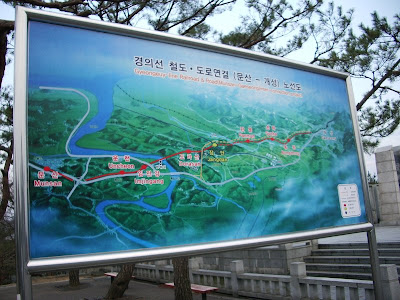 This diagram shows the transportation links from Munsan to Kaesong. The border is in dark blue, and kind of hard to see. The red is the railroad restoration, which is now complete (in fact, a South Korean passenger train went to Kaesong last year, and freight trains continue to make the run daily). The dots along the line indicate the reopened railroad stations, except for the yellow dot, which is a station right on the border and therefore will not be reopened. The bold gray line is the old Highway 1 going through Panmunjom; thinner lines also indicate the new road through the industrial park.
 In 2004, Imjingak was quite a sorry building, boasting a utilitarian architecture from the industrial era. Now, it's been completely remodeled. As it's still early, I can't enter any of its spaces and shops, though I'd like to because it's quite chilly right now.
The second floor houses a restaurant offering various dishes native to North Korea. Cold buckwheat noodles (naengmyon) are my favorite.
 The Korean War saw sixteen UN member nations send combat troops to defend South Korea, and their monuments are scattered all over the nation. And I am glad to find this monument, which honors the American troops who fought here. The US led the multinational coalition, and provided (and lost) the most troops. I wished for a continued healthy relationship between the US and South Korea, even though I feel that in the future, it will be more cultural and economic while being less military, and will involve the center and the left of the political spectrum instead of being a puppet project of the far right.
 This is a monument dedicated to an event that few people remember now. In September 1986, as Seoul was gearing up for the Asian Games just a few days away, a terrorist bomb went off at Gimpo Airport, killing six civilians. This monument memorializes the six, and declares that South Korea is dedicated to lasting peace, something no terrorists will ever derail. I don't know who really was behind the bomb, although blaming North Korea was a common practice at the time. North Korea did bomb a Burmese cemetery in 1983 in an attempt to take out South Korea's President scheduled to visit there (he got late and missed the detonation, but his Cabinet was almost wiped out), as well as a Korean Air flight in 1987.
There are lots of other monuments nearby, some from the Cold War/military dictatorship era, some from more modern times. The earlier monuments feature strong anti-Communist, McCarthyist messages that are simply no longer used today.
 Most South Koreans expect an American to have blond hair and blue eyes. But it bears remembering that Americans of all races and ethnicities fought to defend South Korea, and some of those subgroups have their specific memorials here. This memorial lists the names of the Japanese-American soldiers who died in the Korean War. This is important, because it shows that the Japanese-Americans overcame ancestral Japan's historic animosity toward Korea, and fought to their deaths to defend South Korea on behalf of their real home, the US, despite America's own betrayal of the Japanese-Americans through forced internments earlier.
 An American paratrooper division also has this memorial. I love the name - "Rakkasan," which means parachute in Korean.
 This monument marks the railroad termination point. Rail lines were all cut at the DMZ, when the cease-fire was signed on July 27, 1953. According to the monument, it's 444 kilometers to Sinuiju on the Chinese border, 208 kilometers to Pyongyang, 384 kilometers to Hamhung, and 908 kilometers to Najin (now Rason) near the Russian border.
Of course, as I mentioned a few photos ago, the real rail line is behind me, and fully connected to North Korea now. Only the lack of political will prevents actual through train service.
 This is a steam locomotive, a Mika type, that was prevalent on Korean railroads before the cross-border services stopped. The coal carriage toward the back carries the old logo of Korail, used through the 1980s.
 This altar is familiar to me. It is for those who fled North Korea, still have family members there, and unable to visit them (or even communicate with them), want to do some ceremonies here to wish for a day to meet them again. I bowed here too, as I do have some unknown distant relatives in North Korea.
The seven reliefs in the back (the center one is not visible here) showcase scenes from the five provinces of North Korea: North and South Hamgyong, North and South Pyongan, and Hwanghae. At least those are the five that existed before the division, and officially recognized by South Korea's government. In reality, North Korea now has nine provinces: in addition to the two Hamgyongs and the two Pyongans, Hwanghae has been divided into North and South provinces as well, Chagang and Ryanggang have been carved out of the Pyongans and the Hamgyongs, and portions of Gangwon Province do lie in North Korea (Kangwon as romanized by North Korea). North Korea also has a few directly governed cities (chikhalsi) which are equivalent to South Korea's metropolitan cities, and equal to provinces; while the list of such cities vary, currently they include Pyongyang and Rason, with Namp'o and Kaesong having formerly been on the list as well.
Another major North Korean geographical tendency, while at it, is naming places after key people, which is new, as Koreans traditionally rarely, if ever, name places after people. Ryanggang Province has counties that now bear the names of Kim Il-sung's parents, at the orders of Kim himself. In North Hamgyong, the port city of Songjin was renamed Kimchaek, after Kim Chaek, a People's Army general who died in the Korean War. An engineering school in Pyongyang was also named after him.
 And sure enough, a commuter-class trainset from Seoul heads north, presumably for Dorasan Station, South Korea's last stop on this line, just a mile or two away to the north. This train is empty, however, and destination signs on it say that its official termination point is right here, at Imjin River.
 Imjin River station. It's 52 km from Seoul and another 209 km to Pyongyang. Seriously, when will through train service ever start?
 For now, any travel beyond this stop involves some paperwork, as it involves entering the restricted area. The office on the right provides the necessary forms. I need to fill it out with my name, national ID or passport number, and contact information, and return it along with a ticket to Dorasan Station. Afterwards, I can take a Dorasan-bound train, which runs once a day, and tour the station. It's also possible to hop onto a tourist coach at Dorasan Station, and visit some nearby sights, including a North Korean infiltration tunnel.
Honestly, I am not in a hurry to visit Dorasan Station. After W visited there in 2002, it's just not appetizing at all. In fact, I do believe that the station has many exhibits covering W's "historic" presence there.
 I got back on the Freedom Highway, and drove back south. This section of Freedom Highway ranges from four to eight lanes, and has very light traffic; it still lives up to its reputation as the Korean Autobahn, as the speed limit may only be 90 km/h but many people push well beyond 130. The four-lane sections are being widened to eight lanes; hopefully there will be enough inter-Korean traffic in the near future to actually make use of the extra width. It'd be wonderful if North Korea opens up, and South Koreans drive to Kaesong for day trips and Pyongyang for overnight trips. It'd be even more wonderful if North Korea's economy picks up, and North Korean masses can buy their own cars and drive south to Seoul.
I am back in Paju. It's still early, so I am wandering around town. Paju has an English Village, a setting which is intended to offer an immersive English-speaking experience, in a setting similar to a village in England. Most signs show English first, and some do not show any Korean at all. The village is closed today for Monday, but I'd love to check it out in the future - if only to offer a chance for the Korean locals to practice their English skills. Admission is free after 6PM.
The entrance to the English Village has this wonderful (if less than authentic) rendition of Stonehenge. As I prepare to turn in my rental car and put an end to my South Korean automotive odyssey, I love to keep getting reminders of my only other Old World road trip, which ended at Stonehenge ten years ago.
 It's now 9AM. Odusan Unification Observatory, near the English Village, has opened, and now I am hiking up a gentle but lengthy trail to the observatory, after paying 2,000 won to park at a nearby drive-in cinema.
The above view shows the eight-lane Freedom Highway stretching north. To the left of it, along the river shore, can be seen some fencing and military installations.
 This relief map shows the geography of the area. I am at the observatory, which is located on a hill at the end of the blue arrow.
From the lower right, Han River flows from Seoul. From the upper right, Imjin River comes in. The two merge here and flow left to the Yellow Sea.
The bottom left landmass is the city of Gimpo, South Korea. The right landmass is, again, my observatory, part of the city of Paju, South Korea. The upper landmass is part of Kaepung County, North Hwanghae Province, North Korea. The closest point, Maegol Village at the end of the red arrow, is just a two-mile swim away from me.
 And that's the great view of Maegol Village that I am getting. So close, yet so far.
This is a sizable village, and one of many border villages that North Korea maintains for propaganda value. And while the vast majority of the border villages are empty, this one actually is believed to be inhabited. It features some infrastructure, from schools to a Kim Il-sung paraphernalia museum. On a good day, it's even possible to see farmers and children out and about, nearby signs tell me, if I use this observatory's high-powered telescopes.
As I walked around the observatory, I could see some South Korean schoolchildren's poems. One of them in particular lingered in my mind; a boy was looking forward to playing some games with his future northern friends, and taking a train trip to Kaesong, Pyongyang, Mt. Paektu, China, and the rest of the world. I share his sentiment.
 The observatory has an excellent museum of North Korea-related items. In fact, I think I learned more about North Korea here than by taking an actual tour into North Korea, which currently does not allow me to get an idea of North Korean life at all, much less interact with locals.
The above is an agreement, dated to February 19, 1992, in which both Koreas agreed in principle to non-aggression and cooperation. It's not a treaty, however, so it's largely symbolic. A real peace treaty is still sorely needed.
 Here is another agreement. It was signed on October 4, 2007 in Pyongyang, by President Roh Moo-hyun on behalf of South Korea and Kim Jong-il on behalf of North Korea. This is a North Korean document in its font, spelling, and conventions; however, it uses the terms "South-North," "Republic of Korea," and the southern spelling of Roh's name, to reflect southern conventions and the inter-Korean spirit.
 This August 5, 2007 agreement set up the details of President Roh's Pyongyang visit in October 2007. It's in two identical documents. The left document is done using South Korean conventions. The right document is identical but uses North Korean conventions. Both documents, however, use official titles of both the signatory officials and the two Korean governments.
The agreement is interesting as it states the proposed dates of Roh's Pyongyang visit as August 28th through 30th, 2007. However, North Korea suffered a serious flood shortly thereafter, and Kim Jong-il unilaterally re-scheduled the summit for October 2nd through 4th. Reports do say that damages were still evident in early October, and that the Pyongbu Expressway (its South Korean name is the Kaesong-Pyongyang Expressway, and the mutually agreed neutral name is the West Coast Expressway) wasn't in the greatest of shapes; Kim Jong-il was heard apologizing for the latter to Roh.
 This is the most important of them all. This is a South Korean document which spells out the June 15, 2000 joint declaration between the two Koreas. This was the culmination of President Kim Dae-jung's three-day visit to Pyongyang. Kim Dae-jung and Kim Jong-il both signed this document.
 Another exhibit area shows various products being manufactured at Kaesong Industrial Park. Most of its tenants are small South Korean businesses drawn by Kaesong's cheap labor costs. However, it looks like the neoliberal Samsung empire also takes advantage of Kaesong labor. These are Samsung radios and telephones made in Kaesong.
South Korea would love to sell some of these products in the US, and pushed for that provision when it negotiated its free trade agreement with the US. But it didn't make it in. The US considers Kaesong products to be North Korean, and therefore subject to embargoes.
 This display details the legal procedure for South Korean nationals visiting North Korea. Namely, approval must be granted from both Koreas, and an invitation must formally be issued. Normally, South Koreans, visiting Kaesong and the Diamond Mountains on a tour operated by the Hyundai Asan Group, have all of these taken care of as part of their tour application; however, a 14-day advance reservation is required to allow for processing and approval.
Americans are normally not allowed in North Korea, but if they wish to take a Hyundai Asan tour, the same South Korean rules apply.
Most other nationalities can take the Hyundai Asan tours themselves, or fly directly to Pyongyang from another country and tour other parts of North Korea - though under strict control of the government guides.
 North Korean political/military badges. Quite a sight - especially the center image of Kim Il-sung. The lower left red flag pins are reserved strictly for the Communist Party elites.
 National ID cards for North Koreans. These are samples of the new 2004 issue. The redesign is to put those who illegally fled the country at a disadvantage.
Three IDs exist, as follows:
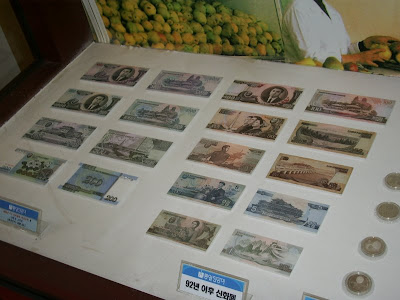 A very nice selection of North Korean banknotes, all issued since 1992.
The left column showcases high-denomination banknotes. They became necessary because the North Korean won has been severely devalued. The official exchange rate used to be pegged at 2.16 won to a US dollar, to mark Kim Jong-il's birthday (February 16), but it's now 153 won to a US dollar, reflecting reality. Nevertheless, black market rates may be much worse, to a point where the North Korean won may be worth even less than the South Korean won, which currently has dropped to 1,500 won to a US dollar. As North Korea is forced to adopt some aspects of the market economy in desperation, food rations are getting expensive and smaller (partly because there is no food to go around at any price), and staying fed can be anywhere from excruciatingly difficult to downright impossible.
The bottom right banknote is a 1-won example. It features a girl selling flowers. It is based on the story of a real Japanese colonial era girl who was forced to make a living selling flowers, when a vicious landlord took away her parents' livelihoods. However, in North Korea, the story takes a twist as a popular "revolutionary drama," as she joins her returning older brother in a fight for Communist revolution. Her story is a very popular revolutionary drama now.
 More exhibits. The top has a boarding pass and a paper ticket from Air Koryo, North Korea's government-owned civilian airline. The middle left shows commemorative coins. The middle right are normal coins in circulation. The bottom pieces of papers are tickets: bus ticket on left, train ticket on right.
 Some North Korean fashion. The left shows a skirt suit. The middle, a shortened traditional dress, is a college women's uniform. The right, another shortened traditional dress, is a cocktail dress. In between the three female mannequins can be seen two jackets from schoolgirl uniforms. Along the bottom are underwear and lingerie items. The far right is a male labor uniform.
 North Korean beverages. The left shows me that even in North Korea, I can drink cola - though it certainly won't be Coke or Pepsi due to the US embargo. Its brand is Ryongsong, after a Pyongyang district. The middle is a can of Kumgang Beer, named after the Diamond Mountains. The right is a bottle of Ryongsong Beer.
 North Korean school supplies, including pencils, crayons, textbooks, and backpacks.
Due to a shortage of paper and shrinking budgets, North Korean textbooks tend to be printed in small fonts on low-quality paper, with very few photographs and pictures, and little to no color. Even then, two students normally must share a textbook. When it comes to textbooks covering the life and ideology of Kim Il-sung, Kim Jong-il, and their family members, however, the textbooks use high-quality paper, bigger fonts, and lots of colorful visual aids. In addition, the names of Kim Il-sung, Kim Jong-il, and their family members must always be written in boldface.
 Some current North Korean magazines. It's possible for me to actually go to a reading room and read them. However, I must show an ID and have my visit logged.
 And for the first time ever, I get to read an issue of Rodong Shinmun, the official propaganda newspaper of the Korean Workers' Party. The slogans next to the title are striking; the left one extols Kim Il-sung and his self-reliance ideology, while the right one praises Kim Jong-il and his directives.
This is the November 2, 2008 issue. It says that Comrade Kim Jong-il ("Supreme Commander of the Korean People's Army") spent time watching a soccer game.
 Here's another issue of Rodong Shinmum, dating from October 3, 2007. It says that the Great Director, Comrade Kim Jong-il, greeted President Roh Moo-hyun as he arrived in Pyongyang. It's noticeable that while Roh gets to be referred by his official title as the President, he's left at just that - President. Not the President of the Republic of Korea, not the President of South Korea, not the President of the Southern Half of the Fatherland, or whatever.
Nearby, there was a TV monitor showing some North Korean TV. I was not allowed to photograph the screen, however. I was informed that it's pre-recorded TV, edited by authorities to cut out blatant ideological propaganda and anti-South Korean rants. I was able to watch a historical drama in progress.
Another exhibit board nearby detailed the features of Pyongyang's subway system, the only one of its kind in North Korea. To guard against nuclear radiation, the stations come with thick steel doors. They are also dug very deep in order to serve as bomb shelters. And there is no heating or air conditioning. And of course, I've already known that the Pyongyang Metro is the only subway system in the world that names its stations after ideological concepts (Glory, Revolution, Red Star, whatever) rather than geography. Pyongyang Metro opened in 1973 as Korea's first subway system, ahead of Seoul Subway in 1974, allowing North Korea to claim a short-lived victory in the Cold War rat race; however, it remains at two very short lines, with no expansion since 1987, and its current primary purpose is little more than a tourist trap for foreign visitors.
 If I walk into a South Korean bookstore and ask for a map of Korea, I'll get something like this. The entire Korean peninsula will be referred to by South Korea's official title - Republic of Korea. However, the administrative divisions will show current boundaries for both Koreas. The inset shows the 1944 provincial boundaries for North Korea - the only boundaries officially recognized by South Korea's government.
 Some North Korean cigarettes. The labels are quite predictable: Hana (One, as in one Korea), Pyongyang, Yonggwang (Glory), Pulgunbyol (Red Star), and Haegumgang (Maritime Diamond Mountains). The lower left is named Cheomseongdae, however, even though Cheomseongdae is located in Gyeongju, in the far southeast of South Korea, and having never fallen under Communist control.
 Now, it's time for me to become a North Korean elementary student. I have entered a typical classroom. In the back of the room, I can see this poster, which asks me to be at the ready at all times, in order to become a trustworthy member of a great Communist society. This poster is not real, but a reproduction by former North Koreans who have defected south. Flanking it are notebook pages from North Korean students; due to paper shortages, North Korean students tend to use one notebook for all subjects.
 Of course, it can never be a North Korean classroom without portraits of Kim Il-sung and Kim Jong-il. Of course, I am also expected to always refer to Kim Il-sung as the "Great Leader" and the "Eternal President," and Kim Jong-il as the "Dear Leader" and the "General." I must also write their names in bold.
Never mind that Kim Jong-il never served in the military, and certainly doesn't deserve the label "General."
I am reminded, at this point, that my grandmother, whose grave I had just visited a few hours before, was from the Jeonju Kim clan - the same clan that these bastards hail from. I see some family resemblance, certainly. Evil as these bastards are, they are my distant relatives, and I won't deny that - even though due to my family's properties, they forced my family to either flee or die. We chose to flee south, and I am glad that we did.
 The classroom has this calendar. And even though it looks too nice to be North Korean, it really is North Korean. I flipped to the December page to be sure. The only holiday on it is the 27th, which is Constitution Day in North Korea. I normally expect the December holiday to be the 25th - Christmas, which is a holiday in South Korea as well as back in the US.
 It's time to actually study. The subject is Korean, and here is a second grade textbook, a 2002 issue obtained and reproduced in 2005.
The lesson for today (right page): something that happened in South Korea. A young second grader, just like myself, is in trouble for his parents' failure to pay monthly school tuition. Even though the student begs the principal for mercy due to the financial difficulties of the family, the principal won't budge; he asks a lowly scum like him to leave class immediately. The moral of the story: in capitalist South Korea, money trumps everything - even your right to have an education.
Of course, this is propaganda. In the real South Korea, elementary school is compulsory and free. And even when it's time to pay tuition, economic hardships can be accommodated in some form in almost all cases.
In North Korea, education funding is a severe problem. Most schools are left to fend for themselves when it comes to supplying essentials, like desks and chairs. The central government does supply some equipment, like pencils and notebooks, but they are of such low quality as to be utterly worthless. Bribery is often expected when it comes to a student's future prospects for college and beyond.
 Boys everywhere in the world (maybe except the US) love soccer. North Korean boys are no exception. However, soccer terminology in North Korea differs significantly. The South Korean terminology (in blue) uses standard international vocabulary, mostly in English, but the North Korean terminology (in red) is all translated into awkward Korean, and even in cases where both Koreas use Korean words for a soccer concept, the terminologies still differ.
This list is set up so that one day, children from both sides can play a soccer game together - and hopefully figure out how to communicate while at it.
Other displays elsewhere in the classroom show differences in country names, as used in the two Koreas. For example, South Korea uses Poland, an English label, while North Korea uses Polska, the Polish native label.
A few more captions also state that schoolchildren outside Pyongyang are sometimes known to whine, saying "Are Pyongyang residents the only humans in our country?" Residency in Pyongyang, the capital, is a privilege reserved strictly for the party elites, and schoolchildren in Pyongyang are often invited to cultural events, recreational activities, and other opportunities that are simply never given to students from elsewhere.
 Here's a reproduction of a typical North Korean living room, showcasing objects used by several different social classes. The television set is supposed to show live footage from Kaesong TV, but it's off for now.
Of course, on the right wall (not pictured), there are Kim Il-sung and Kim Jong-il portraits, as required by law. The posters and the calendars are from this year (2008, or Juche 97 in North Korean calendar, which starts with 1912, the birth year of Kim Il-sung, as Juche (self-reliance) 1).
In North Korea, all housing is government-owned, and rented to the residents. There are a variety of housing types, from single-family rural homes to urban high-rises to everything in between. Housing shortage is severe, however, and many families end up sharing a crowded housing unit. In some cases, illegal black markets even exist for desirable housing.
 It was very nice to get a very good look at North Korean everyday life. Very interesting due to the differences, and very poignant due to some continuing similarities between the two Korean societies, but certainly very sad due to the all-pervasive personality cult and the propaganda.
Now, it's time for me to leave a message for posterity, in a back room. Above, then-President Elect Kim Dae-jung left a message of hope in late 1997. I can leave a message of my own, to be placed in a time capsule and opened ten years after Korea is reunified.
I left a message, in both Korean and English, along the lines of below. I also made sure to identify my parents as former North Koreans who fled south during the war - and put down their hometowns under the current North Korean administrative labels. (I also made sure to identify myself as an American.)
Korea must be reunified. If not, at least the spirit of co-operation must continue and expand. I've driven a car across this beautiful land for the past week, and it saddens me to know that even though I can drive close to Kaesong and the Diamond Mountains, I can never actually drive to either place. The next time I drive, I want to continue on to those places, and on to Pyongyang and my parents' hometowns. I look forward to a post-Kim Jong-il era in North Korea, which will arrive before we know it, where the regime respects its people and works willingly for co-operation with South Korea for a brighter future.
 I have come outside to proceed to the basement gift shop. Here, I can watch across the Imjin River into North Korean territory again. And I also get to listen to this song, titled Rimjin River. (Rimjin is the North Korean pronunciation of Imjin.)
The song is sung in the voice of a male South Korean, then a female North Korean. There is a saying in Korea - 南男北女 (Southern Men, Northern Women) - which connotes that the men are better in the south, and the women are better in the north. This is always reflected in inter-Korean relations; when two generic people are picked to represent the two Koreas, South Korea always gets a male figure, while North Korea gets a female figure. When the two Koreas field a joint team in international athletic competitions, the flag of unified Korea (a blue Korean peninsula on a white background) is carried by a South Korean man and a North Korean woman.
This transwoman is American by upbringing, but South Korean by birth and North Korean (and indirectly Chinese) by parentage. I guess I'll take the ancestry when it comes to my temperament. More strongly than ever, I feel an obligation to travel to North Korea in the future, when the political atmosphere improves. I must go there and do my part to ensure freedom, peace, and prosperity for both Koreas and the rest of the world. Of course, I voted for Barack Obama as the next President of the United States, and I hope that it is a big first step in making all of this happen.
 To carry this spirit forward, I bought a spoon and chopsticks set made in Kaesong, manufactured by Living Art, the first South Korean company to set up shop there. This set, costing me 24,000 won, is labeled the Unification Set, and its packaging showcases images of five old postage stamps - three South Korean, two North Korean. This photo, and the following photo, were taken at my apartment after my return to Seongnam.
As I purchased this set at the observatory, knowing that Kaesong is only a few more miles to the north as the bird flies, I felt very special.
 The set itself. The spoons and all handles have a map of the unified Korean peninsula. This will surely be something to cherish for a long time, next to my Kwan Yin statue, my Gyeongju souvenirs, and my upcoming Hyundai Genesis. And given that North Korea is kind of PO'd right now, and trying to shut down Kaesong Industrial Park and expel the South Korean managers, this may end up as a historical artifact that I may never get another chance to purchase again. I hope the US Customs won't take it away from me, as it is considered North Korean product under US law and therefore subject to embargo. (Fortunately, the certification label shows only the manufacturer's headquarters address and telephone in Incheon, so I could probably talk my way out.)
North Korea is currently PO'd for two reasons. First, the United Nations has just adopted a new annual resolution for North Korean human rights, and this year, South Korea is a co-sponsor. Second, some former North Koreans who have defected south continue to send balloons north, filled with leaflets critical of the Communist leadership as well as facts on the declining health of Kim Jong-il. North Korea is currently asking South Korea to stop these defectors; South Korea did try to discourage them under the Roh government, and even a more "defector-friendly" 2MB government is asking them to stop as well, but there is no legal basis for South Korea to actually stop them. In the long term, I do see great opportunities for the two Koreas to work together, but for now, things are starting to look really bad, and the border and industrial park closures look like they'll go ahead as planned.
Other news items from South Korea today say that 2MB is still in Peru, wrapping up the latest Asia-Pacific Economic Council (APEC) summit. 2MB just had his final summit with W, before the upcoming Obama takeover; 2MB touted his North Korean policy, to which W responded, "that's why I like you." This makes me puke. The Korean people deserve much better leadership than both their current pathetic excuses of leaders - Kim Jong-il and 2MB. On another report, South Korean college grads get their starting pay at 120% of the prevailing wages, much higher than levels seen in Japan (75%) and the US and the UK (95%); while it is an argument to bring the wages down, it's also an argument that the average South Korean is overworked and underpaid. Union-busting in public schools goes on, while nasty fights loom ahead over the fate of the proposed comprehensive real estate tax repeal that will greatly benefit the rich. Meanwhile, the falling won has caused many importers to cut back/stop Japanese products, as the yen is now twice as expensive as it was a year ago, making Japanese products (anything from household tools to Nissan cars) far less competitive. The economy is tanking, and South Korea needs a strong leader who will revive the economy; 2MB, who would rather spend precious government funds on US politics, is not that leader.
I returned to the Freedom Highway, driving back toward Seoul. It was 11 AM by now, and the rush hour traffic had died down, at least on freeways (tollways remained jammed, however). Upon entering Seoul, the Freedom Highway became Riverside North Expressway (City Route 70), and I continued along it all the way to Yongsan, arriving at the rental car office right on time for the return. Other than for the extra day of rental, I did not get charged for anything weird - like strange new damages (none), refueling charge (tank was full), or extra kilometers (I had unlimited kilometers). Good thing I had unlimited kilometers, as I had driven just a few kilometers shy of 2,600 over nine days - something commonly done in the US, but absolutely unheard of in South Korea.
I'll miss driving around South Korea, but on the other hand, I won't miss Seoul's traffic and manic taxi drivers. I was saddened AND relieved to return to walking around and taking mass transit. My subway fare to Seongnam turned out to be 1,400 won - that's 500-won distance surcharge over the 900-won base fare. At least Seongnam has two decent subway connections to Seoul; the first is SMRT's Line 8, which connects downtown Seongnam to Seoul's Jamsil district, and the second is Korail's Bundang Line, which connects the affluent Bundang Ward to Seoul's Teheran Road business district. The two lines intersect twice in downtown Seongnam, and both lead to the heavily traveled Line 2. Bundang Line also connects to Line 3, while Line 8 hooks up to Line 5. In the future, Bundang Line will extend - north across the river to Wangsimni for even more convenient connections, and south to Suwon for connections to southbound Line 1 and a few future lines.
Now, I need to move on to the next stage of my travels - my first-ever visit to Hong Kong, coming up this weekend.
My initial route across Seoul was identical to yesterday's, with a drive along the Olympic Expressway to its western terminus. There, I crossed Haengju Bridge into Ilsan, and headed for my paternal grandmother's grave. When she was first buried there three decades ago, the drive meant navigating the crooked two-lane main street of Ilsan, then a rural township, before taking a one-lane dirt road for several kilometers into a remote Christian cemetery. In the 1980s, the dirt road was paved. In the 1990s, Ilsan became a ward of the city of Goyang, and underwent massive development, though the street patterns of the older town core remained the same. But now, everything has changed, and I had trouble navigating; the original 2-lane Haengju Bridge was closed off, and after taking a six-lane double bridge across the river, I followed an entirely new network of multi-lane thoroughfares, with no signs and no marks on my paper atlas to guide me. Fortunately, my GPS did show the cemetery, and I came to just outside its front entrance, where I could finally pick up the one-lane road again. The cemetery itself, now located in the neighboring city of Paju, is no longer remote either; it is now surrounded by many residential developments and some workshops.
Even the cemetery looked a bit different this time too. The access road was reconfigured, to squeeze more graves into what used to be the parking spot for my grandmother's grave. But I did manage to find the grave anyway - clearly marked but in need of some TLC. I gave my grandmother the traditional two-and-a-half bow, removed a few shrubs around her, and gave her a brief message. As I never got to even know her (even though I feel that I might just as well be her reincarnation), there wasn't much I could say, certainly no promises of taking her back north. But I may have to do just that anyway; cemetery signs said that in order to prevent the Korean Confucian filial piety from taking up too much land for cemeteries, one can be buried at the cemetery for only 15 years at a time, with 3 contract renewals allowed. This means that after at most 60 years, the body must be dug up, cremated, and re-interred elsewhere. That gives my grandmother less than three decades remaining at the cemetery, and I hope to indeed take her back north when the contract is up. A newer banner at the cemetery also indicated that due to zoning changes in 2007 which ignored input from the cemetery management, the cemetery is unable to accept new graves, and will have to close when all the current corpses are moved out.
In any case, I was glad to be with my grandmother to greet today's sunrise, even though it was cloudy. I then got back on the modern street grid, in order to take northbound Jayuro (Freedom Highway), a wide freeway that is designated as part of Provincial Road 23. As I headed north, I followed the river shore, lined with barbed wire fences and outposts; I could even see North Korean territory right across the water. And signs indeed indicated that I was heading for Panmunjom, the immigration checkpoints, Kaesong, and Pyongyang. (Of course, the signs are using the standard South Korean-style romanization, indicating the place names as Panmunjeom, Gaeseong, and Pyeongyang.) More monuments indicated that the Freedom Highway was leading me into a prosperous, peaceful coexistence of the entire Korean people. I really felt quite emotional as I drove north.
The freeway ended in Munsan. I headed for the pavilion of Imjingak, the northernmost point I can travel to in this area without special permission. I followed the signs - which put me on a bridge taking me straight into the restricted area; fortunately, a legal U-turn allowed me to stop and enter the pavilion.
If I continue north (the bridge is part of National Highway 1), and I hope to make that happen sometime in the future, I have two paths available. The first, following the original Highway 1, goes through Camp Bonifas and Panmunjom before entering Kaesong; it's no longer used, except for Panmunjom tours (which I took in 2004). The second takes an immediate left turn upon entering the restricted area, goes through South Korean immigration at Dorasan Station, then follows a modern four-lane road into Kaesong's new industrial park, where North Korea maintains its immigration checkpoint; I can then continue into Kaesong. North Korea has built the Pyongbu (Pyongyang-Busan) Expressway from Panmunjom through Kaesong to Pyongyang, and I can take that to Pyongyang and well beyond (though not quite all the way to China). The second route was used by South Korea's President last year, and continues to be used by bus day trippers into Kaesong, though North Korea will close the crossing next month.
 This diagram shows the transportation links from Munsan to Kaesong. The border is in dark blue, and kind of hard to see. The red is the railroad restoration, which is now complete (in fact, a South Korean passenger train went to Kaesong last year, and freight trains continue to make the run daily). The dots along the line indicate the reopened railroad stations, except for the yellow dot, which is a station right on the border and therefore will not be reopened. The bold gray line is the old Highway 1 going through Panmunjom; thinner lines also indicate the new road through the industrial park.
 In 2004, Imjingak was quite a sorry building, boasting a utilitarian architecture from the industrial era. Now, it's been completely remodeled. As it's still early, I can't enter any of its spaces and shops, though I'd like to because it's quite chilly right now.
The second floor houses a restaurant offering various dishes native to North Korea. Cold buckwheat noodles (naengmyon) are my favorite.
 The Korean War saw sixteen UN member nations send combat troops to defend South Korea, and their monuments are scattered all over the nation. And I am glad to find this monument, which honors the American troops who fought here. The US led the multinational coalition, and provided (and lost) the most troops. I wished for a continued healthy relationship between the US and South Korea, even though I feel that in the future, it will be more cultural and economic while being less military, and will involve the center and the left of the political spectrum instead of being a puppet project of the far right.
 This is a monument dedicated to an event that few people remember now. In September 1986, as Seoul was gearing up for the Asian Games just a few days away, a terrorist bomb went off at Gimpo Airport, killing six civilians. This monument memorializes the six, and declares that South Korea is dedicated to lasting peace, something no terrorists will ever derail. I don't know who really was behind the bomb, although blaming North Korea was a common practice at the time. North Korea did bomb a Burmese cemetery in 1983 in an attempt to take out South Korea's President scheduled to visit there (he got late and missed the detonation, but his Cabinet was almost wiped out), as well as a Korean Air flight in 1987.
There are lots of other monuments nearby, some from the Cold War/military dictatorship era, some from more modern times. The earlier monuments feature strong anti-Communist, McCarthyist messages that are simply no longer used today.
 Most South Koreans expect an American to have blond hair and blue eyes. But it bears remembering that Americans of all races and ethnicities fought to defend South Korea, and some of those subgroups have their specific memorials here. This memorial lists the names of the Japanese-American soldiers who died in the Korean War. This is important, because it shows that the Japanese-Americans overcame ancestral Japan's historic animosity toward Korea, and fought to their deaths to defend South Korea on behalf of their real home, the US, despite America's own betrayal of the Japanese-Americans through forced internments earlier.
 An American paratrooper division also has this memorial. I love the name - "Rakkasan," which means parachute in Korean.
 This monument marks the railroad termination point. Rail lines were all cut at the DMZ, when the cease-fire was signed on July 27, 1953. According to the monument, it's 444 kilometers to Sinuiju on the Chinese border, 208 kilometers to Pyongyang, 384 kilometers to Hamhung, and 908 kilometers to Najin (now Rason) near the Russian border.
Of course, as I mentioned a few photos ago, the real rail line is behind me, and fully connected to North Korea now. Only the lack of political will prevents actual through train service.
 This is a steam locomotive, a Mika type, that was prevalent on Korean railroads before the cross-border services stopped. The coal carriage toward the back carries the old logo of Korail, used through the 1980s.
 This altar is familiar to me. It is for those who fled North Korea, still have family members there, and unable to visit them (or even communicate with them), want to do some ceremonies here to wish for a day to meet them again. I bowed here too, as I do have some unknown distant relatives in North Korea.
The seven reliefs in the back (the center one is not visible here) showcase scenes from the five provinces of North Korea: North and South Hamgyong, North and South Pyongan, and Hwanghae. At least those are the five that existed before the division, and officially recognized by South Korea's government. In reality, North Korea now has nine provinces: in addition to the two Hamgyongs and the two Pyongans, Hwanghae has been divided into North and South provinces as well, Chagang and Ryanggang have been carved out of the Pyongans and the Hamgyongs, and portions of Gangwon Province do lie in North Korea (Kangwon as romanized by North Korea). North Korea also has a few directly governed cities (chikhalsi) which are equivalent to South Korea's metropolitan cities, and equal to provinces; while the list of such cities vary, currently they include Pyongyang and Rason, with Namp'o and Kaesong having formerly been on the list as well.
Another major North Korean geographical tendency, while at it, is naming places after key people, which is new, as Koreans traditionally rarely, if ever, name places after people. Ryanggang Province has counties that now bear the names of Kim Il-sung's parents, at the orders of Kim himself. In North Hamgyong, the port city of Songjin was renamed Kimchaek, after Kim Chaek, a People's Army general who died in the Korean War. An engineering school in Pyongyang was also named after him.
 And sure enough, a commuter-class trainset from Seoul heads north, presumably for Dorasan Station, South Korea's last stop on this line, just a mile or two away to the north. This train is empty, however, and destination signs on it say that its official termination point is right here, at Imjin River.
 Imjin River station. It's 52 km from Seoul and another 209 km to Pyongyang. Seriously, when will through train service ever start?
 For now, any travel beyond this stop involves some paperwork, as it involves entering the restricted area. The office on the right provides the necessary forms. I need to fill it out with my name, national ID or passport number, and contact information, and return it along with a ticket to Dorasan Station. Afterwards, I can take a Dorasan-bound train, which runs once a day, and tour the station. It's also possible to hop onto a tourist coach at Dorasan Station, and visit some nearby sights, including a North Korean infiltration tunnel.
Honestly, I am not in a hurry to visit Dorasan Station. After W visited there in 2002, it's just not appetizing at all. In fact, I do believe that the station has many exhibits covering W's "historic" presence there.
 I got back on the Freedom Highway, and drove back south. This section of Freedom Highway ranges from four to eight lanes, and has very light traffic; it still lives up to its reputation as the Korean Autobahn, as the speed limit may only be 90 km/h but many people push well beyond 130. The four-lane sections are being widened to eight lanes; hopefully there will be enough inter-Korean traffic in the near future to actually make use of the extra width. It'd be wonderful if North Korea opens up, and South Koreans drive to Kaesong for day trips and Pyongyang for overnight trips. It'd be even more wonderful if North Korea's economy picks up, and North Korean masses can buy their own cars and drive south to Seoul.
I am back in Paju. It's still early, so I am wandering around town. Paju has an English Village, a setting which is intended to offer an immersive English-speaking experience, in a setting similar to a village in England. Most signs show English first, and some do not show any Korean at all. The village is closed today for Monday, but I'd love to check it out in the future - if only to offer a chance for the Korean locals to practice their English skills. Admission is free after 6PM.
The entrance to the English Village has this wonderful (if less than authentic) rendition of Stonehenge. As I prepare to turn in my rental car and put an end to my South Korean automotive odyssey, I love to keep getting reminders of my only other Old World road trip, which ended at Stonehenge ten years ago.
 It's now 9AM. Odusan Unification Observatory, near the English Village, has opened, and now I am hiking up a gentle but lengthy trail to the observatory, after paying 2,000 won to park at a nearby drive-in cinema.
The above view shows the eight-lane Freedom Highway stretching north. To the left of it, along the river shore, can be seen some fencing and military installations.
 This relief map shows the geography of the area. I am at the observatory, which is located on a hill at the end of the blue arrow.
From the lower right, Han River flows from Seoul. From the upper right, Imjin River comes in. The two merge here and flow left to the Yellow Sea.
The bottom left landmass is the city of Gimpo, South Korea. The right landmass is, again, my observatory, part of the city of Paju, South Korea. The upper landmass is part of Kaepung County, North Hwanghae Province, North Korea. The closest point, Maegol Village at the end of the red arrow, is just a two-mile swim away from me.
 And that's the great view of Maegol Village that I am getting. So close, yet so far.
This is a sizable village, and one of many border villages that North Korea maintains for propaganda value. And while the vast majority of the border villages are empty, this one actually is believed to be inhabited. It features some infrastructure, from schools to a Kim Il-sung paraphernalia museum. On a good day, it's even possible to see farmers and children out and about, nearby signs tell me, if I use this observatory's high-powered telescopes.
As I walked around the observatory, I could see some South Korean schoolchildren's poems. One of them in particular lingered in my mind; a boy was looking forward to playing some games with his future northern friends, and taking a train trip to Kaesong, Pyongyang, Mt. Paektu, China, and the rest of the world. I share his sentiment.
 The observatory has an excellent museum of North Korea-related items. In fact, I think I learned more about North Korea here than by taking an actual tour into North Korea, which currently does not allow me to get an idea of North Korean life at all, much less interact with locals.
The above is an agreement, dated to February 19, 1992, in which both Koreas agreed in principle to non-aggression and cooperation. It's not a treaty, however, so it's largely symbolic. A real peace treaty is still sorely needed.
 Here is another agreement. It was signed on October 4, 2007 in Pyongyang, by President Roh Moo-hyun on behalf of South Korea and Kim Jong-il on behalf of North Korea. This is a North Korean document in its font, spelling, and conventions; however, it uses the terms "South-North," "Republic of Korea," and the southern spelling of Roh's name, to reflect southern conventions and the inter-Korean spirit.
 This August 5, 2007 agreement set up the details of President Roh's Pyongyang visit in October 2007. It's in two identical documents. The left document is done using South Korean conventions. The right document is identical but uses North Korean conventions. Both documents, however, use official titles of both the signatory officials and the two Korean governments.
The agreement is interesting as it states the proposed dates of Roh's Pyongyang visit as August 28th through 30th, 2007. However, North Korea suffered a serious flood shortly thereafter, and Kim Jong-il unilaterally re-scheduled the summit for October 2nd through 4th. Reports do say that damages were still evident in early October, and that the Pyongbu Expressway (its South Korean name is the Kaesong-Pyongyang Expressway, and the mutually agreed neutral name is the West Coast Expressway) wasn't in the greatest of shapes; Kim Jong-il was heard apologizing for the latter to Roh.
 This is the most important of them all. This is a South Korean document which spells out the June 15, 2000 joint declaration between the two Koreas. This was the culmination of President Kim Dae-jung's three-day visit to Pyongyang. Kim Dae-jung and Kim Jong-il both signed this document.
 Another exhibit area shows various products being manufactured at Kaesong Industrial Park. Most of its tenants are small South Korean businesses drawn by Kaesong's cheap labor costs. However, it looks like the neoliberal Samsung empire also takes advantage of Kaesong labor. These are Samsung radios and telephones made in Kaesong.
South Korea would love to sell some of these products in the US, and pushed for that provision when it negotiated its free trade agreement with the US. But it didn't make it in. The US considers Kaesong products to be North Korean, and therefore subject to embargoes.
 This display details the legal procedure for South Korean nationals visiting North Korea. Namely, approval must be granted from both Koreas, and an invitation must formally be issued. Normally, South Koreans, visiting Kaesong and the Diamond Mountains on a tour operated by the Hyundai Asan Group, have all of these taken care of as part of their tour application; however, a 14-day advance reservation is required to allow for processing and approval.
Americans are normally not allowed in North Korea, but if they wish to take a Hyundai Asan tour, the same South Korean rules apply.
Most other nationalities can take the Hyundai Asan tours themselves, or fly directly to Pyongyang from another country and tour other parts of North Korea - though under strict control of the government guides.
 North Korean political/military badges. Quite a sight - especially the center image of Kim Il-sung. The lower left red flag pins are reserved strictly for the Communist Party elites.
 National ID cards for North Koreans. These are samples of the new 2004 issue. The redesign is to put those who illegally fled the country at a disadvantage.
Three IDs exist, as follows:
- Citizen card (시민증), for Pyongyang citizens (AKA privileged elites)
- Public card (공민증), for non-Pyongyang citizens (shown above)
- Foreigner card (외국인증), for ethnic Koreans from China or Japan, and for foreigners
 A very nice selection of North Korean banknotes, all issued since 1992.
The left column showcases high-denomination banknotes. They became necessary because the North Korean won has been severely devalued. The official exchange rate used to be pegged at 2.16 won to a US dollar, to mark Kim Jong-il's birthday (February 16), but it's now 153 won to a US dollar, reflecting reality. Nevertheless, black market rates may be much worse, to a point where the North Korean won may be worth even less than the South Korean won, which currently has dropped to 1,500 won to a US dollar. As North Korea is forced to adopt some aspects of the market economy in desperation, food rations are getting expensive and smaller (partly because there is no food to go around at any price), and staying fed can be anywhere from excruciatingly difficult to downright impossible.
The bottom right banknote is a 1-won example. It features a girl selling flowers. It is based on the story of a real Japanese colonial era girl who was forced to make a living selling flowers, when a vicious landlord took away her parents' livelihoods. However, in North Korea, the story takes a twist as a popular "revolutionary drama," as she joins her returning older brother in a fight for Communist revolution. Her story is a very popular revolutionary drama now.
 More exhibits. The top has a boarding pass and a paper ticket from Air Koryo, North Korea's government-owned civilian airline. The middle left shows commemorative coins. The middle right are normal coins in circulation. The bottom pieces of papers are tickets: bus ticket on left, train ticket on right.
 Some North Korean fashion. The left shows a skirt suit. The middle, a shortened traditional dress, is a college women's uniform. The right, another shortened traditional dress, is a cocktail dress. In between the three female mannequins can be seen two jackets from schoolgirl uniforms. Along the bottom are underwear and lingerie items. The far right is a male labor uniform.
 North Korean beverages. The left shows me that even in North Korea, I can drink cola - though it certainly won't be Coke or Pepsi due to the US embargo. Its brand is Ryongsong, after a Pyongyang district. The middle is a can of Kumgang Beer, named after the Diamond Mountains. The right is a bottle of Ryongsong Beer.
 North Korean school supplies, including pencils, crayons, textbooks, and backpacks.
Due to a shortage of paper and shrinking budgets, North Korean textbooks tend to be printed in small fonts on low-quality paper, with very few photographs and pictures, and little to no color. Even then, two students normally must share a textbook. When it comes to textbooks covering the life and ideology of Kim Il-sung, Kim Jong-il, and their family members, however, the textbooks use high-quality paper, bigger fonts, and lots of colorful visual aids. In addition, the names of Kim Il-sung, Kim Jong-il, and their family members must always be written in boldface.
 Some current North Korean magazines. It's possible for me to actually go to a reading room and read them. However, I must show an ID and have my visit logged.
 And for the first time ever, I get to read an issue of Rodong Shinmun, the official propaganda newspaper of the Korean Workers' Party. The slogans next to the title are striking; the left one extols Kim Il-sung and his self-reliance ideology, while the right one praises Kim Jong-il and his directives.
This is the November 2, 2008 issue. It says that Comrade Kim Jong-il ("Supreme Commander of the Korean People's Army") spent time watching a soccer game.
 Here's another issue of Rodong Shinmum, dating from October 3, 2007. It says that the Great Director, Comrade Kim Jong-il, greeted President Roh Moo-hyun as he arrived in Pyongyang. It's noticeable that while Roh gets to be referred by his official title as the President, he's left at just that - President. Not the President of the Republic of Korea, not the President of South Korea, not the President of the Southern Half of the Fatherland, or whatever.
Nearby, there was a TV monitor showing some North Korean TV. I was not allowed to photograph the screen, however. I was informed that it's pre-recorded TV, edited by authorities to cut out blatant ideological propaganda and anti-South Korean rants. I was able to watch a historical drama in progress.
Another exhibit board nearby detailed the features of Pyongyang's subway system, the only one of its kind in North Korea. To guard against nuclear radiation, the stations come with thick steel doors. They are also dug very deep in order to serve as bomb shelters. And there is no heating or air conditioning. And of course, I've already known that the Pyongyang Metro is the only subway system in the world that names its stations after ideological concepts (Glory, Revolution, Red Star, whatever) rather than geography. Pyongyang Metro opened in 1973 as Korea's first subway system, ahead of Seoul Subway in 1974, allowing North Korea to claim a short-lived victory in the Cold War rat race; however, it remains at two very short lines, with no expansion since 1987, and its current primary purpose is little more than a tourist trap for foreign visitors.
 If I walk into a South Korean bookstore and ask for a map of Korea, I'll get something like this. The entire Korean peninsula will be referred to by South Korea's official title - Republic of Korea. However, the administrative divisions will show current boundaries for both Koreas. The inset shows the 1944 provincial boundaries for North Korea - the only boundaries officially recognized by South Korea's government.
 Some North Korean cigarettes. The labels are quite predictable: Hana (One, as in one Korea), Pyongyang, Yonggwang (Glory), Pulgunbyol (Red Star), and Haegumgang (Maritime Diamond Mountains). The lower left is named Cheomseongdae, however, even though Cheomseongdae is located in Gyeongju, in the far southeast of South Korea, and having never fallen under Communist control.
 Now, it's time for me to become a North Korean elementary student. I have entered a typical classroom. In the back of the room, I can see this poster, which asks me to be at the ready at all times, in order to become a trustworthy member of a great Communist society. This poster is not real, but a reproduction by former North Koreans who have defected south. Flanking it are notebook pages from North Korean students; due to paper shortages, North Korean students tend to use one notebook for all subjects.
 Of course, it can never be a North Korean classroom without portraits of Kim Il-sung and Kim Jong-il. Of course, I am also expected to always refer to Kim Il-sung as the "Great Leader" and the "Eternal President," and Kim Jong-il as the "Dear Leader" and the "General." I must also write their names in bold.
Never mind that Kim Jong-il never served in the military, and certainly doesn't deserve the label "General."
I am reminded, at this point, that my grandmother, whose grave I had just visited a few hours before, was from the Jeonju Kim clan - the same clan that these bastards hail from. I see some family resemblance, certainly. Evil as these bastards are, they are my distant relatives, and I won't deny that - even though due to my family's properties, they forced my family to either flee or die. We chose to flee south, and I am glad that we did.
 The classroom has this calendar. And even though it looks too nice to be North Korean, it really is North Korean. I flipped to the December page to be sure. The only holiday on it is the 27th, which is Constitution Day in North Korea. I normally expect the December holiday to be the 25th - Christmas, which is a holiday in South Korea as well as back in the US.
 It's time to actually study. The subject is Korean, and here is a second grade textbook, a 2002 issue obtained and reproduced in 2005.
The lesson for today (right page): something that happened in South Korea. A young second grader, just like myself, is in trouble for his parents' failure to pay monthly school tuition. Even though the student begs the principal for mercy due to the financial difficulties of the family, the principal won't budge; he asks a lowly scum like him to leave class immediately. The moral of the story: in capitalist South Korea, money trumps everything - even your right to have an education.
Of course, this is propaganda. In the real South Korea, elementary school is compulsory and free. And even when it's time to pay tuition, economic hardships can be accommodated in some form in almost all cases.
In North Korea, education funding is a severe problem. Most schools are left to fend for themselves when it comes to supplying essentials, like desks and chairs. The central government does supply some equipment, like pencils and notebooks, but they are of such low quality as to be utterly worthless. Bribery is often expected when it comes to a student's future prospects for college and beyond.
 Boys everywhere in the world (maybe except the US) love soccer. North Korean boys are no exception. However, soccer terminology in North Korea differs significantly. The South Korean terminology (in blue) uses standard international vocabulary, mostly in English, but the North Korean terminology (in red) is all translated into awkward Korean, and even in cases where both Koreas use Korean words for a soccer concept, the terminologies still differ.
This list is set up so that one day, children from both sides can play a soccer game together - and hopefully figure out how to communicate while at it.
Other displays elsewhere in the classroom show differences in country names, as used in the two Koreas. For example, South Korea uses Poland, an English label, while North Korea uses Polska, the Polish native label.
A few more captions also state that schoolchildren outside Pyongyang are sometimes known to whine, saying "Are Pyongyang residents the only humans in our country?" Residency in Pyongyang, the capital, is a privilege reserved strictly for the party elites, and schoolchildren in Pyongyang are often invited to cultural events, recreational activities, and other opportunities that are simply never given to students from elsewhere.
 Here's a reproduction of a typical North Korean living room, showcasing objects used by several different social classes. The television set is supposed to show live footage from Kaesong TV, but it's off for now.
Of course, on the right wall (not pictured), there are Kim Il-sung and Kim Jong-il portraits, as required by law. The posters and the calendars are from this year (2008, or Juche 97 in North Korean calendar, which starts with 1912, the birth year of Kim Il-sung, as Juche (self-reliance) 1).
In North Korea, all housing is government-owned, and rented to the residents. There are a variety of housing types, from single-family rural homes to urban high-rises to everything in between. Housing shortage is severe, however, and many families end up sharing a crowded housing unit. In some cases, illegal black markets even exist for desirable housing.
 It was very nice to get a very good look at North Korean everyday life. Very interesting due to the differences, and very poignant due to some continuing similarities between the two Korean societies, but certainly very sad due to the all-pervasive personality cult and the propaganda.
Now, it's time for me to leave a message for posterity, in a back room. Above, then-President Elect Kim Dae-jung left a message of hope in late 1997. I can leave a message of my own, to be placed in a time capsule and opened ten years after Korea is reunified.
I left a message, in both Korean and English, along the lines of below. I also made sure to identify my parents as former North Koreans who fled south during the war - and put down their hometowns under the current North Korean administrative labels. (I also made sure to identify myself as an American.)
Korea must be reunified. If not, at least the spirit of co-operation must continue and expand. I've driven a car across this beautiful land for the past week, and it saddens me to know that even though I can drive close to Kaesong and the Diamond Mountains, I can never actually drive to either place. The next time I drive, I want to continue on to those places, and on to Pyongyang and my parents' hometowns. I look forward to a post-Kim Jong-il era in North Korea, which will arrive before we know it, where the regime respects its people and works willingly for co-operation with South Korea for a brighter future.
 I have come outside to proceed to the basement gift shop. Here, I can watch across the Imjin River into North Korean territory again. And I also get to listen to this song, titled Rimjin River. (Rimjin is the North Korean pronunciation of Imjin.)
The song is sung in the voice of a male South Korean, then a female North Korean. There is a saying in Korea - 南男北女 (Southern Men, Northern Women) - which connotes that the men are better in the south, and the women are better in the north. This is always reflected in inter-Korean relations; when two generic people are picked to represent the two Koreas, South Korea always gets a male figure, while North Korea gets a female figure. When the two Koreas field a joint team in international athletic competitions, the flag of unified Korea (a blue Korean peninsula on a white background) is carried by a South Korean man and a North Korean woman.
This transwoman is American by upbringing, but South Korean by birth and North Korean (and indirectly Chinese) by parentage. I guess I'll take the ancestry when it comes to my temperament. More strongly than ever, I feel an obligation to travel to North Korea in the future, when the political atmosphere improves. I must go there and do my part to ensure freedom, peace, and prosperity for both Koreas and the rest of the world. Of course, I voted for Barack Obama as the next President of the United States, and I hope that it is a big first step in making all of this happen.
 To carry this spirit forward, I bought a spoon and chopsticks set made in Kaesong, manufactured by Living Art, the first South Korean company to set up shop there. This set, costing me 24,000 won, is labeled the Unification Set, and its packaging showcases images of five old postage stamps - three South Korean, two North Korean. This photo, and the following photo, were taken at my apartment after my return to Seongnam.
As I purchased this set at the observatory, knowing that Kaesong is only a few more miles to the north as the bird flies, I felt very special.
 The set itself. The spoons and all handles have a map of the unified Korean peninsula. This will surely be something to cherish for a long time, next to my Kwan Yin statue, my Gyeongju souvenirs, and my upcoming Hyundai Genesis. And given that North Korea is kind of PO'd right now, and trying to shut down Kaesong Industrial Park and expel the South Korean managers, this may end up as a historical artifact that I may never get another chance to purchase again. I hope the US Customs won't take it away from me, as it is considered North Korean product under US law and therefore subject to embargo. (Fortunately, the certification label shows only the manufacturer's headquarters address and telephone in Incheon, so I could probably talk my way out.)
North Korea is currently PO'd for two reasons. First, the United Nations has just adopted a new annual resolution for North Korean human rights, and this year, South Korea is a co-sponsor. Second, some former North Koreans who have defected south continue to send balloons north, filled with leaflets critical of the Communist leadership as well as facts on the declining health of Kim Jong-il. North Korea is currently asking South Korea to stop these defectors; South Korea did try to discourage them under the Roh government, and even a more "defector-friendly" 2MB government is asking them to stop as well, but there is no legal basis for South Korea to actually stop them. In the long term, I do see great opportunities for the two Koreas to work together, but for now, things are starting to look really bad, and the border and industrial park closures look like they'll go ahead as planned.
Other news items from South Korea today say that 2MB is still in Peru, wrapping up the latest Asia-Pacific Economic Council (APEC) summit. 2MB just had his final summit with W, before the upcoming Obama takeover; 2MB touted his North Korean policy, to which W responded, "that's why I like you." This makes me puke. The Korean people deserve much better leadership than both their current pathetic excuses of leaders - Kim Jong-il and 2MB. On another report, South Korean college grads get their starting pay at 120% of the prevailing wages, much higher than levels seen in Japan (75%) and the US and the UK (95%); while it is an argument to bring the wages down, it's also an argument that the average South Korean is overworked and underpaid. Union-busting in public schools goes on, while nasty fights loom ahead over the fate of the proposed comprehensive real estate tax repeal that will greatly benefit the rich. Meanwhile, the falling won has caused many importers to cut back/stop Japanese products, as the yen is now twice as expensive as it was a year ago, making Japanese products (anything from household tools to Nissan cars) far less competitive. The economy is tanking, and South Korea needs a strong leader who will revive the economy; 2MB, who would rather spend precious government funds on US politics, is not that leader.
I returned to the Freedom Highway, driving back toward Seoul. It was 11 AM by now, and the rush hour traffic had died down, at least on freeways (tollways remained jammed, however). Upon entering Seoul, the Freedom Highway became Riverside North Expressway (City Route 70), and I continued along it all the way to Yongsan, arriving at the rental car office right on time for the return. Other than for the extra day of rental, I did not get charged for anything weird - like strange new damages (none), refueling charge (tank was full), or extra kilometers (I had unlimited kilometers). Good thing I had unlimited kilometers, as I had driven just a few kilometers shy of 2,600 over nine days - something commonly done in the US, but absolutely unheard of in South Korea.
I'll miss driving around South Korea, but on the other hand, I won't miss Seoul's traffic and manic taxi drivers. I was saddened AND relieved to return to walking around and taking mass transit. My subway fare to Seongnam turned out to be 1,400 won - that's 500-won distance surcharge over the 900-won base fare. At least Seongnam has two decent subway connections to Seoul; the first is SMRT's Line 8, which connects downtown Seongnam to Seoul's Jamsil district, and the second is Korail's Bundang Line, which connects the affluent Bundang Ward to Seoul's Teheran Road business district. The two lines intersect twice in downtown Seongnam, and both lead to the heavily traveled Line 2. Bundang Line also connects to Line 3, while Line 8 hooks up to Line 5. In the future, Bundang Line will extend - north across the river to Wangsimni for even more convenient connections, and south to Suwon for connections to southbound Line 1 and a few future lines.
Now, I need to move on to the next stage of my travels - my first-ever visit to Hong Kong, coming up this weekend.
Subscribe to:
Posts (Atom)
I've been alive and well (at least as well as I could be under the Republican colonial government, anyway) - I've been too busy blogging and driving to ever check in here in the past two weeks.
Yes, I am describing the so-called "Republic of Korea" as a cut-rate US Republican colony. Not even a colony of the United States of America (which won't be too bad, really), but a colony of the discredited minority party. I no longer recognize the sovereignty of the government, and will only see it as the puppet partisan colonial government that it truly is. Similarly, I am referring to all South Koreans as colonial subjects, and myself as the almighty citizen of the American motherland.
The reason why I am making this determination are as follows:
From now on, I'll do the following.
If you are ever headed this way, I must ask you to do the following: