No, I'm not talking about the Sarah Palin "memoir," and I am not turning this blog back to politics just yet (though this post is a bit political in nature).
I'm talking about Facebook, and its CEO Mark Zuckerberg, especially since a lot of people are on Facebook these days - over 400 million worldwide. I myself have relied heavily on Facebook to meet and befriend new people, from progressive activists to members of the LGBT community to Unitarians. Zuckerberg had started Facebook as a way of communicating with his Harvard classmates, but soon it grew beyond collegiate settings and became an easy-to-use, worldwide phenomenon, replacing Rupert Murdoch's MySpace service in the capacity.
But the following articles state that Facebook has betrayed its origins as a service that gave users control over their information, and now is more of a service where users are collecting and involuntarily giving up information to Zuckerberg so that he can sell them off.
Wired
Electronic Frontier Foundation
Facebook uses some form of algorithm, details virtually unknown to the public, to mine data regarding users, so that Zuckerberg can sell ads that target the users by their interests. And based on what I see, Facebook seems to have profiled me to be something similar to Zuckerberg himself - a far-right Republican. Perhaps my profile as a far-right Republican is based on my demographic information (model minority Asian elitist in upper-class Southern California suburb, speaking the most important Republican language - Korean). Zuckerberg would've been right on about me, if I were Christian and heterosexual; sorry, but I'm neither. Facebook is convinced that I am scared of Hillary Clinton scheming with the United Nations to destroy the Second Amendment, and that I would join over a million other Facebook users in praying for the death of President Barack Obama. (The fact that Facebook refuses to remove that Obama death prayer group, in itself, is a good indication of Zuckerberg's far-right leanings, especially considering that Facebook aggressively removes groups that are tongue-in-cheek jokes about Glenn Beck or Sarah Palin.)
The only good thing I see out of this is that just like America Online, Netscape, and MySpace before it, Facebook will eventually be replaced by something even greater and more accountable to the public. Ten years ago, the world couldn't imagine an online world without AOL or Netscape, the way Facebook is so intergral to Internet experience today. Facebook's no-privacy police state will eventually be its own undoing. For many, a much simpler service like Twitter may do - though I find Twitter to be too limited and not to my liking. Eventually as proprietary America Online gave way to public Internet-based discussion boards on common protocols, Facebook should give way to something similar but more public, and that'll be a very good development for the future of the Internet.
Up until now, I've used Facebook to a point where my travel photos go there first before coming here. That will change. I will once again feature my travel photos here, then have my Facebook profile link here. I am cutting down on other Facebook activities, and limiting my activities to discussions, and comments on friends' statuses.
Showing posts with label technology. Show all posts
Showing posts with label technology. Show all posts
10 May 2010
09 February 2010
Europe recap: Day 1, Munich, Part 2
The rest of my Munich experience on 25 October 2009, after wrapping up the Residenz tour... The Residenz was much bigger than I had expected, and due to the Quiet Day Sunday rendering even convenience stores closed, I was growing hungry.
My first goal after the Residenz was to walk over to the three Pinakotheks ("picture galleries") - Alte Pinakothek (pre-1800), Neue Pinakothek (19th Century), and Pinakothek der Moderne (20th Century) - for some art. Sunday admissions was supposed to be only a single Euro anyway, so time to take in some art.
My first goal after the Residenz was to walk over to the three Pinakotheks ("picture galleries") - Alte Pinakothek (pre-1800), Neue Pinakothek (19th Century), and Pinakothek der Moderne (20th Century) - for some art. Sunday admissions was supposed to be only a single Euro anyway, so time to take in some art.
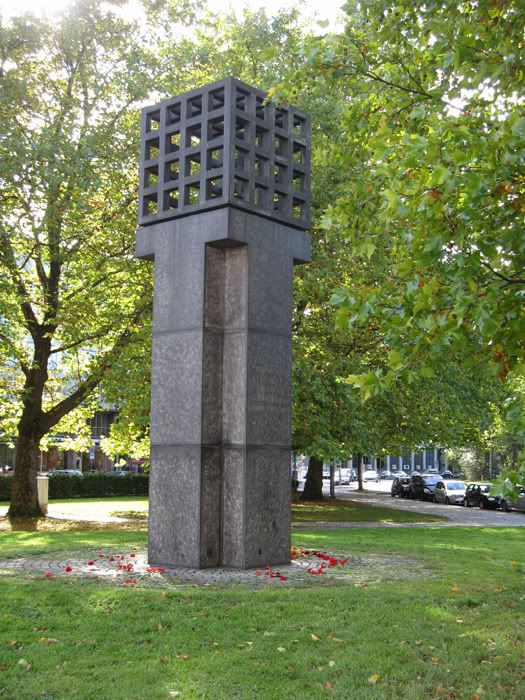
On my way, I came across this plaza with this eternal flame. A nearby sign read Platz der Opfer des Nationalsozialismus, or Place for the Victims of National Socialism. It bore remembering that Bavaria's conservatism played a key part in the formation of the Nazi ideology. Adolf Hitler, though Austrian by birth, started his movement right here in Bavaria, and while the Nazis were fringe extremists at first, Hitler's masterful manipulation of public opinion won him ever more support, until he was the Führer once and for all, and destroyed millions and millions of lives.
While Bavaria remains very conservative, Munich is the liberal hotspot of the region, and I am treasuring its vibrancy. If Bavaria is indeed Texas, then Munich is its Austin. And for that matter, if Bavaria is California (since California is very conservative as well), then Munich is its San Francisco.
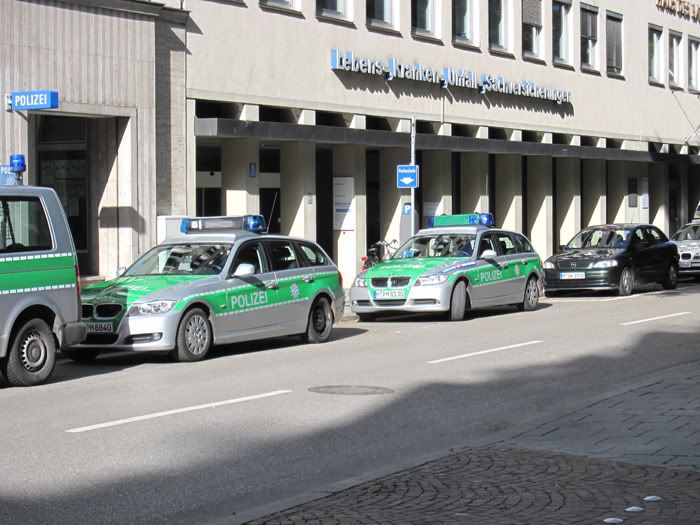
More reminder that I am in Bavaria. Even the police cruisers are made by Bayerische Motorenwerke, better known by its English name Bavarian Motor Works, and shortened to BMW. And sure enough, Munich is BMW's home city.
The BMW emblem, called the Roundel, depicts a spinning aircraft propeller, since BMW's first product line was aircraft engines. And its colors are blue and white - the colors of Bavaria. In fact, the letters BMW officially also stand for Blau mit Weiß, or Blue and White. Driving a BMW is, when it comes down to it, all about the Bavarian pride.
I am once again reminded that for several years, I had dreamed of coming to Munich, to take delivery of a BMW of my own. My original goal, in fact, was to simply terminate the lease on my 2004 325i (fourth generation, codename E46) in early 2007, order a fifth-generation 3-series (E90/91, like the ones above) as a replacement, and come to Munich for the pickup. But eventually, I ended up purchasing the 2004 outright - and selling it in anger over BMW's continued support of far-right causes, including the Pope and Fox News Channel.
And yes, Pope Benedict XVI, a noted homophobic a-hole, is Bavarian, and thanks to BMW's generous corporate sponsorship, hasn't bought a car in decades.
I am glad to finally be in Munich, as a stopover on my way to Stuttgart to pick up a Mercedes-Benz instead. And to keep the Mercedes-Benz theme, I am skipping the BMW Welt next to Olympic Park in the northern reaches of the city. BMW Welt has a museum consisting of vintage BMWs, but very few vintage BMWs are of any interest to me anyway.
Shortly thereafter, I arrived at the Pinakotheks. My intention was to only see the Alte Pinakothek, since it was mid-afternoon already and I wanted to save the greatest artwork for Paris and its Louvre. But with the admission jacked up to €7 for a temporary exhibition I couldn't opt out of, I decided to skip all Pinakotheks. Instead, I decided to hop on the U-Bahn for a quick hop over to Deutsches Museum, Germany's answer to the Smithsonian science museums in Washington, DC and one of the finest science museums in the world.
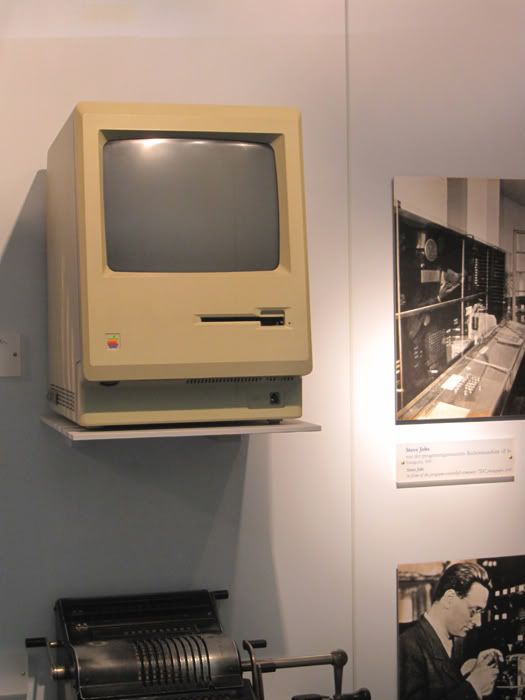
Here is a display I liked - the original Apple Macintosh.
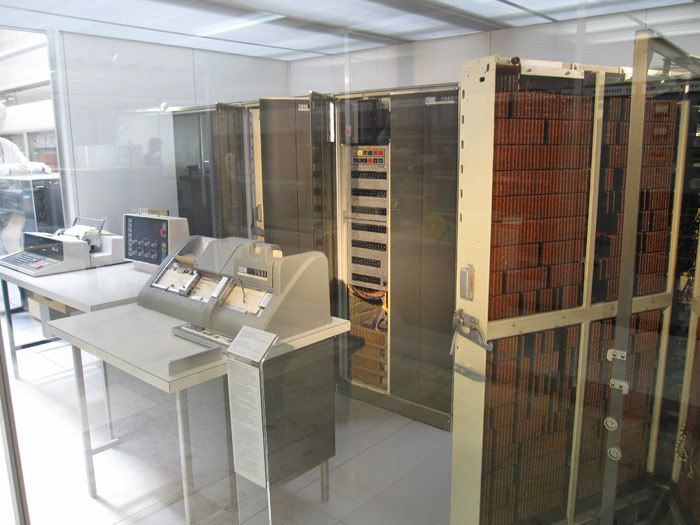
The Deutsches Museum is extremely hardcore. When it comes to computers, I don't just see a Mac - I see a zillion other computers throughout history, all the way back to rudimentary adding machines of the 19th Century. This particular example is an IBM 7074, built in 1962, and used by Allianz. It was state-of-the-art for its day, using punchcards for data input and using something more reliable than vacuum tubes for memory. Even then, its storage capacity was well under a megabyte.
The museum is so hardcore, and covers so many subjects, that trying to cram it into an afternoon, as I tried, is utterly hopeless. I can go from the watermills that powered the Industrial Revolution to a whole catalog of Pratt & Whitney jet engines, and a lot more, even including agricultural technologies. For an engineering enthusiast, this place is pure fantasy.
The museum also runs separate facilities elsewhere in the Munich area to house its land vehicles and aircraft. They will have to wait for a future visit.
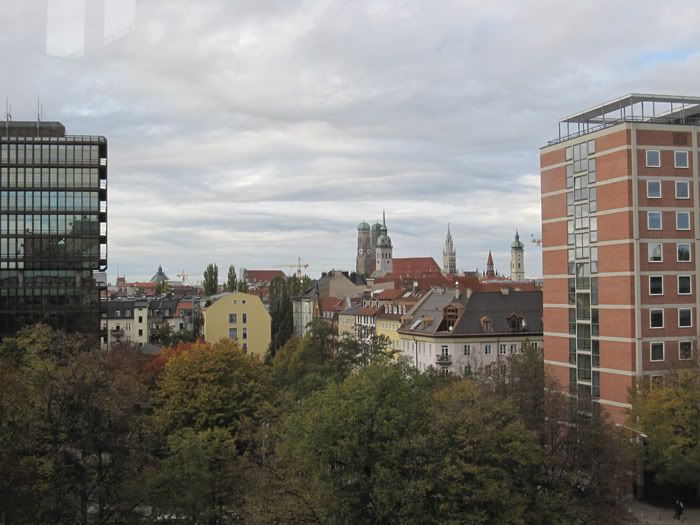
But when it comes down to it, Munich's Old World charms are far important than all the technology and the sights. And I am getting yet another glimpse of the city skyline from one of the Deutsches Museum staircases. I can see the spires of the Frauenkirche and the Neue Rathaus, among other buildings. This is a skyline that I don't get tired of easily.
I had to wind the day down at this point, given the realities of Quiet Day Sunday and also my mother's foot pains. The jet lag was also bugging me, and a bottle of water that I had bought in the U-Bahn turned out to be carbonated water, and not so great tasting. I had to retire, collapse on my hotel bed, and try to figure out a way to overcome the jet lag.
Next up: Monday, October 26th, involving some final moments in Munich before the train run to Stuttgart.

28 September 2009
Facebook poll on Obama assassination
The big news over this past weekend was a poll posted to Facebook via its Polls application. Its question was: "Should Barack Obama be killed?" There were four possible answers: "Yes," "No," "Maybe," and "Yes if he takes away my healthcare."
I was first alerted to this question by a friend, who chose to report it to Facebook for offensive content. I immediately reported for offensive content myself. By Monday, the uproar was so severe, not only over the brazen threat on the President's safety, but also Facebook's inability to respond in a timely manner. Only in the later hours of Monday did Facebook shut down the Polls application, by which time the Secret Service was also involved, and questioning Facebook.
The recent trend, as well demonstrated by the September 12th teabagger rally in Washington DC, is that the prospect of a nonwhite President with a foreign-sounding name is simply too much for the far right to take. They smell blood, between the Obama agenda which is about to start undoing three decades of the Reagan-Bush legacy, and an equally frustrated liberal camp which is fed up at Obama's inability to undo that legacy faster. America is polarized as ever, Obama's leadership can never be decisive enough, and all of a sudden, it's fair game to call for the murder of the President of the United States, which has always been a felony.
I'll gladly agree or disagree with Obama based on his job performance and positions, but I have zero tolerance for those who want to harm him and destroy the American democracy. I also have zero tolerance for the media outlets, such as Fox News, which have served to encourage the teabaggers and validate their lies (i.e. Obama being a Kenyan-born Muslim extremist). I would rather see raucous but healthy debates on the future of the US, on more important issues like healthcare reform, foreign policy, and immigration reform, than waste time dealing with the barbarians who seek not to help, but to destroy.
Facebook's slow response also further confirms my suspicions, that Facebook's management is sympathetic to far-right causes. Facebook considers me, in fact, to be the heartbeat of California's Republican ethnic theocracy, and sends me tons of ads asking me to support the likes of Glenn Beck (who is largely responsible for the rhetoric), Sarah Palin, Rush Limbaugh, and even Joe Wilson (the Congressman who shouted "YOU LIE" to Obama during a congressional speech). Although I have the ability to indicate that I like/dislike individual ads, when it comes to these far-right ads, they only load even more frequently. Many Facebook friends vow to move on to an alternate, more progressive social networking site should one be founded - and I will gladly be joining them.
15 December 2008
Back home for good
It's 3AM at home in Southern California - and I am glad that I'm back home, not just for a few days, but for a while at least.
It was a long day returning to Los Angeles, and not all that pleasant. I had too many souvenirs, and too many gifts that I had to carry from my relatives to my family; the latter is always a headache whenever I fly between the US and South Korea, and I can't stand it anymore. Needless to say, it was a challenge moving around with all my stuff - made even worse by the Korean tendency to cut lines and never queue. I made sure to make some choice comments about those "third-rate colonials."
After breezing through immigration at Incheon, I picked up my new Canon camera (which turned out to be a Japanese-made, Korean-market model, with Korean documentation, but between a multilingual interface and a multivoltage charger with plug adapter, I can use it in the US without a problem), then walked the entire airport concourse - at least the Korean Air/Asiana portion, anyway. (Foreign airlines use a new satellite terminal, which I may not enter without the proper boarding pass.) Incheon is quite annoying right now, due to restaurants being closed for creation of a new food court; the food court will open in a week, however. I wrapped up by going online for a few minutes with my laptop (free, courtesy of South Korea's leading online portal, Naver), and visiting a few San Francisco websites in anticipation of my Hyundai Genesis break-in road trip. Nice to know that the California Academy of Sciences has now opened its new permanent building; that will surely be a treat. (The wireless Naver connection was excellent - looks like my laptop is clean, and the government probably just targeted my apartment or my Ethernet card.)
The flight itself was on an Asiana 777 - the exact same one from October for my temporary return home then (HL7742), complete with video-on-demand. I watched Mamma Mia! - The Movie, which was as great as ever. It not only reminded me of watching the musical itself back in London five years ago, but also a routine that I had created back then. I had taken a Eurostar train from Paris to London, listening to some ABBA in anticipation of the musical; a few years later, I repeated that routine on an identical trainset - the KTX - between Seoul and Busan, and now listening to ABBA or the musical soundtrack is a routine whenever I take a TGV train worldwide! I then continued killing time by doing a 3-hour SimCity marathon on my new Nintendo DS, and by listening to a custom mix of mostly old Korean pop.
My departure from Seoul was on a good note. Taking off to the northwest, the plane made a 180-degree right turn, climbing over Gimpo Airport and following the southern bank of the Han River. I was able to get a marvelous nighttime view of Seoul, from about 16,000 feet up, identifying all major landmarks. Very impressive lighting! For decades, Seoul had been known for cut-rate night lights, and that's no longer true. I'll never forget that view - almost as lovely as Hong Kong. The lights stretched well to the north, being stopped only at the North Korean border. The rest of my routing was more or less as expected, flying just north of Tokyo and crossing the Pacific to make a landfall at Santa Cruz. No San Francisco views, however, due to the clouds.
I landed at LAX on time, but LAX, being the poorly managed pathetic excuse of an airport that it is, gave me a headache. My flight landed immediately after a British Airways 747, and had to stay on the runway for a while as the Speedbird was taking its sweet time on the high-speed turnoff; an EVA Airways 777 behind me had to go around as a result. The Speedbird proceeded to the international terminal alright, but my Asiana flight had to hold on the tarmac for a long time, waiting for a Cathay 747 and a pair of American flights to depart so that the gate would free up. This took 45 minutes! I certainly hate LAX - one of the worst air hubs in the world (alongside most of JFK) - especially after being spoiled by Incheon and Chek Lap Kok.
Fortunately, immigration and customs were a breeze. Despite the crush of passengers from both my Asiana flight and the bastardly Speedbird, and the ever-strict US Customs, the formalities turned out, for me, to be just that - formalities. No questions even asked, all I got was a "kamsahamnida" (thank you) from the customs official (my customs declaration was in Korean). For that matter, due to my United Premier/Star Silver status, my checked bags got priority handling, and I waited for only a few minutes to get them.
My drive home was done in my work car - a Honda Accord that's very similar to my rental Hyundai Sonata back in South Korea. I didn't like my car too much - due to its age and its iffy throttle (it's good, but it had been worked on), it was more difficult to drive than the Sonata, which I had gotten very used to over 9 days and 2,600 kilometers. As I parked, I was also looking for the power folding mirror switch from the Sonata - an absolute necessity in South Korea, but overkill/nonexistent on my Accord in the US. I'm being told that due to work demands, a coworker will need to take the Accord, and I'll have to use my BMW as the daily driver. Of course, nobody knows that I'm about to trade the BMW for a Hyundai Genesis. Also, my hated Samsung TV will probably find a new home at my office, so it looks like I'll get a new TV too. I'll make sure to look for a decent-sized, decent-priced LG.
I'm glad to be home. For good. I had been away for 46 days, a record; if I count all the way back to the very beginning of my Korean stint (mid-September), I've been away for 90 days except for a few days back home in October. All of this had proven to be very productive, and I look forward to entering a new stage of my life at this time, both personally and professionally. It also appears that I will need to vacate my hated house/neighborhood soon, due to a move. I'll strongly push for getting a small apartment of my own.
Of course, I'm not done traveling just yet. Sometime in spring probably, a return to South Korea will be needed - assuming that the 2MB government doesn't try to ban me as a political opponent. I'll use that as an excuse to visit either Japan or Taiwan as well. Even stateside, I'll travel (I may consider doing Vegas early in the New Year after all). And Europe would be lovely too!
28 November 2008
Uiwang: Rail Museum
Today's day tripping took me out to the suburb of Uiwang, south of Seoul. Time to reminisce it and hopefully get over the rage that I had in my last post.
I am in Seongnam, southeast of Seoul, and a direct trip to Uiwang, either by car or on buses, shouldn't take long. But I no longer have a car, and didn't feel like deciphering Seongnam's bus system, so I decided to take a long detour, using the subway system. It involved three transfers (Bundang Line to Seolleung, Line 2 to Sadang, Line 4 to Geumjeong, then Line 1); it's also possible to do it with only two transfers but leading to huge increase in travel time (Bundang Line to Seolleung, Line 2 to Sindorim, then Line 1), or with four transfers for slightly shorter distance but negligible time savings (Bundang Line to Suseo or Dogok, Line 3 to University of Education, Line 2 to Sadang, Line 4 to Geumjeong, then Line 1). Travel time was 90 minutes, and fare was 1,600 won with T-Money and 1,700 won if using cash, meaning a distance surcharge of 700 won.
 On Line 2, just about every car of every train appears to have Sun Moon University's ads. They claim that Sun Moon has more foreign students than any other South Korean university; it's for a good reason, as the Moonies give out generous scholarships to foreigners so that they can come and soak up the primitive Confucio-Christian morality at the source. South Korean universities, otherwise, are poor choices for foreigners, unless they are coming for intensive immersion programs in Korean; due to the excessive stresses of college entrance preparation in high school, undergrad years tend to be a time for relaxation and recreation, not academics.
There were lots of Christian extremist missionaries out and about in the subways today, especially in Seoul Metro sections. I am so incensed that I will boycott Seoul Metro (Lines 1-4) as much as I can from now on. Seoul Metro is also the worst-run of the three subway operators, anyway. Sure, Seoul Metro has the most services into downtown, and I'll probably have to keep riding some of them, but Line 5 of SMRT also goes there, and I can get on Line 5 from Seongnam via Line 8, another SMRT line. Line 5 will also take me to Gimpo Airport tomorrow, where I can take the A'REX airport train to Incheon for my flight to Hong Kong. Korail also runs lots of trains into downtown Seoul, but they are on Line 1, and stop at Seoul Metro stations, forcing me to use Seoul Metro turnstiles and therefore give Seoul Metro ridership and revenue.
Much of Seoul Metro's current policies can be blamed on the city government, headed by Mayor Oh Se-hun, a "Grand National" (Republican) who makes 2MB look like a bleeding-heart liberal, and of course 2MB's hand-picked successor. SMRT appears to be less impacted by the city government's colonials for some reason.
 Uiwang's station is in a busy rail yard, and is surrounded by a number of rail-related facilities, including the Railroad University, the Railroad Cultural Institute, a Railway Workers' Union hall,
and of course the Rail Museum, my destination today. The museum is located 10 minutes on foot from the station, along this 2-lane street which follows the rail line south. There are several signs pointing the way - all in Korean only, however.
Here, next to some ancient shacks, I can see a restaurant serving what some consider a delicacy and even an aphrodisiac - dog meat soup. I'll pass, no matter how hungry I am. And honestly, after discussing South Korea as a US Republican colony, I must say this: if South Korea were a true US colony, this sight would be illegal, and I'd actually be very relieved. Too bad it's the colony of a discredited minority political party instead.
The museum is cheap; it's only 500 won for an adult. It's of interest to definitely hardcore railfans, but even for others, especially history buffs, it may be a nice half-day trip. I have a healthy interest in transportation - trains, planes, and automobiles - so this was a good day. I must admit, however, that on a pissy day like this, I'd rather head out to Incheon Airport and greet (or send off) a United Airlines Boeing 777 - until recently, my primary means of traveling the world.
 The fascists, like their US Republican masters, were so obsessed with expressways and cars, that they completely neglected the rail system for decades. That has been undone in recent years, however, as the expressways jammed up, and I am experiencing the latest result of the progress.
I am in a full-scale mockup of the KTX II bullet train, a native Korean train developed with technology acquired from the French TGV trains that were part of the original KTX program. KTX II will enter service in 2010. With two locomotives and eight passenger carriages, it will serve low-density routes that the current 18-carriage KTX trainsets cannot profitably serve. As the bullet train line was built, conventional lines were also upgraded with double-tracking and electrification.
Korail's eventual hope, according to the video playing inside this mockup, is to launch services into North Korea and onto the Trans-Siberian, Trans-Manchurian, Trans-Chinese, and Trans-Mongolian routes. That will enable speedy and affordable delivery of freight to/from Europe, compared to maritime routes. Korail will also get to carry Japanese freight that would prefer to use rail from South Korea on, rather than maritime shipping. The video also features British, Canadian, and other visitors taking a ride on the KTX bullet train and giving it heaps of praises.
 South Korea saw its first diesel-electric locomotives, when the war ended in 1953 and the UN command left its leftover diesel locomotives to Korail.
This Korail 3100-series diesel-electric was built by ALCO in the US, and Korail started buying these in 1959. Its top speed is 105 km/h (65 MPH). In 1960, it launched the Mugunghwa (Rose of Sharon) express service, making the trip from Seoul to Busan in 6.5 hours, a half-hour savings from before.
 This is a diesel commuter train, with both passenger and engineer compartments. Built in 1963 by Niigata in Japan, it initially served the Seoul-Incheon route, but when electric subway trains took over the route in 1974, it served a number of minor lines until retirement in 1987.
 This is definitely a familiar sight to me - or anyone who remembers Seoul from the 1970s and the 1980s. This is Car 1001, one of the controls cars from the very first subway train in Seoul. It was built by Hitachi in Japan, and put into service on August 15, 1974, when Seoul inaugurated its first subway line. It was retired in December 2000.
This train has a top speed of 110 km/h and the ability to run on both AC power (preferred by Korail) and DC power (preferred by City of Seoul). And it certainly looks a lot like the Tokyo subway trains of that era.
The blue livery with white stripe was the hallmark of Korail's subway trains until well into the 1990s. City of Seoul also bought some of these trains and ran them alongside these Korail trains, but they had white body with red stripe, to signify the then-line color of Line 1.
Of course, in 1981, Seoul created a new public corporation, Seoul Metropolitan Subway Corporation, to take over the operation of city-owned subway lines. It set a precedent followed by other subway systems throughout South Korea. In 2005, this company renamed itself to Seoul Metro.
 This is a VIP car, built in 1927 and rebuilt in 1955. Syngman Rhee and Park Chung-hee both traveled extensively on this car.
 This is the interior of the original rolling stock of Seoul's subway Line 1. This is Car 1315, a middle car, identical to the 1974 Japanese trains but built locally in 1977, becoming the first South Korean-built subway train. Car 1115, the control car from the same consist, is also attached to this car, but it's used as a classroom now and I can't enter it. Both cars served until October 2002. Many of the interior advertisements still date from 2002.
The air conditioning system overhead is an add-on. For a long time, Line 1 did not feature air conditioning, and passengers complained mightily. All subway trains since, starting with the 1980 models put into service on the first sections of Line 2, have come with factory air conditioning.
This is also a look at the pre-fireproofing Seoul subway car interior. The wall panels are colored, while the seats feature plush velvet. There certainly are none of the electronic visual displays for upcoming station stops and other information that I can expect to find in current trainsets. But in terms of physical dimensions and the basic layout, the current trainsets and this car are completely identical (although SMRT's trains have roofs a couple of inches lower).
 Here is most of a 1984 system map, still stuck over a door of Car 1315.
Red is the 1974 Line 1, administered by Seoul Metro, covering the underground portions of the line. Blue is "National Rail," the catch-all phrase at the time for all Korail sections; it extends from Line 1, north to Seongbuk and south to Incheon and Suwon, and offering through service on a mix of Korail and Seoul Metro trains, just like today. (Now, the whole line is called Line 1, and is dark blue, extending north to Soyosan, and the Suwon branch running all the way south to Cheonan.) From Yongsan to Cheongnyangni, a separate branch also runs; long considered part of Line 1 and labeled as generic "National Rail" for ages, now that branch has extended east, and is now called a separate Jungang Line, with the line color of jade. Seoul Metro's Line 2 shows up in green as a complete circle line, which was completed in 1984, but Lines 3 and 4, opened in 1985, don't show up here yet.
The romanization scheme used on the map is the Ministry of Education system, which is similar to the current Revised Romanization system, but with literal transliteration of Korean consonants into their English equivalents with no regard for actual pronunciation. Soon after this map, the Ministry of Education system was abolished, replaced by the McCune-Reischauer system, still used by the US and North Korea, far more friendly to the foreign visitors, but hated by the locals. That lasted until 2000.
 Car 1315 as seen from the outside. Its livery, with yellow and green stripes on a white body, was adopted by Korail in the latter part of the 1990s. It's no longer in use today, however.
The first Line 1 trains had 4 to 6 cars. But in the late 1980s, extra cars (identical to these, but with factory air conditioning) were built to lengthen the trains to ten cars. While the original trains have all been retired and scrapped due to legal age limits, the extra cars are still within legal age, and still in service, inserted into newer trainsets. Seoul Metro even has a consist that is made up entirely of these extra cars.
When Seoul Metro retires its aging Lines 2 and 3 rolling stock over the next year, they won't be scrapped. They will be refurbished and put into service in Vietnam.
 This is a diesel boiler, part of a diesel boiler car. From the 1960s to the 1980s, a boiler car was added to many lower-class trains in winter months to provide heating.
 The first mainline electric train built in South Korea. This was built by Daewoo Heavy Industries in 1976, and operated Mugunghwa services starting in 1981 on the Jungang Line. Jungang Line, stretching from eastern Seoul to Gyeongju over the mountaineous east, was electrified in 1973, and for a long time, was South Korea's only electrified rail line. Due to the rugged line topography, the train could only do 110 km/h.
Of course, now most major lines are electrified in South Korea, and work continues to electrify the remaining lines.
 Interior of the 1976 electric trainset.
Before I go on, I need to discuss the various hierarchy schemes used by Korail to classify its passenger trains. The long-standing system, used well into the 1990s, is as follows:
 In 1959, South Korea built its first passenger carriage, similar to this. This specific example was built by Korail in Incheon in 1962, and is the first one off the new assembly line. It did semi-express services at first, then did Bidulgwi services starting in 1967.
Its interior has fixed seats facing both directions, and is non-air conditioned.
 This is an improved 1965 model, also built at Incheon, decreasing car weight from 36 metric tons to 30. Top speed improved from 110 to 120 km/h. It was used in Tongil service.
 The interior of the Tongil car, which sits 72. The seats can be rotated in the direction of travel, a must in modern South Korean trains (though a feature sadly lacking in KTX's second class cabin, which insists on the French TGV convention of fixed seats and forces some passengers to face backward). No air conditioning here either; the fans overhead are the only means of cooling.
Behind me, there also are a wash basin and a toilet. However, it's an old style toilet that flushes onto the tracks; warnings remind me not to use the toilet when the train is stopped.
When I went to Gimcheon and Jikjisa in 1980, I probably traveled in a carriage similar to this.
 This is a narrow-gauge car, serving South Korea's only narrow-gauge line, the Su-in line from Suwon to Incheon, from 1965 until its closing in 1987.
Korail has re-opened part of Su-in Line as a section of Seoul Subway Line 4, using standard gauge. Construction is under way to re-open the rest of the line to standard gauge subway traffic as well; when completed, dedicated Su-in trains, as well as Line 4 trains and Bundang Line trains via Suwon, will travel the line to Incheon, where they will terminate together and offer a transfer to Line 1.
 Here's another VIP car. Built in 1936, it was rebuilt in 1958 for use of US Eighth Army commanders. On November 1, 1966, US President Lyndon B. Johnson traveled on this car.
 I've entered a small two-story indoors exhibit hall, opened in 1988.
This map shows the bullet train line from Seoul to Busan. Blue is the new high-speed line opened in 2004; dotted part is under construction and will open in 2010. Red is the conventional line sections used by the bullet trains. Black is the rest of the conventional line. Red circles indicate active bullet train stations, while blue circles indicate either dedicated train yards or a future bullet train station. White circles indicate points where high-speed tracks diverge from/merge back to conventional tracks, but are not stops in themselves. The dotted green line indicates an extra bullet train service; however, it currently uses conventional lines, and high-speed lines in that direction won't even start construction until at least 2014.
The right numerals indicate travel times. White numerals indicate travel times from Seoul on the KTX service. Yellow numerals indicate time savings over conventional Saemaul trains.
 This miniature Pacific-class steam locomotive commemorates the first assembly in Korea of a Pacific-class in 1930. All steam locomotives in Korea were given Koreanized model names, "Pashi" in this case, affixed to the front of the locomotives.
 Two photos of progress. In 1911, the rail bridge linking Sinuiju, North Korea, to Dandong, China, was completed, as seen on the right. This allowed through train travel from Korea all the way to Europe through the end of World War II. On the left, a steam locomotive retires in August 1967, as diesel-electrics take over South Korea's rail network.
 A chart of travel times on various trains on the busy Seoul-Busan route, just over 400 kilometers, over the years. The line opened in May 1905, using a steam locomotive, and at 50 km/h tops, the trip took 14 hours. In December 1936, a fast Japanese steam locomotive could make the trip in 6 3/4 hours, but after the end of Japanese rule, inferior steam locomotives slowed the trip back to 9 hours. In 1955, diesel locomotives were introduced, with initial run time of 7 hours. In the industrial era, run times were progressively reduced - to 4 hours and 50 minutes, in 1969, 4 hours and 40 minutes in 1983, and finally 4 hours and 10 minutes in 1987 with a top speed of 150 km/h. KTX is not included here, as it uses a separate, dedicated line; current run time is 2 hours and 40 minutes, and it will be reduced to under 2 hours in 2010 once the entire high-speed line opens.
Nearby is a display showcasing the Gyeongui (Seoul-Sinuiju) Line, with construction starting in 1904 and fully complete by 1906. Built for the use of the Japanese military in the Russo-Japanese War, the line involved forcibly conscripted Korean labor and lots of land grab, leaving the Koreans unhappy and protesting the rail system. Eventually, it served as a valuable rail link, and saw improvements and upgrades to double-tracking, before the division of Korea cut service for good, and the war severely damaged the line. Currently, South Korea runs a single-track line to Dorasan, with double-track electrification between Seoul and Munsan under progress, and a recently restored connection to Kaesong; North Korea runs a single-track electrified line from Kaesong northward. There is even an introduction to the four major stops on the line - Kaesong, Sariwon, Pyongyang, and Sinuiju - with notable sights accessible from each stop.
On the subject of North Korean rail network, it's been much better at electrification than South Korea, with almost all lines electrified early on, but very poor at double-tracking. And the network is now in very poor shape due to the economic collapse.
 Top: passengers gather to ride on the Seoul-Incheon rail line, the first and only Korean rail line, in 1901.
Bottom: before rail, horses were the main means of long-distance travel in Korea. There is a row of ten medals, increasing from one to ten horses; used by governmental officials and others, the number of horses indicated the bearer's rank.
 On September 18, 1899, the first Korean rail line, from Noryangjin southwest of Seoul (now well within Seoul limits) to Incheon, opened for service. The locomotive used on the line was this 2-6-0 Mogul, pulling three carriages. It opened with four locomotives, six passenger carriages, 28 freight cars, and a staff of 119. In the 1910s, a rail bridge across the Han River extended the line to downtown Seoul. In 1974, it became a subway line.
September 18th continues to be marked in South Korean calendars as Railroad Day, though it's not a holiday, and is of significance only to railfans.
 The rail line was planned and designed by James R. Morse, an American. The top shows the design drawing for the line. The bottom right is the English-language copy of the 1896 contract giving Morse the concession to build the line; a Korean copy is just beyond the right edge of this photo.
At this time, most other Asian nations, and many other nations around the world, already had rail systems; the UK and the US already boasted extensive networks. Korea was relatively late to the railroad party.
 Two models of Korail diesel-electric locomotives. Both are in current service, but feature the green 1990s livery that is being phased out.
The left is a standard locomotive, similar to American models (and in fact, imported from the US well into the 1970s), used for both passengers and freight. The right is a passenger train-only locomotive, with a small passenger compartment, and put on either end of a modern-day Saemaul consist with typically six passenger carriages in between. Saemaul trains have two bogies per car, so the carriage number may vary, and cars may be shuffled around; by contrast, KTX uses the shared-bogie design of the French TGVs, so the whole consist is permanently coupled.
 In 1910, as Japan took over Korea and developed Korea's rail network to further its influence, this new station building was built in Busan. It no longer exists, as it burned to the ground in 1953. The current station building was built a few years later, and extensively remodeled in 2004 to prepare for KTX services.
 This presidential proclamation from Park Chung-hee honors train engineer Kim Jae-hyeon.
In 1950, in the early days of the Korean War, North Korean forces marched quickly south, and South Korean and US forces abandoned Daejeon and retreated to Daegu. However, a US Army battalion was trying to defend Daejeon to the end, and it was trapped. To save this battalion, Kim volunteered to run a steam locomotive to Daejeon, pulling a train with 33 American commandos on board. However, as the train neared Daejeon, the North Koreans ambushed it and killed everyone on board. Kim's heroics turned him into the first railroad worker to be interred in the South Korean National Cemetery system, in 1983.
As this exhibit, and most of the rest of the museum, dates from 1988 unchanged, the language used to honor the heroics of Kim - and the war situation - is decidedly very McCarthyistic, referring to the North Korean forces as "illegitimate invaders" for example. By contrast, the newer exhibits, which showcase future plans for connecting South Korean rails to the rest of the Eurasian landmass, uses much more conciliatory language toward North Korea, reflecting the recent trends that the 2MB colonial government has now ended. There is definitely a very split personality here at this museum.
 I am now entering a newer exhibit. Here are three bullet train models. The top is a TGV trainset in Thalys livery, which runs from Paris to Brussels, Amsterdam, and Cologne; I've traveled on Thalys before, though that was a long time ago. The middle one is another TGV, but in AVE livery, running between Madrid and Seville. The bottom is an ICE trainset that runs throughout Germany.
 Two more. The top is a Japanese Shinkansen. The bottom is yet another TGV trainset in KTX livery.
Oddly enough, all TGVs in the two above photos show the newer power car design, even though both AVE and KTX use the older power car designs. Thalys uses both.
 In 1981, computerized reservations were introduced into Korail's network. The left is a computer terminal used for inputting reservations. The right is a dot-matrix printer used to print out tickets. The entire Korail system went into computerized reservations by 1989.
Now, of course, it's possible to use the Internet to reserve, and to print out tickets at home, though in reality, it's difficult without using one's National ID number or passport number. Cell phone users can even use their phones as tickets.
 Hole punches used to invalidate tickets by conductors. The bottom shows three such invalidated old-style tickets.
 Left: a collection of cash fare magnetic subway tickets over the years. Before 1986, tickets were invalidated at entry and collected at the destination by station staff, but since 1986, magnetic Paris-style tickets have been in use, in conjunction with automated turnstiles, though most riders these days use smart chip farecards.
Middle: special tickets issued for inaugurations of various subway lines, by Korail and Seoul Metro. The two top left tickets, from 1985, commemorate the opening of Lines 3 and 4, and invite the holder to take a ride from Sindorim (Lines 1 and 2) to Chang-dong (Lines 1 and 4) for free - hopefully incorporating portions of all four lines then in existence. I had them myself back in the day.
Right: early-model Korail electronic tickets, printed on a dot matrix printer.
 This museum has been visited by representatives of foreign railroads over the years, as evidenced by these two exhibits. The top is a spike from Amtrak. The bottom is a model locomotive from British Rail.
 Here's another American reminder - though it's from the colonial master and something I'd rather do without.
On February 20, 2002, W showed up at Dorasan Station, and signed this railroad tie, with a message: "May this railroad unite Korean families." However, W has completely botched his handling of North Korea, and his colonial servants in power in Seoul today continue to do so. My only solace is in the fact that W is now a lame duck and soon to be gone, to be replaced by Obama, and that the Seoul colonial government is now a servant without its master.
There was also a section dedicated to the engineering aspects of Korean railroads, complete with signaling and electric delivery systems. I took some interest, but didn't take any photos. The first Korean electric railroad was opened in 1924, serving North Korea's Diamond Mountains as a branch of the Seoul-Wonsan line; the line no longer exists, though plans have been floated to rebuild it for South Korean tourists. That line used 1,500 V DC. In 1973, the oldest existing South Korean electric line opened, with 25,000 V AC.
Currently, 1,500 V DC is used for subway lines (except for Korail-operated lines, which continue to insist on 25,000 V AC, and among the few subway lines worldwide with AC power), while 25,000 V AC is used for mainline service. Seoul Subway Lines 1 and 4, jointly run by Korail and Seoul Metro, require voltage switching (which involves coasting on battery power for a minute) and dual-voltage trains, while Line 3, also jointly run by the two, oddly runs only on 1,500 V DC, the only Korail line with that distinction. Line 3 also runs its trains on the right, using Seoul Metro rules - even on Korail sections - and is controlled by Seoul Metro dispatchers; even Korail trains on the route are built to Seoul Metro specs, and serviced by Seoul Metro staff at a Seoul Metro yard.
Maybe I should stay off all of Line 3 as well, as the Korail involvement is in name only, and the Korail section is isolated and requires traveling through the Seoul Metro section (therefore giving Seoul Metro some of the fare revenue). It's a poorly planned line with crooked detours (especially south of the river) and the worst rolling stock anyway.
 I am back outside. This monument, originally erected at Seoul Station in 1972, marks the origin point of the Korean rail system. It shows directions and rail distances to eight key cities, as follows:
 Again, this museum is just outside a rail yard, on the main southbound rail line out of Seoul. All sorts of trains to/from all sorts of destinations throughout South Korea show up here. Visitors are well encouraged to do some trainspotting, and I decided to try it myself.
Here's a very old electric locomotive on a dry run. This is the type put in service in 1973 on the only South Korean electric line then. Now, there are many more electrified lines - in fact, the entire conventional line from Seoul to Busan, this very line, is also electrified - so this aging locomotive is finding lots of extra uses.
It wears the current red-blue Korail livery.
 A diesel-electric pulls a freight train made up of cement cars. With most of the passenger services shifted over to KTX, this line is now primarily a freight line, though plenty of passenger services continue to use it.
In South Korea, a government agency is responsible for planning and building mainline tracks, while another government agency, Korail, owns them and runs the trains. The only non-Korail trains on Korail tracks are those of Seoul Metro. (All other subway operators in South Korea use their own dedicated tracks.) There are no privately owned/operated rail companies in South Korea just yet, though 2MB certainly wants to privatize some parts of Korail in sweetheart deals to crony contractors, and the union is upset.
This busy stretch of track, between Seoul and Suwon, was quadruple-tracked in 1981, according to the museum exhibits, to facilitate service and accommodate both subway trains and mainline trains efficiently.
 That's a Line 1 subway train bearing the current Korail livery.
It's bare metal, except for the doors. All Korail subway trains use the common dark blue on the lower parts of the doors, but the upper parts use different colors for each line. Line 1 uses the line's former color - red. Jungang Line, formerly considered a branch of Line 1, also uses red. Line 3 uses orange, while Line 4 uses light blue, and Bundang Line uses yellow; all three colors are the current official line colors for each line. Those color combinations often look ugly (I prefer the more tasteful Seoul Metro and SMRT color schemes, even though Seoul Metro's trains are junk), and I wondered why they were so; now I understand.
Lines 2, 5, 6, 7, and 8 do not have Korail service, and neither do any other subway lines in other South Korean cities.
 While I certainly enjoyed being a railfan today, this might be something even more to my liking. Apparently, there is a museum somewhere not too far away, named Sudoguksan Museum, which is dedicated to life in "daldongne" (literally "moonshine neighborhood," and referring to hilltop shantytowns with no running water and probably no power, but plenty of moonshine). Its current special exhibition explores shantytown life through a series of matches and matchboxes over the past several decades.
I need to figure out where this museum is, so that I can surely visit it after my Hong Kong trip, and before my US return.
Of course, this is a thing of the past. Former hilltop shantytowns are now luxury neighborhoods, with power, water, and great views (whether the former shantytown residents are properly compensated upon their eviction is another matter, however). But many people, even the well-to-do, certainly remember the poorer times before industrialization.
 Final trainspotting shot. As I walk away from the museum's parking lot, a Saemaul trainset races south. This one has the current blue livery.
I took the same route back to Seongnam. Both Line 1 and Line 4 segments were on Seoul Metro trains, even though all of the Line 1 segment and almost all of the Line 4 segment were on Korail tracks. And once on Line 2, of course Seoul Metro, I got so incensed in the crowded, propaganda-laden train (with a seatmate who was clearly a supporter of the Republican colonial government) that I had to jump off only after two stops, and take a less crowded train two minutes later, even though it was just as propaganda-laden. I'm still so incensed that I hope to never see the interior of a Seoul Metro train for a while, if ever.
Can't wait to fly to Hong Kong and get away from the US Republican madness in South Korea, if only for a few days.
I am in Seongnam, southeast of Seoul, and a direct trip to Uiwang, either by car or on buses, shouldn't take long. But I no longer have a car, and didn't feel like deciphering Seongnam's bus system, so I decided to take a long detour, using the subway system. It involved three transfers (Bundang Line to Seolleung, Line 2 to Sadang, Line 4 to Geumjeong, then Line 1); it's also possible to do it with only two transfers but leading to huge increase in travel time (Bundang Line to Seolleung, Line 2 to Sindorim, then Line 1), or with four transfers for slightly shorter distance but negligible time savings (Bundang Line to Suseo or Dogok, Line 3 to University of Education, Line 2 to Sadang, Line 4 to Geumjeong, then Line 1). Travel time was 90 minutes, and fare was 1,600 won with T-Money and 1,700 won if using cash, meaning a distance surcharge of 700 won.
 On Line 2, just about every car of every train appears to have Sun Moon University's ads. They claim that Sun Moon has more foreign students than any other South Korean university; it's for a good reason, as the Moonies give out generous scholarships to foreigners so that they can come and soak up the primitive Confucio-Christian morality at the source. South Korean universities, otherwise, are poor choices for foreigners, unless they are coming for intensive immersion programs in Korean; due to the excessive stresses of college entrance preparation in high school, undergrad years tend to be a time for relaxation and recreation, not academics.
There were lots of Christian extremist missionaries out and about in the subways today, especially in Seoul Metro sections. I am so incensed that I will boycott Seoul Metro (Lines 1-4) as much as I can from now on. Seoul Metro is also the worst-run of the three subway operators, anyway. Sure, Seoul Metro has the most services into downtown, and I'll probably have to keep riding some of them, but Line 5 of SMRT also goes there, and I can get on Line 5 from Seongnam via Line 8, another SMRT line. Line 5 will also take me to Gimpo Airport tomorrow, where I can take the A'REX airport train to Incheon for my flight to Hong Kong. Korail also runs lots of trains into downtown Seoul, but they are on Line 1, and stop at Seoul Metro stations, forcing me to use Seoul Metro turnstiles and therefore give Seoul Metro ridership and revenue.
Much of Seoul Metro's current policies can be blamed on the city government, headed by Mayor Oh Se-hun, a "Grand National" (Republican) who makes 2MB look like a bleeding-heart liberal, and of course 2MB's hand-picked successor. SMRT appears to be less impacted by the city government's colonials for some reason.
 Uiwang's station is in a busy rail yard, and is surrounded by a number of rail-related facilities, including the Railroad University, the Railroad Cultural Institute, a Railway Workers' Union hall,
and of course the Rail Museum, my destination today. The museum is located 10 minutes on foot from the station, along this 2-lane street which follows the rail line south. There are several signs pointing the way - all in Korean only, however.
Here, next to some ancient shacks, I can see a restaurant serving what some consider a delicacy and even an aphrodisiac - dog meat soup. I'll pass, no matter how hungry I am. And honestly, after discussing South Korea as a US Republican colony, I must say this: if South Korea were a true US colony, this sight would be illegal, and I'd actually be very relieved. Too bad it's the colony of a discredited minority political party instead.
The museum is cheap; it's only 500 won for an adult. It's of interest to definitely hardcore railfans, but even for others, especially history buffs, it may be a nice half-day trip. I have a healthy interest in transportation - trains, planes, and automobiles - so this was a good day. I must admit, however, that on a pissy day like this, I'd rather head out to Incheon Airport and greet (or send off) a United Airlines Boeing 777 - until recently, my primary means of traveling the world.
 The fascists, like their US Republican masters, were so obsessed with expressways and cars, that they completely neglected the rail system for decades. That has been undone in recent years, however, as the expressways jammed up, and I am experiencing the latest result of the progress.
I am in a full-scale mockup of the KTX II bullet train, a native Korean train developed with technology acquired from the French TGV trains that were part of the original KTX program. KTX II will enter service in 2010. With two locomotives and eight passenger carriages, it will serve low-density routes that the current 18-carriage KTX trainsets cannot profitably serve. As the bullet train line was built, conventional lines were also upgraded with double-tracking and electrification.
Korail's eventual hope, according to the video playing inside this mockup, is to launch services into North Korea and onto the Trans-Siberian, Trans-Manchurian, Trans-Chinese, and Trans-Mongolian routes. That will enable speedy and affordable delivery of freight to/from Europe, compared to maritime routes. Korail will also get to carry Japanese freight that would prefer to use rail from South Korea on, rather than maritime shipping. The video also features British, Canadian, and other visitors taking a ride on the KTX bullet train and giving it heaps of praises.
 South Korea saw its first diesel-electric locomotives, when the war ended in 1953 and the UN command left its leftover diesel locomotives to Korail.
This Korail 3100-series diesel-electric was built by ALCO in the US, and Korail started buying these in 1959. Its top speed is 105 km/h (65 MPH). In 1960, it launched the Mugunghwa (Rose of Sharon) express service, making the trip from Seoul to Busan in 6.5 hours, a half-hour savings from before.
 This is a diesel commuter train, with both passenger and engineer compartments. Built in 1963 by Niigata in Japan, it initially served the Seoul-Incheon route, but when electric subway trains took over the route in 1974, it served a number of minor lines until retirement in 1987.
 This is definitely a familiar sight to me - or anyone who remembers Seoul from the 1970s and the 1980s. This is Car 1001, one of the controls cars from the very first subway train in Seoul. It was built by Hitachi in Japan, and put into service on August 15, 1974, when Seoul inaugurated its first subway line. It was retired in December 2000.
This train has a top speed of 110 km/h and the ability to run on both AC power (preferred by Korail) and DC power (preferred by City of Seoul). And it certainly looks a lot like the Tokyo subway trains of that era.
The blue livery with white stripe was the hallmark of Korail's subway trains until well into the 1990s. City of Seoul also bought some of these trains and ran them alongside these Korail trains, but they had white body with red stripe, to signify the then-line color of Line 1.
Of course, in 1981, Seoul created a new public corporation, Seoul Metropolitan Subway Corporation, to take over the operation of city-owned subway lines. It set a precedent followed by other subway systems throughout South Korea. In 2005, this company renamed itself to Seoul Metro.
 This is a VIP car, built in 1927 and rebuilt in 1955. Syngman Rhee and Park Chung-hee both traveled extensively on this car.
 This is the interior of the original rolling stock of Seoul's subway Line 1. This is Car 1315, a middle car, identical to the 1974 Japanese trains but built locally in 1977, becoming the first South Korean-built subway train. Car 1115, the control car from the same consist, is also attached to this car, but it's used as a classroom now and I can't enter it. Both cars served until October 2002. Many of the interior advertisements still date from 2002.
The air conditioning system overhead is an add-on. For a long time, Line 1 did not feature air conditioning, and passengers complained mightily. All subway trains since, starting with the 1980 models put into service on the first sections of Line 2, have come with factory air conditioning.
This is also a look at the pre-fireproofing Seoul subway car interior. The wall panels are colored, while the seats feature plush velvet. There certainly are none of the electronic visual displays for upcoming station stops and other information that I can expect to find in current trainsets. But in terms of physical dimensions and the basic layout, the current trainsets and this car are completely identical (although SMRT's trains have roofs a couple of inches lower).
 Here is most of a 1984 system map, still stuck over a door of Car 1315.
Red is the 1974 Line 1, administered by Seoul Metro, covering the underground portions of the line. Blue is "National Rail," the catch-all phrase at the time for all Korail sections; it extends from Line 1, north to Seongbuk and south to Incheon and Suwon, and offering through service on a mix of Korail and Seoul Metro trains, just like today. (Now, the whole line is called Line 1, and is dark blue, extending north to Soyosan, and the Suwon branch running all the way south to Cheonan.) From Yongsan to Cheongnyangni, a separate branch also runs; long considered part of Line 1 and labeled as generic "National Rail" for ages, now that branch has extended east, and is now called a separate Jungang Line, with the line color of jade. Seoul Metro's Line 2 shows up in green as a complete circle line, which was completed in 1984, but Lines 3 and 4, opened in 1985, don't show up here yet.
The romanization scheme used on the map is the Ministry of Education system, which is similar to the current Revised Romanization system, but with literal transliteration of Korean consonants into their English equivalents with no regard for actual pronunciation. Soon after this map, the Ministry of Education system was abolished, replaced by the McCune-Reischauer system, still used by the US and North Korea, far more friendly to the foreign visitors, but hated by the locals. That lasted until 2000.
 Car 1315 as seen from the outside. Its livery, with yellow and green stripes on a white body, was adopted by Korail in the latter part of the 1990s. It's no longer in use today, however.
The first Line 1 trains had 4 to 6 cars. But in the late 1980s, extra cars (identical to these, but with factory air conditioning) were built to lengthen the trains to ten cars. While the original trains have all been retired and scrapped due to legal age limits, the extra cars are still within legal age, and still in service, inserted into newer trainsets. Seoul Metro even has a consist that is made up entirely of these extra cars.
When Seoul Metro retires its aging Lines 2 and 3 rolling stock over the next year, they won't be scrapped. They will be refurbished and put into service in Vietnam.
 This is a diesel boiler, part of a diesel boiler car. From the 1960s to the 1980s, a boiler car was added to many lower-class trains in winter months to provide heating.
 The first mainline electric train built in South Korea. This was built by Daewoo Heavy Industries in 1976, and operated Mugunghwa services starting in 1981 on the Jungang Line. Jungang Line, stretching from eastern Seoul to Gyeongju over the mountaineous east, was electrified in 1973, and for a long time, was South Korea's only electrified rail line. Due to the rugged line topography, the train could only do 110 km/h.
Of course, now most major lines are electrified in South Korea, and work continues to electrify the remaining lines.
 Interior of the 1976 electric trainset.
Before I go on, I need to discuss the various hierarchy schemes used by Korail to classify its passenger trains. The long-standing system, used well into the 1990s, is as follows:
- Saemaul (New Village), the super-express, limited stops and air conditioning, 4 hours and 10 minutes from Seoul to Busan
- Mugunghwa (Rose of Sharon), the express, some more stops and air conditioning
- Tongil (Unification), the normal, lots of stops and no air conditioning
- Bidulgwi (Dove), the local, even more stops and no air conditioning, over 12 torturous hours from Seoul to Busan, but dirt cheap
- KTX, the bullet train at 305 km/h
- Saemaul, the express, in green or blue
- Mugunghwa, the normal, in red
- Commuter, the local, replacing the Tongil but now air conditioned
 In 1959, South Korea built its first passenger carriage, similar to this. This specific example was built by Korail in Incheon in 1962, and is the first one off the new assembly line. It did semi-express services at first, then did Bidulgwi services starting in 1967.
Its interior has fixed seats facing both directions, and is non-air conditioned.
 This is an improved 1965 model, also built at Incheon, decreasing car weight from 36 metric tons to 30. Top speed improved from 110 to 120 km/h. It was used in Tongil service.
 The interior of the Tongil car, which sits 72. The seats can be rotated in the direction of travel, a must in modern South Korean trains (though a feature sadly lacking in KTX's second class cabin, which insists on the French TGV convention of fixed seats and forces some passengers to face backward). No air conditioning here either; the fans overhead are the only means of cooling.
Behind me, there also are a wash basin and a toilet. However, it's an old style toilet that flushes onto the tracks; warnings remind me not to use the toilet when the train is stopped.
When I went to Gimcheon and Jikjisa in 1980, I probably traveled in a carriage similar to this.
 This is a narrow-gauge car, serving South Korea's only narrow-gauge line, the Su-in line from Suwon to Incheon, from 1965 until its closing in 1987.
Korail has re-opened part of Su-in Line as a section of Seoul Subway Line 4, using standard gauge. Construction is under way to re-open the rest of the line to standard gauge subway traffic as well; when completed, dedicated Su-in trains, as well as Line 4 trains and Bundang Line trains via Suwon, will travel the line to Incheon, where they will terminate together and offer a transfer to Line 1.
 Here's another VIP car. Built in 1936, it was rebuilt in 1958 for use of US Eighth Army commanders. On November 1, 1966, US President Lyndon B. Johnson traveled on this car.
 I've entered a small two-story indoors exhibit hall, opened in 1988.
This map shows the bullet train line from Seoul to Busan. Blue is the new high-speed line opened in 2004; dotted part is under construction and will open in 2010. Red is the conventional line sections used by the bullet trains. Black is the rest of the conventional line. Red circles indicate active bullet train stations, while blue circles indicate either dedicated train yards or a future bullet train station. White circles indicate points where high-speed tracks diverge from/merge back to conventional tracks, but are not stops in themselves. The dotted green line indicates an extra bullet train service; however, it currently uses conventional lines, and high-speed lines in that direction won't even start construction until at least 2014.
The right numerals indicate travel times. White numerals indicate travel times from Seoul on the KTX service. Yellow numerals indicate time savings over conventional Saemaul trains.
 This miniature Pacific-class steam locomotive commemorates the first assembly in Korea of a Pacific-class in 1930. All steam locomotives in Korea were given Koreanized model names, "Pashi" in this case, affixed to the front of the locomotives.
 Two photos of progress. In 1911, the rail bridge linking Sinuiju, North Korea, to Dandong, China, was completed, as seen on the right. This allowed through train travel from Korea all the way to Europe through the end of World War II. On the left, a steam locomotive retires in August 1967, as diesel-electrics take over South Korea's rail network.
 A chart of travel times on various trains on the busy Seoul-Busan route, just over 400 kilometers, over the years. The line opened in May 1905, using a steam locomotive, and at 50 km/h tops, the trip took 14 hours. In December 1936, a fast Japanese steam locomotive could make the trip in 6 3/4 hours, but after the end of Japanese rule, inferior steam locomotives slowed the trip back to 9 hours. In 1955, diesel locomotives were introduced, with initial run time of 7 hours. In the industrial era, run times were progressively reduced - to 4 hours and 50 minutes, in 1969, 4 hours and 40 minutes in 1983, and finally 4 hours and 10 minutes in 1987 with a top speed of 150 km/h. KTX is not included here, as it uses a separate, dedicated line; current run time is 2 hours and 40 minutes, and it will be reduced to under 2 hours in 2010 once the entire high-speed line opens.
Nearby is a display showcasing the Gyeongui (Seoul-Sinuiju) Line, with construction starting in 1904 and fully complete by 1906. Built for the use of the Japanese military in the Russo-Japanese War, the line involved forcibly conscripted Korean labor and lots of land grab, leaving the Koreans unhappy and protesting the rail system. Eventually, it served as a valuable rail link, and saw improvements and upgrades to double-tracking, before the division of Korea cut service for good, and the war severely damaged the line. Currently, South Korea runs a single-track line to Dorasan, with double-track electrification between Seoul and Munsan under progress, and a recently restored connection to Kaesong; North Korea runs a single-track electrified line from Kaesong northward. There is even an introduction to the four major stops on the line - Kaesong, Sariwon, Pyongyang, and Sinuiju - with notable sights accessible from each stop.
On the subject of North Korean rail network, it's been much better at electrification than South Korea, with almost all lines electrified early on, but very poor at double-tracking. And the network is now in very poor shape due to the economic collapse.
 Top: passengers gather to ride on the Seoul-Incheon rail line, the first and only Korean rail line, in 1901.
Bottom: before rail, horses were the main means of long-distance travel in Korea. There is a row of ten medals, increasing from one to ten horses; used by governmental officials and others, the number of horses indicated the bearer's rank.
 On September 18, 1899, the first Korean rail line, from Noryangjin southwest of Seoul (now well within Seoul limits) to Incheon, opened for service. The locomotive used on the line was this 2-6-0 Mogul, pulling three carriages. It opened with four locomotives, six passenger carriages, 28 freight cars, and a staff of 119. In the 1910s, a rail bridge across the Han River extended the line to downtown Seoul. In 1974, it became a subway line.
September 18th continues to be marked in South Korean calendars as Railroad Day, though it's not a holiday, and is of significance only to railfans.
 The rail line was planned and designed by James R. Morse, an American. The top shows the design drawing for the line. The bottom right is the English-language copy of the 1896 contract giving Morse the concession to build the line; a Korean copy is just beyond the right edge of this photo.
At this time, most other Asian nations, and many other nations around the world, already had rail systems; the UK and the US already boasted extensive networks. Korea was relatively late to the railroad party.
 Two models of Korail diesel-electric locomotives. Both are in current service, but feature the green 1990s livery that is being phased out.
The left is a standard locomotive, similar to American models (and in fact, imported from the US well into the 1970s), used for both passengers and freight. The right is a passenger train-only locomotive, with a small passenger compartment, and put on either end of a modern-day Saemaul consist with typically six passenger carriages in between. Saemaul trains have two bogies per car, so the carriage number may vary, and cars may be shuffled around; by contrast, KTX uses the shared-bogie design of the French TGVs, so the whole consist is permanently coupled.
 In 1910, as Japan took over Korea and developed Korea's rail network to further its influence, this new station building was built in Busan. It no longer exists, as it burned to the ground in 1953. The current station building was built a few years later, and extensively remodeled in 2004 to prepare for KTX services.
 This presidential proclamation from Park Chung-hee honors train engineer Kim Jae-hyeon.
In 1950, in the early days of the Korean War, North Korean forces marched quickly south, and South Korean and US forces abandoned Daejeon and retreated to Daegu. However, a US Army battalion was trying to defend Daejeon to the end, and it was trapped. To save this battalion, Kim volunteered to run a steam locomotive to Daejeon, pulling a train with 33 American commandos on board. However, as the train neared Daejeon, the North Koreans ambushed it and killed everyone on board. Kim's heroics turned him into the first railroad worker to be interred in the South Korean National Cemetery system, in 1983.
As this exhibit, and most of the rest of the museum, dates from 1988 unchanged, the language used to honor the heroics of Kim - and the war situation - is decidedly very McCarthyistic, referring to the North Korean forces as "illegitimate invaders" for example. By contrast, the newer exhibits, which showcase future plans for connecting South Korean rails to the rest of the Eurasian landmass, uses much more conciliatory language toward North Korea, reflecting the recent trends that the 2MB colonial government has now ended. There is definitely a very split personality here at this museum.
 I am now entering a newer exhibit. Here are three bullet train models. The top is a TGV trainset in Thalys livery, which runs from Paris to Brussels, Amsterdam, and Cologne; I've traveled on Thalys before, though that was a long time ago. The middle one is another TGV, but in AVE livery, running between Madrid and Seville. The bottom is an ICE trainset that runs throughout Germany.
 Two more. The top is a Japanese Shinkansen. The bottom is yet another TGV trainset in KTX livery.
Oddly enough, all TGVs in the two above photos show the newer power car design, even though both AVE and KTX use the older power car designs. Thalys uses both.
 In 1981, computerized reservations were introduced into Korail's network. The left is a computer terminal used for inputting reservations. The right is a dot-matrix printer used to print out tickets. The entire Korail system went into computerized reservations by 1989.
Now, of course, it's possible to use the Internet to reserve, and to print out tickets at home, though in reality, it's difficult without using one's National ID number or passport number. Cell phone users can even use their phones as tickets.
 Hole punches used to invalidate tickets by conductors. The bottom shows three such invalidated old-style tickets.
 Left: a collection of cash fare magnetic subway tickets over the years. Before 1986, tickets were invalidated at entry and collected at the destination by station staff, but since 1986, magnetic Paris-style tickets have been in use, in conjunction with automated turnstiles, though most riders these days use smart chip farecards.
Middle: special tickets issued for inaugurations of various subway lines, by Korail and Seoul Metro. The two top left tickets, from 1985, commemorate the opening of Lines 3 and 4, and invite the holder to take a ride from Sindorim (Lines 1 and 2) to Chang-dong (Lines 1 and 4) for free - hopefully incorporating portions of all four lines then in existence. I had them myself back in the day.
Right: early-model Korail electronic tickets, printed on a dot matrix printer.
 This museum has been visited by representatives of foreign railroads over the years, as evidenced by these two exhibits. The top is a spike from Amtrak. The bottom is a model locomotive from British Rail.
 Here's another American reminder - though it's from the colonial master and something I'd rather do without.
On February 20, 2002, W showed up at Dorasan Station, and signed this railroad tie, with a message: "May this railroad unite Korean families." However, W has completely botched his handling of North Korea, and his colonial servants in power in Seoul today continue to do so. My only solace is in the fact that W is now a lame duck and soon to be gone, to be replaced by Obama, and that the Seoul colonial government is now a servant without its master.
There was also a section dedicated to the engineering aspects of Korean railroads, complete with signaling and electric delivery systems. I took some interest, but didn't take any photos. The first Korean electric railroad was opened in 1924, serving North Korea's Diamond Mountains as a branch of the Seoul-Wonsan line; the line no longer exists, though plans have been floated to rebuild it for South Korean tourists. That line used 1,500 V DC. In 1973, the oldest existing South Korean electric line opened, with 25,000 V AC.
Currently, 1,500 V DC is used for subway lines (except for Korail-operated lines, which continue to insist on 25,000 V AC, and among the few subway lines worldwide with AC power), while 25,000 V AC is used for mainline service. Seoul Subway Lines 1 and 4, jointly run by Korail and Seoul Metro, require voltage switching (which involves coasting on battery power for a minute) and dual-voltage trains, while Line 3, also jointly run by the two, oddly runs only on 1,500 V DC, the only Korail line with that distinction. Line 3 also runs its trains on the right, using Seoul Metro rules - even on Korail sections - and is controlled by Seoul Metro dispatchers; even Korail trains on the route are built to Seoul Metro specs, and serviced by Seoul Metro staff at a Seoul Metro yard.
Maybe I should stay off all of Line 3 as well, as the Korail involvement is in name only, and the Korail section is isolated and requires traveling through the Seoul Metro section (therefore giving Seoul Metro some of the fare revenue). It's a poorly planned line with crooked detours (especially south of the river) and the worst rolling stock anyway.
 I am back outside. This monument, originally erected at Seoul Station in 1972, marks the origin point of the Korean rail system. It shows directions and rail distances to eight key cities, as follows:
- 444.5 kilometers to Busan (southeast)
- 427.3 kilometers to Mokpo (southwest)
- 166.9 kilometers to Daejeon (south)
- 38.9 kilometers to Incheon (west)
- 377.4 kilometers to Gangneung (east)
- 260.7 kilometers to Pyongyang (northwest)
- 496.0 kilometers to Sinuiju (north)
- 943.8 kilometers to Najin/Rason (northeast)
 Again, this museum is just outside a rail yard, on the main southbound rail line out of Seoul. All sorts of trains to/from all sorts of destinations throughout South Korea show up here. Visitors are well encouraged to do some trainspotting, and I decided to try it myself.
Here's a very old electric locomotive on a dry run. This is the type put in service in 1973 on the only South Korean electric line then. Now, there are many more electrified lines - in fact, the entire conventional line from Seoul to Busan, this very line, is also electrified - so this aging locomotive is finding lots of extra uses.
It wears the current red-blue Korail livery.
 A diesel-electric pulls a freight train made up of cement cars. With most of the passenger services shifted over to KTX, this line is now primarily a freight line, though plenty of passenger services continue to use it.
In South Korea, a government agency is responsible for planning and building mainline tracks, while another government agency, Korail, owns them and runs the trains. The only non-Korail trains on Korail tracks are those of Seoul Metro. (All other subway operators in South Korea use their own dedicated tracks.) There are no privately owned/operated rail companies in South Korea just yet, though 2MB certainly wants to privatize some parts of Korail in sweetheart deals to crony contractors, and the union is upset.
This busy stretch of track, between Seoul and Suwon, was quadruple-tracked in 1981, according to the museum exhibits, to facilitate service and accommodate both subway trains and mainline trains efficiently.
 That's a Line 1 subway train bearing the current Korail livery.
It's bare metal, except for the doors. All Korail subway trains use the common dark blue on the lower parts of the doors, but the upper parts use different colors for each line. Line 1 uses the line's former color - red. Jungang Line, formerly considered a branch of Line 1, also uses red. Line 3 uses orange, while Line 4 uses light blue, and Bundang Line uses yellow; all three colors are the current official line colors for each line. Those color combinations often look ugly (I prefer the more tasteful Seoul Metro and SMRT color schemes, even though Seoul Metro's trains are junk), and I wondered why they were so; now I understand.
Lines 2, 5, 6, 7, and 8 do not have Korail service, and neither do any other subway lines in other South Korean cities.
 While I certainly enjoyed being a railfan today, this might be something even more to my liking. Apparently, there is a museum somewhere not too far away, named Sudoguksan Museum, which is dedicated to life in "daldongne" (literally "moonshine neighborhood," and referring to hilltop shantytowns with no running water and probably no power, but plenty of moonshine). Its current special exhibition explores shantytown life through a series of matches and matchboxes over the past several decades.
I need to figure out where this museum is, so that I can surely visit it after my Hong Kong trip, and before my US return.
Of course, this is a thing of the past. Former hilltop shantytowns are now luxury neighborhoods, with power, water, and great views (whether the former shantytown residents are properly compensated upon their eviction is another matter, however). But many people, even the well-to-do, certainly remember the poorer times before industrialization.
 Final trainspotting shot. As I walk away from the museum's parking lot, a Saemaul trainset races south. This one has the current blue livery.
I took the same route back to Seongnam. Both Line 1 and Line 4 segments were on Seoul Metro trains, even though all of the Line 1 segment and almost all of the Line 4 segment were on Korail tracks. And once on Line 2, of course Seoul Metro, I got so incensed in the crowded, propaganda-laden train (with a seatmate who was clearly a supporter of the Republican colonial government) that I had to jump off only after two stops, and take a less crowded train two minutes later, even though it was just as propaganda-laden. I'm still so incensed that I hope to never see the interior of a Seoul Metro train for a while, if ever.
Can't wait to fly to Hong Kong and get away from the US Republican madness in South Korea, if only for a few days.
26 November 2008
A few observations
Some odd mix of new observations that I've made for a while here in South Korea, but not shared until now.
- It's possible to watch television using a broadcasting format known as DMB. I think it stands for Digital Media Broadcasting, and if my understanding is correct, it uses the nation's excellent cellular network to broadcast TV signals to portable devices. Many people watch television in the subway, using their cell phones, portable game players, and other similar devices; it's simply amazing. DMB can even be received in a car, if I have some sort of a navigation screen in my car, either factory or aftermarket; however, for safety, the reception will be disabled when the car is in motion (though some people are known to override that). The domestic market Hyundai Genesis has a button for DMB broadcasting, to be watched through its navigation system; the US-market Genesis assigns the same button to XM Satellite Radio.
- Speaking of electronics, I am learning of even more brand names in use. LG uses XCanvas for televisions, XNote for notebook computers, and Whisen for its air conditioners. Samsung uses PAVV for televisions and Hauzen for home appliances. Of course, all export models use the standard LG and Samsung names.
- Riding in the subway, I often come across all sorts of people walking through the train and asking for my attention. As all subway trains in South Korea allow me to safely walk through all cars without a problem, such people have the entire train to themselves. Typical of such people are handicapped (mute/deaf, typically) beggars, playing music on a portable radio, head down, and money basket held out in front; vendors selling all sorts of interesting stuff, from shell cutters to bootlegged pop CDs; and doomsday Christian missionaries shouting their nonsense. All of them are illegal, but usually they are tolerated - except today, when a Line 8 train operator loudly asked a vendor to get off a train. With the sour economy, the vendors are working extra aggressively in the subway.
- Two such vendors today were quite interesting. One sold unwrapped gloves; she claimed that the gloves had been domestically manufactured by a now-defaulted company to be sold at 9,900 won, but with the default, the packaging had to be removed and the gloves sold at severe discount. The other sold something that looked like black scarves, but as it turned out, they were leggings, one size fits all, for 4,000 won. The vendor even encouraged male passengers to buy the leggings, and a few men did take up on the offer; in South Korea's cold winters, thermal underwear is often a good idea, and the high-elasticity leggings sold here make great thermal underwear - even for men. (The not-so-great overpriced legwear that I buy in the US are much less suitable as thermal underwear, for men or for women.)
- Some of these subway solicitors simply leave flyers for "work at home" multi-level marketing schemes. They are honestly very insulting. Men are offered management positions, at 2.5 million won per month or more; women are offered only assistant positions, at half the pay levels of men. Most require applicants to demonstrate responsibility - by being between ages 40 and 65. Most also do not want any applicants who are ethnic Koreans originating from overseas; many of them, especially the poorer ones from China, are known to embezzle the money, disappear, and go home.
- A sign at Jamsil's subway station said 행위금지 (no activities), with a letter covered to its front. A closer look revealed that it read 성행위금지 (no sex acts). It looked more like the sign had been tampered with, changing one minor stroke in the first syllable; it should have read 상행위금지 (no vending). Subway station pathways are supposed to be no-vending zones, in order to facilitate movement during rush hours and in emergencies; in reality, however, vendors often set up shop while station managers look the other way. SMRT tends to be more strict about pathway vendors than Seoul Metro and Korail; SMRT stations have very few vendors other than authorized concessionaires, notably 7-Eleven. At Jamsil, served by Line 2 (Seoul Metro) and Line 8 (SMRT), all pathway vendors are in the Seoul Metro section.
19 October 2008
Two things
First, an update from DiAnne Grieser by email alerts me to the following link:
Daily Kos
Namely, indications are that John McCain has been well associated with terrorist organizations that have advocated for the violent overthrow of the United States government. One of them, the WACL, was supported by the government of Taiwan and the Unification Church organization, and counted many Nazis and anti-Semites as members.
The allegations must be verified, though I do feel that they are serious enough (and make enough sense) to justify verifying. So much for Barack Obama being under the influence of Muslim extremists - a false allegation made none other than the Moonies themselves.
Second, I am finding out the secret behind the widespread use of text messaging in South Korea. It all comes down to the very clever way of breaking down the 24 modern letters of the Korean alphabet into their conceptual forms, and assigning them to the ten numerical keys. Keys 1 through 3 are the vowels. Originally, the Korean vowels consisted of only three elements: . (天/sky), ㅡ (地/earth), and ㅣ (人/human). The "sky" element is written as a short stroke in almost all modern fonts, but it's really supposed to be a dot. The vowels thus can be formed by typing these elements in the correct sequential order, from left to right or from top to bottom, using the keys 1 through 3. That leaves the other seven keys for the fourteen consonants, and each key gets two different but related consonants. For example, the 4 key gets ㄱ (g) and ㅋ (k). This results in a highly efficient layout that allows the phone users to type massive amounts of text in very short amounts of time. Try typing 30 words per minute, with a 10-key numeric pad, in English - it can't be done! Korean is the best-suited script for quick, efficient texting, much more so than Roman or Cyrillic alphabets, and certainly even more so than Chinese characters or Japanese kana. As a result, Blackberries and most other smart phones, with full keyboards that have keys too tiny for practical use, are nowhere to be found in South Korea.
In fact, lots of services can be used through text messaging instead of voice, including mass transit real-time information. Most subway riders do not do voice calls, as they tend to get quite obnoxious; they all do texting. In fact, even crimes can be reported by texting. A woman being harassed by a male chauvinistic pig in the subway can send a text message to 112 (the police hot line) similar to this: "I'm on Line 2, between Jamsil and Sports Complex, on Car Number 2416. Help!" (And yes, even in the tunnels, cell phone reception is excellent.)
18 October 2008
2AM - and seething mad
It's 2AM, Sunday, October 19th. I can't sleep because I am seething mad, over what I had heard in the evening from a relative, who runs a manufacturing plant supplying various larger corporations, including Samsung. He had done a round of golf with a Samsung executive and other suppliers.
It looks like the Samsung executive said that it'll be in everyone's best interest to pray for a long Kim Jong-il reign in North Korea, because if/when he dies, four factions will vie for power, and there is a 30% chance of war. He also advised suppliers to hold off on capital investments due to the war threat. He finally asked them to pressure the leftist opposition parties into dropping their proposal for a defense budget cut.
Honestly, I don't know who's a patriot, and who's a leftist Communist puppet, around here anymore. The fact is that the four rival North Korean factions are no more, and no less, likely to consider going to war than the current Kim Jong-il regime, given the international conditions. One thing that they will certainly not have is Kim's totalitarian control and personality cult, and this is extremely important. The personality cult is the most important tool enabling North Korea to exert total control over its people, with very willing compliance; take the cult away, and North Korea will have to change, open up, and start working closely with South Korea and the rest of the world. The North Koreans will not dare speak up against a deity (the Kim family), but WILL speak up against a government that they don't consider divine. Asking for a long, prosperous Kim Jong-il reign is asking for the continued status quo, which will benefit nobody but maybe defense contractors. To me, this is the true treason.
This, combined with Samsung's total support and practice of neoliberal economics, has me seething mad. Samsung would rather offshore overseas than invest in its home market, workforce, society, and consumers. Samsung would rather re-write laws, and re-shape the government, in its favor, than comply with common-sense regulations. Samsung is practicing the same economics and policies that have brought the US down to its knees over the past three decades, slowly but surely. If the economy were sound, those leftist-proposed defense budget cuts may not even be necessary anyway.
The money that I recently spent at Everland will be the last bit of money Samsung will ever see from me. Samsung has done to the electronics industry, and to South Korea, what Toyota has done to the automotive industry, and to Japan and the US. Toyota has pretty much determined the current Supreme Court Chief Justice for the US, and has weakened US labor laws in its favor, while funding its evil deeds by selling the Prius to well-intentioned progressives. And it would be Samsung's wet dream to add to those Toyota accomplishments in the US. Just as I refuse to drive the Prius, I refuse to use the PAVV TVs and other Samsung products from now on.
My first order of business, when I return to the US, will be to immediately throw away my last Samsung product - a 20" TV set with a dead speaker. It'll especially be the case, if the South Korean neoliberal government succeeds in its goals of either a John McCain presidency or the passage of California's teen abortion ban and/or gay marriage ban. The TV has caused me tons of grief, like my former car Ford Contour. And honestly, I would rather buy another Ford piece of scrap metal than another Samsung product. When I am trying to support policies in the US that encourage domestic job creation and discourage further offshoring (therefore restoring the American workers' spending power and the economy as a whole), it makes no sense to continue using products from the world's most eager offshorer - Samsung.
Turning back to the automotive world, Toyota is not the only evil one. BMW, which funded Bill O'Reilly's terrorist threats on San Francisco and progressive politicians, must be taught a lesson. My intention for the past several months has been to keep my South African-built 3-series running as long as possible, but if I get fed up enough, I will again consider selling it. The current Hyundai vehicles, such as the Sonata, the Veracruz, and the Genesis, are tempting, though given that President Lee Myung-bak is a former Hyundai executive, I will think twice before jumping in. At least, if I do end up in a Hyundai, I will be able to claim that I have more appreciation for South Korea's economy, industries, and workers than its own elites, who would rather buy overrated Lexus pieces of scrap metal (especially the RX, which is just a jacked-up Camry wagon) just to "teach the unions a lesson." Now, who's really guilty of treason? (Especially considering that Japan is in a high-stakes territorial dispute with South Korea?)
At least it's a good thing that Samsung is not, and never was, in mass transit vehicle business, and that I don't have to ride Samsung buses and Samsung subway trains around Seoul.
10 October 2008
Meanwhile, back in the US...
The following two sets of images have been circulating in the blogosphere, including at my friends' blogs, in regards to the Democratic and Republican candidates for President and Vice President.
 Love the above. Though honestly I'd rather have Obama be the French TGV rather than the Japanese Shinkansen, given Japan's half-century of uninterrupted reactionary one-party politics. Also, Biden needs to be upgraded from an obsolete Amtrak diesel-electric to a current Amtrak Acela.
And if I try to bring this analogy into my current South Korean context, I see that the policies of the current Lee Myung-bak government are the equivalent of running an old, beat-up steam locomotive at 20 MPH, on a 200-MPH TGV track. Or run the proper TGV train on the said track, though at a much reduced speed, more like 50 MPH - which was indeed the case last week for several minutes as I was returning from Busan.
 This one is great too. McCain is so old that he predates telephones!
I do hope Obama is the new iPhone 3G, which is blazing fast and works worldwide, as opposed to the original iPhone, which I have right now, and which cannot function in Japan and South Korea. Biden as a Blackberry is very admirable too.
07 October 2008
Evolution of Media
It's late morning on October 8th, and I'm still sitting in the rural township I arrived in yesterday, watching some Go tournaments on TV.
Two news items first. First, the exchange rate is soaring, and it now costs well over 1,350 won to buy a US dollar, as opposed to under 1,000 won a few months ago. This is good news for my budget, as my US dollars will finally give me some buying power that I simply didn't have for the past few years, and I'll hopefully have money left over to forward to Barack Obama and No on 8, to counter President Lee's funding of their opponents. However, it's also very telling of Lee's mismanagement of the South Korean economy, though Lee continues to insist that the current difficulties faced by South Korea are external in nature, and that his tax cuts for the rich will go forward. I will continue to use a conversion factor of 1,000 won to a US dollar for this blog, as the math is much easier that way.
Second, the National League Chanpionship Series will feature the Los Angeles Dodgers against the Philadelphia Phillies. The Dodgers appear to be putting in their best performance since their World Series Championship twenty years ago; I wish them the best of luck. The local media here in South Korea also reports often on the Dodgers, though the games themselves are at odd times in the morning and I can't watch them, due to the time difference; this is due to the presence of Chan Ho Park, one of the few remaining South Koreans in Major League Baseball, who first started playing for the Dodgers in 1994 and recently returned there.
This brings me to the topic of media, courtesy of a public service ad that just ran on the Go TV. It was very telling of the evolution of television as mass media here. Here's an outline, with political commentaries added by me.
The first President of South Korea, reactionary Korean-American Syngman Rhee, did not have the luxury of spreading propaganda through television, as no stations existed then; he had to use Daehan News, a news shorts program shown at cinemas before each movie, instead. However, the rich would've been able to catch news coverage of the 1960 student revolution that overthrew Rhee and sent him packing back to the US, through their early, primitive black-and-white sets.
Later unitary executive, President Park Chung-hee, used the television more effectively, as a number of stations started broadcasting, and rising living standards put more television sets into the hands of even the middle class. But even the news of Park's assassination, in 1979, was broadcast in black-and-white.
Color television was the domain of the Chun Doo-hwan military coup regime; by that time, the television was a very powerful medium - so much so, that Chun shut down all stations, except KBS and MBC, soon after taking power. Stereo broadcasts and multi-track broadcasts (for an option of listening to the Chun propaganda in English or some other foreign language) later followed. The format used in South Korea has been NTSC, the same standard used in the US; this also ensured incompatibility with the European PAL standard used in North Korea, and made sure that South Koreans wouldn't be able to watch North Korean TV, inadvertently or intentionally. As a result, the rich in South Korea have traditionally preferred imported used TVs - first, American models like Zenith, then Japanese brands like Sony (as Japan is also NTSC), while the masses watched the cheaper domestic sets from Samsung, Goldstar, and Daewoo. A common experience at that time was to tune into Channel 2, AFKN (American Forces Korean Network), and watch English-language programming straight from the US, such as Jeopardy!, Wheel of Fortune, NBC Nightly News, and even David Letterman.
The civilian governments and the democracy that bloomed in the 1990s resulted in new stations, such as Seoul Broadcasting System (SBS), coming to the market, as well as the beginning of closed captioning. By that time, Daehan News ceased to exist, as everyone now had television sets at home; today, Daehan News has value only as historical archives. In 1995, cable television was legalized, and even more stations, notably news channel YTN, came online. AFKN went off-air, and became a cable channel.
The advent of digital high-definition broadcasting really changed the rules. In fact, the public service announcement was to remind me that NTSC signals will cease in 2012 - three years after the US. I don't know if the older NTSC sets will still work on cable, as will be the case in the US; in any case, I am seeing lots of old 1980s and 1990s NTSC TV sets for sale at used electronics stores. The switchover from analog tube TVs to digital flat-panel TVs also worked in favor of Samsung and Goldstar (now LG); their products have dominated the market worldwide, and well outsold the previous champ Sony. Here in South Korea, Samsung uses the PAVV brand for its digital TVs, while LG uses XCanvas; export models use the standard Samsung and LG brands. Even the rich, who have traditionally scorned domestic products in favor of imports (and continue to scorn top-notch Hyundai cars like the Genesis and the Veracruz, in favor of overpriced inferior import models), now watch PAVV TVs. (Samsung is preferred over LG among the rich, because Samsung is a nonunion shop, while LG is union.)
Subscribe to:
Posts (Atom)