Showing posts with label US politics: 2008 elections. Show all posts

21 January 2009

New Era!


I still can't believe it - but it is true. The W era, which almost every sane person throughout the world had considered a disaster, is now officially history. Now, the President of the United States of America is a tall skinny black man, the son of a Kenyan, with a very funny name. Yes, the Obama era has begun!

Everything had been such a diaster that many people - including whites who had never considered voting for a black man, and Republicans who had never supported a Democrat before - are looking forward to changes that Obama will bring to the nation and the world.

I must remember that Obama is only one man, with only 4 years' worth of time (though he may, and hopefully will, get another 4 years afterwards). Also, there are some issues that Obama and I disagree with - most notably his decision to have Rick Warren deliver the invocation (and reward Orange County for the past three decades of political destruction in America that Obama himself must undo now). Nevertheless, Obama is the best shot at getting things fixed, and he appears to have chosen very competent individuals for his executive team, certainly more fair-minded than those who had served the W administration.

Undoing the legacy of the W years has only begun. It'll be a long, torturous road ahead back to a sane world. But having Obama in the White House is a good start. I do look forward to him overturning the "Defense of Marriage" Act, a disgraceful relic of the Clinton-Gingrich era, though I do recognize that he has his hands full with the economic stimulus and other urgent items requiring more immediate attention. At least, his governing philosophy, as outlined in the inaugural address, is smart and to the point; government is not to be small or big, but rather, to be able to most effectively serve the people's needs.

11 January 2009

More signs of the times

I continue to have afterthoughts from my three months in Asia, especially now that my "sudden" replacement of a BMW with a Hyundai has really come to light among my social circles.

Spending the Christmas holidays in South Korea and Hong Kong was a true eye-opener. It didn't hurt that I took in many non-Christian motifs (especially Buddhist) during my trip. More than ever, I am reminded that the different religious belief systems out there are, just like scientific theories, attempts at explaining the world in ways the average human mind can understand. My Seoul acquaintances told me there are over 8,000 different versions of the Christian Bible, all with different takes on the same core belief; this reminds me that I shouldn't be taking the Bible, or any other religious text, word-for-word (especially given that they're all less-than-satisfactory translations anyway), but rather, get the big picture and live by that.

The Christians really hate idolatry, even though some Christian branches, notably the Catholics and the Mormons, are heavy with statues and other imagery. I decided to take my own interpretation on this. It is wrong to worship Jesus because he is Jesus; for me, being obsessed with the being of Jesus himself is itself idolatry. What really counts is what he embodies - the love of God so great, he sends a part of himself in human form and sacrifices himself, just to save the humankind. Without taking this into the picture, and without taking that into one's everyday life, I believe that being Christian becomes utterly meaningless. Too many Christians are of the mindset that "no matter what I do, I am saved by Jesus, and I am not of this world, so I can be a total a-hole especially around those who refuse to be saved" - I'll never accept that. This salvation theme resonates with many other religions, and over in Buddhism, Kwan Yin vows not to save herself until she saves every human first. I will not worship Kwan Yin; what I worship will be all the mercy and love she connotes. (Of course, the fact that Kwan Yin is transgender doesn't hurt either.)

On a different note, while I will continue to boycott unsavory governments and corporations, I will take that to a more sophisticated level. Many Americans showed their stupidity by boycotting everything French, when France dared to oppose the US-led invasion of Iraq. This ignored over two centuries of shared values and friendship between the people of the US and the people of France. The French kept their cool by continuing to welcome Americans with open arms - assuming that the American visitor didn't act like a jerk, anyway. In almost all countries, the people are good, it's the leaders who deviate from the program for their selfish ends. I found that first-hand in Seoul; the South Koreans are great people, despite their government, the Unification Church, and the Korean-Americans. Rick Steves, the travel guru, reminds me of the same thing, after his visit to Iran.

What will this mean for me? My boycotts will target the worst of the worst, while no longer penalizing people who might as well be my friends. By buying a Hyundai automobile and an LG TV set, I've done just that with the Koreans (I will continue to stay far away from Samsung, Korean Air, and Forever 21). With other nations' corporations, I'll do the same. While Toyota's main US manufacturing subsidiary, notorious for its anti-labor activities and support of John Roberts, shall never be forgiven, other parts of the Toyota empire, including the Japanese headquarters and New United Motors in Northern California, are probably not all that bad; that means while I'll never drive a Kentucky-built Camry or a Texas-built Tundra, I'll no longer rule out a Japan-built Prius or a California-built Tacoma. And taking this to non-corporate levels as well, I may reconsider my boycott of CODEPINK organic coffee, which comes from a women's cooperative in Nicaragua. While I can never forgive Nicaragua's government and popular homophobia (enforced by left-wingers, at that), a bit less poverty among the fair-minded women may be what it takes to start changes there. And conversely, evil corporations, even those from "good" nations, will surely see my wrath; I continue to harbor warm thoughts toward modern-day Germany, but I will never buy Krups or BMW products ever again.

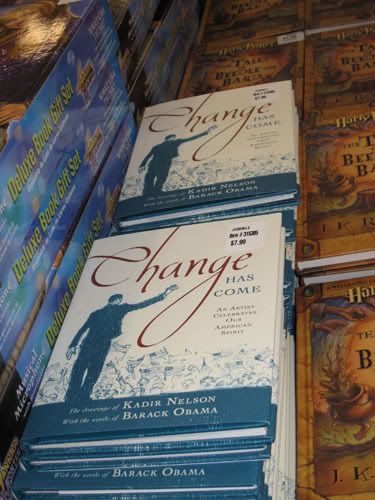
I took a few photos at Costco yesterday as I thought of these things.

Here is a children's book - and it is surely a sign of the times. Barack Obama, in his successful run for the Presidency, popularized many phrases that resonated with most of mainstream America. This book is made up of such phrases, and I think this is priceless. Specifically, it reminds the reader that there is no black America, no white America, no red America, no blue America - but only one America. The "divide and conquer" tactic, rising from the suburban cul-de-sacs and the gated communities of Orange County, which had prevailed in the US for the past three decades, must come to an end, and the Obama Presidency is the first step in making that happen.

The neoliberal economics and the neocon ideology have really trashed the US, especially in the last few years. I must continue to remember that Obama is only one man, with only four years' time; he won't get much done. He can, however, get the mentalities changed and the process rolling. The US is still pretty much the only country that can afford to give healthcare to me if I ask for it, but can't give it to me for ideological reasons; Obama won't change that overnight, but he will start a process that will eventually get that changed. I do hope the changes will be soon enough that by the time I do get sick and need healthcare, I'll be able to get it.

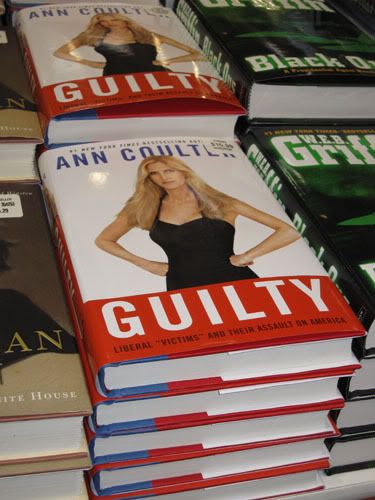
But the forces that corrupted the US for the past three decades won't go away overnight. Mann Coulter, the "shock jock" of conservative commentary, continues to put out garbage like this. Never mind that if I am to take the conservative ideology literally, we're looking at a sodomite who is an abomination in the eyes of God, and must be stoned immediately.

There is no doubt in my mind that Coulter is not a woman, but a castrated sodomite, given all his talk about how women must lose their right to vote, and so forth. I am more reminded than ever that one's gender (including my own) is not determined by what is under the person's mini, but rather, what's between the ears. And this is one sodomite that still has tons of testosterone-induced anger management problems.

I do hope that the American public will see past rambling shock jocks like this, and work for what's best for the nation and the world - and ultimately, themselves. Of course, there will be evil entities standing in the way - News Corporation, the Unification Church, BMW, certain foreign governments, and more - but they have NO right to determine my (or any other American's) future or destiny.

06 December 2008

Obama Realty

Snowy morning in Seoul. It's probably very cold again, but I'll most likely head downtown later on.

I can't access Daily Kos due to the 2MB embargo, but DiAnne Grieser did, and found a photo of Obama Realty, which just opened in Gyeonggi Province, South Korea.

Silenced Majority Portal

Exactly what I needed to see. However, this may be playing with fire, as 2MB hates Obama, and could raid the Obama Realty offices, arrest everyone inside as "left-wing activists," and put them to death after a short summary trial. This would've been nonsense as recently as October, but it's reality today. The only comfort comes from knowing that the vast majority of South Koreans are utterly fed up with their government, and will not cooperate with government demands for help in cracking down the "leftists."

For the rest of my South Korean sojourn, I'll make my biases clear. Despite my US passport which identifies me as a Korean-American (and implies that I am a supporter of 2MB), my allegiance is not to him, but to the everyday South Koreans. Upon my return to the US, I will make sure to kick some major butt in the Korean-American community.

And yes, my Hyundai Genesis will be in red if at all possible - a huge liberty-taking on my part, as almost all Genesises in South Korea are silver, gray, and black. Not only will it give a nod to my partial Chinese background and my Hong Kong experiences, but it will also certainly drive the Korean-American McCarthyists nuts (if its Buddhist-themed vanity plate won't do that already). Until now, I've avoided red cars myself due to their higher visibility (and therefore higher probability of being pulled over for speeding), but this is probably more of a muted metallic red, which I can accept. In any case, I'll have to see the car in person and take it for a spin before I sign the dotted line.

04 December 2008

North American updates

Two news feeds, courtesy of BBC.

First, something unthinkable has happened in Canada. The Conservative Government of Stephen Harper was facing a no-confidence vote that, if allowed to unfold, would've ended Harper's reign as the Prime Minister. To block this, Harper asked for a temporary shutdown of the Parliament - and got his wish through January. This is the first time that such a set of events ever unfolded in Canada. Harper is referring to the opposition coalition as "anti-Canadian," as it includes the Parti Quebecois, which supposedly stands for Quebec independence. I must give a hand to Harper's smearing tactics, which are so similar to those used by the outgoing Republicans in the US and their colonial puppets here in South Korea. I wonder if the Moonies have significant presence in Canada too?

BBC

Second, a Republican Congresswoman from South Florida hung up on Barack Obama twice, thinking he was a prankster from a local radio station. As it turned out, however, it was the real Obama. On the third try, Obama did end up having a great chat with the Congresswoman for a while on a variety of foreign relations issues, and later shrugged off the mishap as a non-event. I was originally alerted to this news item through Yahoo's South Korean website as I logged on there to get weather forecasts; some discussions from fellow Yahoo! users indicated that if it were an opposition South Korean politician hanging up on 2MB, s/he would've surely gone straight to jail as a "communist sympathizer."

BBC

Speaking of weather, Seoul will remain frozen all day today and tomorrow. I'll make sure to bundle up.

25 November 2008

2MB, Obama, and More

Pretty interesting day today, though I spent much of the time traveling - and dozing off on buses and in the subway, due to the exhaustion resulting from days of too much driving/blogging and too little sleeping. For starters, it now costs me 1,500 won and 90 minutes, instead of 1,000 won and 30 minutes, to commute one way to my meditation, due to the vastly increased distance. I'll still take it over driving any day - driving, thanks to the traffic, isn't all that much faster, and the fuel cost alone is more than the fare.

Only one photo today, but pretty interesting nevertheless.

I walked across a caricature booth, and came upon this drawing. It portrays 2MB as a green frog. A green frog has negative connotations in Korean culture, often referring to someone who always does the exact opposite of what s/he is told to do. And of course, there is also the old saying "frog in a well" to refer to a myopic person, though in this picture, 2MB is not sitting inside a well.

A strange feature of Korean personal names is that there are only a few hundred possible family names, with the top three (Kim, Lee, Park) accounting for half of the population, and the top twenty accounting for at least 90%. On the other hand, given names have far more possibilities; even though computerization demands that the Chinese characters to be legally used in a given name can only be from a pool of a few thousand, it can still yield millions of possibilities. It's often necessary to consult a professional when choosing good characters for one's name, whether it's for a new baby or for an adult changing a horrible-sounding name. For some (especially women), purely Korean names may also be used, adding even more possibilities.

For politicians, this means one thing. Politicians with common surnames will often be referred to by the English initials of their given names. This trend took hold in the 1980s, thanks to the longtime presence of the Three Kims. The Three Kims, who are all very old now and definitely retired from active politics, were as follows:
  • Kim Young-sam, a right-wing pro-democracy activist who served as President from 1993 to 1998, and was the first civilian President in decades. He is known as YS.
  • Kim Dae-jung, a left-wing pro-democracy activist who worked with and against YS, and served as the nation's first leftist President from 1998 to 2003. He is known as DJ.
  • Kim Jong-pil, a far-right politician who never served as President, but spent lots of time as Prime Minister (and also headed the KCIA and masterminded the Moonie expansion to the US), and certainly was a major force to be reckoned with. He is known as JP.
On the other hand, politicians with rarer surnames, such as Roh (as in Roh Tae-woo and Roh Moo-hyun), were usually referred to by their full names.

Lee (also written as Rhee or Yi, and pronounced as Yi in South Korea and Ri in North Korea) is very commonplace, so extending this convention, Lee Myung-bak, the current President, is known as MB. The MB moniker is widely used by supporters and critics alike. A common variation of this, however, is 2MB, which uses the number 2 to refer to the surname (2 is pronounced Yi), and connotes that Lee has only two megabytes of brain power. The 2MB moniker is used exclusively by critics, and I prefer to use 2MB myself.

I picked up some 2MB-related stuff today. First, news feeds are telling me that after finishing his Peru tour, 2MB stopped in Los Angeles for an evening with local Korean-American leaders, telling them that South Korea's economy will be back on track in 3 years. Los Angeles has tons of ethnic Koreans, to a point where just about every South Korean now knows of a relative or a friend in Los Angeles (and South Korean tour operators don't sell packages to Los Angeles, asking travelers to simply bum their local relatives/friends for rides and sightseeing); they overwhelmingly support the 2MB agenda and the far-right McCarthyism, and were the final driving force in California's Proposition 8 which enjoyed significant 2MB funding. The scary thing is that Los Angeles is not the worst; New York City's smaller, but nevertheless very large, Korean-American community is even more pro-2MB and reactionary, and as a result, 2MB's first US stop as South Korea's President took place in New York.

The far-right mouthpiece Chosun Ilbo also speculates about the possibility of an alliance between 2MB and Park Geun-hye, the daughter of the late military dictator Park Chung-hee; people indeed wonder why these former rivals can't come together, after seeing a new spirit of cooperation between Barack Obama and Hillary Clinton. Honestly, I was insulted when 2MB compared himself to Obama, and any thought of Park and Hillary having any similarities, other than being women, is even more insulting, because Park and Hillary couldn't be any more different in ideology. Park should be compared to Sarah Palin instead, though Park has never been married, a rarity for any South Korean woman of her power and stature.

Speaking of Barack Obama, I spent some time at a sizable bookstore, ending up with two books full of Obama speeches and quotes. The first was Change We Can Believe In, and the second was a large selection of Obama quotes showcasing his beliefs and policy plans. Both books were completely bilingual, and primarily intended for Koreans studying English and contemporary American society; I picked them up, for a look at how the Koreans translate and interpret the Obama agenda. Some concepts that may be unfamiliar offer a bit of supplemental explanation; for example, few Koreans recognize the acronym LGBT, but when it's written out as "lesbian, gay, bisexual, transgender" and translated into their Korean equivalents, it becomes crystal clear. Of course, there were plenty of other Obama books around, such as Audacity of Hope, in Korean only, but I decided to skip them, as I want to read them in the original English when I return home. There also were plenty of other books, including a Howard Zinn book named A History of the United States which re-interprets history from an anti-imperialist, anti-militarist, pro-masses perspective.

Other developments on the Korean peninsula today include North Korea confirming its plans to seal the border. Starting December 1st, sightseeing tours to Kaesong will cease, and so will the daily freight train service there. All South Koreans in North Korea will be expelled. The only exceptions will be bare essential personnel and motor vehicle traffic required to continue operation of the Kaesong Industrial Park, which for now will remain operational (the North is not stupid - it needs the money). North Korea does emphasize that this is only a "first-stage" action, and further adverse actions may follow if 2MB and the North Korean defectors to South Korea continue to "provoke" the North. (The latter are certainly vowing to continue to send leaflet-filled balloons north, provoking the Communists further, even against the advice of the 2MB government.) I read the details from both the center-right Dong-A Ilbo and the center-left Hankyoreh; the latter opined that "ten years of inter-Korean cooperation efforts go up in smoke." 2MB responds by saying that North Korea's plans to deal only with the US while ignoring South Korea will not succeed. The right-wing parties are vowing to never give in to the latest "northern blackmail," while the left-wing parties ask for a critical look at 2MB's northern policy. In the meantime, Hyundai Asan, which was the main concessionaire in inter-Korean exchanges and operated all the tours to Kaesong and the Diamond Mountains, is certainly hurting very badly; the suspension of the Diamond Mountains tour program, now in its fifth month after ten successful years, has already cost 800 billion won (over half a billion US dollars at today's exchange rate), and the newest North Korean measures will cut the company's revenues by at least two thirds.

22 November 2008

Seoul: Even more driving

I got fed up with my driving today, and vented a bit about my experience in my last post. Now that it's out of the way, and that I've had dinner, here is how my South Korean automotive odyssey continued.

Bugak Skyway is one of the few scenic drives within Seoul city limits. I've known of the hard-to-find route for years, and today was my chance to finally drive it. It winds through the slopes of Mt. Bugak, which is to the north of the Presidential Blue House; as a result, security is extremely strict, and stopping is not allowed anywhere along the route. Except for one place.

This octagonal pavilion is at the summit of the skyway, in a small rest area that is the only legal stopping point along the skyway. There are two restaurants here, one Korean and one Italian. The views are outstanding from here.

Looking north, I can see the rocky cliffs of Bukhansan National Park. The posh residential district of Pyeongchang-dong is between the two mountains. It is one of the few places in Seoul not served by a subway line; to get there, a bus transfer is necessary.

Looking southwest, I can see Inwangsan in the distance, and closer by, a section of the old city wall.

Looking directly south, I can see Namsan and its N-Seoul Tower, as well as the skyscrapers that make up downtown Seoul. Farther away are mountains on the other side of the city.

It's a bit cloudy and hazy today, but it's the warmest day of the week; many people are hitting the streets today to celebrate, helped by an elementary school holiday (normally, Saturday is a half-day), the opening of the ski resorts, and the lower gasoline prices. Today, gasoline is below 1,500 won per liter, rather than 1,800+ won per liter two months ago; it's even sweeter for me due to the recent sudden depreciation of the won, now trading at over 1,500 won to the US dollar. $3.80 per US gallon is something I can swallow - and certainly cheaper than last summer's California prices!

My travel companion at the scenic rest area. Note the folded exterior mirrors. The folding mechanism is power-operated with a driver's door button. It's a feature that would make sense only on the BMW 7-series or some other ridiculously large car back in the US, but over here in South Korea, where parking spaces tend to be very tight, it's a requirement, even on smaller cars like the Hyundai Elantra.

My car also comes with fog lights, which work completely independent of headlights. It's possible to drive with just parking and fog lights on, and many drivers do just that. I always use headlights when I am moving with lights on, however.

I finished the skyway, then proceeded north. My original intention was to head south immediately, leave the city, and visit the Korean Folk Village in Yong-in, about 20 miles or so to the south; but as I was in northern Seoul already, I decided to visit another sight nearby first. My drive northeast took me in front of Dream Land, an amusement park that is now completely closed and demolished to make way for something even better.

This is my destination in northeastern Seoul. It's the 4.19 Cemetery and Memorial, honoring the student-led revolution of April 19, 1960 that overthrew the Syngman Rhee regime, and the final resting place of those who were brutally murdered by the government. Its location, on the eastern slopes of Bukhansan, is marvelous. Although it can be reached by subway with a bit of a walk, I decided that I'd rather drive. Admissions and parking are both free.

Here are the graves of some of the victims. Each tombstone has the person's name, his/her photo, a flower vase, and a national flag.

This Confucian shrine houses the tablets and the photos of the dead. The goal is to ensure that their sacrifices, and their unbreakable democratic spirit, live on and inspire future generations of South Koreans.

This bronze artwork is titled "Fighters for Freedom," and was done by Yi Jong-bin. The middle portion has the pro-democracy student broadcasters, with the Korean flag behind them. They are thrusting a big fist against a rifle-toting policeman and Syngman Rhee.

The memorial has a small hall dedicated to explaining the whole revolution. Here is a timeline of the events:
  • August 15, 1948. South Korea founded, with Dr. Syngman Rhee as the inaugural President.
  • July 4, 1952. Wartime amendment of the Constitution to allow Rhee's re-election.
  • November 27, 1954. Another constitutional amendment to allow Rhee's unlimited re-election.
  • December 24, 1958. Special security measures go into effect.
  • April 30, 1959. Gyeonghyang Shinmun shut down for publishing articles critical of Rhee.
  • February 28, 1960. Major student protest in Daegu over Rhee's tactics, particularly as he prepares for a fourth term. This was triggered by Rhee's orders to have the students attend school on Sunday, to prevent them from attending a rally in support of the opposition candidate.
  • March 15, 1960. Presidential election held. Syngman Rhee wins fourth term. His ally Lee Ki-bung wins the Vice Presidency. However, it was done only with widespread poll rigging.
  • March 15, 1960. Major protest in the southern port city of Masan against Rhee. A student by the name of Kim Ju-yeol, 17 years old, goes missing. Many others are gunned down by Rhee's forces as they protest the poll rigging.
  • April 11, 1960. Kim Ju-yeol's body is found floating in Masan Harbor.
  • April 18, 1960. Korea University students make a declaration, vowing to fight Rhee and protect democracy, following the school's tradition of fighting the Japanese and the Communists. The students march across Seoul, and many are injured when an "anti-Communist" youth group attacks them.
  • April 19, 1960. Citizens hear of what happened to the Korea University students. They band together and march toward the Blue House, demanding to speak to Rhee. Policemen gun down many of them.
  • April 20, 1960. Rhee makes a statement. His ruling political party, the Liberals, blame the citizens for the unrest.
  • April 21, 1960. Rhee's cabinet resigns.
  • April 22, 1960. A special National Assembly committee is formed to deal with the emergency.
  • April 23, 1960. Vice President Chang Myon, from the opposition Democrats, resigns. He demands Rhee's resignation as well.
  • April 24, 1960. Rhee resigns from the presidency of the Liberals. Lee Ki-bung resigns from all public positions.
  • April 25, 1960. University professors join protests.
  • April 26, 1960. Rhee resigns from the Presidency, and goes into exile in Hawaii.
  • April 1960. Lee Gang-seok, son of Lee Ki-bung and stepson of Syngman Rhee, kills Lee's entire family then himself.
  • July 29, 1960. A new National Assembly is elected.
  • August 13, 1960. The Second Republic is established, with Yun Po-sun as President, and Chang Myon as the Prime Minister. The Second Republic was the only South Korean government to feature a bicameral legislature and a parliamentary government. It lasted less than a year, however, as on May 16, 1961, a military coup by General Park Chung-hee ended everything.
Rhee's biggest problem was that despite his credentials as a fierce fighter of both the Japanese and the Communists, he was unpopular. In order to protect his power, he surrounded himself with the powered elites - who had gained their powers by collaborating with the Japanese. Rhee's crony capitalism benefited just these elites at the expense of the rest of the population. His economic plans failed, and South Korea was utterly dependent on American military aid; moreover, farmers who lost their livelihoods in the economic slump, as well as North Korean refugees from the war, crowded the cities and drove down living standards. It was well known that by 1960, Rhee had absolutely no chance of getting re-elected legitimately; he used a whole slew of blatant methods to rig the poll results in his favor.

This diorama shows the citizens marching toward the Blue House on April 19th, to demand to talk to Rhee. Some are being gunned down by the police.

The 4.19 Memorial is a must-visit site for any South Korean politician serious about protecting democracy, including the President. In this photo, 2MB is signing the visitor log. I'm kind of insulted to see this photo here, as 2MB's policies have a lot in common with Syngman Rhee's, and I am extremely offended that 2MB would rather spend South Korea's precious US dollar reserves banning gay marriage in California and funding white supremacists, than put it back into the South Korean economy and revive it.

Here are some politicians' messages left behind. The left top is from 2MB. The right top is his inept leftist predecessor, Roh Moo-hyun. The left bottom is from Roh's intended successor, Chung Dong-young, who was a pathetically weak candidate and lost to 2MB in a landslide. The right bottom is Lee Hoi-chang, a prominent far-right politician.

Not pictured, but also prominent, are messages from former Presidents Kim Young-sam ("YS") and Kim Dae-jung ("DJ"), both noted pro-democracy activists.

While most of the martyred students were boys, a number of girls were also killed. The families of this pair of martyrs decided to marry the two posthumously, as noted here.

This is the body of Kim Ju-yeol, as found floating in Masan Harbor on April 11, 1960. He was found with tear gas canister fragments stuck in his eyes, as seen above.

Some firearms. The rifle was the same model used by the police in gunning down the protesters. The handgun was the same model used in the murder-suicide of Lee Ki-bung's family. The bullet fragments were surgically removed in 1993 from the torso of a protester.

This is one of the ballot boxes used in the rigged March 15, 1960 presidential election. There were two ballots, one for the President, one for the Vice President.

The effects of this revolution were felt overseas. Turkish students were inspired by their South Korean counterparts, and launched a revolution of their own that overthrew their own crony capitalist regime. Japanese students also took to the streets to protest some aspects of the Status of Forces Agreement for the US military in Japan, as negotiated by the Liberal Democratic government, without enough input from the people.

Within South Korea, however, the effects took much longer to take hold. The military coup in 1961 dashed hopes for a democratic society. While Park Chung-hee claimed to be upholding the spirit of the April 19th revolution, his actual policies proved otherwise, especially in the 1970s as he rammed through draconian constitutional amendments designed to keep him in absolute power for life. After Park's assassination in 1979, another military coup, this time by Chun Doo-hwan and Roh Tae-woo, took place, with Chun becoming President (and in the process, gunning down hundreds more peaceful protesters). Only when the people kept standing up to Chun, and the Reagan Administration's support of him, did change start coming. However, even in the presidential election of 1987, the first democratic one in decades, Roh Tae-woo won a minority victory due to the inability of the pro-democracy faction to agree on a single candidate. Only with the civilian Kim Young-sam presidency of 1993 was the April 19th revolution seriously re-visited. And this cemetery, a sleepy local cemetery since its creation in 1961, was finally upgraded to a full national cemetery and memorial in the mid-1990s.

I am now leaving the memorial. This monument says it all. "Freedom, Democracy, and Justice - the Spirit of the April 19th Revolution." May this spirit live on forever - and inspire pro-democracy activists even in the US. They've gotten a lot done by getting an ally, Barack Obama, into the White House; now, they must use that as a starting point for sweeping changes.

I hopped back into my car, and started driving. News feeds indicated that Obama was now picking his Cabinet members, with his former rivals featuring prominently - Hillary Clinton as the Secretary of State, and Bill Richardson as the Secretary of Commerce. While I have my share of disagreements with both, I do think they are good picks, as Obama can reach out to those Democrats who had disagreed with him, and unite the party (and down the road, America too). Both Hillary and Richardson bring tons of great experience, which is honestly a weak point for Obama.

As mentioned in my last post, the drive to Korean Folk Village took two hours. My route took me south along surface streets on the east side of Bukhansan, following the route of the subway system's Line 4, into downtown. From there on, I followed Line 3 across the Han River to the posh fashionista district of Apgujeong-dong, before getting on the Olympic Expressway, transferring to Dongbu Expressway at the Olympic Stadium, then following it to the end. Upon leaving Seoul, the Dongbu Expressway changes its name to Bundang-Suseo Urban Expressway, and raises its speed limit from 80 km/h to 90 km/h; it ends as it leaves Seongnam into Yong-in, merging onto Provincial Road 23. (The Yong-in section of the expressway is currently being built.) Continuing on the 23 for another 10 kilometers or so brings me to the Folk Village. Simple enough, but traffic was extremely heavy both in Seoul and in Yong-in, and the reckless urban taxicabs really tested my patience. On the other hand, the entire stretch was free, and using the tollways would not have helped at all, as they were also hopelessly jammed.

I had really hated the Folk Village in my childhood. But in 2002, I decided to visit it again, and found it much more to my liking. With my increased knowledge of Korean culture and religions, plus memories of my writing mentor Gayle Brandeis' first novel, The Book of Dead Birds, which sends one of its protagonists to work here, I had to come back. Sure, the protagonist, Helen Sing Lo, is strictly fictional, and Gayle herself has never been to South Korea, but I decided to bring both of them here in spirit today.

I was dismayed to find that the admission charge for an adult went up from 9,000 won to 12,000 won. But it's still cheaper for me than last time, thanks to the shrinking won. I guess 2MB is doing me some good after all.

Here's one of my favorite sights. This is a traditional Korean outhouse. The toilet is that wooden hole. The dry leaves in the corner are used as toilet paper. The wooden containers carry away the accumulated waste, and a pottery tank (not pictured) carries away the urine. Fortunately, guests to the Folk Village don't have to rough it out here; they can simply use modern restrooms with sit-down self-flushing toilets and full running water.

A ginseng plantation. Korean ginseng is very good - and the best ones are from Kaesong. Unfortunately, Kaesong is now in North Korea.

These women, dressed in traditional costumes, are weaving silk.

Here's a workshop that visitors can take part in. The goal is to take a stump of bamboo and turn it into a yut stick. Yut is a game, played with four such sticks in place of dice, where two teams of players try to see which team brings its four moving pieces around the board faster. I guess it's time to make those sticks now so that the game can be played on New Year's Day.

The marketplace at the far end of the village. It consists of handicrafts, souvenir shops, and most importantly, a food court.

At the marketplace, I saw these two masks being carved, with finished examples all around.

Masks have lots of different designs. My favorite is that of "umulcheonyeogwisin" (우물처녀귀신), a spirit of a maiden who had fallen into a neighborhood well and drowned. The connotation is that without having ever had a chance to fall in love, she would be one heck of a frustrated spirit, and would haunt many living people.

And here is a neighborhood well serving a mountainside village. The rich could dig their own private wells, but most people had to settle for a communal well like this, a place to get the water, do the laundry, and hang out, especially for the women.

In one of the mountain houses, I can see this man construct a traditional shield kite. Kite flying is a very popular winter sport. A variation of that is a "kite fight," where abrasives are applied to the strings, and two kite flyers battle it out to determine whose string snaps first from the abrasives (and therefore loses the kite and the fight).

Here is another mountain hut. It uses readily available local building materials, including wooden planks as roof tiles. Most Korean homes tend to use brick tiles (for the nobility) or thatched roof (for commoners).

Here is a fortune teller's house, showing elements of native shamanism and Buddhism. One of the side Buddhist statues is certainly that of my transgender matron saint, Kwan Yin. And for that matter, some fortune tellers have traditionally been transgender women.

This particular fortune teller's house can tell me my general fortune, how long I'll live, how healthy I'll be, how well my business will run, and how compatible I am with my significant other (based on our birthdays and zodiac signs). I can get a reading for 20,000 won.

A number of live performances are always available. Here is a seesaw demonstration. These two women (seesaws are always for women in traditional Korea) are acrobats; not only do they jump high, they can even somersault while airborne.

And this man is another acrobat, using a tightrope to showcase his balancing skills.

Another performance, showcasing horseback warriors. These two equestrians are shooting arrows into the target, and their aim is excellent.

In The Book of Dead Birds, Helen would have performed this skill. However, I found that at least today, the announcer was the only female in the performing group, and all riders/warriors were men.

I made sure to visit the village's small Buddhist temple tucked away into a remote hillside while at it. It's small and unconventional, but it does have everything that a Korean Buddhist temple ought to have, between the Four Devas to an Amitabha.

This partition - named "Seven Stars" - is a shamanistic shrine on the grounds of the temple, showing the Korean mix of Buddhism and shamanism. The "Seven Stars" theme is quite popular; "Northern Seven Stars" refer to the Big Dipper (Ursa Major), and a popular soft drink, Chilsung Cider (칠성사이다) which is a slightly sweeter alternative to Sprite and 7-Up, also carries the "Seven Star" theme in its name. (Chilsung = Seven Stars)

Counting stars is a popular theme in Korean culture anyway. The neoliberal corporate empire, Samsung, simply means "Three Stars."

"Folk Village Clinic." This is where I can duck in to learn about acupuncture as practiced in Korean culture.

Here's a sight that Helen Sing Lo would certainly love. This is a collection of Jeju Island homes, circa 19th Century. Notably, the thatched roof is tied down and reinforced due to the strong winds of the island, and the walls use volcanic rock, the most common building material there, as Jeju is a giant volcano.

Another supposedly common sight in traditional Jeju homes is this barrier. When the home owner is away, putting wooden sticks into this barrier keeps neighbors' livestock out. The number of sticks in place can also send different messages as well, though I couldn't figure out what those might be.

Running water is very scarce in Jeju. Here is a water-collecting mechanism, named "cham." Rainwater trickles down along the tree trunk, onto the thatch, and into the jar.

A toilet, Jeju style. The black boars are kept inside; they eat the human waste and leftover food, and serve a number of other useful roles in a Jeju household. I can also see a calico cat sit on the fence and take a look inside.

Sure, it's kind of humiliating to sit in there with a neighbor's cat watching. But then, Jeju is a warm place, so going "traditional" means going naked from the waist down. Definitely humiliating whenever I go about doing anything! (Especially when I look like Ann Coulter between my legs.) At least there is no need to undress as I enter the toilet, since all I need to do is just squat down.

Helen lived in the 1960s, so by then, she would've worn full modern clothing, and even a wetsuit when diving (something she was never good at). However, she'd be familiar with another warm-weather provision: extensive use of wooden flooring in these houses, compared to those on the Korean mainland.

A pair of mirror-image harubangs. Harubang is "grandfather" in Jeju dialect, which is completely out of this world, and can be understood by very few Korean mainlanders.

Unfortunately for Gayle, I could not find any harubang statues for purchase here. I was, in fact, advised that I'd actually have to fly to Jeju to get them. I have no plans to fly to Jeju at this time, as I'll be more than busy going to Hong Kong already. However, my next stint in South Korea WILL include Jeju. Sorry Gayle - you'll have to wait a bit longer for your harubang. At least I'll have time to study some key words of the Jeju dialect.
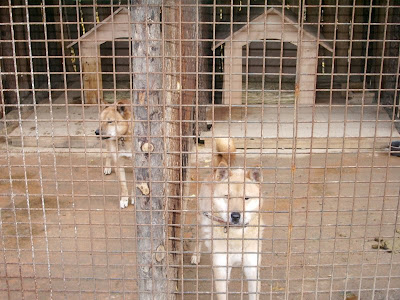
A pair of Jindo dogs, native to Jindo Island in the southwest of Korea. These are very capable dogs, often used for hunting. While Jindo is not an officially recognized breed in the US yet, it is officially recognized in the UK and internationally.

A scholar's house, showing grand architecture but spare, frugal furnishings.

A traditional playground.

In front, there are two jars where I can try to throw arrows into. It's an old game, imported from Tang China and popularized by Silla about 1,200 years ago.

In the distance are seesaws and swings. Both were almost exclusively used by women, as they were often confined to their homes by the Confucian moral code, and needed a way to jump up high and see the outside world over the house fence. For safety, while two riders jump alternately on the seesaw, a third person needs to sit in the middle over the pivot point.

I tried the swing. No luck gaining any altitude.

I entered a seowon, a Confucian academy where young men learn Chinese literature, after spending their childhood learning Chinese characters. I am now doing something that would be more appropriate for a child: writing characters in a sandbox to save money on paper and ink. There are six sample messages for me to write. I picked the top right - 東奔西走 (run busy, from east to west) - because it describes my automotive odyssey exactly. I don't think I got the stroke order correct, however, as stroke order is everything in Asian writing, essential in ensuring proper penmanship and legibility.

Confucian shrines with tablets of the deceased seowon principals.

I am about to leave the village. I am crossing the village creek, which is spanned by a number of traditional bridges. The one that I am crossing is a flat stone bridge without handrails, and the dam in the distance is another bridge, consisting of a series of stepping stones. Both carry warnings, as they are dangerous.

An interesting sight. Three days after a new baby is born, its umbilical cord is burned in this stove. This ensures long life for the baby.

I immediately drove back to Seongnam, even though it still took me almost an hour to cover just a few miles due to the construction. After some rest, I headed back out for a dinner, exploring the Bundang Ward.

While Seongnam used to be a cut-rate town just southeast of Seoul, merely a place to pass through and a home for those who couldn't quite afford the real Seoul, that's no longer the case. South of downtown Seongnam, a new ward named Bundang was created over a wide swath of rice paddies, and it was built up into an endless forest of high-rise (mostly) luxury apartments in the 1990s to relieve overcrowding in Seoul, along with lots of services and businesses to support them. Bundang is so nice, that it's nicer than any part of Seoul for that matter. I am currently in Bundang, which is also linked to Seoul's subway system via the Korail-managed Bundang Line. Just to the west, Pan-gyo is going through the exact same transformation. Seongnam, thanks to the development of Bundang, already boasts one million people, qualifying it to secede from Gyeonggi Province and become a metropolitan city of its own (equal to a province) if it wanted. Once Pan-gyo is fully developed, I am pretty sure this will go forward.

My exploration of Bundang covered the main developments, centering around Yatap and Seohyeon districts. Yatap has a Homeplus department store, anchoring a huge mall with free parking and lots of stores (many of which are empty for now, however). The mall also houses Seongnam's own express bus terminal, with frequent services to all points of the nation; for example, a bus leaves hourly for Busan, and costs 30,800 won for deluxe and 20,700 for regular. Meanwhile, Seohyeon has a Samsung Plaza department store with a food court, as well as a huge number of nightclubs (including apparently strip clubs), bars, exotic restaurants, and more. Bundang, as a whole, is extremely impressive with both its architecture and its businesses - and especially so when they light up at night.

I am expecting to spend tomorrow, my final full day on the road, covering Ganghwa Island in Incheon as well as the Ilsan area. Ilsan also saw massive Bundang-like development in the 1990s, and includes another observatory within a stone's throw of North Korea. Should be a good day.
14 November 2008

More US politics

Sure, I am about to really get into a Korean mindset with my road trip, but for now, I am going back to US politics.

Here are two Daily Kos diaries, dealing with Proposition 8.
In addition, on Saturday the 15th, the LGBT community and its allies are turning out in droves across the US to protest the passage of Prop 8 in California and similar measures elsewhere. Too bad I can't be there in person, but I'll be there in spirit, and will make sure to fight South Korea's own homophobes, who surely played a part in American homophobic legislations.

And Daily Kos also has this great electoral map feature for this year's election. Turns out that my Congressional district, CA-42, remains among the most Republican anywhere in the state (and very Republican even by national standards). The only redder shades were found in places where the Democrats didn't even bother fielding a challenger. On the other hand, it was nice to see most of Southern California, including Inland Empire and San Diego, voting for Obama. My mentor Gayle Brandeis kept telling me that her hometown of Riverside is more progressive than people give it credit for; now, I'll certainly believe her.

13 November 2008

Obama = Renegade

I seriously need to hit the sack, but I am hooked on news articles. And BBC has this latest from the US.

Presidents, presidential candidates, and others subject to US Secret Service protection, get nicknames that are easy to identify and pronounce. As it turns out, Barack Obama is called Renegade, and his immediate family members also have call signs that start with R. They are used for easy identification rather than confidentiality, so they are released to the public.

BBC

Some of these nicknames are as follows, according to the article.
  • Barack Obama: Renegade
  • Michelle Obama: Renaissance
  • Malia Obama: Radiance
  • Sasha Obama: Rosebud
  • Joseph Biden: Celtic
  • John McCain: Phoenix
  • Cindy McCain: Parasol
  • Sarah Palin: Denali
  • Todd Palin: Driller
  • Al Gore: Sawhorse, then Sundance
  • Karenna Gore: Smurfette
  • George W. Bush: Trailblazer
  • Laura Bush: Tempo
  • Dick Cheney: Angler
  • Ronald Reagan: Rawhide
  • Jimmy Carter: Deacon
  • Gerald Ford: Passkey

11 November 2008

Two BBC reports - one from California, one from North Korea

The fight is far from over, according to a BBC report in the wake of Prop 8.

BBC

Both supporters and opponents of Prop 8 had said that the fight was extremely high-stakes. And it surely was, attracting massive funding from out of state (namely Utah and the Mormons) and even overseas (including right here, South Korea).

In fact, I just came across a very ugly face of South Korea's own homophobia, and I will share a picture to that effect on my next post.

It appears that some of the leading South Korean homophobes are former North Koreans who had defected south in search of freedom for themselves. These defectors are prime recruiting targets for the far right groups within South Korea, as well as the Christian extremists from the US. Some of the most welcome guests at the W White House were indeed ex-North Koreans, who supported the W agenda 100%. Unfortunately, they are crushing other people's freedoms and rights to a pursuit of happiness, and I won't stand for it.

From now on, I will fully support returning their sorry asses back north, so that their Dear Leader can finish them off in a forced labor camp. After all, many of these so-called "defectors" didn't come south to seek freedom; they came south to spy, and one was recently caught red-handed. And while at it, the US must stop granting Cuban-style freebie amnesties to North Koreans!

On the subject of North Korea, the inter-Korean border will be completely sealed as of December 1st. North Korea cites the belligerence of the 2MB government here in the South for the reason in its decision. North Korea is making a serious mistake, as a South Korean industrial park in Kaesong will have to close, and 30,000 jobs and lots of funding will disappear. However, it is also an indication that even as other nations are gaining leverage in North Korea, South Korea, thanks to the myopic 2MB policies, is losing leverage instead. Both Koreas will dearly pay for the megalomania of their respective leaders!

BBC

10 November 2008

Obama-mania and more

I am relishing these moments. Not only am I enjoying what I love a lot - travel - but I am also feeling big changes coming. The upcoming Obama Presidency in the US may not add to much in the end, but its symbolism is nevertheless huge; not only did a black man rise from the ashes of slavery and segregation to capture the White House, but the past generation's worth of neoliberal economics and extremist social conservatism is drawing to a close. This will be something that even 2MB and his cronies here in Seoul will not be able to ignore.

I stopped at Seoul's largest bookstore, where I saw all these books, about or by Barack Obama, translated into Korean. The sign on top says: "Meet Obama, the 44th President of the United States." After W's cowboy diplomacy, which had left the vast majority of South Koreans feeling more like a cut-rate US colony than a sovereign nation, the Obama victory couldn't be more welcome.

Of course, there were a couple of books on John McCain nearby as well, but it seemed unlikely that they would sell well. Moreover, those McCain books were joined by a book, written by a Japanese reporter with decades of US experience, exposing the rampant damage done to the US society by three decades of neoliberalism, which has reduced the average American from a real human being to a disposable commodity; Obama certainly has a lot of work cut out for him in making corrections to these recent trends, especially since the neocons and the neoliberals, while down, are certainly not out. After all, 2MB continues to pump tons of money into the Moonies, and managed to get California to ban gay marriages. (And the largest electronics company in the world remains Samsung.)

I had stopped at this bookstore for a quick mini-meal at the fast food joint in the back. The real reason for stopping in the area, however, was to visit Asiana Airlines' main city ticket office, so that I could confirm and pay for my Hong Kong trip. I now have air and hotel reservations for four nights in Hong Kong. I want it to be as inspiring as my past several weeks here in Seoul. In the meantime, I will continue to devote myself to my meditation, which currently is taking a bit of a toll on me as my body starts to purge toxins from itself. I can't forget about this weekend's road trip either, itself a big deal for me as the first of its kind.

In the meantime, more and more people, both here in Seoul and back in the US, are hearing about my decision to retire my BMW and get a Hyundai. Feedback is very positive. I will not inform my family members, however, until the swap is actually done, as it does cost money and will be seen as an "emotional" knee-jerk thing, which is clearly isn't.

09 November 2008

The Democratic shift

New York Times has a slideshow that shows the remarkable shift throughout most of the US in favor of the Democrats. Not only did Obama easily defend all the Kerry states from 2004, he added nine more states to his tally, with a tenth, Missouri, still to be determined. Moreover, the swing demographics, including moderates and Hispanics, really went Democratic, and the base, including the young and blacks, turned out in very large numbers.

Some places, notably most counties of Arkansas, bucked the trend and ended up more Republican than before. But they have to be attributed to latent racism and Obama's race. And in case of parts of Arizona and Alaska turning more Republican, credit is due simply to John McCain and Sarah Palin hailing from those places.

New York Times

08 November 2008

Seoul: Bongeunsa

A good but quite tiring day today.

My meditation this morning had me feel nauseated and fainting. It must've been due to my body trying to get rid of all the toxic stuff that I had built up during the past few weeks, over the mixed results of the US elections. I did my best to unwind afterwards, by talking my thoughts out. I did not bore everyone else with my political beliefs, but I did publicly announce that I will retire my BMW and get a Hyundai Genesis. My master then engaged me in some car talk - and he was impressed with my knowledge of both American and South Korean cars. (He personally prefers German cars, particularly Mercedes-Benz, however, and suggested that I look into the C-class, but I am not a fan of the C-class. Besides, here in South Korea, a Genesis is just too much of a car for someone of my age and standing, but back home, the fact that the Genesis is a Hyundai, a cheap econobox brand, will work out to my benefit.)

My return to my apartment took me through Yongsan Station, where I saw the following:

The Democratic Party (not the victors of the US election, but the center-left opposition here in South Korea) had a number of activists in front of this station, as well as this video truck. It was making claims that the 2MB government worked for only the richest 1%, and that the party will work for the other 99%. Normally, I would've offered a word or two of support, especially after 2MB funded McCain-Palin and Prop 8. But today, I was too tired for even that.

Word also has it that a few National Assembly members of the ruling right-wing Grand National Party has introduced a new bill designed to vastly expand the government's surveillance powers. The Democrats and other left-wing parties are unanimously opposed, and even some within the Grand Nationals are opposed as well. The proponents argue that better data-gathering leads to a more informed, more responsive government, but the opponents rightfully argue that the laws will be turned against domestic political opponents. In South Korea, online activities require submitting one's National ID number, which is linked to current registration and residence information, so it's easy for the authorities to tag someone undesirable and break down his/her door at 4 in the morning.

Later in the afternoon, I visited Bongeunsa, a temple between the COEX Mall and the Gyeonggi High School (considered the best public high school in the entire nation).

The entrance post is topped off by an elephant, which was sculpted by Markus Kuehn of Hildesheim, Germany.

Due to the temple's proximity to the COEX Mall, many foreigners - particularly Westerners - visit this place. I am pretty sure that many find the strong South Korean Buddhist tradition surprising - especially the Americans, who are used to seeing Korean-Americans lock themselves up in extremist Christian megachurches and campaigning on behalf of the Religious Right.

Every Korean Buddhist temple has a Daeungjeon (大雄殿), or Hall of Great Hero, as its main hall, and this is Bongeunsa's version.

The faithful are gathering here to pray for good scores for their children. In five days, high school seniors will take the college entrance examination; the score will be the overwhelmingly most important factor in determining whether one can go to a college or not - preferably one in Seoul, and even more preferably a top-tier school like Seoul National University, Korea University, or Yonsei University. Success is pretty much guaranteed for someone who makes it into those top three schools.

A close-up of the wishing area, with incenses and candles burning. Candles can be bought at the temple entrance.

The banner in the back identifies this year as the Year 2552 on the Buddhist calendar.

A headstone in front of a minor hall. It says that the building was dedicated in March, of the Year 1993 in the "Western" (Christian) calendar and Year 2537 in the Buddhist calendar.

While Sakyamuni and Kwan Yin tend to be the dominant statues in Buddhist temples of other Asian nations, Koreans tend to put Maitreya as their biggest statue. Here's one that is approximately 50 to 60 feet tall, toward the back of the temple. In front is a marble area for prayer; it's a must to take off one's shoes before stepping on the marble.

Once I hit the road, I will visit an even bigger Maitreya, a bronze example standing 100 feet tall; it is the largest statue in the entire Korean peninsula. (The second largest is one of Kim Il-sung in Pyongyang, and barely taller than this Maitreya.) In fact, my Bongeunsa visit today was intended to be a teaser as I prepare for my road trip.

A contrast of old and new. In front, there is an old bell pavilion for the temple. In the back can be seen the COEX Mall, the Inter-Continental Hotel, and other modern developments.

Two nice examples of Korean drums. The fish-shaped drum on the right is quite unusual.

The parting shot. Here's a Kwan Yin, guarding a water spring located in the dead center of a circular lake on an island. Even as California acts to take away my rights (with immense help from Korean-Americans, at that), South Korea's Buddhist tradition, and the very concept of Kwan Yin, continue to inspire me. Now that I have decided to buy a Hyundai and name it after Kwan Yin (the first time I am ever naming my car), every sight of Kwan Yin will have an even bigger significance.

I finished off at the temple's gift shop, initially looking for a Kwan Yin pendant for my car, but I ended up empty-handed. However, I bought a small wooden Happy Buddha for 4,000 won (USD $4), and will eventually send it to Christy Cole of Christy's Art Blog, who loves the Happy Buddha. I could've bought a slightly larger one for 10,000 won, but doubt that it would survive the mailing to Christy in Louisiana.

I walked through COEX Mall to take the subway and return to the apartment. The sights of young fashionistas in Ally McLesbian miniskirt suits and cute tunics with hosiery made me feel good; I look forward to making the exact same fashion statements when I return to the US, and my Kwan Yin-inspired Hyundai will prove to be a great fashion accessory too. And while most foreign women out and about sightseeing tend to dress down, I was able to spot a tall Western brunette in a flimsy floral minidress at the mall.

I am still feeling quite exhausted. I need to save my energy and take care of myself if I am to survive the road trip in a week. There will be a blizzard in the eastern mountains tonight - the first one of the season - and while it is unlikely that a blizzard next week (if it happens at all) is bad enough to derail my itinerary, it does remind me that I need to be careful.